REVIEW 4 major objections 5 minor 1 cited by
The cubic phase of the lead-free double perovskite Cs2KInI6 is dynamically unstable; a machine-learned genetic search finds 42 stable polymorphs whose distortions widen the band gap and mostly flip it from direct to indirect.
Reviewed by Pith at T0; open to challenge. T0 means a machine referee read the full paper against a public rubric. the ladder, T0–T4 →
T0 review · deepseek-v4-flash
2026-08-03 03:43 UTC pith:AHYFLSXL
load-bearing objection Core finding (cubic Cs2KInI6 is dynamically unstable) is solid and the four highlighted polymorphs are DFPT-validated, but the '42 stable' count is a MACE claim that gets oversold in the abstract. the 4 major comments →
From Symmetry to Stability: Structural and Electronic Transformation in Cs₂KInI₆
The pith
A machine-rendered reading of the paper's core claim, the machinery that carries it, and where it could break.
Core claim
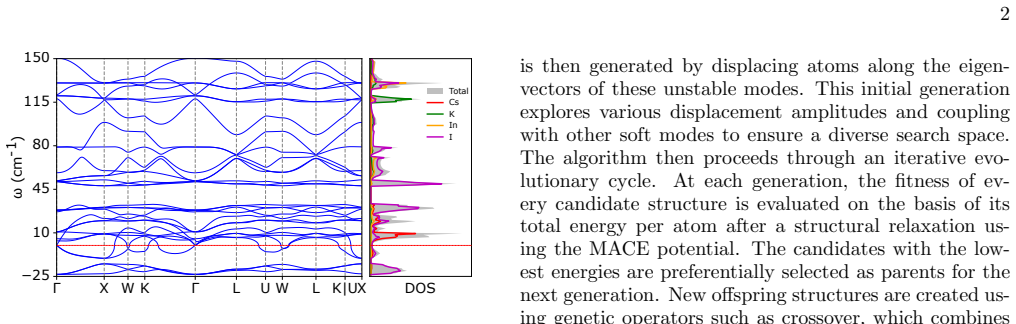
The central claim, stated on the paper's own terms, is that the cubic Fm-3m phase of Cs2KInI6 — the exact structure earlier high-throughput studies promoted for photovoltaics — is dynamically unstable, as shown by imaginary phonon frequencies from density functional perturbation theory. A genetic algorithm seeded with the eigenvectors of those unstable modes and evaluated with a machine-learned interatomic potential enumerates 42 dynamically stable polymorphs in 10-, 20-, 40-, and 80-atom cells; of the 11 re-examined with first-principles phonon calculations, 9 are confirmed stable and 2 are exposed as false positives. The most stable polymorph (Cmc21, 41.9 meV/atom below cubic) is not a dou
What carries the argument
The argument is carried by an instability-guided evolutionary search. First the soft (imaginary-frequency) phonon modes of the unstable cubic phase are identified; displacing atoms along those eigenvectors, at various amplitudes and in combinations, seeds an initial population of distorted crystals. A genetic algorithm then iterates: candidates are relaxed and ranked by energy with a machine-learned interatomic potential, low-energy parents breed through crossover and mutation, and each generation ends with a phonon check whose residual instabilities feed new distortion directions back into the population. This loop converts the cubic phase's instabilities into a systematic generator of lowe
Load-bearing premise
The load-bearing premise is that the machine-learned interatomic potential faithfully represents the true energy landscape of this material: only 11 of the 42 reported stable polymorphs were checked with first-principles phonon calculations, and two of those eleven failed the check, so the stability of the other thirty-one is an extrapolation from the potential.
What would settle it
Synthesize Cs2KInI6 and collect a powder X-ray diffractogram: the paper's Fig. S8 shows the candidate polymorphs give clearly distinguishable diffraction patterns, so a measured pattern matching the Cmc21 or P-3 phases would confirm the central claim, while a pattern matching the cubic phase, or matching none of the predicted phases, would put it in doubt. A computational check of comparable force: run first-principles phonon calculations on the 31 candidates never validated beyond the machine-learned potential — if a substantial fraction of those also prove unstable, the '42 stable polymorphs
If this is right
- The cubic form of Cs2KInI6 that earlier screens advertised with a 1.24 eV direct gap is not a static ground state; at cryogenic temperatures, where anharmonicity cannot rescue it, the material will adopt one of the distorted polymorphs.
- The lowest-energy structures are not double perovskites in the octahedral sense — indium prefers tetrahedral coordination — so the double-perovskite picture that motivated the material does not describe its ground state.
- Distortions widen the band gap to 1.68–2.26 eV in the tested phases and in most cases make it indirect, so the direct-gap advantage survives only in the 80-atom P-1 phase (1.35 eV).
- Flattened bands imply heavier carriers: the hole effective mass along one direction of the I-42m phase is about 16.6 electron masses, a transport penalty that follows directly from the stabilization.
- The instability-seeded genetic search plus first-principles phonon validation is a transferable recipe for other halide double perovskites whose 'ideal' cubic phases may also be saddle points.
Where Pith is reading between the lines
- Editorial note: the abstract quotes a 1.94 eV direct gap for the cubic phase, while the body and the supplementary material consistently report 1.24 eV (Fig. S10, Table S1); the body value appears to be the operative one, but the manuscript leaves the mismatch unresolved.
- Because only 11 of the 42 polymorphs received first-principles phonon checks and two of those failed, the stability census is an extrapolation; running density functional perturbation theory on the remaining 31 candidates is the direct test of the enumeration.
- The instability is assessed at zero temperature; anharmonicity could heal it at operating temperatures, so finite-temperature molecular dynamics or self-consistent phonon calculations on this specific material would reveal whether the cubic form can be synthesized or stabilized — a scenario that would reframe which phase is the relevant solar-cell absorber.
- The face-sharing 1D octahedral strips of the P-3 phase suggest strongly anisotropic transport; computing carrier mobility along versus across the strips would test whether the connectivity collapse is the bottleneck that the band flattening implies.
Editorial analysis
A structured set of objections, weighed in public.
Referee Report
Summary. The paper investigates the structural and electronic stability of the lead-free halide double perovskite Cs2KInI6. Using DFT/DFPT, the authors show that the cubic Fm-3m phase is dynamically unstable. They then use a genetic algorithm accelerated by a pretrained MACE machine-learned potential (MACE-OMAT-0) to search for low-energy polymorphs, reporting 42 candidate structures that are dynamically stable according to MACE finite-displacement phonon calculations. Eleven of these are selected for DFPT validation; 9 are confirmed dynamically stable, while 2 are false positives. The paper focuses on four phases (P-3, I-42m, Cmc21, P-1), reporting their structures, phonon dispersions, electronic band structures, and effective masses. The authors find that structural distortions generally widen the band gap and tend to change it from direct to indirect. They identify Cmc21 as the most stable phase (41.9 meV/atom below the cubic reference) and P-3 as the most stable perovskite-like phase, and highlight the trade-off between octahedral connectivity and electronic properties.
Significance. If the central claims are established, the paper offers a useful demonstration of combining a genetic algorithm with a machine-learned potential to explore the energy landscape of a dynamically unstable double perovskite, and it provides a structure-property map for Cs2KInI6. The DFPT phonon calculations for the cubic phase and the 11 selected structures are standard and credible, and the paper is transparent in reporting the two MACE false positives. However, the headline claim of '42 dynamically stable structures' is not supported: only 9 of the 42 have been confirmed by DFPT, and the MACE-vs-DFT energy ordering is not reported, so the identity of the true most-stable phase remains uncertain. These issues are load-bearing for the main message and require additional analysis or a substantial rewording of the claims.
major comments (4)
- [Abstract and main text (paragraph after Fig. 2; Table S1)] The abstract states 'we identify 42 dynamically stable structures' and the main text states 'This process yielded 42 new polymorphs ... found to be dynamically stable based on frozen-phonon calculations using MACE.' Only 11 of these were checked with DFPT, and 2 of the 11 (id=03 and id=09 in Table S1) turned out to be dynamically unstable at the DFPT level. Thus, the claim '42 dynamically stable' is an overstatement; at most 9 are DFPT-confirmed, and the remaining 31 are only MACE-predicted stable. Given the 18% false-positive rate in the validated subset, the paper should either rephrase the claim as '42 MACE-predicted stable candidates' or validate more structures, and it should discuss the expected number of true positives among the unvalidated set.
- [Table S1 and Table I (energy columns)] The ΔE values in Table S1 are not labeled with the level of theory. For the 31 structures not validated by DFPT, the energies must be MACE values, but this is not stated. For the four structures in Table I, it seems the energies are from DFT, but again the method is not specified. More importantly, no MACE-vs-DFT energy comparison is provided for the 11 structures that were both predicted by MACE and evaluated by DFPT. Without such a comparison, the claim that Cmc21 (id=37) is the most stable phase at -41.9 meV/atom relative to cubic is not fully supported: if the energy ranking in Table S1 comes from MACE, another unvalidated polymorph could have a lower DFT energy. Please report both MACE and DFT ΔE for the validated set and clearly state the level of theory in both tables.
- [Selection of 11 structures for DFPT validation (main text, after Table S1)] The selection of the 11 structures for DFPT is described only qualitatively ('all polymorphs with 10 atoms, two with 20 atoms, one with 40, and one with 80'). This selection is not random and may be biased toward low-energy or specific structural families. Since 2 of the 11 were false positives, the selection does not provide a reliable estimate of the false-positive rate across the full set of 42. The paper should either validate a more representative subset (e.g., a random sample) or at least discuss the selection bias and its implications for the '42' claim. A simple statistical argument would show that several of the 31 unvalidated structures are likely to be DFPT-unstable.
- [Data availability (main text and SI)] The central output of the work is the set of 42 polymorphs and their relative stabilities, yet the crystal structures are not deposited in a public repository (e.g., CIF files), and the input/output files for the DFT/DFPT calculations are not provided. The VibroML code is mentioned only as a GitHub repository without a version or DOI. Independent verification of the claimed polymorphs, energy orderings, and phonon stabilities is therefore impossible. The authors should deposit the structures of all 42 polymorphs, the 11 DFPT-validated structures, and the relevant calculation inputs/outputs, or at minimum provide CIF files in the SI.
minor comments (5)
- [Abstract vs. full text (first sentence)] The abstract at the top of the manuscript (as provided in the review package) states a 'calculated direct band gap of 1.94 eV', while the abstract in the full text and the band-structure plot (Fig. S10) give 1.24 eV. This numerical discrepancy must be corrected.
- [Abstract vs. full text (stability number)] The abstract in the review package says Cmc21 'lies 13 meV/atom above the convex hull', whereas the full-text abstract says '41.9 meV/atom below the cubic reference'. These are not contradictory if the convex hull is ~55 meV/atom below the cubic phase, but they should be reconciled and both statements (or a single one) presented consistently.
- [Main text, first paragraph of results] 'vibrational dynamical stability' is an awkward phrase; consider simply 'dynamical stability'.
- [Main text, paragraph on ChemEnv analysis] The sentence 'For the P-3 structure, our ChemEnv analysis gives 100% octahedral similarity with a slightly distorted octahedron for the K cations Finally, in the P-1 structure...' is missing a period after 'cations'. Also, 'a double perovskites structure' should be 'a double-perovskite structure'.
- [Table II] The effective-mass table reports values for certain directions but does not explain how the effective masses were computed (e.g., parabolic fit, k·p method). Please add a brief methodological note in the text or caption.
Circularity Check
No significant circularity: the central claims rest on independent DFT/DFPT calculations, with MACE used only as an external search surrogate.
full rationale
The derivation chain is not circular. The dynamical instability of cubic Cs2KInI6 is established directly by DFPT phonons (Fig. 1), and the four analyzed polymorphs (P-3, I-42m, Cmc21, P-1) are validated by DFPT phonon calculations (Fig. 2, Table I). MACE-OMAT-0 is a pretrained, externally developed machine-learned potential (refs 30–31), used only as a surrogate to accelerate the genetic-algorithm search; it is not fitted in this paper to the reported polymorph energies or stabilities. The paper explicitly rechecks a subset of MACE predictions with independent DFPT calculations, reporting 9 stable and 2 false-positive cases. No step in the paper defines a predicted quantity in terms of the quantity it is supposed to predict, and no load-bearing conclusion is justified solely by a self-citation. The main caveat—that only 11 of 42 MACE-stable candidates were DFPT-validated, and that Table I reports relative energies that appear to reproduce MACE values from Table S1—is a validation-coverage/accuracy concern, not circularity by construction.
Axiom & Free-Parameter Ledger
free parameters (1)
- Genetic algorithm hyperparameters (population size, number of generations, crossover/mutation rates, displacement amplit =
not specified
axioms (4)
- domain assumption DFT with the PBE functional and norm-conserving PseudoDojo pseudopotentials accurately describes the total energies, phonons, and band gaps of Cs2KInI6.
- domain assumption The MACE-OMAT-0 machine-learned potential is transferable to Cs2KInI6 and accurate enough for the genetic-algorithm search.
- domain assumption The genetic-algorithm search over MACE energies is sufficiently complete to find the lowest-energy dynamically stable polymorphs.
- domain assumption Zero-temperature phonon stability from DFPT is the relevant stability criterion for the claimed polymorphs.
read the original abstract
Cs$_2$KInI$_6$ is a promising lead-free halide double perovskite with a calculated direct band gap of 1.94 eV, ideal for solar cell applications. Our first-principles calculations reveal that its cubic phase (Fm$\bar{3}$m) is dynamically unstable. Using an accelerated machine learning approach, we identify 42 dynamically stable structures and further validate these findings using first-principles calculations on 11 of these. The most stable phase has Cmc$2_1$ symmetry with 20 atoms/unit cell. It lies 13 meV/atom above the convex hull but lacks octahedral cation coordination. The most stable perovskite-like structure has P$\bar{3}$ symmetry with 10 atoms/unit cell and low octahedral connectivity. Structure-property trade-offs are highlighted, with calculated distortions generally widening the band gap, shifting it from direct to indirect, and flattening the band edges. This work showcases the synergy of genetic algorithms, machine-learned potentials, and first-principles validation for discovering stable, complex materials.
Figures


Forward citations
Cited by 1 Pith paper
-
VibroML: an automated toolkit for high-throughput vibrational analysis and dynamic instability remediation of crystalline materials using machine-learned potentials
VibroML automates remediation of dynamic instabilities in crystalline materials by combining MLIPs with genetic algorithms for polymorph search, finite-temperature MD validation, and compositional alloying to yield st...
Reference graph
Works this paper leans on
-
[1]
The double perovskite structure, P ¯ 3 has an indirect band gap of 1.68 eV, see Fig. 4(a). However, the valence band at the Γ point is approximately 20 meV lower than the VBM. This gap is only slightly larger than that of the cubic phase. The structure P ¯ 1 in which only the In cations form octahe- drons has a direct band gap of 1.35 eV, see Fig. 4(b), w...
-
[2]
Remarkably, the two per- ovskites structures, Figs. 2(a) and (b), show a continuous spectra with phonon frequencies below 150 cm −1 while the two non-perovskite structures show multiple localized and high-energy vibrational modes up to 180 cm −1, see Figs. 2(c) and (d). In particular, both show the same iodine localized vibrational peak at 120 cm −1 which...
-
[3]
M. H. Miah, M. U. Khandaker, M. B. Rahman, M. Nur- E-Alam, and M. A. Islam, Band gap tuning of perovskite solar cells for enhancing the efficiency and stability: issues and prospects, RSC Advances 14, 15876–15906 (2024)
2024
-
[4]
De Wolf, J
S. De Wolf, J. Holovsky, S.-J. Moon, P. L¨ oper, B. Niesen, M. Ledinsky, F.-J. Haug, J.-H. Yum, and C. Ballif, Organometallic halide perovskites: Sharp optical absorp- tion edge and its relation to photovoltaic performance, The Journal of Physical Chemistry Letters 5, 1035–1039 (2014)
2014
-
[5]
Chilvery, S
A. Chilvery, S. Das, P. Guggilla, C. Brantley, and A. Sunda-Meya, A perspective on the recent progress in solution-processed methods for highly efficient perovskite solar cells, Science and Technology of Advanced Materi- als 17, 650–658 (2016) . 6
2016
-
[6]
National Renewable Energy Laboratory, Best research- cell efficiency chart, https://www.nrel.gov/pv/ cell-efficiency (2025), accessed: 2025-06-16
2025
-
[7]
Zhao and K
Y. Zhao and K. Zhu, Organic–inorganic hybrid lead halide perovskites for optoelectronic and electronic appli- cations, Chemical Society Reviews 45, 655–689 (2016)
2016
-
[8]
Ponc´ e, M
S. Ponc´ e, M. Schlipf, and F. Giustino, Origin of low car- rier mobilities in halide perovskites, ACS Energy Letters 4, 456–463 (2019)
2019
-
[9]
C. Q. Xia, J. Peng, S. Ponc´ e, J. B. Patel, A. D. Wright, T. W. Crothers, M. Uller Rothmann, J. Borchert, R. L. Milot, H. Kraus, Q. Lin, F. Giustino, L. M. Herz, and M. B. Johnston, Limits to electrical mobility in lead- halide perovskite semiconductors, The Journal of Physi- cal Chemistry Letters 12, 3607–3617 (2021)
2021
-
[10]
G. E. Eperon, G. M. Patern` o, R. J. Sutton, A. Zampetti, A. A. Haghighirad, F. Cacialli, and H. J. Snaith, Inor- ganic caesium lead iodide perovskite solar cells, Journal of Materials Chemistry A 3, 19688–19695 (2015)
2015
-
[11]
M. Lyu, J. Yun, P. Chen, M. Hao, and L. Wang, Ad- dressing toxicity of lead: Progress and applications of low-toxic metal halide perovskites and their derivatives, Advanced Energy Materials 7, 1602512 (2017)
2017
-
[12]
Kye, C.-J
Y.-H. Kye, C.-J. Yu, U.-G. Jong, Y. Chen, and A. Walsh, Critical role of water in defect aggregation and chemi- cal degradation of perovskite solar cells, The Journal of Physical Chemistry Letters 9, 2196–2201 (2018)
2018
-
[13]
Jong, C.-J
U.-G. Jong, C.-J. Yu, G.-C. Ri, A. P. McMahon, N. Har- rison, P. R. F. Barnes, and A. Walsh, Influence of water intercalation and hydration on chemical decomposition and ion transport in methylammonium lead halide per- ovskites, Journal of Materials Chemistry A 6, 1067–1074 (2018)
2018
-
[14]
A. H. Slavney, T. Hu, A. M. Lindenberg, and H. I. Karunadasa, A bismuth-halide double perovskite with long carrier recombination lifetime for photovoltaic appli- cations, Journal of the American Chemical Society 138, 2138–2141 (2016)
2016
-
[15]
Volonakis, M
G. Volonakis, M. R. Filip, A. A. Haghighirad, N. Sakai, B. Wenger, H. J. Snaith, and F. Giustino, Lead-free halide double perovskites via heterovalent substitution of noble metals, The Journal of Physical Chemistry Letters 7, 1254–1259 (2016)
2016
-
[16]
C. N. Savory, A. Walsh, and D. O. Scanlon, Can pb- free halide double perovskites support high-efficiency so- lar cells?, ACS Energy Letters 1, 949–955 (2016)
2016
-
[17]
T. Li, S. Luo, X. Wang, and L. Zhang, Alternative lone-pair ns2-cation-based semiconductors beyond lead halide perovskites for optoelectronic applications, Ad- vanced Materials 33, 2008574 (2021)
2021
-
[18]
E. T. McClure, M. R. Ball, W. Windl, and P. M. Wood- ward, Cs2AgBiX6 (X = Br, Cl): New visible light absorb- ing, lead-free halide perovskite semiconductors, Chem- istry of Materials 28, 1348–1354 (2016)
2016
-
[19]
Y. Cai, W. Xie, Y. T. Teng, P. C. Harikesh, B. Ghosh, P. Huck, K. A. Persson, N. Mathews, S. G. Mhaisalkar, M. Sherburne, and M. Asta, High-throughput computa- tional study of halide double perovskite inorganic com- pounds, Chemistry of Materials 31, 5392–5401 (2019)
2019
-
[20]
A. Jain, S. P. Ong, G. Hautier, W. Chen, W. D. Richards, S. Dacek, S. Cholia, D. Gunter, D. Skinner, G. Ceder, and K. A. Persson, Commentary: The materials project: A materials genome approach to accelerating materials innovation, APL Materials 1, 1–11 (2013)
2013
-
[21]
F. Qi, X. Lv, J. Song, X. Fu, L. Meng, and C.-Z. Lu, Optoelectronic performance of perovskite Cs 2KMI6 (M = Ga, In) based on high-throughput screening and first-principles calculations, Physical Chemistry Chemi- cal Physics 25, 11484–11492 (2023)
2023
-
[22]
R. L. Z. Hoye, J. Hidalgo, R. A. Jagt, J. Correa-Baena, T. Fix, and J. L. MacManus-Driscoll, The role of dimen- sionality on the optoelectronic properties of oxide and halide perovskites, and their halide derivatives, Advanced Energy Materials 12, 2100499 (2021)
2021
-
[23]
Hohenberg and W
P. Hohenberg and W. Kohn, Inhomogeneous electron gas, Physical Review 136, B864–B871 (1964)
1964
-
[24]
Kohn and L
W. Kohn and L. J. Sham, Self-consistent equations in- cluding exchange and correlation effects, Physical Review 140, A1133–A1138 (1965)
1965
-
[25]
Giannozzi, O
P. Giannozzi, O. Andreussi, T. Brumme, O. Bunau, M. Buongiorno Nardelli, M. Calandra, R. Car, C. Cavaz- zoni, D. Ceresoli, M. Cococcioni, N. Colonna, I. Carn- imeo, A. Dal Corso, S. de Gironcoli, P. Delugas, R. A. DiStasio, A. Ferretti, A. Floris, G. Fratesi, G. Fugallo, R. Gebauer, U. Gerstmann, F. Giustino, T. Gorni, J. Jia, M. Kawamura, H.-Y. Ko, A. Ko...
2017
-
[26]
J. P. Perdew, K. Burke, and M. Ernzerhof, Generalized gradient approximation made simple, Physical Review Letters 77, 3865–3868 (1996)
1996
-
[27]
van Setten, M
M. van Setten, M. Giantomassi, E. Bousquet, M. Ver- straete, D. Hamann, X. Gonze, and G.-M. Rignanese, The pseudodojo: Training and grading a 85 element opti- mized norm-conserving pseudopotential table, Computer Physics Communications 226, 39–54 (2018)
2018
-
[28]
H. J. Monkhorst and J. D. Pack, Special points for brillouin-zone integrations, Physical Review B 13, 5188–5192 (1976)
1976
-
[29]
Gonze and C
X. Gonze and C. Lee, Dynamical matrices, born effective charges, dielectric permittivity tensors, and interatomic force constants from density-functional perturbation the- ory, Phys. Rev. B 55, 10355 (1997)
1997
-
[30]
Baroni, S
S. Baroni, S. de Gironcoli, A. Dal Corso, and P. Gi- annozzi, Phonons and related crystal properties from density-functional perturbation theory, Reviews of Mod- ern Physics 73, 515–562 (2001)
2001
-
[31]
Bercx, S
M. Bercx, S. Ponc´ e, Y. Zhang, G. Trezza, A. G. Ghezel- jehmeidan, L. Bastonero, J. Qiao, F. O. von Rohr, G. Pizzi, E. Chiavazzo, and N. Marzari, Charting the landscape of bardeen-cooper-schrieffer superconductors in experimentally known compounds, PRX Energy 4, 033012 (2025)
2025
-
[32]
Batatia, D
I. Batatia, D. P. Kov´ acs, G. N. C. Simm, C. Ortner, and G. Cs´ anyi,Mace: Higher order equivariant message passing neural networks for fast and accurate force fields (2022)
2022
-
[33]
Batatia, S
I. Batatia, S. Batzner, D. P. Kov´ acs, A. Musaelian, G. N. C. Simm, R. Drautz, C. Ortner, B. Kozinsky, and G. Cs´ anyi, The design space of e(3)-equivariant atom- centred interatomic potentials, Nature Machine Intelli- gence 7, 56–67 (2025)
2025
-
[34]
Waroquiers, J
D. Waroquiers, J. George, M. Horton, S. Schenk, K. A. 7 Persson, G.-M. Rignanese, X. Gonze, and G. Hautier, Chemenv: a fast and robust coordination environment identification tool, Acta Crystallographica Section B Structural Science, Crystal Engineering and Materials 76, 683–695 (2020)
2020
-
[35]
Jong, C.-J
U.-G. Jong, C.-J. Yu, Y.-H. Kye, S.-H. Choe, J.-S. Kim, and Y.-G. Choe, Anharmonic phonons and phase tran- sitions in the vacancy-ordered double perovskite Cs 2SnI6 from first-principles predictions, Physical Review B 99, 184105 (2019)
2019
-
[36]
J. Yin, O. Hellman, and S. Ponc´ e, Impact of anharmonic- ity on the carrier mobility of the pb-free CsSnBr 3 per- ovskite, Phys. Rev. B 112, L140303 (2025)
2025
-
[37]
R. A. Gouvˆ ea and G.-M. Rignanese, VibroML (2026), GitHub repository. SI: From Symmetry to Stability: Structural and Electronic Transformatio n in Cs2KInI6 Mohammad Bakhsh 1, Victor Trinquet 1, Rog´ erio Almeida Gouvˆ ea1, Gian-Marco Rignanese 1,2, and Samuel Ponc´ e1,2 1UCLouvain, Institute of Condensed Matter and Nanosciences (IMCN), Chemin des ´Etoile...
2026
discussion (0)
Sign in with ORCID, Apple, or X to comment. Anyone can read and Pith papers without signing in.