REVIEW 4 major objections 4 minor 1 cited by
Fate of dynamical quantum phase transitions from sudden quench to slow quench limit
T0 review · 4 major / 4 minor · reviewed 2026-08-01 · deepseek-v4-flash
Pith's one-line read Slow quenches, not just sudden ones, leave dynamical quantum phase transitions intact only when the ramp crosses an equilibrium quantum critical point; within-phase 'accidental' DQPTs are erased.
desk verdict Plausible filter mechanism, convincingly illustrated in three models, but the general argument is a heuristic and the abstract overstates it. read the letter →
The pith
A machine-rendered reading of the paper's core claim, the machinery that carries it, and where it could break.
The reading
What carries the argument
The central identity is the equal-overlap condition for the Loschmidt echo under slow quench: |p_{k_c,1}||c_{k_c,1}| = |p_{k_c,2}||c_{k_c,2}|, where p_{k,i} are the instantaneous eigenstate occupation amplitudes and c_{k,i} the overlaps of those eigenstates with the initial state. Its behavior is controlled by the Landau-Zener formula P = exp(−π Δ_k²/β), giving the excitation probability for a two-band model ramped linearly at rate β through an avoided crossing of size Δ_k. The argument uses the vanishing of Δ_k at a gap-closing critical point to guarantee a solution for k_c, and the uniform exponential suppression of P in a gapped phase to rule one out.
What would settle it
Find a gapped quantum phase in which a momentum sector has a Landau-Zener parameter Δ_k that is exactly or effectively zero without the system crossing an equilibrium phase boundary; a slow quench within that phase would then still generate a k_c satisfying the equal-overlap condition, producing a DQPT and disproving the filter. Numerically, this can be checked by computing |p_{k,2}(t)| for a very slow ramp in a model with an accidental band touching point.
Extended reading notes
Core claim
For a two-band system initialized in its ground state and driven by a linear ramp, the Loschmidt amplitude factorizes over momenta and a DQPT occurs at a critical momentum k_c when |p_{k_c,1}||c_{k_c,1}| = |p_{k_c,2}||c_{k_c,2}|, the product of the instantaneous-state occupation amplitude and the initial/final overlap amplitude. When the ramp stays within a gapped phase, the Landau-Zener excitation amplitude |p_{k,2}| is exponentially small for all k at slow ramp rates, so this equality cannot be met and accidental DQPTs vanish. When the ramp crosses an equilibrium transition, the gap closes at some k_0, the excitation amplitude reaches one there, and the equality is guaranteed for some k_c
Load-bearing premise
The filter assumes that for a slow ramp inside a gapped phase the excitation amplitude |p_{k,2}| is uniformly small for all momenta at all times of interest, and that for a ramp crossing a gap-closing transition a critical momentum k_c satisfying the equal-overlap condition always exists—justified only by the infinite-time Landau-Zener formula and an existence statement, not by a proof, and known to fail when a transition lacks bulk gap closing.
Editorial extensions
If this is right
- DQPTs that survive a slow ramp pinpoint equilibrium quantum critical points, so a dynamical measurement can locate a static phase boundary without crossing it adiabatically.
- The first DQPT critical time scales with the ramp rate as τ_c ∼ β^{-zν/(1+zν)}, allowing extraction of the equilibrium critical exponent product zν from dynamics.
- Accidental DQPTs reported in the XY chain (same-ferromagnetic-phase quenches) and in the Aubry-André model (same-extended-phase quenches) are predicted to vanish under slow ramps, a directly testable prediction.
- The filter works only when the transition is accompanied by bulk gap closing; a topological transition without gap closing, as in the non-mirror-symmetric trimer SSH model, does not produce slow-quench DQPT.
- The mechanism extends beyond two-band to multiband models, demonstrated by the mirror-symmetric trimer SSH case.
Reading between the lines
- A practical corollary the authors leave implicit: the threshold ramp rate below which accidental DQPTs vanish should be set by the smallest gap along the ramp path, so finite-size or quasiperiodic systems with tiny but nonzero gaps may require impractically slow ramps.
- The same criterion offers a dynamical classifier for whether a given equilibrium phase transition is accompanied by bulk gap closing: observe whether DQPT survives slow driving.
- The Landau-Zener argument is for noninteracting bands; whether the filtering survives interactions, where the Loschmidt echo does not factorize over momenta, is an open extension suggested by the paper's framing.
- Because the equal-overlap condition is stated per momentum, lattice translation invariance is needed; a disorder-induced or position-dependent ramp would require a different formulation.
Editorial analysis
A structured set of objections, weighed in public.
Referee Report
Summary. The paper studies dynamical quantum phase transitions (DQPTs) under slow linear quenches, using the first Loschmidt-amplitude convention G(t)=⟨ψ(t_i)|ψ(t)⟩, and claims two main results: (i) DQPTs remain robust when the ramp crosses an equilibrium quantum phase transition, and (ii) 'accidental' DQPTs, which occur under sudden quenches within the same equilibrium phase, are filtered out in the slow-quench limit. The general argument in Sec. II is based on a two-band Landau-Zener picture and the condition |p_{k_c,1}||c_{k_c,1}|=|p_{k_c,2}||c_{k_c,2}| of Eq. (11). The claims are illustrated numerically for the XY chain, the Aubry-André model, and the trimer Su-Schrieffer-Heeger model, and the authors also extract a critical-time scaling τ_c∼β^{-σ} with σ related to equilibrium exponents. The paper is clearly written and the numerical examples are relevant, but the general argument is heuristic in ways that are load-bearing for the central claim.
Significance. If the central claim were rigorously established, it would provide a practical and physically appealing connection between DQPTs and equilibrium quantum criticality, and it would give a dynamical route to locating quantum critical points and extracting critical exponents. The choice of three distinct models—a spin-chain, a quasiperiodic model, and a multiband topological model—makes the intended scope broad. The paper is also honest about a limitation: the SSH3 no-bulk-gap-closing case does not produce slow-quench DQPTs, which the authors correctly attribute to the absence of gap closing. However, the paper's own general argument is not a proof: it relies on asymptotic Landau-Zener formulas at finite times and treats time-dependent overlaps as constants. The numerical demonstrations are suggestive rather than conclusive, as no finite-size scaling or convergence analysis is provided. The critical-time scaling law is largely inherited from the authors' previous work (Ref. [70]) and is presented without fit details.
major comments (4)
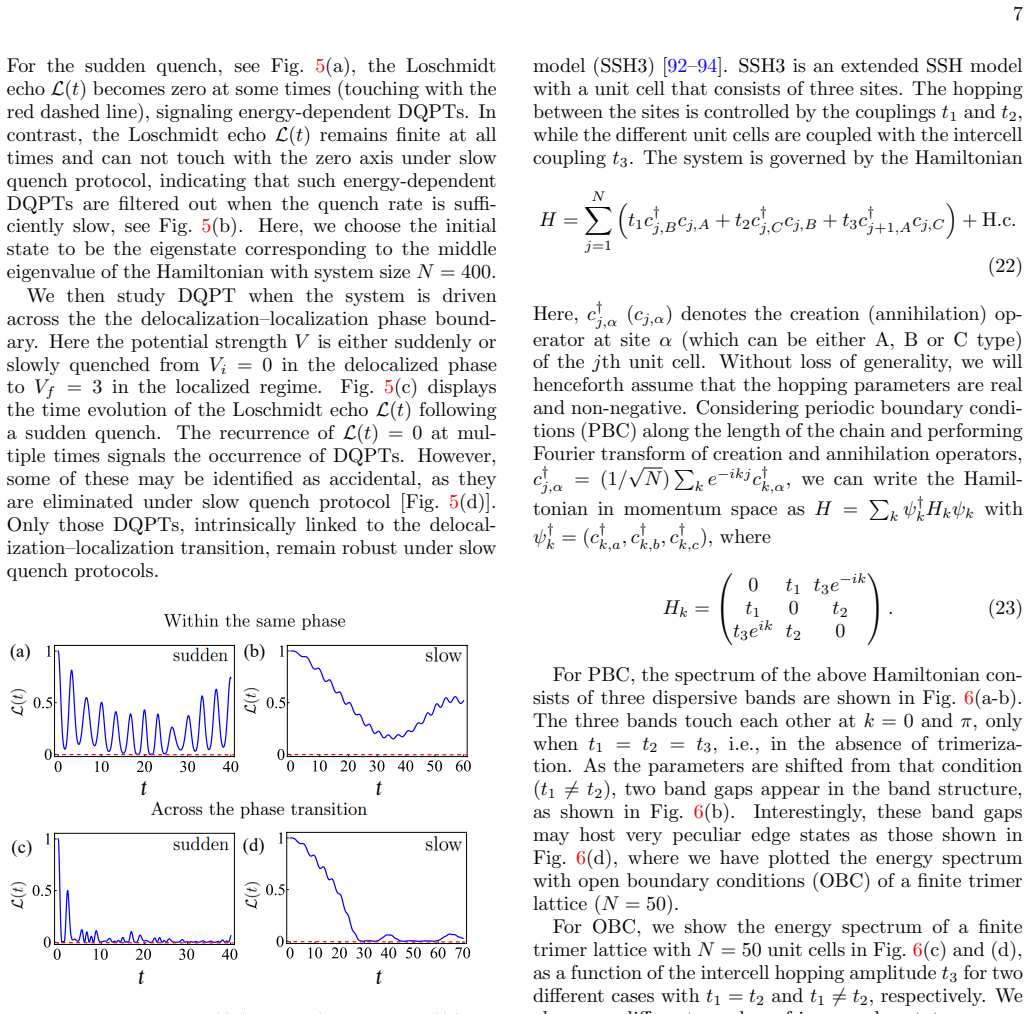
- [Sec. II, Eqs. (10)-(14)] The filtering argument uses the Landau-Zener probability P=exp(-πΔ_k²/β), which is an asymptotic t→±∞ transition probability. In the first approach defining G(t) in Eq. (7), DQPT critical times are evaluated at finite t during the slow ramp (e.g., Figs. 2 and 4). The statement that for a same-phase quench |p_{k,2}| is 'always very small' for small β is therefore not established for the times τ_c where Eq. (11) is actually needed. The paper's own Fig. 3(a2) shows a finite |p_{k,2}|² at β=0.08, which contradicts the 'always very small' assertion. This is a load-bearing gap in the general argument.
- [Sec. II, Eq. (11)] The coefficients |c_{k,i}(t)|=⟨u_i^-|u_k^±(t)⟩ are time-dependent through the instantaneous eigenstates, so the statement that they 'can be seen as a constant' is not correct. Eq. (11) is therefore a condition at the finite time τ_c, not a condition on asymptotic occupation amplitudes. The existence of a k_c for gap-crossing quenches, argued from |p_{k_0,2}|=1 at k_0 and small |p_{k,2}| away from k_0, does not by itself guarantee that |p_{k,1}||c_{k,1}|=|p_{k,2}||c_{k,2}| holds at the same time τ_c. The three numerical examples support the claim as a numerical observation, but they do not fill this logical gap.
- [Sec. III, Figs. 2, 5, 7] DQPTs are defined by nonanalyticities of the rate function in the thermodynamic limit. The manuscript does not report system-size dependence or finite-size scaling for any of the three models. For finite chains, an exact zero of G(t) occurs only if the critical momentum k_c lies on the discrete momentum grid; otherwise only sharp dips appear. Showing that no DQPT is visible at one system size and one quench rate (e.g., Fig. 2(b) for β=0.05) does not establish the claimed filtering in the thermodynamic limit. This is central to the numerical demonstration of the filter mechanism.
- [Sec. III, Figs. 4 and 8, Eq. (24)] The universal scaling τ_c∼β^{-σ} and the extraction of zν=1 are used to argue that DQPTs can identify equilibrium critical exponents. However, the paper gives no fit procedure, no fit range, no error bars, and no finite-size checks for the extracted exponents. Moreover, the XY chain result is quoted as τ_c∼β^{-1/2} while the SSH3 result in Eq. (24) includes a constant shift τ_0; the relation between these forms and the derivation in Ref. [70] is asserted rather than demonstrated. As written, this part of the claim is not independently supported by the data presented.
minor comments (4)
- [Eq. (10)] The notation is inconsistent: the left-hand side writes G_k(t) as a product over k, which should presumably read G(t)=∏_k G_k(t). Please correct.
- [Throughout] There are numerous typos, e.g., 'qunech', 'Hamltonians', 'depictes', 'presentes', and 'DA T AA V AILABILITY'. A careful proofread is needed.
- [Sec. II, around Eq. (11)] Eq. (11) is only a necessary condition for a zero of G_k(t); the phase condition Φ_{k,1}-Φ_{k,2}=π mod 2π is also required. The text should state this explicitly to avoid implying that the magnitude condition alone defines a DQPT.
- [Sec. II, Eq. (15)] The second Loschmidt-amplitude convention is dismissed in one sentence. Since some slow-quench DQPT literature uses that convention, a brief quantitative comparison or explicit statement of why it is not applicable would strengthen the presentation.
Circularity Check
No exhibit-able circular reduction; the filtering claim rests on direct numerics, and the self-cited scaling relation is checked against the paper's own data.
full rationale
I walked the paper's derivation chain from Eq. (10) to Eq. (11) and through the three model studies. The slow-quench DQPT condition (11) is algebraically derived from the Loschmidt-amplitude decomposition; it is not a restatement of the conclusion. The central 'filtering' claim—same-phase sudden-quench DQPTs disappear in the slow-quench limit while gap-crossing DQPTs persist—is supported by explicit numerical solution of the time-dependent Schrödinger equation (Eq. 12) with the same endpoints as the sudden-quench protocols, not by fitting a parameter and renaming it a prediction. The Landau-Zener formula (14) is used heuristically to motivate small transition amplitudes, and the finite-time use of an asymptotic formula is a legitimate correctness concern, but it is not a circular reduction: the existence of a k_c satisfying Eq. (11) is not defined into existence, and the paper's own figures provide the independent numerical check. The 'genuine DQPT' language is a stated criterion, but the substantive result is that the criterion selects gap-crossing quenches, which is an empirical finding rather than a tautology. The self-citations to Ref. [70] supply the scaling relation σ=zν/(1+zν); the paper then compares that relation to its own τ_c(β) data (Figs. 4 and 8). Thus the self-citation is not the sole content of the critical-exponent claim and is not load-bearing in a circular way. Under the hard rule requiring an explicit equation-to-equation reduction or a fitted parameter renamed as prediction, I find no exhibit-able circular step.
Assumptions & free parameters
free parameters (3)
- threshold quench rate β_th =
0.09 (XY, γ=0.3, h_i=0, h_f=0.9)
- critical-time scaling exponent σ =
1/2
- constant shift τ0 =
not specified
assumptions (3)
- domain assumption The infinite-time Landau-Zener formula P = exp(-πΔ_k²/β) is a good approximation for the finite-time slow linear quenches considered here.
- domain assumption For a ramp crossing a gap-closing quantum phase transition, in the thermodynamic limit there is always a critical momentum k_c satisfying Eq. (11).
- ad hoc to paper A 'genuine' DQPT is one that is robust under slow quench and independent of initial state and microscopic details.
Cite this review
Pith. "Pith review of Fate of dynamical quantum phase transitions from sudden quench to slow quench limit." pith.science (2026). https://pith.science/paper/AIBKDGYV
@misc{pith2026260715649,
  author       = {Pith},
  title        = {Pith review of: Fate of dynamical quantum phase transitions from sudden quench to slow quench limit},
  year         = {2026},
  howpublished = {\url{https://pith.science/paper/AIBKDGYV}},
  note         = {Machine review of arXiv:2607.15649}
}
read the original abstract
Previous investigations of dynamical quantum phase transition (DQPT) have predominantly focused on sudden quench protocols. In this work, we systematically explore the fate of DQPT from the sudden to the slow quench regime. We establish that DQPT remains robust under slow quenching when the protocol crosses an equilibrium quantum phase transition. Conversely, we show that accidental DQPTs,which occur when the pre and post quench Hamiltonians reside in the same equilibrium phase, can be filtered out in the slow quench limit. This demonstrates that slow quenches can reveal the intrinsic connection between DQPT and equilibrium quantum phase transitions, thereby enabling DQPT to serve as a dynamical probe for identifying equilibrium quantum critical points. We illustrate these findings with examples from the XY chain, the Aubry-Andr\'e model, and the trimer Su-Schrieffer-Heeger model.
Figures


Figures from the paper (4 more)



Forward citations
Cited by 1 Pith paper
-
Dynamical Quantum Phase Transitions in a Pseudo-Hermitian Hamiltonian: The Imbalanced-Pairing Kitaev Model
For the pseudo-Hermitian imbalanced-pairing Kitaev chain under a linear ramp, dynamical quantum phase transitions require a real post-ramp spectrum, and their critical sweep velocity is v_c = πγΔ²/ln(1+γ), vanishing at γ=-1.
Reference graph
Works this paper leans on
-
[70]
Zhang, L
X. Zhang, L. Hu, and F. Li, Universal scaling in loschmidt echo across quantum phase transitions under nonadia- batic dynamics, Phys. Rev. B112, 024310 (2025)
2025
-
[1]
Langen, R
T. Langen, R. Geiger, and J. Schmiedmayer, Ultracold atoms out of equilibrium, Annu. Rev. Condens. Matter Phys.6, 201 (2015)
2015
-
[2]
Leibfried, R
D. Leibfried, R. Blatt, C. Monroe, and D. Wineland, Quantum dynamics of single trapped ions, Rev. Mod. Phys.75, 281 (2003)
2003
-
[3]
Polkovnikov, K
A. Polkovnikov, K. Sengupta, A. Silva, and M. Vengalat- tore, Colloquium: Nonequilibrium dynamics of closed in- teracting quantum systems, Rev. Mod. Phys.83, 863 (2011)
2011
-
[4]
Z.-C. Liu, K. Li, and Y. Xu, Dynamical Transition Due to Feedback-Induced Skin Effect, Phys. Rev. Lett.133, 090401 (2024)
2024
-
[5]
T. V. Zache, N. Mueller, J. T. Schneider, F. Jendrze- jewski, J. Berges, and P. Hauke, Dynamical Topologi- cal Transitions in the Massive Schwinger Model with aθ term, Phys. Rev. Lett.122, 050403 (2019)
2019
-
[6]
Pal and D
A. Pal and D. A. Huse, Many-body localization phase transition, Phys. Rev. B82, 174411 (2010)
2010
-
[7]
Nandkishore and D
R. Nandkishore and D. A. Huse, Many-body localiza- tion and thermalization in quantum statistical mechan- ics, Annu. Rev. Condens. Matter Phys.6, 15 (2015)
2015
Show all 94 references
-
[8]
D. A. Abanin, E. Altman, I. Bloch, and M. Serbyn, Col- loquium: Many-body localization, thermalization, and entanglement, Rev. Mod. Phys.91, 021001 (2019)
2019
-
[9]
Schreiber, S
M. Schreiber, S. S. Hodgman, P. Bordia, H. P. L¨ uschen, M. H. Fischer, R. Vosk, E. Altman, U. Schneider, and I. Bloch, Observation of many-body localization of inter- acting fermions in a quasirandom optical lattice, Science 349, 842 (2015)
2015
-
[10]
Smith, A
J. Smith, A. Lee, P. Richerme, B. Neyenhuis, P. W. Hess, P. Hauke, M. Heyl, D. A. Huse, and C. Mon- roe, Many-body localization in a quantum simulator with programmable random disorder, Nature Physics12, 907 (2016)
2016
-
[11]
J.-y. Choi, S. Hild, J. Zeiher, P. Schauß, A. Rubio- Abadal, T. Yefsah, V. Khemani, D. A. Huse, I. Bloch, and C. Gross, Exploring the many-body localization transition in two dimensions, Science352, 1547 (2016)
2016
-
[12]
W. H. Zurek, U. Dorner, and P. Zoller, Dynamics of a quantum phase transition, Phys. Rev. Lett.95, 105701 (2005)
2005
-
[13]
Polkovnikov, Universal adiabatic dynamics in the vicinity of a quantum critical point, Phys
A. Polkovnikov, Universal adiabatic dynamics in the vicinity of a quantum critical point, Phys. Rev. B72, 161201 (2005)
2005
-
[14]
D. Sen, K. Sengupta, and S. Mondal, Defect produc- tion in nonlinear quench across a quantum critical point, Phys. Rev. Lett.101, 016806 (2008)
2008
-
[15]
Barankov and A
R. Barankov and A. Polkovnikov, Optimal nonlinear pas- sage through a quantum critical point, Phys. Rev. Lett. 101, 076801 (2008)
2008
-
[16]
Dziarmaga, Dynamics of a quantum phase transition and relaxation to a steady state, Advances in Physics59, 1063 (2010)
J. Dziarmaga, Dynamics of a quantum phase transition and relaxation to a steady state, Advances in Physics59, 1063 (2010)
2010
-
[17]
R. J. Nowak and J. Dziarmaga, Quantum Kibble-Zurek mechanism: Kink correlations after a quench in the quan- tum ising chain, Phys. Rev. B104, 075448 (2021)
2021
-
[18]
Kou and P
H.-C. Kou and P. Li, Varying quench dynamics in the transverse Ising chain: The Kibble-Zurek, saturated, and presaturated regimes, Phys. Rev. B108, 214307 (2023). 10
2023
-
[19]
Liang, L.-Z
E.-W. Liang, L.-Z. Tang, and D.-W. Zhang, Quantum criticality and Kibble-Zurek scaling in the Aubry-Andr´ e- Stark model, Phys. Rev. B110, 024207 (2024)
2024
-
[20]
Wilczek, Quantum time crystals, Phys
F. Wilczek, Quantum time crystals, Phys. Rev. Lett. 109, 160401 (2012)
2012
-
[21]
Sacha,Time crystals, Vol
K. Sacha,Time crystals, Vol. 114 (Springer, 2020)
2020
-
[22]
M. P. Zaletel, M. Lukin, C. Monroe, C. Nayak, F. Wilczek, and N. Y. Yao, Colloquium: Quantum and classical discrete time crystals, Rev. Mod. Phys.95, 031001 (2023)
2023
-
[23]
M. Heyl, A. Polkovnikov, and S. Kehrein, Dynamical quantum phase transitions in the transverse-field Ising model, Phys. Rev. Lett.110, 135704 (2013)
2013
-
[24]
Heyl, Dynamical quantum phase transitions: a re- view, Reports on Progress in Physics81, 054001 (2018)
M. Heyl, Dynamical quantum phase transitions: a re- view, Reports on Progress in Physics81, 054001 (2018)
2018
-
[25]
J. Lang, B. Frank, and J. C. Halimeh, Dynamical quan- tum phase transitions: A geometric picture, Phys. Rev. Lett.121, 130603 (2018)
2018
-
[26]
Vosk and E
R. Vosk and E. Altman, Dynamical Quantum Phase Transitions in Random Spin Chains, Phys. Rev. Lett. 112, 217204 (2014)
2014
-
[27]
Bhattacharya and A
U. Bhattacharya and A. Dutta, Interconnections between equilibrium topology and dynamical quantum phase transitions in a linearly ramped Haldane model, Phys. Rev. B95, 184307 (2017)
2017
-
[28]
Huang, D
Y.-P. Huang, D. Banerjee, and M. Heyl, Dynamical quan- tum phase transitions in U (1) quantum link models, Phys. Rev. Lett.122, 250401 (2019)
2019
-
[29]
Link and W
V. Link and W. T. Strunz, Dynamical phase transitions in dissipative quantum dynamics with quantum optical realization, Phys. Rev. Lett.125, 143602 (2020)
2020
-
[30]
Huang and A
Z. Huang and A. V. Balatsky, Dynamical quantum phase transitions: role of topological nodes in wave function overlaps, Phys. Rev. Lett.117, 086802 (2016)
2016
-
[31]
J. C. Budich and M. Heyl, Dynamical topological or- der parameters far from equilibrium, Phys. Rev. B93, 085416 (2016)
2016
-
[32]
Jurcevic, H
P. Jurcevic, H. Shen, P. Hauke, C. Maier, T. Brydges, C. Hempel, B. Lanyon, M. Heyl, R. Blatt, and C. Roos, Direct observation of dynamical quantum phase transi- tions in an interacting many-body system, Phys. Rev. Lett.119, 080501 (2017)
2017
-
[33]
Fl¨ aschner, D
N. Fl¨ aschner, D. Vogel, M. Tarnowski, B. Rem, D.-S. L¨ uhmann, M. Heyl, J. Budich, L. Mathey, K. Sengstock, and C. Weitenberg, Observation of dynamical vortices after quenches in a system with topology, Nature Physics 14, 265 (2018)
2018
-
[34]
Nie, B.-B
X. Nie, B.-B. Wei, X. Chen, Z. Zhang, X. Zhao, C. Qiu, Y. Tian, Y. Ji, T. Xin, D. Lu, and J. Li, Experimen- tal Observation of Equilibrium and Dynamical Quantum Phase Transitions via Out-of-Time-Ordered Correlators, Phys. Rev. Lett.124, 250601 (2020)
2020
-
[35]
X.-Y. Guo, C. Yang, Y. Zeng, Y. Peng, H.-K. Li, H. Deng, Y.-R. Jin, S. Chen, D. Zheng, and H. Fan, Observation of a Dynamical Quantum Phase Transition by a Supercon- ducting Qubit Simulation, Phys. Rev. Appl.11, 044080 (2019)
2019
-
[36]
Xu, Q.-Q
X.-Y. Xu, Q.-Q. Wang, M. Heyl, J. C. Budich, W.-W. Pan, Z. Chen, M. Jan, K. Sun, J.-S. Xu, Y.-J. Han, et al., Measuring a dynamical topological order parame- ter in quantum walks, Light: Science & Applications9, 7 (2020)
2020
-
[37]
K. Wang, X. Qiu, L. Xiao, X. Zhan, Z. Bian, W. Yi, and P. Xue, Simulating dynamic quantum phase transitions in photonic quantum walks, Phys. Rev. Lett.122, 020501 (2019)
2019
-
[38]
K. Yang, L. Zhou, W. Ma, X. Kong, P. Wang, X. Qin, X. Rong, Y. Wang, F. Shi, J. Gong, and J. Du, Floquet dynamical quantum phase transitions, Phys. Rev. B100, 085308 (2019)
2019
-
[39]
Zamani, R
S. Zamani, R. Jafari, and A. Langari, Floquet dynamical quantum phase transition in the extended XY model: Nonadiabatic to adiabatic topological transition, Phys. Rev. B102, 144306 (2020)
2020
-
[40]
Jafari and A
R. Jafari and A. Akbari, Floquet dynamical phase tran- sition and entanglement spectrum, Phys. Rev. A103, 012204 (2021)
2021
-
[41]
Zamani, R
S. Zamani, R. Jafari, and A. Langari, Out-of-time-order correlations and Floquet dynamical quantum phase tran- sition, Phys. Rev. B105, 094304 (2022)
2022
-
[42]
Jafari, A
R. Jafari, A. Akbari, U. Mishra, and H. Johannesson, Floquet dynamical quantum phase transitions under syn- chronized periodic driving, Phys. Rev. B105, 094311 (2022)
2022
-
[43]
Bhattacharya, S
U. Bhattacharya, S. Bandyopadhyay, and A. Dutta, Mixed state dynamical quantum phase transitions, Phys. Rev. B96, 180303 (2017)
2017
-
[44]
Heyl and J
M. Heyl and J. C. Budich, Dynamical topological quan- tum phase transitions for mixed states, Phys. Rev. B96, 180304 (2017)
2017
-
[45]
B. Mera, C. Vlachou, N. Paunkovi´ c, V. R. Vieira, and O. Viyuela, Dynamical phase transitions at finite tem- perature from fidelity and interferometric loschmidt echo induced metrics, Phys. Rev. B97, 094110 (2018)
2018
-
[46]
J. Lang, B. Frank, and J. C. Halimeh, Concurrence of dynamical phase transitions at finite temperature in the fully connected transverse-field ising model, Phys. Rev. B97, 174401 (2018)
2018
-
[47]
H. Lang, Y. Chen, Q. Hong, and H. Fan, Dynamical quantum phase transition for mixed states in open sys- tems, Phys. Rev. B98, 134310 (2018)
2018
-
[48]
Sedlmayr, M
N. Sedlmayr, M. Fleischhauer, and J. Sirker, Fate of dy- namical phase transitions at finite temperatures and in open systems, Phys. Rev. B97, 045147 (2018)
2018
-
[49]
T. H. Kyaw, V. M. Bastidas, J. Tangpanitanon, G. Romero, and L.-C. Kwek, Dynamical quantum phase transitions and non-Markovian dynamics, Phys. Rev. A 101, 012111 (2020)
2020
-
[50]
J. Naji, M. Jafari, R. Jafari, and A. Akbari, Dissipative floquet dynamical quantum phase transition, Phys. Rev. A105, 022220 (2022)
2022
-
[51]
Kawabata, A
K. Kawabata, A. Kulkarni, J. Li, T. Numasawa, and S. Ryu, Dynamical quantum phase transitions in Sachdev-Ye-Kitaev Lindbladians, Phys. Rev. B108, 075110 (2023)
2023
-
[52]
H.-X. Xiao, W. Jiang, P. Qian, H. Li, Z. Li, H. Shen, and B. Chen, Dynamical topological quantum phase tran- sitions in high-order topological systems, Phys. Rev. B 110, 064306 (2024)
2024
-
[53]
Mas lowski and N
T. Mas lowski and N. Sedlmayr, Dynamical bulk- boundary correspondence and dynamical quantum phase transitions in higher-order topological insulators, Phys. Rev. B108, 094306 (2023)
2023
-
[54]
C. Yang, Y. Wang, P. Wang, X. Gao, and S. Chen, Dy- namical signature of localization-delocalization transition in a one-dimensional incommensurate lattice, Phys. Rev. B95, 184201 (2017). 11
2017
-
[55]
S. Ye, N. A. Khan, and M. Sajid, Disentangling con- nection between static and dynamical phase transitions, Phys. Rev. A111, 042208 (2025)
2025
-
[56]
S. Ye, Z. Zhou, N. A. Khan, and G. Xianlong, Energy- dependent dynamical quantum phase transitions in qua- sicrystals, Phys. Rev. A109, 043319 (2024)
2024
-
[57]
De Nicola, A
S. De Nicola, A. A. Michailidis, and M. Serbyn, Entan- glement view of dynamical quantum phase transitions, Phys. Rev. Lett.126, 040602 (2021)
2021
-
[58]
P¨ oyh¨ onen and T
K. P¨ oyh¨ onen and T. Ojanen, Entanglement echo and dynamical entanglement transitions, Phys. Rev. Res.3, L042027 (2021)
2021
-
[59]
J. Chen, R. C. de Almeida, and H. Weimer, Dynamical quantum phase transition with divergent multipartite en- tanglement, arXiv:2506.13898 (2025)
2025 arXiv
-
[60]
Heyl, Dynamical quantum phase transitions in sys- tems with broken-symmetry phases, Phys
M. Heyl, Dynamical quantum phase transitions in sys- tems with broken-symmetry phases, Phys. Rev. Lett. 113, 205701 (2014)
2014
-
[61]
ˇZunkoviˇ c, M
B. ˇZunkoviˇ c, M. Heyl, M. Knap, and A. Silva, Dynamical quantum phase transitions in spin chains with long-range interactions: Merging different concepts of nonequilib- rium criticality, Phys. Rev. Lett.120, 130601 (2018)
2018
-
[62]
Homrighausen, N
I. Homrighausen, N. O. Abeling, V. Zauner-Stauber, and J. C. Halimeh, Anomalous dynamical phase in quantum spin chains with long-range interactions, Phys. Rev. B 96, 104436 (2017)
2017
-
[63]
Bandyopadhyay, A
S. Bandyopadhyay, A. Polkovnikov, and A. Dutta, Ob- serving dynamical quantum phase transitions through quasilocal string operators, Phys. Rev. Lett.126, 200602 (2021)
2021
-
[64]
N. O. Abeling and S. Kehrein, Quantum quench dynam- ics in the transverse field ising model at nonzero temper- atures, Phys. Rev. B93, 104302 (2016)
2016
-
[65]
V. A. Gilles Parez, Reduced fidelities for free fermions out of equilibrium: From dynamical quantum phase transi- tions to Mpemba effect, arXiv:2509.01608 (2025)
2025
-
[66]
Vajna and B
S. Vajna and B. D´ ora, Disentangling dynamical phase transitions from equilibrium phase transitions, Phys. Rev. B89, 161105 (2014)
2014
-
[67]
Vajna and B
S. Vajna and B. D´ ora, Topological classification of dy- namical phase transitions, Phys. Rev. B91, 155127 (2015)
2015
-
[68]
Andraschko and J
F. Andraschko and J. Sirker, Dynamical quantum phase transitions and the Loschmidt echo: A transfer matrix approach, Phys. Rev. B89, 125120 (2014)
2014
-
[69]
Karrasch and D
C. Karrasch and D. Schuricht, Dynamical quantum phase transitions in the quantum potts chain, Phys. Rev. B95, 075143 (2017)
2017
-
[71]
Puskarov and D
T. Puskarov and D. Schuricht, Time evolution during and after finite-time quantum quenches in the transverse-field Ising chain, SciPost Physics1, 003 (2016)
2016
-
[72]
Sharma, U
S. Sharma, U. Divakaran, A. Polkovnikov, and A. Dutta, Slow quenches in a quantum Ising chain: Dynamical phase transitions and topology, Phys. Rev. B93, 144306 (2016)
2016
-
[73]
Gorin, T
T. Gorin, T. Prosen, T. H. Seligman, and M. ˇZnidariˇ c, Dynamics of Loschmidt echoes and fidelity decay, Physics Reports435, 33 (2006)
2006
-
[74]
H. T. Quan, Z. Song, X. F. Liu, P. Zanardi, and C. P. Sun, Decay of Loschmidt Echo Enhanced by Quantum Criticality, Phys. Rev. Lett.96, 140604 (2006)
2006
-
[75]
Hasegawa, Irreversibility, Loschmidt Echo, and Ther- modynamic Uncertainty Relation, Phys
Y. Hasegawa, Irreversibility, Loschmidt Echo, and Ther- modynamic Uncertainty Relation, Phys. Rev. Lett.127, 240602 (2021)
2021
-
[76]
Jafari and H
R. Jafari and H. Johannesson, Loschmidt Echo Revivals: Critical and Noncritical, Phys. Rev. Lett.118, 015701 (2017)
2017
-
[77]
W. H. Zurek, Sub-Planck structure in phase space and its relevance for quantum decoherence, Nature412, 712 (2001)
2001
-
[78]
W. H. Zurek, Decoherence, einselection, and the quan- tum origins of the classical, Rev. Mod. Phys.75, 715 (2003)
2003
-
[79]
F. M. Cucchietti, D. A. R. Dalvit, J. P. Paz, and W. H. Zurek, Decoherence and the Loschmidt Echo, Phys. Rev. Lett.91, 210403 (2003)
2003
-
[80]
Guti´ errez and A
M. Guti´ errez and A. Goussev, Long-time saturation of the Loschmidt echo in quantum chaotic billiards, Phys. Rev. E79, 046211 (2009)
2009
-
[81]
Jacquod, P
P. Jacquod, P. Silvestrov, and C. Beenakker, Golden rule decay versus Lyapunov decay of the quantum Loschmidt echo, Phys. Rev. E64, 055203 (2001)
2001
-
[82]
N. R. Cerruti and S. Tomsovic, Sensitivity of Wave Field Evolution and Manifold Stability in Chaotic Systems, Phys. Rev. Lett.88, 054103 (2002)
2002
-
[83]
D. A. Wisniacki, Short-time decay of the Loschmidt echo, Phys. Rev. E67, 016205 (2003)
2003
-
[84]
F. M. Cucchietti, H. M. Pastawski, and R. A. Jalabert, Universality of the Lyapunov regime for the Loschmidt echo, Phys. Rev. B70, 035311 (2004)
2004
-
[85]
Tang, S.-P
J.-C. Tang, S.-P. Kou, and G. Sun, Dynamical scaling of Loschmidt echo in non-hermitian systems, Europhysics Letters137, 40001 (2022)
2022
-
[86]
Landau, Zur theorie der energieubertragung
L. Landau, Zur theorie der energieubertragung. ii, Physikalische Zeitschrift der Sowjetunion2, 46 (1932)
1932
-
[87]
Zener, Non-adiabatic crossing of energy levels, Proc
C. Zener, Non-adiabatic crossing of energy levels, Proc. R. Soc. A137, 696 (1932)
1932
-
[88]
E. C. G. Stueckelberg, Theorie der unelastischen st¨ osse zwischen atomen, Helv. Phys. Acta5, 369 (1932)
1932
-
[89]
Majorana, Atomi orientati in campo magnetico vari- abile, Il Nuovo Cimento9, 43 (1932)
E. Majorana, Atomi orientati in campo magnetico vari- abile, Il Nuovo Cimento9, 43 (1932)
1932
-
[90]
Jordan and E
P. Jordan and E. Wigner, ¨Uber das paulische ¨ aquivalenzverbot, Z. Phys.47, 631 (1928)
1928
-
[91]
Dziarmaga, Dynamics of a quantum phase transition: Exact solution of the quantum ising model, Phys
J. Dziarmaga, Dynamics of a quantum phase transition: Exact solution of the quantum ising model, Phys. Rev. Lett.95, 245701 (2005)
2005
-
[92]
Jin, Topological phases and edge states in a non- Hermitian trimerized optical lattice, Phys
L. Jin, Topological phases and edge states in a non- Hermitian trimerized optical lattice, Phys. Rev. A96, 032103 (2017)
2017
-
[93]
V. M. Martinez Alvarez and M. D. Coutinho-Filho, Edge states in trimer lattices, Phys. Rev. A99, 013833 (2019)
2019
-
[94]
Anastasiadis, G
A. Anastasiadis, G. Styliaris, R. Chaunsali, G. Theocharis, and F. K. Diakonos, Bulk-edge cor- respondence in the trimer Su-Schrieffer-Heeger model, Phys. Rev. B106, 085109 (2022)
2022
Reviewed August 1, 2026 · model on record in the stance chip above.
Discussion (0). Continue with ORCID to comment.