REVIEW 4 major objections 6 minor 175 references
Hamilton-Zero: A Neural Tensor-Network Foundation Model for Ground States of Arbitrary Quadratic Qubit Hamiltonians
T0 review · 4 major / 6 minor · reviewed 2026-08-16 · deepseek-v4-flash
Pith's one-line read The paper claims that a single 0.5 billion parameter neural network, pretrained on hundreds of thousands of quadratic spin-1/2 Hamiltonians, can produce variational upper bounds for ground-state energies of unseen systems across different…
desk verdict A genuinely new foundation-model approach to ground-state computation with strong small-system results, hobbled by an abstract that overstates the 8100-qubit capability and a variational-bound claim that outruns the sampler. read the letter →
The pith
A machine-rendered reading of the paper's core claim, the machinery that carries it, and where it could break.
The reading
What carries the argument
The load-bearing object is the manifold wavefunction: a centrally odd scalar function on SU(2)^N, linear in each site's quaternion. That choice lets the Hamiltonian act through Lie derivatives, computed with custom automatic-differentiation primitives, and the Peter-Weyl theorem provides the sector projection that keeps the energy variational. Around this core sits a transformer trunk that reads only the Hamiltonian's coupling tensors, a per-site leaf builder where quaternion coordinates enter, and a balanced binary merge tree with a shared quadrilinear merge tensor; a reinforcement-learned routing policy picks which sites merge early, so the contraction path adapts to each Hamiltonian's interaction structure. The same machinery yields differentiable wavefunctions and an explicit log-amplitude, so energies and observables are evaluated by variational Monte Carlo with a replica-exchange Langevin sampler on SU(2)^N.
What would settle it
Take the 8100-qubit square J1-J2 system from Table 1: the model reports +0.128 per spin while the comparison scale is about -0.497; rerunning with a much longer burn-in and more walkers and checking whether the estimate crosses below zero would settle whether the variational upper bound actually holds at that size.
Extended reading notes
Core claim
The paper's central claim is that a single checkpoint, trained once, can serve as a foundation for ground states across a universal family of spin-1/2 Hamiltonians. The construction represents each spin by a unit quaternion, so a state is a centrally odd, per-site linear function on SU(2)^N; spin operators become left-invariant Lie derivatives evaluated by automatic differentiation. By the Peter-Weyl decomposition, per-site oddness plus linearity in each quaternion confines the wavefunction to the spin-1/2 sector, so the Rayleigh quotient is a rigorous upper bound on the true ground-state energy whenever the Monte Carlo expectation is converged. Empirically, the pretrained model generalizes across system sizes, topologies, and interaction types; on held-out systems fine-tuning the compiled merge tree alone reaches median signed gaps of 3.1e-4% to 6.0e-3% relative to exact diagonalization, and zero-shot evaluation extends to systems with thousands of qubits.
Load-bearing premise
The reported energies are variational upper bounds only if the Monte Carlo sampler has converged and mixed within the sampling budget; the paper states this is unverified at the largest system sizes, especially the 8100-qubit case.
Editorial extensions
If this is right
- A single pretrained checkpoint replaces per-system training from scratch for quadratic spin-1/2 ground-state problems, making the marginal cost of a new Hamiltonian the cost of sampling and optionally fine-tuning a small compiled readout.
- Zero-shot transfer to system sizes far above the training range (up to 8100 qubits) is demonstrated, including nonlocal topologies where tensor-network references are hard to obtain.
- Fine-tuning fewer than one percent of the model's parameters (the compiled merge tree) recovers 0.00031-0.006 percent median signed gaps on held-out systems, with 90-100 percent of systems within one percent of exact diagonalization.
- A fixed checkpoint can serve as a phase-transition witness: fidelity susceptibility computed from zero-shot weights peaks near the transverse-field Ising critical point without any fine-tuning.
- The learned routing policy recovers physically natural contraction hierarchies, such as nearest-neighbour pairs, plaquettes, and carbon-orbital blocks, on systems more than thirty times larger than any seen in pretraining.
Reading between the lines
- A step beyond the paper: if the variational upper bound survives careful sampling at scale, the energies could be promoted to rigorous bounds in combinatorial-optimization settings, giving certified cuts or ground-state energies rather than heuristic estimates; the paper does not claim this.
- One natural extension the paper leaves implicit is using the differentiable wavefunction to compute two-point correlation functions, which would allow a single checkpoint to map complete phase diagrams from correlation-based order parameters, not only fidelity susceptibility.
- The positive zero-shot energy on the 8100-qubit lattice suggests the current checkpoint's size-extrapolation limit is real; pretraining at larger sizes or conditioning more explicitly on system size is the obvious next stress test.
Signed reviews
Editorial analysis
A structured set of objections, weighed in public.
Referee Report
Summary. The manuscript introduces Hamilton-Zero, a roughly 0.5B-parameter neural network that represents spin-1/2 ground states as centrally odd, per-site-linear functions on SU(2)^N, with the Hamiltonian acting through Lie derivatives. Using the Peter-Weyl decomposition, the authors argue that this multilinear ansatz lies in the physical spin-1/2 sector and hence satisfies the variational upper-bound inequality for exact expectations (Sec. 2, SM S1). They pretrain on hundreds of thousands of perturbed quadratic Hamiltonians, evaluate zero-shot and fine-tuned on held-out ED-referenced systems, and report large-system case studies up to 8100 qubits, along with scaling laws, a zero-variance calibration, a phase-transition witness, learned equivariance, and learned contraction routes.
Significance. If the technical claims hold, Hamilton-Zero would be a substantial advance in amortized quantum many-body computation: a single pretrained variational wavefunction transferring across topologies, system sizes, and interaction types at a scale far beyond prior foundation neural quantum states, with a clean Peter-Weyl-based resolution of the phase-space leakage problem. The paper is unusually explicit about limitations (Sec. 6), releases code and model weights, and the small-system exact-diagonalization comparisons support the energy claims in-distribution. The central scientific value, however, depends on whether the gap between the exact-expectation variational bound and the finite-sample Monte-Carlo estimates can be closed or the claims appropriately qualified; in its current form the 'rigorous upper bound' framing overstates what the reported numbers establish.
major comments (4)
- [Sec. 2, Eq. (2.5)] The variational inequality in Eq. (2.5) is derived for exact expectations under |ψθ|^2, but the abstract and Sec. 2 state that 'every energy our optimiser reports is a rigorous upper bound.' Sec. 6 itself concedes that finite-sample Monte-Carlo estimates may violate the inequality through estimator noise or mixing bias. All reported energies in Sec. 5.2 and Table 1 are finite-sample averages (e.g., 512 measurement steps, 256 walkers, 8 replicas), with no proof or diagnostic that the chain is unbiased at the largest system sizes. The 'rigorous upper bound' claim is therefore not established for any reported number; please either provide a sampler-certification argument or revise the claims to 'variational estimate subject to sampling error' and remove 'rigorous' from the abstract and Sec. 2.
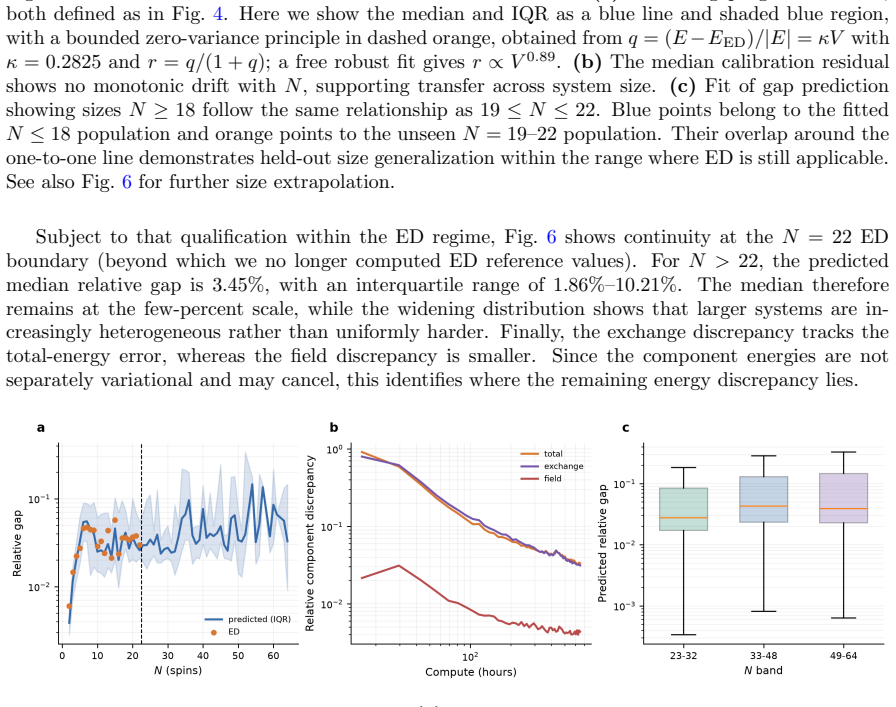
- [Sec. 5.1, Figs. 5-6] The zero-variance calibration constant κ=0.2825 is fitted to ED-referenced systems with N≤18 and then used in Fig. 6 to 'predict' relative gaps for N>22, including the statement that the predicted median relative gap is 3.45%. This is model-based extrapolation under the unverified assumption that q=κV is universal across system size and Hamiltonian family; it is not a measured gap. The scaling-law exponents in Fig. 4 are likewise fitted to this pretraining run. The text should clearly label these quantities as extrapolations under an assumption and should not present the 3.45% as a verified accuracy of the model without independent large-system references.
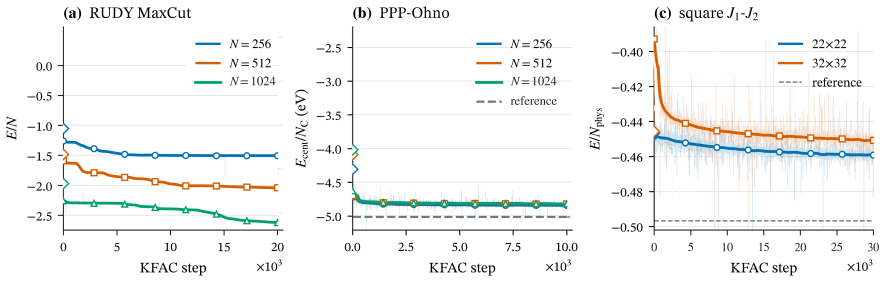
- [Table 1, Sec. 5.3] The large-system comparisons use non-certified references: MaxCut rows compare against archived feasible cuts rather than certified optima; PPP rows compare against a thermodynamic-limit literature value under a different convention; and square and triangular lattice rows compare against thermodynamic-limit scales rather than exact finite-size energies. Consequently the recovery percentages do not certify variational accuracy. The 8100-qubit square-lattice row reports E/N=+0.128 versus a reference of −0.4968, which is a clear failure; the abstract's 'evaluate on systems up to 8100 qubits' should be accompanied by the fact that the model fails at that scale, and the introduction's 'up to 8000 qubits' claim should be tempered accordingly.
- [Sec. 5.2, SM S4] No evidence is given that the replica-exchange Langevin sampler mixes on a timescale short compared with the measurement budget for the large systems. The stationarity tests mentioned in Sec. 6 are heuristic and cannot distinguish a slowly mixing chain from a converged one within a finite number of steps. Please report effective sample sizes, autocorrelation times, replica-exchange acceptance rates, or a comparison with independent references at intermediate sizes (e.g., N=1024 and 2025) before using the large-system zero-shot energies as support for the variational claim.
minor comments (6)
- [Abstract and Sec. 5.3] The phrase 'evaluate on systems up to 8100 qubits' should be qualified with the failure and degradation reported in Sec. 5.3; as written, it invites overreading of the large-system results.
- [Sec. 3 and Sec. 1] The text 'the router’s training has converge to the true optimum' should read 'has converged', and 'electric vehical charging' in the introduction should be 'vehicle charging'.
- [Sec. 5.2] '104 KFAC steps' should read '10^4 KFAC steps'; the exponent appears to be missing.
- [Figs. 7 and 8] The captions of Figs. 7 and 8 appear identical; if this is not intentional, the captions should be differentiated to describe the zero-shot and fine-tuned panels respectively.
- [Sec. 2 and Sec. 6] The spelling 'Supplimentary Material' should be 'Supplementary Material', and 'Hamilton-zero' in Sec. 6 should be consistently capitalized as 'Hamilton-Zero'.
- [SM S2.4, Eq. (S2.61)] The operation in Eq. (S2.61) is described as a 'rank-4 quadrilinear merge' but is bilinear in the two child carriers; consider using consistent terminology such as 'rank-4 blockwise bilinear merge' to avoid confusion.
Circularity Check
Central variational principle is self-contained, but the zero-variance 'predicted gaps' for N>22 are the fitted kappa*V calibration relabeled as prediction.
-
fitted input called prediction
[Sec. 5.1, Fig. 5 caption and Fig. 6 caption]
"a bounded zero-variance principle in dashed orange, obtained from q=(E−E_ED)/|E|=κV with κ=0.2825 and r=q/(1+q); ... For N >22, the predicted median relative gap is 3.45%, with an interquartile range of 1.86%–10.21%."
The constant κ is fit to exact-diagonalization-referenced systems, and the 'predicted' relative gaps for N>22 are then computed as q=κV from the model's V-score on those larger systems. No independent reference enters the prediction; it is the calibration curve itself evaluated at new V. Thus the reported 3.45% median gap is not an independent first-principles result but an algebraic restatement of the earlier ED fit, with the fitted parameter κ carrying the entire predictive content.
full rationale
The central derivation (Sec. 2, SM§S1) is not circular: the per-site odd and multilinear functions are exactly the Peter–Weyl spin-1/2 sector, and the variational inequality ⟨ψ|H|ψ⟩/⟨ψ|ψ⟩ ≥ E0 follows from the sector decomposition and from the fact that the Hamiltonian acts trivially on the row/multiplicity index. This is a theorem with stated assumptions, not an input–output tautology. The zero-shot and fine-tuned energies are direct Monte Carlo estimates of this variational expectation compared against exact diagonalization, and the paper states that ED references are never supplied to evaluation or fine-tuning, so the central energy claims are not fitted-input predictions. The one step that reduces by construction is the auxiliary zero-variance calibration: κ=0.2825 is fit to ED-referenced data, and the 'predicted' N>22 median gap is κV computed on the model's V-score, i.e., the same calibration curve evaluated at new V. This is a fitted parameter renamed as a prediction; it does not support the main energy results. The scaling-law exponents are explicitly descriptive fits of the pretraining run and are not used to predict held-out data. Sec. 6 explicitly concedes that finite-sample estimates may violate the variational inequality by estimator noise or mixing bias; I treat that as a verification limitation rather than a circular step, because the theoretical upper bound for exact expectations is derived independently.
Assumptions & free parameters
free parameters (4)
- zero-variance calibration constant kappa =
0.2825
- pretraining scaling-law exponents =
-0.53 (V-score), -0.61 (relative gap)
- ALiBi tree-distance slope schedule =
geometric schedule from 1.5 to ~0.09
- feature-scale floor tau =
1e-3
assumptions (5)
- standard math Peter-Weyl theorem decomposes L^2(SU(2)^N) into irreps, and the physical spin-1/2 sector is characterized by the per-site Casimir eigenvalue 3/4.
- domain assumption The representation sigma^a_i = -i L^a_i maps the physical spin algebra to left-invariant vector fields on SU(2) with the correct commutation relations and Casimir normalization.
- domain assumption Quadratic two-body Pauli Hamiltonians are universal for quantum computation and sufficient for the target applications.
- domain assumption The pretraining corpus of 5,000 topologies with perturbations is representative enough that a single checkpoint generalizes across the space of quadratic qubit Hamiltonians.
- ad hoc to paper The bounded zero-variance relation q = kappa V is universal across system sizes and Hamiltonian families.
Cite this review
Pith. "Pith review of Hamilton-Zero: A Neural Tensor-Network Foundation Model for Ground States of Arbitrary Quadratic Qubit Hamiltonians." pith.science (2026). https://pith.science/paper/AIVTO7ZD
@misc{pith2026260811911,
  author       = {Pith},
  title        = {Pith review of: Hamilton-Zero: A Neural Tensor-Network Foundation Model for Ground States of Arbitrary Quadratic Qubit Hamiltonians},
  year         = {2026},
  howpublished = {\url{https://pith.science/paper/AIVTO7ZD}},
  note         = {Machine review of arXiv:2608.11911}
}
abstract
A central promise of useful quantum advantage is the ability to compute ground states of Hamiltonian systems beyond the reach of classical simulation methods. Here we demonstrate that this problem can be effectively amortized across an arbitrary and universal set of Hamiltonians by a foundation model with $\sim0.5$B variational parameters, trained with contemporary techniques from large language models and deep reinforcement learning. To do this, we formulate $\text{spin-}1/2$ quantum ground-state learning as manifold variational optimisation over centrally odd scalar functions on $\mathrm{SU}(2)^N$. This replaces explicit Hilbert-space vector amplitudes with manifold functions on which the Hamiltonian acts through Lie derivatives, evaluated by custom automatic differentiation primitives. We prove that the resulting variational principle on this manifold preserves the $\text{spin-}1/2$ sector's ground-state upper bound using the Peter-Weyl theorem, then pre-train our foundation model on a dataset of hundreds of thousands of different Hamiltonian systems, varying the connection topology, system size, interaction types and strengths, bringing together a century of many-body literature. Using a novel $\mathrm{SU}(2)$ replica-exchange Langevin sampler and sharded natural-gradient optimisation, we train our model with our own extension of the Kronecker-Factored Approximate Curvature (KFAC) optimiser on system sizes up to 64 qubits. On a held-out generalisation dataset, we fine-tune our model on system sizes of up to 1024 qubits, and evaluate on systems up to 8100 qubits.
Figures


Figures from the paper (15 more)






Reference graph
Works this paper leans on
-
[1]
Quantum algorithms for quantum chemistry and quantum materials science.Chemical reviews, 120(22):12685–12717, 2020
Bela Bauer, Sergey Bravyi, Mario Motta, and Garnet Kin-Lic Chan. Quantum algorithms for quantum chemistry and quantum materials science.Chemical reviews, 120(22):12685–12717, 2020
2020
-
[2]
Quantum computational chemistry.Reviews of Modern Physics, 92(1):015003, 2020
Sam McArdle, Suguru Endo, Al´ an Aspuru-Guzik, Simon C Benjamin, and Xiao Yuan. Quantum computational chemistry.Reviews of Modern Physics, 92(1):015003, 2020
2020
-
[3]
Simulating fermions with a digital quantum computer.Nature Reviews Physics, 8(3):131–145, 2026
Riley W Chien, Mitchell Chiew, Brent Harrison, Jason Necaise, Weishi Wang, Maryam Mudas- sar, Campbell McLauchlan, Thomas M Henderson, Gustavo E Scuseria, Sergii Strelchuk, et al. Simulating fermions with a digital quantum computer.Nature Reviews Physics, 8(3):131–145, 2026. 85
2026
-
[4]
Combinatorial optimization of supply chain net- works: A retrospective & literature review.Materials today: proceedings, 62:1636–1642, 2022
Guman Singh and Mohammad Rizwanullah. Combinatorial optimization of supply chain net- works: A retrospective & literature review.Materials today: proceedings, 62:1636–1642, 2022
2022
-
[5]
A two-stage stochastic mixed-integer program modelling and hybrid solution approach to portfolio selection problems.Information Sciences, 289:190–205, 2014
Fang He and Rong Qu. A two-stage stochastic mixed-integer program modelling and hybrid solution approach to portfolio selection problems.Information Sciences, 289:190–205, 2014
2014
-
[6]
Combinatorial optimization for electric vehicles man- agement.Journal of Energy and Power Engineering, 6(5):738–743, 2012
Nora Touati-Moungla, Vincent Jost, et al. Combinatorial optimization for electric vehicles man- agement.Journal of Energy and Power Engineering, 6(5):738–743, 2012
2012
-
[7]
Online vehicle routing with neural combinatorial optimization and deep reinforcement learning.IEEE Transactions on Intelligent Transportation Systems, 20 (10):3806–3817, 2019
JQ James, Wen Yu, and Jiatao Gu. Online vehicle routing with neural combinatorial optimization and deep reinforcement learning.IEEE Transactions on Intelligent Transportation Systems, 20 (10):3806–3817, 2019
2019
-
[8]
A combinatorial model to optimize air traffic flow management problems.Computers & operations research, 112:104768, 2019
David Garc´ ıa-Heredia, Antonio Alonso-Ayuso, and Elisenda Molina. A combinatorial model to optimize air traffic flow management problems.Computers & operations research, 112:104768, 2019
2019
Show all 175 references
-
[9]
Springer Science & Business Media, 2013
Gang Yu.Industrial applications of combinatorial optimization. Springer Science & Business Media, 2013
2013
-
[10]
Springer Science & Business Media, 2013
Ding-Zhu Du and Panos M Pardalos.Handbook of combinatorial optimization. Springer Science & Business Media, 2013
2013
-
[11]
Classical simulation of quantum many-body systems with a tree tensor network.Physical Review A, 74(2):022320, 2006
Yao-Yun Shi, Lu-Ming Duan, and Guifr´ e Vidal. Classical simulation of quantum many-body systems with a tree tensor network.Physical Review A, 74(2):022320, 2006. doi: 10.1103/ PhysRevA.74.022320
2006
-
[12]
Noack, and Frank Verstraete
Valentin Murg, ¨Ors Legeza, Reinhard M. Noack, and Frank Verstraete. Simulating strongly correlated quantum systems with tree tensor networks.Physical Review B, 82(20):205105, 2010. doi: 10.1103/PhysRevB.82.205105
2010 doi
-
[13]
Efficient tree tensor network states (TTNS) for quantum chemistry: Generalizations of the density matrix renormalization group algorithm
Naoki Nakatani and Garnet Kin-Lic Chan. Efficient tree tensor network states (TTNS) for quantum chemistry: Generalizations of the density matrix renormalization group algorithm. Journal of Chemical Physics, 138(13):134113, 2013. doi: 10.1063/1.4798639
2013 doi
-
[14]
Love, Al´ an Aspuru-Guzik, and Jeremy L
Alberto Peruzzo, Jarrod McClean, Peter Shadbolt, Man-Hong Yung, Xiao-Qi Zhou, Peter J. Love, Al´ an Aspuru-Guzik, and Jeremy L. O’Brien. A variational eigenvalue solver on a photonic quantum processor.Nature Communications, 5:4213, 2014. doi: 10.1038/ncomms5213
2014 doi
-
[15]
Cerezo, A
M. Cerezo, A. Arrasmith, R. Babbush, S. C. Benjamin, S. Endo, K. Fujii, J. R. McClean, K. Mitarai, X. Yuan, L. Cincio, and P. J. Coles. Variational quantum algorithms.Nature Reviews Physics, 3:625–644, 2021. doi: 10.1038/s42254-021-00348-9
2021 doi
-
[16]
Solving the quantum many-body problem with artificial neural networks.Science, 355:602–606, 2017
Giuseppe Carleo and Matthias Troyer. Solving the quantum many-body problem with artificial neural networks.Science, 355:602–606, 2017. arXiv:1606.02318
2017 arXiv
-
[17]
From architectures to applications: A review of neural quantum states.Quantum Science and Technology, 9(4): 040501, 2024
Hannah Lange, Anka Van de Walle, Atiye Abedinnia, and Annabelle Bohrdt. From architectures to applications: A review of neural quantum states.Quantum Science and Technology, 9(4): 040501, 2024
2024
-
[18]
Barren plateaus in variational quantum computing.Nature Reviews Physics, 7(4):174–189, 2025
Martin Larocca, Supanut Thanasilp, Samson Wang, Kunal Sharma, Jacob Biamonte, Patrick J Coles, Lukasz Cincio, Jarrod R McClean, Zo¨ e Holmes, and Marco Cerezo. Barren plateaus in variational quantum computing.Nature Reviews Physics, 7(4):174–189, 2025
2025
-
[19]
A lie algebraic theory of barren plateaus for deep parameterized quantum circuits.Nature Communications, 15(1):7172, 2024
Michael Ragone, Bojko N Bakalov, Fr´ ed´ eric Sauvage, Alexander F Kemper, Carlos Ortiz Mar- rero, Mart´ ın Larocca, and Marco Cerezo. A lie algebraic theory of barren plateaus for deep parameterized quantum circuits.Nature Communications, 15(1):7172, 2024
2024
-
[20]
McClean, Sergio Boixo, Vadim N
Jarrod R. McClean, Sergio Boixo, Vadim N. Smelyanskiy, Ryan Babbush, and Hartmut Neven. Barren plateaus in quantum neural network training landscapes.Nature Communications, 9: 4812, 2018. doi: 10.1038/s41467-018-07090-4. 86
2018 doi
-
[21]
Approaching the thermodynamic limit with neural-network quantum states.arXiv preprint arXiv:2602.02665, 2026
Luciano Loris Viteritti, Riccardo Rende, Subir Sachdev, and Giuseppe Carleo. Approaching the thermodynamic limit with neural-network quantum states.arXiv preprint arXiv:2602.02665, 2026
2026
-
[22]
Rende, L
R. Rende, L. L. Viteritti, F. Becca, A. Scardicchio, A. Laio, and G. Carleo. Foundation neural- network quantum states as a unified ansatz for multiple Hamiltonians.Nature Communications, 16:7213, 2025. doi: 10.1038/s41467-025-62098-x
2025 doi
-
[23]
Attention-based foundation model for quantum states.arXiv preprint arXiv:2512.11962, 2025
Timothy Zaklama, Daniele Guerci, and Liang Fu. Attention-based foundation model for quantum states.arXiv preprint arXiv:2512.11962, 2025
2025 arXiv
-
[24]
Transformer quantum state: A multi-purpose model for quantum many-body problems.Phys
Yuan-Hang Zhang and Massimiliano Di Ventra. Transformer quantum state: A multi-purpose model for quantum many-body problems.Phys. Rev. B, 107:075147, 2023. arXiv:2208.01758
2023 arXiv
-
[25]
Fine-tuning neural network quantum states.Phys
Riccardo Rende, Sebastian Goldt, Federico Becca, and Luciano Loris Viteritti. Fine-tuning neural network quantum states.Phys. Rev. Research, 6:043280, 2024. arXiv:2403.07795
2024 arXiv
-
[26]
Foundation neural-network quantum states as a unified ansatz for multiple hamiltonians.Nature Communications, 16:7213, 2025
Riccardo Rende, Luciano Loris Viteritti, Federico Becca, Antonello Scardicchio, Alessandro Laio, and Giuseppe Carleo. Foundation neural-network quantum states as a unified ansatz for multiple hamiltonians.Nature Communications, 16:7213, 2025. arXiv:2502.09488
2025 arXiv
-
[27]
Quantum spin glass in the two- dimensional disordered heisenberg model via foundation neural-network quantum states.arXiv preprint arXiv:2507.05073, 2025
Luciano Loris Viteritti, Riccardo Rende, Giacomo Bracci-Testasecca, Jacopo Niedda, Roderich Moessner, Giuseppe Carleo, and Antonello Scardicchio. Quantum spin glass in the two- dimensional disordered heisenberg model via foundation neural-network quantum states.arXiv preprint ...
2025 arXiv
-
[28]
Spencer, Alexander G
David Pfau, James S. Spencer, Alexander G. de G. Matthews, and W. M. C. Foulkes. Ab- initio solution of the many-electron Schr¨ odinger equation with deep neural networks.Phys. Rev. Research, 2:033429, 2020. arXiv:1909.02487
2020 arXiv
-
[29]
Deep-neural-network solution of the electronic Schr¨ odinger equation.Nature Chemistry, 12:891–897, 2020
Jan Hermann, Zeno Sch¨ atzle, and Frank No´ e. Deep-neural-network solution of the electronic Schr¨ odinger equation.Nature Chemistry, 12:891–897, 2020. arXiv:1909.08423
2020 arXiv
-
[30]
Gold-standard solu- tions to the Schr¨ odinger equation using deep learning: How much physics do we need?Advances in Neural Information Processing Systems (NeurIPS), 35, 2022
Leon Gerard, Michael Scherbela, Philipp Marquetand, and Philipp Grohs. Gold-standard solu- tions to the Schr¨ odinger equation using deep learning: How much physics do we need?Advances in Neural Information Processing Systems (NeurIPS), 35, 2022. arXiv:2205.09438
2022 arXiv
-
[31]
Large electron model: A universal ground state predictor.arXiv preprint arXiv:2603.02346, 2026
Timothy Zaklama, Max Geier, and Liang Fu. Large electron model: A universal ground state predictor.arXiv preprint arXiv:2603.02346, 2026
2026 arXiv
-
[32]
QERNEL: A scalable large electron model.arXiv preprint arXiv:2604.26018, 2026
Khachatur Nazaryan and Liang Fu. QERNEL: A scalable large electron model.arXiv preprint arXiv:2604.26018, 2026
2026 arXiv
-
[33]
Solving the electronic Schr¨ odinger equation for multiple nuclear geometries with weight-sharing deep neural networks.Nature Computational Science, 2:331–341, 2022
Michael Scherbela, Rafael Reisenhofer, Leon Gerard, Philipp Marquetand, and Philipp Grohs. Solving the electronic Schr¨ odinger equation for multiple nuclear geometries with weight-sharing deep neural networks.Nature Computational Science, 2:331–341, 2022. arXiv:2105.08351
2022 arXiv
-
[34]
Towards a foundation model for neural network wavefunctions.arXiv preprint arXiv:2303.09949, 2023
Michael Scherbela, Leon Gerard, and Philipp Grohs. Towards a foundation model for neural network wavefunctions.arXiv preprint arXiv:2303.09949, 2023
2023 arXiv
-
[35]
Generalizing neural wave functions.International Conference on Machine Learning (ICML), 2023
Nicholas Gao and Stephan G¨ unnemann. Generalizing neural wave functions.International Conference on Machine Learning (ICML), 2023. arXiv:2302.04168
2023 arXiv
-
[36]
Bern´ at Szab´ o, Lixue Cheng, Jonas K¨ ohler, Gino Cassella, Nicholas Gao, Jiawei Li, Frank No´ e, and Jan Hermann
Adam Foster, Zeno Sch¨ atzle, P. Bern´ at Szab´ o, Lixue Cheng, Jonas K¨ ohler, Gino Cassella, Nicholas Gao, Jiawei Li, Frank No´ e, and Jan Hermann. An ab initio foundation model of wave- functions that accurately describes chemical bond breaking.arXiv preprint arXiv:2506.19960, 2025
2025 arXiv
-
[37]
Trans- former wave function for quantum long-range models.Phys
Sebasti´ an Roca-Jerat, Manuel Gallego, Fernando Luis, Jes´ us Carrete, and David Zueco. Trans- former wave function for quantum long-range models.Phys. Rev. B, 110:205147, 2024. arXiv:2407.04773. 87
2024 arXiv
-
[38]
Pham, Ji Chen, Di He, William A
Du Jiang, Xuelan Wen, Yixiao Chen, Ruichen Li, Weizhong Fu, Hung Q. Pham, Ji Chen, Di He, William A. Goddard, Liwei Wang, and Weiluo Ren. Neural scaling laws surpass chemical accuracy for the many-electron Schr¨ odinger equation.arXiv preprint arXiv:2508.02570, 2025
2025 arXiv
-
[39]
Scaling laws for neural-network quantum states.arXiv preprint arXiv:2606.02794, 2026
Riccardo Rende, Alessandro Sinibaldi, Luciano Loris Viteritti, Roeland Wiersema, Antoine Georges, and Giuseppe Carleo. Scaling laws for neural-network quantum states.arXiv preprint arXiv:2606.02794, 2026
2026 arXiv
-
[40]
Quantum machine learning in multi-qubit phase-space Part I: Foundations.arXiv preprint arXiv:2507.12117, 2025
Timothy Heightman, Edward Jiang, Ruth Mora-Soto, Maciej Lewenstein, and Marcin P lodzie´ n. Quantum machine learning in multi-qubit phase-space Part I: Foundations.arXiv preprint arXiv:2507.12117, 2025
2025
-
[41]
JAX: composable transformations of Python+NumPy programs, 2018
James Bradbury, Roy Frostig, Peter Hawkins, Matthew James Johnson, Yash Katariya, Chris Leary, Dougal Maclaurin, George Necula, Adam Paszke, Jake VanderPlas, Skye Wanderman- Milne, and Qiao Zhang. JAX: composable transformations of Python+NumPy programs, 2018. URLhttp://github...
2018
-
[42]
Version 0.2.5
Nicholas Gao, Jonas K¨ ohler, and Adam Foster.folx– forward laplacian for JAX.https: //github.com/microsoft/folx, 2023. Version 0.2.5
2023
-
[43]
Optimizing neural networks with kronecker-factored approx- imate curvature
James Martens and Roger Grosse. Optimizing neural networks with kronecker-factored approx- imate curvature. InInternational conference on machine learning, pages 2408–2417. PMLR, 2015
2015
-
[44]
Cambridge university press Cambridge, 2000
Michael A Nielsen, Isaac L Chuang, et al.Quantum computation and quantum information, volume 1. Cambridge university press Cambridge, 2000
2000
-
[45]
Heart of entan- glement: Chiral, nematic, and incommensurate phases in the kitaev-gamma ladder in a field
Erik S Sørensen, Andrei Catuneanu, Jacob S Gordon, and Hae-Young Kee. Heart of entan- glement: Chiral, nematic, and incommensurate phases in the kitaev-gamma ladder in a field. Physical Review X, 11(1):011013, 2021
2021
-
[46]
Variational study of the kitaev-heisenberg-gamma model.Physical Review B, 104(1):014411, 2021
Shang-Shun Zhang, G´ abor B Hal´ asz, Wei Zhu, and Cristian D Batista. Variational study of the kitaev-heisenberg-gamma model.Physical Review B, 104(1):014411, 2021
2021
-
[47]
First-principles calculations for dzyaloshinskii– moriya interaction.Nature Reviews Physics, 5(1):43–61, 2023
Hongxin Yang, Jinghua Liang, and Qirui Cui. First-principles calculations for dzyaloshinskii– moriya interaction.Nature Reviews Physics, 5(1):43–61, 2023
2023
-
[48]
Hall.Lie Groups, Lie Algebras, and Representations: An Elementary Introduction, volume 222 ofGraduate Texts in Mathematics
Brian C. Hall.Lie Groups, Lie Algebras, and Representations: An Elementary Introduction, volume 222 ofGraduate Texts in Mathematics. Springer, Cham, 2 edition, 2015. doi: 10.1007/ 978-3-319-13467-3
2015
-
[49]
Peter and H
F. Peter and H. Weyl. Die vollst¨ andigkeit der primitiven darstellungen einer geschlossenen kontinuierlichen gruppe.Mathematische Annalen, 97:737–755, 1927. URLhttps://eudml.org/ doc/182662
1927
-
[50]
Folland.A Course in Abstract Harmonic Analysis
Gerald B. Folland.A Course in Abstract Harmonic Analysis. CRC Press, Boca Raton, 2 edition,
-
[51]
Knapp.Representation Theory of Semisimple Groups: An Overview Based on Examples, volume 36 ofPrinceton Mathematical Series
Anthony W. Knapp.Representation Theory of Semisimple Groups: An Overview Based on Examples, volume 36 ofPrinceton Mathematical Series. Princeton University Press, Princeton, NJ, 2001. ISBN 9780691090894. Paperback reprint with a new preface; originally published in 1986
2001
-
[52]
Sutton and Andrew G
Richard S. Sutton and Andrew G. Barto.Reinforcement Learning: An Introduction. Adaptive Computation and Machine Learning. MIT Press, Cambridge, MA, 1998. ISBN 9780262193986
1998
-
[53]
Bellemare, and Joelle Pineau
Vincent Fran¸ cois-Lavet, Peter Henderson, Riashat Islam, Marc G. Bellemare, and Joelle Pineau. An introduction to deep reinforcement learning.Foundations and Trends in Machine Learning, 11(3–4):219–354, 2018. doi: 10.1561/2200000071
2018 doi
-
[54]
P. W. Anderson. Absence of diffusion in certain random lattices.Physical Review, 109(5): 1492–1505, 1958. doi: 10.1103/PhysRev.109.1492. 88
1958 doi
-
[55]
Two soluble models of an antiferromagnetic chain.Annals of Physics, 16(3):407–466, 1961
Elliott Lieb, Theodore Schultz, and Daniel Mattis. Two soluble models of an antiferromagnetic chain.Annals of Physics, 16(3):407–466, 1961. doi: 10.1016/0003-4916(61)90115-4
1961 doi
-
[56]
J. Hubbard. Electron correlations in narrow energy bands.Proceedings of the Royal Society of London. Series A. Mathematical and Physical Sciences, 276(1365):238–257, 1963. doi: 10.1098/ rspa.1963.0204
1963
-
[57]
Majumdar and Dipan K
Chanchal K. Majumdar and Dipan K. Ghosh. On next-nearest-neighbor interaction in linear chain. I.Journal of Mathematical Physics, 10(8):1388–1398, 1969. doi: 10.1063/1.1664978
1969 doi
-
[58]
Beitrag zur theorie des ferromagnetismus.Zeitschrift f¨ ur Physik, 31:253–258, 1925
Ernst Ising. Beitrag zur theorie des ferromagnetismus.Zeitschrift f¨ ur Physik, 31:253–258, 1925. doi: 10.1007/BF02980577
1925 doi
-
[59]
W. P. Su, J. R. Schrieffer, and A. J. Heeger. Solitons in polyacetylene.Physical Review Letters, 42(25):1698–1701, 1979. doi: 10.1103/PhysRevLett.42.1698
1979 doi
-
[60]
M. J. Rice and E. J. Mele. Elementary excitations of a linearly conjugated diatomic polymer. Physical Review Letters, 49(19):1455–1459, 1982. doi: 10.1103/PhysRevLett.49.1455
1982 doi
-
[61]
Alexei Yu. Kitaev. Unpaired majorana fermions in quantum wires.Physics-Uspekhi, 44(10S): 131–136, 2001. doi: 10.1070/1063-7869/44/10S/S29
2001 doi
-
[62]
Classification of gapped symmetric phases in one-dimensional spin systems.Physical Review B, 83(3):035107, 2011
Xie Chen, Zheng-Cheng Gu, and Xiao-Gang Wen. Classification of gapped symmetric phases in one-dimensional spin systems.Physical Review B, 83(3):035107, 2011. doi: 10.1103/PhysRevB. 83.035107
2011 doi
-
[63]
Cambridge University Press, Cambridge, 1999
Subir Sachdev.Quantum Phase Transitions. Cambridge University Press, Cambridge, 1999. ISBN 9780521582548. doi: 10.1017/CBO9780511622540
1999 doi
-
[64]
Anders W. Sandvik. Evidence for deconfined quantum criticality in a two-dimensional heisenberg model with four-spin interactions.Physical Review Letters, 98(22):227202, 2007. doi: 10.1103/ PhysRevLett.98.227202
2007
-
[65]
Senthil, Ashvin Vishwanath, Leon Balents, Subir Sachdev, and Matthew P
T. Senthil, Ashvin Vishwanath, Leon Balents, Subir Sachdev, and Matthew P. A. Fisher. Decon- fined quantum critical points.Science, 303(5663):1490–1494, 2004. doi: 10.1126/science.1091806
2004 doi
-
[66]
Monroe, W
C. Monroe, W. C. Campbell, L.-M. Duan, Z.-X. Gong, A. V. Gorshkov, P. W. Hess, R. Islam, K. Kim, N. M. Linke, G. Pagano, P. Richerme, C. Senko, and N. Y. Yao. Programmable quantum simulations of spin systems with trapped ions.Reviews of Modern Physics, 93(2):025001, 2021. doi:...
2021 doi
-
[67]
Many-body physics with individually controlled rydberg atoms.Nature Physics, 16:132–142, 2020
Antoine Browaeys and Thierry Lahaye. Many-body physics with individually controlled rydberg atoms.Nature Physics, 16:132–142, 2020. doi: 10.1038/s41567-019-0733-z
2020 doi
-
[68]
Hensgens, T
T. Hensgens, T. Fujita, L. Janssen, Xiao Li, C. J. Van Diepen, C. Reichl, W. Wegscheider, S. Das Sarma, and L. M. K. Vandersypen. Quantum simulation of a fermi-hubbard model using a semiconductor quantum dot array.Nature, 548(7665):70–73, 2017. doi: 10.1038/nature23022
2017 doi
-
[69]
Las Heras, A
U. Las Heras, A. Mezzacapo, L. Lamata, S. Filipp, A. Wallraff, and E. Solano. Digital quantum simulation of spin systems in superconducting circuits.Physical Review Letters, 112(20):200501,
-
[70]
Anyons in an exactly solved model and beyond.Annals of Physics, 321(1):2–111,
Alexei Kitaev. Anyons in an exactly solved model and beyond.Annals of Physics, 321(1):2–111,
-
[71]
P. W. Anderson. Resonating valence bonds: A new kind of insulator?Materials Research Bulletin, 8(2):153–160, 1973. doi: 10.1016/0025-5408(73)90167-0
1973 doi
-
[72]
Spin liquids in frustrated magnets.Nature, 464(7286):199–208, 2010
Leon Balents. Spin liquids in frustrated magnets.Nature, 464(7286):199–208, 2010. doi: 10. 1038/nature08917
2010
-
[73]
Quantum spin liquids: a review.Reports on Progress in Physics, 80(1):016502, 2017
Lucile Savary and Leon Balents. Quantum spin liquids: a review.Reports on Progress in Physics, 80(1):016502, 2017. doi: 10.1088/0034-4885/80/1/016502. Published online 8 November 2016. 89
2017 doi
-
[74]
D. M. Basko, I. L. Aleiner, and B. L. Altshuler. Metal–insulator transition in a weakly interacting many-electron system with localized single-particle states.Annals of Physics, 321(5):1126–1205,
-
[75]
Rahul Nandkishore and David A. Huse. Many-body localization and thermalization in quantum statistical mechanics.Annual Review of Condensed Matter Physics, 6(1):15–38, 2015. doi: 10.1146/annurev-conmatphys-031214-014726
2015 doi
-
[76]
Abanin, Ehud Altman, Immanuel Bloch, and Maksym Serbyn
Dmitry A. Abanin, Ehud Altman, Immanuel Bloch, and Maksym Serbyn. Colloquium: Many- body localization, thermalization, and entanglement.Reviews of Modern Physics, 91(2):021001,
-
[77]
Don N. Page. Average entropy of a subsystem.Physical Review Letters, 71(9):1291–1294, 1993. doi: 10.1103/PhysRevLett.71.1291
1993 doi
-
[78]
doi: 10.1016/j.aop.2005.11.014
2005 doi
-
[79]
Greenberger, Michael A
Daniel M. Greenberger, Michael A. Horne, and Anton Zeilinger. Going beyond bell’s theorem. In Menas Kafatos, editor,Bell’s Theorem, Quantum Theory and Conceptions of the Universe, pages 69–72. Kluwer Academic Publishers, Dordrecht, 1989. doi: 10.1007/978-94-017-0849-4 10
1989 doi
-
[80]
Kenneth G. Wilson. Confinement of quarks.Physical Review D, 10(8):2445–2459, 1974. doi: 10.1103/PhysRevD.10.2445
1974 doi
-
[81]
Kogut and Leonard Susskind
John B. Kogut and Leonard Susskind. Hamiltonian formulation of wilson’s lattice gauge theories. Physical Review D, 11(2):395–408, 1975. doi: 10.1103/PhysRevD.11.395
1975 doi
-
[82]
John B. Kogut. An introduction to lattice gauge theory and spin systems.Reviews of Modern Physics, 51(4):659–713, 1979. doi: 10.1103/RevModPhys.51.659
1979 doi
-
[83]
H. J. Lipkin, N. Meshkov, and A. J. Glick. Validity of many-body approximation methods for a solvable model. I. exact solutions and perturbation theory.Nuclear Physics, 62(2):188–198,
-
[84]
Bravyi and Alexei Yu
Sergey B. Bravyi and Alexei Yu. Kitaev. Fermionic quantum computation.Annals of Physics, 298(1):210–226, 2002. doi: 10.1006/aphy.2002.6254
2002
-
[85]
Love, Florian Mintert, and Peter V
Andrew Tranter, Peter J. Love, Florian Mintert, and Peter V. Coveney. A comparison of the bravyi–kitaev and jordan–wigner transformations for the quantum simulation of quan- tum chemistry.Journal of Chemical Theory and Computation, 14(11):5617–5630, 2018. doi: 10.1021/acs.jctc.8b00450
2018 doi
-
[86]
Goldstone
J. Goldstone. Field theories with superconductor solutions.Il Nuovo Cimento, 19:154–164, 1961. doi: 10.1007/BF02812722
1961 doi
-
[87]
Quasi-particles and gauge invariance in the theory of superconductivity.Phys- ical Review, 117(3):648–663, 1960
Yoichiro Nambu. Quasi-particles and gauge invariance in the theory of superconductivity.Phys- ical Review, 117(3):648–663, 1960. doi: 10.1103/PhysRev.117.648
1960 doi
-
[88]
Graduate Texts in Con- temporary Physics
Assa Auerbach.Interacting Electrons and Quantum Magnetism. Graduate Texts in Con- temporary Physics. Springer, New York, 1994. ISBN 978-0-387-94286-5. doi: 10.1007/ 978-1-4612-0869-3
1994
-
[89]
Pascual Jordan and Eugene P. Wigner. ¨Uber das paulische ¨ aquivalenzverbot.Zeitschrift f¨ ur Physik, 47(9–10):631–651, 1928. doi: 10.1007/BF01331938. English title: About the Pauli exclusion principle
1928 doi
-
[90]
Zibrov, Manuel Endres, Markus Greiner, Vladan Vuleti´ c, and Mikhail D
Hannes Bernien, Sylvain Schwartz, Alexander Keesling, Harry Levine, Ahmed Omran, Hannes Pichler, Soonwon Choi, Alexander S. Zibrov, Manuel Endres, Markus Greiner, Vladan Vuleti´ c, and Mikhail D. Lukin. Probing many-body dynamics on a 51-atom quantum simulator.Nature, 551(7682...
2017 doi
-
[91]
Lieb, and Hal Tasaki
Ian Affleck, Tom Kennedy, Elliott H. Lieb, and Hal Tasaki. Valence bond ground states in isotropic quantum antiferromagnets.Communications in Mathematical Physics, 115:477–528,
-
[92]
C. N. Yang. Concept of off-diagonal long-range order and the quantum phases of liquid He and of superconductors.Reviews of Modern Physics, 34(4):694–704, 1962. doi: 10.1103/RevModPhys. 34.694
1962 doi
-
[93]
Gapless spin-fluid ground state in a random quantum heisenberg magnet.Physical Review Letters, 70(21):3339–3342, 1993
Subir Sachdev and Jinwu Ye. Gapless spin-fluid ground state in a random quantum heisenberg magnet.Physical Review Letters, 70(21):3339–3342, 1993. doi: 10.1103/PhysRevLett.70.3339
1993 doi
-
[94]
Josephine Suh
Alexei Kitaev and S. Josephine Suh. The soft mode in the Sachdev–Ye–Kitaev model and its gravity dual.Journal of High Energy Physics, 2018(5):183, 2018. doi: 10.1007/JHEP05(2018)183
2018 doi
-
[95]
Turner, Alexios A
Christopher J. Turner, Alexios A. Michailidis, Dmitry A. Abanin, Maksym Serbyn, and Zlatko Papi´ c. Weak ergodicity breaking from quantum many-body scars.Nature Physics, 14:745–749,
-
[96]
Dzyaloshinsky
I. Dzyaloshinsky. A thermodynamic theory of “weak” ferromagnetism of antiferromagnetics. Journal of Physics and Chemistry of Solids, 4(4):241–255, 1958. doi: 10.1016/0022-3697(58) 90076-3
1958 doi
-
[97]
Anisotropic superexchange interaction and weak ferromagnetism.Physical Review, 120(1):91–98, 1960
Tˆ oru Moriya. Anisotropic superexchange interaction and weak ferromagnetism.Physical Review, 120(1):91–98, 1960. doi: 10.1103/PhysRev.120.91
1960 doi
-
[98]
K. I. Kugel and D. I. Khomskii. The jahn-teller effect and magnetism: transi- tion metal compounds.Soviet Physics Uspekhi, 25(4):231–256, 1982. doi: 10.1070/ PU1982v025n04ABEH004537
1982
-
[99]
Compass models: Theory and physical motivations
Zohar Nussinov and Jeroen van den Brink. Compass models: Theory and physical motivations. Reviews of Modern Physics, 87(1):1–59, 2015. doi: 10.1103/RevModPhys.87.1
2015 doi
-
[100]
Vari- ational benchmarks for quantum many-body problems.Science, 386(6719):296–301, 2024
Dian Wu, Riccardo Rossi, Filippo Vicentini, Nikita Astrakhantsev, Federico Becca, Xiaodong Cao, Juan Carrasquilla, Francesco Ferrari, Antoine Georges, Mohamed Hibat-Allah, et al. Vari- ational benchmarks for quantum many-body problems.Science, 386(6719):296–301, 2024
2024
-
[101]
A tutorial on formulating and using qubo models
Fred Glover, Gary Kochenberger, and Yu Du. A tutorial on formulating and using qubo models. arXiv preprint arXiv:1811.11538, 2018
2018 arXiv
-
[102]
Quantum bridge analytics i: a tutorial on formulating and using qubo models.Annals of Operations Research, 314(1):141–183, 2022
Fred Glover, Gary Kochenberger, Rick Hennig, and Yu Du. Quantum bridge analytics i: a tutorial on formulating and using qubo models.Annals of Operations Research, 314(1):141–183, 2022
2022
-
[103]
Remarks on the sachdev-ye-kitaev model.Physical Review D, 94(10):106002, 2016
Juan Maldacena and Douglas Stanford. Remarks on the sachdev-ye-kitaev model.Physical Review D, 94(10):106002, 2016. doi: 10.1103/PhysRevD.94.106002
2016 doi
-
[104]
A semi-empirical theory of the electronic spectra and electronic structure of complex unsaturated molecules
Rudolph Pariser and Robert G Parr. A semi-empirical theory of the electronic spectra and electronic structure of complex unsaturated molecules. ii.The Journal of Chemical Physics, 21 (5):767–776, 1953
1953
-
[105]
Electron interaction in unsaturated hydrocarbons.Transactions of the Faraday Society, 49:1375–1385, 1953
John A Pople. Electron interaction in unsaturated hydrocarbons.Transactions of the Faraday Society, 49:1375–1385, 1953
1953
-
[106]
Cambridge University Press, 2017
Federico Becca and Sandro Sorella.Quantum Monte Carlo approaches for correlated systems. Cambridge University Press, 2017
2017
-
[107]
Fidelity approach to quantum phase transitions.International Journal of Modern Physics B, 24(23):4371–4458, 2010
Shi-Jian Gu. Fidelity approach to quantum phase transitions.International Journal of Modern Physics B, 24(23):4371–4458, 2010
2010
-
[108]
Scaling laws for neural language models.arXiv preprint arXiv:2001.08361, 2020
Jared Kaplan, Sam McCandlish, Tom Henighan, Tom B Brown, Benjamin Chess, Rewon Child, Scott Gray, Alec Radford, Jeffrey Wu, and Dario Amodei. Scaling laws for neural language models.arXiv preprint arXiv:2001.08361, 2020. 91
2001 arXiv
-
[109]
Some remarks on the pariser–parr–pople method.Theoretica Chimica Acta, 2: 219–227, 1964
Kimio Ohno. Some remarks on the pariser–parr–pople method.Theoretica Chimica Acta, 2: 219–227, 1964. doi: 10.1007/BF00528281
1964 doi
-
[110]
Soos and S
Zolt´ an G. Soos and S. Ramasesha. Valence-bond theory of linear hubbard and pariser–parr–pople models.Physical Review B, 29:5410–5422, 1984. doi: 10.1103/PhysRevB.29.5410
1984 doi
-
[111]
A semi-empirical theory of the electronic spectra and electronic structure of complex unsaturated molecules
Rudolph Pariser and Robert G Parr. A semi-empirical theory of the electronic spectra and electronic structure of complex unsaturated molecules. i.The Journal of Chemical Physics, 21 (3):466–471, 1953
1953
-
[112]
Amazon braket pricing.https://aws.amazon.com/braket/pricing/,
Amazon Web Services. Amazon braket pricing.https://aws.amazon.com/braket/pricing/,
-
[113]
Mapping phase diagrams of quantum spin systems through semidefinite-programming relaxations.Physical Review Letters, 136(5):050401, 2026
David Jansen, Donato Farina, Luke Mortimer, Timothy Heightman, Andreas Leitherer, Pere Mujal, Jie Wang, and Antonio Ac´ ın. Mapping phase diagrams of quantum spin systems through semidefinite-programming relaxations.Physical Review Letters, 136(5):050401, 2026
2026
-
[114]
Quantum computation.Annual Reviews of Computational Physics VI, pages 259–346, 1999
Dorit Aharonov. Quantum computation.Annual Reviews of Computational Physics VI, pages 259–346, 1999
1999
-
[115]
Stein’s method, logarithmic sobolev and transport inequalities.Geometric and Functional Analysis, 25(1):256–306, 2015
Michel Ledoux, Ivan Nourdin, and Giovanni Peccati. Stein’s method, logarithmic sobolev and transport inequalities.Geometric and Functional Analysis, 25(1):256–306, 2015
2015
-
[116]
Deep stochastic mechanics.arXiv preprint arXiv:2305.19685, 2023
Elena Orlova, Aleksei Ustimenko, Ruoxi Jiang, Peter Y Lu, and Rebecca Willett. Deep stochastic mechanics.arXiv preprint arXiv:2305.19685, 2023
2023 arXiv
-
[117]
Carleo and M
G. Carleo and M. Troyer. Solving the quantum many-body problem with artificial neural net- works.Science, 355(6325):602–606, 2017. doi: 10.1126/science.aag2302
2017 doi
-
[118]
Universal quantum hamiltonians
Toby S Cubitt, Ashley Montanaro, and Stephen Piddock. Universal quantum hamiltonians. Proceedings of the National Academy of Sciences, 115(38):9497–9502, 2018
2018
-
[119]
Shou-Shu Gong, Wei Zhu, D. N. Sheng, Olexei I. Motrunich, and Matthew P. A. Fisher. Plaque- tte ordered phase and quantum phase diagram in the spin-1/2j 1–j2 square heisenberg model. Physical Review Letters, 113(2):027201, 2014. doi: 10.1103/PhysRevLett.113.027201
2014 doi
-
[120]
The complexity of the local hamiltonian problem
Julia Kempe, Alexei Kitaev, and Oded Regev. The complexity of the local hamiltonian problem. Siam journal on computing, 35(5):1070–1097, 2006
2006
-
[121]
Root mean square layer normalization.Advances in neural information processing systems, 32, 2019
Biao Zhang and Rico Sennrich. Root mean square layer normalization.Advances in neural information processing systems, 32, 2019
2019
-
[122]
DauphVaswaniin, Angela Fan, Michael Auli, and David Grangier
Yann N. DauphVaswaniin, Angela Fan, Michael Auli, and David Grangier. Language modeling with gated convolutional networks. InProceedings of the 34th International Conference on Ma- chine Learning, volume 70 ofProceedings of Machine Learning Research, pages 933–941. PMLR,
-
[123]
GLU variants improve transformer.arXiv preprint arXiv:2002.05202, 2020
Noam Shazeer. GLU variants improve transformer.arXiv preprint arXiv:2002.05202, 2020. URL https://arxiv.org/abs/2002.05202
2002 arXiv
-
[124]
Attention is all you need.Advances in neural information processing systems, 30, 2017
Ashish Vaswani, Noam Shazeer, Niki Parmar, Jakob Uszkoreit, Llion Jones, Aidan N Gomez, Lukasz Kaiser, and Illia Polosukhin. Attention is all you need.Advances in neural information processing systems, 30, 2017
2017
-
[125]
Batch normalization biases residual blocks towards the identity function in deep networks
Soham De and Sam Smith. Batch normalization biases residual blocks towards the identity function in deep networks. InAdvances in Neural Information Processing Systems, volume 33, pages 19964–19975. Curran Associates, Inc., 2020. URLhttps://proceedings.neurips.cc/ paper/2020/ha...
2020
-
[126]
nGPT: Normalized trans- former with representation learning on the hypersphere
Ilya Loshchilov, Cheng-Ping Hsieh, Simeng Sun, and Boris Ginsburg. nGPT: Normalized trans- former with representation learning on the hypersphere. InInternational Conference on Learning Representations, 2025. URLhttps://openreview.net/forum?id=se4vjm7h4E. 92
2025
-
[127]
Object-centric learning with slot attention.Advances in neural information processing systems, 33:11525–11538, 2020
Francesco Locatello, Dirk Weissenborn, Thomas Unterthiner, Aravindh Mahendran, Georg Heigold, Jakob Uszkoreit, Alexey Dosovitskiy, and Thomas Kipf. Object-centric learning with slot attention.Advances in neural information processing systems, 33:11525–11538, 2020
2020
-
[128]
The complexity of quantum spin systems on a two- dimensional square lattice.arXiv preprint quant-ph/0504050, 2005
Roberto Oliveira and Barbara M Terhal. The complexity of quantum spin systems on a two- dimensional square lattice.arXiv preprint quant-ph/0504050, 2005
2005 arXiv
-
[129]
An optimal lower bound on the number of variables for graph identification.Combinatorica, 12(4):389–410, 1992
Jin-Yi Cai, Martin F¨ urer, and Neil Immerman. An optimal lower bound on the number of variables for graph identification.Combinatorica, 12(4):389–410, 1992
1992
-
[130]
Provably powerful graph networks.Advances in neural information processing systems, 32, 2019
Haggai Maron, Heli Ben-Hamu, Hadar Serviansky, and Yaron Lipman. Provably powerful graph networks.Advances in neural information processing systems, 32, 2019
2019
-
[131]
Dai, and Quoc V
David Ha, Andrew M. Dai, and Quoc V. Le. HyperNetworks. InInternational Conference on Learning Representations, 2017. URLhttps://openreview.net/forum?id=rkpACe1lx
2017
-
[132]
FiLM: Visual reasoning with a general conditioning layer
Ethan Perez, Florian Strub, Harm de Vries, Vincent Dumoulin, and Aaron Courville. FiLM: Visual reasoning with a general conditioning layer. InProceedings of the AAAI Conference on Artificial Intelligence, volume 32, pages 3942–3951, 2018. doi: 10.1609/aaai.v32i1.11671
2018 doi
-
[133]
The renormalization group and critical phenomena.Reviews of Modern Physics, 55(3):583, 1983
Kenneth G Wilson. The renormalization group and critical phenomena.Reviews of Modern Physics, 55(3):583, 1983
1983
-
[134]
Scaling laws for ising models near t c.Physics Physique Fizika, 2(6):263, 1966
Leo P Kadanoff. Scaling laws for ising models near t c.Physics Physique Fizika, 2(6):263, 1966
1966
-
[135]
Kenneth G. Wilson. The renormalization group: Critical phenomena and the Kondo problem. Reviews of Modern Physics, 47(4):773–840, 1975. doi: 10.1103/RevModPhys.47.773
1975 doi
-
[136]
Entanglement renormalization.Physical Review Letters, 99(22):220405, 2007
Guifr´ e Vidal. Entanglement renormalization.Physical Review Letters, 99(22):220405, 2007. doi: 10.1103/PhysRevLett.99.220405
2007 doi
-
[137]
Train short, test long: Attention with linear biases enables input length extrapolation.arXiv preprint arXiv:2108.12409, 2021
Ofir Press, Noah A Smith, and Mike Lewis. Train short, test long: Attention with linear biases enables input length extrapolation.arXiv preprint arXiv:2108.12409, 2021
2021 arXiv
-
[138]
Highly accurate protein structure prediction with alphafold.nature, 596(7873):583–589, 2021
John Jumper, Richard Evans, Alexander Pritzel, Tim Green, Michael Figurnov, Olaf Ron- neberger, Kathryn Tunyasuvunakool, Russ Bates, AugustinˇZ´ ıdek, Anna Potapenko, et al. Highly accurate protein structure prediction with alphafold.nature, 596(7873):583–589, 2021
2021
-
[139]
Pointer networks
Oriol Vinyals, Meire Fortunato, and Navdeep Jaitly. Pointer networks. InAdvances in Neural Information Processing Systems, volume 28, 2015. URLhttps://proceedings.neurips.cc/ paper/2015/hash/29921001f2f04bd3baee84a12e98098f-Abstract.html
2015
-
[140]
US Government Printing Office, 1954
Emil Julius Gumbel.Statistical theory of extreme values and some practical applications: a series of lectures, volume 33. US Government Printing Office, 1954
1954
-
[141]
Simple statistical gradient-following algorithms for connectionist reinforce- ment learning.Machine learning, 8(3):229–256, 1992
Ronald J Williams. Simple statistical gradient-following algorithms for connectionist reinforce- ment learning.Machine learning, 8(3):229–256, 1992
1992
-
[142]
Algebraic combina- torics in mathematical chemistry
Luitpold Babel, Irina V Chuvaeva, Mikhail Klin, and Dmitrii V Pasechnik. Algebraic combina- torics in mathematical chemistry. methods and algorithms. ii. program implementation of the weisfeiler-leman algorithm.arXiv preprint arXiv:1002.1921, 2010
1921 arXiv
-
[143]
Springer Science & Business Media, 2013
IA Faradzev, Aleksandr Anatolievich Ivanov, M Klin, and AJ Woldar.Investigations in algebraic theory of combinatorial objects. Springer Science & Business Media, 2013
2013
-
[144]
Equation of state calculations by fast computing machines.The journal of chemical physics, 21(6):1087–1092, 1953
Nicholas Metropolis, Arianna W Rosenbluth, Marshall N Rosenbluth, Augusta H Teller, and Edward Teller. Equation of state calculations by fast computing machines.The journal of chemical physics, 21(6):1087–1092, 1953
1953
-
[145]
Monte carlo sampling methods using markov chains and their applications
W Keith Hastings. Monte carlo sampling methods using markov chains and their applications. Biometrika, 57(1):97–109, 1970. 93
1970
-
[146]
Benchmarking simulacra ai’s quantum accurate synthetic data generation for chemical sciences
Fabio Falcioni, Elena Orlova, Timothy Heightman, Philip Mantrov, and Aleksei Ustimenko. Benchmarking simulacra ai’s quantum accurate synthetic data generation for chemical sciences. arXiv preprint arXiv:2511.07433, 2025
2025
-
[147]
Weak convergence and optimal scaling of random walk metropolis algorithms.The annals of applied probability, 7(1):110–120, 1997
Gareth O Roberts, Andrew Gelman, and Walter R Gilks. Weak convergence and optimal scaling of random walk metropolis algorithms.The annals of applied probability, 7(1):110–120, 1997
1997
-
[148]
Shortformer: Better language modeling using shorter inputs
Ofir Press, Noah A Smith, and Mike Lewis. Shortformer: Better language modeling using shorter inputs. InProceedings of the 59th Annual Meeting of the Association for Computational Linguistics and the 11th International Joint Conference on Natural Language Processing (Volume 1:...
2021
-
[149]
Optimal scaling of discrete approximations to langevin diffusions.Journal of the Royal Statistical Society: Series B (Statistical Methodology), 60(1):255–268, 1998
Gareth O Roberts and Jeffrey S Rosenthal. Optimal scaling of discrete approximations to langevin diffusions.Journal of the Royal Statistical Society: Series B (Statistical Methodology), 60(1):255–268, 1998
1998
-
[150]
Replica monte carlo simulation of spin-glasses
Robert H Swendsen and Jian-Sheng Wang. Replica monte carlo simulation of spin-glasses. Physical review letters, 57(21):2607, 1986
1986
-
[151]
Exchange monte carlo method and application to spin glass simulations.Journal of the Physical Society of Japan, 65(6):1604–1608, 1996
Koji Hukushima and Koji Nemoto. Exchange monte carlo method and application to spin glass simulations.Journal of the Physical Society of Japan, 65(6):1604–1608, 1996
1996
-
[152]
A tutorial on adaptive mcmc.Statistics and comput- ing, 18(4):343–373, 2008
Christophe Andrieu and Johannes Thoms. A tutorial on adaptive mcmc.Statistics and comput- ing, 18(4):343–373, 2008
2008
-
[153]
Riemann manifold Langevin and Hamiltonian Monte Carlo methods.Journal of the Royal Statistical Society, Series B, 73(2):123–214, 2011
Mark Girolami and Ben Calderhead. Riemann manifold Langevin and Hamiltonian Monte Carlo methods.Journal of the Royal Statistical Society, Series B, 73(2):123–214, 2011
2011
-
[154]
Geodesic Monte Carlo on embedded manifolds.Scandinavian Journal of Statistics, 40(4):825–845, 2013
Simon Byrne and Mark Girolami. Geodesic Monte Carlo on embedded manifolds.Scandinavian Journal of Statistics, 40(4):825–845, 2013
2013
-
[155]
Non- reversible parallel tempering: A scalable highly parallel mcmc scheme.Journal of the Royal Statistical Society: Series B (Statistical Methodology), 84(2):321–350, 2022
Saifuddin Syed, Alexandre Bouchard-Cˆ ot´ e, George Deligiannidis, and Arnaud Doucet. Non- reversible parallel tempering: A scalable highly parallel mcmc scheme.Journal of the Royal Statistical Society: Series B (Statistical Methodology), 84(2):321–350, 2022
2022
-
[156]
Towards optimal scaling of metropolis-coupled markov chain monte carlo.Statistics and Computing, 21(4):555–568, 2011
Yves F Atchad´ e, Gareth O Roberts, and Jeffrey S Rosenthal. Towards optimal scaling of metropolis-coupled markov chain monte carlo.Statistics and Computing, 21(4):555–568, 2011
2011
-
[157]
Monotone piecewise cubic interpolation.SIAM Journal on Numerical Analysis, 17(2):238–246, 1980
Frederick N Fritsch and Ralph E Carlson. Monotone piecewise cubic interpolation.SIAM Journal on Numerical Analysis, 17(2):238–246, 1980
1980
-
[158]
Exponential convergence of langevin distributions and their discrete approximations.Bernoulli, 2(4):341–363, 1996
Gareth O Roberts and Richard L Tweedie. Exponential convergence of langevin distributions and their discrete approximations.Bernoulli, 2(4):341–363, 1996
1996
-
[159]
A stochastic approximation method.The annals of math- ematical statistics, pages 400–407, 1951
Herbert Robbins and Sutton Monro. A stochastic approximation method.The annals of math- ematical statistics, pages 400–407, 1951
1951
-
[160]
A computational framework for neural network-based variational monte carlo with forward laplacian.Nature Machine Intelligence, 6(2):209–219, 2024
Ruichen Li, Haotian Ye, Du Jiang, Xuelan Wen, Chuwei Wang, Zhe Li, Xiang Li, Di He, Ji Chen, Weiluo Ren, et al. A computational framework for neural network-based variational monte carlo with forward laplacian.Nature Machine Intelligence, 6(2):209–219, 2024
2024
-
[161]
Practical gauss-newton optimisation for deep learning
Aleksandar Botev, Hippolyt Ritter, and David Barber. Practical gauss-newton optimisation for deep learning. InInternational Conference on Machine Learning, pages 557–565. PMLR, 2017
2017
-
[162]
Green function monte carlo with stochastic reconfiguration.Physical review letters, 80(20):4558, 1998
Sandro Sorella. Green function monte carlo with stochastic reconfiguration.Physical review letters, 80(20):4558, 1998
1998
-
[163]
Deep learning in classical and quantum physics.arXiv preprint arXiv:2508.10666, 2025
Timothy Heightman and Marcin P lodzie´ n. Deep learning in classical and quantum physics.arXiv preprint arXiv:2508.10666, 2025
2025 arXiv
-
[164]
Kronecker-factored curvature approximations for recurrent neural networks
James Martens, Jimmy Ba, and Matt Johnson. Kronecker-factored curvature approximations for recurrent neural networks. InInternational Conference on Learning Representations, 2018
2018
-
[165]
Gra- dient descent on neural networks typically occurs at the edge of stability.arXiv preprint arXiv:2103.00065, 2021
Jeremy M Cohen, Simran Kaur, Yuanzhi Li, J Zico Kolter, and Ameet Talwalkar. Gra- dient descent on neural networks typically occurs at the edge of stability.arXiv preprint arXiv:2103.00065, 2021. 94
2021 arXiv
-
[168]
Accurate monotonicity preserving cubic interpolation.SIAM Journal on Scientific and Statistical Computing, 4(4):645–654, 1983
James M Hyman. Accurate monotonicity preserving cubic interpolation.SIAM Journal on Scientific and Statistical Computing, 4(4):645–654, 1983
1983
-
[1965]
doi: 10.1016/0029-5582(65)90862-X
-
[1988]
The related PRL titled ”Rigorous results on valence-bond ground states in antiferromagnets” is 1987, DOI 10.1103/PhysRevLett.59.799
doi: 10.1007/BF01218021. The related PRL titled ”Rigorous results on valence-bond ground states in antiferromagnets” is 1987, DOI 10.1103/PhysRevLett.59.799
1987 doi
-
[2006]
doi: 10.1016/j.aop.2005.10.005
2005 doi
-
[2014]
doi: 10.1103/PhysRevLett.112.200501
- [2016]
-
[2017]
URLhttps://proceedings.mlr.press/v70/dauphin17a.html
-
[2018]
doi: 10.1038/s41567-018-0137-5
-
[2019]
doi: 10.1103/RevModPhys.91.021001
-
[2026]
Accessed 3 August 2026
2026
Reviewed August 16, 2026 · model on record in the stance chip above.
Discussion (0). Continue with ORCID to comment.