REVIEW 4 major objections 4 minor 119 references
A Fluctuation Theory of Topological Susceptibility
T0 review · 4 major / 4 minor · reviewed 2026-08-14 · deepseek-v4-flash
Pith's one-line read Chiral perturbation theory's topological susceptibility has identically zero fluctuation curvature, so the quark-mass/pion-mass surface is non-interacting.
desk verdict A sign error in the third derivative makes the central N=0 claim false as printed, and even after fixing the sign the Ruppeiner-type correlation interpretation rests on an unsupported domain transfer. read the letter →
The pith
A machine-rendered reading of the paper's core claim, the machinery that carries it, and where it could break.
The reading
What carries the argument
The central object is the scalar curvature of the two-dimensional fluctuation surface whose metric is the Hessian of the embedding function, $g_{ij}=\partial^2\chi/\partial x_i\partial x_j$. In two dimensions this curvature is $(k_B/2)N/D^2$, where $D$ is the determinant of the Hessian and $N$ is the determinant of the $3\times 3$ matrix of second and third derivatives; the paper adopts the correspondence $V_{\mathrm{corr}}\sim R$ between this curvature and the correlation volume. The load-bearing identity is that for the ChPT susceptibility $N\equiv 0$, making $R$ identically zero and hence the system non-interacting. For the slab sub-volume susceptibility, the same curvature becomes a ratio of polynomials in $t=t_1-t_2$, and its denominator vanishes at the roots $t_\pm$, which the paper identifies as possible phase-transition separations.
What would settle it
Evaluate the determinant $N$ in Eq. (38) for a next-to-leading-order ChPT susceptibility that includes the $O(p^6)$ terms omitted from Eq. (22); if $N$ is nonzero at any physical $(m,M)$, the paper's central claim fails for the extended model. A lattice measurement of the topological-charge correlation length across nearby quark masses would settle the physical question directly: a nonzero correlation volume in a region where the paper predicts $R=0$ would falsify the correspondence.
Extended reading notes
Core claim
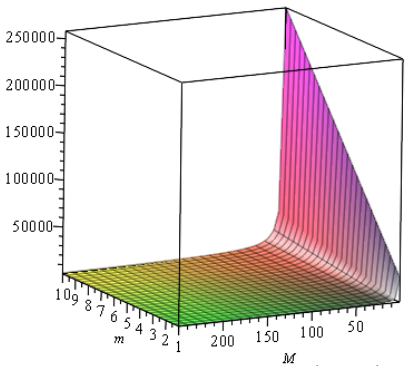
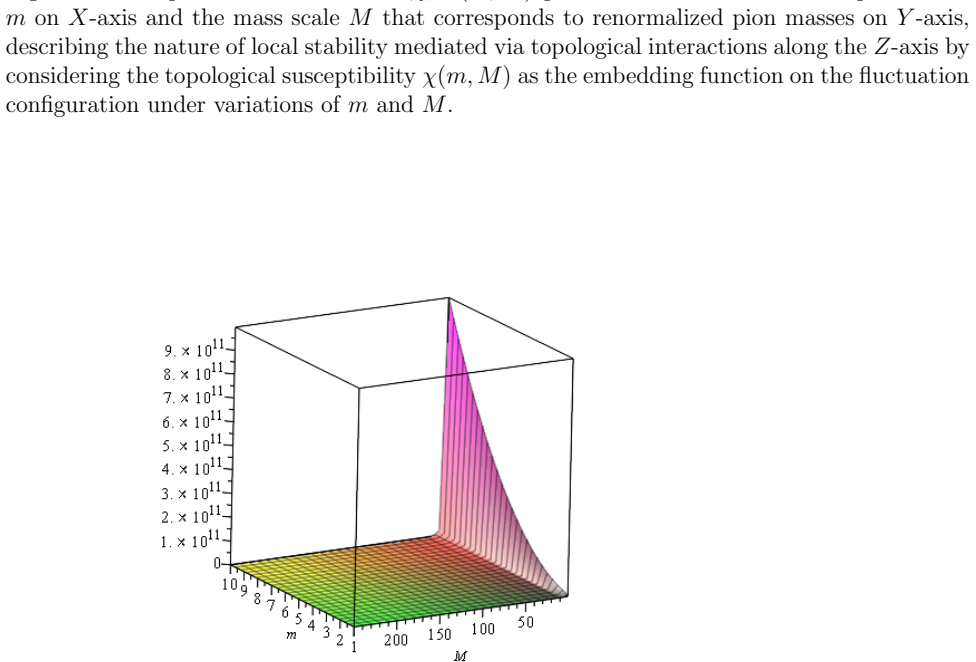
The paper's central claim is that every chiral perturbation theory (ChPT) configuration of the topological susceptibility gives a non-interacting statistical basis in the plane of the quark mass m and the mass scale M that defines renormalized pion masses. Concretely, using the susceptibility $\chi(m,M)=am+\tilde{b}m^2-bm^2\ln m+bm^2\ln M$, the determinant $N$ built from its third derivatives in Eq. (38) vanishes for all $(m,M)$; through the identity $R=(k_B/2)N/D^2$ this forces the scalar curvature $R$ of the Hessian metric to vanish everywhere. In the fluctuation-theory correspondence, zero curvature is zero correlation volume and zero correlation length, so the paper concludes there are no phase transitions and no long-range correlations in this ChPT fluctuation surface. The same machinery applied to the slab sub-volume susceptibility produces a rational curvature that diverges at two slab separations $t_\pm$ (interacting configurations and candidate phase transitions) and that takes an indeterminate $0/0$ form in the infinitesimal slab limit, which the paper reads as a degenerate statistical system.
Load-bearing premise
The load-bearing premise is that the fluctuation-theory relation between scalar curvature and correlation volume, developed for equilibrium thermodynamic surfaces, transfers unchanged to the topological susceptibility treated as an embedding function on $(m,M)$ and $(t_1,t_2)$; if that dictionary does not apply to QCD observables, a vanishing $R$ does not by itself mean the system is non-interacting.
Editorial extensions
If this is right
- Under the paper's correspondence, the ChPT topological susceptibility has zero correlation length in $(m,M)$ space, so mass-parameter fluctuations cannot drive phase transitions in this description.
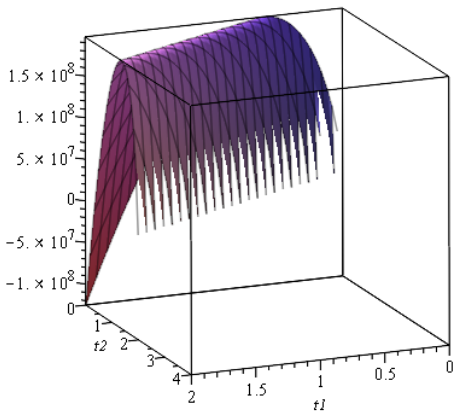
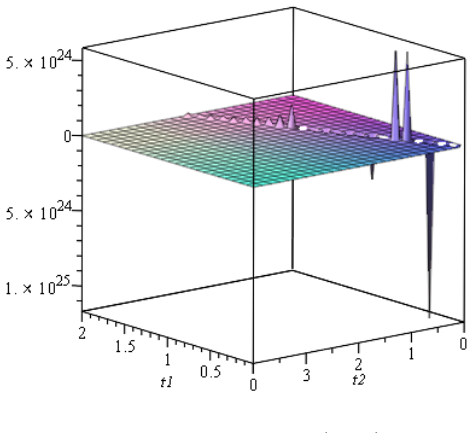
- The finite slab sub-volume method is generically interacting: its scalar curvature is a nonzero rational function of $t$, diverging at the two separations $t_\pm$ given by Eq. (69).
- At the eight roots of Eq. (67), together with $t=0$, the slab curvature vanishes, giving nine candidate non-interacting slab configurations with no global correlations.
- In the infinitesimal slab limit $t_1\to t_2$, the fluctuation determinant vanishes identically, so the slab method's fluctuation surface is degenerate and its curvature is an ill-defined $0/0$ form.
Reading between the lines
- The identity $N=0$ is a direct consequence of the one-loop functional form of Eq. (22); extending $\chi(m,M)$ to higher chiral order would generically produce a nonzero $N$, so the 'always non-interacting' claim is likely tied to the truncation used.
- If the fluctuation-theory dictionary is taken literally, a lattice measurement of the connected topological-charge correlation volume at two nearby quark masses would provide a direct test: a nonzero measured correlation volume where $R=0$ would indicate the dictionary, not the vacuum, is what fails.
- The slab-method phase-transition roots $t_\pm$ depend on lattice volume $V$ and the integration constants of the flow equations, so scanning $R(t)$ over those parameters could give a practical prescription for choosing slab separations that minimize auto-correlation and bias.
Signed reviews
Editorial analysis
A structured set of objections, weighed in public.
Referee Report
Summary. The paper proposes to apply Ruppeiner thermodynamic geometry to the topological susceptibility chi(m,M) of Eq. (1), viewed as an embedding phi: M^2 -> R in the parameter space of the quark mass m and the renormalization mass scale M. It claims that for the chiral perturbation theory (ChPT) form, the Ruppeiner scalar curvature in Eq. (19) vanishes identically because the determinant N in Eq. (38) is zero, so the ChPT configuration is a non-interacting statistical basis with no phase transitions. For the slab sub-volume formula in Eq. (13), the paper derives a rational expression for the scalar curvature in the slab separation t and concludes that finite slabs are generically interacting with possible phase transitions at the roots of Eq. (68), while infinitesimal slabs give a degenerate 0/0 system in Section 5. The paper also discusses stability conditions, flow equations, and qualitative numerical plots in Section 6.
Significance. If the central N=0 result were correct, it would be a notable structural statement about correlations in the ChPT parameterization, and the paper makes an interesting attempt to compare ChPT and slab sub-volume methods in a unified geometric language. The algebraic derivations are presented explicitly and the model parameters are specified in Section 6.1.1, which makes the calculations checkable and falsifiable. However, the central claim is invalidated by the manuscript's own derivative expressions, and the physical interpretation depends on an unproven transfer of Ruppeiner's fluctuation theory from entropy Hessians to an arbitrary embedding function. The paper does not present new lattice data or a quantitative numerical prediction beyond algebraic curves, so its contribution is not sufficient for publication in its current form.
major comments (4)
- [Sec. 3, Eqs. (38)-(39)] The determinant N in Eq. (38) does not vanish identically when the second and third derivatives from Eqs. (29), (30), and (39) are substituted. Factoring the matrix with r = m/M gives N = -8 b^3 r^4 [2 ln(M/m) + 2 btilde/b - 1] / m^2, which is nonzero for generic (m,M) and vanishes only on the codimension-one curve ln(M/m) = 1/2 - btilde/b. This directly contradicts the statement following Eq. (39) that the determinant N vanishes identically for all values of the model parameters, and it invalidates the paper's main claim that the ChPT fluctuation surface is non-interacting.
- [Sec. 2.3, Eq. (15)] The physical conclusion that N=0 means no phase transitions or long-range correlations relies on Ruppeiner's correspondence V_corr ~ R, which in the standard framework applies to the Hessian of the entropy with respect to extensive variables of an equilibrium ensemble and measures correlations only after a Gaussian fluctuation approximation. Here the metric is the Hessian of the topological susceptibility chi with respect to (m,M), which are not the natural fluctuation variables of the QCD ensemble, and chi is not a thermodynamic potential; no derivation, limiting argument, or numerical check is provided for this domain transfer. Therefore, even a correct algebraic identity N=0 would not establish that ChPT configurations are non-interacting; it would at most establish a property of the chosen model function chi(m,M).
- [Sec. 3, Eqs. (24), (29), (30)] The derivative expressions are mutually inconsistent. Differentiating Eq. (22) gives chi_M = +b m^2/M, whereas Eq. (24) states chi_M = -b m^2/M^2; Eq. (29) gives chi_MM = -b m^2/M^2, which is the derivative of the correct chi_M but not of the printed chi_M; and Eq. (30) gives chi_mM = 2bm/M, which is consistent with the correct chi_M but not with the printed chi_M. Consequently, the flow equations chi_m=0=chi_M, the determinant Delta in Eq. (33), and the degeneration equation in Eq. (34) do not reliably follow from the stated derivatives, affecting the stability and phase-transition analysis of Section 3.
- [Sec. 5, Eq. (79)] The simultaneous solution of the two flow equations dq/dt1=0 and dq/dt2=0 in Eq. (78) is not generally possible. Setting both derivatives to zero requires ln(t1-t2) = C1 C/(2k) from the first equation and ln(t1-t2) = -1/2 from the second, which are compatible only when C1 = -k/C. The branch h=exp(-1/2) in Eq. (79) imposes only dq/dt2=0 for generic k, and the branch h=exp(C C1/(2k)) is singular when k=0. Thus the critical values of (t1,t2) used to evaluate the second derivatives in Eq. (85) and to obtain the degenerate 0/0 conclusion are not established for the stated model inputs, including the choice C1=1 in Section 6.1.2.
minor comments (4)
- [Throughout] The manuscript contains numerous typographical and grammatical errors, such as "it's" for "its", "Riemanian" for "Riemannian", and inconsistent capitalization in headings; a thorough editorial revision would be needed.
- [Sec. 4, Eq. (55)] In the determinant matrix for N, the third row prints chi_{t1t2t2} twice; the lower-right entry should presumably be chi_{t2t2t2}, which is defined later in Eq. (56).
- [Sec. 4, Eq. (67)] Eq. (67) writes a degree-eight equation with the sum running from i=0 to 8, but the coefficients n_i are only defined for i=0,...,7 in Eq. (64), and Eq. (66) shows a numerator of degree seven; the index range and the number of roots stated in the text should be reconciled.
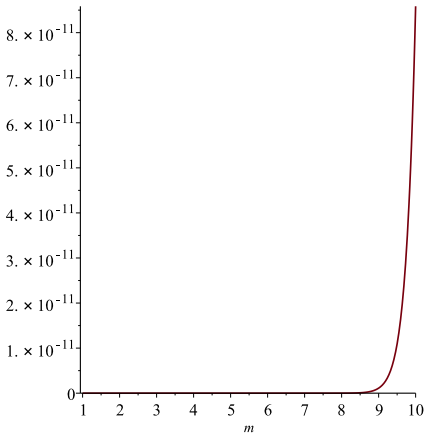
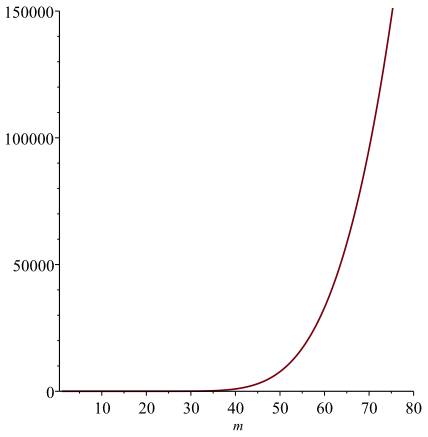
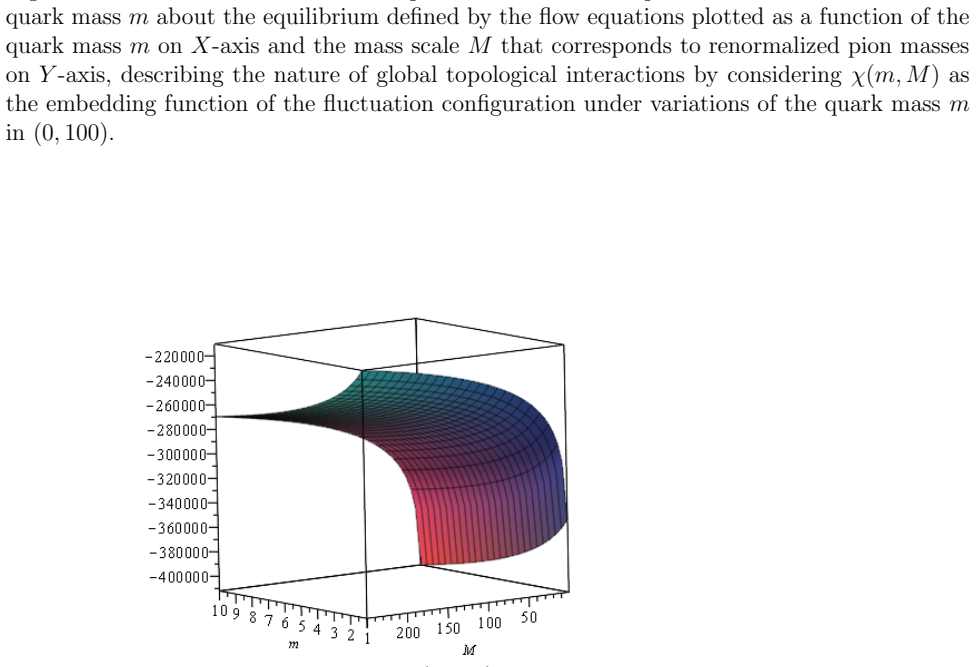
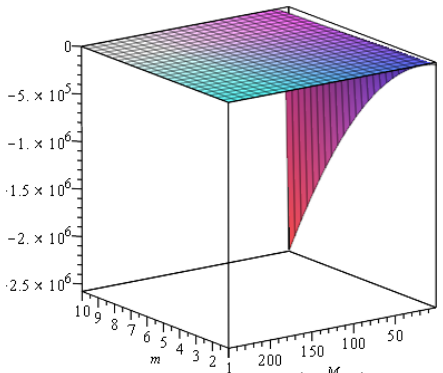
- [Sec. 6.1.2] The "numerical predictions" are qualitative plots of the model functions with no actual lattice data, error bars, or comparison to the JLQCD and ALPHA results cited in the text; the captions and text should clarify that these are illustrative evaluations, not data-driven fits.
Circularity Check
No circular derivation: the N=0 result is a direct (intended) derivative computation from the ChPT embedding, and the self-citations are applications, not load-bearing inputs.
full rationale
The paper's central claim that the ChPT configuration is a non-interacting statistical basis is obtained by computing the determinant N in Eq. (38) from derivatives of the ChPT susceptibility Eq. (1)/(22). This is a self-contained calculation: no parameter is fitted to a subset of data and then renamed as a prediction, and N=0 is not assumed. The identification of 'non-interacting statistical basis' with vanishing R (or N=0) is made in Section 2.3, but that only means the physical interpretation is definitional within the Ruppeiner framework; the algebraic content is a direct computation. The V_corr ~ R correspondence is imported from Ruppeiner's external theory (Ref. [45]) rather than from the author's own prior work; the many Tiwari/Bellucci citations are applications of the same framework and are not the source of the load-bearing relation. The slab analysis similarly computes invariants from the chosen model chi(t1,t2) and the solved q(t); its conclusions follow from the stated model, not from a hidden fit. One non-circular internal issue exists: the printed Eq. (39) gives chi_MMM = -2bm^2/M^3, and with that sign the determinant N in Eq. (38) does not vanish; the derivative should be +2bm^2/M^3, which makes row 3 proportional to row 2 and yields N=0. This is an arithmetic/sign error and a correctness concern, not a circular step.
Assumptions & free parameters
free parameters (1)
- C1, C2 integration constants =
C1=1, C2=0 (chosen by hand)
assumptions (3)
- domain assumption The scalar curvature R of the Hessian metric measures the correlation volume (V_corr ~ R) for any embedding function, including the topological susceptibility.
- domain assumption The Hessian of chi defines a nondegenerate metric on the parameter space (det H != 0) wherever curvature is evaluated.
- ad hoc to paper The two flow equations dq/dt1=0 and dq/dt2=0 in Section 5 have a common critical point.
Cite this review
Pith. "Pith review of A Fluctuation Theory of Topological Susceptibility." pith.science (2026). https://pith.science/paper/AJJO6UYI
@misc{pith2026190806018,
  author       = {Pith},
  title        = {Pith review of: A Fluctuation Theory of Topological Susceptibility},
  year         = {2026},
  howpublished = {\url{https://pith.science/paper/AJJO6UYI}},
  note         = {Machine review of arXiv:1908.06018}
}
read the original abstract
We investigate the long-range statistical correlations, whereby discuss the nature of the undermining interacting/ noninteracting domains and associated phase transitions under variations of the quark mass and the mass scale that corresponds to renormalized pion masses and the dimensions of an ensemble of slab sub-volumes of an arbitrary simulated lattice. The purpose of this paper is to compute the system's stability and its phase structures when it's model parameters vary infinitesimally. In particular, we focus on the stability properties and phases of an arbitrary (2+1) flavor QCD configuration under fluctuations of its parameters. In order to investigate the nature of statistical and systematic errors, and the presence of noises in the system, we explore fluctuation theory equivalences of the slab sub-volume method of computing the topological susceptibility with its low energy ChPT counterpart. Hereby, we find that the ChPT configurations always correspond to a non-interacting statistical basis in the space of the quark mass and the mass scale that corresponds to renormalized pion masses. The second system as an ensemble of finite slab sub-volumes of a simulated lattice turns out to be generically interacting under fluctuations of the slab dimensions. However, it yields an ill-defined degenerate system in the infinitesimal limit of slab parameters. It is worth mentioning that implications of the intrinsic geometric analysis are well suited towards the modeling based understanding of the gluonic topological charge density fluctuations, quark mass dependence and long auto-correlation of the global topology. Finally, we discuss the stability properties of sub-volume simulated lattice improvements towards the understanding of QCD vacua, the behavior of UV divergences, finite-volume effects, statistical precision, simultaneous measurements, and associated quantum channel measurements.
Figures

Figures from the paper (12 more)





Reference graph
Works this paper leans on
-
[1]
Staggered fermions and topological susceptibility in lattice QCD at = 5.7,
J. Smit, and J. C. Vink. “Staggered fermions and topological susceptibility in lattice QCD at = 5.7,” Phys. Lett. B 194 (1987): 433
1987
-
[2]
Topological susceptibility in lattice QCD with two flavors of dynamical quarks
A. A. Khan, S. Aoki, R. Burkhalter, S. Ejiri, M. Fukugita, S. Hashimoto, N. Ishizuka, Y. Iwasaki, K. Kanaya, T. Kaneko, and Y. Kuramashi, “Topological susceptibility in lattice QCD with two flavors of dynamical quarks”, Physical review D, 64(11), p.114501, 2001. 44
2001
-
[3]
Topological susceptibility in lattice QCD and perturbation theory
M. Bochicchio, G. C. Rossi, M. Testa, and K. Yoshida. “Topological susceptibility in lattice QCD and perturbation theory”, Physics Letters B 149, no. 6 487-491, 1984
1984
-
[4]
Exact chiral symmetry, topological charge and related topics
F. Niedermayer, “Exact chiral symmetry, topological charge and related topics.” Nuclear Physics B-Proceedings Supplements 73, no. 1-3, 105-119, 1999
1999
-
[5]
QCD at fixed topology
R. Brower, S. Chandrasekharan, J. W. Negele, and U-J. Wiese, “QCD at fixed topology”, Physics Letters B 560, no. 1-2, 64-74, 2003
2003
-
[6]
Topological susceptibility in full QCD at zero and finite temperature
B. Alles, D’Elia Massimo and A. Di Giacomo, “Topological susceptibility in full QCD at zero and finite temperature”, Physics Letters B 483, no. 1-3, 139-143, 2000
2000
-
[7]
Topological susceptibility in 2+1-flavor QCD with chiral fermions
S. Aoki, G. Cossu, H. Fukaya, S. Hashimoto, and T. Kaneko, “Topological susceptibility in 2+1-flavor QCD with chiral fermions”, EPJ Web of Conferences 175, 04008 (2018), https://doi.org/10.1051/epjconf/201817504008 arXiv:1712.05541 [hep-lat]]
arXiv 2018
-
[8]
Topological susceptibility in su (3) gauge theory
L. Del Debbio, L. Giusti, and C. Pica, “Topological susceptibility in su (3) gauge theory”, Physical review letters, 94(3), p.032003, 2005
2005
Show all 119 references
-
[9]
A new approach to the problem of dynamical quarks in numerical simulations of lattice QCD
M. Luscher, “A new approach to the problem of dynamical quarks in numerical simulations of lattice QCD”, Nuclear Physics B 418, no. 3, 637-648, 1994
1994
-
[10]
Lattice study of the conformal window in QCD-like theories
T. Appelquist, G. T. Fleming, and E. T. Neil, “Lattice study of the conformal window in QCD-like theories”, Physical review letters, 100(17), p.171607, 2008
2008
-
[11]
Topology and dynamics of the confinement mechanism
A. S. Kronfeld, G. Schierholz, and U. J. Wiese, “Topology and dynamics of the confinement mechanism”, Nuclear Physics B, 293, pp.461-478, 1987
1987
-
[12]
Critical slowing down and error analysis in lattice QCD simulations
S. Schaefer, R. Sommer and F. Virotta [ALPHA Collaboration], “Critical slowing down and error analysis in lattice QCD simulations”, Nucl. Phys. B 845, 93 (2011) doi:10.1016/j.nuclphysb.2010.11.020 arXiv:1009.5228 [hep-lat]
2011 arXiv
-
[13]
Topological Susceptibility to the One-Loop Order in Chiral Perturbation Theory
Y.-Y. Mao, and T.-W. Chiu [TWQCD Collaboration], “Topological Susceptibility to the One-Loop Order in Chiral Perturbation Theory”, Phys. Rev. D 80, 034502 (2009), doi:10.1103/PhysRevD.80.034502 arXiv:0903.2146 [hep-lat]
2009 arXiv
-
[14]
Chiral perturbation theory in a theta vacuum
S. Aoki, and H. Fukaya, “Chiral perturbation theory in a theta vacuum”, Phys. Rev. D 81, 034022 (2010), doi:10.1103/PhysRevD.81.034022 arXiv:0906.4852 [hep-lat]
2010 arXiv
-
[15]
Cumulants of the QCD topological charge distribu- tion
F. K. Guo, and U. G. Meißner, “Cumulants of the QCD topological charge distribu- tion”, Phys. Lett. B 749, 278 (2015), doi:10.1016/j.physletb.2015.07.076 arXiv:1506.05487 [hep-ph]
2015 arXiv
-
[16]
Λ MS from the static potential for QCD withnf = 2 dynamical quark flavors:
K. Jansen, F. Karbstein, A. Nagy, and M. Wagner, “Λ MS from the static potential for QCD withnf = 2 dynamical quark flavors:”,Journal of High Energy Physics, 2012(1), p.25, 2012
2012
-
[17]
Pion form factors in holographic QCD
H. J. Kwee, and R. F. Lebed, “Pion form factors in holographic QCD”, Journal of High Energy Physics, 2008 (01), 027, 2008
2008
-
[18]
Witten, Private communication, 2019
E. Witten, Private communication, 2019. 45
2019
-
[19]
Foundations of quantum chromodynamics: an introduction to perturbative methods in gauge theories
T. Muta, “Foundations of quantum chromodynamics: an introduction to perturbative methods in gauge theories”, ISBN-13: 978-9812793546, World Scientific; 1998
1998
-
[20]
Riemannian geometry
M. P. do Carmo, “Riemannian geometry”, ASIN: B004JENPBY, Birkh¨ auser Boston (1992)
1992
-
[21]
Geometric Perspective of Entropy Function: Embedding, Spectrum and Convexity
B. N. Tiwari, “Geometric Perspective of Entropy Function: Embedding, Spectrum and Convexity”, (LAP Lambert Academic Publishing, 2011), ISBN-13: 978-3-8454-3178-9 http://arxiv.org/abs/1108.4654v2 [hep-th]
2011 arXiv
-
[22]
Thermodynamic Geometry: Evolution, Correlation and Phase Transition
S. Bellucci, and B. N. Tiwari, “Thermodynamic Geometry: Evolution, Correlation and Phase Transition”, Physica A: Statistical Mechanics and its Applications 390 2074 (2011). e-print: arXiv:1010.5148v1 [stat-phys]
2011 arXiv
-
[23]
Quark mass and flavour dependence of the QCD phase transition
F. Karsch, E. Laermann, and A. Peikert, “Quark mass and flavour dependence of the QCD phase transition”, Nuclear Physics B, 605(1-3), pp.579-599, 2001
2001
-
[24]
Renormalization group invariance and optimal QCD renormalization scale-setting: a key issues review
X. G. Wu, Y. Ma, S. Q. Wang, H. B. Fu, H. H. Ma, S. J. Brodsky, and M. Mojaza, “Renormalization group invariance and optimal QCD renormalization scale-setting: a key issues review”, Reports on Progress in Physics, 78(12), p.126201, 2015
2015
-
[25]
Tanabashi et al
M. Tanabashi et al. (Particle Data Group), “Review of Particle Physics – Light Quarks (u, d, s), Phys. Rev. D 98, 030001 (2018)
2018
-
[26]
Surface Tension of Fluids
B. Widom, “Surface Tension of Fluids”, in Phase Transitions and Critical Phenomena, Vol. 2 (eds C. Domb and J. L. Lebowitz), (Academic Press, 1972)
1972
-
[27]
Topological susceptibility in two-flavor lattice QCD with exact chiral symmetry
S. Aoki, T. W. Chiu, H. Fukaya, S. Hashimoto, T. H. Hsieh, T. Kaneko, H. Matsufuru, J. Noaki, K. Ogawa, T. Onogi, and N. Yamada [JLQCD and TWQCD Collaborations], “Topological susceptibility in two-flavor lattice QCD with exact chiral symmetry”, Phys. Lett. B 665, 294 (2008) arX...
2008 arXiv
-
[28]
Topological susceptibil- ity in (2+1)-flavor lattice QCD with overlap fermion
T.W. Chiu, S. Aoki, S. Hashimoto, T.H. Hsieh, T. Kaneko, H. Matsufuru, J. Noaki, T. Onogi, and N. Yamada [JLQCD and TWQCD Collaborations], “Topological susceptibil- ity in (2+1)-flavor lattice QCD with overlap fermion”, PoS LATTICE 2008, 072 (2008) arXiv:0810.0085 [hep-lat]
2008 arXiv
-
[29]
η′ meson mass from topological charge density correlator in QCD
H. Fukaya, S. Aoki, G. Cossu, S. Hashimoto, T. Kaneko, and J. Noaki [JLQCD Collabo- rations], “η′ meson mass from topological charge density correlator in QCD”, Phys. Rev. D 92, 111501 (2015)
2015
-
[30]
Chiral perturbation theory to one loop
J. Gasser, and H. Leutwyler, “Chiral perturbation theory to one loop”, Annals Phys. 158, 142 (1984). doi:10.1016/0003-4916(84)90242-2
1984 doi
-
[31]
QCD and the chiral critical point
S. Gavin, A. Gocksch, and R. D. Pisarski, “QCD and the chiral critical point”, Phys. Rev. D 49, R3079(R) - Published 1 April 1994
1994
-
[32]
Event-by-event fluctuations from decay of a Polyakov loop condensate
A. Dumitru and R. D. Pisarski “Event-by-event fluctuations from decay of a Polyakov loop condensate”, Physics Letters B Volume 504, Issue 4, 19 April 2001, Pages 282-290
2001
-
[33]
Phase boundary for the chiral transition in (2+ 1)-flavor QCD at small values of the chemical potential
Kaczmarek, Olaf, et al. “Phase boundary for the chiral transition in (2+ 1)-flavor QCD at small values of the chemical potential.” Physical Review D 83.1 (2011): 014504. 46
2011
-
[34]
Quarkonium correlators and spectral functions at zero and finite tem- perature
A. Jakovac, et al. “Quarkonium correlators and spectral functions at zero and finite tem- perature.” Physical Review D 75.1 (2007): 014506
2007
-
[35]
Lattice QCD at high temperature and density
F. Karsch, “Lattice QCD at high temperature and density.” Lectures on quark matter. Springer, Berlin, Heidelberg, 2002. 209-249
2002
-
[36]
Where is the chiral critical point in three flavor QCD?
Karsch, F. et al., “Where is the chiral critical point in three flavor QCD?” Nucl. Phys. Proc. Suppl. 129 (2004) 614-616, hep-lat/0309116 BI-TP-2003-25, SWAT-03-379
2004 arXiv
-
[37]
Quark mass and the QCD transition
A. Mocsy, “Quark mass and the QCD transition”, Journal of Physics G: Nuclear and Particle Physics, Volume 31, Number 6, 2005
2005
-
[38]
Quark mass effects in quark number susceptibilities
G. Thorben, and P. Petreczky. “Quark mass effects in quark number susceptibilities.” Journal of Physics: Conference Series. Vol. 832. No. 1. IOP Publishing, 2017
2017
-
[39]
Heavy quark free energies, potentials and the renormalized Polyakov loop
Kaczmarek, O. et al. “Heavy quark free energies, potentials and the renormalized Polyakov loop”, Nucl. Phys. Proc. Suppl. 129 (2004) 560-562, hep-lat/0309121
2004 arXiv
-
[40]
Hadronic spectrum of the quark plasma
C. De Tar, and J. Kogut, “Hadronic spectrum of the quark plasma” Physical Review Letters, Physical Review Letters 59.4 (1987): 399
1987
-
[41]
Gluon quasiparticles and the Polyakov loop
P. N. Meisinger, M. C. Ogilvie, and T R. Miller, “Gluon quasiparticles and the Polyakov loop.” Physics Letters B 585.1-2 (2004): 149-154
2004
-
[42]
Confinement versus chiral symmetry
A. Mocsy, F. Sannino, and K. Tuominen. “Confinement versus chiral symmetry.” Physical review letters 92.18 (2004): 182302
2004
-
[43]
Chiral effective model with the Polyakov loop
K. Fukushima, “Chiral effective model with the Polyakov loop.” Physics Letters B 591.3-4 (2004): 277-284
2004
-
[44]
Application of the renormalization group to a second-order QCD phase tran- sition
F. Wilczek, “Application of the renormalization group to a second-order QCD phase tran- sition.” International Journal of Modern Physics A 7.16 (1992): 3911-3925
1992
-
[45]
Riemannian geometry in thermodynamic fluctuation theory
G. Ruppeiner, “Riemannian geometry in thermodynamic fluctuation theory”, Rev. Mod. Phys. 67, 605-659 (1995), [Erratum, 313-313, 68, 1996]
1995
-
[46]
A Thermodynamic Geometric Study Of Complex Entropies: Statistical Fluctuations: Shannon, Renyi, Tsallis, Abe And Structural Configurations
B. N. Tiwari, V. Chandra, and S. Banerjee, “A Thermodynamic Geometric Study Of Complex Entropies: Statistical Fluctuations: Shannon, Renyi, Tsallis, Abe And Structural Configurations”, LAP LAMBERT Academic Publishing, ISBN-13: 978-3845420691, 2011
2011
-
[47]
Preservation of a quantum R´ enyi relative entropy implies existence of a recovery map
A. Jencova, “Preservation of a quantum R´ enyi relative entropy implies existence of a recovery map”, Journal of Physics A: Mathematical and Theoretical, 50(8), 085303 (2017)
2017
-
[48]
State-space Correlations and Stabilities
S. Bellucci, and B. N. Tiwari, “State-space Correlations and Stabilities”, Phys. Rev. D 82, 084008 (2010) arXiv:0910.5309v1 [hep-th]
2010 arXiv
-
[49]
Sur l´ es corrections de la g´ eom´ etrie thermodynamique des trous noirs
B. N. Tiwari, “Sur l´ es corrections de la g´ eom´ etrie thermodynamique des trous noirs”, ISBN: 978-613-1-53539-0, ´Editions Universitaires Europ´ eennes, 2011,arXiv:0801.4087v2 [hep-th]. 47
2011 arXiv
-
[50]
Geometrical methods for power network anal- ysis
S. Bellucci, B. N. Tiwari, and N. Gupta, “Geometrical methods for power network anal- ysis”, SpringerBriefs in Electrical and Computer Engineering, ISBN: 978-3-642-33343-9, 2013
2013
-
[51]
Intrinsic geometric analysis of the network reli- ability and voltage stability
N. Gupta, B. N. Tiwari, and S. Bellucci, “Intrinsic geometric analysis of the network reli- ability and voltage stability”, International Journal of Electrical Power & Energy Systems. 44(1), 872-879 (2010)
2010
-
[52]
Randomized Cunningham Numbers in Cryptography: Randomization theory, Cryptanalysis, RSA cryptosystem, Primality test- ing, Cunningham numbers, Optimization theory
B. N. Tiwari, J. M. Adeegbe, and J. Kuipo Kibind´ e, “Randomized Cunningham Numbers in Cryptography: Randomization theory, Cryptanalysis, RSA cryptosystem, Primality test- ing, Cunningham numbers, Optimization theory”, LAP LAMBERT Academic Publishing, ISBN-13: 978-6139858477, 2018
2018
-
[53]
Flat Information Geometries in Black Hole Thermodynamics
J. E. Aman, I. Bengtsson, and N. Pidokrajt, “Flat Information Geometries in Black Hole Thermodynamics”, Gen. Rel. Grav. 38, 1305-1315 (2006) arXiv:gr-qc/0601119v1
2006 arXiv
-
[54]
An Exact Fluctuating 1/2-BPS Configuration
S. Bellucci, and B. N. Tiwari, “An Exact Fluctuating 1/2-BPS Configuration”, JHEP 1005 023 (2010), arXiv:0910.5314v2 [hep-th]
2010 arXiv
-
[55]
System configuration and combinatorial optimization
M. S. Levin, “System configuration and combinatorial optimization”, In Modular System Design and Evaluation, 89-109 (2015), Springer, Cham
2015
-
[56]
Quantum versus classical annealing of Ising spin glasses
B. Heim, T. F. Rønnow, S. V. Isakov, and M. Troyer, “Quantum versus classical annealing of Ising spin glasses”, Science, 348(6231), 215-217 (2015)
2015
-
[57]
An inequality involving the gamma and digamma functions
F. Qi, and B. N. Guo, “An inequality involving the gamma and digamma functions”, Journal of Applied Analysis, 22(1), 49-54 (2016)
2016
-
[58]
Elements of Information Theory
T. M. Cover, and J. A. Thomas, “Elements of Information Theory”, 2nd ed. (Wiley- Interscience, 2006)
2006
-
[59]
Nachrichten von der Gesellschaft der Wissenschaften zu Got- tingen
J. von Neumann, “Nachrichten von der Gesellschaft der Wissenschaften zu Got- tingen”, Wahrscheinlichkeitstheoretischer Aufbau der Quantenmechanik, Mathematisch- Physikalische Klasse: 245-272 (1927), https://eudml.org/doc/59230
1927
-
[60]
Synergy, redundancy, and multi- variate information measures: an experimentalist’s perspective
N. Timme, W. Alford, B. Flecker, and J. M Beggs, “Synergy, redundancy, and multi- variate information measures: an experimentalist’s perspective”, Journal of computational neuroscience, 36(2), 119-140 (2014)
2014
-
[61]
HH42A digital thermometer is the most recent addition to a series of instruments based upon our high precision temperature measurement system technol- ogy
The OMEGA TM , “HH42A digital thermometer is the most recent addition to a series of instruments based upon our high precision temperature measurement system technol- ogy”, https://www.omega.com/temperature/pdf/HH42A.pdf (Last Accessed 05 September 2018)
2018
-
[62]
Metric geometry of equilibrium thermodynamics
F. Weinhold, “Metric geometry of equilibrium thermodynamics”, J. Chem. Phys. 63, 2479 (1975), DOI:10.1063/1.431689
1975 doi
-
[63]
Metric geometry of equilibrium thermodynamics. II. Scaling, homo- geneity, and generalized GibbsDuhem relations
F. Weinhold, “Metric geometry of equilibrium thermodynamics. II. Scaling, homo- geneity, and generalized GibbsDuhem relations”, J. Chem. Phys. 63, 2484 (1975), doi/10.1063/1.431635. 48
1975 doi
-
[64]
Thermodynamic critical fluctuation theory?
G. Ruppeiner, “Thermodynamic critical fluctuation theory?”, Phys. Rev. Lett. 50, 287-290 (1983)
1983
-
[65]
Thermodynamics: A Riemannian geometric model
G. Ruppeiner, “Thermodynamics: A Riemannian geometric model”, Phys. Rev. A 20, 1608-1613 (1979)
1979
-
[66]
New thermodynamic fluctuation theory using path integrals
G. Ruppeiner, “New thermodynamic fluctuation theory using path integrals”, Phys. Rev. A 27, 1116-1133 (1983)
1983
-
[67]
Fluid phases: Going supercritical
P. F. McMillan, and H. E. Stanley, “Fluid phases: Going supercritical”, Nature Physics 6, 479 (2010)
2010
-
[68]
The Widom line as the crossover between liquid-like and gas-like behaviour in supercritical fluids
G. G. Simeoni, T. Bryk, F. A. Gorelli, M. Krisch, G. Ruocco, M. Santoro, and T. Scopigno, “The Widom line as the crossover between liquid-like and gas-like behaviour in supercritical fluids”, Nature Physics 6, 503 (2010)
2010
-
[69]
Mobius fermions: Improved domain wall chiral fermions
R. C. Brower, H. Neff, and K. Orginos, “Mobius fermions: Improved domain wall chiral fermions”, Nucl. Phys. Proc. Suppl. 140, 686 (2005), doi:10.1016/j.nuclphysbps.2004.11.180 [hep-lat/0409118]; arXiv:1206.5214 [hep-lat]
2005 arXiv
-
[70]
Large-scale simulations with chiral symmetry
T. Kaneko, S. Aoki, G. Cossu, H. Fukaya, S. Hashimoto, and J. Noaki [JLQCD Collab- oration], “Large-scale simulations with chiral symmetry” PoS LATTICE 2013, 125 (2014) [arXiv:1311.6941 [hep-lat]]
2014 arXiv
-
[71]
Fine lattice simulations with chirally symmetric fermions
J. Noaki, H. Fukaya, T. Kaneko, G. Cossu, S. Hashimoto and S. Aoki [JLQCD Collabo- ration], “Fine lattice simulations with chirally symmetric fermions”, PoS LATTICE 2013, 263 (2014)
2014
-
[72]
JLQCD IroIro++ lattice code on BG/Q
G. Cossu, J. Noaki, S. Hashimoto, T. Kaneko, H. Fukaya, P. A. Boyle, and J. Doi, “JLQCD IroIro++ lattice code on BG/Q”, arXiv:1311.0084 [hep-lat] , URL : http : //suchix.kek.jp/guidocossu/documents/DoxyGen/html/index.html
-
[73]
QCD at Fixed Topology
R. Brower, S. Chandrasekharan, J. W. Negele, and U. J. Wiese, “QCD at Fixed Topology”, Phys. Lett. B 560, 64 (2003), arXiv:hep-lat/0302005, doi:10.1016/S0370-2693(03)00369-1
2003 arXiv
-
[74]
Finite volume QCD at fixed topological charge
S. Aoki, H. Fukaya, S. Hashimoto, and T. Onogi, “Finite volume QCD at fixed topological charge”, Phys. Rev. D 76, 054508 (2007), arXiv:0707.0396 [hep-lat]
2007 arXiv
-
[75]
Topological Susceptibility from Slabs
W. Bietenholz, P. de Forcrand, and U. Gerber, “Topological Susceptibility from Slabs”, JHEP 1512, 070 (2015), doi:10.1007/JHEP12(2015)070 arXiv:1509.06433 [hep-lat]
2015 arXiv
-
[76]
The Slab Method to Measure the Topological Susceptibility
W. Bietenholz, K. Cichy, P. de Forcrand, A. Dromard, and U. Gerber, “The Slab Method to Measure the Topological Susceptibility”, PoS LATTICE 2016, 321 (2016) arXiv:1610.00685 [hep-lat]
2016 arXiv
-
[77]
Topological Susceptibility under Gradient Flow
H. Meja-Daz, W. Bietenholz, P. de Forcrand, U. Gerber, and I. O. Sandoval, “Topological Susceptibility under Gradient Flow”, arXiv:1712.01395[hep-lat]
-
[78]
Screening of the topological charge in a correlated instanton vacuum
E. V. Shuryak, and J. J. M. Verbaarschot, “Screening of the topological charge in a correlated instanton vacuum”, Phys. Rev. D 52, 295 (1995) doi:10.1103/PhysRevD.52.295 hep-lat/9409020. 49
1995 arXiv
-
[79]
Local topological and chiral properties of QCD
P. de Forcrand, M. Garcia Perez, J. E. Hetrick, E. Laermann, J. F. Lagae, and I. O. Stamatescu, “Local topological and chiral properties of QCD”, Nucl. Phys. Proc. Suppl. 73, 578 (1999) doi:10.1016/S0920-5632(99)85143-3 hep-lat/9810033
1999 arXiv
-
[80]
A Geometric Approach to Correlations and Quark Number Susceptibilities
S. Bellucci, V. Chandra, and B. N. Tiwari, “A Geometric Approach to Correlations and Quark Number Susceptibilities”, Mod. Phys. Lett. A 2 Vol. 27, No. 10 (2012) 1250055. e-print: arXiv:1010.4405 [hep-th], doi.org/10.1142/S0217732312500551
2012 arXiv
-
[81]
Thermodynamic Stability of Quarkoniumn Bound States
S. Bellucci, V. Chandra, and B. N. Tiwari, “Thermodynamic Stability of Quarkoniumn Bound States”, Int. J. Mod. Phys. A26 (2011) 2665-2724. e-print: arXiv:1010.4225v1 [hep- th], doi.org/10.1142/S0217751X11053511
2011 arXiv
-
[82]
Thermodynamic Geometry and Free Energy of Hot QCD
S. Bellucci, V. Chandra, and B. N. Tiwari, “Thermodynamic Geometry and Free Energy of Hot QCD”, Int. J. Mod. Phys. A 26 (2011) 43-70. e-print: arXiv:0812.3792v1 [hep-th], doi.org/10.1142/S0217751X11051172
2011 arXiv
-
[83]
Properties and uses of the Wilson flow in lattice QCD
M. L¨ uscher, “Properties and uses of the Wilson flow in lattice QCD”, JHEP 1008, 071 (2010) [Erratum-ibid. 1403, 092 (2014)] arXiv:1006.4518 [heplat]
2010 arXiv
-
[84]
Perturbative analysis of the gradient flow in non-abelian gauge theories
M. L¨ uscher, and P. Weisz, “Perturbative analysis of the gradient flow in non-abelian gauge theories”, JHEP 1102, 051 (2011) arXiv:1101.0963 [hep-th]
2011 arXiv
-
[85]
Comparison of the gradient flow with cooling in SU (3) pure gauge theory
C. Bonati and M. DElia, “ Comparison of the gradient flow with cooling in SU (3) pure gauge theory”, Phys. Rev. D 89, no. 10, 105005 (2014) arXiv:1401.2441 [hep-lat]
2014 arXiv
-
[86]
High-precision scale setting in lattice QCD
S. Borsanyi, S. Durr, Z. Fodor, C. Hoelbling, S. D. Katz, S. Krieg, T. Kurth, L. Lellouch, T. Lippert, C. McNeile, and K. K. Szabo, “High-precision scale setting in lattice QCD”, JHEP 1209, 010 (2012) arXiv:1203.4469 [hep-lat]
2012 arXiv
-
[87]
Axial U (1) symmetry at finite temperature with M¨ obius domain-wall fermions
S. Hashimoto, S. Aoki, G. Cossu, H. Fukaya, T. Kaneko, J. Noaki, and P. A. Boyle, “Axial U (1) symmetry at finite temperature with M¨ obius domain-wall fermions”, PoS LATTICE 2013, 431 (2014)
2014
-
[88]
Review of Particle Physics
W-M Yao et. al 2006, “Review of Particle Physics”, J. Phys. G: Nucl. Part. Phys. 33, 1
2006
-
[89]
Decay constants and spectroscopy of mesons in lattice QCD using domain-wall fermions
B. Fahy, G. Cossu, S. Hashimoto, T. Kaneko, J. Noaki, and M. Tomii [JLQCD Collab- oration], “Decay constants and spectroscopy of mesons in lattice QCD using domain-wall fermions”, PoS LATTICE 2015, 074 (2016) [arXiv:1512.08599 [hep-lat]]
2016 arXiv
-
[90]
Topological suscepti- bility and the sampling of field space in Nf = 2 lattice QCD simulations
M. Bruno, S. Schaefer, and R. Sommer [ALPHA Collaboration], “ Topological suscepti- bility and the sampling of field space in Nf = 2 lattice QCD simulations”, JHEP 1408, 150 (2014), doi:10.1007/JHEP08(2014)150 arXiv:1406.5363 [hep-lat]
2014 arXiv
-
[91]
The Pion Mass Formula
R. T. Cahill and S. M. Gunner, “The Pion Mass Formula”, Australian journal of physics 51.3 (1998): 509-525. arxiv/hep-ph/9602240v2
1998 arXiv
-
[92]
A new mass formula for NG bosons in QCD
R. T. Cahill, and S. M. Gunner. “A new mass formula for NG bosons in QCD.” Modern Physics Letters A 10.39 (1995): 3051-3058
1995
-
[93]
R., and Craig D
Frank, M. R., and Craig D. Roberts. ”Model gluon propagator and pion and -meson observables.” Physical Review C 53.1 (1996): 390. 50
1996
-
[94]
The quark condensate in the Gell-Mann-Oakes-Renner relation
K. Langfeld, and C. Kettner. “The quark condensate in the Gell-Mann-Oakes-Renner relation.” Modern Physics Letters A 11.16 (1996): 1331-1337
1996
-
[95]
Behavior of current divergences underSU (3)× SU (3)
M. Gell-Mann, R. J. Oakes, and B. Renner. “Behavior of current divergences underSU (3)× SU (3).” Murray Gell-Mann: Selected Papers. 2010. 160-164
2010
-
[96]
Hadron properties from QCD sum rules
L. J. Reinders, S. Yazaki, and H. R. Rubinstein. “Hadron properties from QCD sum rules.” Phys. Rep. 127.CERN-TH-4079 (1984): 1-97
1984
-
[97]
QCD Spectral Sum Rules
S. Narison, “QCD Spectral Sum Rules”, World Scientific Lecture Notes in Physics Vol. 26, Singapore 1989
1989
-
[98]
Light quark masses in QCD
J. Bijnens,P. Joaquim, and E. de Rafael. “Light quark masses in QCD.” Physics Letters B 348.1-2 (1995): 226-238
1995
-
[99]
Dyson-Schwinger equations and their application to hadronic physics
C. D. Roberts, and A. G. Williams. “Dyson-Schwinger equations and their application to hadronic physics.” Progress in Particle and Nuclear Physics 33 (1994): 477-575
1994
-
[100]
Soliton bag models of hadrons from QCD
R. T. Cahill, and . D. Roberts. “Soliton bag models of hadrons from QCD.” Physical Review D 32.9 (1985): 2419
1985
-
[101]
Goldstone theorem and diquark confine- ment beyond rainbow-ladder approximation
A. Bender, C. D. Roberts, and L. V. Smekal. “Goldstone theorem and diquark confine- ment beyond rainbow-ladder approximation.” Physics Letters B 380.1-2 (1996): 7-12
1996
-
[102]
Chiral perturbation theory: expansions in the mass of the strange quark
J. Gasser, and H. Leutwyler. “Chiral perturbation theory: expansions in the mass of the strange quark.” Nuclear Physics B 250.1-4 (1985): 465-516
1985
-
[103]
Low-energy QCD: Chiral coefficients and the quark- quark interaction
M. R. Frank, and T.s Meissner. “Low-energy QCD: Chiral coefficients and the quark- quark interaction.” Physical Review C 53.5 (1996): 2410
1996
-
[104]
The NambuJona-Lasinio model of quantum chromodynamics
S. P. Klevansky, “The NambuJona-Lasinio model of quantum chromodynamics.” Reviews of Modern Physics 64.3 (1992): 649
1992
-
[105]
Cloudy bag model of the nucleon
A. W. Thomas, S. Theberge, and G. A. Miller. “Cloudy bag model of the nucleon.” Physical Review D 24.1 (1981): 216
1981
-
[106]
A possible quark mechanism for the saturation of nuclear matter
P. A M. Guichon, “A possible quark mechanism for the saturation of nuclear matter.” Physics Letters B 200.3 (1988): 235-240
1988
-
[107]
Confining quark condensate model of the nucleon
M. R. Frank, and P. C. Tandy. “Confining quark condensate model of the nucleon.” Physical Review C 46.1 (1992): 338
1992
-
[108]
Dynamical chiral-symmetry breaking
K. Higashijima, “Dynamical chiral-symmetry breaking.” Physical Review D 29.6 (1984): 1228
1984
-
[109]
Nonperturbative enhancement of current quark masses and underlying strong- coupling dynamics in QCD
V. Elias, “Nonperturbative enhancement of current quark masses and underlying strong- coupling dynamics in QCD.” Canadian journal of physics 71.7-8 (1993): 347-350
1993
-
[110]
Quark and gluon propagators from meson data
R.T. Cahill, and S. M. Gunner. “Quark and gluon propagators from meson data.” Physics Letters B 359.3-4 (1995): 281-287. 51
1995
-
[111]
Lattice calculation of coordinate-space vector and axial-vector current cor- relators in QCD
M. Tomii, G. Cossu, B. Fahy, H. Fukaya, S. Hashimoto, T. Kaneko, and J. Noaki (JLQCD collaboration), “Lattice calculation of coordinate-space vector and axial-vector current cor- relators in QCD”, Phys. Rev. D 96, 054511 (2017) arXiv:1703.06249 [hep-lat]
2017 arXiv
-
[112]
TWQCD’s dynamical DWF project
T.-W. Chiu, T.-S. Guu, T.-H. Hsieh, C.-H. Huang, Y.-Y. Lee, Y.-Y. Mao, K. Ogawa, and P.-K. Tseng (TWQCD Collaboration), “TWQCD’s dynamical DWF project”, PoS LAT2009:034,2009 arXiv:0911.5029 [hep-lat]
2009 arXiv
-
[113]
The determination of αs by the ALPHA collab- oration
M. Bruno, M. D. Brida, P. Fritzsch, T. Korzec, A. Ramos, S. Schaefer, H. Simma, S. Sint, and R. Sommer (ALPHA collaboration), “The determination of αs by the ALPHA collab- oration” DESY 16-214, CERN-TH-2016-236, IFT-UAM/CSIC-16-119 arXiv:1611.05750 [hep-lat]
2016 arXiv
-
[114]
Stochastic calculation of the Dirac spectrum on the lattice and a determination of chiral condensate in 2+1-flavor QCD
G. Cossu, H. Fukaya, S. Hashimoto, T. Kaneko, and J. I. Noaki, “Stochastic calculation of the Dirac spectrum on the lattice and a determination of chiral condensate in 2+1-flavor QCD”, PTEP 2016, no. 9, 093B06 (2016) doi:10.1093/ptep/ptw129 [arXiv:1607.01099 [hep- lat]]
2016 arXiv
-
[115]
Review on Composite Higgs Models
O. Witzel, “Review on Composite Higgs Models”, arXiv preprint arXiv:1901.08216, 2019
1901 arXiv
-
[116]
Probing the Electroweak Sector and QCD with the ATLAS Detector
Y. Wu, “Probing the Electroweak Sector and QCD with the ATLAS Detector” (No. ATL-PHYS-SLIDE-2018-734). ATL-COM-PHYS-2018-968, 2018
2018
-
[117]
The QCD running coupling
A. Deur, S. J. Brodsky, and G. F.de T´ eramond, “The QCD running coupling”, Progress in Particle and Nuclear Physics, 90, pp.1-74, 2016
2016
-
[118]
A Mini-Introduction To Information Theory
E. Witten, “A Mini-Introduction To Information Theory”, arXiv preprint, arXiv:1805.11965v4 [hep-th] (2018)
2018 arXiv
-
[119]
APS Medal for Exceptional Achievement in Research: Invited article on entanglement properties of quantum field theory
E. Witten, “APS Medal for Exceptional Achievement in Research: Invited article on entanglement properties of quantum field theory.” Reviews of Modern Physics 90.4 (2018): 045003. 52
2018
Reviewed August 14, 2026 · model on record in the stance chip above.
Discussion (0). Continue with ORCID to comment.