Metastable and critical-bubble branches of Coleman--Weinberg monopoles
Pith reviewed 2026-06-26 16:13 UTC · model grok-4.3
The pith
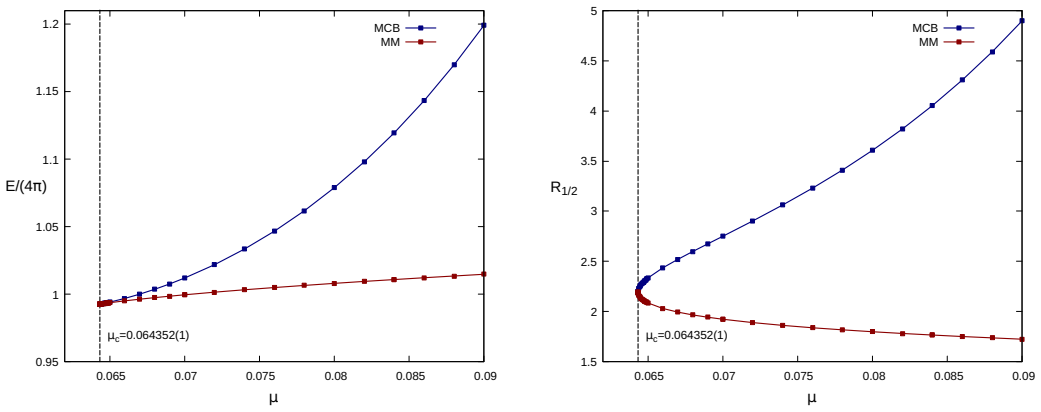
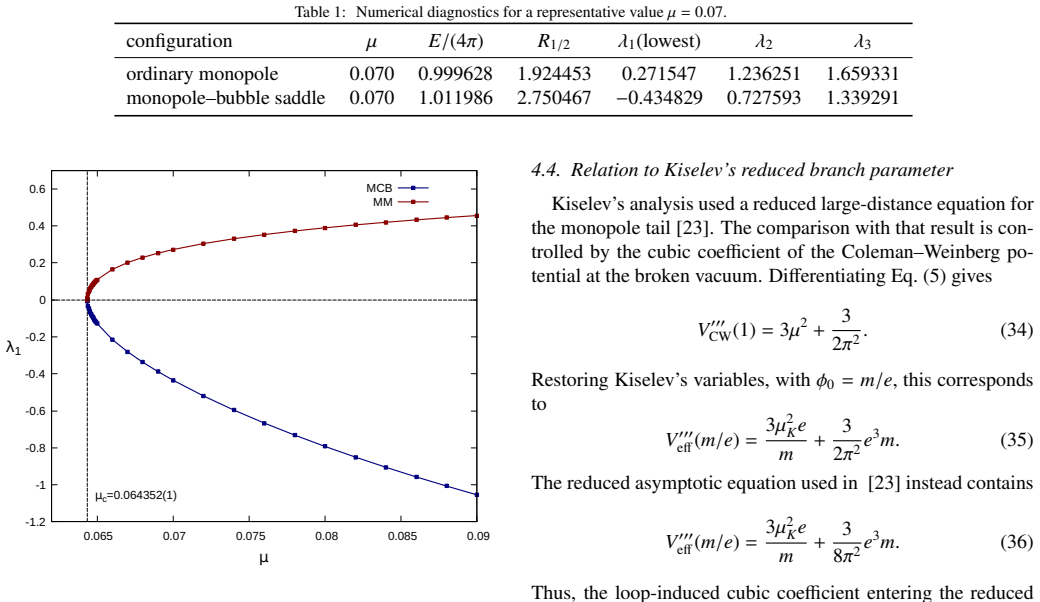
The metastable Coleman-Weinberg monopole remains locally stable until its lowest radial Hessian eigenvalue reaches zero at the critical rescaled scalar mass μ_c=0.064352(1), where a saddle-point monopole-critical-bubble branch appears.
A machine-rendered reading of the paper's core claim, the machinery that carries it, and where it could break.
Core claim
The monopole-critical-bubble configuration in the full coupled radial Higgs-gauge system is a saddle of the static energy functional. The monopole-bubble solution carries a negative radial mode, while the metastable monopole remains locally stable until its lowest radial Hessian eigenvalue approaches zero at the critical rescaled scalar mass parameter μ_c=0.064352(1). This branch structure supplies a direct static picture of how Coleman-Weinberg monopoles lose metastability.
What carries the argument
The radial Hessian spectrum of the static energy functional evaluated on the monopole and monopole-bubble profiles in the coupled Higgs-gauge system.
If this is right
- The monopole-bubble branch connects to the metastable monopole at the point where the lowest radial eigenvalue reaches zero.
- The monopole-bubble configuration has exactly one negative radial mode and is therefore a saddle.
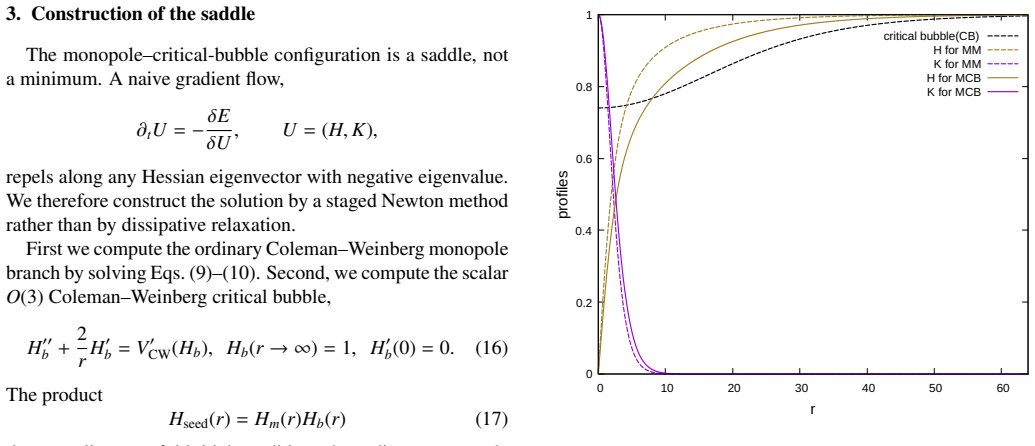
- The two branches are distinguished by their radial profiles, total energies, and radial Hessian spectra.
- The critical value is given numerically as μ_c=0.064352(1).
Where Pith is reading between the lines
- The static saddle picture implies that the decay of the metastable monopole proceeds through the critical-bubble configuration, which could be checked by constructing the corresponding instanton or by evolving the fields in real time.
- Extending the Hessian analysis to include angular dependence might reveal whether additional negative modes appear at the same critical value or at a shifted value.
- The numerical value of μ_c could serve as a benchmark for other numerical or analytic approximations to the same coupled system in different gauges or truncations.
Load-bearing premise
That the radial Hessian spectrum alone determines the stability threshold of the monopole branch, without angular modes or full time-dependent dynamics altering the conclusion that the eigenvalue zero-crossing marks loss of metastability.
What would settle it
A computation of the full Hessian spectrum that includes angular modes and finds a different zero-crossing value for the lowest eigenvalue, or a time-dependent simulation showing continued stability past μ_c=0.064352(1), would falsify the claim that the radial eigenvalue crossing alone marks the loss of metastability.
Figures
read the original abstract
We revisit the Coleman--Weinberg monopole problem introduced by Kiselev, where radiative symmetry breaking makes the broken vacuum metastable. We construct the associated static monopole--critical-bubble configuration in the full coupled radial Higgs--gauge system and show that it is a saddle of the static energy functional. The metastable monopole and monopole--critical-bubble branches are characterized by their profiles, energies, and radial Hessian spectra. The monopole--bubble solution carries a negative radial mode, while the metastable monopole remains locally stable until its lowest radial Hessian eigenvalue approaches zero. The resulting branch structure gives a direct static picture of how Coleman--Weinberg monopoles lose metastability, with critical rescaled scalar mass parameter \(\mu_c=0.064352(1)\).
Editorial analysis
A structured set of objections, weighed in public.
Referee Report
Summary. The paper constructs the static monopole-critical-bubble solution in the coupled radial Higgs-gauge system for the Coleman-Weinberg monopole with a metastable broken vacuum. It characterizes the metastable monopole and monopole-bubble branches through profiles, energies, and radial Hessian spectra, showing that the bubble is a saddle with a negative radial mode while the monopole remains locally stable until its lowest radial Hessian eigenvalue reaches zero at the critical value μ_c=0.064352(1). This supplies a direct static picture of the loss of metastability along the monopole branch.
Significance. If the result holds, the work supplies a concrete numerical realization of the branch structure connecting a metastable monopole to a critical bubble in a radiatively broken gauge theory, together with a high-precision determination of the critical parameter. The explicit solution of the full coupled boundary-value problem and the reported radial spectra represent a technical advance in the study of non-perturbative instabilities.
major comments (1)
- [Abstract] Abstract and branch-structure description: the stability threshold is identified exclusively with the zero-crossing of the lowest eigenvalue in the radial (l=0) sector of the Hessian at μ_c=0.064352(1). For a spherically symmetric background the second-variation operator decomposes into independent angular-momentum sectors l=0,1,2,…. The manuscript supplies no evidence that the lowest eigenvalue in any l≥1 sector remains positive up to this μ; an earlier crossing in an l≥1 sector would alter the actual point at which the monopole ceases to be a local minimum, changing the claimed branch structure.
Simulated Author's Rebuttal
We thank the referee for the careful reading and for identifying the need to address all angular-momentum sectors in the Hessian. We respond to the single major comment below and will make the corresponding changes.
read point-by-point responses
-
Referee: [Abstract] Abstract and branch-structure description: the stability threshold is identified exclusively with the zero-crossing of the lowest eigenvalue in the radial (l=0) sector of the Hessian at μ_c=0.064352(1). For a spherically symmetric background the second-variation operator decomposes into independent angular-momentum sectors l=0,1,2,…. The manuscript supplies no evidence that the lowest eigenvalue in any l≥1 sector remains positive up to this μ; an earlier crossing in an l≥1 sector would alter the actual point at which the monopole ceases to be a local minimum, changing the claimed branch structure.
Authors: We agree that the present manuscript restricts the Hessian analysis to the radial (l=0) sector and supplies no data on l≥1 sectors. The claim that the monopole remains locally stable up to μ_c therefore requires additional verification. We will revise the manuscript by extending the fluctuation operator to include angular dependence and by computing the lowest eigenvalues in the l=1 and l=2 sectors as functions of μ. The revised version will present these results (in a new subsection or appendix) and confirm that the eigenvalues remain positive through μ_c, so that the reported critical value is indeed the point at which local stability is lost. The abstract and the discussion of the branch structure will be updated accordingly. revision: yes
Circularity Check
No circularity: μ_c obtained by direct numerical solution of ODE boundary-value problem
full rationale
The paper constructs the monopole and monopole-bubble solutions by solving the coupled radial ODEs from the static energy functional, then computes the radial (l=0) Hessian spectrum on those backgrounds. The value μ_c=0.064352(1) is the parameter at which the lowest radial eigenvalue crosses zero; this is a standard numerical root-finding procedure on the linearized operator and does not reduce by the paper's own equations to a quantity defined in terms of itself or to a fitted parameter that is then relabeled a prediction. No self-citation chains, ansatzes smuggled via prior work, or uniqueness theorems imported from the same authors appear in the derivation. The central claim therefore remains self-contained against external benchmarks (the equations of motion and the definition of the second-variation operator).
Axiom & Free-Parameter Ledger
axioms (1)
- domain assumption The Coleman-Weinberg potential is taken as the effective potential generated by radiative corrections in the model.
Reference graph
Works this paper leans on
-
[1]
’t Hooft, Magnetic monopoles in unified gauge theo- ries, Nucl
G. ’t Hooft, Magnetic monopoles in unified gauge theo- ries, Nucl. Phys. B79(1974) 276
1974
-
[2]
A. M. Polyakov, Particle spectrum in quantum field the- ory, JETP Lett.20(1974) 194
1974
-
[3]
M. K. Prasad and C. M. Sommerfield, Exact classical so- lution for the ’t Hooft monopole and the Julia–Zee dyon, Phys. Rev. Lett.35(1975) 760
1975
-
[4]
E. B. Bogomolny, Stability of classical solutions, Sov. J. Nucl. Phys.24(1976) 449
1976
-
[5]
Goddard and D
P. Goddard and D. I. Olive, Magnetic monopoles in gauge field theories, Rep. Prog. Phys.41(1978) 1357
1978
-
[6]
Preskill, Magnetic monopoles, Ann
J. Preskill, Magnetic monopoles, Ann. Rev. Nucl. Part. Sci.34(1984) 461
1984
-
[7]
Rajaraman,Solitons and Instantons, North-Holland, Amsterdam, 1982
R. Rajaraman,Solitons and Instantons, North-Holland, Amsterdam, 1982
1982
-
[8]
N. S. Manton and P. Sutcliffe,Topological Solitons, Cam- bridge University Press, Cambridge, 2004
2004
-
[9]
Vilenkin and E
A. Vilenkin and E. P. S. Shellard,Cosmic Strings and Other Topological Defects, Cambridge University Press, Cambridge, 1994
1994
-
[10]
F. A. Bais, To be or not to be? Magnetic monopoles in non-Abelian gauge theories, arXiv:hep-th/0407197
-
[11]
I. Y . Kobzarev, L. B. Okun and M. B. V oloshin, Bubbles in metastable vacuum, Sov. J. Nucl. Phys.20(1975) 644
1975
-
[12]
S. R. Coleman, The fate of the false vacuum. 1. Semiclas- sical theory, Phys. Rev. D15(1977) 2929; Erratum: Phys. Rev. D16(1977) 1248
1977
-
[13]
C. G. Callan and S. R. Coleman, The fate of the false vac- uum. 2. First quantum corrections, Phys. Rev. D16(1977) 1762
1977
-
[14]
J. S. Langer, Theory of the condensation point, Ann. Phys. 41(1967) 108
1967
-
[15]
Affleck, Quantum-statistical metastability, Phys
I. Affleck, Quantum-statistical metastability, Phys. Rev. Lett.46(1981) 388
1981
-
[16]
A. D. Linde, Fate of the false vacuum at finite tempera- ture: theory and applications, Phys. Lett. B100(1981) 37. 6
1981
-
[17]
A. D. Linde, Decay of the false vacuum at finite tempera- ture, Nucl. Phys. B216(1983) 421; Erratum: Nucl. Phys. B223(1983) 544
1983
-
[18]
P. J. Steinhardt, Monopole and vortex dissociation and de- cay of the false vacuum, Nucl. Phys. B190(1981) 583
1981
-
[19]
J. Preskill and A. Vilenkin, Decay of metastable topo- logical defects, Phys. Rev. D47(1993) 2324, arXiv:hep- ph/9209210
arXiv 1993
-
[20]
B. Kumar, M. B. Paranjape and U. A. Yajnik, Fate of the false monopoles: induced vacuum decay, Phys. Rev. D82 (2010) 025022, arXiv:1006.0693
Pith/arXiv arXiv 2010
-
[21]
P. Agrawal and M. Nee, The boring monopole, SciPost Phys.13(2022) 049, arXiv:2202.11102
arXiv 2022
-
[22]
M. B. Paranjape and Y . Saxena, Thin-wall monopoles in a false vacuum, Phys. Rev. D110(2024) 025005, arXiv:2312.17154
arXiv 2024
-
[23]
V . G. Kiselev, A monopole in the Coleman–Weinberg model, Phys. Lett. B249(1990) 269
1990
-
[24]
M. Eto, Y . Hamada, R. Jinno, M. Nitta and M. Yamada, Abrikosov–Nielsen–Olesen strings from the Coleman– Weinberg potential, Phys. Rev. D106(2022) 116002, arXiv:2205.04394
arXiv 2022
-
[25]
Kim, Large solitons flattened by small quan- tum corrections, Phys
E. Kim, Large solitons flattened by small quan- tum corrections, Phys. Lett. B853(2024) 138681, arXiv:2405.09262
arXiv 2024
-
[26]
S. R. Coleman and E. J. Weinberg, Radiative corrections as the origin of spontaneous symmetry breaking, Phys. Rev. D7(1973) 1888
1973
-
[27]
R. B. Lehoucq, D. C. Sorensen and C. Yang,ARPACK Users’ Guide: Solution of Large-Scale Eigenvalue Prob- lems with Implicitly Restarted Arnoldi Methods, SIAM, Philadelphia, 1998. 7
1998
discussion (0)
Sign in with ORCID, Apple, or X to comment. Anyone can read and Pith papers without signing in.