REVIEW 3 major objections 6 minor 43 references
Training for X-Ray Vision: Amodal Segmentation, Amodal Content Completion, and View-Invariant Object Representation from Multi-Camera Video
T0 review · 3 major / 6 minor · reviewed 2026-08-06 · deepseek-v4-flash
Pith's one-line read A new synthetic dataset, MOVi-MC-AC, provides the first ground-truth amodal content labels for roughly 5.8 million object instances in 2,041 multi-camera scenes, enabling direct training and evaluation of amodal content completion and…
desk verdict A genuinely new multi-camera amodal dataset whose ground-truth claims are unverified as submitted; worth reviewing, but only after code and verification are provided. read the letter →
The pith
A machine-rendered reading of the paper's core claim, the machinery that carries it, and where it could break.
The reading
What carries the argument
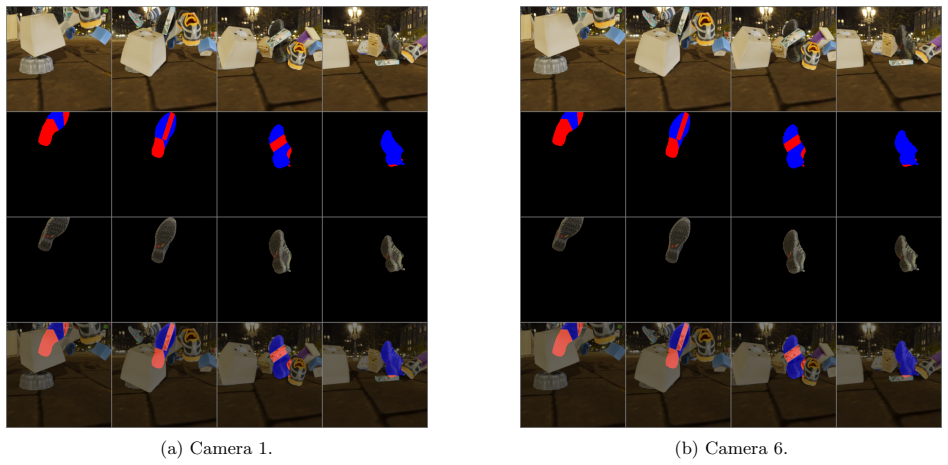
The load-bearing object is the dataset itself, generated from a simulation engine: each of the 2,041 scenes is a two-second, 24-frame video captured by six cameras whose motion is static, linear, or an arc, and contains 2 to 40 generic household objects, including up to 20 objects thrown through the air to create heavy occlusion. For each object, the generator produces modal and amodal masks, amodal RGB content, and amodal depth, and assigns a consistent object ID across frames and cameras through scene-object descriptors. Those descriptors are what make the multi-camera consistency claim real: they let a model associate one object's appearance in all six views, which is the mechanism that could support view-invariant object representation and re-identification. The proposed metrics use the modal mask to subtract the visible region, so evaluation can focus on the occluded areas where completion is genuinely hard.
What would settle it
A reader could take a random sample of occluded instances, independently re-render each object's unoccluded appearance from its 3D model, and compare pixel-by-pixel with the provided amodal content; any systematic misalignment, or any object whose ID is not present in all six cameras' annotation files, would falsify the dataset's central claims.
Extended reading notes
Core claim
On its own terms, the central discovery is the dataset: every object in every frame of every scene comes with modal masks, amodal masks, amodal RGB content (the 'x-ray' view through occluders), depth, and a scene-object descriptor that ties detections to a single identity across six cameras. With about 4.09 million occluded instances at an average occlusion rate of 45.2%, the dataset is large enough that occlusion-heavy training is feasible. The authors further propose multi-camera video amodal content completion as a new task and adapt PSNR, LPIPS, and SSIM, plus occluded-region variants, to measure how well a model reconstructs hidden content. Their argument is that this combination replaces the previous workaround of pseudo-label generation with direct supervision and adds camera perspective as a source of object context alongside time.
Load-bearing premise
The ground-truth amodal content and the cross-camera object identities are produced correctly by the simulator and line up exactly with the RGB frames and masks; if the rendering is misaligned or an object's ID drifts between cameras, the dataset's central value collapses.
Editorial extensions
If this is right
- Amodal content completion models can be trained directly on ground-truth occluded appearance rather than pseudo-labels from cut-and-paste schemes, making their outputs comparable for the first time.
- Multi-camera object tracking and detection can be cast as a single task with one consistent ID per object across all six views, instead of per-camera tracking with later association.
- Object retrieval and re-identification can be evaluated across cameras and across scenes with unseen object classes, because the training and test splits use disjoint object sets.
- The occluded-region metric variants (e.g., PSNR_occ, LPIPS_occ, SSIM_occ) isolate reconstruction quality in the genuinely hidden parts of objects, preventing easy visible-region pixels from inflating scores.
- The dataset's depth and amodal depth annotations open a path toward amodal 3D detection and amodal mask prediction beyond 2D image and video tasks.
Reading between the lines
- Editorial inference: the paper does not train any model, so a natural next experiment is to fine-tune an existing diffusion-based video amodal completion model on MOVi-MC-AC and compare it against the same model trained on pseudo-labels; if the ground-truth labels do not yield better occluded-region PSNR/LPIPS, the dataset's practical value would need stronger justification.
- Editorial inference: the six cameras with shared IDs provide a free self-supervised signal: a model that must predict the same object's appearance from different viewpoints could learn view-invariant features that transfer to real-world re-identification, even though all training data is synthetic.
- Editorial inference: because objects are rigid household items, claims about object permanence and amodal completion for articulated, deformable, or human objects are not yet tested; extending the simulator to such categories is a direct next step.
- Editorial inference: the dataset is released without code to regenerate annotations, so an independent alignment check — re-rendering a sample of objects from their 3D models and comparing against the provided amodal RGB — would settle whether the ground truth is as clean as claimed.
Editorial analysis
A structured set of objections, weighed in public.
Referee Report
Summary. The paper introduces MOVi-MC-AC, a synthetic multi-camera video dataset generated with Kubric. The dataset is claimed to be the first to provide ground-truth amodal content labels and the largest amodal segmentation dataset to date, with 2,041 scenes, 293,904 scene images, and 5,899,104 object instances across six cameras per scene. The paper presents dataset statistics in Table 1, describes scene-level and object-level annotations, and proposes evaluation metrics for amodal segmentation and amodal content completion adapted from existing mIoU, PSNR, LPIPS, and SSIM measures. The full dataset is released on HuggingFace. The paper does not include experiments, baselines, or code for regenerating or validating the annotations.
Significance. If the annotation claims are verified, this dataset would be a valuable resource: it is the first to offer ground-truth amodal content for occluded objects, and it provides consistent object IDs across multiple camera views, enabling new research on multi-camera amodal segmentation, content completion, and view-invariant object representation. The release on HuggingFace and the use of standard metrics are practical strengths. However, because the central claims depend entirely on the correctness of unverified synthetic annotations, the significance is conditional on the dataset generation and validation details being made available and confirmed.
major comments (3)
- [Section 3, Annotations] The central claim that MOVi-MC-AC provides ground-truth amodal content is not supported by a description of how that content is generated. The text says only that amodal content is 'the unoccluded amodal RGB content' and that amodal depth is provided, but it does not specify the rendering pipeline: whether each object is rendered with other objects hidden, how occluder/occludee interactions are handled, how amodal depth is produced, or how the amodal content is aligned with the modal masks. Without this specification, the claim of ground-truth amodal content is unverifiable. Please document the exact rendering steps and provide visual and quantitative validation (e.g., checks that occluded pixels in the amodal content match the object's appearance in frames where it is unoccluded, or from a camera with an unobstructed view).
- [Table 1 and Section 3, scene-object descriptors] The dataset claims consistent object IDs across all six cameras, but no statistics or verification are reported. The paper should report the fraction of object instances whose IDs are consistent across all cameras, the rate of missing detections per camera, the number of fragmented or switched tracks, and agreement between scene-object descriptors and per-camera instance masks. Without such numbers, the multi-camera re-identification claim is not established.
- [Section 3, Data release] The paper does not state that generation code, validation scripts, or annotation metadata are released. Since the contribution is a dataset, reproducibility requires either releasing the code used to generate the annotations or providing detailed pseudocode plus validation scripts that verify the amodal content, amodal masks, and cross-camera object ID consistency. At present, users cannot distinguish between correct annotations and plausible-looking but incorrect ones.
minor comments (6)
- [Section 4.1] The definitions of mIoU and mIoUocc use symbols Mi, Ai, and Ai without clearly specifying that Mi is the modal mask, Ai is the ground-truth amodal mask, and Ai-hat is the predicted amodal mask; please define all symbols explicitly.
- [Section 4.2] Equation (3) for SSIM repeats the sentence 'x and y are the two image patches being compared' and the definitions of variables are duplicated; please clean up the exposition.
- [Section 3, Annotations] There is a typo: 'scebe-object descriptors' should be 'scene-object descriptors'.
- [Abstract and Section 3] The number of instances is given as '5.8 million' in the abstract and '5,899,104' in Table 1; the consistency is fine, but the paper should clarify that 5.8 million is rounded.
- [Figure 1 and Figure 2] The captions are long and nearly identical to each other; shorten them and ensure each caption identifies the specific content shown in the figure.
- [Section 4.3] The occluded-region metrics are defined only for images; for video content completion, clarity is needed on whether the metrics are computed per frame and then averaged over frames or computed on concatenated volumes.
Circularity Check
No significant circularity: the paper is a dataset release with no fitted parameters, predictions, or derived quantities that reduce to their inputs.
full rationale
The paper's central contribution is the MOVi-MC-AC dataset: simulated multi-camera, multi-object videos with modal masks, amodal masks, amodal RGB content, amodal depth, and cross-camera object identifiers generated by the Kubric engine. No quantity in the paper is fitted from data and then renamed as a prediction. The amodal content labels are ground-truth renderings of unobscured object appearance produced by the simulator, not outputs of a learned model or of a metric tied to the paper's own claims. The proposed metrics (mIoU, mIoUocc, PSNR, LPIPS, SSIM) are standard external measures borrowed from segmentation and image reconstruction literature; they are not constructed so that a particular model trivially scores perfectly. The only self-references are two related-work citations [11, 29] concerning motion-based objectness and video object segmentation memory; neither is invoked to justify the dataset's validity, the amodal ground-truth generation, or the novelty claims. Skeptical concerns about the undocumented rendering pipeline, missing cross-camera identity agreement statistics, and absence of released validation code are legitimate reproducibility and correctness risks, but they are not circularity: they do not show that any derivation reduces to its own input. The paper makes no predictive claim that could be forced by construction, so the circularity score is 0.
Assumptions & free parameters
assumptions (2)
- domain assumption The Kubric synthetic engine renders physically plausible RGB, depth, and segmentation for occluded and unoccluded objects.
- ad hoc to paper Amodal content is defined as the unoccluded object appearance from the same viewpoint, and the dataset provides this content without specifying how it is generated.
Cite this review
Pith. "Pith review of Training for X-Ray Vision: Amodal Segmentation, Amodal Content Completion, and View-Invariant Object Representation from Multi-Camera Video." pith.science (2026). https://pith.science/paper/AKTNTJSD
@misc{pith2026250700339,
  author       = {Pith},
  title        = {Pith review of: Training for X-Ray Vision: Amodal Segmentation, Amodal Content Completion, and View-Invariant Object Representation from Multi-Camera Video},
  year         = {2026},
  howpublished = {\url{https://pith.science/paper/AKTNTJSD}},
  note         = {Machine review of arXiv:2507.00339}
}
read the original abstract
Amodal segmentation and amodal content completion require using object priors to estimate occluded masks and features of objects in complex scenes. Until now, no data has provided an additional dimension for object context: the possibility of multiple cameras sharing a view of a scene. We introduce MOVi-MC-AC: Multiple Object Video with Multi-Cameras and Amodal Content, the largest amodal segmentation and first amodal content dataset to date. Cluttered scenes of generic household objects are simulated in multi-camera video. MOVi-MC-AC contributes to the growing literature of object detection, tracking, and segmentation by including two new contributions to the deep learning for computer vision world. Multiple Camera (MC) settings where objects can be identified and tracked between various unique camera perspectives are rare in both synthetic and real-world video. We introduce a new complexity to synthetic video by providing consistent object ids for detections and segmentations between both frames and multiple cameras each with unique features and motion patterns on a single scene. Amodal Content (AC) is a reconstructive task in which models predict the appearance of target objects through occlusions. In the amodal segmentation literature, some datasets have been released with amodal detection, tracking, and segmentation labels. While other methods rely on slow cut-and-paste schemes to generate amodal content pseudo-labels, they do not account for natural occlusions present in the modal masks. MOVi-MC-AC provides labels for ~5.8 million object instances, setting a new maximum in the amodal dataset literature, along with being the first to provide ground-truth amodal content. The full dataset is available at https://huggingface.co/datasets/Amar-S/MOVi-MC-AC ,
Figures

Reference graph
Works this paper leans on
-
[1]
pix2gestalt: Amodal segmentation by synthesizing wholes, 2024
Ege Ozguroglu, Ruoshi Liu, D ´ ıdac Sur ´ ıs, Dian Chen, Achal Dave, Pavel Tokmakov, and Carl Vondrick. pix2gestalt: Amodal segmentation by synthesizing wholes, 2024
work page 2024
-
[2]
Bot-sort: Robust associations multi-pedestrian tracking, 2022
Nir Aharon, Roy Orfaig, and Ben-Zion Bobrovsky. Bot-sort: Robust associations multi-pedestrian tracking, 2022
work page 2022
-
[3]
Bytetrack: Multi-object tracking by associating every detection box, 2022
Yifu Zhang, Peize Sun, Yi Jiang, Dongdong Yu, Fucheng Weng, Zehuan Yuan, Ping Luo, Wenyu Liu, and Xinggang Wang. Bytetrack: Multi-object tracking by associating every detection box, 2022
work page 2022
-
[4]
Ho Kei Cheng and Alexander G. Schwing. Xmem: Long-term video object segmentation with an atkinson-shiffrin memory model, 2022
work page 2022
-
[5]
Putting the object back into video object segmentation, 2024
Ho Kei Cheng, Seoung Wug Oh, Brian Price, Joon-Young Lee, and Alexander Schwing. Putting the object back into video object segmentation, 2024
work page 2024
-
[6]
Sam 2: Segment anything in images and videos, 2024
Nikhila Ravi, Valentin Gabeur, Yuan-Ting Hu, Ronghang Hu, Chaitanya Ryali, Tengyu Ma, Haitham Khedr, Roman R¨ adle, Chloe Rolland, Laura Gustafson, Eric Mintun, Junting Pan, Kalyan Vasudev Alwala, Nicolas Carion, Chao-Yuan Wu, Ross Girshick, Piotr Doll´ ar, and Christoph Feichtenhofer. Sam 2: Segment anything in images and videos, 2024
work page 2024
-
[7]
Transformer for object re-identification: A survey, 2024
Mang Ye, Shuoyi Chen, Chenyue Li, Wei-Shi Zheng, David Crandall, and Bo Du. Transformer for object re-identification: A survey, 2024
work page 2024
-
[8]
Feature aggregation and con- nectivity for object re-identification
Dongchen Han, Baodi Liu, Shuai Shao, Weifeng Liu, and Yicong Zhou. Feature aggregation and con- nectivity for object re-identification. Pattern Recognition, 157:110869, 2025
work page 2025
Show all 43 references
-
[9]
Repaint: Inpainting using denoising diffusion probabilistic models, 2022
Andreas Lugmayr, Martin Danelljan, Andres Romero, Fisher Yu, Radu Timofte, and Luc Van Gool. Repaint: Inpainting using denoising diffusion probabilistic models, 2022
2022
-
[10]
Sdxl: Improving latent diffusion models for high-resolution image synthesis, 2023
Dustin Podell, Zion English, Kyle Lacey, Andreas Blattmann, Tim Dockhorn, Jonas M¨ uller, Joe Penna, and Robin Rombach. Sdxl: Improving latent diffusion models for high-resolution image synthesis, 2023
2023
-
[11]
Seeing objects in a cluttered world: Computational objectness from motion in video, 2024
Douglas Poland and Amar Saini. Seeing objects in a cluttered world: Computational objectness from motion in video, 2024
2024
-
[12]
Learning 6-dof object poses to grasp category-level objects by language instructions, 2022
Chilam Cheang, Haitao Lin, Yanwei Fu, and Xiangyang Xue. Learning 6-dof object poses to grasp category-level objects by language instructions, 2022
2022
-
[13]
Are we ready for autonomous driving? the kitti vision benchmark suite
Andreas Geiger, Philip Lenz, and Raquel Urtasun. Are we ready for autonomous driving? the kitti vision benchmark suite. In 2012 IEEE Conference on Computer Vision and Pattern Recognition, pages 3354–3361, 2012
2012
-
[14]
Impdet: Exploring implicit fields for 3d object detection, 2022
Xuelin Qian, Li Wang, Yi Zhu, Li Zhang, Yanwei Fu, and Xiangyang Xue. Impdet: Exploring implicit fields for 3d object detection, 2022
2022
-
[15]
Rethinking amodal video segmentation from learning supervised signals with object-centric representa- tion, 2023
Ke Fan, Jingshi Lei, Xuelin Qian, Miaopeng Yu, Tianjun Xiao, Tong He, Zheng Zhang, and Yanwei Fu. Rethinking amodal video segmentation from learning supervised signals with object-centric representa- tion, 2023
2023
-
[16]
Amodal panoptic segmentation, 2022
Rohit Mohan and Abhinav Valada. Amodal panoptic segmentation, 2022
2022
-
[17]
Aisformer: Amodal instance segmentation with transformer, 2024
Minh Tran, Khoa Vo, Kashu Yamazaki, Arthur Fernandes, Michael Kidd, and Ngan Le. Aisformer: Amodal instance segmentation with transformer, 2024
2024
-
[18]
Amodal segmentation based on visible region segmentation and shape prior, 2020
Yuting Xiao, Yanyu Xu, Ziming Zhong, Weixin Luo, Jiawei Li, and Shenghua Gao. Amodal segmentation based on visible region segmentation and shape prior, 2020
2020
-
[19]
Deep occlusion-aware instance segmentation with overlap- ping bilayers, 2021
Lei Ke, Yu-Wing Tai, and Chi-Keung Tang. Deep occlusion-aware instance segmentation with overlap- ping bilayers, 2021. 7
2021
-
[20]
Using diffusion priors for video amodal segmen- tation, 2024
Kaihua Chen, Deva Ramanan, and Tarasha Khurana. Using diffusion priors for video amodal segmen- tation, 2024
2024
-
[21]
Taco: Taming diffusion for in-the-wild video amodal completion
Ruijie Lu, Yixin Chen, Yu Liu, Jiaxiang Tang, Junfeng Ni, Diwen Wan, Gang Zeng, and Siyuan Huang. Taco: Taming diffusion for in-the-wild video amodal completion. arXiv preprint arXiv:2503.12049, 2025
2025 arXiv
-
[22]
Learning to see the invisible: End-to-end trainable amodal instance segmentation, 2018
Patrick Follmann, Rebecca K¨ onig, Philipp H¨ artinger, and Michael Klostermann. Learning to see the invisible: End-to-end trainable amodal instance segmentation, 2018
2018
-
[23]
Amodal instance segmentation with diffusion shape prior estimation, 2024
Minh Tran, Khoa Vo, Tri Nguyen, and Ngan Le. Amodal instance segmentation with diffusion shape prior estimation, 2024
2024
-
[24]
Amodal instance segmentation, 2016
Ke Li and Jitendra Malik. Amodal instance segmentation, 2016
2016
-
[25]
Self-supervised scene de-occlusion, 2020
Xiaohang Zhan, Xingang Pan, Bo Dai, Ziwei Liu, Dahua Lin, and Chen Change Loy. Self-supervised scene de-occlusion, 2020
2020
-
[26]
Amodal instance segmentation with kins dataset
Lu Qi, Li Jiang, Shu Liu, Xiaoyong Shen, and Jiaya Jia. Amodal instance segmentation with kins dataset. In 2019 IEEE/CVF Conference on Computer Vision and Pattern Recognition (CVPR), pages 3009–3018, 2019
2019
-
[27]
Bosch, Tessa M
Jordy Thielen, Sander E. Bosch, Tessa M. van Leeuwen, Marcel A. J. van Gerven, and Rob van Lier. Neuroimaging findings on amodal completion: A review. i-Perception, 10(2):2041669519840047, 2019. PMID: 31007887
2019
-
[28]
Amodal completion via progressive mixed context diffusion, 2023
Katherine Xu, Lingzhi Zhang, and Jianbo Shi. Amodal completion via progressive mixed context diffusion, 2023
2023
-
[29]
Addressing issues with working memory in video object segmentation, 2024
Clayton Bromley, Alexander Moore, Amar Saini, Douglas Poland, and Carmen Carrano. Addressing issues with working memory in video object segmentation, 2024
2024
-
[30]
Narasimhan
N Dinesh Reddy, Robert Tamburo, and Srinivasa G. Narasimhan. Walt: Watch and learn 2d amodal representation from time-lapse imagery. In 2022 IEEE/CVF Conference on Computer Vision and Pattern Recognition (CVPR), pages 9346–9356, 2022
2022
-
[31]
Foundation models for amodal video instance segmentation in automated driving, 2024
Jasmin Breitenstein, Franz J¨ unger, Andreas B¨ ar, and Tim Fingscheidt. Foundation models for amodal video instance segmentation in automated driving, 2024
2024
-
[32]
Synwoodscape: Synthetic surround-view fisheye camera dataset for au- tonomous driving
Ahmed Rida Sekkat, Yohan Dupuis, Varun Ravi Kumar, Hazem Rashed, Senthil Yogamani, Pascal Vasseur, and Paul Honeine. Synwoodscape: Synthetic surround-view fisheye camera dataset for au- tonomous driving. IEEE Robotics and Automation Letters, 7(3):8502–8509, July 2022
2022
-
[33]
R3d3: Dense 3d reconstruction of dynamic scenes from multiple cameras, 2023
Aron Schmied, Tobias Fischer, Martin Danelljan, Marc Pollefeys, and Fisher Yu. R3d3: Dense 3d reconstruction of dynamic scenes from multiple cameras, 2023
2023
-
[34]
The wildtrack multi-camera person dataset, 2017
Tatjana Chavdarova, Pierre Baqu´ e, St´ ephane Bouquet, Andrii Maksai, Cijo Jose, Louis Lettry, Pascal Fua, Luc Van Gool, and Fran¸ cois Fleuret. The wildtrack multi-camera person dataset, 2017
2017
-
[35]
Mmptrack: Large-scale densely annotated multi-camera multiple people tracking benchmark, 2021
Xiaotian Han, Quanzeng You, Chunyu Wang, Zhizheng Zhang, Peng Chu, Houdong Hu, Jiang Wang, and Zicheng Liu. Mmptrack: Large-scale densely annotated multi-camera multiple people tracking benchmark, 2021
2021
-
[36]
Multi-camera multi-object tracking: A review of current trends and future advances
Temitope Ibrahim Amosa, Patrick Sebastian, Lila Iznita Izhar, Oladimeji Ibrahim, Lukman Shehu Ayinla, Abdulrahman Abdullah Bahashwan, Abubakar Bala, and Yau Alhaji Samaila. Multi-camera multi-object tracking: A review of current trends and future advances. Neurocomputing, 552:...
2023
-
[37]
Ferryman and Ali Shahrokni
James M. Ferryman and Ali Shahrokni. Pets2009: Dataset and challenge. 2009 Twelfth IEEE Interna- tional Workshop on Performance Evaluation of Tracking and Surveillance, pages 1–6, 2009. 8
2009
-
[38]
Multiview equivariance improves 3d correspondence understanding with minimal feature finetuning, 2025
Yang You, Yixin Li, Congyue Deng, Yue Wang, and Leonidas Guibas. Multiview equivariance improves 3d correspondence understanding with minimal feature finetuning, 2025
2025
-
[39]
Klaus Greff, Francois Belletti, Lucas Beyer, Carl Doersch, Yilun Du, Daniel Duckworth, David J Fleet, Dan Gnanapragasam, Florian Golemo, Charles Herrmann, Thomas Kipf, Abhijit Kundu, Dmitry Lagun, Issam Laradji, Hsueh-Ti (Derek) Liu, Henning Meyer, Yishu Miao, Derek Nowrouzeza...
2022
-
[40]
Coarse-to-fine amodal segmentation with shape prior, 2023
Jianxiong Gao, Xuelin Qian, Yikai Wang, Tianjun Xiao, Tong He, Zheng Zhang, and Yanwei Fu. Coarse-to-fine amodal segmentation with shape prior, 2023
2023
-
[41]
Self-supervised amodal video object segmentation, 2022
Jian Yao, Yuxin Hong, Chiyu Wang, Tianjun Xiao, Tong He, Francesco Locatello, David Wipf, Yanwei Fu, and Zheng Zhang. Self-supervised amodal video object segmentation, 2022
2022
-
[42]
Efros, Eli Shechtman, and Oliver Wang
Richard Zhang, Phillip Isola, Alexei A. Efros, Eli Shechtman, and Oliver Wang. The unreasonable effectiveness of deep features as a perceptual metric, 2018
2018
-
[43]
Z. Wang, A. C. Bovik, H. R. Sheikh, and E. P. Simoncelli. Image Quality Assessment: From Error Visibility to Structural Similarity. IEEE Transactions on Image Processing, 13(4):600–612, April 2004. 9
2004
Reviewed August 6, 2026 · model on record in the stance chip above.
Discussion (0). Continue with ORCID to comment.