REVIEW 2 major objections 5 minor 148 references
MultiverSeg: Scalable Interactive Segmentation of Biomedical Imaging Datasets with In-Context Guidance
T0 review · 2 major / 5 minor · reviewed 2026-08-11 · deepseek-v4-flash
Pith's one-line read Interactive segmentation cuts clicks by 36% as context grows
desk verdict A well-run empirical paper that makes a real incremental advance—interactive segmentation with variable-size in-context context—and backs it with unusually broad evaluation, though the headline gains are measured with oracle-style simulated corrections and would be stronger with human-user evidence. read the letter →
The pith
A machine-rendered reading of the paper's core claim, the machinery that carries it, and where it could break.
The reading
What carries the argument
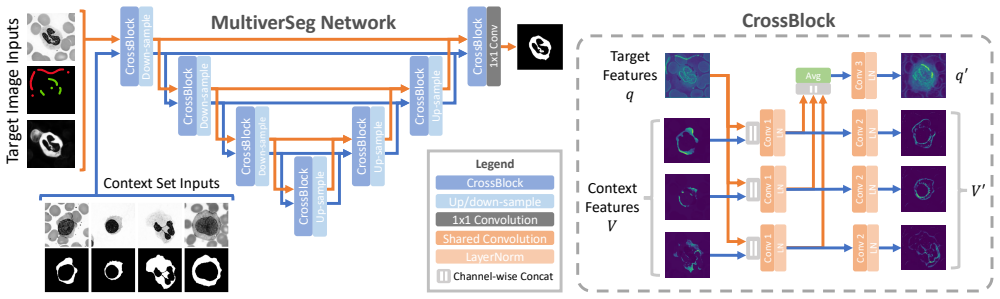
The model is a UNet-style encoder-decoder in which every convolutional block is replaced by a CrossBlock. A CrossBlock takes the target image features and the context set features, uses a cross-convolution to pair the target with each context feature, then aggregates through an average and layer-normalized convolution to update both target and context representations. This lets a variable-size context set interact with the target at every scale. When the context is empty, a dummy entry is used, and the first image is segmented by a pretrained ScribblePrompt-UNet; afterward, each completed segmentation is appended to the context set.
What would settle it
Run a human-in-the-loop study where annotators interactively segment the same 18-image sets with MultiverSeg and ScribblePrompt, placing their own correction clicks; if the per-image click counts do not fall with context size or the 36% reduction disappears, the central claim fails. A cheaper probe: replace center-of-error clicks with clicks at random locations in the error region; if the advantage vanishes, the result is an artifact of the simulation.
Extended reading notes
Core claim
The central claim is that interactive segmentation can be performed in context: a single network consumes the target image, whatever user interactions it has received, and a variably sized set of previously segmented image–segmentation pairs, and improves as that set grows. On 161 held-out tasks from eight unseen datasets, the number of interactions required to reach a 90% Dice target decreases with each additional completed image, and the total interaction budget over the first 18 images is 36.41% ± 1.33% lower for clicks and 25.26% ± 1.80% lower for scribble steps than the ScribblePrompt baseline.
Load-bearing premise
The interaction counts rely on an oracle-like simulation where corrections are always placed at the center of the largest ground-truth error region and scribbles are drawn from ground-truth centerlines, which may not match how human annotators actually correct a model.
Editorial extensions
If this is right
- Total annotation effort for a new dataset falls as context grows: per-image interactions decrease, often to zero, so the cost curve flattens rather than scaling linearly with image count.
- Reaching 90% Dice on the first 18 images takes about 36% fewer clicks and 25% fewer scribble steps than the strongest per-image interactive baseline.
- Accuracy on later images is correlated with earlier predictions, and thresholding previous predictions at 0.5 before adding them to the context improves subsequent accuracy.
- No retraining is needed: the same weights segment unseen tasks at inference time, with runtime below 150 ms even with a 64-example context set.
- Larger context sets give diminishing returns; one additional correction step typically buys more Dice than doubling the context size.
Reading between the lines
- Beyond the paper, if human corrections follow the simulated oracle pattern, MultiverSeg-style amortization could turn one-pass annotation of a large medical cohort into labeling a few images and then verifying automated predictions.
- The authors' protocol assumption is testable: a user study with real clinicians placing corrections would show whether the 36% click reduction survives noisy, non-oracle interaction placement.
- Context selection is the natural next lever: choosing which completed images to feed as context, rather than including all of them, could cut interaction counts further on heterogeneous datasets.
- The same in-context amortization idea could be applied to other interactive prediction tasks, such as detection or registration, where previous outputs constrain the next input.
Editorial analysis
A structured set of objections, weighed in public.
Referee Report
Summary. The paper proposes MultiverSeg, a UNet-like interactive segmentation network that takes user interactions on the target image together with a variable-size context set of previously segmented image-label pairs, produced sequentially by the user as they segment a new dataset. For the first image of a new task, the method falls back to a pre-trained ScribblePrompt; for subsequent images, the context set grows and the network is expected to segment with progressively fewer interactions. The paper contributes synthetic task generation via superpixel-derived labels with aggressive augmentation, a training loop with simulated interaction steps, and an evaluation on 12 held-out biomedical datasets (161 tasks with at least 18 test examples) comparing against interactive, in-context, and hybrid baselines. The reported central result is that MultiverSeg reduces the number of clicks by 36% and scribble steps by 25% to reach 90% Dice relative to ScribblePrompt on the first 18 images of unseen tasks.
Significance. If the result holds, MultiverSeg addresses a real bottleneck in biomedical annotation: dataset-level segmentation effort that scales sublinearly with the number of images. The paper is strong on breadth: 161 unseen tasks, 200 simulation rounds, several independent baselines (including a fine-tuning baseline and a hybrid SP+UVS), ablations of context-set quality, and a resolution sensitivity analysis. Code and weights are released, and the main result is an empirical measurement on held-out data rather than a derivation, so there is no internal circularity. The main risk to the headline claim is not fairness across methods but the realism of the simulated interaction protocol, since all methods are evaluated with ground-truth-guided correction placement; a robustness analysis under noisier prompts would substantially increase confidence in the human-effort interpretation of the numbers.
major comments (2)
- [§5.3 / Algorithm 1] The headline interaction reductions (36% fewer clicks and 25% fewer scribble steps vs ScribblePrompt, Section 6.2) are measured under the 'Center Clicks' and 'Centerline Scribbles' protocols of Section 5.3, in which every correction is placed at the center of the largest component of the ground-truth error region. The same ground-truth-guided oracle is used in training (Algorithm 1, hψ(yt, ŷj−1)). Because the paper's central claim is about reducing human effort, this protocol's realism is load-bearing: a human user cannot know the error region with respect to ground truth and will place noisier, less optimal corrections. The paper provides no sensitivity analysis (e.g., perturbed click locations, random positive/negative clicks, or a small human study) showing that MultiverSeg's relative advantage is robust to such noise. I request such an analysis, or a clearly stated restriction of the claim to the oracle protocol.
- [§8 / §2 / Table 6] The conclusion states 'we introduce the first model that can perform interactive segmentation of biomedical images in context.' This is contradicted by the paper's own related work and Table 6, which classifies OnePrompt as both interactive and in-context (context size = 1) and describes in Appendix D.1 that OnePrompt supports interactive segmentation by using the same image as context and target. Please revise the novelty claim to the specific contribution — variable-size context sets with iterative corrections on the target image — or remove the 'first' claim.
minor comments (5)
- [Appendix E.4] The reported MultiverSeg numbers '4.64 ± 0.10 clicks or 4.64 ± 0.10 scribble steps per image' are identical, which is likely a typo; please correct the scribble-steps value.
- [§5.2 / §6.1] The text states the evaluation covers 12 held-out datasets and 187 tasks, while Section 6.1 reports results on 161 tasks from 8 datasets; the relationship between these counts should be stated explicitly.
- [§6.2] The sentence 'For larger sets of images, using MultiverSeg results in even greater reductions' is supported by Appendix E.2 figures but not quantified in the main text; consider giving a specific number for the 60-image setting shown in Figures 13–15.
- [§7 / §6] Experiment 2 is evaluated at 1282 resolution while Experiment 1 is at 2562; this is disclosed but the different resolutions make direct comparison of absolute Dice values across the two experiments difficult, so a short reminder in the Experiment 2 setup would help.
- [Abstract / §6.1] The abstract says 'without requiring access to any existing labeled data from that task or domain,' but Experiment 1 seeds the context with an image from the training split of the same dataset that is interactively labeled to 90% Dice; please clarify that the seed image is annotated by the user rather than drawn from pre-existing labels.
Circularity Check
No significant circularity: the 36%/25% interaction reductions are held-out empirical measurements; same-lab baselines and oracle-style click simulation raise fairness/validity concerns, not circular reductions.
full rationale
MultiverSeg's headline result — 36% fewer clicks and 25% fewer scribble steps to 90% Dice than ScribblePrompt — is an empirical measurement on 12 held-out test datasets (Section 6), averaged over 200 simulations with bootstrapped confidence intervals. The quantity being predicted (total interactions per dataset) is not a parameter fitted from the data that produced it; no fitted value is reused as a prediction. The architecture borrows the CrossBlock from UniverSeg [16] and uses the authors' own ScribblePrompt [130] for the first-image segmenter and as a comparison baseline, and SP+UVS combines two same-lab models. These are implementation and evaluation choices, not evidence that the measured reduction holds, and the comparison itself is against external test data; the same-lab origin does not make the outcome an identity by construction. The SP+UVS threshold (minimum context set size 5) and binary context predictions are selected on validation data; this is standard model selection and a potential fairness concern, not a circular reduction. The Prompt Simulation protocol (correction clicks at the center of the largest ground-truth error region, Algorithm 1 and Section 5.3) is an assumption about user behavior shared by all methods and used in training; it threatens external validity but does not define the measured interaction reduction in terms of itself. The paper's Limitations paragraph acknowledges weaker context benefit on heterogeneous datasets such as BUID, which is consistent with sensitivity to the simulation but is not circularity. I find no self-definitional step, no fitted-input-called-prediction step, no uniqueness theorem imported from authors, and no ansatz smuggled in via citation. Score 2 reflects only minor, non-load-bearing self-citations.
Assumptions & free parameters
free parameters (4)
- Context set binarization threshold =
0.5
- SP+UVS minimum context set size =
5
- Synthetic task probability psynth =
0.5
- Context set size distribution U[0,64] =
U[0,64]
assumptions (4)
- domain assumption Training on 67 biomedical datasets plus synthetic tasks transfers to the 12 held-out evaluation datasets, including unseen modalities and labels.
- domain assumption Simulated center clicks and centerline scribbles, with corrections placed in the largest ground-truth error region, approximate real user interactions.
- domain assumption Thresholded predicted segmentations can stand in for ground-truth labels in the context set at inference.
- domain assumption 90% Dice is an appropriate accuracy target because fully-supervised nnUNet models average 88.67 Dice on the same test data.
Cite this review
Pith. "Pith review of MultiverSeg: Scalable Interactive Segmentation of Biomedical Imaging Datasets with In-Context Guidance." pith.science (2026). https://pith.science/paper/ALAAOMQL
@misc{pith2026241215058,
  author       = {Pith},
  title        = {Pith review of: MultiverSeg: Scalable Interactive Segmentation of Biomedical Imaging Datasets with In-Context Guidance},
  year         = {2026},
  howpublished = {\url{https://pith.science/paper/ALAAOMQL}},
  note         = {Machine review of arXiv:2412.15058}
}
read the original abstract
Medical researchers and clinicians often need to perform novel segmentation tasks on a set of related images. Existing methods for segmenting a new dataset are either interactive, requiring substantial human effort for each image, or require an existing set of previously labeled images. We introduce a system, MultiverSeg, that enables practitioners to rapidly segment an entire new dataset without requiring access to any existing labeled data from that task or domain. Along with the image to segment, the model takes user interactions such as clicks, bounding boxes or scribbles as input, and predicts a segmentation. As the user segments more images, those images and segmentations become additional inputs to the model, providing context. As the context set of labeled images grows, the number of interactions required to segment each new image decreases. We demonstrate that MultiverSeg enables users to interactively segment new datasets efficiently, by amortizing the number of interactions per image to achieve an accurate segmentation. Compared to using a state-of-the-art interactive segmentation method, MultiverSeg reduced the total number of clicks by 36% and scribble steps by 25% to achieve 90% Dice on sets of images from unseen tasks. We release code and model weights at https://multiverseg.csail.mit.edu
Figures


Figures from the paper (22 more)


Reference graph
Works this paper leans on
-
[1]
Automatic segmentation of mandible in panoramic x-ray.Journal of Medical Imaging, 2(4):044003,
Amir Hossein Abdi, Shohreh Kasaei, and Mojdeh Mehdizadeh. Automatic segmentation of mandible in panoramic x-ray.Journal of Medical Imaging, 2(4):044003,
-
[2]
C. J. Aine, H. J. Bockholt, J. R. Bustillo, J. M. Ca ˜nive, A. Caprihan, C. Gasparovic, F. M. Hanlon, J. M. Houck, R. E. Jung, J. Lauriello, J. Liu, A. R. Mayer, N. I. Perrone- Bizzozero, S. Posse, J. M. Stephen, J. A. Turner, V . P. Clark, and Vince D. Calhoun. Multimodal Neuroimaging in Schizophrenia: Description and Dissemination. Neuroin- formatics, 1...
2017
-
[3]
Dataset of breast ultrasound images
Walid Al-Dhabyani, Mohammed Gomaa, Hussien Khaled, and Aly Fahmy. Dataset of breast ultrasound images. Data in Brief, 28:104863, 2020. 4, 5, 6, 7, 18, 20, 26
2020
-
[4]
Muhammad Asad, Lucas Fidon, and Tom Vercauteren. ECONet: Efficient Convolutional Online Likelihood Net- work for Scribble-based Interactive Segmentation. InInter- national Conference on Medical Imaging with Deep Learn- ing, pages 35–47. PMLR, 2022. arXiv:2201.04584 [cs, eess]. 2
work page Pith review arXiv 2022
-
[5]
Adaptive Multi-scale Online Likelihood Network for AI-assisted Interactive Segmentation
Muhammad Asad, Helena Williams, Indrajeet Mandal, Sarim Ather, Jan Deprest, Jan D’hooge, and Tom Ver- cauteren. Adaptive Multi-scale Online Likelihood Net- work for AI-assisted Interactive Segmentation. In Inter- national Conference on Medical Image Computing and Computer-Assisted Intervention , pages 564–574, 2023. arXiv:2303.13696 [cs, eess]. 2
work page Pith review arXiv 2023
-
[6]
Jimmy Lei Ba, Jamie Ryan Kiros, and Geoffrey E Hinton. Layer normalization. arXiv preprint arXiv:1607.06450 ,
-
[7]
Ujjwal Baid, Satyam Ghodasara, Suyash Mohan, Michel Bilello, Evan Calabrese, Errol Colak, Keyvan Farahani, Jayashree Kalpathy-Cramer, Felipe C Kitamura, Sarthak Pati, et al. The rsna-asnr-miccai brats 2021 benchmark on brain tumor segmentation and radiogenomic classification. arXiv preprint arXiv:2107.02314, 2021. 4, 19
arXiv 2021
-
[8]
Advancing the cancer genome atlas glioma mri collections with expert seg- mentation labels and radiomic features
Spyridon Bakas, Hamed Akbari, Aristeidis Sotiras, Michel Bilello, Martin Rozycki, Justin S Kirby, John B Freymann, Keyvan Farahani, and Christos Davatzikos. Advancing the cancer genome atlas glioma mri collections with expert seg- mentation labels and radiomic features. Scientific data, 4 (1):1–13, 2017. 19
2017
Show all 148 references
-
[9]
Deep placental vessel segmentation for fetoscopic mosaicking
Sophia Bano, Francisco Vasconcelos, Luke M Shepherd, Emmanuel Vander Poorten, Tom Vercauteren, Sebastien Ourselin, Anna L David, Jan Deprest, and Danail Stoy- anov. Deep placental vessel segmentation for fetoscopic mosaicking. In Medical Image Computing and Computer Assisted I...
2020
-
[10]
Large-scale interactive object segmentation with human an- notators
Rodrigo Benenson, Stefan Popov, and Vittorio Ferrari. Large-scale interactive object segmentation with human an- notators. In Proceedings of the IEEE/CVF conference on computer vision and pattern recognition , pages 11700– 11709, 2019. 5
2019
-
[11]
Deep learning techniques for automatic mri cardiac multi-structures segmentation and diagnosis: is the problem solved? IEEE transactions on medical imaging , 37(11):2514–2525, 2018
Olivier Bernard, Alain Lalande, Clement Zotti, Frederick Cervenansky, Xin Yang, Pheng-Ann Heng, Irem Cetin, Karim Lekadir, Oscar Camara, Miguel Angel Gonzalez Ballester, et al. Deep learning techniques for automatic mri cardiac multi-structures segmentation and diagnosis: is t...
2018
-
[12]
The liver tumor segmentation benchmark (lits)
Patrick Bilic, Patrick Ferdinand Christ, Eugene V orontsov, Grzegorz Chlebus, Hao Chen, Qi Dou, Chi-Wing Fu, Xiao Han, Pheng-Ann Heng, J ¨urgen Hesser, et al. The liver tumor segmentation benchmark (lits). arXiv preprint arXiv:1901.04056, 2019. 4, 19
1901 arXiv
-
[13]
Synthseg: Segmenta- tion of brain mri scans of any contrast and resolution with- out retraining
Benjamin Billot, Douglas N Greve, Oula Puonti, Axel Thielscher, Koen Van Leemput, Bruce Fischl, Adrian V Dalca, Juan Eugenio Iglesias, et al. Synthseg: Segmenta- tion of brain mri scans of any contrast and resolution with- out retraining. Medical image analysis, 86:102789, 2023. 4
2023
-
[14]
Nci-isbi 2013 challenge: automated segmentation of prostate structures
Nicholas Bloch, Anant Madabhushi, Henkjan Huisman, John Freymann, Justin Kirby, Michael Grauer, Andinet Enquobahrie, Carl Jaffe, Larry Clarke, and Keyvan Fara- hani. Nci-isbi 2013 challenge: automated segmentation of prostate structures. The Cancer Imaging Archive, 370(6):5,
2013
-
[15]
Association of genomic subtypes of lower-grade gliomas with shape features automatically extracted by a deep learn- ing algorithm
Mateusz Buda, Ashirbani Saha, and Maciej A Mazurowski. Association of genomic subtypes of lower-grade gliomas with shape features automatically extracted by a deep learn- ing algorithm. Computers in biology and medicine , 109: 218–225, 2019. 19
2019
-
[16]
Sabuncu, John Guttag, and Adrian V
Victor Ion Butoi*, Jose Javier Gonzalez Ortiz*, Tianyu Ma, Mert R. Sabuncu, John Guttag, and Adrian V . Dalca. Uni- verseg: Universal medical image segmentation. In ICCV,
-
[17]
Caicedo, Allen Goodman, Kyle W
Juan C. Caicedo, Allen Goodman, Kyle W. Karhohs, Beth A. Cimini, Jeanelle Ackerman, Marzieh Haghighi, CherKeng Heng, Tim Becker, Minh Doan, Claire McQuin, Mohammad Rohban, Shantanu Singh, and Anne E. Carpen- ter. Nucleus segmentation across imaging experiments: the 2018 Data S...
2018
-
[18]
An integrated micro-and macroarchitectural analysis of the drosophila brain by computer-assisted serial section electron microscopy.PLoS biology, 8(10):e1000502, 2010
Albert Cardona, Stephan Saalfeld, Stephan Preibisch, Ben- jamin Schmid, Anchi Cheng, Jim Pulokas, Pavel Toman- cak, and V olker Hartenstein. An integrated micro-and macroarchitectural analysis of the drosophila brain by computer-assisted serial section electron microscopy.PLoS...
2010
-
[19]
SAM-Med2D, 2023
Junlong Cheng, Jin Ye, Zhongying Deng, Jianpin Chen, Tianbin Li, Haoyu Wang, Yanzhou Su, Ziyan Huang, Jilong 9 Chen, Lei Jiang, Hui Sun, Junjun He, Shaoting Zhang, Min Zhu, and Yu Qiao. SAM-Med2D, 2023. arXiv:2308.16184 [cs]. 1, 5, 22
2023 arXiv
-
[20]
Interactive medical image segmentation: A bench- mark dataset and baseline
Junlong Cheng, Bin Fu, Jin Ye, Guoan Wang, Tianbin Li, Haoyu Wang, Ruoyu Li, He Yao, Junren Cheng, JingWen Li, et al. Interactive medical image segmentation: A bench- mark dataset and baseline. In Proceedings of the Computer Vision and Pattern Recognition Conference, pages 208...
2025
-
[21]
Noel C. F. Codella, David A. Gutman, M. Emre Celebi, Brian Helba, Michael A. Marchetti, Stephen W. Dusza, Aadi Kalloo, Konstantinos Liopyris, Nabin K. Mishra, Har- ald Kittler, and Allan Halpern. Skin lesion analysis to- ward melanoma detection: A challenge at the 2017 interna...
2017 arXiv
-
[22]
Neuralizer: General neuroimage analysis without re-training
Steffen Czolbe and Adrian V Dalca. Neuralizer: General neuroimage analysis without re-training. In Proceedings of the IEEE/CVF Conference on Computer Vision and Pattern Recognition, pages 6217–6230, 2023. 2
2023
-
[23]
Anatomical priors in convolutional networks for unsuper- vised biomedical segmentation
Adrian V Dalca, John Guttag, and Mert R Sabuncu. Anatomical priors in convolutional networks for unsuper- vised biomedical segmentation. In Proceedings of the IEEE Conference on Computer Vision and Pattern Recognition , pages 9290–9299, 2018. 19
2018
-
[24]
Anatomical priors in convolutional networks for unsuper- vised biomedical segmentation
Adrian V Dalca, John Guttag, and Mert R Sabuncu. Anatomical priors in convolutional networks for unsuper- vised biomedical segmentation. In Proceedings of the IEEE Conference on Computer Vision and Pattern Recognition , pages 9290–9299, 2018. 18
2018
-
[25]
Label anything: Multi-class few- shot semantic segmentation with visual prompts
Pasquale De Marinis, Nicola Fanelli, Raffaele Scaringi, Emanuele Colonna, Giuseppe Fiameni, Gennaro Vessio, and Giovanna Castellano. Label anything: Multi-class few- shot semantic segmentation with visual prompts. arXiv preprint arXiv:2407.02075, 2024. 2, 5, 17, 22
2024 arXiv
-
[26]
Teleophta: Machine learning and image process- ing methods for teleophthalmology
Etienne Decenciere, Guy Cazuguel, Xiwei Zhang, Guil- laume Thibault, J-C Klein, Fernand Meyer, Beatriz Mar- cotegui, Gw´enol´e Quellec, Mathieu Lamard, Ronan Danno, et al. Teleophta: Machine learning and image process- ing methods for teleophthalmology. Irbm, 34(2):196–203,
-
[27]
Early detection of myocardial infarction in low- quality echocardiography
Aysen Degerli, Morteza Zabihi, Serkan Kiranyaz, Tahir Hamid, Rashid Mazhar, Ridha Hamila, and Moncef Gab- bouj. Early detection of myocardial infarction in low- quality echocardiography. IEEE Access, 9:34442–34453,
-
[28]
Monai label: A framework for ai-assisted interactive label- ing of 3d medical images
Andres Diaz-Pinto, Sachidanand Alle, Vishwesh Nath, Yucheng Tang, Alvin Ihsani, Muhammad Asad, Fernando P´erez-Garc´ıa, Pritesh Mehta, Wenqi Li, Mona Flores, et al. Monai label: A framework for ai-assisted interactive label- ing of 3d medical images. Medical Image Analysis , 9...
2024
-
[29]
Measures of the amount of ecologic association between species
Lee R Dice. Measures of the amount of ecologic association between species. Ecology, 26(3):297–302, 1945. 5, 6
1945
-
[30]
Efficient graph-based image segmentation
Pedro F Felzenszwalb and Daniel P Huttenlocher. Efficient graph-based image segmentation. International journal of computer vision, 59:167–181, 2004. 5, 17
2004
-
[31]
Freesurfer
Bruce Fischl. Freesurfer. Neuroimage, 62(2):774–781,
-
[32]
Pan- nuke dataset extension, insights and baselines
J Gamper, NA Koohbanani, K Benes, S Graham, M Jahan- ifar, SA Khurram, A Azam, K Hewitt, and N Rajpoot. Pan- nuke dataset extension, insights and baselines. arxiv. 2020 doi: 10.48550. ARXIV, 2003. 4, 19
2020
-
[33]
Boosting your context by dual similarity checkup for in-context learning medical im- age segmentation
Jun Gao, Qicheng Lao, Qingbo Kang, Paul Liu, Chenlin Du, Kang Li, and Le Zhang. Boosting your context by dual similarity checkup for in-context learning medical im- age segmentation. IEEE Transactions on Medical Imaging,
-
[34]
Segmented anisotropic ssTEM dataset of neural tissue
Stephan Gerhard, Jan Funke, Julien Martel, Albert Car- dona, and Richard Fetter. Segmented anisotropic ssTEM dataset of neural tissue. 2013. 4, 19
2013
-
[35]
The mcic collection: a shared repository of multi- modal, multi-site brain image data from a clinical inves- tigation of schizophrenia
Randy L Gollub, Jody M Shoemaker, Margaret D King, Tonya White, Stefan Ehrlich, Scott R Sponheim, Vincent P Clark, Jessica A Turner, Bryon A Mueller, Vince Magnotta, et al. The mcic collection: a shared repository of multi- modal, multi-site brain image data from a clinical in...
-
[36]
Synthetic data in generalizable, learning-based neuroimaging
Karthik Gopinath, Andrew Hoopes, Daniel C Alexander, Steven E Arnold, Yael Balbastre, Benjamin Billot, Adri `a Casamitjana, You Cheng, Russ Yue Zhi Chua, Brian L Ed- low, et al. Synthetic data in generalizable, learning-based neuroimaging. Imaging Neuroscience, 2:1–22, 2024. 4
2024
-
[37]
Embar- rassingly simple scribble supervision for 3d medical seg- mentation
Karol Gotkowski, Carsten L ¨uth, Paul F J ¨ager, Sebastian Ziegler, Lars Kr ¨amer, Stefan Denner, Shuhan Xiao, Nico Disch, Klaus H Maier-Hein, and Fabian Isensee. Embar- rassingly simple scribble supervision for 3d medical seg- mentation. arXiv preprint arXiv:2403.12834, 2024. 2
2024 arXiv
-
[38]
Automatic segmentation of brain mris of 2-year-olds into 83 regions of interest
Ioannis S Gousias, Daniel Rueckert, Rolf A Heckemann, Leigh E Dyet, James P Boardman, A David Edwards, and Alexander Hammers. Automatic segmentation of brain mris of 2-year-olds into 83 regions of interest. Neuroim- age, 40(2):672–684, 2008. 19
2008
-
[39]
Magnetic resonance imaging of the newborn brain: manual segmentation of labelled atlases in term-born and preterm infants
Ioannis S Gousias, A David Edwards, Mary A Ruther- ford, Serena J Counsell, Jo V Hajnal, Daniel Rueckert, and Alexander Hammers. Magnetic resonance imaging of the newborn brain: manual segmentation of labelled atlases in term-born and preterm infants. Neuroimage, 62(3):1499– 1...
2012
-
[40]
Hover-net: Simultaneous segmentation and classi- fication of nuclei in multi-tissue histology images
Simon Graham, Quoc Dang Vu, Shan E Ahmed Raza, Ayesha Azam, Yee Wah Tsang, Jin Tae Kwak, and Nasir Rajpoot. Hover-net: Simultaneous segmentation and classi- fication of nuclei in multi-tissue histology images. Medical Image Analysis, 58:101563, 2019. 4
2019
-
[41]
Deep learning enables automatic detection and segmentation of brain metastases on multisequence mri
Endre Grøvik, Darvin Yi, Michael Iv, Elizabeth Tong, Daniel Rubin, and Greg Zaharchuk. Deep learning enables automatic detection and segmentation of brain metastases on multisequence mri. Journal of Magnetic Resonance Imaging, 51(1):175–182, 2020. 19
2020
-
[42]
X-ray images of the hip joints
Daniel Gut. X-ray images of the hip joints. 1, 2021. Pub- lisher: Mendeley Data. 4, 5, 6, 7, 18, 20, 26
2021
-
[43]
The state of the 10 art in kidney and kidney tumor segmentation in contrast- enhanced ct imaging: Results of the kits19 challenge
Nicholas Heller, Fabian Isensee, Klaus H Maier-Hein, Xi- aoshuai Hou, Chunmei Xie, Fengyi Li, Yang Nan, Guan- grui Mu, Zhiyong Lin, Miofei Han, et al. The state of the 10 art in kidney and kidney tumor segmentation in contrast- enhanced ct imaging: Results of the kits19 challe...
2020
-
[44]
Isles 2022: A multi-center magnetic resonance imaging stroke lesion segmentation dataset
Moritz R Hernandez Petzsche, Ezequiel de la Rosa, Uta Hanning, Roland Wiest, Waldo Valenzuela, Mauricio Reyes, Maria Meyer, Sook-Lei Liew, Florian Kofler, Ivan Ezhov, et al. Isles 2022: A multi-center magnetic resonance imaging stroke lesion segmentation dataset. Scientific da...
2022
-
[45]
Greve, Bruce Fischl, John Guttag, and Adrian V
Andrew Hoopes, Malte Hoffmann, Douglas N. Greve, Bruce Fischl, John Guttag, and Adrian V . Dalca. Learning the effect of registration hyperparameters with hypermorph. Machine Learning for Biomedical Imaging , 1:1–30, 2022. 19
2022
-
[46]
Locating blood vessels in retinal images by piece- wise threshold probing of a matched filter response
AD Hoover, Valentina Kouznetsova, and Michael Gold- baum. Locating blood vessels in retinal images by piece- wise threshold probing of a matched filter response. IEEE Transactions on Medical imaging, 19(3):203–210, 2000. 4, 5, 19
2000
-
[47]
Icl-sam: Synergizing in-context learn- ing model and sam in medical image segmentation
Jiesi Hu, Yang Shang, Yanwu Yang, Guo Xutao, Hanyang Peng, and Ting Ma. Icl-sam: Synergizing in-context learn- ing model and sam in medical image segmentation. InMed- ical Imaging with Deep Learning, 2024. 2
2024
-
[48]
How to efficiently adapt large segmentation model(sam) to medical images,
Xinrong Hu, Xiaowei Xu, and Yiyu Shi. How to efficiently adapt large segmentation model(sam) to medical images,
-
[49]
Interformer: Real-time interactive image segmentation
You Huang, Hao Yang, Ke Sun, Shengchuan Zhang, Liu- juan Cao, Guannan Jiang, and Rongrong Ji. Interformer: Real-time interactive image segmentation. In Proceedings of the IEEE/CVF International Conference on Computer Vision, pages 22301–22311, 2023. 5
2023
-
[50]
Matchseg: Towards better segmentation via reference image matching
Jiayu Huo, Ruiqiang Xiao, Haotian Zheng, Yang Liu, Se- bastien Ourselin, and Rachel Sparks. Matchseg: Towards better segmentation via reference image matching. arXiv preprint arXiv:2403.15901, 2024. 8
2024 arXiv
-
[51]
Klanderman, and William J Rucklidge
Daniel P Huttenlocher, Gregory A. Klanderman, and William J Rucklidge. Comparing images using the haus- dorff distance. IEEE Transactions on pattern analysis and machine intelligence, 15(9):850–863, 1993. 6
1993
-
[52]
Teeth segmentation dataset
Humans in the Loop. Teeth segmentation dataset. 4, 19
-
[53]
Jaeger, Simon A
Fabian Isensee, Paul F. Jaeger, Simon A. A. Kohl, Jens Petersen, and Klaus H. Maier-Hein. nnU-Net: a self- configuring method for deep learning-based biomedical im- age segmentation. Nature Methods, 18(2):203–211, 2021. 2, 5
2021
-
[54]
Amos: A large-scale abdominal multi-organ benchmark for versatile medical image segmentation.arXiv preprint arXiv:2206.08023, 2022
Yuanfeng Ji, Haotian Bai, Jie Yang, Chongjian Ge, Ye Zhu, Ruimao Zhang, Zhen Li, Lingyan Zhang, Wanling Ma, Xi- ang Wan, et al. Amos: A large-scale abdominal multi-organ benchmark for versatile medical image segmentation.arXiv preprint arXiv:2206.08023, 2022. 4, 19
2022 arXiv
-
[55]
Rashed Karim, R James Housden, Mayuragoban Balasub- ramaniam, Zhong Chen, Daniel Perry, Ayesha Uddin, Yosra Al-Beyatti, Ebrahim Palkhi, Prince Acheampong, Saman- tha Obom, et al. Evaluation of current algorithms for seg- mentation of scar tissue from late gadolinium enhancemen...
2013
-
[56]
Alper Selver, O ˘guz Dicle, Mustafa Barıs ¸, and N
Ali Emre Kavur, M. Alper Selver, O ˘guz Dicle, Mustafa Barıs ¸, and N. Sinem Gezer. CHAOS - Combined (CT-MR) Healthy Abdominal Organ Segmentation Challenge Data,
-
[57]
Emre Kavur, N
A. Emre Kavur, N. Sinem Gezer, Mustafa Barıs ¸, Sinem Aslan, Pierre-Henri Conze, Vladimir Groza, Duc Duy Pham, Soumick Chatterjee, Philipp Ernst, Savas ¸ ¨Ozkan, Bora Baydar, Dmitry Lachinov, Shuo Han, Josef Pauli, Fabian Isensee, Matthias Perkonigg, Rachana Sathish, Ron- nie ...
2021
-
[58]
Evaluation and improvement of segment anything model for interactive histopathology image segmentation,
SeungKyu Kim, Hyun-Jic Oh, Seonghui Min, and Won-Ki Jeong. Evaluation and improvement of segment anything model for interactive histopathology image segmentation,
-
[59]
Adam: A method for stochastic optimization
Diederik P Kingma and Jimmy Ba. Adam: A method for stochastic optimization. arXiv preprint arXiv:1412.6980 ,
-
[60]
Left ventricular wall motion estimation by ac- tive polynomials for acute myocardial infarction detection
Serkan Kiranyaz, Aysen Degerli, Tahir Hamid, Rashid Mazhar, Rayyan El Fadil Ahmed, Rayaan Abouhasera, Morteza Zabihi, Junaid Malik, Ridha Hamila, and Moncef Gabbouj. Left ventricular wall motion estimation by ac- tive polynomials for acute myocardial infarction detection. IEEE...
2020
-
[61]
Berg, Wan-Yen Lo, Piotr Doll´ar, and Ross Girshick
Alexander Kirillov, Eric Mintun, Nikhila Ravi, Hanzi Mao, Chloe Rolland, Laura Gustafson, Tete Xiao, Spencer Whitehead, Alexander C. Berg, Wan-Yen Lo, Piotr Doll´ar, and Ross Girshick. Segment anything. In ICCV, 2023. 1, 2, 3, 5, 17, 22
2023
-
[62]
Continuous adaptation for interac- tive object segmentation by learning from corrections
Theodora Kontogianni, Michael Gygli, Jasper Uijlings, and Vittorio Ferrari. Continuous adaptation for interac- tive object segmentation by learning from corrections. In Computer Vision–ECCV 2020: 16th European Conference, Glasgow, UK, August 23–28, 2020, Proceedings, Part XVI ...
2020
-
[63]
Tracked 3d ultrasound and deep neural network-based thyroid segmentation reduce interobserver variability in thyroid volumetry
Markus Kr ¨onke, Christine Eilers, Desislava Dimova, Melanie K¨ohler, Gabriel Buschner, Lilit Schweiger, Lemo- nia Konstantinidou, Marcus Makowski, James Nagarajah, Nassir Navab, et al. Tracked 3d ultrasound and deep neural network-based thyroid segmentation reduce interobserv...
-
[64]
Standardized assessment of automatic segmentation of white matter hyperintensities and results of the wmh segmentation challenge
Hugo J Kuijf, J Matthijs Biesbroek, Jeroen De Bresser, Rutger Heinen, Simon Andermatt, Mariana Bento, Matt Berseth, Mikhail Belyaev, M Jorge Cardoso, Adria Casamitjana, et al. Standardized assessment of automatic segmentation of white matter hyperintensities and results of the...
2019
-
[65]
A dynamic 4d probabilistic atlas of 11 the developing brain.NeuroImage, 54(4):2750–2763, 2011
Maria Kuklisova-Murgasova, Paul Aljabar, Latha Srini- vasan, Serena J Counsell, Valentina Doria, Ahmed Serag, Ioannis S Gousias, James P Boardman, Mary A Rutherford, A David Edwards, et al. A dynamic 4d probabilistic atlas of 11 the developing brain.NeuroImage, 54(4):2750–2763...
2011
-
[66]
Segthor: segmentation of thoracic organs at risk in ct images
Zo ´e Lambert, Caroline Petitjean, Bernard Dubray, and Su Kuan. Segthor: segmentation of thoracic organs at risk in ct images. In 2020 Tenth International Conference on Image Processing Theory, Tools and Applications (IPTA) , pages 1–6. IEEE, 2020. 4, 19
2020
-
[67]
Discobox: Weakly supervised instance segmentation and semantic correspondence from box su- pervision
Shiyi Lan, Zhiding Yu, Christopher Choy, Subhashree Rad- hakrishnan, Guilin Liu, Yuke Zhu, Larry S Davis, and An- ima Anandkumar. Discobox: Weakly supervised instance segmentation and semantic correspondence from box su- pervision. In Proceedings of the IEEE/CVF International ...
2021
-
[68]
Miccai multi-atlas labeling beyond the cranial vault–workshop and challenge
Bennett Landman, Zhoubing Xu, J Igelsias, Martin Styner, T Langerak, and Arno Klein. Miccai multi-atlas labeling beyond the cranial vault–workshop and challenge. In Proc. MICCAI Multi-Atlas Labeling Beyond Cranial Vault Work- shop Challenge, page 12, 2015. 4, 5, 17, 18, 19
2015
-
[69]
Deep learning for segmentation using an open large-scale dataset in 2d echocardiography
Sarah Leclerc, Erik Smistad, Joao Pedrosa, Andreas Østvik, Frederic Cervenansky, Florian Espinosa, Torvald Espeland, Erik Andreas Rye Berg, Pierre-Marc Jodoin, Thomas Gre- nier, et al. Deep learning for segmentation using an open large-scale dataset in 2d echocardiography. IEE...
2019
-
[70]
Computer-aided detection and diagnosis for prostate cancer based on mono and multi-parametric mri: a review
Guillaume Lema ˆıtre, Robert Mart´ı, Jordi Freixenet, Joan C Vilanova, Paul M Walker, and Fabrice Meriaudeau. Computer-aided detection and diagnosis for prostate cancer based on mono and multi-parametric mri: a review. Com- puters in biology and medicine, 60:8–31, 2015. 4, 19
2015
-
[71]
Ipn-v2 and octa-500: Methodology and dataset for retinal image segmentation
Mingchao Li, Yuhan Zhang, Zexuan Ji, Keren Xie, Songtao Yuan, Qinghuai Liu, and Qiang Chen. Ipn-v2 and octa-500: Methodology and dataset for retinal image segmentation. arXiv preprint arXiv:2012.07261, 2020. 4, 19
2012 arXiv
-
[72]
Scribblevc: Scribble-supervised medical im- age segmentation with vision-class embedding
Zihan Li, Yuan Zheng, Xiangde Luo, Dandan Shan, and Qingqi Hong. Scribblevc: Scribble-supervised medical im- age segmentation with vision-class embedding. InProceed- ings of the 31st ACM International Conference on Multime- dia, pages 3384–3393, 2023. 2
2023
-
[73]
Scribblesup: Scribble-supervised convolutional networks for semantic segmentation
Di Lin, Jifeng Dai, Jiaya Jia, Kaiming He, and Jian Sun. Scribblesup: Scribble-supervised convolutional networks for semantic segmentation. InProceedings of the IEEE con- ference on computer vision and pattern recognition , pages 3159–3167, 2016. 2
2016
-
[74]
Focal loss for dense object detection
Tsung-Yi Lin, Priya Goyal, Ross Girshick, Kaiming He, and Piotr Doll ´ar. Focal loss for dense object detection. In Proceedings of the IEEE international conference on com- puter vision, pages 2980–2988, 2017. 5
2017
-
[75]
Samus: Adapting segment any- thing model for clinically-friendly and generalizable ultra- sound image segmentation, 2023
Xian Lin, Yangyang Xiang, Li Zhang, Xin Yang, Zengqiang Yan, and Li Yu. Samus: Adapting segment any- thing model for clinically-friendly and generalizable ultra- sound image segmentation, 2023. 2
2023
-
[76]
Evaluation of prostate segmentation algorithms for mri: the promise12 challenge
Geert Litjens, Robert Toth, Wendy van de Ven, Caroline Hoeks, Sjoerd Kerkstra, Bram van Ginneken, Graham Vin- cent, Gwenael Guillard, Neil Birbeck, Jindang Zhang, et al. Evaluation of prostate segmentation algorithms for mri: the promise12 challenge. Medical image analysis, 18...
2014
-
[77]
Clickseg: 3d instance segmentation with click-level weak annotations
Leyao Liu, Tao Kong, Minzhao Zhu, Jiashuo Fan, and Lu Fang. Clickseg: 3d instance segmentation with click-level weak annotations. arXiv preprint arXiv:2307.09732, 2023. 2
2023 arXiv
-
[78]
Simpleclick: Interactive image segmentation with simple vision transformers
Qin Liu, Zhenlin Xu, Gedas Bertasius, and Marc Ni- ethammer. Simpleclick: Interactive image segmentation with simple vision transformers. In Proceedings of the IEEE/CVF International Conference on Computer Vision , pages 22290–22300, 2023. 2, 5
2023
-
[79]
Rethinking interactive image segmentation with low latency high quality and diverse prompts
Qin Liu, Jaemin Cho, Mohit Bansal, and Marc Nietham- mer. Rethinking interactive image segmentation with low latency high quality and diverse prompts. In Proceedings of the IEEE/CVF Conference on Computer Vision and Pat- tern Recognition, pages 3773–3782, 2024. 2, 5, 22
2024
-
[80]
The effects of interactive la- tency on exploratory visual analysis
Zhicheng Liu and Jeffrey Heer. The effects of interactive la- tency on exploratory visual analysis. IEEE transactions on visualization and computer graphics , 20(12):2122–2131,
-
[81]
One thing one click: A self-training approach for weakly supervised 3d semantic segmentation
Zhengzhe Liu, Xiaojuan Qi, and Chi-Wing Fu. One thing one click: A self-training approach for weakly supervised 3d semantic segmentation. InProceedings of the IEEE/CVF conference on computer vision and pattern recognition , pages 1726–1736, 2021. 2
2021
-
[82]
Annotated high-throughput microscopy image sets for validation
Vebjorn Ljosa, Katherine L Sokolnicki, and Anne E Car- penter. Annotated high-throughput microscopy image sets for validation. Nature methods, 9(7):637–637, 2012. 4, 19
2012
-
[83]
A vertebral segmentation dataset with fracture grading
Maximilian T L ¨offler, Anjany Sekuboyina, Alina Jacob, Anna-Lena Grau, Andreas Scharr, Malek El Husseini, Mareike Kallweit, Claus Zimmer, Thomas Baum, and Jan S Kirschke. A vertebral segmentation dataset with fracture grading. Radiology: Artificial Intelligence , 2(4):e190138,
-
[84]
Word: Revisiting organs segmentation in the whole abdom- inal region
Xiangde Luo, Wenjun Liao, Jianghong Xiao, Tao Song, Xi- aofan Zhang, Kang Li, Guotai Wang, and Shaoting Zhang. Word: Revisiting organs segmentation in the whole abdom- inal region. arXiv preprint arXiv:2111.02403, 2021. 4, 19
2021 arXiv
-
[85]
Mideepseg: Minimally interactive segmentation of unseen objects from medical images using deep learning
Xiangde Luo, Guotai Wang, Tao Song, Jingyang Zhang, Michael Aertsen, Jan Deprest, Sebastien Ourselin, Tom Vercauteren, and Shaoting Zhang. Mideepseg: Minimally interactive segmentation of unseen objects from medical images using deep learning. Medical image analysis , 72: 1021...
2021
-
[86]
Scribble- supervised medical image segmentation via dual-branch network and dynamically mixed pseudo labels supervision
Xiangde Luo, Minhao Hu, Wenjun Liao, Shuwei Zhai, Tao Song, Guotai Wang, and Shaoting Zhang. Scribble- supervised medical image segmentation via dual-branch network and dynamically mixed pseudo labels supervision. In International Conference on Medical Image Comput- ing and Co...
2022
-
[87]
Fast and low-gpu-memory abdomen ct organ seg- mentation: the flare challenge
Jun Ma, Yao Zhang, Song Gu, Xingle An, Zhihe Wang, Cheng Ge, Congcong Wang, Fan Zhang, Yu Wang, Yinan Xu, et al. Fast and low-gpu-memory abdomen ct organ seg- mentation: the flare challenge. Medical Image Analysis, 82: 102616, 2022. 19
2022
-
[88]
Segment anything in medical images
Jun Ma, Yuting He, Feifei Li, Lin Han, Chenyu You, and Bo Wang. Segment anything in medical images. Nature Communications, 15:1–9, 2024. 1, 2, 5, 22 12
2024
-
[89]
Rose: a retinal oct-angiography vessel segmentation dataset and new model
Yuhui Ma, Huaying Hao, Jianyang Xie, Huazhu Fu, Jiong Zhang, Jianlong Yang, Zhen Wang, Jiang Liu, Yalin Zheng, and Yitian Zhao. Rose: a retinal oct-angiography vessel segmentation dataset and new model. IEEE Transactions on Medical Imaging, 40(3):928–939, 2021. 4, 19
2021
-
[90]
Macdonald, Zhe Zhu, Brandon Konkel, Maciej Mazurowski, Walter Wiggins, and Mustafa Bashir
Jacob A. Macdonald, Zhe Zhu, Brandon Konkel, Maciej Mazurowski, Walter Wiggins, and Mustafa Bashir. Duke liver dataset (MRI) v2, 2023. 4, 19
2023
-
[91]
Open access series of imaging studies (oasis): cross-sectional mri data in young, middle aged, nondemented, and demented older adults
Daniel S Marcus, Tracy H Wang, Jamie Parker, John G Csernansky, John C Morris, and Randy L Buckner. Open access series of imaging studies (oasis): cross-sectional mri data in young, middle aged, nondemented, and demented older adults. Journal of cognitive neuroscience , 19(9):...
2007
-
[92]
The parkinson progression marker initiative (ppmi)
Kenneth Marek, Danna Jennings, Shirley Lasch, Andrew Siderowf, Caroline Tanner, Tanya Simuni, Chris Coffey, Karl Kieburtz, Emily Flagg, Sohini Chowdhury, et al. The parkinson progression marker initiative (ppmi). Progress in neurobiology, 95(4):629–635, 2011. 4, 19
2011
-
[93]
Meiburger
Francesco Marzola, Nens Van Alfen, Jonne Doorduin, and Kristen M. Meiburger. Deep learning segmentation of transverse musculoskeletal ultrasound images for neuro- muscular disease assessment. Computers in Biology and Medicine, 135:104623, 2021. 19
2021
-
[94]
Maciej A Mazurowski, Kal Clark, Nicholas M Czarnek, Parisa Shamsesfandabadi, Katherine B Peters, and Ashir- bani Saha. Radiogenomics of lower-grade glioma: algorithmically-assessed tumor shape is associated with tu- mor genomic subtypes and patient outcomes in a multi- institu...
2017
-
[95]
Quantification of uncertainties in biomed- ical image quantification 2021
Bjoern Menze, Leo Joskowicz, Spyridon Bakas, Andras Jakab, Ender Konukoglu, Anton Becker, Amber Simpson, and Richard D. Quantification of uncertainties in biomed- ical image quantification 2021. 4th International Confer- ence on Medical Image Computing and Computer Assisted In...
2021
-
[96]
The multimodal brain tumor image segmentation benchmark (brats)
Bjoern H Menze, Andras Jakab, Stefan Bauer, Jayashree Kalpathy-Cramer, Keyvan Farahani, Justin Kirby, Yuliya Burren, Nicole Porz, Johannes Slotboom, Roland Wiest, et al. The multimodal brain tumor image segmentation benchmark (brats). IEEE transactions on medical imaging, 34(1...
1993
-
[97]
Ultrasound nerve segmentation, 2016
Anna Montoya, Hasnin, kaggle446, shirzad, Will Cukier- ski, and yffud. Ultrasound nerve segmentation, 2016. 4, 19
2016
-
[98]
Adap- tivesam: Towards efficient tuning of sam for surgical scene segmentation
Jay N Paranjape, Nithin Gopalakrishnan Nair, Shameema Sikder, S Swaroop Vedula, and Vishal M Patel. Adap- tivesam: Towards efficient tuning of sam for surgical scene segmentation. In Annual Conference on Medical Image Un- derstanding and Analysis, pages 187–201. Springer, 2024. 2
2024
-
[99]
An automatic multi-tissue human fetal brain segmentation benchmark using the fetal tissue annotation dataset
Kelly Payette, Priscille de Dumast, Hamza Kebiri, Ivan Ezhov, Johannes C Paetzold, Suprosanna Shit, Asim Iqbal, Romesa Khan, Raimund Kottke, Patrice Grehten, et al. An automatic multi-tissue human fetal brain segmentation benchmark using the fetal tissue annotation dataset. Sc...
2021
-
[100]
An open access thy- roid ultrasound image database
Lina Pedraza, Carlos Vargas, Fabi´an Narv´aez, Oscar Dur´an, Emma Mu˜noz, and Eduardo Romero. An open access thy- roid ultrasound image database. In 10th international sym- posium on medical information processing and analysis , page 92870W. SPIE / International Society for Op...
2015
-
[101]
HaN-Seg: The head and neck organ-at-risk CT and MR segmentation dataset
Ga ˇsper Podobnik, Primo ˇz Strojan, Primo ˇz Peterlin, Bulat Ibragimov, and Toma ˇz Vrtovec. HaN-Seg: The head and neck organ-at-risk CT and MR segmentation dataset. Medical Physics , 50(3):1917–1927, 2023. tex.eprint: https://aapm.onlinelibrary.wiley.com/doi/pdf/10.1002/mp.1...
1917 doi
-
[102]
Indian diabetic retinopathy image dataset (idrid), 2018
Prasanna Porwal, Samiksha Pachade, Ravi Kamble, Manesh Kokare, Girish Deshmukh, Vivek Sahasrabuddhe, and Fabrice Meriaudeau. Indian diabetic retinopathy image dataset (idrid), 2018. 4, 19
2018
-
[103]
Evaluation framework for algorithms segmenting short axis cardiac mri
Perry Radau, Yingli Lu, Kim Connelly, Gideon Paul, AJWG Dick, and Graham Wright. Evaluation framework for algorithms segmenting short axis cardiac mri. The MIDAS Journal-Cardiac MR Left Ventricle Segmentation Challenge, 49, 2009. 4, 5, 17, 18
2009
-
[104]
Wong, Jose Javier Gonzalez Or- tiz, Beth Cimini, John V
Marianne Rakic, Hallee E. Wong, Jose Javier Gonzalez Or- tiz, Beth Cimini, John V . Guttag, and Adrian V . Dalca. Tyche: Stochastic in-context learning for medical image segmentation. Computer Vision and Pattern Reconition (CVPR), 2024. 2, 4, 16, 17
2024
-
[105]
Uncle sam: Unleash- ing sam’s potential for continual prostate mri segmentation
Amin Ranem, Mohamed Afham Mohamed Aflal, Moritz Fuchs, and Anirban Mukhopadhyay. Uncle sam: Unleash- ing sam’s potential for continual prostate mri segmentation. In Medical Imaging with Deep Learning, 2024. 2
2024
-
[106]
Sam 2: Segment anything in images and videos
Nikhila Ravi, Valentin Gabeur, Yuan-Ting Hu, Ronghang Hu, Chaitanya Ryali, Tengyu Ma, Haitham Khedr, Ro- man R ¨adle, Chloe Rolland, Laura Gustafson, et al. Sam 2: Segment anything in images and videos. arXiv preprint arXiv:2408.00714, 2024. 2
2024 arXiv
-
[107]
Blaine Rister, Darvin Yi, Kaushik Shivakumar, Tomomi Nobashi, and Daniel L. Rubin. CT-ORG, a new dataset for multiple organ segmentation in computed tomography. Scientific Data, 7(1):381, 2020. 4, 19
2020
-
[108]
Rotkopf, Heinz-Peter Schlemmer, and Klaus Maier-Hein
Maximilian Rokuss, Yannick Kirchhoff, Seval Akbal, Balint Kovacs, Saikat Roy, Constantin Ulrich, Tassilo Wald, Lukas T. Rotkopf, Heinz-Peter Schlemmer, and Klaus Maier-Hein. Lesionlocator: Zero-shot universal tumor seg- mentation and tracking in 3d whole-body imaging. 2025. 5
2025
-
[109]
U- net: Convolutional networks for biomedical image seg- mentation
Olaf Ronneberger, Philipp Fischer, and Thomas Brox. U- net: Convolutional networks for biomedical image seg- mentation. In Medical Image Computing and Computer- Assisted Intervention–MICCAI 2015: 18th International Conference, Munich, Germany, October 5-9, 2015, Pro- ceedings,...
2015
-
[110]
Roth, Dong Yang, Ziyue Xu, Xiaosong Wang, and Daguang Xu
Holger R. Roth, Dong Yang, Ziyue Xu, Xiaosong Wang, and Daguang Xu. Going to Extremes: Weakly Super- vised Medical Image Segmentation. Machine Learning and Knowledge Extraction, 3(2):507–524, 2021. 2
2021
-
[111]
Erickson
Tomas Sakinis, Fausto Milletari, Holger Roth, Panagio- tis Korfiatis, Petro Kostandy, Kenneth Philbrick, Zeynettin 13 Akkus, Ziyue Xu, Daguang Xu, and Bradley J. Erickson. Interactive segmentation of medical images through fully convolutional neural networks, 2019. arXiv:1903.08205. 2
2019 arXiv
-
[112]
Deep learn- ing saliency maps do not accurately highlight diagnostically relevant regions for medical image interpretation.MedRxiv,
Adriel Saporta, Xiaotong Gui, Ashwin Agrawal, Anuj Pa- reek, SQ Truong, CD Nguyen, Van-Doan Ngo, Jayne Seekins, Francis G Blankenberg, AY Ng, et al. Deep learn- ing saliency maps do not accurately highlight diagnostically relevant regions for medical image interpretation.MedRxiv,
-
[113]
Fink, Victoria Mayer, Jan Sellner, Moon Sung Kim, Klaus H
Constantin Seibold, Simon Reiß, Saquib Sarfraz, Matthias A. Fink, Victoria Mayer, Jan Sellner, Moon Sung Kim, Klaus H. Maier-Hein, Jens Kleesiek, and Rainer Stiefelhagen. Detailed annotations of chest x-rays via ct projection for report understanding. In Proceedings of the 33t...
2022
-
[114]
Construction of a consistent high-definition spatio-temporal atlas of the de- veloping brain using adaptive kernel regression
Ahmed Serag, Paul Aljabar, Gareth Ball, Serena J Counsell, James P Boardman, Mary A Rutherford, A David Edwards, Joseph V Hajnal, and Daniel Rueckert. Construction of a consistent high-definition spatio-temporal atlas of the de- veloping brain using adaptive kernel regression....
2012
-
[115]
Validation, comparison, and combi- nation of algorithms for automatic detection of pulmonary nodules in computed tomography images: the luna16 chal- lenge
Arnaud Arindra Adiyoso Setio, Alberto Traverso, Thomas De Bel, Moira SN Berens, Cas Van Den Bogaard, Piergior- gio Cerello, Hao Chen, Qi Dou, Maria Evelina Fantacci, Bram Geurts, et al. Validation, comparison, and combi- nation of algorithms for automatic detection of pulmonar...
2017
-
[116]
A large annotated medical image dataset for the development and evaluation of segmentation algorithms
Amber L Simpson, Michela Antonelli, Spyridon Bakas, Michel Bilello, Keyvan Farahani, Bram Van Ginneken, An- nette Kopp-Schneider, Bennett A Landman, Geert Litjens, Bjoern Menze, et al. A large annotated medical image dataset for the development and evaluation of segmentation a...
1902 arXiv
-
[117]
F-BRS: Rethinking Backpropagating Re- finement for Interactive Segmentation
Konstantin Sofiiuk, Ilia Petrov, Olga Barinova, and An- ton Konushin. F-BRS: Rethinking Backpropagating Re- finement for Interactive Segmentation. In 2020 IEEE/CVF Conference on Computer Vision and Pattern Recognition (CVPR), pages 8620–8629, Seattle, W A, USA, 2020. IEEE. 2
2020
-
[118]
Petrov, and Anton Konushin
Konstantin Sofiiuk, Ilia A. Petrov, and Anton Konushin. Reviving Iterative Training with Mask Guidance for Inter- active Segmentation, 2021. arXiv:2102.06583 [cs]. 5
2021 arXiv
-
[119]
CT2US: Cross-modal transfer learning for kidney segmentation in ultrasound images with synthe- sized data
Yuxin Song, Jing Zheng, Long Lei, Zhipeng Ni, Baoliang Zhao, and Ying Hu. CT2US: Cross-modal transfer learning for kidney segmentation in ultrasound images with synthe- sized data. Ultrasonics, 122:106706, 2022. 4, 19
2022
-
[120]
Ridge-based vessel segmentation in color images of the retina
Joes Staal, Michael D Abr `amoff, Meindert Niemeijer, Max A Viergever, and Bram Van Ginneken. Ridge-based vessel segmentation in color images of the retina. IEEE transactions on medical imaging, 23(4):501–509, 2004. 4, 18
2004
-
[121]
Boxinst: High-performance instance segmentation with box annotations
Zhi Tian, Chunhua Shen, Xinlong Wang, and Hao Chen. Boxinst: High-performance instance segmentation with box annotations. In Proceedings of the IEEE/CVF Confer- ence on Computer Vision and Pattern Recognition , pages 5443–5452, 2021. 2
2021
-
[122]
Stegmann, and Marco Loog
Bram van Ginneken, Mikkel B. Stegmann, and Marco Loog. Segmentation of anatomical structures in chest ra- diographs using supervised methods: a comparative study on a public database. Medical Image Analysis , 10(1):19– 40, 2006. 4, 5, 6, 7, 18, 20
2006
-
[123]
Improving realism in patient- specific abdominal ultrasound simulation using cyclegans
Santiago Vitale, Jos ´e Ignacio Orlando, Emmanuel Iarussi, and Ignacio Larrabide. Improving realism in patient- specific abdominal ultrasound simulation using cyclegans. International journal of computer assisted radiology and surgery, 15(2):183–192, 2020. 19
2020
-
[124]
Sam-octa: A fine-tuning strategy for applying foun- dation model to octa image segmentation tasks, 2023
Chengliang Wang, Xinrun Chen, Haojian Ning, and Shiy- ing Li. Sam-octa: A fine-tuning strategy for applying foun- dation model to octa image segmentation tasks, 2023. 2
2023
-
[125]
Dy- namically Balanced Online Random Forests for Interactive Scribble-Based Segmentation
Guotai Wang, Maria A Zuluaga, Rosalind Pratt, Michael Aertsen, Tom Doel, Maria Klusmann, Anna L David, Jan Deprest, Tom Vercauteren, and Sebastien Ourselin. Dy- namically Balanced Online Random Forests for Interactive Scribble-Based Segmentation. In Medical Image Comput- ing a...
2016
-
[126]
Zuluaga, Rosalind Pratt, Premal A
Guotai Wang, Wenqi Li, Maria A. Zuluaga, Rosalind Pratt, Premal A. Patel, Michael Aertsen, Tom Doel, Anna L. David, Jan Deprest, Sebastien Ourselin, and Tom Ver- cauteren. Interactive Medical Image Segmentation Using Deep Learning With Image-Specific Fine Tuning. IEEE Transact...
2018
-
[127]
Deepigeos: a deep interactive geodesic framework for medical image segmen- tation
Guotai Wang, Maria A Zuluaga, Wenqi Li, Rosalind Pratt, Premal A Patel, Michael Aertsen, Tom Doel, Anna L David, Jan Deprest, S ´ebastien Ourselin, et al. Deepigeos: a deep interactive geodesic framework for medical image segmen- tation. IEEE transactions on pattern analysis a...
2018
-
[128]
Seggpt: Towards seg- menting everything in context
Xinlong Wang, Xiaosong Zhang, Yue Cao, Wen Wang, Chunhua Shen, and Tiejun Huang. Seggpt: Towards seg- menting everything in context. In Proceedings of the IEEE/CVF International Conference on Computer Vision , pages 1130–1140, 2023. 2
2023
-
[129]
Totalsegmentator: Robust segmentation of 104 anatomic structures in ct images
Jakob Wasserthal, Hanns-Christian Breit, Manfred T Meyer, Maurice Pradella, Daniel Hinck, Alexander W Sauter, Tobias Heye, Daniel T Boll, Joshy Cyriac, Shan Yang, et al. Totalsegmentator: Robust segmentation of 104 anatomic structures in ct images. Radiology: Artificial In- te...
2023
-
[130]
Wong, Marianne Rakic, John Guttag, and Adrian V
Hallee E. Wong, Marianne Rakic, John Guttag, and Adrian V . Dalca. Scribbleprompt: Fast and flexible interac- tive segmentation for any medical image. European Con- ference on Computer Vision (ECCV), 2024. 1, 2, 3, 4, 5, 16, 17, 22
2024
-
[131]
Efficient in-context medical seg- mentation with meta-driven visual prompt selection
Chenwei Wu, David Restrepo, Zitao Shuai, Zhongming Liu, and Liyue Shen. Efficient in-context medical seg- mentation with meta-driven visual prompt selection. In In- ternational Conference on Medical Image Computing and Computer-Assisted Intervention, pages 255–265. Springer,
-
[132]
One-prompt to segment all med- ical images
Junde Wu and Min Xu. One-prompt to segment all med- ical images. In Computer Vision and Pattern Recognition (CVPR), pages 11302–11312, 2024. 2, 5, 17, 22 14
2024
-
[133]
Medical sam adapter: Adapt- ing segment anything model for medical image segmenta- tion
Junde Wu, Wei Ji, Yuanpei Liu, Huazhu Fu, Min Xu, Yanwu Xu, and Yueming Jin. Medical sam adapter: Adapt- ing segment anything model for medical image segmenta- tion. arXiv preprint arXiv:2304.12620, 2023. 2
2023 arXiv
-
[134]
Deep Interactive Object Selection
Ning Xu, Brian Price, Scott Cohen, Jimei Yang, and Thomas Huang. Deep Interactive Object Selection. In 2016 IEEE Conference on Computer Vision and Pattern Recog- nition (CVPR), pages 373–381, Las Vegas, NV , USA, 2016. IEEE. 5
2016
-
[135]
Deep GrabCut for Object Selection
Ning Xu, Brian Price, Scott Cohen, Jimei Yang, and Thomas Huang. Deep GrabCut for Object Selection. arXiv,
-
[136]
Sa-med2d-20m dataset: Segment anything in 2d medical imaging with 20 million masks
Jin Ye, Junlong Cheng, Jianpin Chen, Zhongying Deng, Tianbin Li, Haoyu Wang, Yanzhou Su, Ziyan Huang, Jilong Chen, Lei Jiang, et al. Sa-med2d-20m dataset: Segment anything in 2d medical imaging with 20 million masks. arXiv preprint arXiv:2311.11969, 2023. 2
2023 arXiv
-
[137]
User-guided 3d active contour segmentation of anatomical structures: significantly improved efficiency and reliability
Paul A Yushkevich, Joseph Piven, Heather Cody Hazlett, Rachel Gimpel Smith, Sean Ho, James C Gee, and Guido Gerig. User-guided 3d active contour segmentation of anatomical structures: significantly improved efficiency and reliability. Neuroimage, 31(3):1116–1128, 2006. 1
2006
-
[138]
Customized segment any- thing model for medical image segmentation, 2023
Kaidong Zhang and Dong Liu. Customized segment any- thing model for medical image segmentation, 2023. 2
2023
-
[139]
Cyclemix: A holistic strat- egy for medical image segmentation from scribble supervi- sion
Ke Zhang and Xiahai Zhuang. Cyclemix: A holistic strat- egy for medical image segmentation from scribble supervi- sion. In Proceedings of the IEEE/CVF Conference on Com- puter Vision and Pattern Recognition, pages 11656–11665,
-
[140]
Interactive Object Segmentation With Inside-Outside Guidance
Shiyin Zhang, Jun Hao Liew, Yunchao Wei, Shikui Wei, and Yao Zhao. Interactive Object Segmentation With Inside-Outside Guidance. In 2020 IEEE/CVF Confer- ence on Computer Vision and Pattern Recognition (CVPR), pages 12231–12241. IEEE, 2020. 2
2020
-
[141]
Busis: A benchmark for breast ultrasound image segmentation
Yingtao Zhang, Min Xian, Heng-Da Cheng, Bryar Shareef, Jianrui Ding, Fei Xu, Kuan Huang, Boyu Zhang, Chun- ping Ning, and Ying Wang. Busis: A benchmark for breast ultrasound image segmentation. In Healthcare, page 729. MDPI, 2022. 4, 19
2022
-
[142]
Guttag, and Adrian V
Amy Zhao, Guha Balakrishnan, Fredo Durand, John V . Guttag, and Adrian V . Dalca. Data augmentation using learned transformations for one-shot medical image seg- mentation. In Proceedings of the IEEE/CVF Conference on Computer Vision and Pattern Recognition (CVPR), 2019. 5, 17
2019
-
[143]
A multi-modality ovarian tumor ultrasound image dataset for unsupervised cross-domain semantic segmenta- tion
Qi Zhao, Shuchang Lyu, Wenpei Bai, Linghan Cai, Bing- hao Liu, Meijing Wu, Xiubo Sang, Min Yang, and Lijiang Chen. A multi-modality ovarian tumor ultrasound image dataset for unsupervised cross-domain semantic segmenta- tion. CoRR, abs/2207.06799, 2022. 4, 19
2022 arXiv
-
[144]
A continual learning framework for uncertainty- aware interactive image segmentation
Ervine Zheng, Qi Yu, Rui Li, Pengcheng Shi, and Anne Haake. A continual learning framework for uncertainty- aware interactive image segmentation. In Proceedings of the AAAI Conference on Artificial Intelligence, pages 6030– 6038, 2021. 2
2021
-
[145]
Evaluation and comparison of 3d intervertebral disc localization and segmentation methods for 3d t2 mr data: A grand challenge
Guoyan Zheng, Chengwen Chu, Daniel L Belav `y, Bu- lat Ibragimov, Robert Korez, Toma ˇz Vrtovec, Hugo Hutt, Richard Everson, Judith Meakin, Isabel L ˘opez Andrade, et al. Evaluation and comparison of 3d intervertebral disc localization and segmentation methods for 3d t2 mr dat...
-
[146]
train” splits from the 67 training datasets to train Multi- verSeg models. We use the “validation
Xin Zheng, Yong Wang, Guoyou Wang, and Jianguo Liu. Fast and robust segmentation of white blood cell images by self-supervised learning. Micron, 107:55–71, 2018. 4, 5, 6, 7, 18, 20, 22, 26 15 MultiverSeg: Scalable Interactive Segmentation of Biomedical Imaging Datasets with In...
2018
-
[2017]
arXiv:1707.00243 [cs]. 2
-
[2023]
2, 3, 4, 5, 8, 16, 17, 21, 22
Reviewed August 11, 2026 · model on record in the stance chip above.
Discussion (0). Continue with ORCID to comment.