Multi-peaked high-frequency gravitational waves from PBH-assisted leptogenesis
Pith reviewed 2026-06-26 07:55 UTC · model grok-4.3
The pith
Primordial black holes enable non-thermal leptogenesis that produces a multi-peaked high-frequency gravitational wave spectrum.
A machine-rendered reading of the paper's core claim, the machinery that carries it, and where it could break.
Core claim
The authors claim that right-handed neutrinos from PBH evaporation generate the lepton asymmetry needed for non-thermal leptogenesis, and the graviton bremsstrahlung from their decays produces an enhanced GW spectrum; the PBH-dominated epoch further supplies distinct GW contributions from density perturbations and Hawking evaporation, resulting in a multi-peaked spectrum whose peaks lie in the MHz-EHz range for very high-scale seesaw models consistent with neutrino mass and leptogenesis.
What carries the argument
The ultra-light PBH dominated epoch, which supplies right-handed neutrinos while keeping leptogenesis free of strong washout and sourcing multiple distinct GW signals.
If this is right
- The GW spectrum receives separate peaks from RHN graviton bremsstrahlung, PBH density perturbations, and Hawking radiation.
- Peak frequencies lie in the MHz-EHz range for the optimistic high-scale seesaw consistent with neutrino masses.
- Leptogenesis proceeds without the strong washout that affects thermal scenarios at very high scales.
- The PBH epoch produces a GW background distinct from the stochastic background of the thermal bath.
Where Pith is reading between the lines
- Future detectors sensitive to MHz-EHz gravitational waves could place bounds on the seesaw scale or PBH parameters if the predicted peaks are absent.
- The same PBH-assisted production mechanism could be applied to other heavy-particle baryogenesis scenarios.
- Correlations between the GW peak positions and the observed baryon asymmetry might offer an independent test of the model.
Load-bearing premise
An ultra-light primordial black hole dominated era must exist that produces enough right-handed neutrinos for successful leptogenesis without triggering strong washout.
What would settle it
A search for multi-peaked gravitational wave signals whose frequencies and amplitudes match the relations set by the right-handed neutrino mass and the PBH mass scale in the MHz-EHz band.
Figures
read the original abstract
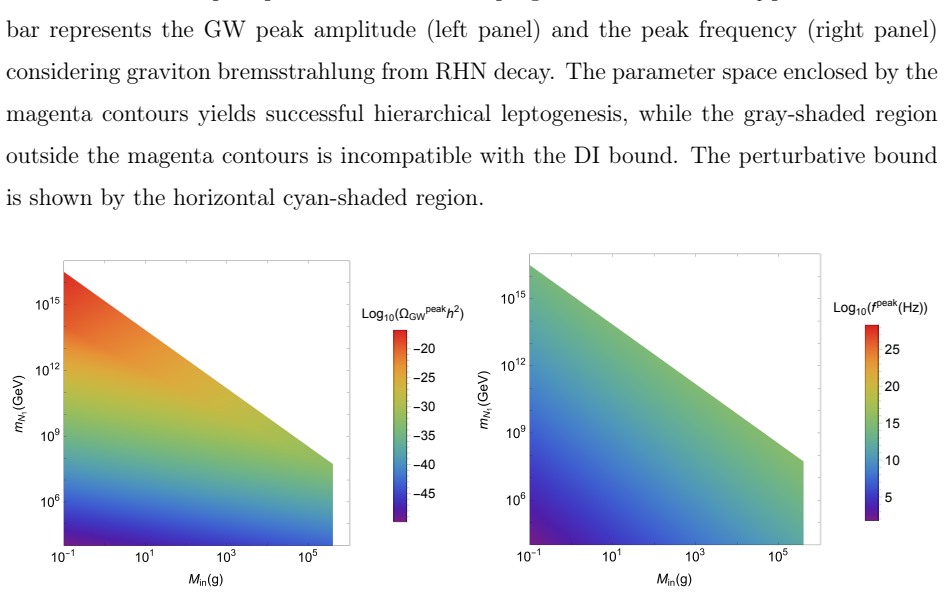
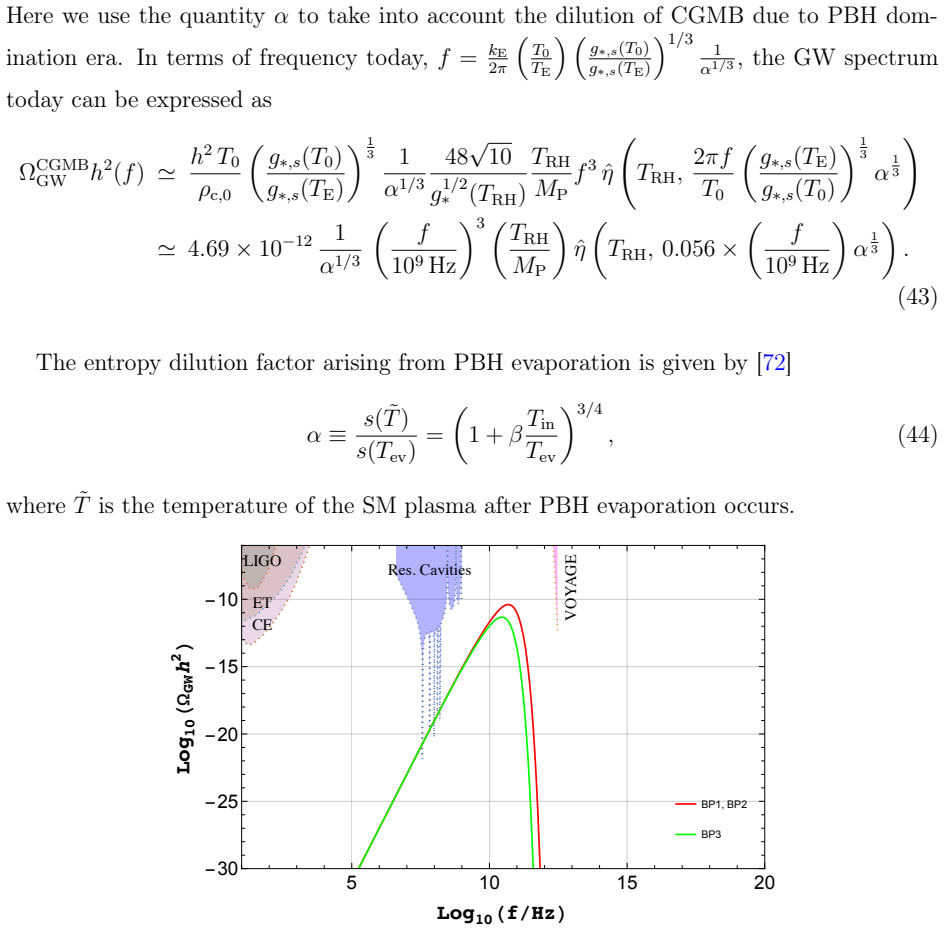
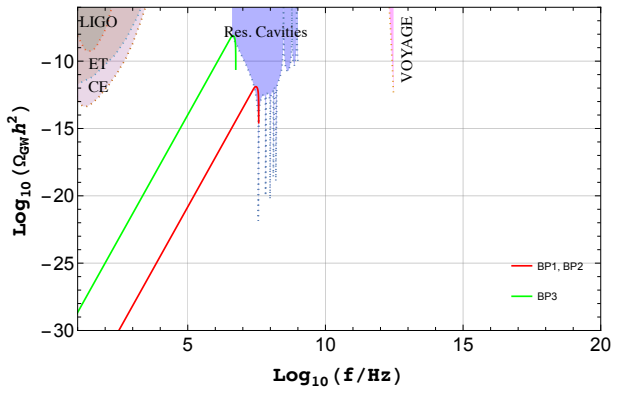
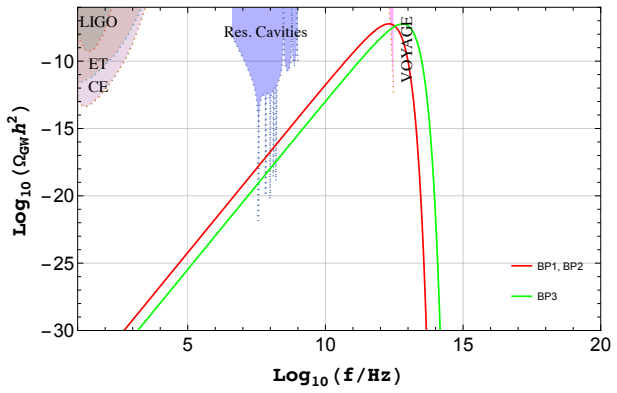
We study the possibility of probing non-thermal leptogenesis with multi-peaked high-frequency gravitational waves (GW) by considering heavy right-handed neutrino (RHN) produced from primordial black hole (PBH) evaporation to be responsible for generating the required lepton asymmetry. The decay of RHN also produces a GW spectrum due to graviton bremsstrahlung with the corresponding amplitude being enhanced for heavier RHN. The presence of an ultra-light PBH dominated epoch not only ensures sufficient production of RHNs, but also keeps the leptogenesis scenario free from strong washout problem of thermal leptogenesis at very high scale. In addition, the PBH dominated epoch also helps in generating a gravitational bremsstrahlung spectrum distinct from the stochastic GW background from the thermal bath. Finally, PBH evaporation also brings two separate sources of GW via density perturbation and graviton emission via Hawking evaporation. For the most optimistic scenario with very high scale seesaw consistent with neutrino mass and leptogenesis, this leads to a multi-peaked GW spectrum with peak frequencies lying in the MHz-EHz range.
Editorial analysis
A structured set of objections, weighed in public.
Referee Report
Summary. The manuscript proposes that evaporation of ultra-light primordial black holes (PBHs) produces heavy right-handed neutrinos (RHNs) that drive non-thermal leptogenesis, generating the observed baryon asymmetry while evading the strong washout that rules out thermal leptogenesis at seesaw scales ≳10^14 GeV. The PBH-dominated epoch is also claimed to source a distinctive multi-peaked stochastic gravitational-wave background via graviton bremsstrahlung from RHN decays, density perturbations, and Hawking radiation, with peaks spanning the MHz–EHz range in optimistic parameter choices consistent with neutrino masses.
Significance. If the central claims are substantiated, the work would link PBH cosmology, high-scale leptogenesis, and high-frequency GW phenomenology in a falsifiable way, offering a potential observational window on seesaw scales otherwise inaccessible to colliders or low-energy probes. The multi-source GW spectrum is a concrete, potentially distinctive signature.
major comments (2)
- [Abstract / leptogenesis section] Abstract and § on leptogenesis mechanism: the claim that the ultra-light PBH epoch 'keeps the leptogenesis scenario free from strong washout problem of thermal leptogenesis at very high scale' is load-bearing for the viability at seesaw scales ≳10^14 GeV, yet no explicit Boltzmann evolution, integrated washout factor, or parameter scan is shown demonstrating that the final Y_B remains O(10^{-10}) when inverse decays and ΔL=2 scatterings remain active during the matter-dominated phase.
- [GW production section] GW spectrum section: the assertion of a 'multi-peaked' spectrum with distinct contributions from bremsstrahlung, density perturbations, and Hawking evaporation requires quantitative demonstration that the peaks are separable and that the bremsstrahlung amplitude is indeed enhanced for the heavier RHN masses needed for high-scale leptogenesis; no explicit spectra or peak-frequency formulas are referenced in the available text.
minor comments (2)
- [Abstract] Notation for frequency units (MHz-EHz) and RHN mass scale should be defined consistently with standard conventions (e.g., explicit relation to M_N).
- [Results section] The optimistic scenario parameters (PBH mass/abundance, RHN scale) should be tabulated with the resulting peak frequencies and amplitudes for reproducibility.
Simulated Author's Rebuttal
We thank the referee for the careful reading and constructive comments on our manuscript. We address the major comments point by point below, agreeing that additional quantitative support is needed for the central claims.
read point-by-point responses
-
Referee: [Abstract / leptogenesis section] Abstract and § on leptogenesis mechanism: the claim that the ultra-light PBH epoch 'keeps the leptogenesis scenario free from strong washout problem of thermal leptogenesis at very high scale' is load-bearing for the viability at seesaw scales ≳10^14 GeV, yet no explicit Boltzmann evolution, integrated washout factor, or parameter scan is shown demonstrating that the final Y_B remains O(10^{-10}) when inverse decays and ΔL=2 scatterings remain active during the matter-dominated phase.
Authors: We agree that the manuscript would be strengthened by explicit calculations. In the revised version we will add the Boltzmann equations governing the lepton asymmetry evolution during the PBH-dominated phase, including inverse decays and ΔL=2 scatterings. We will present numerical results showing that Y_B reaches O(10^{-10}) for seesaw scales ≳10^14 GeV, with washout suppressed by the non-thermal RHN production and the matter-dominated expansion history, together with a limited parameter scan consistent with neutrino masses. revision: yes
-
Referee: [GW production section] GW spectrum section: the assertion of a 'multi-peaked' spectrum with distinct contributions from bremsstrahlung, density perturbations, and Hawking evaporation requires quantitative demonstration that the peaks are separable and that the bremsstrahlung amplitude is indeed enhanced for the heavier RHN masses needed for high-scale leptogenesis; no explicit spectra or peak-frequency formulas are referenced in the available text.
Authors: We acknowledge that explicit formulas and spectra are required. In the revision we will derive and quote the peak-frequency expressions for graviton bremsstrahlung from RHN decays, PBH-induced density perturbations, and Hawking radiation. We will include plots of the total GW spectrum demonstrating that the peaks remain separable in the MHz–EHz range for optimistic parameters, and we will show the enhancement of the bremsstrahlung amplitude for the heavier RHN masses needed at high-scale leptogenesis. revision: yes
Circularity Check
No circularity identified; derivation relies on external physics inputs without self-referential reduction.
full rationale
The abstract and available text describe a PBH-assisted leptogenesis scenario leading to multi-peaked GW spectra, invoking standard mechanisms for RHN production, asymmetry generation, and graviton bremsstrahlung. No equations, parameter fits, or self-citations are presented that reduce any claimed prediction to an input by construction (e.g., no fitted washout factors renamed as predictions, no uniqueness theorems imported from the authors' prior work, and no ansatzes smuggled via citation). The central claims rest on model assumptions that remain independently falsifiable outside the paper's fitted values, making the chain self-contained against external benchmarks.
Axiom & Free-Parameter Ledger
free parameters (2)
- RHN mass scale
- PBH mass and abundance
axioms (1)
- domain assumption High-scale seesaw mechanism remains consistent with observed neutrino masses and leptogenesis
Reference graph
Works this paper leans on
-
[1]
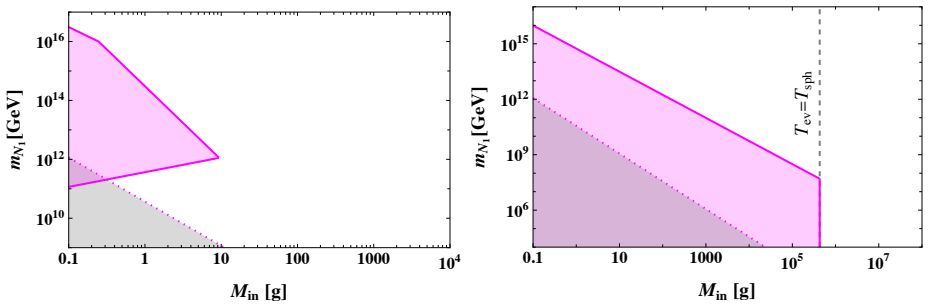
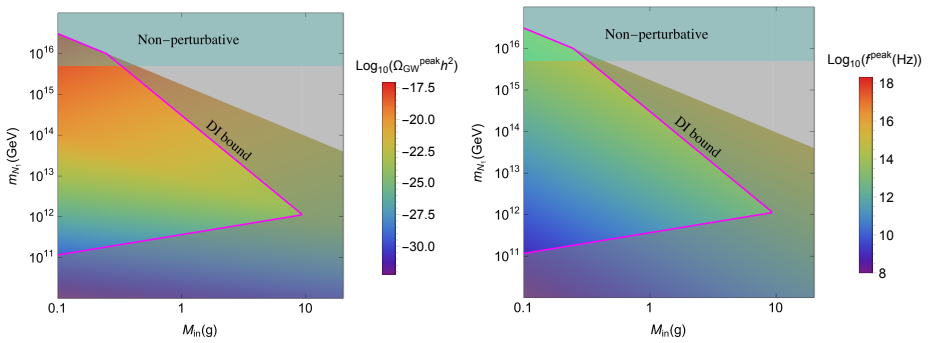
but without any connection to the origin of neutrino mass or leptogenesis. In this work, we consider a type-I seesaw leptogenesis scenario with a PBH dominating epoch such that heavy RHNs are produced non-thermally and hence does not suffer from the problem of strong∆L= 2washout [72]. Due to the early matter dominated phase of ultra-light PBH, it also sep...
-
[2]
Analytical estimation of Baryon Asymmetry In terms of the number of the lightest RHNN1 species,N N1, produced from the complete evaporation of a PBH, the Eq. (13) can be expressed as Y ∆L =ϵ ∆L 1 asph NN1nBH(aev) s(aev) .(17) The expression forN N1 is obtained from the generic expression of the number of a species with massm X and internal degrees of free...
-
[3]
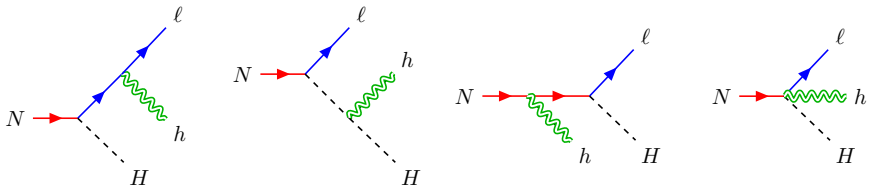
Analytical estimation of GW via bremsstrahlung The Eq. (26) can be re-written as d dt dρgw dEk + 4Hdρgw dEk = dΓ1→3 dEk Ek nN1.(28) 10 In terms of scale factora, d da a5 dρgw dlnE k = a4 H dΓ1→3 dEk E2 k nN1.(29) Integrating the above equation from the evaporation of PBH,aev to the decay of RHN,aN, we get dρgw(aN) dlnE k ≃ 2 3 τN nN1(aev) aev aN 3" 1− aev...
-
[4]
However, this approximation breaks down on scales smaller than the average separation between PBH
From density fluctuations The stochastic GW background generated by Poisson fluctuations in the PBH number density can be approximated by [74] ΩPBH GW (f)≃Ω peak GW f f PBH peak !11/3 Θ f PBH peak −f ,(45) whereΩ peak GW denotes the maximum GW energy density fraction, given by ΩPBH,peak GW ≃2×10 −6 β 10−8 16/3 Min 107 g 34/9 .(46) The above description re...
-
[5]
In this work, we follow Ref
From PBH evaporation The production of gravitons from PBH evaporation has been investigated in several stud- ies [71, 100, 116–118]. In this work, we follow Ref. [116] to estimate the GW spectrum generated from PBH evaporation. The present-day GW energy density spectrum can be approximated as ΩPBH,ev GW h2(f)≃1.36×10 −21 g∗,H 100 2 1 g Min 2 f 109 Hz 4 I ...
2022
-
[6]
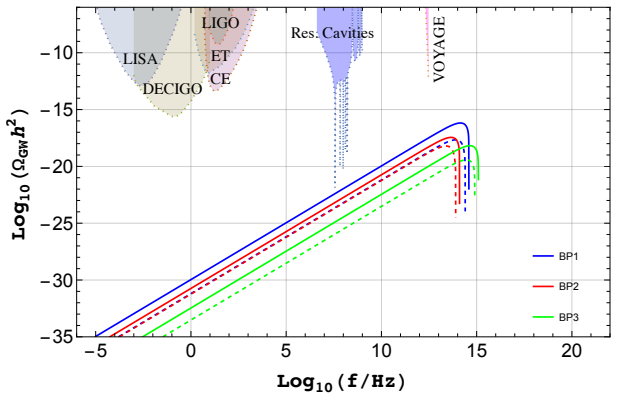
BP1 :M in = 0.1g,β= 5×10 −4,m N1 = 1015 GeV,m N2 = 7×10 15 GeV,m N3 = 1016 GeV,m 1 = 10−10 eV,ω 1 = 0,ω 2 = 0.00056−i0.00039,ω 3 = 0.0055−i0.0011. The corresponding Yukawa matrix is given by Yν = 1.59×10 −3 + 4.31×10 −4 i7.89×10 −1 −4.91×10 −6 i−6.11×10 −1 + 1.56×10 −1 i 2.46×10 −3 + 1.43×10 −4 i9.85×10 −1 + 1.91×10 −2 i2.49 + 2.23×10 −6 i −7.32×...
-
[7]
BP2 :M in = 0.1g,β= 5×10 −4,m N1 = 1014 GeV,m N2 = 7×10 15 GeV,m N3 = 1016 GeV, m1 = 10−6 eV,ω 1 = 0,ω 2 = 0.004−i10 −4,ω 3 = 0.012 +i10 −3. The corresponding Yukawa matrix is given by Yν = 2.36×10 −3 + 1.63×10 −4 i7.89×10 −1 −2.18×10 −5 i−6.11×10 −1 + 1.56×10 −1 i 1.74×10 −3 + 1.56×10 −4 i9.85×10 −1 + 1.91×10 −2 i2.49−5.50×10 −6 i 1.17×10 −3 −2....
-
[8]
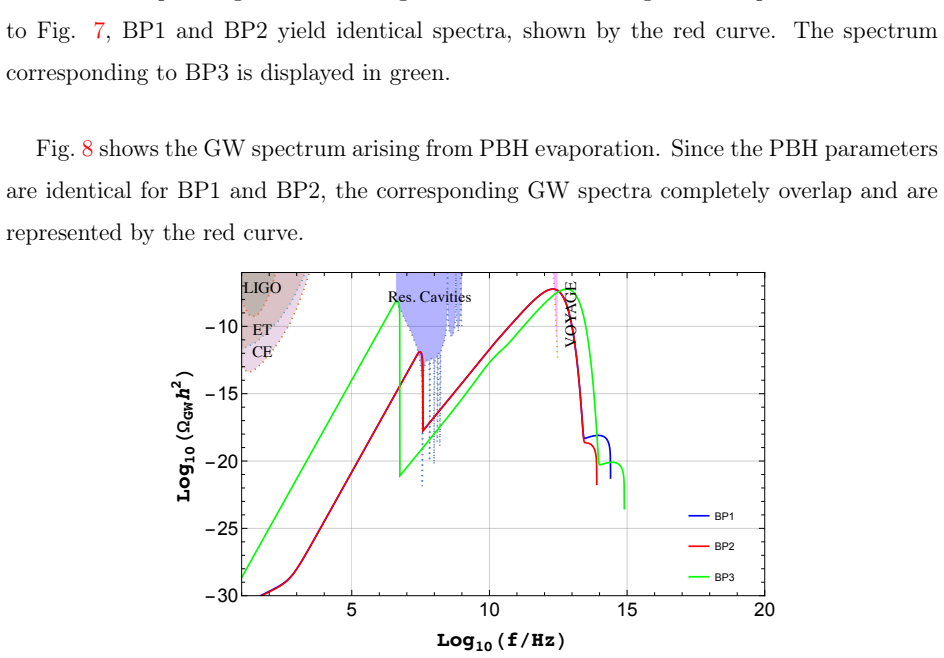
BP3 :M in = 1g,β= 5×10 −4,m N1 = 1014 GeV,m N2 = 7×10 15 GeV,m N3 = 1016 GeV, m1 = 10−6 eV,ω 1 = 0,ω 2 = 0.004−i10 −4,ω 3 = 0.012 +i10 −3. The corresponding Yukawa matrix is given by Yν = 3.54×10 −4 + 4.26×10 −4 i7.89×10 −1 −1.80×10 −5 i−6.11×10 −1 + 1.56×10 −1 i 5.24×10 −4 + 8.48×10 −4 i9.85×10 −1 + 1.91×10 −2 i2.49−1.12×10 −5 i 1.56×10 −4 −4.74...
Pith/arXiv arXiv 2018
-
[9]
Sakharov,Violation of CP Invariance, C asymmetry, and baryon asymmetry of the universe,Pisma Zh
A.D. Sakharov,Violation of CP Invariance, C asymmetry, and baryon asymmetry of the universe,Pisma Zh. Eksp. Teor. Fiz.5(1967) 32
1967
-
[10]
Weinberg,Cosmological Production of Baryons,Phys
S. Weinberg,Cosmological Production of Baryons,Phys. Rev. Lett.42(1979) 850. 24
1979
-
[11]
Kolb and S
E.W. Kolb and S. Wolfram,Baryon Number Generation in the Early Universe,Nucl. Phys. B172(1980) 224
1980
-
[12]
Fukugita and T
M. Fukugita and T. Yanagida,Baryogenesis Without Grand Unification,Phys. Lett. B174 (1986) 45
1986
-
[13]
Kuzmin, V.A
V.A. Kuzmin, V.A. Rubakov and M.E. Shaposhnikov,On the Anomalous Electroweak Baryon Number Nonconservation in the Early Universe,Phys. Lett.155B(1985) 36
1985
-
[14]
Minkowski,µ→eγat a Rate of One Out of10 9 Muon Decays?,Phys
P. Minkowski,µ→eγat a Rate of One Out of10 9 Muon Decays?,Phys. Lett. B67(1977) 421
1977
-
[15]
M. Gell-Mann, P. Ramond and R. Slansky,Complex Spinors and Unified Theories,Conf. Proc. C790927(1979) 315 [1306.4669]
Pith/arXiv arXiv 1979
-
[16]
Mohapatra and G
R.N. Mohapatra and G. Senjanovic,Neutrino Mass and Spontaneous Parity Nonconservation,Phys. Rev. Lett.44(1980) 912
1980
-
[17]
Schechter and J
J. Schechter and J. Valle,Neutrino Masses in SU(2) x U(1) Theories,Phys. Rev. D22 (1980) 2227
1980
-
[18]
Schechter and J.W.F
J. Schechter and J.W.F. Valle,Neutrino Decay and Spontaneous Violation of Lepton Number,Phys. Rev. D25(1982) 774
1982
-
[19]
S. Davidson and A. Ibarra,A Lower bound on the right-handed neutrino mass from leptogenesis,Phys. Lett.B535(2002) 25 [hep-ph/0202239]
Pith/arXiv arXiv 2002
-
[20]
J.A. Dror, T. Hiramatsu, K. Kohri, H. Murayama and G. White,Testing the Seesaw Mechanism and Leptogenesis with Gravitational Waves,Phys. Rev. Lett.124(2020) 041804 [1908.03227]
arXiv 2020
- [21]
-
[22]
B. Fornal and B. Shams Es Haghi,Baryon and Lepton Number Violation from Gravitational Waves,Phys. Rev. D102(2020) 115037 [2008.05111]
arXiv 2020
-
[23]
R. Samanta and S. Datta,Gravitational wave complementarity and impact of NANOGrav data on gravitational leptogenesis,JHEP05(2021) 211 [2009.13452]
arXiv 2021
- [24]
-
[25]
P. Huang and K.-P. Xie,Leptogenesis triggered by a first-order phase transition,2206.04691
-
[26]
A. Dasgupta, P.S.B. Dev, A. Ghoshal and A. Mazumdar,Gravitational Wave Pathway to 25 Testable Leptogenesis,2206.07032
-
[27]
N. Okada and O. Seto,Probing the seesaw scale with gravitational waves,Phys. Rev. D98 (2018) 063532 [1807.00336]
Pith/arXiv arXiv 2018
-
[28]
T. Hasegawa, N. Okada and O. Seto,Gravitational waves from the minimal gaugedU(1)B−L model,Phys. Rev. D99(2019) 095039 [1904.03020]
Pith/arXiv arXiv 2019
- [29]
- [30]
- [31]
- [32]
-
[33]
D. Borah and I. Saha,Gravitational waves from seesaw assisted collapsing domain walls, 2512.22339
-
[34]
D. Borah, P.K. Paul and N. Sahu,Can Dirac neutrinos destabilizeZ2 domain wall network?,2602.07380
-
[35]
Saikawa,A review of gravitational waves from cosmic domain walls,Universe3(2017) 40 [1703.02576]
K. Saikawa,A review of gravitational waves from cosmic domain walls,Universe3(2017) 40 [1703.02576]
Pith/arXiv arXiv 2017
-
[36]
R. Roshan and G. White,Using gravitational waves to see the first second of the Universe, 2401.04388
-
[37]
S. Bhattacharya, N. Mondal, R. Roshan and D. Vatsyayan,Leptogenesis, dark matter and gravitational waves from discrete symmetry breaking,JCAP06(2024) 029 [2312.15053]
arXiv 2024
- [38]
- [39]
- [40]
-
[41]
P.K. Paul, N. Sahu and P. Shukla,Thermal leptogenesis, dark matter, and gravitational 26 waves from an extended canonical seesaw scenario,Phys. Rev. D112(2025) 015032 [2409.08828]
arXiv 2025
-
[42]
Z.A. Borboruah, D. Borah, L. Malhotra and U. Patel,Minimal Dirac seesaw dark matter, Phys. Rev. D112(2025) 015022 [2412.12267]
arXiv 2025
- [43]
-
[44]
K.-Y. Choi, E. Lkhagvadorj and S. Mahapatra,A possible cosmological origin of the KM3-230213A event,JCAP10(2025) 079 [2503.22465]
arXiv 2025
-
[45]
H. Murayama, B. Noether and J. Schütte-Engel,Observing leptogenesis in action with gravitational waves,JCAP12(2025) 027 [2506.15772]
arXiv 2025
-
[46]
S. Kanemura, K. Kaneta and D. Nanda,Gravitational waves from supermassive right-handed neutrinos produced at preheating,Phys. Rev. D113(2026) 055046 [2508.00315]
arXiv 2026
-
[47]
Y. Wang and W. Chao,Testing the type-II seesaw mechanism with gravitational waves, Phys. Rev. D113(2026) 075026 [2510.26235]. [42]Planckcollaboration,Planck 2018 results. X. Constraints on inflation,Astron. Astrophys. 641(2020) A10 [1807.06211]
arXiv 2026
-
[48]
W. Buchmuller, P. Di Bari and M. Plumacher,Leptogenesis for pedestrians,Annals Phys. 315(2005) 305 [hep-ph/0401240]
Pith/arXiv arXiv 2005
-
[49]
G. Giudice, A. Notari, M. Raidal, A. Riotto and A. Strumia,Towards a complete theory of thermal leptogenesis in the SM and MSSM,Nucl. Phys. B685(2004) 89 [hep-ph/0310123]
Pith/arXiv arXiv 2004
-
[50]
J. Ghiglieri and M. Laine,Gravitational wave background from Standard Model physics: Qualitative features,JCAP07(2015) 022 [1504.02569]
Pith/arXiv arXiv 2015
-
[51]
J. Ghiglieri, G. Jackson, M. Laine and Y. Zhu,Gravitational wave background from Standard Model physics: Complete leading order,JHEP07(2020) 092 [2004.11392]
arXiv 2020
-
[52]
A. Ringwald, J. Schütte-Engel and C. Tamarit,Gravitational Waves as a Big Bang Thermometer,JCAP03(2021) 054 [2011.04731]
arXiv 2021
-
[53]
Lazarides and Q
G. Lazarides and Q. Shafi,Origin of matter in the inflationary cosmology,Phys. Lett. B 258(1991) 305
1991
-
[54]
Murayama, H
H. Murayama, H. Suzuki, T. Yanagida and J. Yokoyama,Chaotic inflation and baryogenesis by right-handed sneutrinos,Phys. Rev. Lett.70(1993) 1912
1993
-
[55]
E.W. Kolb, A.D. Linde and A. Riotto,GUT baryogenesis after preheating,Phys. Rev. Lett. 77(1996) 4290 [hep-ph/9606260]. 27
Pith/arXiv arXiv 1996
-
[56]
G. Giudice, M. Peloso, A. Riotto and I. Tkachev,Production of massive fermions at preheating and leptogenesis,JHEP08(1999) 014 [hep-ph/9905242]
Pith/arXiv arXiv 1999
-
[57]
T. Asaka, K. Hamaguchi, M. Kawasaki and T. Yanagida,Leptogenesis in inflaton decay, Phys. Lett. B464(1999) 12 [hep-ph/9906366]
Pith/arXiv arXiv 1999
-
[58]
T. Asaka, K. Hamaguchi, M. Kawasaki and T. Yanagida,Leptogenesis in inflationary universe,Phys. Rev. D61(2000) 083512 [hep-ph/9907559]
Pith/arXiv arXiv 2000
-
[59]
K. Hamaguchi, H. Murayama and T. Yanagida,Leptogenesis from N dominated early universe,Phys. Rev. D65(2002) 043512 [hep-ph/0109030]
Pith/arXiv arXiv 2002
-
[60]
F. Hahn-Woernle and M. Plumacher,Effects of reheating on leptogenesis,Nucl. Phys. B 806(2009) 68 [0801.3972]
Pith/arXiv arXiv 2009
-
[61]
Y. Hamada, R. Kitano and W. Yin,Leptogenesis via Neutrino Oscillation Magic,JHEP10 (2018) 178 [1807.06582]
Pith/arXiv arXiv 2018
- [62]
-
[63]
A. Maleknejad,Chiral anomaly in SU(2)R-axion inflation and the new prediction for particle cosmology,JHEP21(2020) 113 [2103.14611]
arXiv 2020
- [64]
- [65]
- [66]
-
[67]
G. Lazarides, R. Maji, R. Roshan and Q. Shafi,A predictive SO(10) model,JCAP12 (2022) 009 [2210.03710]
arXiv 2022
- [68]
- [69]
- [70]
- [71]
-
[72]
T. Chowdhury, L. Jenks, E.W. Kolb, A.J. Long and E. McDonough,Nonthermal leptogenesis via cosmological gravitational particle production is tested by inflationary gravitational waves,2605.05304
-
[73]
Hawking,Black hole explosions,Nature248(1974) 30
S.W. Hawking,Black hole explosions,Nature248(1974) 30
1974
-
[74]
Hawking,Particle Creation by Black Holes,Commun
S.W. Hawking,Particle Creation by Black Holes,Commun. Math. Phys.43(1975) 199
1975
-
[75]
B. Carr, K. Kohri, Y. Sendouda and J. Yokoyama,Constraints on primordial black holes, Rept. Prog. Phys.84(2021) 116902 [2002.12778]
Pith/arXiv arXiv 2021
-
[76]
K.-Y. Choi, E. Lkhagvadorj and S. Mahapatra,Gravitational wave sourced by decay of massive particle from primordial black hole evaporation,JCAP07(2024) 064 [2403.15269]
arXiv 2024
-
[77]
N. Bernal, C.S. Fong, Y.F. Perez-Gonzalez and J. Turner,Rescuing High-Scale Leptogenesis using Primordial Black Holes,2203.08823
-
[78]
T. Papanikolaou, V. Vennin and D. Langlois,Gravitational waves from a universe filled with primordial black holes,JCAP03(2021) 053 [2010.11573]
arXiv 2021
-
[79]
G. Domènech, C. Lin and M. Sasaki,Gravitational wave constraints on the primordial black hole dominated early universe,JCAP04(2021) 062 [2012.08151]
arXiv 2021
-
[80]
G. Domènech, V. Takhistov and M. Sasaki,Exploring evaporating primordial black holes with gravitational waves,Phys. Lett. B823(2021) 136722 [2105.06816]
arXiv 2021
discussion (0)
Sign in with ORCID, Apple, or X to comment. Anyone can read and Pith papers without signing in.