REVIEW 4 major objections 7 minor 22 references
Future frames can train how a video model writes its memory, not just how it reads it.
Reviewed by Pith at T0; open to challenge. T0 means a machine referee read the full paper against a public rubric. the ladder, T0–T4 →
T0 review · deepseek-v4-flash
2026-08-01 10:00 UTC pith:ALRC2VGN
load-bearing objection SGF is a plausible, honestly written fix for a real training-signal gap, but the load-bearing replay-fidelity assumption is only verified in forward space and the closest prior is structurally closer than the main text suggests. the 4 major comments →
Self Gradient Forcing: Native Long Video Extrapolation
The pith
A machine-rendered reading of the paper's core claim, the machinery that carries it, and where it could break.
Core claim
Self Gradient Forcing restores a credit-assignment path that self forcing leaves cut. In autoregressive video diffusion, the model denoises each new latent while attending to a key–value (KV) cache built from its own previously generated clean latents. The cache is written at the clean context timestep, and in self forcing that writing computation is treated as frozen state: future losses can train the model to better read historical memory, but cannot propagate back into how that memory was encoded. SGF performs a no-gradient rollout to collect self-generated context and noisy exit latents, then reconstructs the same exit computation in parallel, this time allowing losses on future video la
What carries the argument
The central object is the historical context-gradient gap and the two-pass reconstruction that closes it. Pass 1 is an ordinary no-gradient autoregressive rollout that records, at a randomly sampled denoising exit step, both the self-generated clean latent context and the noisy latents fed to the model. Pass 2 discards the serial cache and recomputes that exit step in parallel: the recorded context latents are re-encoded at the clean context timestep with stop-gradient on the latents themselves, but with gradients kept through the K/V projections and the causal future-to-context attention under a reconstructed mask that mirrors the sink-plus-FIFO streaming cache. This fixed-window replay tur
Load-bearing premise
The whole method rests on the assumption that the parallel Pass-2 replay faithfully reproduces the serial attention relation used at the sampled rollout step, so that the recovered gradients train the same cache writer that operates at inference.
What would settle it
Train SGF exactly as described, then rerun Pass 2 with the context K/V path explicitly stop-gradient, making the reconstruction identical to frozen-cache self forcing. If long-horizon metrics stay at the SGF level rather than reverting to the self-forcing level, the gains are not coming from the memory-writing gradient. Alternatively, perturb the Pass-2 reconstruction mask or sink positions by a few latents; if 60s/240s consistency does not degrade, the method is not actually supervising the cache writer at the sampled exit step.
If this is right
- Training on a 5-second window can extrapolate to 60-second and 240-second videos, so long-horizon consistency does not require a proportionally long training window.
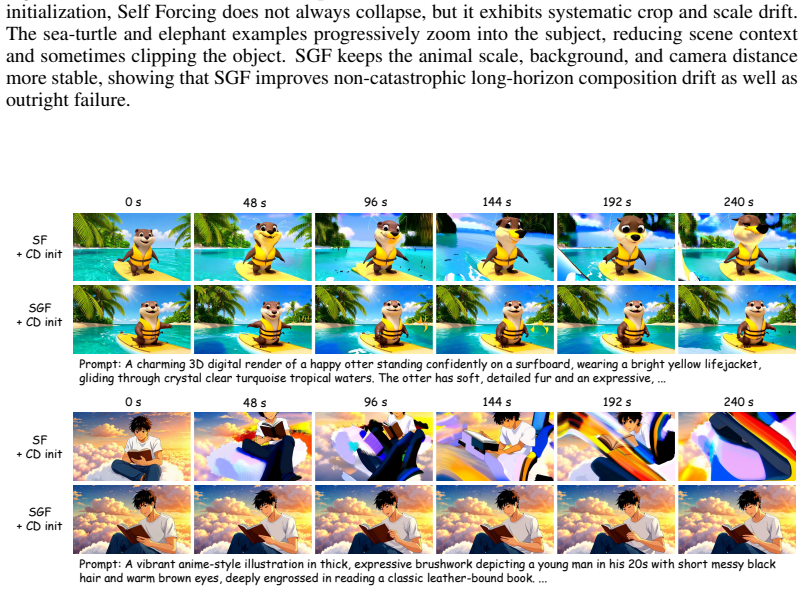
- Subject identity, background/layout consistency, and temporal stability improve over matched self-forcing baselines, while 5-second short-horizon quality stays on par.
- The benefit appears in both frame-wise and chunk-wise autoregressive generation, and under teacher-forcing, consistency-distillation, and ODE initializations.
- SGF is a drop-in gradient-boundary change, not a new architecture, so it can be stacked with existing forcing improvements and context/cache designs.
- Restoring the memory-writing gradient costs modest extra memory and runtime (about 10% wall-clock in the reported configuration), whereas a directly differentiable cache runs out of memory.
Where Pith is reading between the lines
- The same argument should transfer to any autoregressive sequence model with a KV cache: if future losses cannot reach the writing computation, long-horizon drift should appear there too, and SGF-style replay could be tested on language or world models.
- If the gap widens as shared parameters shift under few-step distillation, SGF should matter most with short denoising schedules and less with full-step training — a quantitative prediction implied by the paper's mechanism.
- One could ablate replay fidelity directly by perturbing the Pass-2 reconstruction mask or sink positions; if long-horizon gains collapse while short-horizon metrics hold, the memory-writing supervision is doing the work rather than the extra forward pass.
- Because Pass 2 is a bounded surrogate, its benefits may saturate as rollout lengthens; combining SGF with longer-context retrieval or recurrent memory could extend write supervision to memory evicted from the FIFO window.
Editorial analysis
A structured set of objections, weighed in public.
Referee Report
Summary. The paper proposes Self Gradient Forcing (SGF), a two-pass training strategy for autoregressive video diffusion built on Self Forcing. Pass 1 performs a no-gradient serial self-rollout and records sampled noisy latents and predicted clean latents at a sampled denoising exit step; Pass 2 reconstructs the exit-step computation in parallel, re-encoding the recorded context latents at the clean timestep with stop-gradient inputs but permitting gradients through the context KV projections and future-to-context attention, so DMD losses supervise the cache-writing computation without full rollout BPTT. The paper identifies the 'historical context-gradient gap' in frozen-cache Self Forcing and claims that SGF restores this memory-writing supervision, improving long-horizon consistency at 60s and 240s while matching at 5s. Experiments compare matched Self Forcing baselines under frame-wise and chunk-wise settings with TF, causal-CD, and causal-ODE initializations, using VBench-Long metrics, a GSB study, and qualitative strips; an appendix verifies forward recovery fidelity of Pass 2; a feasibility table documents memory/runtime overhead.
Significance. If the central claim holds, the contribution is valuable: it isolates a plausible and previously under-specified credit-assignment problem in frozen-cache self-rollout training and proposes a computationally bounded, implementation-friendly fix that is orthogonal to existing forcing objectives and long-context mechanisms. The paper ships unusually strong empirical infrastructure for this area: controlled matched-pair comparisons (same prompt, seed, initialization, inference geometry), a large GSB study (>1,900 judgments), a Pass-1/Pass-2 recovery diagnostic with error scaled against bf16 precision, and a direct-differentiable-cache feasibility measurement (OOM) that motivates the bounded surrogate. These assets make the empirical claim materially more credible than a purely qualitative report. However, the load-bearing mechanism—that Pass 2's gradients train the same causal memory writer used at inference—is verified only at the level of forward latent recovery, not at the level of gradient identity or the attention relation; the Limitations section (G) concedes this. The main experimental tables also lack error bars and significance tests, so some gains are on the order of small m
major comments (4)
- [§3.3, Algorithm 1, Appendix D, Limitations G] The central mechanistic claim—that future DMD losses supervise the clean-context K/V writer used at inference—rests on the assumption that Pass 2's parallel reconstruction reproduces the exact causal computation of Pass 1's serial cache, including the backward path through attention and K/V projections. Appendix D verifies forward recovery only (cosine similarity ~0.9999, RelL2 ~1.4%); Limitations G explicitly concedes that a mask, sink, RoPE, timestep, or chunk-alignment deviation would make SGF 'train a different writer.' Forward agreement does not imply backward agreement: small forward differences can be amplified by the backward pass through attention and KV projections, and a mismatched mask could leave forward outputs close while producing gradients for a different relation. The paper should either provide a direct gradient-alignment diagnostic (e.g., gradient cosine similarity be
- [Tables 1-2, §4.2] Tables 1 and 2 report no error bars, confidence intervals, or significance tests, and many SGF-vs-SF differences are small (e.g., frame-wise 60s TF-initiated Background 0.970→0.974; CD-initiated Flickering 0.992→0.992). Given the paper's emphasis on 'especially consistent' gains, the reader cannot tell which differences exceed run-to-run noise. Reporting seed-level variance or significance over the 128 prompts would materially strengthen the claim that SGF improves long-horizon metrics, beyond the human study.
- [§4.2 and Appendix H] The dynamic-degree results appear to go against the paper's own conclusion: SGF is claimed to improve temporal stability and motion quality, yet dynamics drop substantially in several controlled rows (e.g., frame-wise 60s causal-ODE 0.867→0.566; 240s 0.840→0.556; chunk-wise 240s TF 0.943→0.566). The paper attributes SF's higher dynamics to 'incoherent motion' from scene jumps and deformation (Appendix H), but provides no controlled quantification of this explanation—no correlation between dynamic-degree and human judgments, no perceptual evaluation of the specific videos, and no alternative motion-quality metric. Since dynamics is one of the headline metrics in the tables, this is a load-bearing inconsistency that needs a concrete diagnostic, not just an appeal to appendix examples.
- [§4.2, Tables 1-2 and §3.5, Appendix A.1] There is a notable gap between the training context and the long-horizon evaluation context. Frame-wise training uses the full 5-second window with a standard teacher-forcing-style causal mask, while long-horizon inference uses a streaming sink-4/FIFO-16/current-1 window with a different attention geometry (Appendix A.1). The paper asserts the Pass-2 mask 'matches' the sampled rollout, but the sampled rollout is a training-window full-context rollout, not the inference geometry. Since SGF's value proposition is improving the cache writer used at inference, the paper should explicitly state whether SGF's Pass-2 mask is aligned to training rollout or to the inference streaming geometry, and justify why a mask that matches only the training rollout transfers to the streaming policy. This is exactly the alignment risk flagged in Limitations G.
minor comments (7)
- [Throughout] Reference dates include 2026 entries and the arXiv ID (2607.20368) is in the future relative to standard CVPR/ICML review cycles; the paper should ensure the bibliography is complete and correctly dated for the venue version.
- [§3.3, Eq. (4)] Equation (4) writes the gradient inclusion symbolically; it would be clearer to state explicitly which terms are stop-gradient (context latents, noise samples, scheduler states) and which are not, ideally in the equation or immediately after it.
- [Appendix D, Table 7] The recovery metrics are computed on latent predictions before VAE decoding; the claim 'visual pairs are nearly indistinguishable' is fine, but the text should clarify that decoded comparisons are illustrative, not a formal perceptual metric.
- [§4.5] The feasibility table reports a 5-step cycle time and peak memory on one hardware setup; specifying the exact GPU type, batch size, and model size would make the numbers reproducible.
- [§4.3] The GSB study should state how many raters, how many pairs per comparison, and the inter-annotator agreement; currently it reports only the total number of paired judgments and the aggregate score.
- [§4.1] The 240s setting uses 128 MovieGen prompts, but the 60s setting is described only as 'VBench-Long prompts'; the number of prompts per condition should be stated for both.
- [Appendix F] The added discussion of Checkpointed Self Forcing in Solaris is appreciated and appropriately positioned as related work; the text should also cite it in the related-work section, not only in an appendix.
Circularity Check
No circular derivation: SGF is an operationally defined training objective and its claimed long-horizon benefit is evaluated on held-out benchmarks against matched baselines.
full rationale
The claimed derivation is self-contained rather than circular. SGF is defined operationally in Algorithm 1 and Eqs. (3)-(4): Pass 1 records a no-gradient rollout state, and Pass 2 recomputes the exit-step prediction with gradients flowing through the clean-context K/V path. The paper's central empirical claim that this improves 60s/240s extrapolation is not an input to that definition; it is evaluated on VBench-Long and MovieGen-128 prompts against matched Self Forcing baselines under fixed seeds, prompts, and inference geometry (Sections 4.2-4.3). The two-pass recovery fidelity check (Appendix D) is an internal sanity test of the replay construction, not a fitted prediction. The assumption that the parallel reconstruction faithfully reproduces the serial context relation is explicitly flagged as a limitation (Limitations G), not asserted as a theorem. The only self-references (Zhuang et al. 2026; Luo et al. 2026) appear in related-work context and do not carry the argument. The acknowledgment that Solaris (Savva et al. 2026) contains a closely related checkpointed parallel recompute (Appendix F) is a novelty disclosure, not a circular step. No quantity is defined in terms of the metric it purports to improve, and no prediction reduces to its own input by construction.
Axiom & Free-Parameter Ledger
free parameters (3)
- Sink latents (frame-wise) =
4
- FIFO window / total context (frame-wise) =
FIFO 16, total window 21
- Chunk-wise context policy =
sink 3, FIFO 6, chunk size 3
axioms (4)
- domain assumption A causal DiT shares parameters between noisy denoising steps and the clean t_ctx=0 cache-writing computation, so updates at noisy steps can drift the cache writer (Eq. 2).
- domain assumption Pass-2 parallel reconstruction faithfully reproduces the serial cache relation at the sampled exit step (mask M_rec, positional indices, deterministic layers).
- domain assumption Distribution-matching distillation (DMD) from a bidirectional video model is a valid supervision signal for self-rollout training.
- domain assumption The Wan video VAE requires a 4-latent sink to cover its start-boundary group, and this boundary diagnostic transfers to training/evaluation.
read the original abstract
Recent autoregressive video diffusion methods are increasingly built upon Self Forcing, where the student is trained on histories produced by its own rollout rather than ground-truth video contexts. This reduces exposure bias, but the historical key-value cache is still used by future frames only as frozen rollout state. As a result, future losses cannot supervise how earlier generated latents should be written into more useful keys and values for later video-latent generation. We call this the historical context-gradient gap. We propose Self Gradient Forcing (SGF), a two-pass training strategy that restores this missing supervision signal without backpropagating through the full serial rollout. Pass 1 performs a no-gradient autoregressive rollout matching inference and, at a sampled denoising exit step, records both the self-generated context and the noisy latents fed to the model. Pass 2 performs parallel context-gradient reconstruction for the recorded exit step. The generated context is used as stop-gradient clean-latent input, while the model recomputes the context KV representations and future-to-context causal attention. Thus, SGF provides the missing memory-writing supervision within the native autoregressive training objective, using losses on future video latents to train the model to encode context into more effective causal memory. Across extensive long-horizon frame-wise and chunk-wise experiments under different initializations, SGF achieves stronger native long-video extrapolation than Self Forcing, especially in subject identity, background/layout consistency, and temporal stability. Remarkably, using only a 5-second training window, SGF can extrapolate to videos lasting several minutes. Code and models will be released to advance research on autoregressive video generation.
Figures




Reference graph
Works this paper leans on
-
[1]
Lumiere: A space-time diffusion model for video generation.arXiv preprint arXiv:2401.12945,
Omer Bar-Tal, Hila Chefer, Omer Tov, Charles Herrmann, Roni Paiss, Shiran Zada, Ariel Ephrat, Junhwa Hur, Guanghui Liu, Amit Raj, Yuanzhen Li, Michael Rubinstein, Tomer Michaeli, Oliver Wang, Deqing Sun, Tali Dekel, and Inbar Mosseri. Lumiere: A space-time diffusion model for video generation.arXiv preprint arXiv:2401.12945,
-
[3]
Metrics are rows and model variants are columns, and boldface marks the better value within each matched Self Forcing–SGF pair
B FULLMETRICTABLES This appendix reports the complete 5-second VBench results. Metrics are rows and model variants are columns, and boldface marks the better value within each matched Self Forcing–SGF pair. These 13 Table 5: Frame-wise 5-second VBench metrics. Evaluation uses sink 4, FIFO 16, and current chunk 1, for a total context window of 21 latent fr...
2060
-
[6]
Rolling forcing: Autoregressive long video diffusion in real time.arXiv preprint arXiv:2509.25161,
Kunhao Liu, Wenbo Hu, Jiale Xu, Ying Shan, and Shijian Lu. Rolling forcing: Autoregressive long video diffusion in real time.arXiv preprint arXiv:2509.25161,
-
[7]
Shotstream: Streaming multi-shot video generation for interactive storytelling
Yawen Luo, Xiaoyu Shi, Junhao Zhuang, Yutian Chen, Quande Liu, Xintao Wang, Pengfei Wan, and Tianfan Xue. Shotstream: Streaming multi-shot video generation for interactive storytelling. arXiv preprint arXiv:2603.25746,
-
[8]
Yu Meng, Xiangyang Luo, Letian Li, Wenyuan Jiang, Chen Gao, Xinlei Chen, Yong Li, and Xiao- Ping Zhang. Tethercache: Stabilizing autoregressive long-form video generation with gated recall and trusted alignment.arXiv preprint arXiv:2606.13035,
-
[12]
Jiahao Tian, Yiwei Wang, Gang Yu, and Chi Zhang. Head forcing: Long autoregressive video generation via head heterogeneity.arXiv preprint arXiv:2605.14487,
-
[13]
Fu-Yun Wang, Wenshuo Chen, Guanglu Song, Han-Jia Ye, Yu Liu, and Hongsheng Li. Gen-l-video: Multi-text to long video generation via temporal co-denoising.arXiv preprint arXiv:2305.18264,
-
[14]
Zile Wang, Zexiang Liu, Jiaxing Li, Kaichen Huang, Baixin Xu, Fei Kang, Mengyin An, Peiyu Wang, Biao Jiang, Yichen Wei, Yidan Xietian, Jiangbo Pei, Liang Hu, Boyi Jiang, Hua Xue, Zidong Wang, Haofeng Sun, Wei Li, Wanli Ouyang, Xianglong He, Yang Liu, Yangguang Li, and Yahui Zhou. Matrix-game 3.0: Real-time and streaming interactive world model with long- ...
-
[15]
Boxun Xu, Yuming Du, Zichang Liu, Siyu Yang, Ziyang Jiang, Siqi Yan, Rajasi Saha, Albert Pumarola, Wenchen Wang, and Peng Li. Sparse forcing: Native trainable sparse attention for real-time autoregressive diffusion video generation.arXiv preprint arXiv:2604.21221, 2026a. Gangwei Xu, Qihang Zhang, Jiaming Zhou, Xing Zhu, Yujun Shen, Xin Yang, and Yinghao X...
-
[16]
Hidir Yesiltepe, Tuna Han Salih Meral, Adil Kaan Akan, Kaan Oktay, and Pinar Yanardag. Infinity- RoPE: Action-controllable infinite video generation emerges from autoregressive self-rollout. arXiv preprint arXiv:2511.20649,
-
[17]
Video-mirai: Autore- gressive video diffusion models need foresight.arXiv preprint arXiv:2606.03971,
Yonghao Yu, Lang Huang, Runyi Li, Zerun Wang, and Toshihiko Yamasaki. Video-mirai: Autore- gressive video diffusion models need foresight.arXiv preprint arXiv:2606.03971,
-
[18]
Min Zhao, Hongzhou Zhu, Kaiwen Zheng, Zihan Zhou, Bokai Yan, Xinyuan Li, Xiao Yang, Chongxuan Li, and Jun Zhu. Causal forcing++: Scalable few-step autoregressive diffusion distil- lation for real-time interactive video generation.arXiv preprint arXiv:2605.15141,
-
[19]
Hongzhou Zhu, Min Zhao, Guande He, Hang Su, Chongxuan Li, and Jun Zhu. Causal forcing: Autoregressive diffusion distillation done right for high-quality real-time interactive video gener- ation.arXiv preprint arXiv:2602.02214,
-
[20]
The 5-second setting follows the standard VBench protocol and reports all 16 quality and semantic dimensions
A ADDITIONALEXPERIMENTALDETAILS Benchmark protocol.We evaluate matched Self Forcing and SGF pairs at 5s, 60s, and 240s. The 5-second setting follows the standard VBench protocol and reports all 16 quality and semantic dimensions. The 60-second setting uses the VBench-Long protocol, while the 240-second setting uses 128 randomly sampled MovieGen prompts wi...
2026
-
[22]
The controlled SGF comparisons are the matched causal-CD and TF pairs; ODE-initialized Self Forcing rows are reference baselines. Metric Bidirectional ODE init Causal ODE init Causal CD init TF init SF SF SF SGF SF SGF Aesthetics 0.659 0.660 0.6610.663 0.6630.678 Background 0.961 0.959 0.9450.958 0.9480.964 Dynamics 0.647 0.836 0.7530.875 0.9080.692 Imagi...
2000
-
[2020]
Kingma, Ben Poole, Mohammad Norouzi, David J
Jonathan Ho, William Chan, Chitwan Saharia, Jay Whang, Ruiqi Gao, Alexey Gritsenko, Diederik P. Kingma, Ben Poole, Mohammad Norouzi, David J. Fleet, and Tim Salimans. Imagen video: High definition video generation with diffusion models.arXiv preprint arXiv:2210.02303, 2022a. Jonathan Ho, William Chan, Chitwan Saharia, Jay Whang, Ruiqi Gao, Alexey Gritsenk...
-
[2021]
Roformer: En- hanced transformer with rotary position embedding.arXiv preprint arXiv:2104.09864,
Jianlin Su, Yu Lu, Shengfeng Pan, Ahmed Murtadha, Bo Wen, and Yunfeng Liu. Roformer: En- hanced transformer with rotary position embedding.arXiv preprint arXiv:2104.09864,
-
[2022]
Solaris: Building a multiplayer video world model in minecraft.arXiv preprint arXiv:2602.22208,
Georgy Savva, Oscar Michel, Daohan Lu, Suppakit Waiwitlikhit, Timothy Meehan, Dhairya Mishra, Srivats Poddar, Jack Lu, and Saining Xie. Solaris: Building a multiplayer video world model in minecraft.arXiv preprint arXiv:2602.22208,
-
[2023]
Movie gen: A cast of media founda- tion models.arXiv preprint arXiv:2410.13720,
Adam Polyak, Amit Zohar, Andrew Brown, Andros Tjandra, Animesh Sinha, Ann Lee, Apoorv Vyas, Bowen Shi, Chih-Yao Ma, Ching-Yao Chuang, et al. Movie gen: A cast of media founda- tion models.arXiv preprint arXiv:2410.13720,
-
[2024]
Andreas Blattmann, Tim Dockhorn, Sumith Kulal, Daniel Mendelevitch, Maciej Kilian, Dominik Lorenz, Yam Levi, Zion English, Vikram V oleti, Adam Letts, Varun Jampani, and Robin Rom- bach. Stable video diffusion: Scaling latent video diffusion models to large datasets.arXiv preprint arXiv:2311.15127, 2023a. Andreas Blattmann, Robin Rombach, Huan Ling, Tim D...
-
[2025]
Yicheng Ji, Zhizhou Zhong, Jun Zhang, Qin Yang, Xitai Jin, Ying Qin, Wenhan Luo, Shuiyang Mao, Wei Liu, and Huan Li. Forcing-kv: Hybrid kv cache compression for efficient autoregressive video diffusion models.arXiv preprint arXiv:2605.09681,
-
[2026]
Xun Huang, Zhengqi Li, Guande He, Mingyuan Zhou, and Eli Shechtman. Self forcing: Bridging the train-test gap in autoregressive video diffusion.arXiv preprint arXiv:2506.08009,
discussion (0)
Sign in with ORCID, Apple, or X to comment. Anyone can read and Pith papers without signing in.