REVIEW 4 major objections 6 minor 38 references
Social Chain of Thought: A Multi-Agent Architecture Grounded in Medical Differential Diagnosis Methodology
T0 review · 4 major / 6 minor · reviewed 2026-08-15 · deepseek-v4-flash
Pith's one-line read A seven-round "doctor panel" built from one LLM—five persona-conditioned specialist agents who propose, challenge, and vote on diagnoses—recovers more correct diagnoses from the same model than single-agent inference or repeated sampling…
desk verdict The hard-case diagnostic gains are plausible and worth chasing, but the central claim that SCoT beats monolithic best-of-n at matched compute is not supported by the evidence. read the letter →
The pith
A machine-rendered reading of the paper's core claim, the machinery that carries it, and where it could break.
The reading
What carries the argument
The central object is the SCoT pipeline itself—a seven-round deliberative scaffold (with the refinement round split into three sub-rounds) in which the backend LLM first generates five specialist personas tailored to the vignette, then has them act as a panel. Rounds 1–3 elicit relevance ranking, triage, and independent differentials; round 4 compiles a deduplicated master list; round 5 runs three debate sub-rounds (support/challenge/neutral, cross-agent challenge, defense/update); round 6 aggregates rankings by credibility-weighted Borda voting; round 7 adds a "can't-miss" safety check for life-threatening diagnoses. The mechanism doing the work is persona-conditioned heterogeneity plus structured consensus: persona conditioning decorrelates errors, the shared candidate list lets agents revise in response to one another, and the voting step converts a broadened candidate space into a ranked differential, so that recall comes from breadth and precision from selection.
What would settle it
Run SCoT and a single-model repeated-sampling control on the same 570 cases with matched total generated tokens and union-based aggregation (not majority vote). If the single model reaches or exceeds SCoT's 0.607 recall under matched compute, the social-scaling claim is falsified; if it still falls short at several times the token budget, the claim is strengthened.
Extended reading notes
Core claim
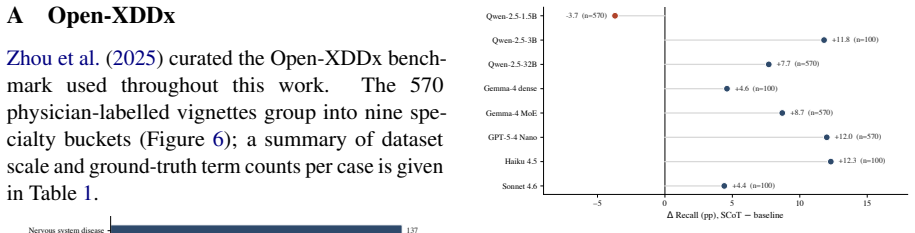
On the 570-case benchmark used in this paper, SCoT with five specialist personas improves macro recall by 4.4–12.3 percentage points over the same model's single-agent baseline across capable backends, while the smallest tested model loses 3.7 points. The decisive control uses Qwen-2.5-32B: best-of-5 reaches 0.524 recall, best-of-35 reaches 0.537, best-of-35 with a judge reaches 0.499, and all three lower precision and F1 compared with SCoT's 0.607 recall, 0.509 precision, and 0.531 F1. A single agent run through the SCoT pipeline loses recall (−5.44 points) but gains precision (+10.74 points), indicating that the pipeline's voting mechanism filters rather than broadens without heterogeneity. SCoT's lift is difficulty-conditioned: in the hardest quartile, F1 rises 15.1 points (0.212 to 0.363), while the easiest quartile shows net decreases; in the 89 cases where baselines recovered zero ground-truth diagnoses, SCoT recovered at least one in 53.9% of them, with 36% of its true positives arriving through late refinement.
Load-bearing premise
The load-bearing premise is that the best-of-n experiment gives the monolithic model a fair, compute-matched chance against SCoT; if SCoT actually consumes far more prompts and tokens per case, the headline "no advantage for monolithic inference" may be an artifact of unequal effort, and the majority-vote aggregation may further disadvantage repeated sampling.
Editorial extensions
If this is right
- If SCoT's claim holds, a fixed open-weight LLM can gain 4–12 percentage points of diagnostic recall without fine-tuning or a larger model, by spending inference budget on structured multi-agent deliberation.
- Repeated sampling with the same model does not automatically recover the same recall at the compare budgets tested, so test-time scaling alone is not a substitute for heterogeneous multi-agent structure.
- Deployment can be difficulty-aware: cases that a monolithic baseline handles confidently can stay on the cheaper single-pass path, while low-confidence or hard cases get the SCoT panel, because SCoT's gains concentrate there and it can hurt precision on easy cases.
- There is a capability floor for social scaling; small models below the threshold (around 1.5B parameters in the Qwen family) should not be placed in multi-agent deliberation, since SCoT makes them worse.
- The architecture adds transparency: each round records which specialist proposed, challenged, and revised which diagnoses, producing an audit trail of how the final differential was formed.
Reading between the lines
- A natural next test is token-matched rather than pass-matched compute: count the total prompts and generated tokens SCoT consumes, then give a single model that same budget via repeated sampling with union-of-samples recall. If the gap narrows, the "social" part of the gain shrinks; if it persists, SCoT's claim is robust.
- SCoT's difficulty-conditioned results suggest a routing rule the paper does not itself propose: reserve multi-agent deliberation for cases where a monolithic baseline is uncertain, and keep the cheap single-pass path for easy cases.
- The reported error-correlation results imply persona conditioning accounts for only a modest decorrelation; a counterfactual that isolates conversation itself—same personas, same rounds, but no cross-agent messages—would separate the social mechanism from static panel diversity.
- SCoT-like panels may transfer to other high-stakes reasoning tasks where candidate sets must be broadened before consensus is applied, such as failure diagnosis in engineering systems; the paper mentions future work beyond diagnostics but does not test it.
Signed reviews
Editorial analysis
A structured set of objections, weighed in public.
Referee Report
Summary. The paper introduces Social Chain of Thought (SCoT), a multi-round, multi-agent architecture for medical differential diagnosis. Five persona-conditioned specialist agents generated by a single backend LLM deliberate over seven rounds (specialist ranking, symptom management, independent differentials, master list, three refinement sub-rounds, credibility-weighted Borda voting, and a final 'can't miss' safety round) to produce a ranked differential diagnosis. The authors evaluate SCoT on the Open-XDDx benchmark (570 physician-curated vignettes) across eight backend models, comparing against single-agent baselines, a single-agent SCoT ablation, and best-of-n repeated sampling with and without a judge. They report consistent recall gains of 4–12 percentage points across most backends, with larger gains on harder cases, and interpret the results as evidence that SCoT's recall advantage comes from structured multi-agent heterogeneity rather than from additional compute or repeated monolithic sampling.
Significance. If the central claim were established, the paper would make a meaningful contribution: it shows a concrete task domain (medical differential diagnosis) where a structured multi-agent interaction protocol with a single backend model outperforms repeated sampling at matched or greater inference budgets, and it provides a reproducible pipeline with open-weight models. The paper also contains useful ablations (agent count, temperature, single-agent pipeline) and a difficulty-conditioned analysis that identifies where the architecture helps most. However, the paper's headline claim—that SCoT's recall advantage is not reproduced by monolithic inference and scaling—rests on a best-of-n control that is not compute-matched and on an aggregation rule that is compared asymmetrically. The cross-model results also contain a case-count mismatch for the Claude Haiku 4.5 condition. These issues are load-bearing; until they are fixed, the social-scaling interpretation is not supported.
major comments (4)
- [§5.4 and §6.2, Figure 3]
- [Table 2 and Figure 1]
- [Appendix F]
- [§6.3 and Figure 5]
minor comments (6)
- [Abstract]
- [§5.2 vs Appendix F.4]
- [Table 2 caption]
- [Figure 5]
- [Appendix D]
- [References]
Circularity Check
No significant circularity: SCoT's claims rest on external benchmark measurements and internal ablated baselines, not on definitions or self-citations.
full rationale
The paper's derivation chain is empirical rather than definitional. The central comparison is SCoT versus single-agent baseline, one-agent pipeline ablation, and best-of-n repeated sampling, all run on the externally curated Open-XDDx benchmark (Zhou et al., 2025). No parameter is fitted to the test labels, and the Appendix F credibility weights are hand-specified heuristics rather than fitted quantities; despite being tunable-looking, the paper gives no evidence that they were optimized on the benchmark, so they do not constitute a fitted input renamed as a prediction. The cited prior work on multi-agent debate, Delphi consensus, and repeated sampling is external and used as design inspiration or as an independent baseline method, not as a load-bearing self-citation. The strongest concern identified by a skeptical reading is that the best-of-n control is not compute-matched and uses majority-vote aggregation, which may suppress monolithic recall; however, that is a threat to the validity of the comparison as evidence for 'social scaling,' not a case where the claimed result is equal to its inputs by construction. A best-of-n arm with more passes or a recall-friendlier aggregation rule could in principle match or exceed SCoT, so the outcome is not analytically forced. Under the required standard of exhibiting a specific reduction from the paper's own equations or citations, no circular step is present.
Assumptions & free parameters
free parameters (6)
- Voting weight coefficients (Insight/Breadth/Actionability) =
2.5, 1.5, 1.0
- Actionability threshold =
2 evidence items, 20 points
- Valence multiplier thresholds =
0.6, 0.8, 1.0, 1.2
- Credibility cap =
2 times median DES
- Borda point scheme =
3, 2, 1 points for 1st, 2nd, 3rd choices
- Agent count and temperature split =
5 agents: 2 innovative T=0.7, 3 conservative T=0.3
assumptions (4)
- domain assumption Open-XDDx ground-truth labels and Boolean matching are a valid measure of diagnostic recall
- domain assumption Persona-conditioned agents from a single backend LLM provide meaningful heterogeneity
- domain assumption The Delphi-inspired pipeline is a faithful operationalization of medical deliberation
- domain assumption Temperature-based sampling diversity is a proxy for model diversity
Cite this review
Pith. "Pith review of Social Chain of Thought: A Multi-Agent Architecture Grounded in Medical Differential Diagnosis Methodology." pith.science (2026). https://pith.science/paper/AMQ4FYPI
@misc{pith2026260811420,
  author       = {Pith},
  title        = {Pith review of: Social Chain of Thought: A Multi-Agent Architecture Grounded in Medical Differential Diagnosis Methodology},
  year         = {2026},
  howpublished = {\url{https://pith.science/paper/AMQ4FYPI}},
  note         = {Machine review of arXiv:2608.11420}
}
read the original abstract
Medical diagnostic reasoning is a high-impact use case for LLMs that carries significant implications for the health and wellbeing of users. When OpenAI (2026) reports that more than 5% of ChatGPT messages globally are healthcare-related, the transparency of these systems becomes a serious design concern. This is especially true for complex cases, where differential diagnosis often requires integrating multiple forms of specialist reasoning. Existing work has proposed multi-agent approaches to medical diagnosis, but it remains unclear when such systems are needed, why they help, and where they outperform monolithic inference. We introduce Social Chain of Thought (SCoT),a multi-round pipeline for medical differential diagnosis that structures multi-agent interaction as a deliberative framework for collabora. tive LLM reasoning. Evaluating SCoT against single-agent baselines, one-agent pipeline ablations, and best-of-n scaling, we show that its recall advantage is not reproduced by monolithic inference alone. SCoT is most successful in the hardest diagnostic cases, where multiple rounds of specialist conversation help recover ground-truth diagnoses and converge on a higher-recall differential.
Figures


Figures from the paper (5 more)



Reference graph
Works this paper leans on
-
[1]
Anthropic . 2025 a . Claude C ode. https://www.anthropic.com/claude-code. Command-line coding agent for Claude ; accessed 2026-05-23
work page 2025
-
[2]
Anthropic . 2025 b . https://www.anthropic.com/claude-haiku-4-5-system-card Claude haiku 4.5 system card . Technical report, Anthropic
work page 2025
-
[3]
Anthropic . 2025 c . https://www.anthropic.com/claude-sonnet-4-6-system-card Claude sonnet 4.6 system card . Technical report, Anthropic
work page 2025
-
[4]
Le, Christopher R \'e , and Azalia Mirhoseini
Bradley Brown, Jordan Juravsky, Ryan Ehrlich, Ronald Clark, Quoc V. Le, Christopher R \'e , and Azalia Mirhoseini. 2024. http://arxiv.org/abs/2407.21787 Large language monkeys: Scaling inference compute with repeated sampling . Computing Research Repository, arXiv:2407.21787
arXiv 2024
-
[5]
Mert Cemri, Melissa Z. Pan, Shuyi Yang, Lakshya A. Agrawal, Bhavya Chopra, Rishabh Tiwari, Kurt Keutzer, Aditya Parameswaran, Dan Klein, Kannan Ramchandran, Matei Zaharia, Joseph E. Gonzalez, and Ion Stoica. 2025. http://arxiv.org/abs/2503.13657 Why do multi-agent LLM systems fail? In Advances in Neural Information Processing Systems ( NeurIPS 2025) Track...
arXiv 2025
-
[6]
Chi-Min Chan, Weize Chen, Yusheng Su, Jianxuan Yu, Wei Xue, Shanghang Zhang, Jie Fu, and Zhiyuan Liu. 2024. http://arxiv.org/abs/2308.07201 ChatEval : Towards better LLM -based evaluators through multi-agent debate . In Proceedings of the Twelfth International Conference on Learning Representations ( ICLR 2024)
arXiv 2024
-
[7]
Justin Chih-Yao Chen, Swarnadeep Saha, and Mohit Bansal. 2024. http://arxiv.org/abs/2309.13007 ReConcile : Round-table conference improves reasoning via consensus among diverse LLM s . In Proceedings of the 62nd Annual Meeting of the Association for Computational Linguistics (Volume 1: Long Papers), pages 7066--7085. Association for Computational Linguistics
arXiv 2024
-
[8]
Xi Chen, Huahui Yi, Mingke You, WeiZhi Liu, Li Wang, Hairui Li, Xue Zhang, Yingman Guo, Lei Fan, Gang Chen, Qicheng Lao, Weili Fu, Kang Li, and Jian Li. 2025. https://doi.org/10.1038/s41746-025-01550-0 Enhancing diagnostic capability with multi-agents conversational large language models . npj Digital Medicine, 8. Introduces the Multi-Agent Conversation (...
Show all 38 references
-
[9]
Zeming Chen, Alejandro Hern \'a ndez Cano, Angelika Romanou, Antoine Bonnet, Kyle Matoba, Francesco Salvi, Matteo Pagliardini, Simin Fan, Andreas K \"o pf, Amirkeivan Mohtashami, Alexandre Sallinen, Alireza Sakhaeirad, Vinitra Swamy, Igor Krawczuk, Deniz Bayazit, Axel Marmet, ...
2023 arXiv
-
[10]
Yufan Dang, Chen Qian, Xueheng Luo, Jingru Fan, Zihao Xie, Ruijie Shi, Weize Chen, Cheng Yang, Xiaoyin Che, Ye Tian, Xuantang Xiong, Lei Han, Zhiyuan Liu, and Maosong Sun. 2025. http://arxiv.org/abs/2505.19591 Multi-agent collaboration via evolving orchestration . In Advances ...
2025
-
[11]
Shehzaad Dhuliawala, Mojtaba Komeili, Jing Xu, Roberta Raileanu, Xian Li, Asli Celikyilmaz, and Jason Weston. 2024. http://arxiv.org/abs/2309.11495 Chain-of-verification reduces hallucination in large language models . In Findings of the Association for Computational Linguisti...
2024 arXiv
-
[12]
Tenenbaum, and Igor Mordatch
Yilun Du, Shuang Li, Antonio Torralba, Joshua B. Tenenbaum, and Igor Mordatch. 2024. http://arxiv.org/abs/2305.14325 Improving factuality and reasoning in language models through multiagent debate . In Proceedings of the 41st International Conference on Machine Learning
2024 arXiv
-
[13]
Foundation 29 . 2025. DxGPT : AI diagnostic support for complex & rare diseases. https://dxgpt.app/. Web application; accessed 2026-05-23
2025
-
[14]
Cool, Zahir Kanjee, Andrew S
Ethan Goh, Robert Gallo, Jason Hom, Eric Strong, Yingjie Weng, Hannah Kerman, Jos \'e phine A. Cool, Zahir Kanjee, Andrew S. Parsons, Neera Ahuja, Eric Horvitz, Daniel Yang, Arnold Milstein, Andrew P. J. Olson, Adam Rodman, and Jonathan H. Chen. 2024. https://doi.org/10.1001/j...
2024
-
[15]
Google . 2025. Agent garden: Samples for learning, discovering and building. Google Developers Blog. https://developers.googleblog.com/agent-garden-samples-for-learning-discovering-and-building/. Authored by K. Patlolla and T. M \'a gedli. Curated library of prebuilt agent sam...
2025
-
[16]
Google DeepMind . 2026. Gemma 4 : Byte for byte, the most capable open models. Google Blog. https://blog.google/innovation-and-ai/technology/developers-tools/gemma-4/. Authored by C. Farabet and O. Lacombe. Open-weight model release; variants include E2B, E4B, 26B-A4B MoE , an...
2026
-
[17]
Brent Graham, Glenn Regehr, and James G. Wright. 2003. https://doi.org/10.1016/S0895-4356(03)00211-7 Delphi as a method to establish consensus for diagnostic criteria . Journal of Clinical Epidemiology, 56(12):1150--1156
2003 doi
-
[18]
Chawla, Olaf Wiest, and Xiangliang Zhang
Taicheng Guo, Xiuying Chen, Yaqi Wang, Ruidi Chang, Shichao Pei, Nitesh V. Chawla, Olaf Wiest, and Xiangliang Zhang. 2024. http://arxiv.org/abs/2402.01680 Large language model based multi-agents: A survey of progress and challenges . Proceedings of the 33rd International Joint...
2024 arXiv
-
[19]
Audrey Huang, Adam Block, Qinghua Liu, Nan Jiang, Akshay Krishnamurthy, and Dylan J. Foster. 2025. http://arxiv.org/abs/2503.21878 Is best-of- N the best of them? C overage, scaling, and optimality in inference-time alignment . Computing Research Repository, arXiv:2503.21878
2025 arXiv
-
[20]
Jie Huang, Xinyun Chen, Swaroop Mishra, Huaixiu Steven Zheng, Adams Wei Yu, Xinying Song, and Denny Zhou. 2024. http://arxiv.org/abs/2310.01798 Large language models cannot self-correct reasoning yet . In International Conference on Learning Representations ( ICLR )
2024 arXiv
-
[21]
Ryo Kamoi, Yusen Zhang, Nan Zhang, Jiawei Han, and Rui Zhang. 2024. http://arxiv.org/abs/2406.01297 When can LLMs actually correct their own mistakes? A critical survey of self-correction of LLMs . Transactions of the Association for Computational Linguistics, 12:1417--1440
2024 arXiv
-
[22]
Guohao Li, Hasan Abed Al Kader Hammoud, Hani Itani, Dmitrii Khizbullin, and Bernard Ghanem. 2023. http://arxiv.org/abs/2303.17760 CAMEL : Communicative agents for ``mind'' exploration of large language model society . In Advances in Neural Information Processing Systems, volume 36
2023 arXiv
-
[23]
Wenliang Li, Rui Yan, Xu Zhang, Li Chen, Hongji Zhu, Jing Zhao, Junjun Li, Mengru Li, Wei Cao, Zihang Jiang, Wei Wei, Kun Zhang, and Shaohua Kevin Zhou. 2025. http://arxiv.org/abs/2509.20067 MACD : Multi-agent clinical diagnosis with self-learned knowledge for LLM . Computing ...
2025
-
[24]
Tian Liang, Zhiwei He, Wenxiang Jiao, Xing Wang, Yan Wang, Rui Wang, Yujiu Yang, Shuming Shi, and Zhaopeng Tu. 2024. https://doi.org/10.18653/v1/2024.emnlp-main.992 Encouraging divergent thinking in large language models through multi-agent debate . In Proceedings of the 2024 ...
2024 doi
-
[25]
Gorle, Maahe Zehra Kazmi, Ayesha Mohsin, Muhammad Usman Rafique, Zihao He, Pulkit Mehta, Muhammad Ali Jamshed, and John M
Muhammad Ahmed Mohsin, Muhammad Umer, Ahsan Bilal, Zeeshan Memon, Muhammad Ibtsaam Qadir, Sagnik Bhattacharya, Hassan Rizwan, Abhiram R. Gorle, Maahe Zehra Kazmi, Ayesha Mohsin, Muhammad Usman Rafique, Zihao He, Pulkit Mehta, Muhammad Ali Jamshed, and John M. Cioffi. 2025. htt...
2025
-
[26]
OpenAI . 2025 a . ChatGPT agent system card. https://deploymentsafety.openai.com/chatgpt-agent. System card for ChatGPT Agent (unified agent mode combining Operator browser use and Deep Research ); accessed 2026-05-23
2025
-
[27]
OpenAI . 2025 b . https://cdn.openai.com/gpt-5-system-card.pdf GPT-5 system card . Technical report, OpenAI
2025
-
[28]
OpenAI . 2026. https://cdn.openai.com/pdf/2cb29276-68cd-4ec6-a5f4-c01c5e7a36e9/OpenAI-AI-as-a-Healthcare-Ally-Jan-2026.pdf AI as a healthcare ally: How Americans are navigating the system with ChatGPT . Technical report, OpenAI
2026
- [29]
-
[30]
O'Brien, Carrie J
Joon Sung Park, Joseph C. O'Brien, Carrie J. Cai, Meredith Ringel Morris, Percy Liang, and Michael S. Bernstein. 2023. https://doi.org/10.1145/3586183.3606763 Generative agents: Interactive simulacra of human behavior . In Proceedings of the 36th Annual ACM Symposium on User I...
2023
-
[31]
Qwen Team . 2025. http://arxiv.org/abs/2412.15115 Qwen2.5 technical report . Technical Report arXiv:2412.15115, Alibaba Group. Released December 2024; revised January 2025
2025 arXiv
-
[32]
Te, Steven A
Ashwin Ramaswamy, Alvira Tyagi, Hannah Hugo, Joy Jiang, Pushkala Jayaraman, Mateen Jangda, Alexis E. Te, Steven A. Kaplan, Joshua Lampert, Robert Freeman, Nicholas Gavin, Ashutosh K. Tewari, Ankit Sakhuja, Bilal Naved, Alexander W. Charney, Mahmud Omar, Michael A. Gorin, Eyal ...
2026 doi
-
[33]
Sara Mahdavi, Christopher Semturs, Juraj Gottweis, Joelle Barral, and 5 others
Tao Tu, Anil Palepu, Mike Schaekermann, Khaled Saab, Jan Freyberg, Ryutaro Tanno, Amy Wang, Brenna Amin, Nenad Tomasev, Shekoofeh Azizi, Karan Singhal, Yong Cheng, Le Hou, Albert Webson, Kavita Kulkarni, S. Sara Mahdavi, Christopher Semturs, Juraj Gottweis, Joelle Barral, and ...
2024 arXiv
-
[34]
Chi, Quoc V
Jason Wei, Xuezhi Wang, Dale Schuurmans, Maarten Bosma, Brian Ichter, Fei Xia, Ed H. Chi, Quoc V. Le, and Denny Zhou. 2022. http://arxiv.org/abs/2201.11903 Chain-of-thought prompting elicits reasoning in large language models . In Advances in Neural Information Processing Syst...
2022 arXiv
-
[35]
Kai Xiong, Xiao Ding, Yixin Cao, Ting Liu, and Bing Qin. 2023. http://arxiv.org/abs/2305.11595 Examining inter-consistency of large language models collaboration: An in-depth analysis via debate . In Findings of the Association for Computational Linguistics: EMNLP 2023 . Intro...
2023 arXiv
-
[36]
Yongjin Yang, Euiin Yi, Jongwoo Ko, Kimin Lee, Zhijing Jin, and Se-Young Yun. 2025. http://arxiv.org/abs/2505.22960 Revisiting multi-agent debate as test-time scaling: A systematic study of conditional effectiveness . Computing Research Repository, arXiv:2505.22960
2025 arXiv
-
[37]
Yusen Zhang, Ruoxi Sun, Yanfei Chen, Tomas Pfister, Rui Zhang, and Sercan \"O . Arik. 2024. http://arxiv.org/abs/2406.02818 Chain of agents: Large language models collaborating on long-context tasks . In Advances in Neural Information Processing Systems ( NeurIPS 2024)
2024 arXiv
-
[38]
Shuai Zhou, Mingquan Xu, and 1 others. 2025. https://doi.org/10.1038/s44401-025-00015-6 Explainable differential diagnosis with dual-inference large language models . npj Health Systems, 2(1):12
2025 doi
Reviewed August 15, 2026 · model on record in the stance chip above.
Discussion (0). Continue with ORCID to comment.