Few-class Fidelity: Evaluating Explanations of Real-conditions CNN classifiers with Optimized Perturbations
Pith reviewed 2026-06-30 09:44 UTC · model grok-4.3
The pith
Few-class fidelity metric evaluates XAI explanations using optimized perturbations
A machine-rendered reading of the paper's core claim, the machinery that carries it, and where it could break.
Core claim
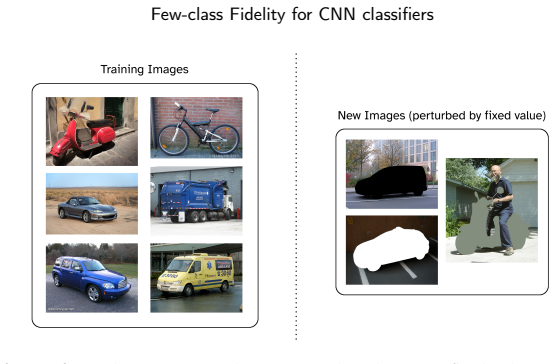
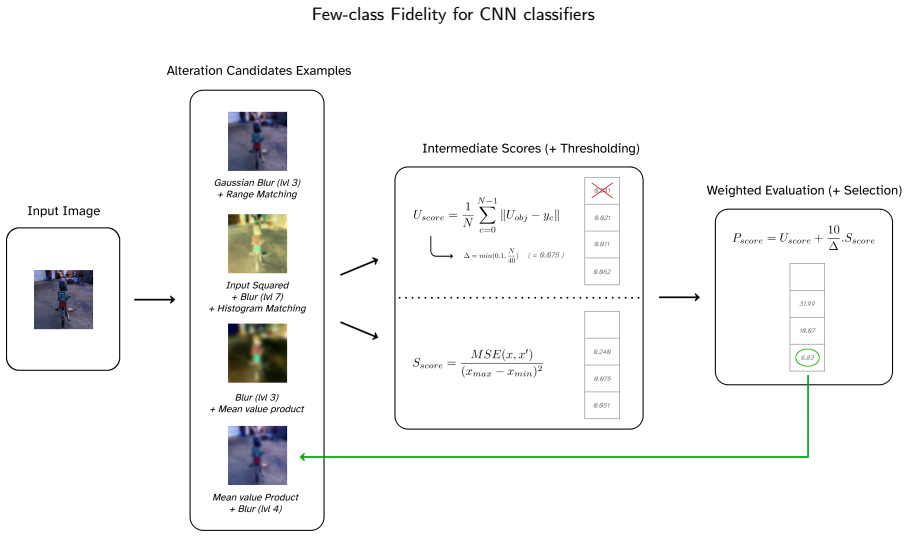
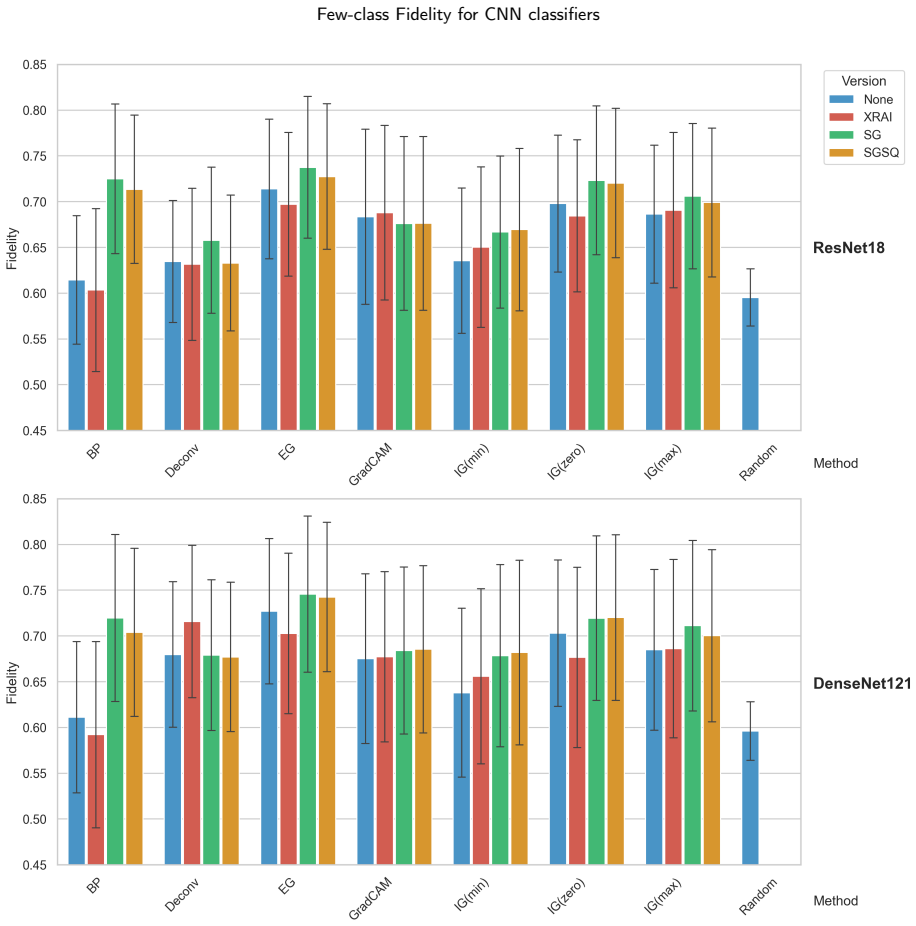
The central claim is that a variation of fidelity metrics, using in-distribution uncertainty-provoking perturbations, properly measures the faithfulness of XAI explanations for few-class CNN classifiers in real conditions, and this approach correlates with human-centric metrics when applied to medical and natural imaging applications.
What carries the argument
Generation of optimized in-distribution perturbations that provoke model uncertainty to quantify explanation faithfulness.
If this is right
- Enables direct comparison of different XAI methods in low-class real-world scenarios.
- Reveals correlations between application domain, data curation practices, and suitable XAI solutions.
- Supports validation of new CNN model training through reliable explanation assessment.
- Demonstrates utility in both medical imaging and natural image classification tasks.
Where Pith is reading between the lines
- The method could extend to evaluating explanations in multi-class settings with adjustments.
- It implies that current XAI evaluations may be unreliable without accounting for class count and distribution.
- Future work might test the perturbations on other model architectures like transformers.
Load-bearing premise
Optimized perturbations can be created that stay in the training distribution while still causing enough uncertainty to test explanation quality accurately.
What would settle it
A test where the perturbations either exit the data distribution or do not increase model uncertainty would show the metric does not work as intended.
Figures



read the original abstract
The wide use of Convolutional Neural Networks (CNN) in numerous domains and real-world classification applications is justified by their high precision and automation speed, helping users concentrate on higher-expertise tasks. To better understand the models and avoid bias during deployment, eXplainable Artificial Intelligence (XAI) techniques can be used after training. But as the list of XAI solutions expand, comparisons between them diverge, and consensus over their evaluation cannot be reached. This paper proposes a variation of Fidelity-based XAI metrics, with a focus on real-conditions applications, where the number of classes is often low. The approach generates in-distribution, uncertainty-provoking perturbations, to ensure proper measurement of the XAI methods faithfulness. As demonstration of the evaluation framework usefulness, it is compared with human-centric object localization and segmentation metrics. Once applied to both medical and natural imaging applications, it highlights the intricate correlation between domain, data curation, and XAI solution choices in order to validate training of a new CNN model.
Editorial analysis
A structured set of objections, weighed in public.
Referee Report
Summary. The manuscript proposes 'Few-class Fidelity,' a variation on fidelity-based XAI evaluation metrics tailored to real-world CNN classifiers that operate with few classes. It generates in-distribution perturbations via an optimization procedure intended to provoke model uncertainty, thereby providing a more faithful measure of explanation quality. The framework is demonstrated through comparison against human object-localization and segmentation metrics on both medical and natural-image datasets, with the results used to illustrate dependencies among domain, data curation, and choice of XAI method when validating a new CNN.
Significance. If the optimization can be shown to produce perturbations that remain in-distribution while reliably inducing uncertainty, the metric could supply a practical, domain-aware alternative to existing fidelity measures for low-class regimes. The explicit cross-domain comparison with human metrics offers an additional validation axis that is rarely quantified in XAI papers; however, the absence of any equations, loss terms, or tabulated results in the supplied text limits any assessment of whether these strengths are realized.
major comments (2)
- [Abstract] Abstract: the central claim that the perturbations are 'in-distribution' and 'uncertainty-provoking' is stated without any objective function, constraint set, or optimization algorithm. Because this construction is load-bearing for the definition of Few-class Fidelity, the metric cannot be reproduced or its faithfulness properties evaluated from the given text.
- [Abstract] Abstract: the comparison to 'human-centric object localization and segmentation metrics' is described only qualitatively; no quantitative scores, correlation coefficients, or error bars are supplied. This comparison is presented as the primary demonstration of the framework's usefulness, yet the lack of results prevents verification of the claimed 'intricate correlation' between domain and XAI choice.
Simulated Author's Rebuttal
We thank the referee for the constructive comments highlighting the need for greater detail in the abstract. We address each point below and will revise the abstract to improve reproducibility and support for the claims while preserving its concise nature.
read point-by-point responses
-
Referee: [Abstract] Abstract: the central claim that the perturbations are 'in-distribution' and 'uncertainty-provoking' is stated without any objective function, constraint set, or optimization algorithm. Because this construction is load-bearing for the definition of Few-class Fidelity, the metric cannot be reproduced or its faithfulness properties evaluated from the given text.
Authors: We agree that the abstract does not include the specific objective function, constraints, or optimization algorithm, which limits standalone reproducibility. The full manuscript details the optimization procedure, including loss terms that enforce in-distribution perturbations while maximizing model uncertainty. To address the concern, we will revise the abstract to briefly reference the optimization framework and its key properties. revision: yes
-
Referee: [Abstract] Abstract: the comparison to 'human-centric object localization and segmentation metrics' is described only qualitatively; no quantitative scores, correlation coefficients, or error bars are supplied. This comparison is presented as the primary demonstration of the framework's usefulness, yet the lack of results prevents verification of the claimed 'intricate correlation' between domain and XAI choice.
Authors: We agree that the abstract presents the comparison only qualitatively and omits quantitative scores, correlations, or error bars. The full manuscript reports these results from experiments on medical and natural-image datasets. We will revise the abstract to include key quantitative findings that illustrate the domain-XAI dependencies. revision: yes
Circularity Check
No significant circularity
full rationale
The paper introduces a variation on fidelity metrics for XAI evaluation in few-class real-world settings by generating in-distribution uncertainty-provoking perturbations and validating against human localization/segmentation metrics. No equations, derivations, or self-citations are shown that reduce the proposed metric or its 'predictions' to quantities fitted from the same data or to prior author work by construction. The approach is presented as an independent evaluation framework with external human-centric benchmarks, making the derivation self-contained against external validation.
Axiom & Free-Parameter Ledger
axioms (2)
- domain assumption Perturbations exist that remain in-distribution for the target CNN while reliably increasing predictive uncertainty
- domain assumption Agreement between the new fidelity scores and human object localization/segmentation metrics demonstrates the framework's usefulness
Reference graph
Works this paper leans on
-
[1]
Sanitychecksforsaliencymaps
Adebayo,J.,Gilmer,J.,Muelly,M.,Goodfellow,I.,Hardt,M.,Kim,B.,2018. Sanitychecksforsaliencymaps. Advancesinneuralinformation processing systems 31
2018
-
[2]
Explainingimageclassifiersbyremovinginputfeaturesusinggenerativemodels,in:ProceedingsoftheAsian Conference on Computer Vision
Agarwal,C.,Nguyen,A.,2020. Explainingimageclassifiersbyremovinginputfeaturesusinggenerativemodels,in:ProceedingsoftheAsian Conference on Computer Vision. W. Marchadour et al.:Preprint submitted to ElsevierPage 14 of 16 Few-class Fidelity for CNN classifiers
2020
-
[3]
Towards better understanding of gradient-based attribution methods for Deep Neural Networks
Ancona, M., Ceolini, E., Öztireli, C., Gross, M., 2017. Towards better understanding of gradient-based attribution methods for deep neural networks. arXiv preprint arXiv:1711.06104
work page internal anchor Pith review Pith/arXiv arXiv 2017
-
[4]
Fairwashing explanations with off-manifold detergent, in: International Conference on Machine Learning, PMLR
Anders, C., Pasliev, P., Dombrowski, A.K., Müller, K.R., Kessel, P., 2020. Fairwashing explanations with off-manifold detergent, in: International Conference on Machine Learning, PMLR. pp. 314–323
2020
-
[5]
The lung image database consortium (lidc) and image database resource initiative (idri): a completed reference database of lung nodules on ct scans
ArmatoIII,S.G.,McLennan,G.,Bidaut,L.,McNitt-Gray,M.F.,Meyer,C.R.,Reeves,A.P.,Zhao,B.,Aberle,D.R.,Henschke,C.I.,Hoffman, E.A., et al., 2011. The lung image database consortium (lidc) and image database resource initiative (idri): a completed reference database of lung nodules on ct scans. Medical physics 38, 915–931
2011
-
[6]
Brocki, L., Marchadour, W., Maison, J., Badic, B., Papadimitroulas, P., Hatt, M., Vermet, F., Chung, N.C., 2022. Evaluation of importance estimatorsindeeplearningclassifiersforcomputedtomography,in:InternationalWorkshoponExplainable,TransparentAutonomousAgents and Multi-Agent Systems, Springer. pp. 3–18
2022
-
[7]
Explaining Image Classifiers by Counterfactual Generation
Chang, C.H., Creager, E., Goldenberg, A., Duvenaud, D., 2018. Explaining image classifiers by counterfactual generation. arXiv preprint arXiv:1807.08024
work page internal anchor Pith review Pith/arXiv arXiv 2018
-
[8]
Real time image saliency for black box classifiers
Dabkowski, P., Gal, Y., 2017. Real time image saliency for black box classifiers. Advances in neural information processing systems 30
2017
-
[9]
Improving performance of deep learning models with axiomatic attribution priors and expected gradients
Erion, G., Janizek, J.D., Sturmfels, P., Lundberg, S.M., Lee, S.I., 2021. Improving performance of deep learning models with axiomatic attribution priors and expected gradients. Nature machine intelligence 3, 620–631
2021
-
[10]
Interpretableexplanationsofblackboxesbymeaningfulperturbation,in:ProceedingsoftheIEEEinternational conference on computer vision, pp
Fong,R.C.,Vedaldi,A.,2017. Interpretableexplanationsofblackboxesbymeaningfulperturbation,in:ProceedingsoftheIEEEinternational conference on computer vision, pp. 3429–3437
2017
-
[11]
Counterfactualvisualexplanations,in:InternationalConferenceonMachine Learning, PMLR
Goyal,Y.,Wu,Z.,Ernst,J.,Batra,D.,Parikh,D.,Lee,S.,2019. Counterfactualvisualexplanations,in:InternationalConferenceonMachine Learning, PMLR. pp. 2376–2384
2019
-
[12]
Evaluating feature importance estimates
Hooker, S., Erhan, D., Kindermans, P.J., Kim, B., 2018. Evaluating feature importance estimates. arXiv preprint arXiv:1806.10758 2
-
[13]
A benchmark for interpretability methods in deep neural networks
Hooker, S., Erhan, D., Kindermans, P.J., Kim, B., 2019. A benchmark for interpretability methods in deep neural networks. Advances in neural information processing systems 32
2019
-
[14]
Poisoningandevasionattacksagainstdeeplearningalgorithmsinautonomousvehicles
Jiang,W.,Li,H.,Liu,S.,Luo,X.,Lu,R.,2020. Poisoningandevasionattacksagainstdeeplearningalgorithmsinautonomousvehicles. IEEE transactions on vehicular technology 69, 4439–4449
2020
-
[15]
Xrai: Better attributions through regions, in: Proceedings of the IEEE/CVF international conference on computer vision, pp
Kapishnikov, A., Bolukbasi, T., Viégas, F., Terry, M., 2019. Xrai: Better attributions through regions, in: Proceedings of the IEEE/CVF international conference on computer vision, pp. 4948–4957
2019
-
[16]
Adversarial deep learning: A survey on adversarial attacks and defense mechanisms on image classification
Khamaiseh, S.Y., Bagagem, D., Al-Alaj, A., Mancino, M., Alomari, H.W., 2022. Adversarial deep learning: A survey on adversarial attacks and defense mechanisms on image classification. IEEE Access 10, 102266–102291
2022
-
[17]
Lin,Y.S.,Lee,W.C.,Celik,Z.B.,2021. Whatdoyousee?evaluationofexplainableartificialintelligence(xai)interpretabilitythroughneural backdoors, in: Proceedings of the 27th ACM SIGKDD conference on knowledge discovery & data mining, pp. 1027–1035
2021
-
[18]
Methods for interpreting and understanding deep neural networks
Montavon, G., Samek, W., Müller, K.R., 2018. Methods for interpreting and understanding deep neural networks. Digital signal processing 73, 1–15
2018
-
[19]
Universaladversarialperturbations,in:ProceedingsoftheIEEEconference on computer vision and pattern recognition, pp
Moosavi-Dezfooli,S.M.,Fawzi,A.,Fawzi,O.,Frossard,P.,2017. Universaladversarialperturbations,in:ProceedingsoftheIEEEconference on computer vision and pattern recognition, pp. 1765–1773
2017
-
[20]
Nam, W.J., Gur, S., Choi, J., Wolf, L., Lee, S.W., 2020. Relative attributing propagation: Interpreting the comparative contributions of individual units in deep neural networks, in: Proceedings of the AAAI conference on artificial intelligence, pp. 2501–2508
2020
-
[21]
Deepneuralnetworksareeasilyfooled:Highconfidencepredictionsforunrecognizableimages,in: Proceedings of the IEEE conference on computer vision and pattern recognition, pp
Nguyen,A.,Yosinski,J.,Clune,J.,2015. Deepneuralnetworksareeasilyfooled:Highconfidencepredictionsforunrecognizableimages,in: Proceedings of the IEEE conference on computer vision and pattern recognition, pp. 427–436
2015
-
[22]
Lndb: a lung nodule database on computed tomography
Pedrosa,J.,Aresta,G.,Ferreira,C.,Rodrigues,M.,Leitão,P.,Carvalho,A.S.,Rebelo,J.,Negrão,E.,Ramos,I.,Cunha,A.,etal.,2019. Lndb: a lung nodule database on computed tomography. arXiv preprint arXiv:1911.08434
-
[23]
RISE: Randomized Input Sampling for Explanation of Black-box Models
Petsiuk, V., Das, A., Saenko, K., 2018. Rise: Randomized input sampling for explanation of black-box models. arXiv preprint arXiv:1806.07421
work page internal anchor Pith review Pith/arXiv arXiv 2018
-
[24]
Resisting out-of-distribution data problem in perturbation of xai
Qiu, L., Yang, Y., Cao, C.C., Liu, J., Zheng, Y., Ngai, H.H.T., Hsiao, J., Chen, L., 2021. Resisting out-of-distribution data problem in perturbation of xai. arXiv preprint arXiv:2107.14000
-
[25]
why should i trust you?
Ribeiro, M.T., Singh, S., Guestrin, C., 2016. " why should i trust you?" explaining the predictions of any classifier, in: Proceedings of the 22nd ACM SIGKDD international conference on knowledge discovery and data mining, pp. 1135–1144
2016
-
[26]
Irof: a low resource evaluation metric for explanation methods
Rieger, L., Hansen, L.K., 2020. Irof: a low resource evaluation metric for explanation methods. arXiv preprint arXiv:2003.08747
-
[27]
Evaluating the visualization of what a deep neural network has learned
Samek, W., Binder, A., Montavon, G., Lapuschkin, S., Müller, K.R., 2016. Evaluating the visualization of what a deep neural network has learned. IEEE transactions on neural networks and learning systems 28, 2660–2673
2016
-
[28]
Grad-cam: Visual explanations from deep networks via gradient-based localization, in: Proceedings of the IEEE international conference on computer vision, pp
Selvaraju, R.R., Cogswell, M., Das, A., Vedantam, R., Parikh, D., Batra, D., 2017. Grad-cam: Visual explanations from deep networks via gradient-based localization, in: Proceedings of the IEEE international conference on computer vision, pp. 618–626
2017
-
[29]
Deep convolutional neural networks for computer-aided detection: Cnn architectures, dataset characteristics and transfer learning
Shin, H.C., Roth, H.R., Gao, M., Lu, L., Xu, Z., Nogues, I., Yao, J., Mollura, D., Summers, R.M., 2016. Deep convolutional neural networks for computer-aided detection: Cnn architectures, dataset characteristics and transfer learning. IEEE transactions on medical imaging 35, 1285–1298
2016
-
[30]
A comprehensive analysis of perturbation methods in explainable ai feature attribution validation for neural time series classifiers
Šimić, I., Veas, E., Sabol, V., 2025. A comprehensive analysis of perturbation methods in explainable ai feature attribution validation for neural time series classifiers. Scientific Reports 15, 26607
2025
-
[31]
Deep Inside Convolutional Networks: Visualising Image Classification Models and Saliency Maps
Simonyan, K., Vedaldi, A., Zisserman, A., 2013. Deep inside convolutional networks: Visualising image classification models and saliency maps. arXiv preprint arXiv:1312.6034
work page internal anchor Pith review Pith/arXiv arXiv 2013
-
[32]
SmoothGrad: removing noise by adding noise
Smilkov, D., Thorat, N., Kim, B., Viégas, F., Wattenberg, M., 2017. Smoothgrad: removing noise by adding noise. arXiv preprint arXiv:1706.03825
work page internal anchor Pith review Pith/arXiv arXiv 2017
-
[33]
Axiomaticattributionfordeepnetworks,in:Internationalconferenceonmachinelearning,PMLR
Sundararajan,M.,Taly,A.,Yan,Q.,2017. Axiomaticattributionfordeepnetworks,in:Internationalconferenceonmachinelearning,PMLR. pp. 3319–3328. W. Marchadour et al.:Preprint submitted to ElsevierPage 15 of 16 Few-class Fidelity for CNN classifiers
2017
-
[34]
A deep neural network and machine learning approach for retinal fundus image classification
Thanki, R., 2023. A deep neural network and machine learning approach for retinal fundus image classification. Healthcare Analytics 3, 100140
2023
-
[35]
On the (in) fidelity and sensitivity of explanations
Yeh, C.K., Hsieh, C.Y., Suggala, A., Inouye, D.I., Ravikumar, P.K., 2019. On the (in) fidelity and sensitivity of explanations. Advances in neural information processing systems 32
2019
-
[36]
Foreign object debris (fod) classification through material recognition using deep convolutional neural network with focus on metal
Zainab, S.M., Khan, K., Fazil, A., Zakwan, M., 2023. Foreign object debris (fod) classification through material recognition using deep convolutional neural network with focus on metal. IEEE Access 11, 10925–10934
2023
-
[37]
Visualizing and Understanding Convolutional Networks
Zeiler, M., Fergus, R., 2013. Visualizing and understanding convolutional networks. arxiv. arXiv preprint arXiv:1311.2901
work page internal anchor Pith review Pith/arXiv arXiv 2013
-
[38]
A survey on neural network interpretability
Zhang, Y., Tiňo, P., Leonardis, A., Tang, K., 2021. A survey on neural network interpretability. IEEE Transactions on Emerging Topics in Computational Intelligence 5, 726–742. W. Marchadour et al.:Preprint submitted to ElsevierPage 16 of 16
2021
discussion (0)
Sign in with ORCID, Apple, or X to comment. Anyone can read and Pith papers without signing in.