REVIEW 3 major objections 4 minor 95 references
A Multi-Scale Spatial Attention-Based Zero-Shot Learning Framework for Low-Light Image Enhancement
T0 review · 3 major / 4 minor · reviewed 2026-08-15 · deepseek-v4-flash
Pith's one-line read Zero-shot low-light enhancement can beat paired-supervision methods on every benchmark tested.
desk verdict A competent architectural mashup whose headline result is an artifact of averaging raw metric scores on incompatible scales; the per-metric evidence is mixed. read the letter →
The pith
A machine-rendered reading of the paper's core claim, the machinery that carries it, and where it could break.
The reading
What carries the argument
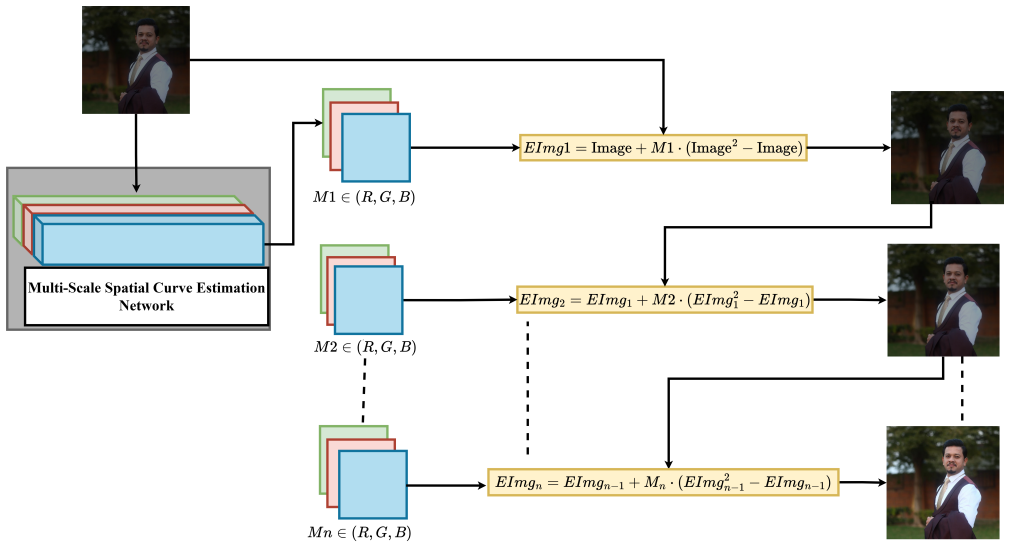
The load-bearing object is the multi-scale spatial curve estimation network: the input image is processed at full, half, and quarter resolution by parallel stacks of depthwise separable convolutions, fused hierarchically, passed through a spatial attention block, and mapped by a final depthwise separable convolution layer with tanh activation into an enhancement curve. Enhancement is applied recurrently through the residual quadratic update $X_t = X_{t-1} + D(X_{t-1}^2 - X_{t-1})$, where $D$ is a diagonal matrix of per-pixel curve parameters predicted by the network. This structure lets the model refine exposure over iterations while staying cheap enough for deployment. The other load-bearing piece is the six-term composite loss, including total variation, spatial consistency, color constancy, exposure control, segmentation guidance, and the MUSIQ-AVA no-reference aesthetic loss, which supplies the perceptual and semantic pressure that replaces ground-truth supervision.
What would settle it
Recompute the Average rows in Tables 2 through 8 after standardizing each no-reference metric, for example by converting each method's score to a rank per metric before averaging; if LucentVisionNet does not rank first on a majority of the unpaired datasets, the headline claim is an artifact of raw-scale averaging. As a second check, evaluate all methods with a BIQA model outside the MUSIQ family that was not used in training; if the ordering changes substantially, the claimed perceptual advantage does not transfer.
Extended reading notes
Core claim
The paper's central claim is that LucentVisionNet consistently outperforms state-of-the-art supervised, unsupervised, and zero-shot low-light enhancement methods on both paired and unpaired benchmarks. On the paired LOL and LOL-v2 datasets it reports the highest PSNR among all compared methods, tied-highest SSIM and VSI, the lowest or tied-lowest LPIPS and DISTS on LOL, and the lowest MAD; on seven unpaired datasets it reports the highest average no-reference score in every table. The mechanism credited for this is the integration of multi-scale spatial attention into a deep curve estimation network, a recurrent residual enhancement step, and a composite loss whose sixth term is a no-reference aesthetic score from MUSIQ-AVA that rewards perceptually pleasing outputs during training. The authors present this as evidence that zero-shot enhancement can exceed paired methods while staying computationally light enough for near-real-time deployment.
Load-bearing premise
The superiority claims rest on averaging raw scores from no-reference metrics that have different ranges, roughly NIMA around 4, PaQ2PiQ around 60, DBCNN around 30, and CLIPIQA around 0.1, and treating the resulting average as a meaningful summary, plus the unstated assumption that optimizing the MUSIQ-AVA aesthetic score does not bias the MUSIQ-family evaluation metrics.
Editorial extensions
If this is right
- Zero-shot enhancement can match or beat paired-supervision methods on public paired benchmarks, so collecting aligned low-light and normal-light pairs may not be necessary for strong PSNR or perceptual results.
- Recurrent application of a learned quadratic curve, rather than a single pass, is a viable way to trade a little latency for better exposure and structure preservation.
- Using a differentiable no-reference aesthetic model as a training loss can steer enhancement toward human-preferred outputs without any reference image, and the same principle could transfer to other image restoration tasks.
- At roughly 1 to 1.5 seconds for 1200 by 900 images on one GPU, the architecture is near real-time enough for mobile and edge deployment, with the depthwise separable backbone being the main reason for the low cost.
Reading between the lines
- The reported average no-reference scores in Tables 2 through 8 are arithmetic means of raw values on different scales, such as NIMA around 4, PaQ2PiQ around 60, DBCNN around 30, and CLIPIQA around 0.1; redoing the comparison with per-metric ranks or z-score normalization could change the winner, so the headline highest-average claim should be read with that caveat.
- Because the same MUSIQ architecture family appears both as the training loss, MUSIQ-AVA, and as an evaluation metric, MUSIQ-Koniq, the evaluation may be biased in the model's favor; a held-out BIQA model outside that family would test how much of the gain is real perceptual improvement.
- A natural next experiment is to keep the architecture fixed and ablate the MUSIQ-AVA loss term against the other five losses, since the contribution of the paper's one novel loss has not been isolated in the experiments.
Signed reviews
Editorial analysis
A structured set of objections, weighed in public.
Referee Report
Summary. The paper introduces LucentVisionNet, a low-light image enhancement framework that combines multi-scale depthwise separable convolutions, spatial attention, and a recurrent curve estimation strategy. Training uses a composite loss with six terms, including a no-reference aesthetic loss based on MUSIQ-AVA. The authors evaluate on paired datasets (LOL, LOL-v2) with full-reference metrics and on unpaired datasets (DarkBDD, DarkCityScape, DICM, LIME, MEF, NPE, VV) with no-reference IQA metrics, and they claim that LucentVisionNet consistently outperforms supervised, unsupervised, and zero-shot baselines across all metrics.
Significance. If the empirical claims were sound, the paper would offer a practical contribution to low-light enhancement: the architecture is lightweight (depthwise separable convolutions, multi-scale fusion, residual learning) and the integration of a differentiable aesthetic quality loss is a plausible way to improve perceptual quality without paired data. The full-reference results on LOL and LOL-v2 show some encouraging improvements, notably in LPIPS and DISTS. However, the central claim of consistent superiority rests on statistically invalid aggregation of no-reference metrics and on differences that are not tested for significance. The per-metric results are mixed, so the headline claim is not supported by the evidence as presented.
major comments (3)
- [Tables 2-8, Section 6.1.1] The 'Average' rows in Tables 2-8 are computed as arithmetic means of raw scores from metrics with incompatible ranges: NIMA is roughly 3-5, PaQ2PiQ roughly 60-77, DBCNN roughly 30-60, MUSIQ-Koniq roughly 39-66, MANIQA roughly 0.5-0.7, CLIPIQA roughly 0.1-0.6, and HyperIQA/GPR-BIQA/QualityNet/PIQI roughly 0.3-0.7. This averaging gives dominant weight to the largest-scale metrics, so the resulting 'Average' is not a meaningful summary of perceptual quality. For example, on DarkBDD (Table 2) the proposed method tops the Average (18.06) despite being below the best method on NIMA (3.99 vs 4.13), PaQ2PiQ (66.73 vs 68.55), MUSIQ-Koniq (42.30 vs 45.92), MANIQA (0.55 vs 0.59), CLIPIQA (0.13 vs 0.14), and HyperIQA (0.30 vs 0.30). Similar patterns appear in Tables 3-8. The Abstract and Conclusion (Section 8) claim consistent outperformance 'across multiple full-reference and no-reference image quality metrics,' but the per-metric tables show mixed results. This is a load-bearing flaw in the central performance claim.
- [Tables 2-10, Section 6] No error bars, confidence intervals, or statistical significance tests are reported for any of the quantitative comparisons. The margins in the average scores are small in several cases (e.g., Table 2: 18.06 vs 18.02; Table 4: 24.76 vs 24.43; Table 5: 24.18 vs 24.03), and the full-reference improvements are also modest (e.g., Table 9: PSNR 18.39 vs 18.33; SSIM tied at 0.85). Without an estimate of variability across the test images, the reader cannot determine whether the reported differences are meaningful. The 'consistently outperforms' claim requires at least per-image distributions or a suitable significance test.
- [Section 4.6 and Tables 2-8] The training loss explicitly maximizes the MUSIQ-AVA aesthetic score (Eq. 23), and the evaluation includes MUSIQ-Koniq, a separate fine-tuned variant of the same MUSIQ architecture. The paper does not discuss this potential circularity: the model is optimized for a MUSIQ-family score and then evaluated with a sibling model. This weakens the independence of the MUSIQ-Koniq results as evidence of perceptual superiority. The authors should either exclude MUSIQ-family metrics from the evaluation, report results with and without the MUSIQ-based loss, or provide an argument that the loss transfers without bias to other metrics.
minor comments (4)
- [Section 5.1] The method is trained on 2,422 images from the SICE dataset, so calling it 'zero-shot learning' is misleading in the strict sense. The term 'zero-reference' (as in Zero-DCE) or 'unsupervised' would be more accurate and would avoid confusion with the established zero-shot learning literature.
- [Figure 2 caption and Table headers] The caption of Figure 2 states that scores are 'scaled to 100,' but the numbers in Tables 2-8 are raw scores, and the 'Average' rows are clearly raw averages (e.g., the DarkBDD average 18.06 matches the sum of raw values divided by 11). This inconsistency should be resolved.
- [Table 8 and Figure 5/6 captions] There are typographical inconsistencies: Figure 5 and 6 captions list '(h) Semantic Guide ZERO DCE51 and (h) Ours' with the same label (h) for two entries, and the table headers in Tables 2-8 use 'A verage' with a space in some rows (e.g., Table 2, 3, 7).
- [Introduction, paragraph on real-time] The claim of 'real-time capability' is questionable: processing a 1200x900 image in 1-1.5 seconds is not real-time for video. If the intended meaning is 'interactive,' this should be stated more precisely.
Circularity Check
No significant circularity: the paper is an empirical comparison, and its training objective is not equivalent by construction to its evaluation metrics.
full rationale
LucentVisionNet is presented as an empirical zero-shot enhancement system, not as a derived prediction from first principles. The training objective in Eq. (23) maximizes the MUSIQ-AVA aesthetic score, while the evaluation tables report MUSIQ-Koniq, a different fine-tuned instance of the same MUSIQ architecture; maximizing one score does not by construction equal the other. The full-reference metrics relied on in the conclusion (PSNR, SSIM, LPIPS, DISTS) are not part of the training loss, so the headline claim is not a renamed training target. The self-cited IQA tools (GPR-BIQA, QualityNet, PIQI) are external published models that can be applied to any image and are not fitted to this paper's outputs, so their use does not constitute a self-citation chain. The strongest legitimate concern is statistical, not circular: the 'Average' rows in Tables 2-8 arithmetically average raw scores on incompatible scales, so the reported superiority is partly an artifact of scale dominance (e.g., PaQ2PiQ near 70 vs. MANIQA near 0.6). That is a validity weakness in the evidence, but it is not a circular derivation, and no quoted equation or construction reduces the claimed result to its own input.
Assumptions & free parameters
free parameters (5)
- lambda_TV =
1600
- lambda_color =
5
- lambda_exp =
10
- lambda_seg =
0.1
- lambda_NR =
0.1
assumptions (4)
- domain assumption MUSIQ-AVA provides a differentiable and valid proxy for human aesthetic quality when used as a training objective.
- domain assumption The SICE multi-exposure training set covers the distribution of the test datasets (LOL, LIME, VV, etc.).
- domain assumption BIQA metrics used in evaluation reflect true perceptual quality and are comparable to one another.
- ad hoc to paper Averaging unnormalized metric values yields a meaningful performance comparison.
Cite this review
Pith. "Pith review of A Multi-Scale Spatial Attention-Based Zero-Shot Learning Framework for Low-Light Image Enhancement." pith.science (2026). https://pith.science/paper/AP7II5X2
@misc{pith2026250618323,
  author       = {Pith},
  title        = {Pith review of: A Multi-Scale Spatial Attention-Based Zero-Shot Learning Framework for Low-Light Image Enhancement},
  year         = {2026},
  howpublished = {\url{https://pith.science/paper/AP7II5X2}},
  note         = {Machine review of arXiv:2506.18323}
}
read the original abstract
Low-light image enhancement remains a challenging task, particularly in the absence of paired training data. In this study, we present LucentVisionNet, a novel zero-shot learning framework that addresses the limitations of traditional and deep learning-based enhancement methods. The proposed approach integrates multi-scale spatial attention with a deep curve estimation network, enabling fine-grained enhancement while preserving semantic and perceptual fidelity. To further improve generalization, we adopt a recurrent enhancement strategy and optimize the model using a composite loss function comprising six tailored components, including a novel no-reference image quality loss inspired by human visual perception. Extensive experiments on both paired and unpaired benchmark datasets demonstrate that LucentVisionNet consistently outperforms state-of-the-art supervised, unsupervised, and zero-shot methods across multiple full-reference and no-reference image quality metrics. Our framework achieves high visual quality, structural consistency, and computational efficiency, making it well-suited for deployment in real-world applications such as mobile photography, surveillance, and autonomous navigation.
Figures


Figures from the paper (3 more)


Reference graph
Works this paper leans on
-
[1]
Liba, O. et al. Handheld mobile photography in very low light. ACM Trans. Graph. 38, 164–1 (2019)
2019
-
[2]
& Asif, S
Ahmed, N. & Asif, S. Biq2021: a large-scale blind image quality assessment database. J. Electron. Imaging 31, 053010–053010 (2022)
2022
-
[4]
Ahmed, N., Asif, H. M. S. & Khalid, H. Image quality assessment using a combination of hand-crafted and deep features. In International Conference on Intelligent Technologies and Applications, 593–605 (Springer, 2019)
2019
-
[5]
Aslam, M. A. et al. Vrl-iqa: Visual representation learning for image quality assessment. IEEE Access 12, 2458–2473 (2023)
2023
-
[6]
Ahmed, N., Shahzad Asif, H., Bhatti, A. R. & Khan, A. Deep ensembling for perceptual image quality assessment. Soft Comput. 26, 7601–7622 (2022)
2022
-
[7]
Ahmed, N., Asif, H. M. S., Saleem, G. & Younus, M. U. Image quality assessment for foliar disease identification (agropath). J. Agric. Res. (03681157) 59 (2021)
2021
-
[8]
& Asif, H
Ahmed, N. & Asif, H. M. S. Ensembling convolutional neural networks for perceptual image quality assessment. In 2019 13th International conference on mathematics, actuarial science, computer science and statistics (MACS) , 1–5 (IEEE, 2019)
2019
-
[11]
Saleem, G., Bajwa, U. I. & Raza, R. H. Toward human activity recognition: a survey.Neural Comput. Appl. 35, 4145–4182 (2023)
2023
Show all 95 references
-
[12]
Saleem, G. et al. Efficient anomaly recognition using surveillance videos. PeerJ Comput. Sci. 8, e1117 (2022)
2022
-
[13]
Aslam, M. A. et al. Tqp: An efficient video quality assessment framework for adaptive bitrate video streaming. IEEE Access (2024)
2024
-
[14]
& GAO, X
Tao, Q., Ren, K., Feng, B. & GAO, X. An accurate low-light object detection method based on pyramid networks. In Optoelectronic Imaging and Multimedia Technology VII, vol. 11550, 253–260 (SPIE, 2020)
2020
-
[15]
& Kshirsagar, A
Agrawal, A., Jadhav, N., Gaur, A., Jeswani, S. & Kshirsagar, A. Improving the accuracy of object detection in low light conditions using multiple retinex theory-based image enhancement algorithms. In 2022 Second International Conference on Advances in Electrical, Computing, Co...
2022
-
[16]
H., Dewan, M
Abdullah-Al-Wadud, M., Kabir, M. H., Dewan, M. A. A. & Chae, O. A dynamic histogram equalization for image contrast enhancement. IEEE transactions on consumer electronics 53, 593–600 (2007). 18/22
2007
-
[17]
& Arshad, S
Ahmed, N., Ahmed, W. & Arshad, S. M. Digital radiographic image enhancement for improved visualization. proceedings COMSATS Inst. Inf. Technol.(2011)
2011
-
[18]
Reza, A. M. Realization of the contrast limited adaptive histogram equalization (clahe) for real-time image enhancement. J. VLSI signal processing systems for signal, image video technology 38, 35–44 (2004)
2004
-
[19]
& Kong, N
Ibrahim, H. & Kong, N. S. P. Brightness preserving dynamic histogram equalization for image contrast enhancement. IEEE Transactions on Consumer Electron. 53, 1752–1758 (2007)
2007
-
[20]
& Haibin, G
Guan, X., Jian, S., Hongda, P., Zhiguo, Z. & Haibin, G. An image enhancement method based on gamma correction. In 2009 Second international symposium on computational intelligence and design, vol. 1, 60–63 (IEEE, 2009)
2009
-
[21]
A linear programming approach for optimal contrast-tone mapping
Wu, X. A linear programming approach for optimal contrast-tone mapping. IEEE transactions on image processing 20, 1262–1272 (2010)
2010
-
[22]
& Allebach, J
Hu, L., Chen, H. & Allebach, J. P. Joint multi-scale tone mapping and denoising for hdr image enhancement. InProceedings of the IEEE/CVF Winter Conference on Applications of Computer Vision, 729–738 (2022)
2022
-
[23]
& Lee, S.-L
Tseng, C.-C. & Lee, S.-L. A weak-illumation image enhancement method uisng homomorphic filter and image fusion. In 2017 IEEE 6th Global Conference on Consumer Electronics (GCCE), 1–2 (IEEE, 2017)
2017
-
[24]
& Sugita, Y
Yamakawa, M. & Sugita, Y . Image enhancement using retinex and image fusion techniques.Electron. Commun. Jpn. 101, 52–63 (2018)
2018
-
[25]
& Luo, H
Pei, L., Zhao, Y . & Luo, H. Application of wavelet-based image fusion in image enhancement. In2010 3rd International Congress on Image and Signal Processing, vol. 2, 649–653 (IEEE, 2010)
2010
-
[26]
& Chang, F
Wang, W. & Chang, F. A multi-focus image fusion method based on laplacian pyramid. J. Comput. 6, 2559–2566 (2011)
2011
-
[27]
Wang, S., Zheng, J., Hu, H.-M. & Li, B. Naturalness preserved enhancement algorithm for non-uniform illumination images. IEEE transactions on image processing 22, 3538–3548 (2013)
2013
-
[28]
Fast algorithm of image enhancement based on multi-scale retinex
Zotin, A. Fast algorithm of image enhancement based on multi-scale retinex. Procedia Comput. Sci. 131, 6–14 (2018)
2018
-
[29]
& Zhang, H
Song, X., Zhou, Z., Guo, H., Zhao, X. & Zhang, H. Adaptive retinex algorithm based on genetic algorithm and human visual system. In 2016 8th International Conference on Intelligent Human-Machine Systems and Cybernetics (IHMSC), vol. 1, 183–186 (IEEE, 2016)
2016
-
[30]
& Tang, B
Du, H., Wei, Y . & Tang, B. Rranet: low-light image enhancement based on retinex theory and residual attention. InThird International Conference on Artificial Intelligence and Computer Engineering (ICAICE 2022), vol. 12610, 406–414 (SPIE, 2023)
2022
-
[31]
& Xiong, C
Ma, J., Fan, X., Ni, J., Zhu, X. & Xiong, C. Multi-scale retinex with color restoration image enhancement based on gaussian filtering and guided filtering. Int. J. Mod. Phys. B 31, 1744077 (2017)
2017
-
[32]
Li, C. et al. Low-light image and video enhancement using deep learning: A survey. IEEE transactions on pattern analysis machine intelligence 44, 9396–9416 (2021)
2021
-
[33]
Guo, X. & Hu, Q. Low-light image enhancement via breaking down the darkness. Int. J. Comput. Vis. 131, 48–66 (2023)
2023
-
[34]
& Ding, D
Zhang, Y ., Liu, H. & Ding, D. A cross-scale framework for low-light image enhancement using spatial–spectral information. Comput. Electr. Eng. 106, 108608 (2023)
2023
-
[35]
Zhang, Y . et al. Simplifying low-light image enhancement networks with relative loss functions. arXiv preprint arXiv:2304.02978 (2023)
2023 arXiv
-
[36]
& Wang, J
Liu, X., Ma, W., Ma, X. & Wang, J. Lae-net: A locally-adaptive embedding network for low-light image enhancement. Pattern Recognit. 133, 109039 (2023)
2023
-
[37]
Lv, F., Li, Y . & Lu, F. Attention guided low-light image enhancement with a large scale low-light simulation dataset.Int. J. Comput. Vis. 129, 2175–2193 (2021)
2021
-
[38]
Loh, Y . P. & Chan, C. S. Getting to know low-light images with the exclusively dark dataset.Comput. Vis. Image Underst. 178, 30–42 (2019)
2019
-
[39]
Wu, W., Wang, W., Jiang, K., Xu, X. & Hu, R. Self-supervised learning on a lightweight low-light image enhancement model with curve refinement. In ICASSP 2022-2022 IEEE International Conference on Acoustics, Speech and Signal Processing (ICASSP), 1890–1894 (IEEE, 2022)
2022
-
[40]
Low-light image enhancement by learning contrastive representations in spatial and frequency domains
Huang, Y .et al. Low-light image enhancement by learning contrastive representations in spatial and frequency domains. In 2023 IEEE International Conference on Multimedia and Expo (ICME), 1307–1312 (IEEE, 2023). 19/22
2023
-
[41]
Seeing dynamic scene in the dark: A high-quality video dataset with mechatronic alignment
Wang, R.et al. Seeing dynamic scene in the dark: A high-quality video dataset with mechatronic alignment. InProceedings of the IEEE/CVF international conference on computer vision, 9700–9709 (2021)
2021
-
[42]
& Zhang, J
Fu, Y ., Wang, Z., Zhang, T. & Zhang, J. Low-light raw video denoising with a high-quality realistic motion dataset.IEEE Transactions on Multimed. 25, 8119–8131 (2022)
2022
-
[43]
Song, W. et al. Matching in the dark: A dataset for matching image pairs of low-light scenes. In Proceedings of the IEEE/CVF International Conference on Computer Vision, 6029–6038 (2021)
2021
-
[44]
& Guo, X
Zhang, Y ., Zhang, J. & Guo, X. Kindling the darkness: A practical low-light image enhancer. InProceedings of the 27th ACM international conference on multimedia, 1632–1640 (2019)
2019
-
[45]
& Koltun, V
Chen, C., Chen, Q., Xu, J. & Koltun, V . Learning to see in the dark. InProceedings of the IEEE conference on computer vision and pattern recognition, 3291–3300 (2018)
2018
-
[46]
& Zhang, Y
Fu, Q., Di, X. & Zhang, Y . Learning an adaptive model for extreme low-light raw image processing.IET Image Process. 14, 3433–3443 (2020)
2020
-
[47]
& Liu, J
Wei, C., Wang, W., Yang, W. & Liu, J. Deep retinex decomposition for low-light enhancement. arXiv preprint arXiv:1808.04560 (2018)
2018 arXiv
-
[48]
XIANG, S., W ANG, Y ., DENG, H., WU, J. & YU, L. Zero-shot learning for low-light image enhancement based on dual iteration. J. Electron. Inf. Technol.44, 3379–3388 (2022)
2022
-
[49]
Guo, C. et al. Zero-reference deep curve estimation for low-light image enhancement. In Proceedings of the IEEE/CVF conference on computer vision and pattern recognition, 1780–1789 (2020)
2020
-
[50]
Li, C., Guo, C. G. & Loy, C. C. Learning to enhance low-light image via zero-reference deep curve estimation. In IEEE Transactions on Pattern Analysis and Machine Intelligence, DOI: 10.1109/TPAMI.2021.3063604 (2021)
2021
-
[51]
& Gupta, G
Zheng, S. & Gupta, G. Semantic-guided zero-shot learning for low-light image/video enhancement. In Proceedings of the IEEE/CVF Winter conference on applications of computer vision, 581–590 (2022)
2022
-
[52]
& Yang, F
Ke, J., Wang, Q., Wang, Y ., Milanfar, P. & Yang, F. Musiq: Multi-scale image quality transformer. InProceedings of the IEEE/CVF international conference on computer vision, 5148–5157 (2021)
2021
-
[53]
Enlightengan: Deep light enhancement without paired supervision
Jiang, Y .et al. Enlightengan: Deep light enhancement without paired supervision. IEEE Transactions on Image Process. 30, 2340–2349 (2021)
2021
-
[54]
& Luo, Z
Ma, L., Ma, T., Liu, R., Fan, X. & Luo, Z. Toward fast, flexible, and robust low-light image enhancement. In Proceedings of the IEEE/CVF Conference on Computer Vision and Pattern Recognition, 5637–5646 (2022)
2022
-
[55]
Self-supervised low light image enhancement and denoising
Zhang, Y .et al. Self-supervised low light image enhancement and denoising. arXiv preprint arXiv:2103.00832 (2021)
2021 arXiv
-
[56]
& Wang, C
Zhang, Y ., Di, X., Zhang, B., Ji, R. & Wang, C. Better than reference in low-light image enhancement: conditional re-enhancement network. IEEE Transactions on Image Process. 31, 759–772 (2021)
2021
-
[57]
& Zhang, J
Zhang, Y ., Guo, X., Ma, J., Liu, W. & Zhang, J. Beyond brightening low-light images.Int. J. Comput. Vis. 129, 1013–1037 (2021)
2021
-
[58]
& Milanfar, P
Tu, Z., Talebi, H., Zhang, H. & Milanfar, P. Maxim: Multi-axis mlp for image processing. InProceedings of the IEEE/CVF Conference on Computer Vision and Pattern Recognition, 5769–5780 (2022)
2022
-
[59]
& Luo, J
Xiong, W., Liu, D., Shen, X., Fang, C. & Luo, J. Unsupervised low-light image enhancement with decoupled networks. In 2022 26th International Conference on Pattern Recognition (ICPR), 457–463 (IEEE, 2022)
2022
-
[60]
Howard, A. G. et al. Mobilenets: Efficient convolutional neural networks for mobile vision applications. In arXiv preprint arXiv:1704.04861 (2017)
2017 arXiv
-
[61]
Xception: Deep learning with depthwise separable convolutions
Chollet, F. Xception: Deep learning with depthwise separable convolutions. In Proceedings of the IEEE conference on computer vision and pattern recognition, 1251–1258 (2017)
2017
-
[62]
& Kweon, I
Woo, S., Park, J., Lee, J.-Y . & Kweon, I. S. Cbam: Convolutional block attention module. InProceedings of the European Conference on Computer Vision (ECCV), 3–19 (2018)
2018
-
[63]
Zamir, S. W.et al. Learning enriched features for real image restoration and enhancement. In Computer Vision–ECCV 2020: 16th European Conference, Glasgow, UK, August 23–28, 2020, Proceedings, Part XXV 16 , 492–511 (Springer, 2020)
2020
-
[64]
& Perronnin, F
Murray, N., Marchesotti, L. & Perronnin, F. Ava: A large-scale database for aesthetic visual analysis. In 2012 IEEE conference on computer vision and pattern recognition, 2408–2415 (IEEE, 2012). 20/22
2012
-
[65]
& Zhang, L
Cai, J., Gu, S. & Zhang, L. Learning a deep single image contrast enhancer from multi-exposure images.IEEE Transactions on Image Process. 27, 2049–2062 (2018)
2018
-
[66]
Bdd100k: A diverse driving video database with scalable annotation tooling
Yu, F.et al. Bdd100k: A diverse driving video database with scalable annotation tooling. arXiv preprint arXiv:1805.04687 (2020)
2020 arXiv
-
[67]
Cordts, M. et al. The cityscapes dataset for semantic urban scene understanding. In Proceedings of the IEEE conference on computer vision and pattern recognition, 3213–3223 (2016)
2016
-
[68]
& Kim, C.-S
Lee, C. & Kim, C.-S. Contrast enhancement based on layered difference representation of 2d histograms.IEEE Transactions on Image Process. 22, 5372–5384 (2013)
2013
-
[69]
& Ling, H
Guo, X., Li, Y . & Ling, H. Lime: Low-light image enhancement via illumination map estimation. arXiv preprint arXiv:1605.09782 (2016)
2016 arXiv
-
[70]
& Liu, J
Wei, C., Wang, W., Yang, W. & Liu, J. Deep retinex decomposition for low-light enhancement. InBritish Machine Vision Conference (BMVC) (2018)
2018
-
[71]
& Liu, J
Yang, W., Wang, S., Fang, Y ., Wang, Y . & Liu, J. From fidelity to perceptual quality: A semi-supervised approach for low-light image enhancement. In Proceedings of the IEEE/CVF Conference on Computer Vision and Pattern Recognition, 3066–3075 (2021)
2021
-
[72]
& Wang, Z
Ma, K., Zeng, K. & Wang, Z. Perceptual quality assessment for multi-exposure image fusion. IEEE Transactions on Image Process. 24, 3345–3356 (2015)
2015
-
[73]
& Liao, Q
Wang, Y ., Wang, Q. & Liao, Q. Naturalness preserved enhancement algorithm for non-uniform illumination images.IEEE Transactions on Image Process. 22, 3538–3548 (2013)
2013
-
[74]
& Winkler, S
Jinda-Apiraksa, A., V onikakis, V . & Winkler, S. California-nd: An annotated dataset for near-duplicate detection in personal photo collections. In 2013 Fifth International Workshop on Quality of Multimedia Experience (QoMEX), 142–147 (IEEE, 2013)
2013
-
[75]
C., Sheikh, H
Wang, Z., Bovik, A. C., Sheikh, H. R. & Simoncelli, E. P. Image quality assessment: from error visibility to structural similarity. IEEE Transactions on Image Process. 13, 600–612 (2004)
2004
-
[76]
& Ziou, D
Hore, A. & Ziou, D. Image quality metrics: Psnr vs. ssim. In 2010 20th International Conference on Pattern Recognition, 2366–2369 (IEEE, 2010)
2010
-
[77]
& Zhang, D
Zhang, L., Zhang, L., Mou, X. & Zhang, D. Fsim: A feature similarity index for image quality assessment. IEEE Transactions on Image Process. 20, 2378–2386 (2011)
2011
-
[78]
Zhang, L., Shen, Y . & Li, H. Vsi: A visual saliency-induced index for perceptual image quality assessment. IEEE Transactions on Image Process. 23, 4270–4281 (2014)
2014
-
[79]
A., Shechtman, E
Zhang, R., Isola, P., Efros, A. A., Shechtman, E. & Wang, O. The unreasonable effectiveness of deep features as a perceptual metric. Proc. IEEE Conf. on Comput. Vis. Pattern Recognit. (CVPR)586–595 (2018)
2018
-
[80]
& Simoncelli, E
Ding, K., Ma, K., Wang, S. & Simoncelli, E. P. Image quality assessment: Unifying structure and texture similarity. IEEE Transactions on Pattern Analysis Mach. Intell.(2020). Early access
2020
-
[81]
& Milanfar, P
Talebi, H. & Milanfar, P. NIMA: Neural image assessment. In Proceedings of the IEEE Conference on Computer Vision and Pattern Recognition (CVPR), 5168–5177 (2018)
2018
-
[82]
Ying, X. et al. PaQ-2-PiQ: Attribute-aware learning for blind image quality assessment. In Proceedings of the IEEE/CVF Conference on Computer Vision and Pattern Recognition (CVPR), 3560–3569 (2020)
2020
-
[83]
& Dong, W
Zhang, L., Li, H., Fu, X., Xiong, S. & Dong, W. DBCNN: A dual branch convolutional neural network for no-reference image quality assessment. In Proceedings of the IEEE International Conference on Computer Vision (ICCV), 5660–5669, DOI: 10.1109/ICCV .2018.00593 (2018)
2018
-
[84]
& Mou, X
Yang, H., Zhu, P., Wang, Z., Min, X. & Mou, X. MANIQA: Multi-dimension attention network for no-reference image quality assessment. In Proceedings of the IEEE/CVF Conference on Computer Vision and Pattern Recognition (CVPR), 11432–11441, DOI: 10.1109/CVPR52688.2022.01115 (2022)
2022
-
[85]
& Wang, Z
Wang, Z., Lin, R., Lu, X. & Wang, Z. CLIP-IQA: Clip-based image quality assessment. In Proceedings of the IEEE/CVF Conference on Computer Vision and Pattern Recognition (CVPR), 3565–3574, DOI: 10.1109/CVPR52729.2023.00328 (2023). 21/22
2023
-
[86]
Lin, S., Wang, Q., Jiang, J. & Ma, J. Tres: A transformer relation network for no-reference image quality assessment. In European Conference on Computer Vision (ECCV), vol. 13671 of Lecture Notes in Computer Science, 267–284, DOI: 10.1007/978-3-031-19800-2_16 (Springer, 2022)....
-
[87]
Y ., Zeng, D., Hong, Z., Ouyang, W
Su, M. Y ., Zeng, D., Hong, Z., Ouyang, W. & Yu, X. Blindly assess image quality in the wild leveraging an uncertainty- aware HyperNet. IEEE Transactions on Image Process. 29, 5035–5048, DOI: 10.1109/TIP.2020.2985256 (2020)
2020
-
[88]
& Ahmed, N
Khalid, H., Ali, M. & Ahmed, N. Gaussian process-based feature-enriched blind image quality assessment. J. Vis. Commun. Image Represent. 77, 103092 (2021)
2021
-
[89]
Aslam, M. A. et al. Qualitynet: A multi-stream fusion framework with spatial and channel attention for blind image quality assessment. Sci. Reports 14, 26039 (2024)
2024
-
[90]
Ahmed, N., Asif, H. M. S. & Khalid, H. Piqi: perceptual image quality index based on ensemble of gaussian process regression. Multimed. Tools Appl. 80, 15677–15700 (2021)
2021
-
[91]
Mittal, A., Moorthy, A. K. & Bovik, A. C. No-reference image quality assessment in the spatial domain.IEEE Transactions on Image Process. 21, 4695–4708 (2012)
2012
-
[92]
Zhang, W., Chen, C., Li, C. & Ma, K. Blind image quality assessment using a score distribution prior. In Proceedings of the IEEE/CVF Conference on Computer Vision and Pattern Recognition (CVPR), 16758–16767 (2021)
2021
-
[93]
& Asif, H
Ahmed, N. & Asif, H. M. S. Perceptual quality assessment of digital images using deep features. Comput. Informatics 39, 385–409 (2020)
2020
-
[94]
& Gao, W
Ying, Z., Li, G. & Gao, W. A bio-inspired multi-exposure fusion framework for low-light image enhancement. arXiv preprint arXiv:1711.00591 (2017)
2017 arXiv
-
[95]
& Ling, H
Guo, X., Li, Y . & Ling, H. Lime: Low-light image enhancement via illumination map estimation. IEEE Transactions on image processing 26, 982–993 (2016)
2016
-
[96]
Fu, X. et al. A fusion-based enhancing method for weakly illuminated images. Signal Process. 129, 82–96 (2016)
2016
-
[97]
B., Sbert, C
Petro, A. B., Sbert, C. & Morel, J.-M. Multiscale retinex. Image processing on line 71–88 (2014)
2014
-
[98]
Enlightengan: Deep light enhancement without paired supervision
Jiang, Y .et al. Enlightengan: Deep light enhancement without paired supervision. IEEE Transactions on Image Process. 30, 2340–2349 (2021). 22/22
2021
Reviewed August 15, 2026 · model on record in the stance chip above.
Discussion (0). Continue with ORCID to comment.