Enhancing Protein-Protein Interaction Prediction with Hierarchical Motif-based Multimodal Protein Embedding
Pith reviewed 2026-06-28 18:11 UTC · model grok-4.3
The pith
A hierarchical motif-based multimodal encoder outperforms state-of-the-art models on protein-protein interaction prediction.
A machine-rendered reading of the paper's core claim, the machinery that carries it, and where it could break.
Core claim
MMM-PPI constructs PPI embeddings in a bottom-up multi-modal manner across three scales. At the micro-scale, three modal residue features are encoded. At the meso-scale, a multimodal motif encoder aggregates residues into spatially-informed motif embeddings. At the macro-scale, a multimodal protein encoder integrates motifs into protein embeddings by jointly modeling motif importance and inter-modal correlations. The pre-trained encoder yields superior performance on multiple PPI datasets compared with state-of-the-art multi-label models, especially under challenging data partitions and limited data scenarios.
What carries the argument
The Hierarchical Motif-based Multi-Modal protein Encoder that aggregates multimodal features bottom-up from micro-scale residues through meso-scale motifs to macro-scale proteins while capturing motif importance and cross-modal correlations.
If this is right
- The pre-trained encoder can be used off-the-shelf for large-scale PPI prediction without retraining.
- Gains are largest on challenging data partitions that split interactions by protein families or limited training sets.
- Joint modeling of motif importance and inter-modal correlations improves multi-label interaction predictions.
- The three-scale construction integrates sequence, structure, and function modalities more effectively than prior single-scale or single-modality approaches.
Where Pith is reading between the lines
- The same hierarchical motif aggregation might transfer to predicting other biomolecular associations such as protein-RNA or protein-small-molecule interactions.
- Meso-scale motif embeddings could serve as interpretable features for downstream biological network analysis beyond prediction accuracy.
- Testing the encoder on time-resolved or condition-specific PPI datasets would reveal whether the motif-level representations capture regulatory dynamics.
Load-bearing premise
Meso-scale motifs critically regulate PPIs and bottom-up multimodal aggregation across the three scales will overcome the two stated limitations of prior methods.
What would settle it
Running MMM-PPI on a new PPI benchmark where ablating the meso-scale motif component produces no drop in accuracy relative to a flat multimodal baseline would falsify the claim.
Figures
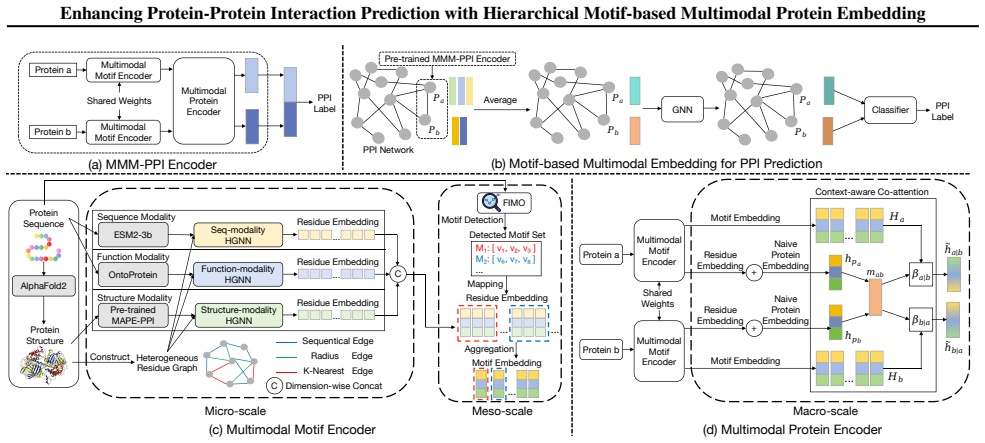
read the original abstract
Protein-protein interactions (PPIs) are essential for many biological processes. However, existing PPI prediction approaches suffer from two major limitations: they overlook the hierarchical organization of proteins, particularly meso-scale motifs that critically regulate PPIs, and fail to effectively integrate sequence, structure, and function modalities. To address these limitations, we propose MMM-PPI, a Hierarchical Motif-based Multi-Modal protein Encoder for PPI Prediction that constructs PPI embeddings in a bottom-up multi-modal manner across three scales. At the micro-scale, we encode three modal residue features; at the meso-scale, a novel multimodal motif encoder aggregates residues into spatially-informed motif embeddings; at the macro-scale, a multimodal protein encoder integrates motifs into protein embeddings by jointly modeling motif importance and inter-modal correlations. The pre-trained encoder can be used off-the-shelf for large-scale PPI prediction. Extensive experiments on multiple PPI datasets show that MMM-PPI outperforms state-of-the-art multi-label PPI prediction models, particularly under challenging data partitions and limited data scenarios. Codes are in https://github.com/yzf-code/MMM-PPI.
Editorial analysis
A structured set of objections, weighed in public.
Referee Report
Summary. The manuscript introduces MMM-PPI, a hierarchical motif-based multimodal protein encoder for protein-protein interaction (PPI) prediction. It constructs embeddings bottom-up across three scales: micro-scale encoding of three modal residue features, meso-scale multimodal motif encoder that aggregates residues into spatially-informed motif embeddings, and macro-scale multimodal protein encoder that integrates motifs while modeling importance and inter-modal correlations. The pre-trained encoder is applied off-the-shelf to large-scale PPI prediction and is reported to outperform state-of-the-art multi-label PPI models on multiple datasets, with particular gains under challenging data partitions and limited-data scenarios.
Significance. If the experimental claims hold after full verification, the work could advance PPI prediction by explicitly incorporating meso-scale motifs and joint multimodal aggregation, addressing two stated limitations of prior methods. The open-source code release supports reproducibility and downstream use.
minor comments (2)
- The abstract asserts outperformance 'particularly under challenging data partitions and limited data scenarios' but provides no dataset names, partition definitions, baseline models, or quantitative metrics; these details are required in §4 or §5 to evaluate the central claim.
- The description of the meso-scale motif encoder mentions 'spatially-informed motif embeddings' without specifying how spatial information is encoded or aggregated from residue features; a concrete description or equation in §3.2 would clarify the novelty.
Simulated Author's Rebuttal
We thank the referee for the careful summary of MMM-PPI and for noting its potential to advance PPI prediction through explicit meso-scale motif modeling and joint multimodal aggregation. We appreciate the recognition that the open-source code aids reproducibility. Because the report lists no specific major comments, we provide a brief overall response and remain available to address any additional questions or to supply further verification experiments.
Circularity Check
No significant circularity detected
full rationale
The provided abstract and description outline a three-scale bottom-up multimodal encoder architecture (micro-scale residue features, meso-scale motif aggregation, macro-scale protein integration) without any equations, parameter fits, or derivations shown. No self-citations, uniqueness theorems, or ansatzes are invoked. Outperformance claims rest on external experiments rather than internal reductions to inputs. The derivation chain is an architectural proposal with no load-bearing steps that collapse by construction.
Axiom & Free-Parameter Ledger
free parameters (1)
- model hyperparameters and training settings
axioms (2)
- domain assumption Proteins exhibit hierarchical organization in which meso-scale motifs critically regulate protein-protein interactions.
- domain assumption Integrating sequence, structure, and function modalities at multiple scales will overcome the stated limitations of prior PPI predictors.
Reference graph
Works this paper leans on
-
[1]
Microbiological Reviews , volume=
Protein-protein interactions: methods for detection and analysis , author=. Microbiological Reviews , volume=. 1995 , publisher=
1995
-
[2]
Briefings in bioinformatics , volume=
A survey on computational models for predicting protein--protein interactions , author=. Briefings in bioinformatics , volume=. 2021 , publisher=
2021
-
[3]
Future Medicinal Chemistry , volume=
Targeting protein--protein interactions for therapeutic intervention: A challenge for the future , author=. Future Medicinal Chemistry , volume=. 2009 , publisher=
2009
-
[4]
Genome Medicine , volume=
Protein-protein interaction networks: Probing disease mechanisms using model systems , author=. Genome Medicine , volume=. 2013 , publisher=
2013
-
[5]
Journal of Medicinal Chemistry , volume=
Drug design targeting protein--protein interactions (PPIs) using multiple ligand simultaneous docking (MLSD) and drug repositioning: discovery of raloxifene and bazedoxifene as novel inhibitors of IL-6/GP130 interface , author=. Journal of Medicinal Chemistry , volume=
-
[6]
Current Pharmaceutical Design , volume=
Computational drug design targeting protein-protein interactions , author=. Current Pharmaceutical Design , volume=. 2012 , publisher=
2012
-
[7]
Cellular and Molecular Life Sciences , volume=
A context-dependent and disordered ubiquitin-binding motif , author=. Cellular and Molecular Life Sciences , volume=. 2022 , publisher=
2022
-
[8]
Bioinformatics , volume=
Identification of context-dependent motifs by contrasting ChIP binding data , author=. Bioinformatics , volume=. 2010 , publisher=
2010
-
[9]
International Symposium on BioInformatics and BioEngineering , pages=
Supervised statistical and machine learning approaches to inferring pairwise and module-based protein interaction networks , author=. International Symposium on BioInformatics and BioEngineering , pages=
-
[10]
Bioinformatics , volume=
Prediction of protein--protein interactions using random decision forest framework , author=. Bioinformatics , volume=. 2005 , publisher=
2005
-
[11]
Nucleic Acids Research , volume=
Using support vector machine combined with auto covariance to predict protein--protein interactions from protein sequences , author=. Nucleic Acids Research , volume=. 2008 , publisher=
2008
-
[12]
Heterogeneous data integration by tree-augmented naive
Lin, Xiaotong and Chen, Xue-wen , journal=. Heterogeneous data integration by tree-augmented naive. 2013 , publisher=
2013
-
[13]
International Conference on Advanced Intelligent Computing Theories and Applications , pages=
Detection of protein-protein interactions from amino acid sequences using a rotation forest model with a novel PR-LPQ descriptor , author=. International Conference on Advanced Intelligent Computing Theories and Applications , pages=
-
[14]
Journal of Biosciences , volume=
Machine-learning techniques for the prediction of protein--protein interactions , author=. Journal of Biosciences , volume=. 2019 , publisher=
2019
-
[15]
Nucleic Acids Research , volume=
Struct2Net: a web service to predict protein--protein interactions using a structure-based approach , author=. Nucleic Acids Research , volume=. 2010 , publisher=
2010
-
[16]
Nature , volume=
Structure-based prediction of protein--protein interactions on a genome-wide scale , author=. Nature , volume=. 2012 , publisher=
2012
-
[17]
Nature Communications , volume=
Improved prediction of protein-protein interactions using AlphaFold2 , author=. Nature Communications , volume=. 2022 , publisher=
2022
-
[18]
Nature , volume=
Highly accurate protein structure prediction with AlphaFold , author=. Nature , volume=
-
[19]
IEEE Transactions on Neural Networks and Learning Systems , volume=
A comprehensive survey on graph neural networks , author=. IEEE Transactions on Neural Networks and Learning Systems , volume=. 2020 , publisher=
2020
-
[20]
Bioinformatics , volume=
FIMO: Scanning for occurrences of a given motif , author=. Bioinformatics , volume=. 2011 , publisher=
2011
-
[21]
Nucleic Acids Research , volume=
MEME SUITE: Tools for motif discovery and searching , author=. Nucleic Acids Research , volume=. 2009 , publisher=
2009
-
[22]
Proceedings of the National Academy of Sciences , volume=
Statistical significance for genomewide studies , author=. Proceedings of the National Academy of Sciences , volume=. 2003 , publisher=
2003
-
[23]
Learning sequence, structure, and function representations of proteins with language models , author=
-
[24]
International Conference on Knowledge Discovery & Data Mining , pages=
Heterogeneous graph neural network , author=. International Conference on Knowledge Discovery & Data Mining , pages=
-
[25]
Nature Reviews Methods Primers , volume=
Graph neural networks , author=. Nature Reviews Methods Primers , volume=. 2024 , publisher=
2024
-
[26]
International Conference on Learning Representations , year=
How Powerful are Graph Neural Networks? , author=. International Conference on Learning Representations , year=
-
[27]
Journal of Molecular Biology , volume=
Recognition of spatial motifs in protein structures , author=. Journal of Molecular Biology , volume=. 1999 , publisher=
1999
-
[28]
arXiv preprint arXiv:2501.10282 , year=
Computational protein science in the era of large language models (LLMs) , author=. arXiv preprint arXiv:2501.10282 , year=
-
[29]
Briefings in Functional Genomics and Proteomics , volume=
A review on models and algorithms for motif discovery in protein--protein interaction networks , author=. Briefings in Functional Genomics and Proteomics , volume=. 2008 , publisher=
2008
-
[30]
Current Opinion in Structural Biology , volume=
Affinity and specificity of motif-based protein--protein interactions , author=. Current Opinion in Structural Biology , volume=. 2019 , publisher=
2019
-
[31]
Cell Communication and Signaling , volume=
Motif mediated protein-protein interactions as drug targets , author=. Cell Communication and Signaling , volume=. 2016 , publisher=
2016
-
[32]
Bioessays , volume=
The tetratricopeptide repeat: A structural motif mediating protein-protein interactions , author=. Bioessays , volume=. 1999 , publisher=
1999
-
[33]
Genes & Development , volume=
The POZ domain: A conserved protein-protein interaction motif , author=. Genes & Development , volume=. 1994 , publisher=
1994
-
[34]
Proceedings of the National Academy of Sciences , volume=
Biological structure and function emerge from scaling unsupervised learning to 250 million protein sequences , author=. Proceedings of the National Academy of Sciences , volume=. 2021 , publisher=
2021
-
[35]
Science , volume=
Evolutionary-scale prediction of atomic-level protein structure with a language model , author=. Science , volume=. 2023 , publisher=
2023
-
[36]
Bioinformatics , volume=
UniRef: comprehensive and non-redundant UniProt reference clusters , author=. Bioinformatics , volume=. 2007 , publisher=
2007
-
[37]
Nucleic Acids Research , volume=
CATH: Increased structural coverage of functional space , author=. Nucleic Acids Research , volume=. 2021 , publisher=
2021
-
[38]
IEEE Transactions on Pattern Analysis and Machine Intelligence , volume=
Prottrans: Toward understanding the language of life through self-supervised learning , author=. IEEE Transactions on Pattern Analysis and Machine Intelligence , volume=
-
[39]
The Eleventh International Conference on Learning Representations , year=
Protein Representation Learning by Geometric Structure Pretraining , author=. The Eleventh International Conference on Learning Representations , year=
-
[40]
Bioinformatics , volume=
Structure-aware protein self-supervised learning , author=. Bioinformatics , volume=. 2023 , publisher=
2023
-
[41]
NAR Genomics and Bioinformatics , volume =
Heinzinger, Michael and Weissenow, Konstantin and Sanchez, Joaquin Gomez and Henkel, Adrian and Mirdita, Milot and Steinegger, Martin and Rost, Burkhard , title =. NAR Genomics and Bioinformatics , volume =. 2024 , month =. doi:10.1093/nargab/lqae150 , url =
-
[42]
International Conference on Machine Learning , pages=
Structure-informed language models are protein designers , author=. International Conference on Machine Learning , pages=
-
[43]
The Twelfth International Conference on Learning Representations , year=
SaProt: Protein Language Modeling with Structure-aware Vocabulary , author=. The Twelfth International Conference on Learning Representations , year=
-
[44]
International Conference on Learning Representations , year=
OntoProtein: Protein Pretraining With Gene Ontology Embedding , author=. International Conference on Learning Representations , year=
-
[45]
International Conference on Learning Representations , year=
Protein representation learning via knowledge enhanced primary structure reasoning , author=. International Conference on Learning Representations , year=
-
[46]
Xu, Minghao and Yuan, Xinyu and Miret, Santiago and Tang, Jian , booktitle=. Prot
-
[47]
Advanced Science , volume=
A multimodal protein representation framework for quantifying transferability across biochemical downstream tasks , author=. Advanced Science , volume=. 2023 , publisher=
2023
-
[48]
Science , pages=
Simulating 500 million years of evolution with a language model , author=. Science , pages=. 2025 , publisher=
2025
-
[49]
Journal of Chemical Theory and Computation , volume=
The application of ligand-mapping molecular dynamics simulations to the rational design of peptidic modulators of protein--protein interactions , author=. Journal of Chemical Theory and Computation , volume=. 2015 , publisher=
2015
-
[50]
Wiley Interdisciplinary Reviews: Computational Molecular Science , volume=
Computational close up on protein--protein interactions: How to unravel the invisible using molecular dynamics simulations? , author=. Wiley Interdisciplinary Reviews: Computational Molecular Science , volume=. 2015 , publisher=
2015
-
[51]
Current Drug Targets , volume=
Recent advances in protein-protein docking , author=. Current Drug Targets , volume=. 2016 , publisher=
2016
-
[52]
Biophysical Reviews , pages=
Protein--protein interaction prediction methods: from docking-based to AI-based approaches , author=. Biophysical Reviews , pages=. 2022 , publisher=
2022
-
[53]
Scientific Reports , volume=
Predicting protein-protein interactions from matrix-based protein sequence using convolution neural network and feature-selective rotation forest , author=. Scientific Reports , volume=. 2019 , publisher=
2019
-
[54]
Journal of Theoretical Biology , volume=
Protein--protein interaction inference based on semantic similarity of gene ontology terms , author=. Journal of Theoretical Biology , volume=. 2016 , publisher=
2016
-
[55]
Nucleic Acids Research , volume=
Prediction of yeast protein--protein interaction network: insights from the Gene Ontology and annotations , author=. Nucleic Acids Research , volume=. 2006 , publisher=
2006
-
[56]
IEEE/ACM Transactions on Computational Biology and Bioinformatics , volume=
Analyzing effect of multi-modality in predicting protein-protein interactions , author=. IEEE/ACM Transactions on Computational Biology and Bioinformatics , volume=. 2022 , publisher=
2022
-
[57]
2021 International Joint Conference on Neural Networks , pages=
Prediction of protein-protein interactions using deep multi-modal representations , author=. 2021 International Joint Conference on Neural Networks , pages=
2021
-
[58]
Neurocomputing , volume=
Sequence-based prediction of protein-protein interaction sites by simplified long short-term memory network , author=. Neurocomputing , volume=. 2019 , publisher=
2019
-
[59]
Proceedings of the Thirtieth International Joint Conference on Artificial Intelligence (IJCAI-21) , pages =
Learning Unknown from Correlations: Graph Neural Network for Inter-novel-protein Interaction Prediction , author =. Proceedings of the Thirtieth International Joint Conference on Artificial Intelligence (IJCAI-21) , pages =. 2021 , doi =
2021
-
[60]
Zhao, Ziyuan and Qian, Peisheng and Yang, Xulei and Zeng, Zeng and Guan, Cuntai and Tam, Wai Leong and Li, Xiaoli , title =. 2023 , isbn =. doi:10.24963/ijcai.2023/554 , booktitle =
-
[61]
Nature Communications , volume=
Hierarchical graph learning for protein--protein interaction , author=. Nature Communications , volume=. 2023 , publisher=
2023
-
[62]
Li , booktitle=
Lirong Wu and Yijun Tian and Yufei Huang and Siyuan Li and Haitao Lin and Nitesh V Chawla and Stan Z. Li , booktitle=. 2024 , url=
2024
-
[63]
Neural Information Processing Systems , year=
Hierarchical question-image co-attention for visual question answering , author=. Neural Information Processing Systems , year=
-
[64]
IEEE/CVF Conference on Computer Vision and Pattern Recognition , pages=
Deep modular co-attention networks for visual question answering , author=. IEEE/CVF Conference on Computer Vision and Pattern Recognition , pages=
-
[65]
IEEE Conference on Computer Vision and Pattern Recognition , pages=
Visual question answering with memory-augmented networks , author=. IEEE Conference on Computer Vision and Pattern Recognition , pages=
-
[66]
Artificial Intelligence in Medicine , volume=
DDI-GCN: drug-drug interaction prediction via explainable graph convolutional networks , author=. Artificial Intelligence in Medicine , volume=. 2023 , publisher=
2023
-
[67]
Nucleic Acids Research , volume=
STRING v11: Protein--protein association networks with increased coverage, supporting functional discovery in genome-wide experimental datasets , author=. Nucleic Acids Research , volume=. 2019 , publisher=
2019
-
[68]
Bioinformatics , volume=
Multifaceted protein--protein interaction prediction based on Siamese residual RCNN , author=. Bioinformatics , volume=. 2019 , publisher=
2019
-
[69]
Bioinformatics , volume=
Predicting protein--protein interactions through sequence-based deep learning , author=. Bioinformatics , volume=. 2018 , publisher=
2018
-
[70]
Molecules , volume=
Deep neural network based predictions of protein interactions using primary sequences , author=. Molecules , volume=. 2018 , publisher=
2018
-
[71]
Current Opinion in Structural Biology , volume=
The present and the future of motif-mediated protein--protein interactions , author=. Current Opinion in Structural Biology , volume=. 2018 , publisher=
2018
-
[72]
Cell Communication and Signaling , volume=
High-throughput methods for identification of protein-protein interactions involving short linear motifs , author=. Cell Communication and Signaling , volume=. 2015 , publisher=
2015
-
[73]
BMC bioinformatics , volume=
DCMF-PPI: a protein-protein interaction predictor based on dynamic condition and multi-feature fusion , author=. BMC bioinformatics , volume=. 2025 , publisher=
2025
-
[74]
BMC biology , volume=
Prediction of protein--protein interaction based on interaction-specific learning and hierarchical information , author=. BMC biology , volume=. 2025 , publisher=
2025
-
[75]
Journal of Chemical Information and Modeling , volume=
MicroEnvPPI: Microenvironment-Aware Optimization Enables Generalizable Protein--Protein Interaction Prediction , author=. Journal of Chemical Information and Modeling , volume=. 2025 , publisher=
2025
-
[76]
IEEE Transactions on Neural Networks and Learning Systems , year=
Accurate Protein--Protein Interaction Prediction: Based on Multiview Heterogeneous Graph Autoencoders and Random Masking , author=. IEEE Transactions on Neural Networks and Learning Systems , year=
-
[77]
Nucleic acids research , volume=
AlphaFold Protein Structure Database: massively expanding the structural coverage of protein-sequence space with high-accuracy models , author=. Nucleic acids research , volume=. 2022 , publisher=
2022
-
[78]
ICLR 2024 Workshop on Generative and Experimental Perspectives for Biomolecular Design , year=
Revealing data leakage in protein interaction benchmarks , author=. ICLR 2024 Workshop on Generative and Experimental Perspectives for Biomolecular Design , year=
2024
-
[79]
Nature , volume=
Highly accurate protein structure prediction for the human proteome , author=. Nature , volume=. 2021 , publisher=
2021
-
[80]
Nature methods , volume=
Flaws in evaluation schemes for pair-input computational predictions , author=. Nature methods , volume=. 2012 , publisher=
2012
discussion (0)
Sign in with ORCID, Apple, or X to comment. Anyone can read and Pith papers without signing in.