Evidence for Multiband Superconductivity in 2H-NbSeS
Pith reviewed 2026-06-26 18:47 UTC · model grok-4.3
The pith
2H-NbSeS exhibits intrinsic multiband superconductivity with two nodeless gaps once its charge density wave is suppressed by Se/S substitution.
A machine-rendered reading of the paper's core claim, the machinery that carries it, and where it could break.
Core claim
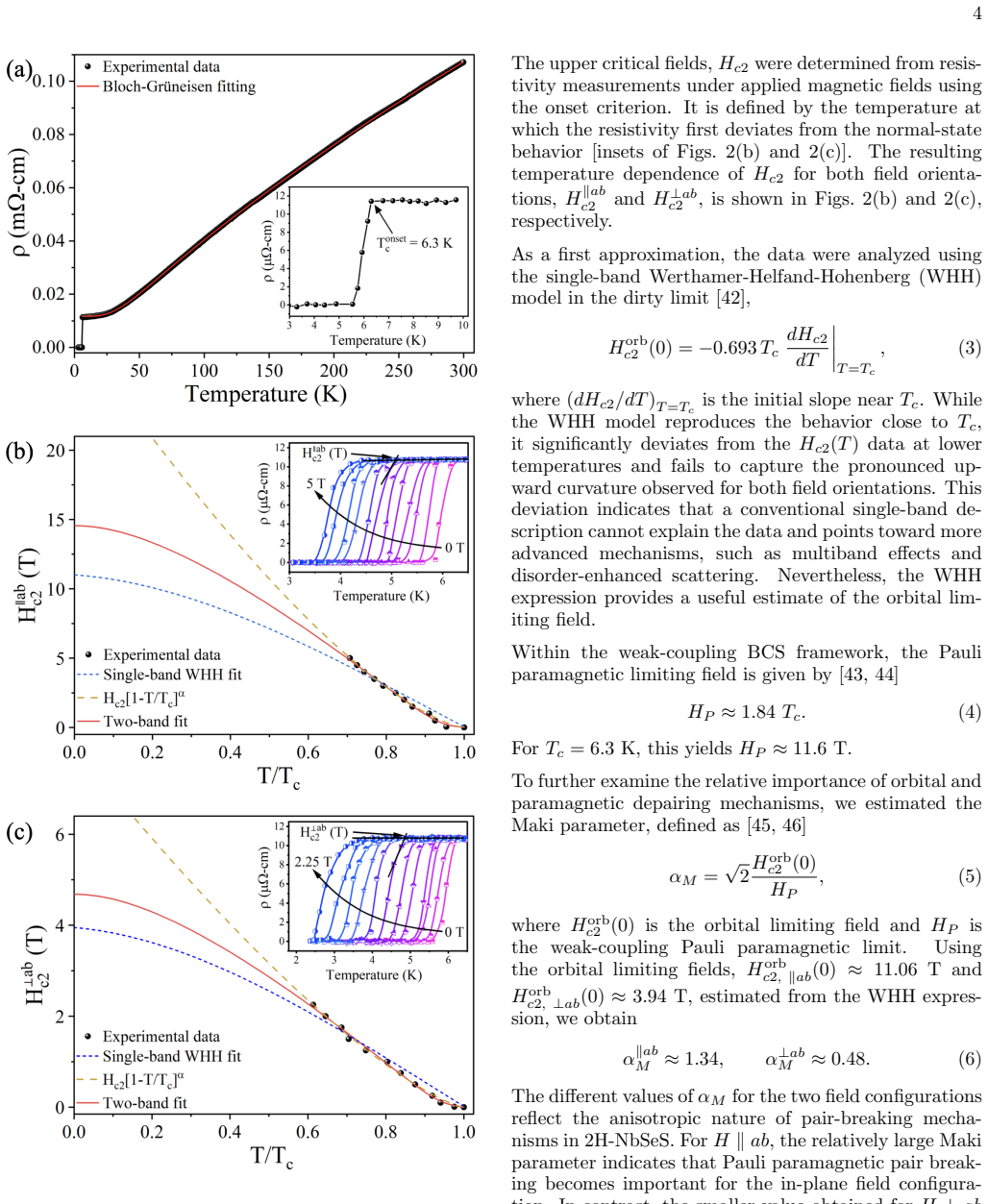
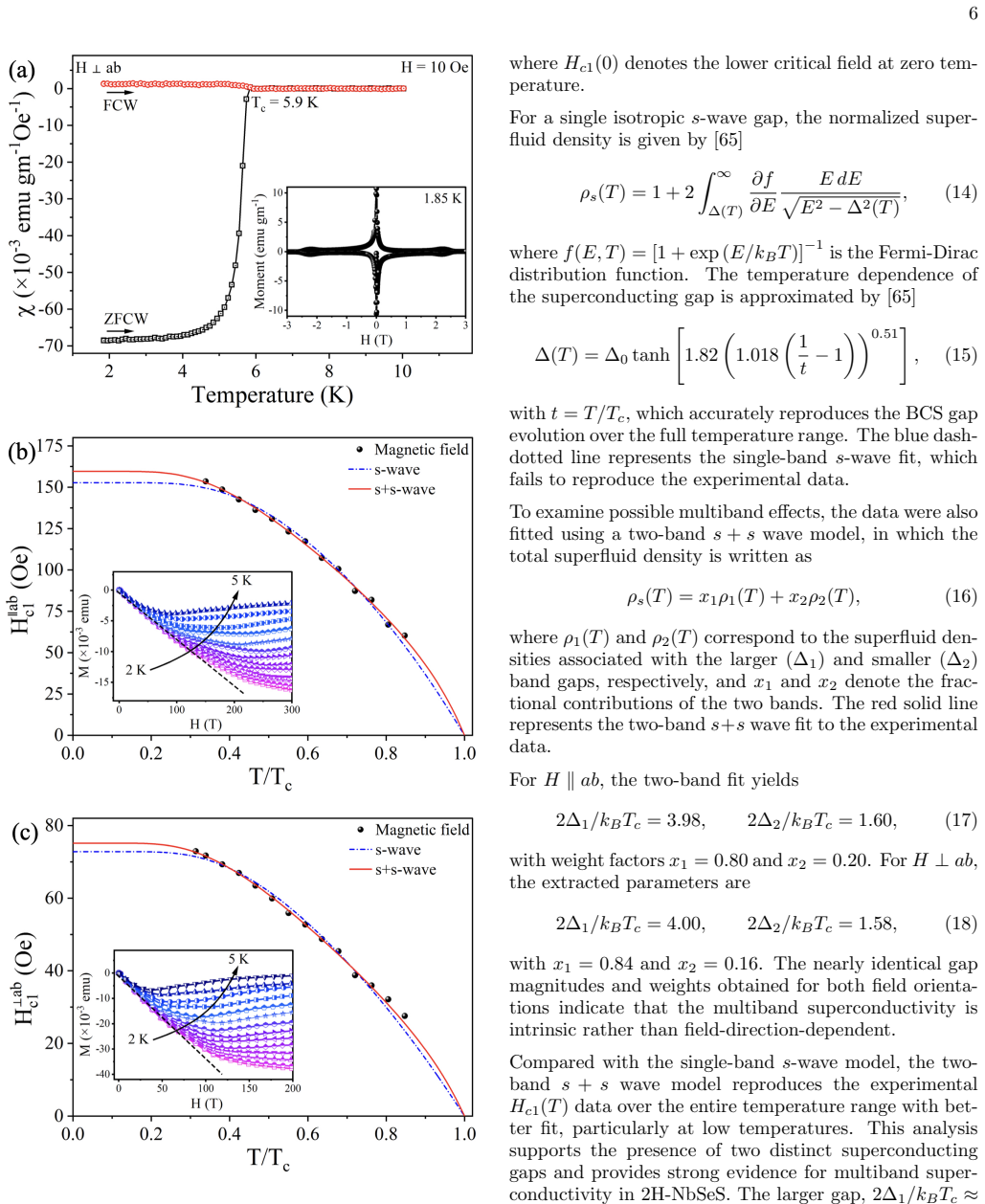
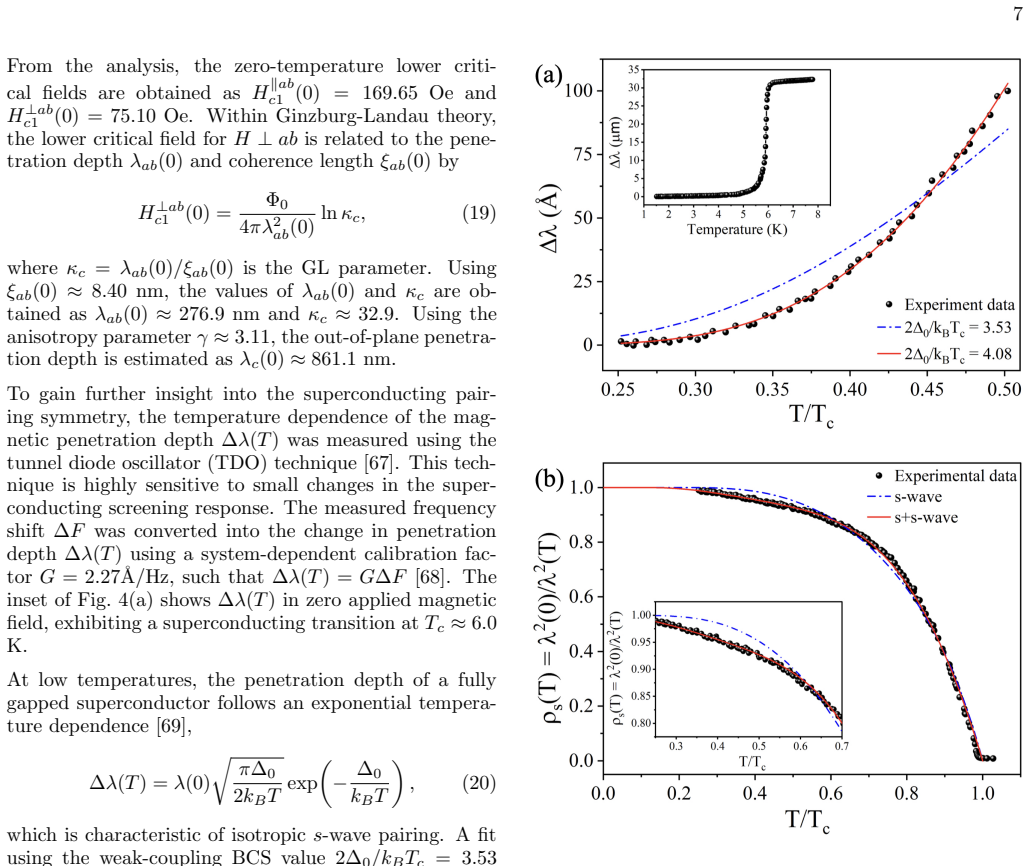
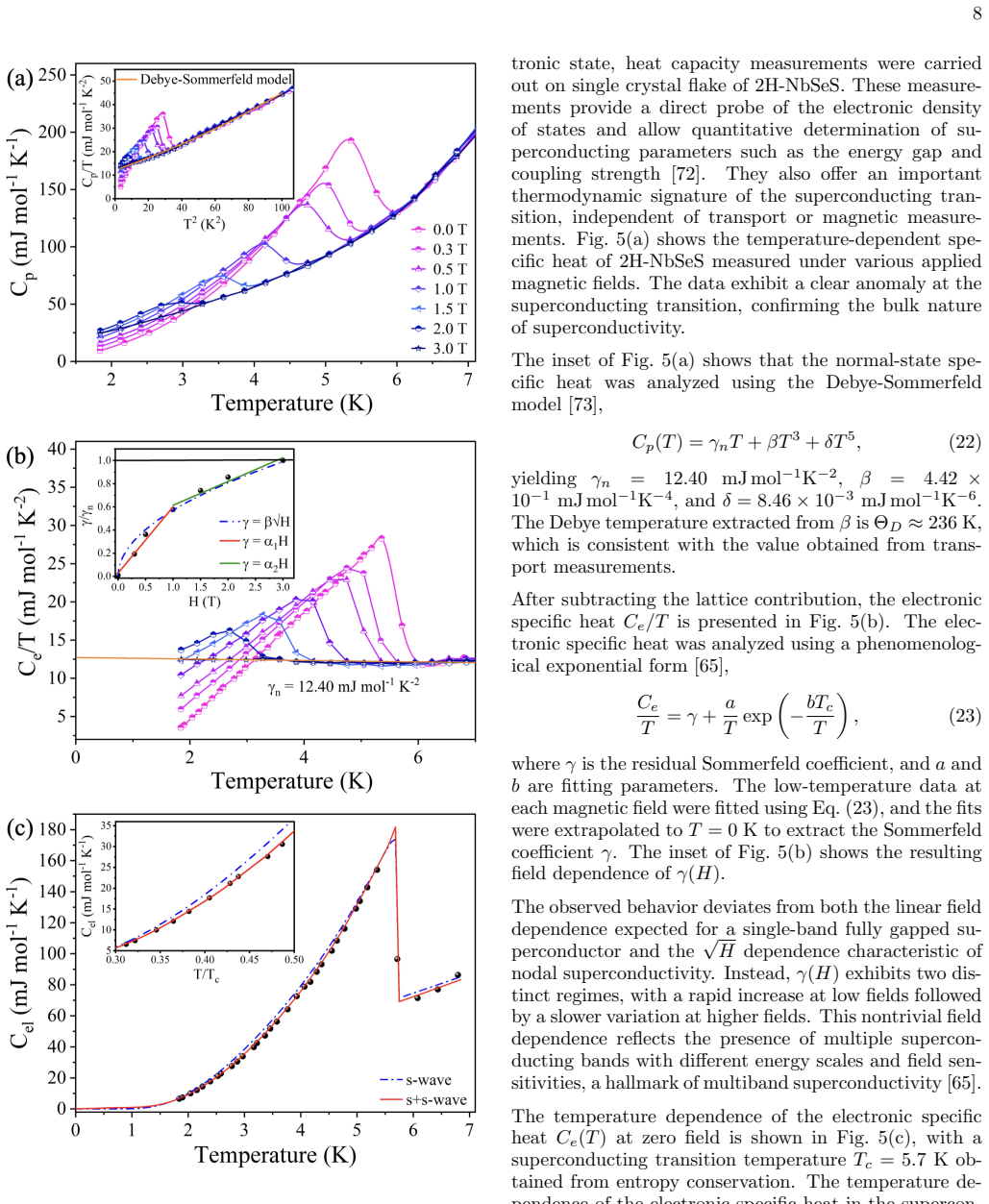
The authors report that 2H-NbSeS becomes superconducting below 6 K and displays an upper critical field with pronounced upward curvature that is successfully described by a dirty-limit two-band model featuring a large diffusivity ratio between the bands. This model indicates strong band-dependent scattering. The in-plane upper critical field surpasses the Pauli limit. Data on the lower critical field, superfluid density, and specific heat are consistent with a fully gapped superconducting state containing two nodeless gaps of unequal magnitudes.
What carries the argument
The dirty-limit two-band model for the temperature dependence of the upper critical field, which accounts for the upward curvature via a large ratio of diffusivities in the two bands.
If this is right
- The superconducting state is fully gapped with no nodes.
- The in-plane upper critical field exceeds the weak-coupling Pauli limit.
- Strong band-dependent scattering is present due to the large diffusivity ratio.
- The material shows moderate magnetic anisotropy.
Where Pith is reading between the lines
- Tuning the sulfur content could vary the gap magnitudes and test the robustness of the two-band fit.
- The results suggest that CDW order in the parent compound may mask or alter the intrinsic multiband nature.
- Measurements in other mixed chalcogenides could confirm if this is a general feature of the family.
Load-bearing premise
That the Se/S substitution suppresses the CDW without creating local fluctuations or disorder strong enough to produce apparent multigap behavior in the upper critical field and specific heat.
What would settle it
A high-resolution tunneling spectroscopy measurement that detects only a single gap value across the sample would contradict the two-gap interpretation.
Figures
read the original abstract
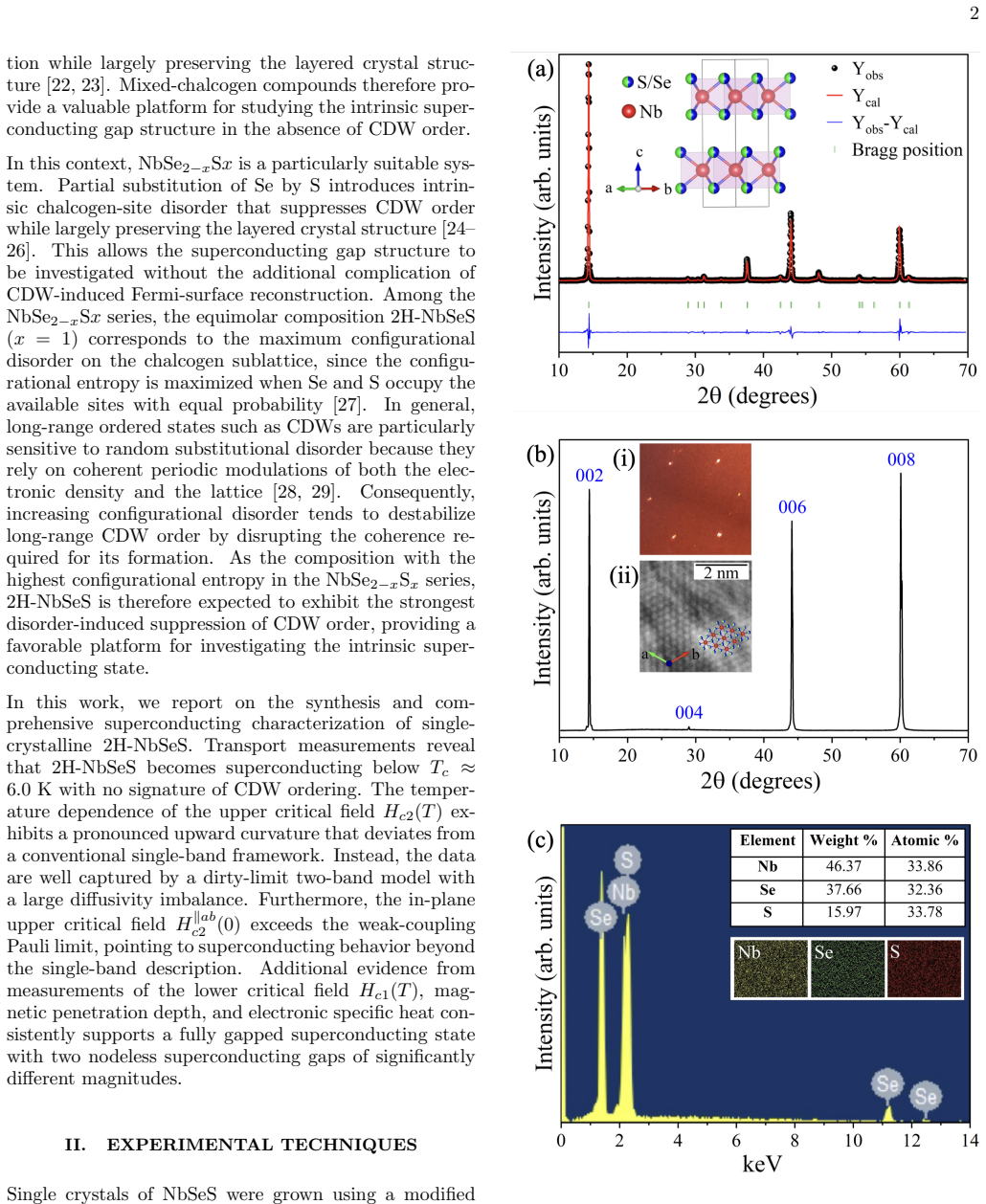
The nature of superconductivity in 2H-NbSe2 has generated sustained debate in the recent past. While angle resolved photoemission spectroscopy data have been interpreted as evidence for multiband superconductivity, the data from scanning tunneling microscope experiments relate to strongly anisotropic single-band superconductivity. In the later case, the charge density wave (CDW) order mimics the multigap character. Because the CDW reconstructs the Fermi surface and modifies the superconducting gap distribution, disentangling intrinsic multiband pairing from CDW-related effects is challenging. To address this issue, we investigate single-crystalline 2H-NbSeS, a mixed-chalcogen analogue of 2H-NbSe2 in which random Se/S substitution suppresses long-range CDW order while preserving the layered crystal structure P63/mmc. The material becomes superconducting below 6.0 K with moderate magnetic anisotropy. The upper critical field exhibits a pronounced upward curvature that cannot be described within a single-band framework but is well captured by a dirty-limit two-band model with a large diffusivity ratio. This indicates strong band-dependent scattering. The in-plane upper critical field exceeds the weak-coupling Pauli limit. Measurements of the lower critical field, superfluid density, and electronic specific heat are consistent with an interpretation of a fully gapped superconducting state with two nodeless gaps of different magnitudes.
Editorial analysis
A structured set of objections, weighed in public.
Referee Report
Summary. The manuscript claims that random Se/S substitution in 2H-NbSeS suppresses long-range CDW order (while preserving the P63/mmc structure), enabling observation of intrinsic multiband superconductivity. The upper critical field shows pronounced upward curvature that cannot be fit by single-band models but is captured by a dirty-limit two-band model with large diffusivity ratio, indicating band-dependent scattering; the in-plane Hc2 exceeds the Pauli limit. Lower critical field, superfluid density, and electronic specific heat are reported as consistent with a fully gapped state having two nodeless gaps of different magnitudes.
Significance. If the CDW suppression is confirmed and the multi-probe consistency holds, the work would provide a valuable platform for studying intrinsic multiband pairing in the NbSe2 family without CDW-induced Fermi-surface reconstruction, helping resolve the ARPES vs. STM debate on pure NbSe2. The use of a standard dirty-limit two-band model for Hc2 and cross-checks with Hc1, ho s(T), and Ce(T) are standard strengths when the underlying assumption is secure.
major comments (1)
- [Abstract] Abstract: The central attribution of the two-band Hc2 curvature and two nodeless gaps to intrinsic multiband superconductivity rests on the claim that 'random Se/S substitution suppresses long-range CDW order while preserving the layered crystal structure.' No quantitative evidence (e.g., absence of CDW superlattice peaks in XRD, no FS reconstruction in ARPES, or temperature-independent gap anisotropy) is referenced, yet residual short-range CDW patches or substitution-induced inhomogeneity could produce apparent multigap signatures exactly as the paper notes occurs in pure NbSe2. This assumption is load-bearing for the interpretation.
Simulated Author's Rebuttal
We thank the referee for the careful reading of our manuscript and for the positive assessment of its potential significance in providing a platform to study intrinsic multiband superconductivity in the NbSe2 family. We address the single major comment below.
read point-by-point responses
-
Referee: [Abstract] Abstract: The central attribution of the two-band Hc2 curvature and two nodeless gaps to intrinsic multiband superconductivity rests on the claim that 'random Se/S substitution suppresses long-range CDW order while preserving the layered crystal structure.' No quantitative evidence (e.g., absence of CDW superlattice peaks in XRD, no FS reconstruction in ARPES, or temperature-independent gap anisotropy) is referenced, yet residual short-range CDW patches or substitution-induced inhomogeneity could produce apparent multigap signatures exactly as the paper notes occurs in pure NbSe2. This assumption is load-bearing for the interpretation.
Authors: We agree that the claim of CDW suppression is central to the interpretation and that the absence of explicit quantitative evidence (such as XRD superlattice peaks or ARPES) in the current version weakens the presentation. The manuscript currently supports the claim via the preserved P63/mmc structure, the lack of CDW-related anomalies in transport, and the consistency of multigap signatures across Hc2, Hc1, superfluid density, and specific heat. However, to directly address the concern, the revised manuscript will incorporate additional XRD data confirming the absence of CDW superlattice peaks, a discussion of why short-range CDW patches are unlikely given the multi-probe consistency, and references to prior work on Se/S substitution effects in related compounds. revision: yes
Circularity Check
No circularity: standard model fits to independent observables; CDW assumption is external premise, not definitional reduction.
full rationale
The paper reports measured Hc2(T) curvature, Hc1, superfluid density, and specific heat on 2H-NbSeS. These are fitted to the standard dirty-limit two-band Usadel equations with free parameters (diffusivity ratio, two gaps). The upward curvature is an experimental datum, not constructed from the fit parameters. No equations reduce to each other by definition, no fitted input is relabeled as prediction, and no load-bearing self-citation chain is invoked. The premise that random Se/S substitution fully suppresses CDW is an external assumption about sample quality, not a self-referential step inside the derivation. The analysis is therefore self-contained against external benchmarks.
Axiom & Free-Parameter Ledger
free parameters (2)
- diffusivity ratio
- gap magnitudes
axioms (2)
- domain assumption Random Se/S substitution suppresses long-range CDW order while preserving the P63/mmc layered structure
- domain assumption The dirty-limit two-band model applies to this material
Reference graph
Works this paper leans on
-
[1]
M. Zehetmayer, A review of two-band superconductiv- ity: materials and effects on the thermodynamic and re- versible mixed-state properties, Superconductor Science and Technology26, 043001 (2013)
2013
-
[2]
Kruchinin, Multiband superconductors, Reviews in Theoretical Science4, 165 (2016)
S. Kruchinin, Multiband superconductors, Reviews in Theoretical Science4, 165 (2016). 10
2016
-
[3]
Bouquet, R
F. Bouquet, R. Fisher, N. Phillips, D. Hinks, and J. Jor- gensen, Specific heat of mg 11 b 2: evidence for a second energy gap, Physical review letters87, 047001 (2001)
2001
-
[4]
Boaknin, M
E. Boaknin, M. A. Tanatar, J. Paglione, D. G. Hawthorn, F. Ronning, R. W. Hill, M. Sutherland, L. Taillefer, J. E. Sonier, S. M. Hayden,et al., Heat conduction in the vor- tex state of nbse 2: Evidence for multiband superconduc- tivity, Physical Review Letters90, 117003 (2003)
2003
-
[5]
Fletcher, A
J. Fletcher, A. Carrington, P. Diener, P. Rodiere, J.-P. Brison, R. Prozorov, T. Olheiser, and R. Giannetta, Pen- etration depth study of superconducting gap structure of 2 h-nbse 2, Physical review letters98, 057003 (2007)
2007
-
[6]
Inosov, V
D. Inosov, V. Zabolotnyy, D. Evtushinsky, A. Kordyuk, B. B¨ uchner, R. Follath, H. Berger, and S. Borisenko, Fermi surface nesting in several transition metal dichalco- genides, New Journal of Physics10, 125027 (2008)
2008
-
[7]
J. A. Wilson, F. J. Di Salvo, and S. Mahajan, Transi- tion metal dichalcogenides discussion and interpretation of the observed optical, electrical and structural proper- ties, Advances in Physics18, 193 (1969)
1969
-
[8]
Rossnagel, On the origin of charge-density waves in select layered transition-metal dichalcogenides, Journal of Physics: Condensed Matter23, 213001 (2011)
K. Rossnagel, On the origin of charge-density waves in select layered transition-metal dichalcogenides, Journal of Physics: Condensed Matter23, 213001 (2011)
2011
-
[9]
N. H. Aase, C. S. Johnsen, and A. Sudbø, Constrained weak-coupling superconductivity in multiband supercon- ductors, Physical Review B108, 024509 (2023)
2023
-
[10]
C. Kim, D. Bhoi, Y. Sur, B.-G. Jeon, D. Wulferding, B. H. Min, J. Kim, and K. H. Kim, Experimental signa- tures of nodeless multiband superconductivity in a 2h- pd 0.08 tase 2 single crystal, Scientific reports11, 13383 (2021)
2021
-
[11]
J. Luo, Y. Li, J. Zhang, H. Ji, H. Wang, J.-Y. Shan, C. Zhang, C. Cai, J. Liu, Y. Wang,et al., Possible uncon- ventional two-band superconductivity in mo te 2, Physi- cal Review B102, 064502 (2020)
2020
-
[12]
Alshemi, E
A. Alshemi, E. Forgan, A. Hiess, R. Cubitt, J. White, K. Schmalzl, and E. Blackburn, Two characteristic con- tributions to the superconducting state of 2 h-nbse 2, Physical Review Letters134, 116001 (2025)
2025
-
[13]
Hanaguri, Modulation of superconducting properties by the charge density wave at the surface of 2 h-nbse 2, Physical Review Research8, 013164 (2026)
T. Hanaguri, Modulation of superconducting properties by the charge density wave at the surface of 2 h-nbse 2, Physical Review Research8, 013164 (2026)
2026
-
[14]
Yokoya, T
T. Yokoya, T. Kiss, A. Chainani, S. Shin, M. Nohara, and H. Takagi, Fermi surface sheet-dependent supercon- ductivity in 2 h-nbse2, Science294, 2518 (2001)
2001
-
[15]
Rossnagel, O
K. Rossnagel, O. Seifarth, L. Kipp, M. Skibowski, D. Voß, P. Kruger, A. Mazur, and J. Pollmann, Fermi surface of 2h-nbse˜ 2 and its implications on the charge-density-wave mechanism, PHYSICAL REVIEW- SERIES B-64, 235119 (2001)
2001
-
[16]
Johannes, I
M. Johannes, I. Mazin, and C. Howells, Fermi-surface nesting and the origin of the charge-density wave in nb se 2, Physical Review B—Condensed Matter and Materials Physics73, 205102 (2006)
2006
-
[17]
Sanna, C
A. Sanna, C. Pellegrini, E. Liebhaber, K. Rossnagel, K. J. Franke, and E. Gross, Real-space anisotropy of the su- perconducting gap in the charge-density wave material 2h-nbse2, npj Quantum Materials7, 6 (2022)
2022
-
[18]
D. Rahn, S. Hellmann, M. Kall¨ ane, C. Sohrt, T. Kim, L. Kipp, and K. Rossnagel, Gaps and kinks in the elec- tronic structure of the superconductor 2 h-nbse 2 from angle-resolved photoemission at 1 k, Physical Review B—Condensed Matter and Materials Physics85, 224532 (2012)
2012
-
[19]
Yasuzuka, S
S. Yasuzuka, S. Uji, S. Sugiura, T. Terashima, Y. Nogami, K. Ichimura, and S. Tanda, Highly isotropic in-plane upper critical field in the anisotropic s-wave su- perconductor 2 h-nbse2, Journal of Superconductivity and Novel Magnetism33, 953 (2020)
2020
-
[20]
T. Kiss, T. Yokoya, A. Chainani, S. Shin, T. Hanaguri, M. Nohara, and H. Takagi, Charge-order-maximized momentum-dependent superconductivity, Nature Physics3, 720 (2007)
2007
-
[21]
D. E. Moncton, J. Axe, and F. DiSalvo, Neutron scat- tering study of the charge-density wave transitions in 2 h- ta se 2 and 2 h- nb se 2, Physical Review B16, 801 (1977)
1977
-
[22]
L. Li, X. Deng, Z. Wang, Y. Liu, M. Abeykoon, E. Dooryhee, A. Tomic, Y. Huang, J. B. Warren, E. S. Bozin,et al., Superconducting order from disorder in 2h- tase2−xsx, npj Quantum Materials2, 11 (2017)
2017
-
[23]
Y. Liu, D. F. Shao, L. J. Li, W. J. Lu, X. D. Zhu, P. Tong, R. C. Xiao, L. S. Ling, C. Y. Xi, L. Pi, H. F. Tian, H. X. Yang, J. Q. Li, W. H. Song, X. B. Zhu, and Y. P. Sun, Nature of charge density waves and superconductivity in 1t−tase 2−xtex, Phys. Rev. B94, 045131 (2016)
2016
-
[24]
K. Cho, M. Ko´ nczykowski, S. Teknowijoyo, M. A. Tanatar, J. Guss, P. Gartin, J. Wilde, A. Kreyssig, R. McQueeney, A. I. Goldman,et al., Using controlled disorder to probe the interplay between charge order and superconductivity in nbse2, Nature communications9, 2796 (2018)
2018
-
[25]
J. A. Moreno, M. Roig, V. Barrena, E. Herrera, A. M. Ruiz, S. Ma˜ nas-Valero, A. Fente, A. Smeets, J. Arag´ on, Y. Fasano,et al., Gapless superconductivity from ex- tremely dilute magnetic disorder in 2h-nbse2-xsx, arXiv preprint arXiv:2508.00435 (2025)
arXiv 2025
-
[26]
Tsuppayakorn-Aek, P
P. Tsuppayakorn-Aek, P. Pluengphon, P. Phansuke, B. Inceesungvorn, W. Busayaporn, P. Kaewtubtim, and T. Bovornratanaraks, Effect of substitution on the su- perconducting phase of transition metal dichalcogenide nb (se x s 1-x) 2 van der waals layered structure, Scien- tific Reports11, 15215 (2021)
2021
-
[27]
Kittel and H
C. Kittel and H. Kroemer, Thermal physics, American Journal of Physics39, 126 (1971)
1971
-
[28]
Morosan, H
E. Morosan, H. W. Zandbergen, B. Dennis, J. Bos, Y. Onose, T. Klimczuk, A. Ramirez, N. Ong, and R. J. Cava, Superconductivity in cu x tise2, Nature Physics2, 544 (2006)
2006
-
[29]
L. Fang, Y. Wang, P. Zou, L. Tang, Z. Xu, H. Chen, C. Dong, L. Shan, and H. Wen, Fabrication and super- conductivity of na x ta s 2 crystals, Physical Review B—Condensed Matter and Materials Physics72, 014534 (2005)
2005
-
[30]
Benz and W
K.-W. Benz and W. Neumann,Introduction to crystal growth and characterization(John Wiley & Sons, 2014)
2014
-
[31]
B. D. Cullity,Elements of X-ray Diffraction(Hsin Yueh, 1986)
1986
-
[32]
Simonov and A
A. Simonov and A. L. Goodwin, Designing disorder into crystalline materials, Nature Reviews Chemistry4, 657 (2020)
2020
-
[33]
Gregory, Elements of x-ray diffraction., Journal of the American Chemical Society79, 1773 (1957)
N. Gregory, Elements of x-ray diffraction., Journal of the American Chemical Society79, 1773 (1957)
1957
-
[34]
Mottas, T
M.-L. Mottas, T. Jaouen, B. Hildebrand, M. Rumo, F. Vanini, E. Razzoli, E. Giannini, C. Barreteau, D. Bowler, C. Monney,et al., Semimetal-to- semiconductor transition and charge-density-wave suppression in 1 t-tise 2- x s x single crystals, Physical 11 Review B99, 155103 (2019)
2019
-
[35]
Gr¨ uneisen, Die abh¨ angigkeit des elektrischen wider- standes reiner metalle von der temperatur, Annalen der Physik408, 530 (1933)
E. Gr¨ uneisen, Die abh¨ angigkeit des elektrischen wider- standes reiner metalle von der temperatur, Annalen der Physik408, 530 (1933)
1933
-
[36]
Naito and S
M. Naito and S. Tanaka, Galvanomagnetic effects in the charge-density-wave state of 2h-nbse2 and 2h-tase2, Jour- nal of the Physical Society of Japan51, 228 (1982)
1982
-
[37]
Kittel,Introduction to Solid State Physics, 8th ed
C. Kittel,Introduction to Solid State Physics, 8th ed. (Wiley, 2005)
2005
-
[38]
N. F. Mott and H. Jones, The theory of the properties of metals and alloys, (No Title) (1936)
1936
-
[39]
Tinkham,Introduction to Superconductivity, 2nd ed
M. Tinkham,Introduction to Superconductivity, 2nd ed. (McGraw-Hill, 1996)
1996
-
[40]
Gurevich, Enhancement of the upper critical field by nonmagnetic impurities in dirty two-gap superconduc- tors, Physical Review B67, 184515 (2003)
A. Gurevich, Enhancement of the upper critical field by nonmagnetic impurities in dirty two-gap superconduc- tors, Physical Review B67, 184515 (2003)
2003
-
[41]
P. J. Hirschfeld, M. M. Korshunov, and I. I. Mazin, Gap symmetry and structure of fe-based superconductors, Re- ports on Progress in Physics74, 124508 (2011)
2011
-
[42]
N. R. Werthamer, E. Helfand, and P. C. Hohenberg, Tem- perature and purity dependence of the superconducting critical field, h c2. iii. electron spin and spin-orbit effects, Physical Review147, 295 (1966)
1966
-
[43]
A. M. Clogston, Upper limit for the critical field in hard superconductors, Physical Review Letters9, 266 (1962)
1962
-
[44]
B. S. Chandrasekhar, A note on the maximum critical field of high-field superconductors, Applied Physics Let- ters1, 7 (1962)
1962
-
[45]
Maki, Effect of pauli paramagnetism on magnetic properties of high-field superconductors, Physical Review 148, 362 (1966)
K. Maki, Effect of pauli paramagnetism on magnetic properties of high-field superconductors, Physical Review 148, 362 (1966)
1966
-
[46]
Maki, Critical fluctuation of the order parameter in a superconductor
K. Maki, Critical fluctuation of the order parameter in a superconductor. i, Progress of Theoretical Physics40, 193 (1968)
1968
-
[47]
H.-S. Lee, M. Bartkowiak, J.-H. Park, J.-Y. Lee, J.-Y. Kim, N.-H. Sung, B. K. Cho, C.-U. Jung, J. S. Kim, and H.-J. Lee, Effects of two gaps and paramagnetic pair breaking on the upper critical field of smfeaso 0.85 and smfeaso 0.8 f 0.2 single crystals, Physical Review B—Condensed Matter and Materials Physics80, 144512 (2009)
2009
-
[48]
X. Xing, W. Zhou, J. Wang, Z. Zhu, Y. Zhang, N. Zhou, B. Qian, X. Xu, and Z. Shi, Two-band and pauli-limiting effects on the upper critical field of 112-type iron pnictide superconductors, Scientific Reports7, 45943 (2017)
2017
-
[49]
Zocco, K
D. Zocco, K. Grube, F. Eilers, T. Wolf, and H. v. L¨ ohneysen, Pauli-limited multiband superconductivity in kfe 2 as 2, Physical Review Letters111, 057007 (2013)
2013
-
[50]
Askerzade,Unconventional superconductors: anisotropy and multiband effects, Vol
I. Askerzade,Unconventional superconductors: anisotropy and multiband effects, Vol. 153 (Springer Science & Business Media, 2012)
2012
-
[51]
Freudenberger, S.-L
J. Freudenberger, S.-L. Drechsler, G. Fuchs, A. Kreyssig, K. Nenkov, S. V. Shulga, K.-H. M¨ uller, and L. Schultz, Superconductivity and disorder in y xlu1−xni2b2c, Phys- ica C: Superconductivity306, 1 (1998)
1998
-
[52]
Kneidinger, H
F. Kneidinger, H. Michor, E. Bauer, A. Gribanov, A. Li- patov, Y. Seropegin, J. Sereni, and P. Rogl, Supercon- ductivity and non-fermi-liquid behavior of la 3 pd 4 si 4 and ce 3 pd 4 si 4, Physical Review B—Condensed Matter and Materials Physics88, 024423 (2013)
2013
-
[53]
W. Liu, S. Li, H. Wu, N. Dhale, P. Koirala, and B. Lv, Enhanced superconductivity in the se-substituted 1t- pdte 2, Physical Review Materials5, 014802 (2021)
2021
-
[54]
Y. Yang, X. Fan, J. Liu, C. Cao, Z. Liu, J. Deng, T. Lin, Q. Zhang, K. Liao, X. Dong,et al., Discovery of a su- perconductor bi5o4s3cl containing the unique bis3 layer, Advanced Science10, 2303569 (2023)
2023
-
[55]
Shulga, S.-L
S. Shulga, S.-L. Drechsler, G. Fuchs, K.-H. M¨ uller, K. Winzer, M. Heinecke, and K. Krug, Upper critical field peculiarities of superconducting yni 2 b 2 c and luni 2 b 2 c, Physical review letters80, 1730 (1998)
1998
-
[56]
J. Kim, N. Haberkorn, S.-Z. Lin, L. Civale, E. Nazaret- ski, B. Moeckly, C. Yung, J. D. Thompson, and R. Movshovich, Measurement of the magnetic pene- tration depth of a superconducting mgb 2 thin film with a large intraband diffusivity, Physical Review B—Condensed Matter and Materials Physics86, 024501 (2012)
2012
-
[57]
Gozzelino, B
L. Gozzelino, B. Minetti, G. Ummarino, R. Gerbaldo, G. Ghigo, F. Laviano, G. Lopardo, G. Giunchi, E. Perini, and E. Mezzetti, Intraband scattering rate and electronic diffusivity study in mgb2 bulk samples, Superconductor Science and Technology22, 065007 (2009)
2009
-
[58]
H. Suhl, B. T. Matthias, and L. R. Walker, Bardeen- cooper-schrieffer theory of superconductivity in the case of overlapping bands, Physical Review Letters3, 552 (1959)
1959
-
[59]
V. A. Moskalenko, Superconductivity of metals with overlapping energy bands, Physics of Metals and Met- allography8, 25 (1959)
1959
-
[60]
R. A. Klemm,Layered Superconductors(Oxford Univer- sity Press, 2012)
2012
-
[61]
Prober, R
D. Prober, R. Schwall, and M. Beasley, Upper critical fields and reduced dimensionality of the superconducting layered compounds, Physical Review B21, 2717 (1980)
1980
-
[62]
H¨ ark¨ onen, I
K. H¨ ark¨ onen, I. Tittonen, J. Westerholm, and K. Ul- lakko, Percolation models in granular high-t c supercon- ductors in the transition region, Physical Review B39, 7251 (1989)
1989
-
[63]
Blatter, M
G. Blatter, M. V. Feigel’man, V. B. Geshkenbein, A. I. Larkin, and V. M. Vinokur, Vortices in high-temperature superconductors, Reviews of Modern Physics66, 1125 (1994)
1994
-
[64]
D. S. Chikurov and M. P. Volkov, Magnetic flux jumps upon magnetization of superconducting niobium plate with the magnetic field oriented normally and parallel to the surface, Technical Physics66, 1311 (2021)
2021
-
[65]
M. Zhou, S. Ni, Y. Shi, L. Chen, J. Yi, Y. Gu, Q. Liu, B. Ruan, Q. Yang, J. Yu,et al., Nodeless two-gap super- conductivity revealed by low-temperature specific heat and lower critical field in 4 h a-nb se 2, Physical Review B111, 024513 (2025)
2025
-
[66]
Romeo and R
F. Romeo and R. Citro, Minimal model of point contact andreev reflection spectroscopy of multiband supercon- ductors, Physical Review B91, 035427 (2015)
2015
-
[67]
Prozorov and R
R. Prozorov and R. W. Giannetta, Magnetic penetration depth in unconventional superconductors, Superconduc- tor Science and Technology19, R41 (2006)
2006
-
[68]
Yadav, M
K. Yadav, M. Lamba, and S. Patnaik, Possible coexis- tence of nodal and nodeless pairing symmetry in super- conducting 6 r-snnbse 2, Physical Review B112, 174510 (2025)
2025
-
[69]
H. Kim, N. Sung, B. Cho, M. Tanatar, and R. Prozorov, Magnetic penetration depth in single crystals of srpd 2 ge 2 superconductor, Physical Review B—Condensed Mat- ter and Materials Physics87, 094515 (2013). 12
2013
-
[70]
Carrington and F
A. Carrington and F. Manzano, Magnetic penetration depth of mgb2, Physica C385, 205 (2003)
2003
-
[71]
Hashimoto, T
K. Hashimoto, T. Shibauchi, T. Kato, K. Ikada, R. Okazaki, H. Shishido, M. Ishikado, H. Kito, A. Iyo, H. Eisaki,et al., Microwave penetration depth and quasi- particle conductivity of prfeaso 1-y single crystals: Evi- dence for a full-gap superconductor, Physical review let- ters102, 017002 (2009)
2009
-
[72]
Prakash, A
O. Prakash, A. Thamizhavel, and S. Ramakrishnan, Multiband superconductivity in lu3os4ge13, Supercon- ductor Science and Technology28, 115012 (2015)
2015
-
[73]
Balakrishnan, L
G. Balakrishnan, L. Bawden, S. Cavendish, and M. R. Lees, Superconducting properties of the in-substituted topological crystalline insulator snte, Physical Review B—Condensed Matter and Materials Physics87, 140507 (2013)
2013
-
[74]
Bouquet, Y
F. Bouquet, Y. Wang, R. Fisher, D. Hinks, J. Jorgensen, A. Junod, and N. Phillips, Phenomenological two-gap model for the specific heat of mgb2, EPL (Europhysics Letters)56, 856 (2001)
2001
discussion (0)
Sign in with ORCID, Apple, or X to comment. Anyone can read and Pith papers without signing in.