Anomalous Hall viscosity of altermagnets
Pith reviewed 2026-06-26 01:02 UTC · model grok-4.3
The pith
Phonon Hall viscosity at zero magnetic field distinguishes altermagnets from ferromagnets and antiferromagnets via finite tensor elements.
A machine-rendered reading of the paper's core claim, the machinery that carries it, and where it could break.
Core claim
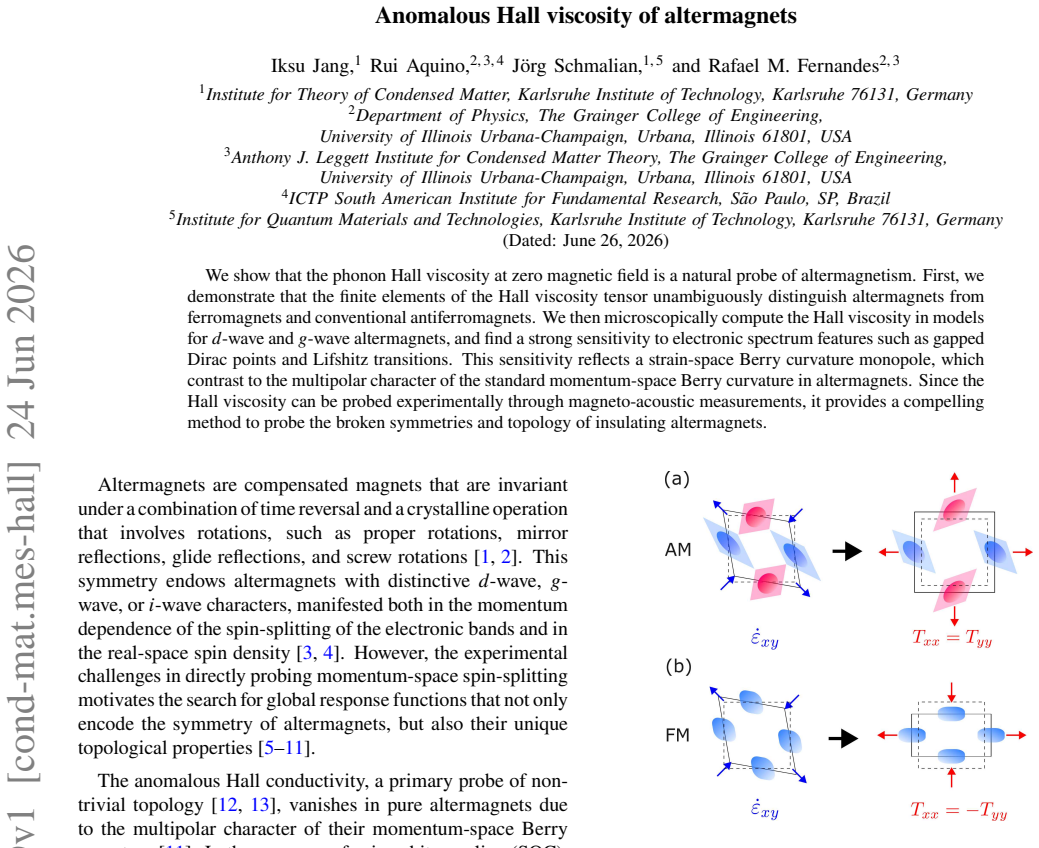
Altermagnets exhibit a nonzero phonon Hall viscosity at zero field generated by a strain-space Berry curvature monopole. This produces finite components of the viscosity tensor that are absent in ferromagnets and conventional antiferromagnets. Explicit computations in d-wave and g-wave microscopic models demonstrate that the magnitude and sign of the viscosity track electronic spectrum features including gapped Dirac points and Lifshitz transitions, in contrast to the multipolar momentum-space Berry curvature that characterizes altermagnets.
What carries the argument
Strain-space Berry curvature monopole that generates the anomalous Hall viscosity response under strain.
If this is right
- Magneto-acoustic measurements can detect the broken symmetries and topology of insulating altermagnets.
- The Hall viscosity shows strong sensitivity to gapped Dirac points and Lifshitz transitions in the electronic spectrum.
- Finite elements of the viscosity tensor provide an unambiguous signature separating altermagnets from other magnetic classes.
- The effect occurs at zero magnetic field and does not require external fields for observation.
Where Pith is reading between the lines
- The strain-space formulation could be applied to compute similar responses in other classes of materials with momentum-space multipolar order.
- Measurements on specific material realizations of d-wave or g-wave altermagnets would allow direct comparison with the model predictions.
- Temperature or doping dependence of the viscosity could reveal additional signatures tied to the underlying band features.
Load-bearing premise
The chosen microscopic models for d-wave and g-wave altermagnets capture the dominant contributions to the phonon Hall viscosity without significant corrections from disorder or electron-phonon coupling details.
What would settle it
An experimental determination of the phonon Hall viscosity tensor in a candidate insulating altermagnet at zero field that finds all predicted finite elements to be zero would disprove the claim that these elements distinguish altermagnets.
Figures
read the original abstract
We show that the phonon Hall viscosity at zero magnetic field is a natural probe of altermagnetism. First, we demonstrate that the finite elements of the Hall viscosity tensor unambiguously distinguish altermagnets from ferromagnets and conventional antiferromagnets. We then microscopically compute the Hall viscosity in models for d-wave and g-wave altermagnets, and find a strong sensitivity to electronic spectrum features such as gapped Dirac points and Lifshitz transitions. This sensitivity reflects a strain-space Berry curvature monopole, which contrast to the multipolar character of the standard momentum-space Berry curvature in altermagnets. Since the Hall viscosity can be probed experimentally through magneto-acoustic measurements, it provides a compelling method to probe the broken symmetries and topology of insulating altermagnets.
Editorial analysis
A structured set of objections, weighed in public.
Referee Report
Summary. The paper claims that the phonon Hall viscosity at zero magnetic field serves as a probe of altermagnetism. It shows that finite elements of the Hall viscosity tensor distinguish altermagnets from ferromagnets and conventional antiferromagnets, then computes the viscosity microscopically in tight-binding models of d-wave and g-wave altermagnets. The results exhibit strong sensitivity to electronic features such as gapped Dirac points and Lifshitz transitions, attributed to strain-space Berry curvature monopoles (contrasting with momentum-space Berry curvature multipoles). The authors suggest experimental access via magneto-acoustic measurements for insulating altermagnets.
Significance. If the central claim holds, the work identifies a symmetry-based, zero-field transport signature that could experimentally distinguish altermagnetic order and its associated topology. The strain-space Berry curvature perspective offers a new angle on altermagnetism beyond standard spin-split band structures, with potential implications for phonon-mediated probes in magnetic materials.
major comments (2)
- [Microscopic calculations section (likely §3 or §4)] The central claim that finite Hall viscosity elements 'unambiguously distinguish' altermagnets (abstract and §1) rests on computations in clean, specific tight-binding models for d- and g-wave cases. No analysis is provided showing that these non-zero tensor elements survive under disorder, realistic electron-phonon matrix elements, or additional interactions that could renormalize or cancel the distinguishing components while preserving the magnetic order (see skeptic note on weakest assumption).
- [Berry curvature discussion] § on strain-space Berry curvature: the mapping from gapped Dirac points/Lifshitz transitions to monopoles in strain space is presented as the origin of the viscosity, but it is unclear how this remains robust when the underlying electronic spectrum is perturbed (e.g., by finite temperature or weak disorder), which is load-bearing for the distinction from FM/AFM.
minor comments (1)
- [Eq. definitions] Notation for the viscosity tensor components should be clarified with explicit definitions in terms of the strain tensor to avoid ambiguity when comparing to standard literature on Hall viscosity.
Simulated Author's Rebuttal
We thank the referee for their careful reading and constructive comments. Below we address the major points, clarifying the role of symmetry arguments versus model calculations and noting planned revisions for added discussion.
read point-by-point responses
-
Referee: [Microscopic calculations section (likely §3 or §4)] The central claim that finite Hall viscosity elements 'unambiguously distinguish' altermagnets (abstract and §1) rests on computations in clean, specific tight-binding models for d- and g-wave cases. No analysis is provided showing that these non-zero tensor elements survive under disorder, realistic electron-phonon matrix elements, or additional interactions that could renormalize or cancel the distinguishing components while preserving the magnetic order (see skeptic note on weakest assumption).
Authors: The claim that finite Hall viscosity elements unambiguously distinguish altermagnets is grounded in the symmetry analysis (Section 2), which shows these tensor components are permitted solely by the magnetic point groups of altermagnets and forbidden in ferromagnets and conventional antiferromagnets. The tight-binding computations (Section 3) illustrate that the elements are non-zero and sensitive to spectrum features in representative clean models. We agree that disorder, realistic electron-phonon matrix elements, and interactions are not analyzed; such effects lie outside the present scope and would require substantial further work. In the clean limit appropriate to high-quality insulating samples the symmetry-allowed terms remain. We will add a concise discussion of these modeling assumptions and their implications in the revised manuscript. revision: partial
-
Referee: [Berry curvature discussion] § on strain-space Berry curvature: the mapping from gapped Dirac points/Lifshitz transitions to monopoles in strain space is presented as the origin of the viscosity, but it is unclear how this remains robust when the underlying electronic spectrum is perturbed (e.g., by finite temperature or weak disorder), which is load-bearing for the distinction from FM/AFM.
Authors: The strain-space Berry curvature monopoles originate from the deformation-induced mapping of electronic features (gapped Dirac points, Lifshitz transitions) onto singularities in strain-parameter space. Finite temperature and weak disorder will broaden these features, yet the topological monopole character implies that the integrated contribution to the Hall viscosity remains finite provided the altermagnetic order (and associated symmetry breaking) is preserved. We will insert a short clarifying paragraph on the expected robustness under weak perturbations in the revised manuscript. revision: yes
Circularity Check
No significant circularity; derivation is model-driven and self-contained
full rationale
The paper computes the phonon Hall viscosity tensor explicitly from tight-binding models of d-wave and g-wave altermagnets, identifying non-zero elements via strain-space Berry curvature monopoles at gapped Dirac points and Lifshitz transitions. These calculations are performed directly on the chosen microscopic Hamiltonians without fitting parameters to target observables or renaming fitted quantities as predictions. No load-bearing self-citations, uniqueness theorems imported from prior author work, or ansatzes smuggled via citation are invoked to force the distinguishing finite tensor elements. The distinction from ferromagnets and conventional antiferromagnets follows from symmetry analysis and the explicit model spectra rather than any definitional reduction or statistical forcing. The derivation chain remains independent of its inputs.
Axiom & Free-Parameter Ledger
Reference graph
Works this paper leans on
-
[1]
Consider, for instance, the cases of a /u1D451/u1D4652− /u1D4662 altermagnet ( /u1D435− 2/u1D454 ) and a ferromagnet with out-of-plane magnetization (/u1D434− 2/u1D454 )
implies that each type of magnetic order parameter is associated with a unique combination of non-zero anomalous Hall viscosity tensor elements, demonstrating the suitability of /u1D702/u1D43B /u1D456 /u1D457 /u1D458/u1D459to distinguish between magnetic orders. Consider, for instance, the cases of a /u1D451/u1D4652− /u1D4662 altermagnet ( /u1D435− 2/u1D4...
-
[2]
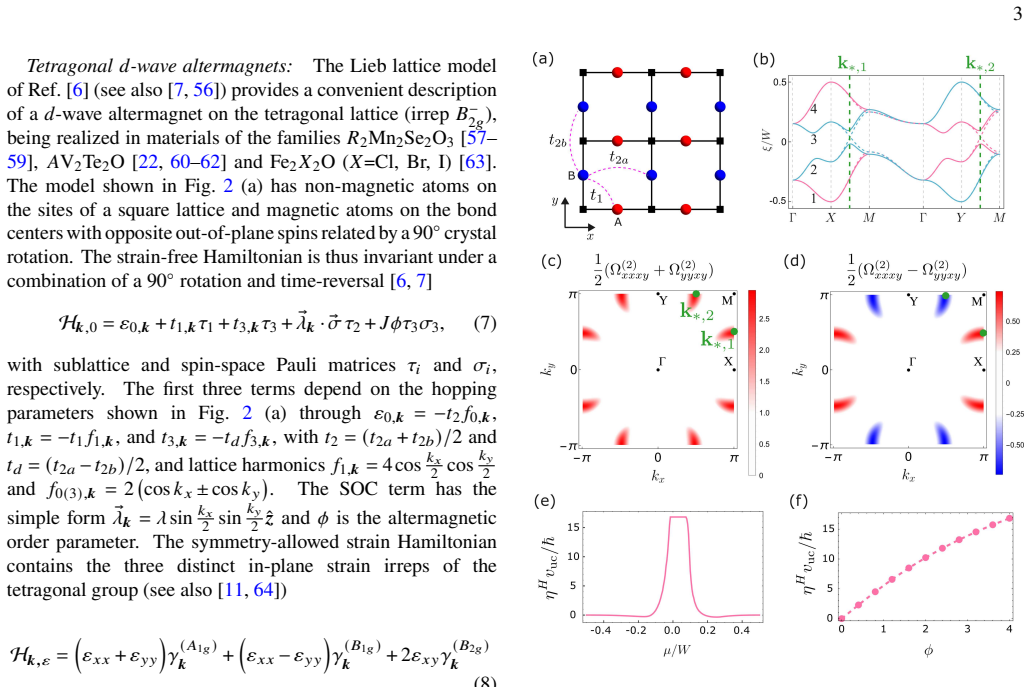
The End Matter shows the symmetry- allowed /u1D702/u1D43B /u1D456 /u1D457 /u1D458/u1D459for altermagnets in various point groups. Microscopic expression: To investigate the microscopic origin of the anomalous Hall viscosity in altermagnets, we consider a system described by Bloch states /barex /barex /u1D462/u1D48C,/u1D44F ⟩ with crystal momentum /u1D48Ca...
-
[3]
Moreover, SOC must be present to induce local Berry curvature
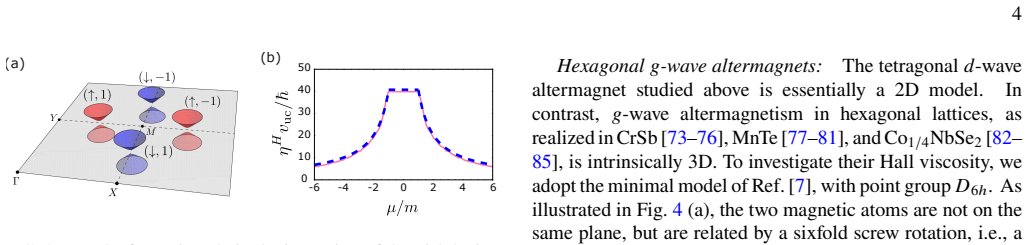
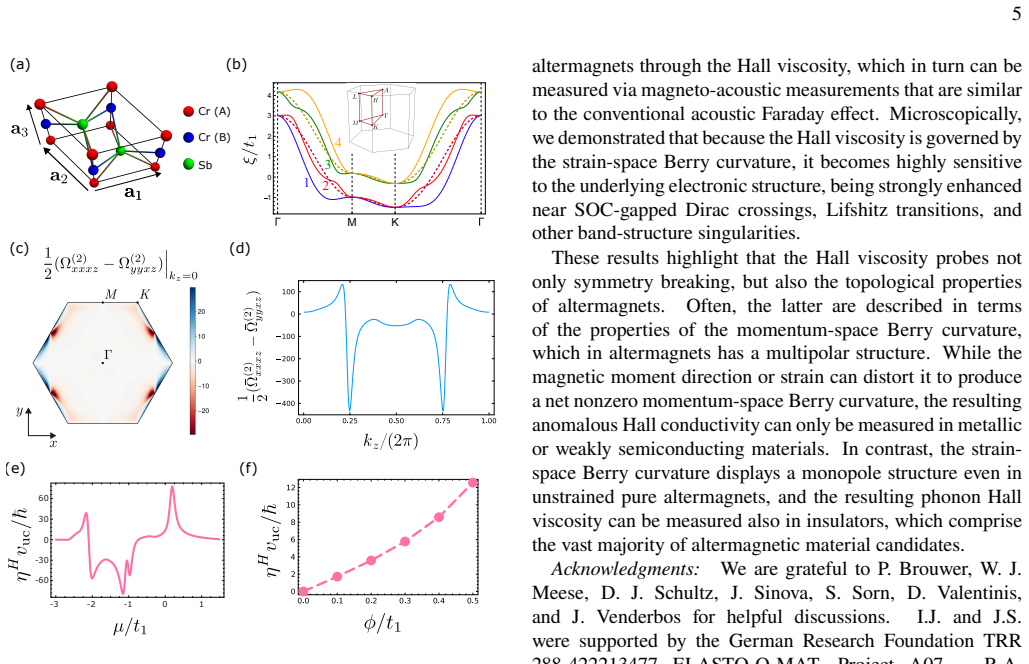
to be finite, H/u1D48C ,/u1D700must not commute with H/u1D48C ,0, otherwise /u1D6FE/u1D456 /u1D457 /u1D44F′/u1D44F is diagonal. Moreover, SOC must be present to induce local Berry curvature. To elucidate the microscopic properties that govern Ω( /u1D44F) /u1D456 /u1D457 /u1D458/u1D459, we compute it in minimal models for tetragonal /u1D451-wave and hexagon...
-
[4]
For the parameters values used here, see the SM [ 55]
(blue dashed line). For the parameters values used here, see the SM [ 55]. with Dirac matrices /u1D6FC/u1D70E /u1D456 and /u1D6FD, velocities /u1D463/u1D70E,/u1D705 /u1D456 , and SOC- generated mass /u1D45A/u1D70E = /u1D70E/u1D706 √ 1− /u1D719//u1D719/u1D450. Crucially, strain appears as an electromagnetic gauge field with /u1D700/u1D465 /u1D465± /u1D700/u...
-
[5]
in terms of the emergent gauge fields: /u1D446eff = /u1D70E/u1D43B /u1D465 /u1D466 /summationdisplay.1 /u1D70E,/u1D705 /u1D70E ∫ /u1D465,/u1D461 /u1D716/u1D456 /u1D457A /u1D70E,/u1D705 /u1D456 /u1D715/u1D461A /u1D70E,/u1D705 /u1D457 , (13) with /u1D716/u1D456 /u1D457the 2D Levi-Civita symbol. This action is noting but the temporal version of two Chern-Simon...
2025
-
[6]
2023/05765-7)
and from FAPESP (Grant No. 2023/05765-7). R.M.F. acknowledges support from the Research Corporation for Science Advancement through the Cottrell SEED Award CS- SEED-2025-012 and a Mercator Fellowship from the German Research Foundation (DFG) through Grant No. TRR 288, 422213477 Elasto-Q-Mat
2023
-
[7]
Šmejkal, J
L. Šmejkal, J. Sinova, and T. Jungwirth, Beyond conventional ferromagnetism and antiferromagnetism: A phase with nonrelativistic spin and crystal rotation symmetry, Phys. Rev. X 12, 031042 (2022)
2022
-
[8]
Šmejkal, J
L. Šmejkal, J. Sinova, and T. Jungwirth, Emerging Research Landscape of Altermagnetism, Phys. Rev. X12, 040501 (2022)
2022
-
[9]
Jungwirth, R
T. Jungwirth, R. M. Fernandes, E. Fradkin, A. H. MacDonald, J. Sinova, and L. Å mejkal, Altermagnetism: An unconventional spin-ordered phase of matter, Newton 1, 100162 (2025)
2025
-
[10]
Jungwirth, J
T. Jungwirth, J. Sinova, R. M. Fernandes, Q. Liu, H. Watanabe, S. Murakami, S. Nakatsuji, and L. Å mejkal, Symmetry, microscopy and spectroscopy signatures of altermagnetism, Nature 649, 837 (2026)
2026
-
[11]
Y . Fang, J. Cano, and S. A. A. Ghorashi, Quantum Geometry Induced Nonlinear Transport in Altermagnets, Phys. Rev. Lett. 133, 106701 (2024)
2024
-
[12]
D. S. Antonenko, R. M. Fernandes, and J. W. F. Venderbos, Mirror chern bands and weyl nodal loops in altermagnets, Phys. Rev. Lett. 134, 096703 (2025)
2025
-
[13]
M. Roig, A. Kreisel, Y . Yu, B. M. Andersen, and D. F. Agterberg, Minimal models for altermagnetism, Phys. Rev. B 110, 144412 6 (2024)
2024
-
[14]
P . Rao, A. Mook, and J. Knolle, T unable band topology and optical conductivity in altermagnets, Phys. Rev. B 110, 024425 (2024)
2024
-
[15]
K. Parshukov, R. Wiedmann, and A. P . Schnyder, Topological responses from gapped Weyl points in 2D altermagnets, arXiv:2403.09520 (2024)
arXiv 2024
-
[16]
Farajollahpour, R
T. Farajollahpour, R. Ganesh, and K. Samokhin, Light-induced charge and spin Hall currents in materials with C 4K symmetry, npj Quantum Materials 10, 29 (2025)
2025
-
[17]
Takahashi, C
K. Takahashi, C. R. W. Steward, M. Ogata, R. M. Fernandes, and J. Schmalian, Elasto-Hall conductivity and the anomalous Hall effect in altermagnets, Phys. Rev. B 111, 184408 (2025)
2025
-
[18]
Nagaosa, J
N. Nagaosa, J. Sinova, S. Onoda, A. H. MacDonald, and N. P . Ong, Anomalous Hall effect, Rev. Mod. Phys. 82, 1539 (2010)
2010
-
[19]
Å mejkal, A
L. Å mejkal, A. H. MacDonald, J. Sinova, S. Nakatsuji, and T. Jungwirth, Anomalous hall antiferromagnets,Nature Reviews Materials 7, 482 (2022)
2022
-
[20]
L. Šmejkal, R. González-Hernández, T. Jungwirth, and J. Sinova, Crystal time-reversal symmetry breaking and spontaneous hall effect in collinear antiferromagnets, Science Advances 6, eaaz8809 (2020) , https://www.science.org/doi/pdf/10.1126/sciadv.aaz8809
-
[21]
K. P . Kluczyk, K. Gas, M. J. Grzybowski, P . Skupiński, M. A. Borysiewicz, T. Fas, J. Suffczyński, J. Z. Domagala, K. Grasza, A. Mycielski, M. Baj, K. H. Ahn, Výborný, M. Sawicki, and M. Gryglas-Borysiewicz, Coexistence of anomalous Hall effect and weak magnetization in a nominally collinear antiferromagnet MnTe, Phys. Rev. B 110, 155201 (2023)
2023
-
[23]
M. Roig, Y . Yu, R. C. Ekman, A. Kreisel, B. M. Andersen, and D. F. Agterberg, Quasisymmetry-constrained spin ferromagnetism in altermagnets, Phys. Rev. Lett. 135, 016703 (2025)
2025
-
[24]
A. Osin, A. Levchenko, and M. Khodas, Extrinsic anomalous Hall effect in altermagnets, arXiv:2511.03151 (2025)
arXiv 2025
-
[25]
Y . Guo, H. Liu, O. Janson, I. C. Fulga, J. van den Brink, and J. I. Facio, Spin-split collinear antiferromagnets: A large-scale ab-initio study, Mater. Today Phys. 32, 100991 (2023)
2023
-
[26]
Sødequist and T
J. Sødequist and T. Olsen, T wo-dimensional altermagnets from high throughput computational screening: Symmetry requirements, chiral magnons, and spin-orbit effects, Applied Physics Letters 124 (2024)
2024
-
[27]
X. Wan, S. Mandal, Y . Guo, and K. Haule, High-throughput search for metallic altermagnets by embedded dynamical mean field theory, Phys. Rev. Lett. 135, 106501 (2025)
2025
-
[28]
H.- Y . Ma, M. Hu, N. Li, J. Liu, W. Y ao, J.-F. Jia, and J. Liu, Multifunctional antiferromagnetic materials with giant piezomagnetism and noncollinear spin current, Nature communications 12, 2846 (2021)
2021
-
[29]
Bhowal and N
S. Bhowal and N. A. Spaldin, Ferroically ordered magnetic octupoles in /u1D451-wave altermagnets, Phys. Rev. X 14, 011019 (2024)
2024
-
[30]
C. R. W. Steward, R. M. Fernandes, and J. Schmalian, Dynamic paramagnon-polarons in altermagnets,Phys. Rev. B108, 144418 (2023)
2023
-
[31]
R. M. Fernandes, V . S. de Carvalho, T. Birol, and R. G. Pereira, Topological transition from nodal to nodeless Zeeman splitting in altermagnets, Phys. Rev. B 109, 024404 (2024)
2024
-
[32]
Aoyama and K
T. Aoyama and K. Ohgushi, Piezomagnetic properties in altermagnetic MnTe, Phys. Rev. Mat. 8, L041402 (2024)
2024
-
[33]
P . A. McClarty and J. G. Rau, Landau Theory of Altermagnetism, Phys. Rev. Lett. 132, 176702 (2024)
2024
-
[34]
K. V . Y ershov, V . P . Kravchuk, M. Daghofer, and J. van den Brink, Fluctuation-induced piezomagnetism in local moment altermagnets, Phys. Rev. B 110, 144421 (2024)
2024
-
[35]
Attias, A
L. Attias, A. Levchenko, and M. Khodas, Intrinsic anomalous Hall effect in altermagnets, Phys. Rev. B 110, 094425 (2024)
2024
-
[36]
A. R. Chakraborty, J. Schmalian, and R. M. Fernandes, Magnetic-field-tuned randomness in inhomogeneous altermagnets, Phys. Rev. B 112, 035146 (2025)
2025
-
[37]
Jiang, X
Y . Jiang, X. Zhang, H. Bai, Y . Tian, B. Zhang, W.-J. Gong, and X. Kong, Strain-engineering spin-valley locking effect in altermagnetic monolayer with multipiezo properties, Applied Physics Letters 126 (2025)
2025
-
[38]
Schiff, P
H. Schiff, P . McClarty, J. G. Rau, and J. Romhányi, Collinear altermagnets and their landau theories,Phys. Rev. Res.7, 033301 (2025)
2025
-
[39]
M. Hu, X. Cheng, Z. Huang, and J. Liu, Catalog of /u1D436-paired spin-momentum locking in antiferromagnetic systems, Phys. Rev. X 15, 021083 (2025)
2025
-
[40]
Karetta, X
B. Karetta, X. H. Verbeek, R. Jaeschke-Ubiergo, L. Šmejkal, and J. Sinova, Strain-controlled /u1D454- to /u1D451-wave transition in altermagnetic crsb, Phys. Rev. B 112, 094454 (2025)
2025
-
[41]
H. Radhakrishnan, B. Bell, C. Ortix, and J. Venderbos, Topological piezomagnetic effect in two-dimensional dirac quadrupole altermagnets, arXiv:2602.05894 (2026)
Pith/arXiv arXiv 2026
-
[42]
Khodas, S
M. Khodas, S. Mu, I. I. Mazin, and K. D. Belashchenko, T uning of altermagnetism by strain, Phys. Rev. B 113, 104422 (2026)
2026
-
[43]
R. Ohlendorf, L. Buiarelli, H. M. Noad, A. P . Mackenzie, R. M. Fernandes, T. Birol, J. Schmalian, and E. Gati, Probing multipolar order in the candidate altermagnet MnF 2 through the elastocaloric effect under strain, arXiv:2601.19343 (2026)
arXiv 2026
-
[44]
J. E. Avron, R. Seiler, and P . G. Zograf, Viscosity of quantum Hall fluids, Phys. Rev. Lett. 75, 697 (1995)
1995
-
[45]
Barkeshli, S
M. Barkeshli, S. B. Chung, and X.-L. Qi, Dissipationless phonon Hall viscosity, Phys. Rev. B 85, 245107 (2012)
2012
-
[46]
Bradlyn, M
B. Bradlyn, M. Goldstein, and N. Read, Kubo formulas for viscosity: Hall viscosity, Ward identities, and the relation with conductivity, Phys. Rev. B 86, 245309 (2012)
2012
-
[47]
T. Qin, J. Zhou, and J. Shi, Berry curvature and the phonon Hall effect, Phys. Rev. B 86, 104305 (2012)
2012
-
[48]
Shapourian, T
H. Shapourian, T. L. Hughes, and S. Ryu, Viscoelastic response of topological tight-binding models in two and three dimensions, Phys. Rev. B 92, 165131 (2015)
2015
-
[49]
Saito, K
T. Saito, K. Misaki, H. Ishizuka, and N. Nagaosa, Berry phase of phonons and thermal Hall effect in nonmagnetic insulators, Phys. Rev. Lett. 123, 255901 (2019)
2019
-
[50]
B. S. Kim, Modeling Hall viscosity in magnetic-skyrmion systems, Phys. Rev. Res. 2, 013268 (2020)
2020
-
[51]
M. Y e, L. Savary, and L. Balents, Phonon Hall viscosity in magnetic insulators, arXiv:2103.04223 (2021)
arXiv 2021
-
[52]
Zhang, Y
Y . Zhang, Y . Teng, R. Samajdar, S. Sachdev, and M. S. Scheurer, Phonon Hall viscosity from phonon-spinon interactions, Phys. Rev. B 104, 035103 (2021)
2021
-
[53]
Flebus and A
B. Flebus and A. H. MacDonald, Phonon Hall viscosity of ionic crystals, Phys. Rev. Lett. 131, 236301 (2023)
2023
-
[54]
H.-L. Kim, T. Saito, H. Y ang, H. Ishizuka, M. J. Coak, J. H. Lee, H. Sim, Y . S. Oh, N. Nagaosa, and J.-G. Park, Thermal Hall effects due to topological spin fluctuations in YMnO 3, Nature Communications 15, 243 (2024)
2024
-
[55]
Shragai, E
A. Shragai, E. Horsley, S. Kim, Y .-J. Kim, and B. Ramshaw, Phonon Hall viscosity and the intrinsic thermal Hall effect of /u1D6FC-RuCl3, Nature 652, 1166 (2026). 7
2026
-
[56]
Müller, J
M. Müller, J. Schmalian, and L. Fritz, Graphene: A nearly perfect fluid, Phys. Rev. Lett. 103, 025301 (2009)
2009
-
[57]
J. M. Link, P . P . Orth, D. E. Sheehy, and J. Schmalian, Universal collisionless transport of graphene, Phys. Rev. B 93, 235447 (2016)
2016
-
[58]
A. A. Herasymchuk, E. V . Gorbar, and P . O. Sukhachov, Viscoelastic tensor and hydrodynamics of altermagnets, Phys. Rev. B 112, 075150 (2025)
2025
-
[59]
Jahn, Note on the Bhagavantam–Suranarayana method of enumerating the physical constants of crystals, Acta Crystallographica 2, 30 (1949)
H. Jahn, Note on the Bhagavantam–Suranarayana method of enumerating the physical constants of crystals, Acta Crystallographica 2, 30 (1949)
1949
-
[60]
/u1D449stands, as usual, for a polar vector, square brackets imply a symmetric combination, curly brackets imply an anti-symmetric combination, and /u1D44Edenotes time reversal
-
[61]
See Supplemental Material at https://journals.aps.org/authors/supplemental-material- instructions for details of tight binding model of the hexagonal system and acoustic Faraday effect
-
[62]
Brekke, A
B. Brekke, A. Brataas, and A. Sudbø, T wo-dimensional altermagnets: Superconductivity in a minimal microscopic model, Phys. Rev. B 108, 224421 (2023)
2023
-
[63]
C.-C. Wei, X. Li, S. Hatt, X. Huai, J. Liu, B. Singh, K.-M. Kim, R. M. Fernandes, P . Cardon, L. Zhao, T. T. Tran, B. A. Frandsen, K. S. Burch, F. Liu, and H. Ji, La 2O3Mn2Se2: A correlated insulating layered d-wave altermagnet, Phys. Rev. Mater. 9, 024402 (2025)
2025
-
[64]
Chang, K
P .-H. Chang, K. D. Belashchenko, and I. I. Mazin, Inverse lieb materials: Altermagnetism and more, npj Quantum Materials (2026)
2026
-
[65]
Garcia-Gassull, A
L. Garcia-Gassull, A. Razpopov, P . P . Stavropoulos, I. I. Mazin, and R. Valentí, Microscopic origin of the magnetic interactions and their experimental signatures in altermagnetic La2O3Mn2Se2, npj Spintronics 4, 9 (2026)
2026
-
[66]
Zhang, X
F. Zhang, X. Cheng, Z. Yin, C. Liu, L. Deng, Y . Qiao, Z. Shi, S. Zhang, J. Lin, Z. Liu, et al., Crystal-symmetry-paired spin–valley locking in a layered room-temperature metallic altermagnet candidate, Nature Physics 21, 760 (2025)
2025
-
[67]
Jiang, M
B. Jiang, M. Hu, J. Bai, Z. Song, C. Mu, G. Qu, W. Li, W. Zhu, H. Pi, Z. Wei, et al., A metallic room-temperature d-wave altermagnet, Nature Physics 21, 754 (2025)
2025
-
[68]
B. Thapa, P .-H. Chang, K. Belashchenko, and I. I. Mazin, Is altermagnetism in vanadium oxychalcogenides a lost cause?, arXiv:2602.18672 (2026)
arXiv 2026
-
[69]
Y .-K. Wang, S. Li, and S. A. Y ang, T wo-dimensional altermagnetic iron oxyhalides: Real chern topology and valley– spin–lattice coupling, Nano Letters 26, 831 (2026)
2026
-
[70]
B. Bell and J. Venderbos, Orbital piezomagnetic polarizability of pure insulating altermagnets, arXiv:2602.10076 (2026)
arXiv 2026
- [71]
-
[72]
M. A. Vozmediano, M. Katsnelson, and F. Guinea, Gauge fields in graphene, Physics Reports 496, 109 (2010)
2010
-
[73]
N. Levy, S. A. Burke, K. Meaker, M. Panlasigui, A. Zettl, F. Guinea, A. C. Neto, and M. F. Crommie, Strain-induced pseudo–magnetic fields greater than 300 tesla in graphene nanobubbles, Science 329, 544 (2010)
2010
-
[74]
von Oppen, F
F. von Oppen, F. Guinea, and E. Mariani, Synthetic electric fields and phonon damping in carbon nanotubes and graphene, Phys. Rev. B 80, 075420 (2009)
2009
-
[75]
Cortijo, Y
A. Cortijo, Y . Ferreirós, K. Landsteiner, and M. A. H. Vozmediano, Elastic gauge fields in weyl semimetals,Phys. Rev. Lett. 115, 177202 (2015)
2015
-
[76]
Cortijo, Y
A. Cortijo, Y . Ferreirós, K. Landsteiner, and M. A. Vozmediano, Visco elasticity in 2d materials, 2D Materials 3, 011002 (2016)
2016
-
[77]
Ferreiros and M
Y . Ferreiros and M. A. H. Vozmediano, Elastic gauge fields and Hall viscosity of dirac magnons, Phys. Rev. B 97, 054404 (2018)
2018
-
[78]
However, the limit /u1D719→ 0 cannot be taken, since well-separated Dirac points exist only for sufficiently large values of the order parameter
Notice that whenever the chemical potential lies within the gap of the Dirac spectrum, the Hall viscosity is independent of both the order parameter /u1D719and the spin-orbit coupling /u1D706. However, the limit /u1D719→ 0 cannot be taken, since well-separated Dirac points exist only for sufficiently large values of the order parameter
-
[79]
J. Ding, Z. Jiang, X. Chen, Z. Tao, Z. Liu, T. Li, J. Liu, J. Sun, J. Cheng, J. Liu, Y . Y ang, R. Zhang, L. Deng, W. Jing, Y . Huang, Y . Shi, M. Y e, S. Qiao, Y . Wang, Y . Guo, D. Feng, and D. Shen, Large band splitting in /u1D454-wave altermagnet CrSb, Phys. Rev. Lett. 133, 206401 (2024)
2024
-
[80]
G. Y ang, Z. Li, S. Y ang, J. Li, H. Zheng, W. Zhu, Z. Pan, Y . Xu, S. Cao, W. Zhao, A. Jana, J. Zhang, M. Y e, Y . Song, L.-H. Hu, L. Y ang, J. Fujii, I. Vobornik, M. Shi, H. Yuan, Y . Zhang, Y . Xu, and Y . Liu, Three-dimensional mapping and electronic origin of large altermagnetic splitting near Fermi level in CrSb, arXiv:2405.12575 (2024)
arXiv 2024
-
[81]
C. Li, M. Hu, Z. Li, Y . Wang, W. Chen, B. Thiagarajan, M. Leandersson, C. Polley, T. Kim, H. Liu, C. Fulga, M. G. Vergniory, O. Janson, O. Tjernberg, and J. van den Brink, Topological Weyl Altermagnetism in CrSb, arXiv:2405.14777 (2024)
arXiv 2024
discussion (0)
Sign in with ORCID, Apple, or X to comment. Anyone can read and Pith papers without signing in.