REVIEW 3 major objections 4 minor 6 cited by
AdaCliP: Adaptive Clipping for Private SGD
T0 review · 3 major / 4 minor · reviewed 2026-08-14 · deepseek-v4-flash
Pith's one-line read Adaptive per-coordinate clipping gives the same differential-privacy guarantee with substantially less added noise than standard L2 clipping.
desk verdict A clean per-coordinate clipping idea with a real privacy-accounting gap; the sqrt(B) issue is genuine but runs in the authors' favor here, so the paper deserves a careful revision rather than rejection. read the letter →
The pith
A machine-rendered reading of the paper's core claim, the machinery that carries it, and where it could break.
The reading
What carries the argument
The load-bearing object is the per-coordinate transformation $w^t = (g^t - a^t)/b^t$ with clipping $\hat{w}^t = w^t/\max(1,\|w^t\|)$ before adding Gaussian noise $N(0,\sigma^2 I)$. The optimal scale comes from the constrained program $\min_{a,b}\sum_i b_i^2$ subject to $\sum_i (s_i^2 + (m_i-a_i)^2)/b_i^2 \le \gamma$; Cauchy's inequality gives equality when $a_i = m_i$ and $b_i^2 = s_i S_t/\gamma$. Here $\gamma$ is a parameter bounding the expected squared norm of the transformed gradient, which controls how often clipping occurs. The algorithm estimates the mean $m$ and standard deviation $s$ by exponential moving averages of private noisy gradients, with a debiasing correction that subtracts the known noise variance $(b_i^t)^2\sigma^2$ from each squared deviation.
What would settle it
Run Algorithm 1 exactly as written and feed its per-step noisy gradients to a moments accountant, comparing the resulting $\epsilon$ with the values in Tables 1 and 2; a discrepancy would show the per-example-versus-mean noise equivalence fails at the implemented scale. Separately, on the paper's regression example with $d=1000$ and one informative coordinate, measure the empirical average of $\|b_t\|^2\sigma^2$; if the injected noise grows with $d$, the predicted factor-$d$ reduction is absent.
Extended reading notes
Core claim
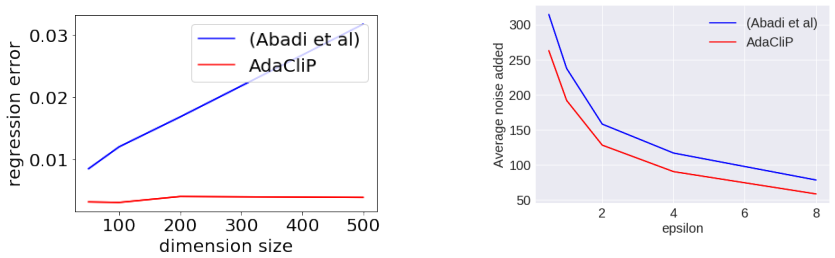
The paper's central claim is that in the family of element-wise linear gradient transformations—subtract a vector, divide coordinate-wise, clip to unit norm, add Gaussian noise, then rescale—the choice that minimizes injected noise is not the usual L2-norm clipping and not classical whitening. Writing $s_i^t$ for the standard deviation of coordinate $i$ of the stochastic gradient at iteration $t$, the optimal shift is $a_i^t = \mathbb{E}g_i^t$ and the optimal scale is $b_i^t = \sqrt{s_i^t S_t/\gamma}$, where $S_t = \sum_j s_j^t$ and $\gamma$ bounds the expected squared norm of the transformed gradient. The expected squared added noise then equals $\sigma^2 S_t^2/\gamma$, compared with $\sigma^2 d\sum_i (s_i^t)^2/\gamma$ for L2 clipping, so the advantage grows with the number of coordinates that carry no signal. On MNIST, AdaCliP reports accuracy improvements of 0.2 to 1.6 percentage points over L2 clipping at the same $(\epsilon,\delta)$ budgets, consistent with the smaller injected noise.
Load-bearing premise
If adding Gaussian noise to each per-example gradient and then averaging is not the same as adding one Gaussian perturbation to the averaged gradient at the scale the moments accountant assumes, then the reported $\epsilon$ does not describe the algorithm actually executed.
Editorial extensions
If this is right
- At a fixed $(\epsilon,\delta)$ budget, AdaCliP's coordinate-adaptive clipping yields lower expected injected noise than L2 norm clipping whenever coordinate standard deviations are unequal, because $(\sum_i s_i)^2 \le d\sum_i s_i^2$.
- On sparse-gradient problems such as the paper's regression example, the noise saving is a factor of the dimension $d$, and the optimization error no longer grows with the number of uninformative coordinates.
- AdaCliP needs no public data or precomputed Lipschitz bounds; it estimates the per-coordinate mean and standard deviation from the same private noisy gradients used for updates.
- The privacy-utility tradeoff in deep models improves consistently on MNIST: with $(\epsilon,10^{-5})$-differential privacy, accuracy rises by 0.2 to 1.6 percentage points at matched $\epsilon$ compared with L2 clipping.
- The same moments accountant used for standard private SGD applies, so AdaCliP can be inserted into existing private-training pipelines without changing the privacy accounting method.
Reading between the lines
- A direct consequence the paper leaves implicit: if the per-user noise in Algorithm 1 is not scaled by $1/\sqrt{B}$ before averaging, the effective noise-to-sensitivity ratio on the batch mean is not the $\sigma$ used in the moments accountant, so the reported $\epsilon$ values should be rechecked against the exact per-user algorithm.
- The debiased variance estimator subtracts $(b_i^t)^2\sigma^2$ under the assumption that clipping did not occur, while the analysis assumes clipping happens with constant probability; an unbiased variance estimator robust to clipping would make the theory and implementation consistent.
- The same per-coordinate scaling idea could be tested in federated learning settings, where client gradient variances are naturally heterogeneous; one could check whether AdaCliP's advantage over L2 clipping grows with the degree of heterogeneity across clients.
Signed reviews
Editorial analysis
A structured set of objections, weighed in public.
Referee Report
Summary. The paper proposes AdaCliP, a differentially private SGD method with coordinate-wise adaptive clipping. In the proposed framework, a stochastic gradient is transformed by subtracting a vector a_t and dividing by a vector b_t, clipped to unit L2 norm, and perturbed with Gaussian noise; Theorem 1 states that under a constraint E||w_t||^2 <= gamma, the optimal choices are a_t equal to the true gradient mean and b_t proportional to coordinate standard deviations, yielding noise whose squared norm scales as the square of the sum of standard deviations rather than d times the L2-clipping noise. Algorithm 1 estimates these quantities from noisy gradients and averages per-user noisy gradients over a minibatch. Experiments on a synthetic regression and on MNIST for logistic regression and a neural network report that AdaCliP achieves better accuracy than L2 clipping and noise proportional to the gradient norm bound for the same reported (epsilon,delta).
Significance. The core optimization idea is attractive and the derivation in Theorem 1 is transparent: if the privacy mechanism is genuinely the one analyzed in Section 4.1, coordinate-wise adaptive clipping provably reduces added noise relative to uniform clipping, and the empirical gains on MNIST would be valuable. The paper also gives a concrete algorithm and an explicit experimental protocol, which are assets. However, the advertised privacy guarantee is not established as written, because the noise accounting in Section 5 does not match the mechanism actually run in Algorithm 1, and because the convergence theorem is proved for an idealized variant with batch size 1 and a_t equal to the true gradient mean. The central claim is therefore currently conditional on a repair of the privacy analysis.
major comments (3)
- [Section 5, Algorithm 1] The sentence 'adding Gaussian noise to the individual user processed gradient and to the mean processed gradient is essentially equivalent' is not correct as stated. If each per-user transformed gradient receives N(0,sigma^2 I), the averaged noisy gradient has noise covariance (b_t b_t^T) sigma^2 / B, whereas the framework of Section 4.1 assumes the mean receives N(0,sigma^2 I). Conditioned on the history, so that b_t is fixed, the per-step mechanism has L2 sensitivity 2||b_t||/B and noise standard deviation ||b_t|| sigma / sqrt(B), giving an effective Gaussian-mechanism noise scale z = sigma sqrt(B)/2 (up to the usual factor of 2 in the sensitivity convention) rather than sigma. The moments accountant is therefore invoked with the wrong per-step privacy parameter, so the reported (epsilon,delta) is not derived from the algorithm as written and the claimed 'provably adds less noise under (epsilon,delta)-DP' is not established. For the experimental batch size B=600 the corrected z is larger and the reported epsilon would be conservative, but for B<4 the opposite holds. Please either modify Algorithm 1 to scale the per-user noise by sqrt(B), or add the noise directly to the mean with scale sigma, and in either case provide a conditional-privacy analysis that accounts for the data-dependent b_t.
- [Section 5, variance estimator] The debiasing identity used for the variance estimate, deriving E[(g_t^i - m_t^i)^2] from E[(~g_t^i - m_t^i)^2] - (b_t^i)^2 sigma^2, is derived under the assumption that clipping does not take place, i.e., ~g_t = g_t + b_t N_t. This directly conflicts with the design premise of the paper, which states that E||w_t||^2 <= gamma ensures that w_t is clipped with constant probability. Consequently the variance estimate is biased precisely in the operating regime the algorithm targets. In addition, if per-user noise is averaged over a batch, the correction should involve sigma^2 / B rather than sigma^2. This should be acknowledged as a heuristic, or the estimator should be analyzed in the presence of clipping.
- [Section 4.2, Theorem 2] Theorem 2 is stated for batch size 1 and for a_t equal to the true expectation E[g_t], while Algorithm 1 uses a minibatch of size B and replaces a_t by the exponential moving average m_t of noisy gradients defined in Eq. (4). The convergence bound therefore does not apply to the algorithm whose accuracy is reported in Section 6. Since the theoretical motivation for AdaCliP rests on this bound, the paper should either extend the analysis to the estimated a_t and b_t (with batch size B), or explicitly state Theorem 2 as an ideal-population analysis and provide a separate, weaker guarantee for the implemented variant.
minor comments (4)
- [Section 4, Theorem 1 and Theorem 2] The notation s_t^i = Σ E[(g_t^i - E g_t^i)^2] appears to be a typo; it should denote the coordinate variance E[(g_t^i - E g_t^i)^2] or its square root, since the proof uses (s_t^i)^2 in the numerator. Please make the definition of s_t^i unambiguous.
- [Section 5, Eq. (5)] The expression for b_t^i in Algorithm 1 is rendered ambiguously in the text; the intended formula b_t^i = sqrt(s_t^i / gamma) * sqrt(sum_j s_t^j) should be written explicitly with parentheses so that the derivation in Theorem 1 is reproducible.
- [Appendix B] The text contains 'deferentially private momentum optimization'; this should be 'differentially private'.
- [Section 6, Figure 3] Figure 3 reports an average noise ratio around 0.8, but no error bars or number of independent runs are given; since this figure directly supports the claim of reduced added noise, some measure of variability would be helpful.
Circularity Check
No circular reduction in the noise-minimization core; only a minor, non-load-bearing self-citation in the convergence lemma.
full rationale
The paper's central derivation is not circular. Theorem 1 (Section 4.1) is a self-contained constrained optimization: it minimizes the expected squared L2-norm of the added Gaussian noise, sum_i (b_t^i)^2, subject to the constraint E||w_t||^2 ≤ gamma, and the Holder-inequality argument yields b_t^i proportional to sqrt(s_t^i) with squared noise proportional to (sum_i sqrt(s_t^i))^2/gamma. This result does not assume the conclusion; it derives it from the stated objective. Section 4.3 then evaluates the L2-clipping choice a=0, b=C as a feasible point and compares objective values, which is a legitimate feasible-point comparison rather than an input-output circularity. The convergence analysis (Theorem 2 and Appendix A) relies on Lemma 2, which is cited from [42] by overlapping authors; however, Lemma 2 is a standard SGD variance/bias bound that is not the paper's target privacy-or-noise claim, so under the hard rules this self-citation does not constitute load-bearing circularity. Two passages are worth flagging but are not circular: Section 5's statement that 'since the sum of Gaussian noises is also Gaussian noise, adding Gaussian noise to the individual user processed gradient and to the mean processed gradient is essentially equivalent' is a scale-sensitive accounting assertion (off by a sqrt(B) factor for the released batch mean), and Equation (5)'s debiasing step E(g_i - m_i)^2 = E(g_tilde_i - m_i)^2 - (b_i)^2 sigma^2 explicitly assumes clipping does not occur while the analysis assumes it occurs with constant probability. These are correctness or privacy-accounting gaps, not self-referential derivations. Accordingly, no prediction in the paper reduces to its input by construction, and the score of 2 reflects only the minor non-load-bearing self-citation in the convergence lemma.
Assumptions & free parameters
free parameters (2)
- h2 =
not reported
- gamma (variance budget) =
1 (implicit)
assumptions (5)
- standard math Gaussian mechanism gives (epsilon, delta)-DP for noise scale sigma (Lemma 1)
- standard math SGD convergence bound from Reddi et al. (Lemma 2)
- domain assumption E||w_t||^2 <= gamma limits clipping in the analysis
- ad hoc to paper Adding noise to each per-example gradient is equivalent to adding noise to the mean
- ad hoc to paper Variance estimator assumes no clipping
Cite this review
Pith. "Pith review of AdaCliP: Adaptive Clipping for Private SGD." pith.science (2026). https://pith.science/paper/ARKW4MTF
@misc{pith2026190807643,
  author       = {Pith},
  title        = {Pith review of: AdaCliP: Adaptive Clipping for Private SGD},
  year         = {2026},
  howpublished = {\url{https://pith.science/paper/ARKW4MTF}},
  note         = {Machine review of arXiv:1908.07643}
}
read the original abstract
Privacy preserving machine learning algorithms are crucial for learning models over user data to protect sensitive information. Motivated by this, differentially private stochastic gradient descent (SGD) algorithms for training machine learning models have been proposed. At each step, these algorithms modify the gradients and add noise proportional to the sensitivity of the modified gradients. Under this framework, we propose AdaCliP, a theoretically motivated differentially private SGD algorithm that provably adds less noise compared to the previous methods, by using coordinate-wise adaptive clipping of the gradient. We empirically demonstrate that AdaCliP reduces the amount of added noise and produces models with better accuracy.
Figures


Forward citations
Cited by 6 Pith papers
-
StraightDP: Geometry-Aware Differential Privacy for Rectified-Flow Transformers
StraightDP releases a few DP class-conditioned moments to define the noise-end velocity of a rectified flow, then uses DP-SGD only on the sample-specific part, improving strong-privacy generation accuracy.
-
Private training in quantum machine learning
Hybrid QML models trained with classical DP-SGD retain higher accuracy than classical models under fixed privacy budgets on synthetic and image-classification tasks.
-
Efficient Differentially Private Fine-Tuning of LLMs via Reinforcement Learning
RLDP uses a soft actor-critic policy to adapt per-adapter clipping and noise during DP-SGD fine-tuning of LLMs, claiming utility gains and faster convergence, but the privacy proof is internally inconsistent.
-
Structure-Preference Enabled Graph Embedding Generation under Differential Privacy
A private graph embedding method that claims to preserve user-chosen node proximities, though its central proof and privacy analysis contain serious gaps.
-
AdaDPIGU: Differentially Private SGD with Adaptive Clipping and Importance-Based Gradient Updates for Deep Neural Networks
A DP-SGD variant using top-60% gradient sparsification and coordinate-wise adaptive clipping is proposed; its privacy guarantee is not established for the actual algorithm because the mask comes from private data.
-
Fast Fourier Transform-Based Spectral and Temporal Gradient Filtering for Differential Privacy
FFTKF applies an FFT low-pass mask and a Kalman filter to privatized gradients, reporting modest accuracy gains over DP-SGD and DiSK on several image benchmarks, but with incomplete privacy accounting.
Reference graph
Works this paper leans on
-
[1]
Delving deep into rectifiers: Surpassing human-level performance on imagenet classification
Kaiming He, Xiangyu Zhang, Shaoqing Ren, and Jian Sun. Delving deep into rectifiers: Surpassing human-level performance on imagenet classification. InProceedings of the IEEE international conference on computer vision, pages 1026–1034, 2015
work page 2015
-
[2]
Imagenet classification with deep convolutional neural networks
Alex Krizhevsky, Ilya Sutskever, and Geoffrey E Hinton. Imagenet classification with deep convolutional neural networks. InAdvances in neural information processing systems, pages 1097–1105, 2012
work page 2012
-
[3]
Recurrent neural network based language model
Tomáš Mikolov, Martin Karafiát, Lukáš Burget, Jan Černock` y, and Sanjeev Khudanpur. Recurrent neural network based language model. In Eleventh Annual Conference of the International Speech Communication Association, 2010
work page 2010
-
[4]
Oriol Vinyals, Łukasz Kaiser, Terry Koo, Slav Petrov, Ilya Sutskever, and Geoffrey Hinton. Grammar as a foreign language. InAdvances in Neural Information Processing Systems, pages 2773–2781, 2015
work page 2015
-
[5]
The netflix challenge.WIRED-SAN FRANCISCO-, 16(3):114, 2008
Jordan Ellenberg. The netflix challenge.WIRED-SAN FRANCISCO-, 16(3):114, 2008
work page 2008
-
[6]
Federated learning for mobile keyboard prediction
Andrew Hard, Kanishka Rao, Rajiv Mathews, Françoise Beaufays, Sean Augenstein, Hubert Eichner, Chloé Kiddon, and Daniel Ramage. Federated learning for mobile keyboard prediction. arXiv preprint arXiv:1811.03604, 2018
arXiv 2018
-
[7]
Lattice rescoring strategies for long short term memory language models in speech recognition
Shankar Kumar, Michael Nirschl, Daniel Holtmann-Rice, Hank Liao, Ananda Theertha Suresh, and Felix Yu. Lattice rescoring strategies for long short term memory language models in speech recognition. InAutomatic Speech Recognition and Understanding Workshop (ASRU), 2017 IEEE, pages 165–172. IEEE, 2017
work page 2017
-
[8]
Calibrating noise to sensitivity in private data analysis
Cynthia Dwork, Frank McSherry, Kobbi Nissim, and Adam Smith. Calibrating noise to sensitivity in private data analysis. In Theory of cryptography conference, pages 265–284. Springer, 2006
2006
Show all 43 references
-
[9]
The algorithmic foundations of differential privacy.Foun- dations and TrendsR©in Theoretical Computer Science, 9(3–4):211–407, 2014
Cynthia Dwork, Aaron Roth, et al. The algorithmic foundations of differential privacy.Foun- dations and TrendsR©in Theoretical Computer Science, 9(3–4):211–407, 2014
2014
-
[10]
Privacy-preserving logistic regression
Kamalika Chaudhuri and Claire Monteleoni. Privacy-preserving logistic regression. InAdvances in Neural Information Processing Systems, pages 289–296, 2009
2009
-
[11]
Differentially private empirical risk minimization
Kamalika Chaudhuri, Claire Monteleoni, and Anand D Sarwate. Differentially private empirical risk minimization. Journal of Machine Learning Research, 12(Mar):1069–1109, 2011
2011
-
[12]
Bolt- on differential privacy for scalable stochastic gradient descent-based analytics
Xi Wu, Fengan Li, Arun Kumar, Kamalika Chaudhuri, Somesh Jha, and Jeffrey Naughton. Bolt- on differential privacy for scalable stochastic gradient descent-based analytics. InProceedings of the 2017 ACM International Conference on Management of Data, pages 1307–1322. ACM, 2017
2017
-
[13]
Privacy-preserving deep learning
Reza Shokri and Vitaly Shmatikov. Privacy-preserving deep learning. InProceedings of the 22nd ACM SIGSAC conference on computer and communications security, pages 1310–1321. ACM, 2015. 12
2015
-
[14]
Deep learning with differential privacy
Martin Abadi, Andy Chu, Ian Goodfellow, H Brendan McMahan, Ilya Mironov, Kunal Talwar, and Li Zhang. Deep learning with differential privacy. InProceedings of the 2016 ACM SIGSAC Conference on Computer and Communications Security, pages 308–318. ACM, 2016
2016
-
[15]
Learning differentially private language models without losing accuracy.arXiv preprint arXiv:1710.06963, 2017
H Brendan McMahan, Daniel Ramage, Kunal Talwar, and Li Zhang. Learning differentially private language models without losing accuracy.arXiv preprint arXiv:1710.06963, 2017
2017 arXiv
-
[16]
Differentially private empirical risk minimization: Efficient algorithms and tight error bounds.arXiv preprint arXiv:1405.7085, 2014
Raef Bassily, Adam Smith, and Abhradeep Thakurta. Differentially private empirical risk minimization: Efficient algorithms and tight error bounds.arXiv preprint arXiv:1405.7085, 2014
2014 arXiv
-
[17]
Our data, ourselves: Privacy via distributed noise generation
Cynthia Dwork, Krishnaram Kenthapadi, Frank McSherry, Ilya Mironov, and Moni Naor. Our data, ourselves: Privacy via distributed noise generation. InAnnual International Conference on the Theory and Applications of Cryptographic Techniques, pages 486–503. Springer, 2006
2006
-
[18]
The optimal noise-adding mechanism in differential privacy
Quan Geng and Pramod Viswanath. The optimal noise-adding mechanism in differential privacy. IEEE Transactions on Information Theory, 62(2):925–951, 2016
2016
-
[19]
Optimal noise-adding mechanism in additive differential privacy.arXiv preprint arXiv:1809.10224, 2018
Quan Geng, Wei Ding, Ruiqi Guo, and Sanjiv Kumar. Optimal noise-adding mechanism in additive differential privacy.arXiv preprint arXiv:1809.10224, 2018
2018 arXiv
-
[20]
Privacy, accuracy, and consistency too: a holistic solution to contingency table release
Boaz Barak, Kamalika Chaudhuri, Cynthia Dwork, Satyen Kale, Frank McSherry, and Kunal Talwar. Privacy, accuracy, and consistency too: a holistic solution to contingency table release. In Proceedings of the twenty-sixth ACM SIGMOD-SIGACT-SIGART symposium on Principles of databa...
2007
-
[21]
When random sampling preserves privacy
Kamalika Chaudhuri and Nina Mishra. When random sampling preserves privacy. InAnnual International Cryptology Conference, pages 198–213. Springer, 2006
2006
-
[22]
Mechanism design via differential privacy
Frank McSherry and Kunal Talwar. Mechanism design via differential privacy. InFoundations of Computer Science, 2007. FOCS’07. 48th Annual IEEE Symposium on, pages 94–103. IEEE, 2007
2007
-
[23]
Localprivacyandstatisticalminimax rates
JohnCDuchi, MichaelIJordan, andMartinJWainwright. Localprivacyandstatisticalminimax rates. In Foundations of Computer Science (FOCS), 2013 IEEE 54th Annual Symposium on, pages 429–438. IEEE, 2013
2013
-
[24]
A stability-based validation procedure for differen- tially private machine learning
Kamalika Chaudhuri and Staal A Vinterbo. A stability-based validation procedure for differen- tially private machine learning. InAdvances in Neural Information Processing Systems, pages 2652–2660, 2013
2013
-
[25]
Learning in a large func- tion space: Privacy-preserving mechanisms for svm learning.arXiv preprint arXiv:0911.5708, 2009
Benjamin IP Rubinstein, Peter L Bartlett, Ling Huang, and Nina Taft. Learning in a large func- tion space: Privacy-preserving mechanisms for svm learning.arXiv preprint arXiv:0911.5708, 2009
2009 arXiv
-
[26]
Functional mechanism: regression analysis under differential privacy.Proceedings of the VLDB Endowment, 5(11):1364–1375, 2012
Jun Zhang, Zhenjie Zhang, Xiaokui Xiao, Yin Yang, and Marianne Winslett. Functional mechanism: regression analysis under differential privacy.Proceedings of the VLDB Endowment, 5(11):1364–1375, 2012
2012
-
[27]
Some methods of speeding up the convergence of iteration methods.USSR Computational Mathematics and Mathematical Physics, 4(5):1–17, 1964
Boris T Polyak. Some methods of speeding up the convergence of iteration methods.USSR Computational Mathematics and Mathematical Physics, 4(5):1–17, 1964. 13
1964
-
[28]
Adaptive subgradient methods for online learning and stochastic optimization.Journal of Machine Learning Research, 12(Jul):2121–2159, 2011
John Duchi, Elad Hazan, and Yoram Singer. Adaptive subgradient methods for online learning and stochastic optimization.Journal of Machine Learning Research, 12(Jul):2121–2159, 2011
2011
-
[29]
Adam: A method for stochastic optimization.arXiv preprint arXiv:1412.6980, 2014
Diederik P Kingma and Jimmy Ba. Adam: A method for stochastic optimization.arXiv preprint arXiv:1412.6980, 2014
2014 arXiv
-
[30]
Practical secure aggregation for privacy-preserving machine learning
Keith Bonawitz, Vladimir Ivanov, Ben Kreuter, Antonio Marcedone, H Brendan McMahan, Sarvar Patel, Daniel Ramage, Aaron Segal, and Karn Seth. Practical secure aggregation for privacy-preserving machine learning. InProceedings of the 2017 ACM SIGSAC Conference on Computer and Co...
2017
-
[31]
Yu, Sanjiv Kumar, and Brendan McMahan
Naman Agarwal, Ananda Theertha Suresh, Felix X. Yu, Sanjiv Kumar, and Brendan McMahan. cpSGD: Communication-efficient and differentially-private distributed SGD. InProceedings of NeurIPS, pages 7575–7586, 2018
2018
-
[32]
Privacy integrated queries: an extensible platform for privacy-preserving data analysis
Frank D McSherry. Privacy integrated queries: an extensible platform for privacy-preserving data analysis. InProceedings of the 2009 ACM SIGMOD International Conference on Manage- ment of data, pages 19–30. ACM, 2009
2009
-
[33]
Boosting and differential privacy
Cynthia Dwork, Guy N Rothblum, and Salil Vadhan. Boosting and differential privacy. In2010 IEEE 51st Annual Symposium on Foundations of Computer Science, pages 51–60. IEEE, 2010
2010
-
[34]
Differential privacy and robust statistics
Cynthia Dwork and Jing Lei. Differential privacy and robust statistics. InProceedings of the forty-first annual ACM symposium on Theory of computing, pages 371–380. ACM, 2009
2009
-
[35]
Concentrated differential privacy: Simplifications, extensions, and lower bounds
Mark Bun and Thomas Steinke. Concentrated differential privacy: Simplifications, extensions, and lower bounds. InTheory of Cryptography Conference, pages 635–658. Springer, 2016
2016
-
[36]
The composition theorem for differential privacy
Peter Kairouz, Sewoong Oh, and Pramod Viswanath. The composition theorem for differential privacy. IEEE Transactions on Information Theory, 63(6):4037–4049, 2017
2017
-
[37]
Differentially private model publishing for deep learning.arXiv preprint arXiv:1904.02200, 2019
Lei Yu, Ling Liu, Calton Pu, Mehmet Emre Gursoy, and Stacey Truex. Differentially private model publishing for deep learning.arXiv preprint arXiv:1904.02200, 2019
1904 arXiv
-
[38]
P3sgd: Patient privacy preserving sgd for regularizing deep cnns in pathological image classification
Bingzhe Wu, Shiwan Zhao, Guangyu Sun, Xiaolu Zhang, Zhong Su, Caihong Zeng, and Zhihong Liu. P3sgd: Patient privacy preserving sgd for regularizing deep cnns in pathological image classification. InProceedings of the IEEE Conference on Computer Vision and Pattern Recognition, p...
2019
-
[39]
Differentially private releasing via deep generative model (technical report).arXiv preprint arXiv:1801.01594, 2018
Xinyang Zhang, Shouling Ji, and Ting Wang. Differentially private releasing via deep generative model (technical report).arXiv preprint arXiv:1801.01594, 2018
2018 arXiv
-
[40]
Three tools for practical differential privacy.arXiv preprint arXiv:1812.02890, 2018
Koen Lennart van der Veen, Ruben Seggers, Peter Bloem, and Giorgio Patrini. Three tools for practical differential privacy.arXiv preprint arXiv:1812.02890, 2018
2018 arXiv
-
[41]
Differentially private learning with adaptive clipping
Om Thakkar, Galen Andrew, and H Brendan McMahan. Differentially private learning with adaptive clipping. arXiv preprint arXiv:1905.03871, 2019
1905 arXiv
-
[42]
Stochastic variance reduction for nonconvex optimization
Sashank J Reddi, Ahmed Hefny, Suvrit Sra, Barnabas Poczos, and Alex Smola. Stochastic variance reduction for nonconvex optimization. InInternational conference on machine learning, pages 314–323, 2016. 14
2016
-
[43]
Gradient-based learning applied to document recognition.Proceedings of the IEEE, 86(11):2278–2324, 1998
Yann LeCun, Léon Bottou, Yoshua Bengio, and Patrick Haffner. Gradient-based learning applied to document recognition.Proceedings of the IEEE, 86(11):2278–2324, 1998. 15 Appendix - AdaCliP: Adaptive Clipping for Private SGD A AdaCliP Convergence Analysis Theorem. Suppose the fun...
1998
Reviewed August 14, 2026 · model on record in the stance chip above.
Discussion (0). Continue with ORCID to comment.