Equilibrium with Internal Transfers
Pith reviewed 2026-06-26 14:52 UTC · model grok-4.3
The pith
In polymatrix games every stationary point of the social welfare function can be sustained as a self-enforcing transfer equilibrium using budget-balanced transfers.
A machine-rendered reading of the paper's core claim, the machinery that carries it, and where it could break.
Core claim
For polymatrix games, every stationary point of the social welfare function, in particular any socially optimal strategy profile, can be sustained as a SETE. This induces a Nash equilibrium in the agent normal form of the corresponding augmented game. Any socially optimal strategy profile can be supported as an M-SETE in any finite game while preserving budget balance.
What carries the argument
Self-Enforcing Transfer Equilibrium (SETE) where players commit to nonnegative peer-to-peer transfers paid only if the recipient does not deviate from a prescribed strategy, along with its mediated variant M-SETE.
If this is right
- Every stationary point of the social welfare function can be sustained as a SETE in polymatrix games.
- Polynomial-time algorithm and decentralized learning dynamic compute such equilibria.
- Internal transfers improve welfare and computation while preserving independent play on the equilibrium path.
- When full sequential-game stability is required, binding mediation provides the implementation.
Where Pith is reading between the lines
- The results suggest that internal transfers can substitute for external mechanisms in achieving efficiency in multi-player settings.
- Decentralized learning dynamics may allow players to converge to these improved equilibria without central coordination.
Load-bearing premise
Players can credibly commit to nonnegative peer-to-peer transfers paid only if the recipient does not deviate from a prescribed strategy and that these transfers remain budget-balanced.
What would settle it
A polymatrix game with a stationary social welfare point that cannot be supported as a SETE would falsify the main result for polymatrix games.
Figures
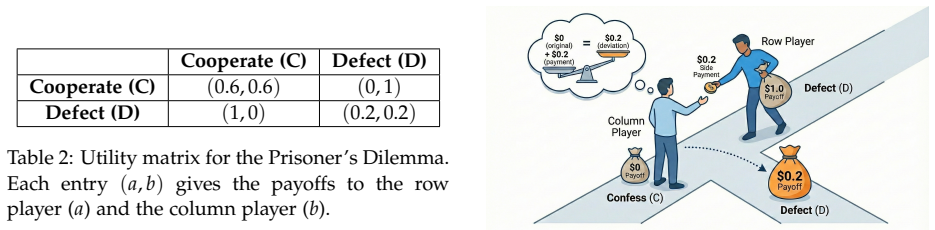
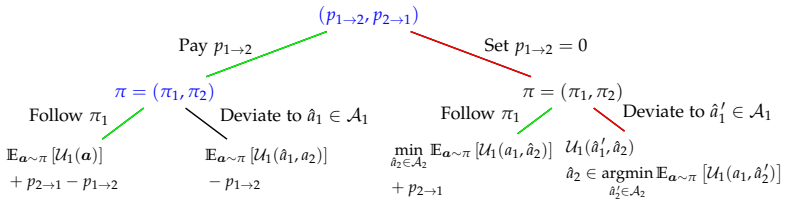
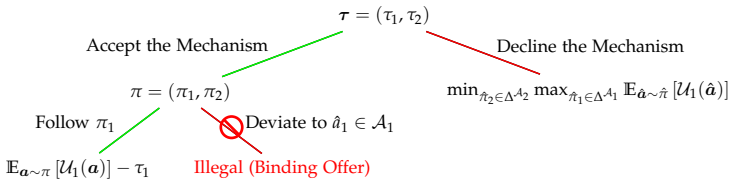
read the original abstract
Nash equilibrium (NE) arises from selfish utility maximization, yet its social welfare can be arbitrarily far from optimal. Moreover, computing an NE is intractable in general. We study augmented game models in which players use budget-balanced internal transfers to improve incentives before play. We first introduce \emph{Self-Enforcing Transfer Equilibrium} (SETE), where players commit to nonnegative peer-to-peer transfers that are paid only if the recipient does not deviate from a prescribed strategy. For polymatrix games, we show that every stationary point of the social welfare function, in particular any socially optimal strategy profile, can be sustained as a SETE. This induces a Nash equilibrium in the agent normal form of the corresponding augmented game. We further propose a polynomial-time algorithm and a decentralized learning dynamic to compute such product-form equilibria. We then introduce \emph{Mediated Self-Enforcing Transfer Equilibrium} (M-SETE), where a mediator makes both the payment schedule and the prescribed strategies binding offers. This additional enforcement resolves the agent-normal-form limitation: an M-SETE is a Nash equilibrium of the augmented game itself, not merely of its agent normal form, and any socially optimal strategy profile can be supported as an M-SETE in any finite game while preserving budget balance. Thus, internal transfers improve welfare and computation while preserving independent play on the equilibrium path. When full sequential-game stability is required, binding mediation provides the corresponding implementation.
Editorial analysis
A structured set of objections, weighed in public.
Referee Report
Summary. The paper introduces Self-Enforcing Transfer Equilibrium (SETE) in which players commit to nonnegative budget-balanced peer-to-peer transfers paid only if the recipient does not deviate from a prescribed strategy. For polymatrix games it shows that every stationary point of the social welfare function (including social optima) can be sustained as a SETE, inducing a Nash equilibrium in the agent normal form of the augmented game; it supplies a polynomial-time algorithm and a decentralized learning dynamic to compute product-form equilibria. It further introduces Mediated Self-Enforcing Transfer Equilibrium (M-SETE) in which a mediator makes both the payment schedule and prescribed strategies binding, allowing any socially optimal profile to be supported as a direct Nash equilibrium of the augmented game in any finite game while preserving budget balance.
Significance. If the results hold, the work supplies an explicit mechanism for improving social welfare and computational tractability via internal transfers while preserving independent play on the equilibrium path. The constructions rely on the polymatrix decomposition for stationarity and on mediator binding for generality; the provision of both an algorithm and a learning dynamic, together with the clean separation between agent-normal-form and direct NE, constitutes a concrete contribution to the literature on equilibrium refinement and implementation.
minor comments (2)
- [Abstract] Abstract: the phrase 'product-form equilibria' is used without a one-sentence gloss; a brief parenthetical definition would improve immediate readability.
- The distinction between the agent-normal-form NE induced by SETE and the direct NE obtained by M-SETE is central; a short illustrative 2-player example placed immediately after the definitions would help readers track the technical difference.
Simulated Author's Rebuttal
We thank the referee for their careful reading of the manuscript and for the positive evaluation, including the recommendation to accept.
Circularity Check
No significant circularity
full rationale
The paper establishes existence results and algorithms for SETE in polymatrix games (every stationary point of social welfare is supportable via budget-balanced conditional transfers) and M-SETE in arbitrary finite games. These follow directly from the game structure, the definitions of the augmented games, and standard equilibrium arguments in the agent normal form or with mediation; no step reduces a claimed prediction to a fitted parameter, self-definition, or load-bearing self-citation chain. The derivations are self-contained against the stated assumptions.
Axiom & Free-Parameter Ledger
axioms (2)
- domain assumption Finite action spaces and existence of Nash equilibria in finite games
- domain assumption Polymatrix payoff structure for the first set of results
invented entities (2)
-
Self-Enforcing Transfer Equilibrium (SETE)
no independent evidence
-
Mediated Self-Enforcing Transfer Equilibrium (M-SETE)
no independent evidence
Reference graph
Works this paper leans on
-
[1]
Subjectivity and correlation in randomized strategies
Robert J Aumann. Subjectivity and correlation in randomized strategies. Journal of mathematical Economics, 1 0 (1): 0 67--96, 1974
1974
-
[2]
The myth of the folk theorem
Christian Borgs, Jennifer Chayes, Nicole Immorlica, Adam Tauman Kalai, Vahab Mirrokni, and Christos Papadimitriou. The myth of the folk theorem. Games and Economic Behavior, 70 0 (1): 0 34--43, 2010
2010
-
[3]
Settling the complexity of two-player Nash equilibrium
Xi Chen and Xiaotie Deng. Settling the complexity of two-player Nash equilibrium. In Symposium on Foundations of Computer Science (FOCS), 2006
2006
-
[4]
The complexity of computing a Nash equilibrium
Constantinos Daskalakis, Paul W Goldberg, and Christos H Papadimitriou. The complexity of computing a Nash equilibrium. Communications of the ACM, 52 0 (2): 0 89--97, 2009
2009
-
[5]
Existence of correlated equilibria
Sergiu Hart and David Schmeidler. Existence of correlated equilibria. Mathematics of Operations Research, 14 0 (1): 0 18--25, 1989
1989
-
[6]
Introduction to online convex optimization
Elad Hazan et al. Introduction to online convex optimization. Foundations and Trends in Optimization , 2 0 (3-4): 0 157--325, 2016
2016
-
[7]
Endogenous games and mechanisms: Side payments among players
Matthew O Jackson and Simon Wilkie. Endogenous games and mechanisms: Side payments among players. The Review of Economic Studies, 72 0 (2): 0 543--566, 2005
2005
-
[8]
Paying to do better: Games with payments between learning agents
Yoav Kolumbus, Joe Halpern, and \'E va Tardos. Paying to do better: Games with payments between learning agents. arXiv preprint arXiv:2405.20880, 2024
arXiv 2024
-
[9]
On solving larger games: Designing new algorithms adaptable to deep reinforcement learning
Mingyang Liu. On solving larger games: Designing new algorithms adaptable to deep reinforcement learning. Master's thesis, Massachusetts Institute of Technology, 2025
2025
-
[10]
Computing equilibrium beyond unilateral deviation
Mingyang Liu, Gabriele Farina, and Asuman Ozdaglar. Computing equilibrium beyond unilateral deviation. In International Conference on Learning Representations (ICLR), 2026
2026
-
[11]
Potential games
Dov Monderer and Lloyd S Shapley. Potential games. Games and economic behavior, 14 0 (1): 0 124--143, 1996
1996
-
[12]
k-implementation
Dov Monderer and Moshe Tennenholtz. k-implementation. In Proceedings of the 4th ACM conference on Electronic Commerce, pages 19--28, 2003
2003
-
[13]
Strategically zero-sum games: the class of games whose completely mixed equilibria cannot be improved upon
Herv \'e Moulin and J-P Vial. Strategically zero-sum games: the class of games whose completely mixed equilibria cannot be improved upon. International Journal of Game Theory, 7 0 (3-4): 0 201--221, 1978
1978
-
[14]
Equilibrium points in n-person games
John F Nash. Equilibrium points in n-person games. Proceedings of the national academy of sciences, 36 0 (1): 0 48--49, 1950
1950
-
[15]
Vazirani, et al
Noam Nisan, Tim Roughgarden, Eva Tardos, Vijay V. Vazirani, et al. Algorithmic Game Theory. Cambridge University Press, 2007
2007
-
[16]
Semi bandit dynamics in congestion games: Convergence to nash equilibrium and no-regret guarantees
Ioannis Panageas, Stratis Skoulakis, Luca Viano, Xiao Wang, and Volkan Cevher. Semi bandit dynamics in congestion games: Convergence to nash equilibrium and no-regret guarantees. In International Conference on Machine Learning (ICML), 2023
2023
-
[17]
How bad is selfish routing? Journal of the ACM (JACM), 49 0 (2): 0 236--259, 2002
Tim Roughgarden and \'E va Tardos. How bad is selfish routing? Journal of the ACM (JACM), 49 0 (2): 0 236--259, 2002
2002
-
[18]
Evolutionary implementation and congestion pricing
William H Sandholm. Evolutionary implementation and congestion pricing. The Review of Economic Studies, 69 0 (3): 0 667--689, 2002
2002
-
[19]
Negative externalities and evolutionary implementation
William H Sandholm. Negative externalities and evolutionary implementation. The Review of Economic Studies, 72 0 (3): 0 885--915, 2005
2005
-
[20]
Reexamination of the perfectness concept for equilibrium points in extensive games
Reinhard Selten. Reexamination of the perfectness concept for equilibrium points in extensive games. International Journal of Game Theory, 4, 1975
1975
-
[21]
Linear last-iterate convergence in constrained saddle-point optimization
Chen - Yu Wei, Chung - Wei Lee, Mengxiao Zhang, and Haipeng Luo. Linear last-iterate convergence in constrained saddle-point optimization. In International Conference on Learning Representations (ICLR), 2021
2021
-
[22]
Steering no-regret learners to a desired equilibrium
Brian Hu Zhang, Gabriele Farina, Ioannis Anagnostides, Federico Cacciamani, Stephen Marcus McAleer, Andreas Alexander Haupt, Andrea Celli, Nicola Gatti, Vincent Conitzer, and Tuomas Sandholm. Steering no-regret learners to a desired equilibrium. arXiv preprint arXiv:2306.05221, 2023
arXiv 2023
discussion (0)
Sign in with ORCID, Apple, or X to comment. Anyone can read and Pith papers without signing in.