REVIEW 4 major objections 4 minor 62 references
This paper shows that AdS compact objects in extended metric-Palatini gravity with a geometric Proca field have standard black hole thermodynamics, including a first law, with stability depending on the AdS length scale.
Reviewed by Pith at T0; open to challenge. T0 means a machine referee read the full paper against a public rubric. the ladder, T0–T4 →
Thermodynamic quantities for Einstein-Geometric Proca AdS compact objects are derived and plotted, but the first law of thermodynamics is not satisfied for generic parameters.
T0 review reviewed 2026-08-04 challenge →
load-bearing objection Thermodynamics of Einstein-Geometric Proca AdS objects: standard extension, but the first law is not an identity and the q1=0 temperature limit fails. the 4 major comments →
Thermodynamics of Einstein-Geometric Proca AdS compact objects
The pith
A machine-rendered reading of the paper's core claim, the machinery that carries it, and where it could break.
The reading
Core claim
The central claim is that the Einstein-Geometric Proca AdS solutions satisfy the standard black hole thermodynamic relations. Using the area-law entropy S = A_h/(4G_N) and the surface-gravity temperature, the authors compute the heat capacity via C = (dM/dr_h)/(dT/dr_h) and find a sign change from negative (unstable) to positive (stable) as the horizon radius grows past roughly the AdS radius. They further verify the first law dM = T dS + Φ₂ dq₂, with the uniform-potential work term dropped, by showing that Δ = dM/dr_h − T dS/dr_h vanishes along the contour plot in their Fig. 8. This establishes, within the model's assumptions, that these geometric-Proca objects have a well-defined thermodyn
What carries the argument
The machinery is the family of static spherically symmetric solutions of extended metric-Palatini gravity: metric components f(r̂) = r̂²/l² + 1 + n₁/r̂^{1−σ} + n₂/r̂ and h(r̂) similarly, built from the Proca field solution φ(r̂) = q₁/r̂^{(1−σ)/2} + q₂/r̂^{(1+σ)/2}. The exponent σ (with 0 ≤ σ < 1 from the Breitenlohner-Freedman bound) encodes the Proca mass relative to the AdS radius. The thermodynamics follows by evaluating surface gravity at the horizon and using the mass/enthalpy expression from the horizon condition, with the parameter pair (q₁, q₂) controlling all deviations from Schwarzschild-AdS behavior.
Load-bearing premise
The analysis assumes that the Bekenstein-Hawking area law S = A/(4G) remains the correct entropy in extended metric-Palatini gravity, and that the work term for the uniform potential q₁ can be omitted from the first law; if either fails, the first-law check and the stability conclusions do not follow.
What would settle it
Compute the first law including the Φ₁ dq₁ term from the full mass formula; if Δ = dM − T dS − Φ₁ dq₁ − Φ₂ dq₂ does not vanish along the same contours, the stated first law is incomplete. Alternatively, derive the entropy from the Euclidean action of the EMPG action and check whether it differs from A/4; any difference would invalidate Eq. (22) and the heat-capacity analysis.
If this is right
- If correct, these compact objects can be treated as thermodynamic systems with a consistent temperature, entropy, and stability analysis, meaning the first law applies in this modified-gravity setting.
- The heat-capacity sign change implies a phase transition between small unstable and large stable configurations, with the transition scale set by the AdS radius.
- The q₁ and q₂ parameters provide handles to shift horizon temperature, so astrophysical observations of such objects could constrain these geometric-Proca couplings.
- The Schwarzschild-AdS limit (q₁ = 0) is recovered, validating the framework against known results.
Where Pith is reading between the lines
- The paper implicitly assumes the Bekenstein-Hawking area law without deriving it from the extended action; a Euclidean-action or Wald-entropy calculation for this theory could test whether geometric-Proca corrections generate additional entropy terms.
- The dropping of the Φ₁ dq₁ work term is a nontrivial choice; if the correct first law includes it, the Δ = 0 contours would shift, making the verification in Fig. 8 conditional on that choice.
- The phase transition near r_h ~ l resembles the Hawking-Page transition in AdS; a free-energy comparison between the small and large branches could determine which phase is globally preferred.
- The monotonicity claims are based on numerical plots for specific parameter values; an analytic proof of the sign of heat capacity would strengthen the stability claim.
Editorial analysis
A structured set of objections, weighed in public.
Referee Report
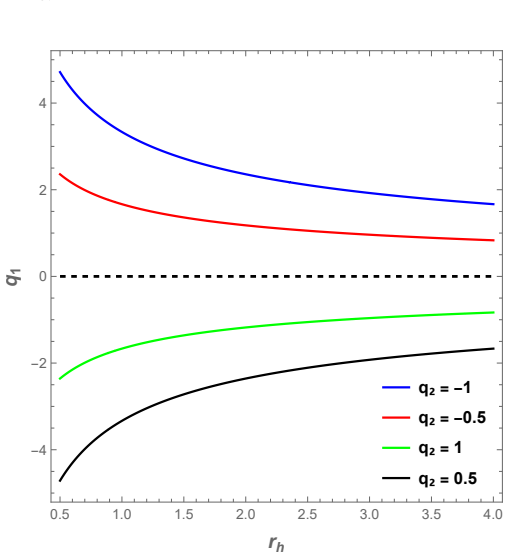
Summary. The paper studies the thermodynamics of static, spherically symmetric compact-object solutions in extended metric-Palatini gravity with a geometric Proca field, using the solution previously constructed by the same authors in [29]. It defines Hawking temperature, enthalpy, heat capacity, entropy, and Gibbs free energy as functions of the horizon radius and the parameters q1, q2, and sigma, and attempts to verify the first law dM = T dS + Phi2 dq2. The claimed results are that the temperature decreases with horizon radius and increases with q1, that the heat capacity is negative at small radii and positive at large radii with a phase transition near r_h ~ l, and that the first law holds along the Delta=0 contours of Fig. 8.
Significance. If correct, this would be a useful thermodynamic survey of a nontrivial modified-gravity solution and would provide concrete predictions for the stability of Einstein-Geometric Proca AdS compact objects. The paper makes an explicit attempt at a first-law consistency check and provides analytic formulas and numerical figures. However, the central thermodynamic framework is internally inconsistent: the printed Hawking temperature has the wrong Schwarzschild-AdS limit, the Delta expression in Eq. (27) does not match the temperature from Eq. (18), the heat-capacity expression is not the derivative defined in Eq. (20) and is complex in the stated parameter range, and the first law is verified only on selected contours rather than identically. These are load-bearing failures, so the numerical conclusions about temperature behavior, phase transitions, and stability are not supported by the manuscript as written.
major comments (4)
- [Sec. III A, Eq. (18)] In the q1=0 limit the radicand simplifies and gives T_H = (l^2 + 3 r_h^2)/(4 l^2 r_h sqrt(pi)). The surface-gravity formulas (15)-(17) applied to the metric (12) give instead (l^2 + 3 r_h^2)/(4 pi l^2 r_h). The printed expression is therefore sqrt(pi) larger; as l -> infinity it gives 1/(8 sqrt(pi) M), not the stated T0 = 1/(8 pi M). Thus Eq. (18) is not the Hawking temperature of the metric, and every quantity derived from it inherits this error.
- [Sec. III F, Eq. (27)] The expression labelled Delta is not dM/dr_h - T dS/dr_h using T from Eq. (18) and S = pi r_h^2. With Eq. (18), T dS/dr_h has an extra 1/sqrt(pi) relative to the second term of Eq. (27); Eq. (27) corresponds to a temperature with denominator 16 sqrt(3) pi l^2 r_h^2, not the printed 16 l^2 r_h^2 sqrt(3 pi). More fundamentally, a genuine first law must give Delta = 0 identically for all r_h at fixed q2; the contour plot in Fig. 8 shows Delta vanishes only on measure-zero curves. Hence M, T, and S are not mutually consistent thermodynamic variables, and the first-law 'verification' is not valid.
- [Sec. III C, Eq. (21)] The heat capacity formula contains a factor sqrt(sigma - 3) in the numerator, which is imaginary for the stated physical range 0 <= sigma < 1; the real curves plotted in Figs. 4-5 cannot follow from this expression. Independently, the q1=0 limit of Eq. (21) is pi(l^2+3r^2)/(18 r^3), whereas Eq. (20) applied to Eqs. (19) and (18) gives 2 sqrt(pi) r^2(l^2+3r^2)/(3r^2-l^2) (or 2 pi r^2(...)/(3r^2-l^2) with the corrected temperature). Eq. (21) is therefore not the derivative dM/dT, and the stability and phase-transition conclusions drawn from it are unsupported.
- [Sec. III F, Eq. (23)] The first law drops the Phi1 dq1 work term solely because q1 becomes a uniform potential in the Maxwell limit. This is not a justification: M depends on q1 for generic sigma, and variations in q1 must be accompanied by the conjugate work term. If q1 is held fixed, then the Delta=0 contours in Fig. 8, which scan q1 at fixed q2, are not permitted variations and cannot serve as a first-law check. The paper must either include Phi1 dq1 or consistently work at fixed q1 in a way that makes the identity hold for all r_h.
minor comments (4)
- [Secs. III B and III E] The paper interchangeably calls M the enthalpy H and then uses M in G = M - T S. This should be clarified, especially because Eq. (19) is derived from f(r_h)=0 and is later identified with the ADM mass.
- [Sec. III D, Eq. (22)] The Bekenstein-Hawking area law is assumed without derivation in this extended metric-Palatini theory with a massive Proca field. A Wald or Noether-charge computation would be needed to justify that S=pi r_h^2 remains exact; otherwise the first-law and heat-capacity results could change.
- [General] The notation is inconsistent about dimensionless quantities: Eqs. (18)-(27) use r_h and l without the hats defined in Sec. II. Please state the units/conventions used in the thermodynamic formulas.
- [Conclusion and captions] There are several typos, e.g., 'bcompact' in the conclusion and 'Fig. (2)' instead of 'Fig. 2'. The caption of Fig. 8 should state which parameters are held fixed in the contour plot.
Circularity Check
First-law 'verification' is circular: Δ=0 contours are imposed, not derived; bulk thermodynamic results are non-circular.
specific steps
-
self definitional
[Sec. III F, Eqs. (24)-(27), Fig. 8]
"To verify the validity of the first law, we plot the contour curves where ∆ = 0. Along each such curve in Fig. 8, the first law of thermodynamics is exactly satisfied."
The first law, Eq. (24), states dM/dr_h = T dS/dr_h. If M, T, and S are mutually consistent thermodynamic functions, this identity must hold for all r_h and parameters, i.e. Δ ≡ 0 identically. Instead, the paper defines Δ in Eq. (25) as the difference dM/dr_h − T dS/dr_h, then treats the locus Δ=0 as a verification. Those contours are precisely the set of points on which the unproven identity is imposed. The preceding sentence 'we need to satisfy Δ = 0' confirms that the condition is an input, not an outcome. Thus the claim 'the first law is exactly satisfied' along the curves is true by construction: it restates the defining equation of the plotted contours rather than providing an independent consistency check.
full rationale
The paper's main thermodynamic quantities—Hawking temperature (Eq. 18), enthalpy (Eq. 19), heat capacity (Eq. 21), entropy, and Gibbs free energy—are obtained by applying standard black-hole thermodynamic formulas (surface gravity, area-law entropy, ∂M/∂T) to a static spherically symmetric solution imported from the authors' prior work [29]. These derivations are not fitted to the target conclusions and are not circular: the temperature and heat-capacity behaviors follow from the metric functions, and the entropy is the usual horizon-area entropy. The self-citation to [29] is load-bearing only in the normal sense that any paper builds on its earlier solution; it is not a case of an unverified self-citation substituting for derivation. The one genuine circular step is the first-law 'verification' in Sec. III F: instead of demonstrating that dM = T dS holds identically for the derived M, T, and S, the paper defines the discrepancy Δ and then plots curves where Δ=0 as if this were a test. Since Δ=0 is exactly the first law, the verification is equivalent to the input. Separate issues—such as the unargued dropping of Φ1 dq1 and the inaccurate claim that q1=0 recovers T0=1/(8πM) rather than the Schwarzschild-AdS temperature—are correctness concerns, not circularity. Overall, the central thermodynamic predictions are independent, but the first-law validation partially reduces to its own defining condition.
Axiom & Free-Parameter Ledger
free parameters (1)
- γ (surface term coefficient)
axioms (4)
- domain assumption The extended metric-Palatini gravity action (Eq. (2)) and its reduction to GR plus a geometric Proca field (Eq. (5)) are valid.
- domain assumption The static spherically symmetric solution (10)-(12) from Ref. [29] is the correct solution of the field equations.
- domain assumption The entropy-area law S=A_h/(4G_N) applies to these compact objects in EMPG.
- ad hoc to paper The work term for the uniform potential q1 can be omitted from the first law because in the Maxwell limit q1 is a uniform potential.
Cite this review
Pith. "Pith review of Thermodynamics of Einstein-Geometric Proca AdS compact objects." pith.science (2026). https://pith.science/paper/ATYZCMT7
@misc{pith2026250909389,
  author       = {Pith},
  title        = {Pith review of: Thermodynamics of Einstein-Geometric Proca AdS compact objects},
  year         = {2026},
  howpublished = {\url{https://pith.science/paper/ATYZCMT7}},
  note         = {Machine review of arXiv:2509.09389}
}
read the original abstract
In this study we explore metric-Palatini gravity extended by the antisymmetric component of the affine curvature. This gravitational theory results in general relativity plus a geometric Proca field. Building on our previous work, where we constructed its static spherically symmetric solutions in the Anti-de Sitter (AdS) background (Eur. Phys. J. C 83(4):318, 2023), we conduct a comprehensive analysis of the system's thermodynamics. We examine the thermodynamic properties of the Einstein-Geometric Proca AdS compact objects, focusing on the Hawking temperature, enthalpy, heat capacity, entropy, and Gibbs free energy. Particular attention is given to the dependence of the Hawking temperature, enthalpy, and heat capacity on the uniform potential $q_{1}$ and the electromagnetic-type charge $q_{2}$. Through numerical analysis we compute the entropy and Gibbs free energy and investigate how these quantities vary with the model parameters.
Figures


Reference graph
Works this paper leans on
-
[2]
Hawking, Communications in Mathematical Physics43(3), 199 (1975)
S.W. Hawking, Communications in Mathematical Physics43(3), 199 (1975). doi:10.1007/BF02345020
-
[3]
Hawking, Nature248(5443), 30 (1974)
S.W. Hawking, Nature248(5443), 30 (1974). doi: 10.1038/248030a0
doi:10.1038/248030a0 1974
-
[4]
Wald,Quantum field theory in curved spacetime and black hole thermodynamics.(1994)
R.M. Wald,Quantum field theory in curved spacetime and black hole thermodynamics.(1994)
1994
-
[5]
R.G. Cai, Y.S. Myung, Y.Z. Zhang, Phys. Rev. D65(8), 084019 (2002). doi:10.1103/PhysRevD.65.084019
-
[6]
S. Nojiri, S.D. Odintsov, Phys.Rep505(2), 59 (2011). doi:10.1016/j.physrep.2011.04.001
-
[7]
Davies, Reports on Progress in Physics41(8), 1313 (1978)
P.C.W. Davies, Reports on Progress in Physics41(8), 1313 (1978). doi:10.1088/0034-4885/41/8/004
-
[8]
R.G. Cai, Y.P. Hu, Q.Y. Pan, Y.L. Zhang, Phys. Rev. D 91(2), 024032 (2015). doi:10.1103/PhysRevD.91.024032
-
[9]
M. Appels, R. Gregory, D. Kubiz ˚A´ ak, Phys. Rev. Lett.117(13), 131303 (2016). doi: 10.1103/PhysRevLett.117.131303
-
[10]
G. Rakhimova, F. Atamurotov, F. Javed, A. Abdu- jabbarov, G. Mustafa, Nuclear Physics B996, 116363 (2023). doi:10.1016/j.nuclphysb.2023.116363
arXiv 2023
- [11]
- [12]
-
[13]
A. Ditta, X. Tiecheng, G. Mustafa, M. Yasir, F. Ata- murotov, Eur. Phys. J. C82(8), 756 (2022). doi: 10.1140/epjc/s10052-022-10708-z
- [14]
-
[15]
Y. Sekhmani, S.K. Maurya, M.K. Jasim, ˙I. Sakallı, J. Rayimbaev, I. Ibragimov, Eur. Phys. J. C85(3), 229 (2025). doi:10.1140/epjc/s10052-025-13932-5
-
[16]
B. Rahmatov, M. Zahid, S.U. Khan, J. Rayimbaev, I. Ibragimov, Z. Yuldoshev, A. Dauletov, S. Muminov, Chin. Phys. C49(7), 075105 (2025). doi:10.1088/1674- 1137/adc188
doi:10.1088/1674- 2025
-
[17]
Schr¨ odinger,Space-Time Structure(1985)
E. Schr¨ odinger,Space-Time Structure(1985)
1985
-
[18]
F.W. Hehl, J.D. McCrea, E.W. Mielke, Y. Ne’eman, physrep258(1), 1 (1995). doi:10.1016/0370- 1573(94)00111-F
doi:10.1016/0370- 1995
-
[19]
V. Vitagliano, T.P. Sotiriou, S. Liberati, An- nals of Physics326(5), 1259 (2011). doi: 10.1016/j.aop.2011.02.008
-
[20]
T. Harko, T.S. Koivisto, F.S.N. Lobo, G.J. Olmo, Phys. Rev. D85(8), 084016 (2012). doi: 10.1103/PhysRevD.85.084016 10
-
[21]
Hybrid f(R) theories, local constraints, and cosmic speedup
S. Capozziello, T. Harko, T.S. Koivisto, F.S.N. Lobo, G.J. Olmo, arXiv e-prints arXiv:1301.2209 (2013). doi: 10.48550/arXiv.1301.2209
work page internal anchor Pith review Pith/arXiv arXiv doi:10.48550/arxiv.1301.2209 2013
-
[22]
S. Capozziello, T. Harko, T.S. Koivisto, F.S.N. Lobo, G.J. Olmo, Universe1(2), 199 (2015). doi: 10.3390/universe1020199
-
[23]
S. Capozziello, T. Harko, T.S. Koivisto, F.S.N. Lobo, G.J. Olmo, JCAP2013(7), 024 (2013). doi: 10.1088/1475-7516/2013/07/024
-
[24]
S. Capozziello, T. Harko, T.S. Koivisto, F.S.N. Lobo, G.J. Olmo, Phys. Rev. D86(12), 127504 (2012). doi: 10.1103/PhysRevD.86.127504
-
[25]
S. Capozziello, T. Harko, T.S. Koivisto, F.S.N. Lobo, G.J. Olmo, JCAP2013(4), 011 (2013). doi: 10.1088/1475-7516/2013/04/011
-
[26]
D. Demir, B. Puli¸ ce, JCAP04, 051 (2020). doi: 10.1088/1475-7516/2020/04/051
- [27]
-
[28]
and [29], aiming to obtain black hole solutions for Λ = 0 and Λ<0, respectively. In pursuit of a gen- eral static spherically symmetric solution, the following ansatz is employed gµν = diag(−h(r), 1 f(r) , r2, r2 sin2 θ),(8) and the vector field satisfying the equation of motion(7), can be considered as purely time-like ˆYµ = ˆϕ(r)δ0 µ (9) lead to the sol...
1974
-
[29]
D. Demir, B. Puli¸ ce, Eur. Phys. J. C82(11), 996 (2022). doi:10.1140/epjc/s10052-022-10986-7
-
[30]
E. Ghorani, B. Puli¸ ce, F. Atamurotov, J. Rayimbaev, A. Abdujabbarov, D. Demir, Eur. Phys. J. C83(4), 318 (2023). doi:10.1140/epjc/s10052-023-11490-2
-
[31]
D. Demir, Adv. High Energy Phys.2019, 4652048 (2019). doi:10.1155/2019/4652048
-
[32]
D. Demir, Gen. Rel. Grav.53(2), 22 (2021). doi: 10.1007/s10714-021-02797-0
-
[33]
D. Demir, Phys. Rev. D107(10), 105014 (2023). doi: 10.1103/PhysRevD.107.105014
-
[34]
F. Bauer, D.A. Demir, Phys. Lett. B665, 222 (2008). doi:10.1016/j.physletb.2008.06.014
-
[35]
F. Bauer, D.A. Demir, Phys. Lett. B698, 425 (2011). doi:10.1016/j.physletb.2011.03.042
-
[36]
T.P. Sotiriou, S. Liberati, Annals Phys.322, 935 (2007). doi:10.1016/j.aop.2006.06.002
-
[37]
M. Koussour, A. Altaibayeva, S. Bekov, O. Donmez, S. Muminov, J. Rayimbaev, Physics of the Dark Universe 46, 101577 (2024). doi:10.1016/j.dark.2024.101577
arXiv 2024
-
[38]
M. Koussour, S. Bekov, A. Syzdykova, S. Muminov, I. Ibragimov, J. Rayimbaev, Phys. Dark Univ.47, 101799 (2025). doi:10.1016/j.dark.2024.101799
arXiv 2025
-
[39]
V. Vitagliano, Class. Quant. Grav.31(4), 045006 (2014). doi:10.1088/0264-9381/31/4/045006
-
[40]
V. Vitagliano, T.P. Sotiriou, S. Liberati, Phys. Rev. D 82, 084007 (2010). doi:10.1103/PhysRevD.82.084007
-
[41]
H.A. Buchdahl, J. Phys. A12, 1235 (1979). doi: 10.1088/0305-4470/12/8/018
-
[42]
Tucker, C
R.W. Tucker, C. Wang, inMathematical Aspects of The- ories of Gravitation(1996)
1996
-
[43]
Y.N. Obukhov, E.J. Vlachynsky, W. Esser, F.W. Hehl, Phys. Rev. D56(12), 7769 (1997). doi: 10.1103/PhysRevD.56.7769
-
[44]
E. Ghorani, S. Mitra, J. Rayimbaev, B. Puli¸ ce, F. Ata- murotov, A. Abdujabbarov, D. Demir, Eur. Phys. J. C 84(10), 1022 (2024). doi:10.1140/epjc/s10052-024-13373- 6
-
[45]
R. Tresguerres, Z. Phys. C65(2), 347 (1995). doi: 10.1007/BF01571892
-
[46]
R.W. Tucker, C. Wang, Class. Quant. Grav.12(10), 2587 (1995). doi:10.1088/0264-9381/12/10/016
-
[47]
E.J. Vlachynsky, R. Tresguerres, Y.N. Obukhov, F.W. Hehl, Class. Quant. Grav.13(12), 3253 (1996). doi: 10.1088/0264-9381/13/12/016
-
[48]
A. Mac ´ ıas, J. Socorro, Class. Quant. Grav.16(7), 2323 (1999). doi:10.1088/0264-9381/16/7/312
-
[49]
J.D. Bekenstein, Phys. Rev. D5(6), 1239 (1972). doi: 10.1103/PhysRevD.5.1239
-
[50]
J.D. Bekenstein, Phys. Rev. D5(10), 2403 (1972). doi: 10.1103/PhysRevD.5.2403
-
[51]
S.L. Adler, R.B. Pearson, Phys. Rev. D18(8), 2798 (1978). doi:10.1103/PhysRevD.18.2798
-
[52]
V.P. Frolov, Gen. Rel. Grav.9(7), 569 (1978). doi: 10.1007/BF00761002
-
[53]
D. Gottlieb, R. Hojman, L.H. Rodr ´ ıguez, N. Zamorano, Nuovo Cim. B80(1), 62 (1984). doi:10.1007/BF02899373
-
[54]
B. Leaute, B. Linet, Gen. Rel. Grav.17(8), 783 (1985). doi:10.1007/BF00762627
-
[55]
E. Ay´ on-Beato, A. Garc ´ ıa, A. Mac ´ ıas, H. Quevedo, Phys. Rev. D61(8), 084017 (2000). doi: 10.1103/PhysRevD.61.084017
-
[56]
Y.N. Obukhov, E.J. Vlachynsky, An- nals Phys.511(6), 497 (1999). doi: 10.1002/andp.1999511060310.1002/(SICI)1521- 3889(199909)8:6¡497::AID-ANDP497¿3.0.CO;2-5
arXiv 1999
-
[57]
M. Toussaint, Gen. Rel. Grav.32(9), 1689 (2000). doi: 10.1023/A:1001942420350
-
[58]
H.S. Liu, H. L¨ u, C.N. Pope, JHEP06, 109 (2014). doi: 10.1007/JHEP06(2014)109
-
[59]
Wald, (2001)
R.M. Wald, (2001). Lecture Notes in Physics, vol. 769, pp. 1-37
2001
-
[60]
W.G. Unruh, Phys. Rev. D14(4), 870 (1976). doi: 10.1103/PhysRevD.14.870
-
[61]
J.D. Bekenstein, Phys. Rev. D7, 2333 (1973). doi: 10.1103/PhysRevD.7.2333
-
[62]
D. Kastor, S. Ray, J. Traschen, arXiv preprint (2018). URLhttps://arxiv.org/abs/1807.09801
Pith/arXiv arXiv 2018
-
[63]
S. Mahapatra, I. Banerjee, Physics of the Dark Universe 39, 101172 (2023). doi:10.1016/j.dark.2023.101172. URL https://doi.org/10.1016/j.dark.2023.101172
arXiv 2023
This paper was first reviewed by deepseek-v4-flash on August 4, 2026.
discussion (0)
Sign in with ORCID, Apple, or X to comment. Anyone can read and Pith papers without signing in.