REVIEW 2 major objections 3 minor 31 references
Spooky effect in optimal OSPA estimation and how GOSPA solves it
T0 review · 2 major / 3 minor · reviewed 2026-08-14 · deepseek-v4-flash
Pith's one-line read This paper shows that the minimum mean-square OSPA estimator couples independent far-away targets, so a change in one existence probability can flip the optimal report for all others, while GOSPA with α=2 decouples the decisions and…
desk verdict The paper's core OSPA/UOSPA coupling observation is real, but the GOSPA avoidance proof is overclaimed: for distances just above c a midpoint estimate beats every subset, so the proof needs a d>2c fix. read the letter →
The pith
A machine-rendered reading of the paper's core claim, the machinery that carries it, and where it could break.
The reading
What carries the argument
The load-bearing construction is the multi-Bernoulli posterior of Eqs. (3)–(4): $N$ independent Bernoulli components, where component $i$ has existence probability $r_i$ and a Dirac-delta density at $x_i$, with $d(x_i,x_j)>c$ for $i\neq j$. Because the positions are exactly known, any candidate estimate that is not a subset of $\{x_1,\ldots,x_N\}$ strictly increases the expected error (Appendix A), so estimates are parameterised by detection flags $\hat{e}_i$. The metric expressions in Lemma 4 then determine the behaviour: for GOSPA with $\alpha=2$, the assignment-set representation makes the squared error a per-component sum with threshold $0.5$, whereas UOSPA and OSPA include $\max(n,\hat{n})$ cardinality terms that tie every component's contribution to the total number reported. This structural difference — additivity versus cardinality normalisation — is the mechanism that turns a change in one remote $r_i$ into a global flip of the estimate.
What would settle it
Take a two-component multi-Bernoulli posterior with known locations separated by more than $c$, $r_1=0.6$, $r_2=0.4$, and enumerate the expected squared GOSPA error for all four subsets $\emptyset$, $\{x_1\}$, $\{x_2\}$, $\{x_1,x_2\}$; the paper predicts $\{x_1\}$ is the unique minimiser. If any other subset wins, the $r>0.5$ rule fails even in the paper's Dirac-delta regime. The same enumeration with $r_1=r_2=r_3=0.4$ under OSPA tests the prediction that the optimal estimate jumps from $\emptyset$ to all three targets because $(0.6)^3<0.4$.
Extended reading notes
Core claim
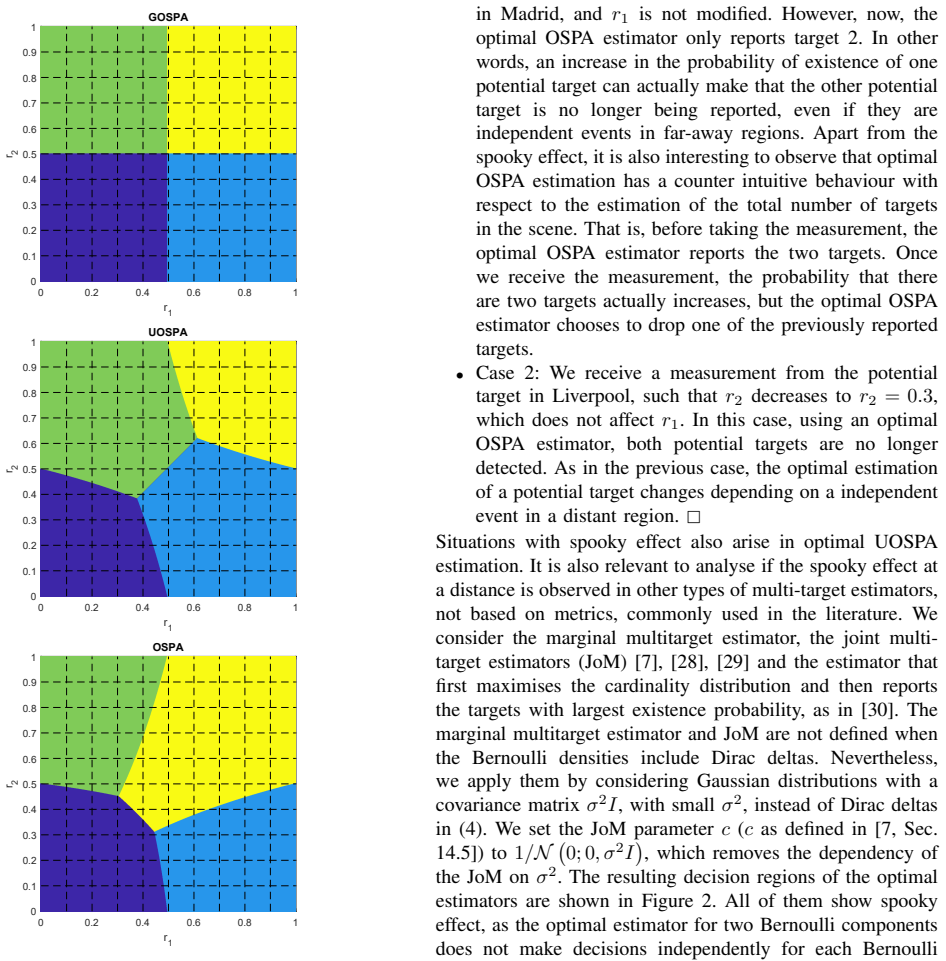
Within a multi-Bernoulli posterior with Dirac-delta single-target densities at known locations $x_i$ and pairwise distances greater than $c$, the paper derives closed-form mean-square errors for OSPA, UOSPA, and GOSPA ($\alpha=2$) and shows that every optimal estimate is a subset of $\{x_1,\ldots,x_N\}$. For GOSPA the squared error is additive, $\operatorname{MSGOSPA}=\frac{c^2}{2}\sum_{i=1}^N [r_i(1-\hat{e}_i)+(1-r_i)\hat{e}_i]$, so the optimal detection flag is $\hat{e}_i=1$ iff $r_i>0.5$, independent of all other components. For UOSPA and OSPA the errors contain cardinality-normalised terms $\max(n,\hat{n})$ that couple components; in the equal-probability case the optimal OSPA estimate is either empty or all $N$ targets, with all $N$ chosen exactly when $(1-r)^N<r$. The authors present this spooky effect at a distance as a reason to prefer GOSPA for conventional tracking, while noting that applications focused on total target count might deliberately want such coupling.
Load-bearing premise
The key premise is that the posterior is a multi-Bernoulli density with Dirac-delta single-target densities at known locations and pairwise separations larger than the cutoff $c$; the closed-form computations and the $0.5$ threshold are proven only in this idealised, well-separated regime.
Editorial extensions
If this is right
- For well-separated independent potential targets, the minimum mean-square GOSPA ($\alpha=2$) estimate is obtained componentwise: report target $i$ iff $r_i>0.5$, with no global search over subsets.
- In the same regime, the minimum mean-square OSPA and UOSPA estimates cannot be obtained componentwise, because the decision for one target depends on the existence probabilities of all other targets even at arbitrarily large separations.
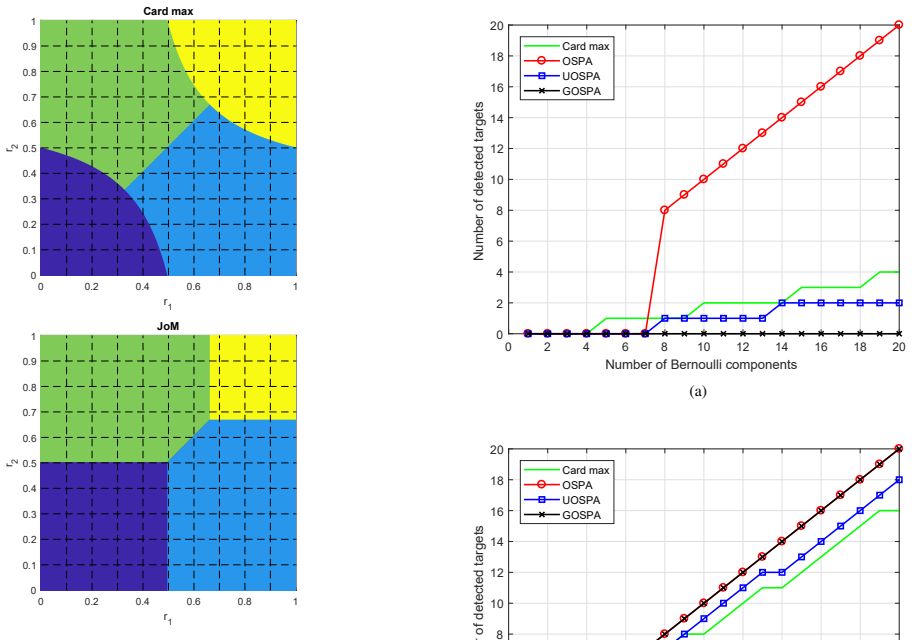
- With $N$ equal-probability components, the optimal OSPA estimate is bimodal — either no targets or all $N$ targets — and switches at $(1-r)^N<r$, so adding a distant component can reverse the report for every target.
- UOSPA changes the reported number of targets one at a time, but adding or removing a far-away component still adds or removes reports for targets elsewhere, so UOSPA also shows the spooky effect.
- The paper concludes that the spooky effect gives a rationale for using GOSPA ($\alpha=2$) in standard multitarget tracking, since it separates localisation, false-target, and missed-target costs.
Reading between the lines
- The structural cause visible in Lemma 4 — cardinality normalisation couples independent components — implies that any metric whose square error includes a $\max(n,\hat{n})$ or cardinality-mismatch term will exhibit spooky behaviour in mean-square estimation, not just OSPA and UOSPA; the paper shows two instances, and the mechanism is general.
- A practical consequence the paper leaves implicit is that GOSPA-based Bayesian reporting can be decentralised: each local tracker can threshold its own existence probability at $0.5$ without a global consensus step, whereas OSPA-based reporting requires knowing all components before deciding any single report.
- A testable extension, not covered by the proofs, is to replace the Dirac deltas with narrow Gaussians or to allow separations comparable to $c$; whether the $0.5$ threshold and the all-or-nothing jump survive location uncertainty is an open question that simulation could settle.
- The equal-probability condition $(1-r)^N<r$ gives a distinctive signature: OSPA-evaluated trackers should produce a bimodal reported-track-count distribution at 0 and $N$ as scene size grows, which could be checked in Monte Carlo runs without rederiving the mathematics.
Signed reviews
Editorial analysis
A structured set of objections, weighed in public.
Referee Report
Summary. This paper studies minimum mean-square estimation of a multi-target set when the posterior is a multi-Bernoulli density with N independent components whose single-target densities are Dirac deltas at known locations x_i. It claims that, provided the locations are separated by more than c, the optimal estimates under the OSPA and UOSPA metrics exhibit a 'spooky effect at a distance': the optimal report for one independent component can abruptly change when another far-away component changes its existence probability. In particular, for equal existence probabilities the OSPA estimator reports either no targets or all N targets according to (1-r)^N < r (Eq. 11). In contrast, it claims that the optimal mean-square GOSPA estimator (alpha=2) detects each target independently iff r_i > 0.5 (Eq. 9), so GOSPA avoids the spooky effect. The paper provides closed-form MSE formulas (5)-(7) under the assumption that the optimal estimate is a subset of {x_i}, proves the all-or-nothing OSPA result in Appendix C, and illustrates the decision regions in Figures 1-3.
Significance. The paper addresses an important conceptual question in multi-target tracking: whether the choice of metric induces unwanted coupling in optimal estimates. Its analytical setup is clean, and the closed-form expressions (5)-(7) and the all-or-nothing condition (11) are useful and clearly presented. The OSPA/UOSPA spooky-effect phenomenon is demonstrated concretely, and the contrast with GOSPA's decoupling property is a valuable message for the tracking community. However, the central GOSPA claim is established only under a subset restriction that is not valid for all separations d(x_i,x_j)>c; the paper needs a corrected proof or a strengthened assumption. With that repair, the paper would be a solid contribution.
major comments (2)
- [Appendix A / Section III-A] The assertion that the optimal estimate must be a subset of {x_1,...,x_N} is false for GOSPA when the separation is only d(x_i,x_j)>c. For c=1, x_1=0, x_2=1.1, and r_1=r_2=0.49, the singleton estimate y=0.5 has mean square GOSPA error c^2[0.2601*0.5 + 0.2499*0.25 + 0.2499*0.36 + 0.2401*0.75] = 0.4626 c^2, whereas the best subset estimate is empty with error 0.49 c^2 (and {x_1,x_2} has error 0.51 c^2). Thus the true minimizer of (2) is not a subset, contradicting the premise on which Lemma 4 and Eq. (9) rest. The same example shows that GOSPA can exhibit the spooky effect in this regime: with r_2=0 the optimal estimate for the remaining Bernoulli component is empty, while with r_2=0.49 the optimal estimate is no longer empty (the singleton {0.5} beats every subset estimate). The proof in Appendix A only lower-bounds non-subset distances by the cardinality term, which is 0 for equal-cardinality comparisons and does not rule out a non-subset estimate that is much closer to one target than c/sqrt(2). The results can be repaired by strengthening the separation assumption to d(x_i,x_j)>2c (or explicitly restricting estimates to subsets of {x_i}), but as written the theorem overstates the regime.
- [Section III-D and Figures 1-3] The paper presents the GOSPA decoupling result and the comparison with OSPA/UOSPA as valid for all d(x_i,x_j)>c. Since Eq. (9) is derived from Lemma 4, which assumes the invalid subset restriction, the GOSPA panel of Figure 1 and the GOSPA curves in Figure 3 do not describe the unconstrained minimizer of (2) when c<d(x_i,x_j)<2c. The paper should either prove the subset restriction under a clearly stated stronger condition (for example d(x_i,x_j)>2c) or explicitly frame the results as optimal estimates within the class of subsets of known locations. This is a load-bearing issue because the central claim that GOSPA 'avoids the spooky effect' is precisely what the counterexample above calls into question.
minor comments (3)
- [Section III-A] The phrase 'sufficiently far' is used informally; since the formal assumption d(x_i,x_j)>c is not sufficient for the proof, the separation condition should be stated explicitly wherever it is used.
- [Appendix A] The inequality for non-subset estimates compares only against a cardinality-only lower bound; even after strengthening the separation, the proof would be clearer as a dominance argument, for example by projecting any candidate point onto the nearest known location and comparing the resulting GOSPA distances for every ground-truth set.
- [Example 5] Example 5 does not specify the distances between the two Bernoulli components; since the claimed OSPA behaviour relies on the subset restriction, the example should either state d much larger than c or be updated to the regime in which the formal assumptions hold.
Circularity Check
No circular derivation: Lemma 4 and Appendices B-C are self-contained; only a minor, non-load-bearing self-citation to [21] for the GOSPA decomposition.
full rationale
The paper's central claims are derived algebraically from the stated multi-Bernoulli posterior (3)-(4) and the metric definitions. Lemma 4 is proved in Appendix B by direct enumeration of the Bernoulli existence events, giving closed-form expressions (5)-(7) without fitting any parameter or assuming the spooky effect. The GOSPA threshold (9) and the OSPA all-or-nothing condition (11) are then obtained by minimizing those expressions; Appendix C explicitly verifies that intermediate OSPA cardinalities are worse than the extremes. Proposition 3, which supplies the assignment-set decomposition of GOSPA for alpha=2, is cited from [21] by two of the present authors, but it is a parameter-free mathematical property of the metric itself, used as an input, not as evidence for the paper's target conclusion. Thus the self-citation is present but not load-bearing, and the derivation does not reduce to its own inputs. Any concern about the validity of the subset restriction in Appendix A for distances only slightly above c is a correctness issue in the proof, not circularity.
Assumptions & free parameters
assumptions (4)
- domain assumption The posterior is a multi-Bernoulli density with independent Bernoulli components (Eq. 3-4).
- domain assumption All Bernoulli component locations are mutually farther than the metric cutoff: d(x_i,x_j) > c for i != j.
- domain assumption The single-target density of each Bernoulli component is a Dirac delta at a known location (Eq. 4).
- standard math Standard set-integral calculus and the multi-Bernoulli cardinality distribution are used.
Cite this review
Pith. "Pith review of Spooky effect in optimal OSPA estimation and how GOSPA solves it." pith.science (2026). https://pith.science/paper/AUCKBG4E
@misc{pith2026190808815,
  author       = {Pith},
  title        = {Pith review of: Spooky effect in optimal OSPA estimation and how GOSPA solves it},
  year         = {2026},
  howpublished = {\url{https://pith.science/paper/AUCKBG4E}},
  note         = {Machine review of arXiv:1908.08815}
}
abstract
In this paper, we show the spooky effect at a distance that arises in optimal estimation of multiple targets with the optimal sub-pattern assignment (OSPA) metric. This effect refers to the fact that if we have several independent potential targets at distant locations, a change in the probability of existence of one of them can completely change the optimal estimation of the rest of the potential targets. As opposed to OSPA, the generalised OSPA (GOSPA) metric ($\alpha=2$) penalises localisation errors for properly detected targets, false targets and missed targets. As a consequence, optimal GOSPA estimation aims to lower the number of false and missed targets, as well as the localisation error for properly detected targets, and avoids the spooky effect.
Figures

Reference graph
Works this paper leans on
-
[21]
Gen- eralized optimal sub-pattern assignment metric,
A. S. Rahmathullah, A. F. García-Fernández, and L. Svensson, “Gen- eralized optimal sub-pattern assignment metric,” in 20th International Conference on Information Fusion , 2017
2017
-
[1]
Blackman and R
S. Blackman and R. Popoli, Design and Analysis of Modern Tracking Systems. Artech House, 1999
1999
-
[2]
Model based vehicle detection and tracking for autonomous urban driving,
A. Petrovskaya and S. Thrun, “Model based vehicle detection and tracking for autonomous urban driving,” Autonomous Robots , vol. 26, no. 2, pp. 123–139, 2009
work page 2009
-
[3]
Likelihood-based data association for extended object tracking using sampling methods,
K. Granström, L. Svensson, S. Reuter, Y . Xia, and M. Fatemi, “Likelihood-based data association for extended object tracking using sampling methods,” IEEE Transactions on Intelligent Vehicles , vol. 3, no. 1, pp. 30–45, March 2018
work page 2018
-
[4]
Särkkä, Bayesian Filtering and Smoothing
S. Särkkä, Bayesian Filtering and Smoothing . Cambridge University Press, 2013
2013
-
[5]
C. P. Robert, The Bayesian Choice . Springer, 2007
work page 2007
-
[6]
S. M. Kay, Fundamentals of Statistical Signal Processing: Estimation Theory. Prentice-Hall, 1993
work page 1993
-
[7]
R. P. S. Mahler, Statistical Multisource-Multitarget Information Fusion . Artech House, 2007
2007
Show all 31 references
-
[8]
Multitarget miss distance via optimal assignment,
J. R. Hoffman and R. P. S. Mahler, “Multitarget miss distance via optimal assignment,” IEEE Transactions on Systems, Man, and Cybernetics - Part A: Systems and Humans , vol. 34, no. 3, pp. 327–336, May 2004
2004
-
[9]
Tests of goodness of fit based on the L2-Wasserstein distance,
E. del Barrio, J. A. Cuesta-Albertos, C. Matrán, and J. M. Rodríguez- Rodriguez, “Tests of goodness of fit based on the L2-Wasserstein distance,” vol. 27, no. 4, pp. 1230–1239, 1999
1999
-
[10]
Villani, Optimal transport: Old and New
C. Villani, Optimal transport: Old and New . Springer, 2009
2009
-
[11]
A consistent metric for performance evaluation of multi-object filters,
D. Schuhmacher, B.-T. V o, and B.-N. V o, “A consistent metric for performance evaluation of multi-object filters,” IEEE Transactions on Signal Processing, vol. 56, no. 8, pp. 3447–3457, Aug. 2008
2008
-
[12]
A new metric between distributions of point processes,
D. Schuhmacher and A. Xia, “A new metric between distributions of point processes,” vol. 40, no. 3, pp. 651–672, Sep. 2008
2008
-
[13]
Shooting two birds with two bullets: How to find minimum mean OSPA estimates,
M. Guerriero, L. Svensson, D. Svensson, and P. Willett, “Shooting two birds with two bullets: How to find minimum mean OSPA estimates,” in 13th Conference on Information Fusion , July 2010, pp. 1–8
2010
-
[14]
Polynomial-time algorithms for the exact MMOSPA estimate of a multi-object probability density represented by particles,
M. Baum, P. Willett, and U. D. Hanebeck, “Polynomial-time algorithms for the exact MMOSPA estimate of a multi-object probability density represented by particles,” IEEE Transactions on Signal Processing , vol. 63, no. 10, pp. 2476–2484, May 2015
2015
-
[15]
Calculating some exact MMOSPA estimates for particle distributions,
M. Baum, P. Willett, and U. Hanebeck, “Calculating some exact MMOSPA estimates for particle distributions,” in 15th International Conference on Information Fusion , 2012, pp. 847–853
2012
-
[16]
A geometrical look at MOSPA es- timation using transportation theory,
G. M. Lipsa and M. Guerriero, “A geometrical look at MOSPA es- timation using transportation theory,” IEEE Signal Processing Letters , vol. 23, no. 12, pp. 1835–1838, Dec. 2016
2016
-
[17]
An approximate minimum MOSPA estimator,
D. F. Crouse, P. Willett, M. Guerriero, and L. Svensson, “An approximate minimum MOSPA estimator,” in IEEE International Conference on Acoustics, Speech and Signal Processing , 2011, pp. 3644–3647
2011
-
[18]
Set JPDA filter for multitarget tracking,
L. Svensson, D. Svensson, M. Guerriero, and P. Willett, “Set JPDA filter for multitarget tracking,” IEEE Transactions on Signal Processing, vol. 59, no. 10, pp. 4677–4691, Oct. 2011
2011
-
[19]
An efficient, variational approximation of the best fitting multi-Bernoulli filter,
J. L. Williams, “An efficient, variational approximation of the best fitting multi-Bernoulli filter,” IEEE Transactions on Signal Processing, vol. 63, no. 1, pp. 258–273, Jan. 2015
2015
-
[20]
Metrics for evaluating feature-based mapping performance,
P. Barrios, M. Adams, K. Leung, F. Inostroza, G. Naqvi, and M. E. Orchard, “Metrics for evaluating feature-based mapping performance,” IEEE Transactions on Robotics, vol. 33, no. 1, pp. 198–213, Feb. 2017
2017
-
[22]
Ambiguities in evaluating per- formance of multiple target tracking algorithms,
O. E. Drummond and B. E. Fridling, “Ambiguities in evaluating per- formance of multiple target tracking algorithms,” in Proceedings of the SPIE conference, 1992, pp. 326–337
1992
-
[23]
Performance evaluation methods for multiple-target-tracking algorithms,
B. E. Fridling and O. E. Drummond, “Performance evaluation methods for multiple-target-tracking algorithms,” vol. 1481, 1991, pp. 371–383
1991
-
[24]
Performance metrics for multiple-sensor multiple-target tracking,
R. L. Rothrock and O. E. Drummond, “Performance metrics for multiple-sensor multiple-target tracking,” inProc. SPIE, vol. 4048, 2000, pp. 521–531
2000
-
[25]
A performance assessment environment for radar signal processing and tracking algorithms,
S. Mabbs, “A performance assessment environment for radar signal processing and tracking algorithms,” in IEEE Pacific Rim Conference on Communications, Computers and Signal Processing , vol. 1, May 1993, pp. 9–12
1993
-
[26]
"Spooky action at a dis- tance
D. Franken, M. Schmidt, and M. Ulmke, “"Spooky action at a dis- tance" in the cardinalized probability hypothesis density filter,” IEEE Transactions on Aerospace and Electronic Systems , vol. 45, no. 4, pp. 1657–1664, Oct. 2009
2009
-
[27]
R. P. S. Mahler, Advances in Statistical Multisource-Multitarget Infor- mation Fusion. Artech House, 2014
2014
-
[28]
A joint multi- target estimator for the joint target detection and tracking filter,
E. Baser, M. McDonald, T. Kirubarajan, and M. Efe, “A joint multi- target estimator for the joint target detection and tracking filter,” IEEE Transactions on Signal Processing, vol. 63, no. 15, pp. 3857–3871, Aug. 2015
2015
-
[29]
A novel joint multitarget estimator for multi-Bernoulli models,
E. Baser, T. Kirubarajan, M. Efe, and B. Balaji, “A novel joint multitarget estimator for multi-Bernoulli models,” IEEE Transactions on Signal Processing, vol. 64, no. 19, pp. 5038–5051, Oct. 2016
2016
-
[30]
Labeled random finite sets and multi-object conjugate priors,
B. T. V o and B. N. V o, “Labeled random finite sets and multi-object conjugate priors,” IEEE Transactions on Signal Processing , vol. 61, no. 13, pp. 3460–3475, July 2013
2013
-
[31]
Performance evaluation of multi-Bernoulli conjugate priors for multi- target filtering,
Y . Xia, K. Granström, L. Svensson, and A. F. García-Fernández, “Performance evaluation of multi-Bernoulli conjugate priors for multi- target filtering,” in 20th International Conference on Information Fusion, July 2017, pp. 1–8
2017
Reviewed August 14, 2026 · model on record in the stance chip above.
Discussion (0). Continue with ORCID to comment.