REVIEW 4 major objections 5 minor 1 cited by
Making Expert Reasoning Learnable with Self-Distillation
T0 review · 4 major / 5 minor · reviewed 2026-08-03 · deepseek-v4-flash
Pith's one-line read Distribution Aligned Imitation Learning lets a student model learn from fewer than 1,000 expert solutions and outperform RLVR on hard math.
desk verdict A promising method for learning from expert solutions that deserves a careful referee, but the reported gains need tightening and the trace-faithfulness assumption needs direct evidence. read the letter →
The pith
A machine-rendered reading of the paper's core claim, the machinery that carries it, and where it could break.
The reading
What carries the argument
The central object is the privileged student, a frozen copy of the student model M_θref(·|x,s) that is conditioned on the expert solution s; mixed policy rollouts interleave the student's own sampling with acceptance by this privileged student at threshold τ, producing traces that preserve the student's natural flow while anchoring to the expert's reasoning. The other load-bearing component is the negative reference M_NR(·|x,s̃), conditioned on the final answer and a regex-extracted list of intermediate waypoints, which serves as the contrastive 'bad teacher' in the loss: the student is pushed toward the privileged distribution and away from the shortcut-prone negative distribution, with a s
What would settle it
Take a set of expert solutions that are already fully detailed and present no didactic gaps, and compare DAIL against plain behavioral cloning on the resulting traces: if DAIL shows no advantage, the improvement reported here depends on trace expansion rather than on the contrastive objective. More directly, inspect the tokens the negative reference penalizes and verify on held-out problems that DAIL-trained models avoid those specific shortcut errors while NLL-trained models reproduce them.
Extended reading notes
Core claim
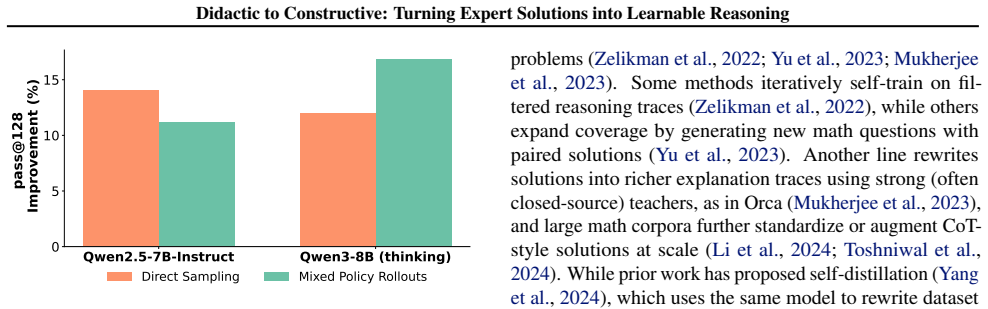
The core claim is that expert human solutions can be turned into learnable supervision for LLMs through a two-step process. First, a 'privileged student' — the frozen model conditioned on both the problem and the expert solution — generates an expanded, in-distribution reasoning trace, via direct sampling for instruction-tuned models or mixed policy rollouts for long-chain-of-thought models; this fills didactic gaps such as skipped proofs or implied calculations. Second, a contrastive loss trains the student to match the privileged student's token distribution while penalizing agreement with a 'negative reference' model conditioned only on the final answer and intermediate waypoints, which c
Load-bearing premise
The load-bearing premise is that the frozen privileged student's expanded traces faithfully preserve the expert's correct reasoning, contain no references to the expert solution, and stay in-distribution for the student; the paper's own experiments on weaker models show this condition can fail.
Editorial extensions
If this is right
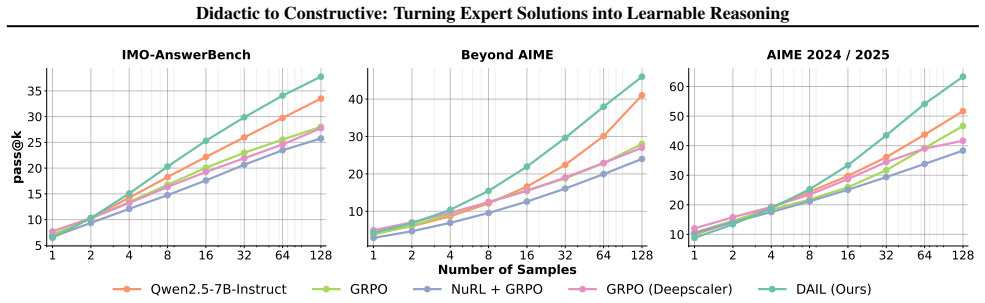
- With fewer than 1,000 expert solutions, DAIL improves pass@k on AIME 2024/2025, BeyondAIME, and IMO-AnswerBench for both an instruction-tuned model (Qwen2.5-7B-Instruct) and a long-CoT reasoning model (Qwen3-8B), including a 15% IMO-AnswerBench gain.
- DAIL is the first method the authors report that improves a long-CoT reasoning model directly from expert solutions, enabling training on non-verifiable proof problems where outcome-based RL gives no reward signal.
- Models trained with DAIL match or exceed the base model's accuracy while using 2–4× fewer reasoning tokens under budget forcing, meaning the learned reasoning is more direct.
- DAIL also preserves or slightly improves performance on the out-of-domain GPQA-Diamond benchmark, indicating no catastrophic forgetting.
- Standard RLVR baselines on the same hard problems either fail to update or overfit to rare stochastic successes; DAIL avoids this and generalizes better.
Reading between the lines
- This suggests a general recipe for fine-tuning any post-trained model on a small dataset of target outputs: expand each output into in-distribution reasoning before training, rather than applying SFT directly to the outputs; the paper's impact section gestures at this for safety-related applications.
- The contrastive principle — penalize probability assigned to tokens that are plausible only when the answer is leaked — could transfer to other one-to-many distillation settings, such as code repair or medical reasoning, wherever a teacher's target is compressed.
- The paper's own Figure 16 shows weaker models receive mixed benefit, implying DAIL needs a baseline level of reasoning competence; tuning the contrastive strength γ per model may extend the regime, but that is not yet shown.
- A direct test of the mechanism: if expert solutions are already fully expanded and contain no didactic gaps, DAIL should reduce approximately to plain behavioral cloning; if it still outperforms, the contrastive term is doing independent work.
Editorial analysis
A structured set of objections, weighed in public.
Referee Report
Summary. The paper proposes Distribution Aligned Imitation Learning (DAIL), a two-stage method for fine-tuning an LLM on small sets of high-quality expert solutions. Stage 1 expands didactic expert solutions into in-distribution reasoning traces using a frozen 'privileged student' conditioned on the solution, either by direct sampling or by mixed-policy rollouts with an acceptance threshold. Stage 2 trains the student with a contrastive KL objective that rewards agreement with the privileged student while penalizing agreement with a 'negative reference' conditioned only on solution waypoints. The method is evaluated on Qwen2.5-7B-Instruct and Qwen3-8B (think) using AIME 2024/2025, BeyondAIME, IMO-AnswerBench, and GPQA-Diamond, with claims of 10-31% pass@k gains, 2-4x token efficiency, and out-of-domain generalization.
Significance. If the main claims hold, DAIL is a valuable contribution: it addresses the practical problem of learning from expensive expert human solutions without a stronger teacher, and it provides an alternative to RLVR in non-verifiable domains. The paper is strengthened by public release of code and the e1-proof dataset, comparison against several relevant baselines (SFT, STaR, GRPO, NuRL, DeepScaleR-GRPO), the token-budget efficiency analysis, and explicit disclosure of a 15-problem overlap in IMO-AnswerBench with a robustness check. The central limitation is that the privileged-student traces are never directly validated for logical correctness, and the reported gain numbers are internally inconsistent. These issues need to be resolved before the paper's central claim can be accepted.
major comments (4)
- [Abstract/§1] The gain numbers are inconsistent across the abstract and body. The front abstract claims 'up to 31% pass@128 gains', while the full-text abstract says '10-25% pass@k gains' and §1 cites 'a 15% gain for Qwen3 (think) on IMO-AnswerBench'. No figure or table in §3 directly reports a 31% gain or gives per-benchmark point estimates for all claimed improvements. Please unify the claims and add a results table with exact pass@k gains per benchmark and model.
- [§2.1/§B.6] The central premise that privileged-student traces r are logically faithful to the expert solution is never directly evaluated. Figure 6 reports only final-answer accuracy on the training set, which cannot distinguish a valid derivation from an invalid derivation that reaches the same answer. The paper's own Figure 16/B.6 states that for weaker models traces are 'laden with shortcuts, which cannot be effectively mitigated'; no analogous trace-quality diagnosis is given for Qwen2.5/Qwen3. Because the contrastive objective (§2.2) only suppresses tokens that are more probable under M_NR than under M_PS, rationalization errors shared by the two conditioned models are not penalized. Please provide direct trace-validation evidence — e.g., human/LLM checks of logical validity, or an ablation that filters Dsyn by verified correctness — for the models used in the main experiments.
- [§B.2/§B.3] Hyperparameter selection weakens the generalization claim. The acceptance threshold τ is calibrated on the training set (Figure 11), and γ is tuned on a 100-sample validation set; both are then fixed across models and ablations. No confidence intervals or multiple seeds are reported anywhere. This makes it difficult to bound sampling noise in pass@k estimates or to know how sensitive the results are to these choices. Please report bootstrap confidence intervals (or seed-level variance) and a γ/τ sensitivity analysis for the central comparisons.
- [Appendix A/Figure 14] The 15-problem overlap with IMO-AnswerBench is disclosed, but 'no significant change' is asserted without a significance test or exact de-duplicated numbers. Please report the de-duplicated pass@k values and their uncertainty so readers can judge leakage robustness directly.
minor comments (5)
- [§2.1/§3.1] The symbol τ is used for both the mixed-policy acceptance threshold (§2.1) and the sampling temperature (§3.1). Please rename one to avoid confusion.
- [§B.2] Truncating Qwen3 rollouts at 256 tokens is a strong truncation for long-CoT models. Please state whether this truncation is applied equivalently to baselines and how final answers are obtained from truncated rollouts.
- [Figure 12] The caption says 'using Qwen2.5-7B-Instruct on e1-verifiable' but the surrounding text describes mixed-policy rollouts. Clarify which generation method the length histogram corresponds to.
- [Table 4] The contrastive-objective ablation is reported on only one benchmark. Consider adding standard errors or additional benchmarks to make the comparison more robust.
- [References] Some references, such as the NVIDIA whitepaper, are missing full publication details. Please standardize the bibliography.
Circularity Check
No significant circularity: DAIL's training signal is self-generated, but all headline claims are evaluated on held-out external benchmarks and no fitted parameter is renamed as a prediction.
full rationale
Walking the derivation chain: DAIL first builds Dsyn by sampling from a privileged student M_PS = M_θref(·|x,s) (or via mixed policy rollouts), then optimizes L(θ)=Σ[D_KL(M_θ‖M_PS)-γD_KL(M_θ‖M_NR)]. This is a training objective, not an estimate of the evaluation quantity. The paper's claims (pass@k gains, 2-4x token efficiency, OOD generalization) are measured on AIME 2024/2025, BeyondAIME, IMO-AnswerBench, and GPQA-Diamond, none of which are used to fit any parameter. Training sets are historical AIME 1985-2023 unsolved by the base model (e1-verifiable) and Olympiad proofs (e1-proof); γ and τ are selected on a validation set and training-set success rate, respectively, not on the test benchmarks. The self-referential structure—student, privileged student, and negative reference all derive from the same frozen θref—is a data-generation/regularization choice; it does not make the held-out pass@k results true by construction. The paper even reports a check for potential benchmark overlap (15 IMO-AnswerBench problems sharing sources with e1-verifiable) and finds no significant change when excluded. Figure 16's limitation that weaker models produce shortcut-laden traces is an acknowledged robustness boundary, not an identity between input and output. No uniqueness theorem, no load-bearing self-citation, and no fitted-input-called-prediction step appears in the paper.
Assumptions & free parameters
free parameters (4)
- τ (acceptance threshold) =
0.8
- γ (negative-reference weight) =
0.1
- epochs =
5 (Qwen2.5), 3 (Qwen3)
- rollout truncation length for reasoning models =
256 tokens
assumptions (7)
- domain assumption Expert solutions are out-of-distribution for post-trained models and direct behavioral cloning degrades reasoning.
- domain assumption The privileged student, conditioned on (x, s), produces in-distribution traces that preserve correct reasoning.
- domain assumption The negative reference conditioned on waypoints is a valid model of rationalization shortcuts, and penalizing its tokens improves generalization.
- domain assumption Benchmarks accurately measure reasoning and are not materially contaminated.
- domain assumption RLVR provides zero or weak signal on problems the model cannot solve, motivating DAIL.
- standard math Unbiased pass@k estimator and KL divergence are valid statistical tools.
- domain assumption A baseline level of model reasoning competence is required for DAIL to help.
invented entities (2)
-
Privileged student (M_PS)
-
Negative reference (M_NR)
Cite this review
Pith. "Pith review of Making Expert Reasoning Learnable with Self-Distillation." pith.science (2026). https://pith.science/paper/AUVETHBO
@misc{pith2026260202405,
  author       = {Pith},
  title        = {Pith review of: Making Expert Reasoning Learnable with Self-Distillation},
  year         = {2026},
  howpublished = {\url{https://pith.science/paper/AUVETHBO}},
  note         = {Machine review of arXiv:2602.02405}
}
read the original abstract
Improving the reasoning capabilities of large language models (LLMs) typically relies either on the model's ability to sample a correct solution to be reinforced or the existence of a stronger model able to solve the problem. However, many difficult problems remain intractable for even current frontier models, preventing the extraction of valid training signals. A promising alternative is to leverage high-quality expert human solutions, yet naive imitation of this data fails because it is fundamentally out-of-distribution: expert solutions are typically didactic, containing implicit reasoning gaps intended for human readers rather than computational models. Furthermore, high-quality expert solutions are expensive, necessitating generalizable, sample-efficient training methods. We propose Distribution Aligned Imitation Learning (DAIL), a two-step self-distillation method that bridges the distributional gap by first transforming expert solutions into detailed, in-distribution reasoning traces and then applying a contrastive objective to focus learning on expert insights and methodologies. We find that DAIL can leverage fewer than 1000 high-quality expert solutions to achieve up to 31% pass@128 gains on Qwen2.5-Instruct and Qwen3, double reasoning efficiency, and enable out-of-domain generalization.
Figures


Figures from the paper (11 more)




Forward citations
Cited by 1 Pith paper
-
Prefix Teach, Suffix Fade: Local Teachability Collapse in Strong-to-Weak On-Policy Distillation
Local teachability collapse occurs in later trajectory segments during strong-to-weak OPD; a margin-based release rule using top-K teacher advantage and BIC change-point detection on sentence segments outperforms full...
Reference graph
Works this paper leans on
-
[2]
Accessed: 2025-01-09. NVIDIA. Nvidia h100 tensor core gpu architecture. Whitepaper, 2022. URL https://resources.nv idia.com/en-us-hopper-architecture/nv idia-h100-tensor-c. OpenAI. Introducing openai o3 and o4-mini, April 2025. URL https://openai.com/index/introdu cing-o3-and-o4-mini/. Phan, L., Gatti, A., Han, Z., Li, N., Hu, J., Zhang, H., Zhang, C. B. ...
arXiv 2025
-
[3]
CMU MLD Blog. Reimers, N. and Gurevych, I. Sentence-bert: Sentence embeddings using siamese bert-networks.arXiv preprint arXiv:1908.10084, 2019. Rein, D., Hou, B. L., Stickland, A. C., Petty, J., Pang, R. Y ., Dirani, J., Michael, J., and Bowman, S. R. Gpqa: A graduate-level google-proof q&a benchmark. InFirst Conference on Language Modeling, 2024. Ross, ...
arXiv 1908
-
[2025]
Luong, M.-T., Hwang, D., Nguyen, H
Notion Blog. Luong, M.-T., Hwang, D., Nguyen, H. H., Ghiasi, G., Cher- vonyi, Y ., Seo, I., Kim, J., Bingham, G., Lee, J., Mishra, S., et al. Towards robust mathematical reasoning. In Proceedings of the 2025 Conference on Empirical Meth- ods in Natural Language Processing, pp. 35406–35430, 2025. Mai, X., Xu, H., Li, Z.-Z., Wang, W., Hu, J., Zhang, Y ., Zh...
arXiv 2025
Reviewed August 3, 2026 · model on record in the stance chip above.
Discussion (0). Sign in to comment.