REVIEW 3 major objections 6 minor 2 cited by
A Universal Model for Human Mobility Prediction
T0 review · 3 major / 6 minor · reviewed 2026-08-11 · deepseek-v4-flash
Pith's one-line read On three real-world mobility datasets, UniMob outperforms task-specific models on both trajectory and flow prediction, with the largest gains under noisy or scarce data.
desk verdict The unification idea is real but the printed C2I loss inverts the paper's own alignment claim, so the central mechanism needs correction and code before the results can be trusted. read the letter →
The pith
A machine-rendered reading of the paper's core claim, the machinery that carries it, and where it could break.
The reading
What carries the argument
The load-bearing mechanism is the bidirectional individual–collective alignment built on top of a multi-view mobility tokenizer and a joint diffusion transformer. The tokenizer turns trajectories into spatial-graph-plus-temporal embeddings and flows into the same format plus a historical-value embedding, so both modalities become token sequences the same transformer can denoise. Diffusion is formulated as a joint noise predictor learned on the pair (trajectory, flow), following a known unification of marginal and conditional denoising objectives. Two auxiliary losses do the alignment: the I2C loss sums trajectory embeddings and maximizes cosine similarity with the flow embedding, and the C2I loss uses the InfoNCE contrastive objective to pull trajectories that match flow peaks toward those flows while pushing other trajectories away. Four sharing and configuration variants show the architecture can be deployed with or without parameter sharing and with one or both data types at test time.
What would settle it
Train UniMob on a dataset in which flow peaks are artificially uncorrelated with trajectory times and places while all other structure is preserved; if the C2I loss still improves trajectory and flow prediction, then the semantic pairing assumed by the alignment is not the source of the gains, and the paper's main mechanism is not doing the claimed work.
Extended reading notes
Core claim
The central claim is that individual trajectories and crowd flows are two coupled modalities of the same phenomenon, and that a universal model can learn their common spatiotemporal patterns instead of modeling one in isolation. UniMob encodes trajectories and flows into tokens with a shared transformer-based diffusion backbone, then aligns them bidirectionally: aggregated trajectory embeddings are matched to flow embeddings (individual-to-collective), and contrastive learning pulls trajectory and flow representations together when a trajectory coincides with a flow peak (collective-to-individual). In experiments on three real-world datasets the model outperforms specialized baselines in both trajectory and flow prediction; the reported gains reach more than 10% relative improvement in flow prediction under 0.3 noise, up to 17.82% in noisy trajectory prediction, up to 14% in flow prediction with 75% of regions missing, and up to 25% in trajectory Accuracy@5 with only a quarter of the training data. The authors read these results as evidence that bidirectional alignment, rather than the shared transformer alone, carries the benefit: ablations that remove either alignment loss or either data type degrade performance.
Load-bearing premise
The collective-to-individual alignment assumes that a trajectory occurring at the same time and place as a flow peak is semantically aligned with that collective pattern; if the peak threshold is off or the batch's negative samples are noisy, the contrastive loss can push trajectory and flow embeddings apart instead of together, and the paper does not analyze that sensitivity.
Editorial extensions
If this is right
- A city can use one trained system for both next-location recommendation and crowd-flow forecasting, replacing separate deployed models.
- When one modality is missing or corrupted, the other supplies enough spatiotemporal signal to keep predictions useful; the paper reports up to 14% MAPE improvement with 75% of flow regions missing and up to 25% Accuracy@5 with 25% of trajectories.
- Diffusion-based modeling of the joint distribution gives resilience to noise: at 0.3 noise level UniMob improves flow MAPE by more than 10% over the best baseline, and trajectory accuracy gain reaches 17.82%.
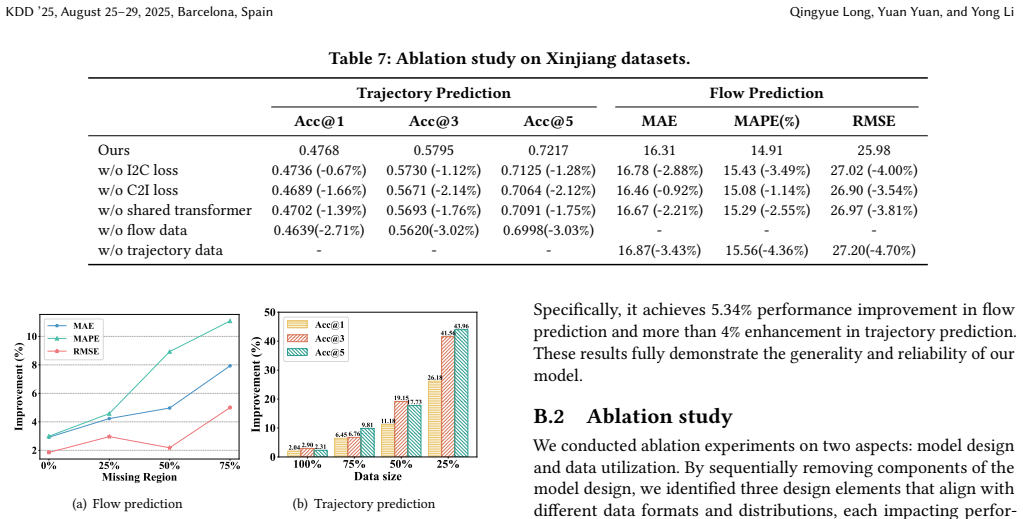
- Ablations imply both alignment losses are needed; removing I2C or C2I hurts either flow or trajectory prediction, so mutual enhancement comes from the coupling, not from a larger model.
- Because the four variants cover sharing and non-sharing parameters and single or dual test-time data, the universal model can be adapted to low-compute or single-source deployment without retraining the core.
Reading between the lines
- The paper does not analyze how sensitive the C2I alignment is to the threshold that defines a 'flow peak'; if the threshold is moved, the positive and negative pairing changes, so the claimed mechanism could be tested directly by a threshold sweep.
- The I2C alignment aggregates user embeddings by addition, which is a proxy for aggregate behavior rather than a true count-based aggregation; replacing it with a count-weighted aggregation would reveal whether the proxy loses information.
- The authors test three cities separately, but an implicit promise of a 'universal' model is cross-city transfer, which they do not evaluate; a zero-shot transfer experiment would be a natural next test.
- Their stated future direction of adding weather, social-network, and GIS data suggests the same tokenizer-and-alignment recipe could generalize to additional urban modalities, giving a concrete way to stress-test the architecture beyond the two-modality case.
Editorial analysis
A structured set of objections, weighed in public.
Referee Report
Summary. The paper proposes UniMob, a universal model that performs both individual trajectory prediction and crowd flow prediction in a single framework. The model tokenizes trajectories and flows into shared spatiotemporal tokens, processes them with a diffusion-transformer joint noise predictor, and introduces a bidirectional individual-collective alignment mechanism (I2C and C2I losses) intended to let the two modalities mutually enhance each other. Experiments on Shanghai, Senegal, and Xinjiang datasets compare UniMob against task-specific baselines, with ablations, noise-perturbation tests, and few-shot tests that report improved robustness in noisy and data-scarce settings.
Significance. If the method as described were correct, the paper would make a useful contribution: it is an early attempt at a single model for both micro-level trajectory prediction and macro-level flow prediction, and the empirical comparisons span three real-world datasets with consistent gains over specialized baselines. The four model variants and the noise/scarcity robustness analyses are also practically relevant, and the paper explicitly reports ablations showing that the alignment losses and the shared transformer contribute to the results. However, the central alignment objective is specified inconsistently in the manuscript: the printed C2I loss is not the InfoNCE loss described in the text, and as written it would push positive trajectory-flow pairs apart rather than together. Because this issue lies at the core of the paper's claimed bidirectional-alignment mechanism, the method description must be corrected before the empirical claims can be fully assessed.
major comments (3)
- [§4.5.2, Eq. (16)] The C2I loss as printed, L_C2I = sum_i log[phi(F,R+) / sum_{R- in S} phi(F,R-)], is not InfoNCE and does not maximize positive similarity. Minimizing this objective with respect to phi(F,R+) increases the log numerator, but the gradient with respect to sim(F,R+) is positive, so gradient descent decreases the similarity between the flow anchor and its positive trajectory; conversely, the gradient with respect to sim(F,R-) is negative, so minimizing the loss increases similarity to negatives. The standard InfoNCE form contains a minus sign and also includes the positive sample in the denominator: -log[phi(F,R+)/(phi(F,R+)+sum_{R-} phi(F,R-))]. Since Eq. (18) minimizes alpha*L_I2C + beta*L_C2I + gamma*L_pred with beta presumably positive, the stated objective would actively anti-align trajectories and flows. The ablations in Tables 3, 4, and 7 cannot resolve this, because they report the effect of removing whichever loss was actually implemented, not the loss specified by Eq. (16). The paper must either correct Eq. (16) to the true objective or, if a different contrastive formulation was used, state it explicitly; without this correction the central alignment mechanism is not specified.
- [§5.1 and Appendix A.2] Essential experimental details are missing. The manuscript does not report the values of the loss weights alpha, beta, and gamma in Eq. (18), the contrastive temperature tau in Eq. (16), the number of diffusion timesteps and the noise schedule, the transformer dimensions and layer count, the training epoch/budget, the learning rate, or the batch size. The noise-perturbation experiments (Figures 4, 5, 8) and few-shot experiments (Figures 6, 7, 9) also lack precise protocols: what noise distribution and injection rule were used, how missing regions were selected, and how many random restarts produced the reported averages. These omissions prevent replication and make it difficult to judge whether the reported robustness gains are sensitive to particular hyperparameter choices.
- [§4.5.2, positive/negative sample construction] The definition of positive and negative samples depends on unspecified thresholds and procedures. The text states that a trajectory is positive if it appears at a location and time where flow data shows a peak, and negative otherwise, but it does not define 'peak' quantitatively, does not state the time tolerance used to match trajectories to flow peaks, and does not describe how many negatives are drawn from the batch. Since C2I is a load-bearing component of the claimed mutual-enhancement mechanism, the paper should specify the peak-detection threshold and provide a sensitivity analysis showing that the reported gains are not an artifact of the pairing rule.
minor comments (6)
- [§1, Contributions] The third bullet contains a duplicated phrase: 'caused by caused by data modalities'; it should read 'caused by data modalities'.
- [§5.2] The text refers to the 'Xingjiang dataset', but the appendix and the rest of the paper use 'Xinjiang'; the spelling should be unified.
- [Figure 2] The figure legend lists two modules labeled '(3)': 'Joint Noise Predictor' and 'Mobility Predictor'; the numbering should be corrected to four distinct module labels.
- [§4.2.1, token count formula] The formula C = (T-p)/Q for the number of input tokens is likely missing a floor and a '+1'; as written it can be non-integer and does not count the final token. This should be clarified, including the handling of overlapping tokens.
- [Figures 4–7] The axis labels in the printed figures appear as corrupted symbolic strings (e.g., '/uni00000013/...'), making the figures unreadable; the axis labels and legends should be regenerated.
- [§4.5.2, text near Eq. (16)] The phrase 'minimizing the similarity between anchors and negative examples lost through InfoNCE' is grammatically unclear and should be rewritten; presumably the intended meaning is that the InfoNCE loss minimizes similarity to negatives.
Circularity Check
No significant circularity: UniMob's claims rest on held-out comparisons against external baselines, not on self-referential derivation.
full rationale
UniMob is an empirical systems paper. The claimed derivation chain is: tokenize trajectory and flow into shared embeddings (Eqs. 5-8), train a joint diffusion noise predictor (Eqs. 9, 17) with auxiliary alignment losses I2C (Eq. 15) and C2I (Eq. 16), and decode embeddings into predictions (Eqs. 10-13). None of these steps defines a prediction target in terms of the model's own output. The trajectory predictor maps denoised embeddings to location probabilities via a projection matrix; the flow predictor applies a fully connected layer. The alignment losses are auxiliary training objectives, not evaluation metrics. All headline results (Tables 2, 3, 4, 6, 7 and the noise/few-shot figures) are reported against external baselines (HA, VAR, ST-ResNet, MSDR, STID, PriSTI, Markov, LSTM, DeepMove, STAN, SNPM, TrajGDM, GETNext) on held-out test splits, so there is no fitted parameter being renamed as a prediction. The self-citations in the references (e.g., DeepMove [15], UniST [51], and the authors' other mobility papers) are contextual and are not used to justify the central claim that UniMob outperforms baselines; that claim is supported by the experiments in this paper. No uniqueness theorem or prior-work premise is imported to make the model choice forced. One non-circularity caveat: Section 4.5.2, Eq. (16), as printed, is not InfoNCE (no positive term in the denominator and no negative sign), so minimizing it as written would decrease similarity to the positive sample; this is a correctness/reproducibility defect, not a circularity, because it does not make the prediction equivalent to an input. Overall, the paper is self-contained against external benchmarks and merits a circularity score of 0.
Assumptions & free parameters
free parameters (5)
- loss weights alpha, beta, gamma =
not reported
- contrastive temperature tau =
not reported
- flow peak threshold =
not reported
- diffusion timestep count and schedule =
not reported
- sliding stride Q and token length p =
not reported
assumptions (4)
- domain assumption The crowd flow is the aggregation of individual trajectories, and trajectories are shaped by flow constraints.
- domain assumption Positive and negative samples in C2I are correctly identified by spatiotemporal flow peaks.
- domain assumption Joint diffusion noise prediction over trajectory and flow embeddings is an appropriate generative model for both modalities.
- domain assumption Transformer backbone captures spatiotemporal correlations across both modalities.
invented entities (2)
-
UniMob model
-
I2C and C2I alignment losses
Cite this review
Pith. "Pith review of A Universal Model for Human Mobility Prediction." pith.science (2026). https://pith.science/paper/AUZF5W7B
@misc{pith2026241215294,
  author       = {Pith},
  title        = {Pith review of: A Universal Model for Human Mobility Prediction},
  year         = {2026},
  howpublished = {\url{https://pith.science/paper/AUZF5W7B}},
  note         = {Machine review of arXiv:2412.15294}
}
read the original abstract
Predicting human mobility is crucial for urban planning, traffic control, and emergency response. Mobility behaviors can be categorized into individual and collective, and these behaviors are recorded by diverse mobility data, such as individual trajectory and crowd flow. As different modalities of mobility data, individual trajectory and crowd flow have a close coupling relationship. Crowd flows originate from the bottom-up aggregation of individual trajectories, while the constraints imposed by crowd flows shape these individual trajectories. Existing mobility prediction methods are limited to single tasks due to modal gaps between individual trajectory and crowd flow. In this work, we aim to unify mobility prediction to break through the limitations of task-specific models. We propose a universal human mobility prediction model (named UniMob), which can be applied to both individual trajectory and crowd flow. UniMob leverages a multi-view mobility tokenizer that transforms both trajectory and flow data into spatiotemporal tokens, facilitating unified sequential modeling through a diffusion transformer architecture. To bridge the gap between the different characteristics of these two data modalities, we implement a novel bidirectional individual and collective alignment mechanism. This mechanism enables learning common spatiotemporal patterns from different mobility data, facilitating mutual enhancement of both trajectory and flow predictions. Extensive experiments on real-world datasets validate the superiority of our model over state-of-the-art baselines in trajectory and flow prediction. Especially in noisy and scarce data scenarios, our model achieves the highest performance improvement of more than 14% and 25% in MAPE and Accuracy@5.
Figures


Figures from the paper (4 more)



Forward citations
Cited by 2 Pith papers
-
One Fits All: General Mobility Trajectory Modeling via Masked Conditional Diffusion
A masked conditional diffusion model with historical user embeddings simultaneously performs trajectory generation, recovery, and prediction, beating task-specific baselines on two datasets.
-
Noise Matters: Diffusion Model-based Urban Mobility Generation with Collaborative Noise Priors
CoDiffMob injects city-level flow statistics and hourly movement rhythms into a diffusion model's starting noise, improving reported trajectory and flow fidelity, though the evaluation is partly circular.
Reference graph
Works this paper leans on
-
[1]
Josh Achiam, Steven Adler, Sandhini Agarwal, Lama Ahmad, Ilge Akkaya, Floren- cia Leoni Aleman, Diogo Almeida, Janko Altenschmidt, Sam Altman, Shyamal Anadkat, et al. 2023. Gpt-4 technical report. arXiv preprint arXiv:2303.08774 (2023)
arXiv 2023
-
[2]
Juan Miguel Lopez Alcaraz and Nils Strodthoff. 2022. Diffusion-based time series imputation and forecasting with structured state space models. arXiv preprint arXiv:2208.09399 (2022)
arXiv 2022
-
[3]
Fan Bao, Shen Nie, Kaiwen Xue, Chongxuan Li, Shi Pu, Yaole Wang, Gang Yue, Yue Cao, Hang Su, and Jun Zhu. 2023. One transformer fits all distributions in multi-modal diffusion at scale. In International Conference on Machine Learning . PMLR, 1692–1717
work page 2023
-
[4]
Hugo Barbosa, Marc Barthelemy, Gourab Ghoshal, Charlotte R James, Maxime Lenormand, Thomas Louail, Ronaldo Menezes, José J Ramasco, Filippo Simini, and Marcello Tomasini. 2018. Human mobility: Models and applications. Physics Reports 734 (2018), 1–74
2018
-
[5]
Marin Biloš, Kashif Rasul, Anderson Schneider, Yuriy Nevmyvaka, and Stephan Günnemann. 2022. Modeling temporal data as continuous functions with process diffusion. arXiv preprint arXiv:2211.02590 (2022)
work page Pith review arXiv 2022
-
[6]
Sebastiano Bontorin, Simone Centellegher, Riccardo Gallotti, Luca Pappalardo, Bruno Lepri, and Massimiliano Luca. 2024. Mixing Individual and Collective Behaviours to Predict Out-of-Routine Mobility. arXiv preprint arXiv:2404.02740 (2024)
work page Pith review arXiv 2024
-
[7]
Dirk Brockmann, Lars Hufnagel, and Theo Geisel. 2006. The scaling laws of human travel. Nature 439, 7075 (2006), 462–465
work page 2006
-
[8]
Marco Cardia, Massimiliano Luca, and Luca Pappalardo. 2022. Enhancing crowd flow prediction in various spatial and temporal granularities. In Companion Proceedings of the Web Conference 2022 . 1251–1259
work page 2022
Show all 69 references
-
[9]
H Chang, Youngjoo Lee, B Yoon, and Sanghoon Baek. 2012. Dynamic near-term traffic flow prediction: system-oriented approach based on past experiences. IET intelligent transport systems 6, 3 (2012), 292–305
2012
-
[10]
Yong Chen, Haoge Xu, Xiqun Michael Chen, and Ziyou Gao. 2023. A multi-scale unified model of human mobility in urban agglomerations. Patterns 4, 11 (2023)
2023
-
[11]
Chen Chu, Hengcai Zhang, Peixiao Wang, and Feng Lu. 2024. Simulating hu- man mobility with a trajectory generation framework based on diffusion model. International Journal of Geographical Information Science 38, 5 (2024), 847–878
2024
-
[12]
Yuwei Du, Jie Feng, Jie Zhao, and Yong Li. 2024. TrajAgent: An Agent Framework for Unified Trajectory Modelling. arXiv preprint arXiv:2410.20445 (2024)
2024
-
[13]
Jie Feng, Yuwei Du, Jie Zhao, and Yong Li. 2024. AgentMove: Predicting Human Mobility Anywhere Using Large Language Model based Agentic Framework. arXiv preprint arXiv:2408.13986 (2024)
2024 arXiv
-
[14]
Jie Feng, Yong Li, Ziqian Lin, Can Rong, Funing Sun, Diansheng Guo, and Depeng Jin. 2021. Context-aware spatial-temporal neural network for citywide crowd flow prediction via modeling long-range spatial dependency. ACM Transactions on Knowledge Discovery from Data (TKDD) 16, 3...
2021
-
[15]
Jie Feng, Yong Li, Chao Zhang, Funing Sun, Fanchao Meng, Ang Guo, and Depeng Jin. 2018. Deepmove: Predicting human mobility with attentional recurrent networks. In Proceedings of the 2018 world wide web conference . 1459–1468
2018
-
[16]
Sébastien Gambs, Marc-Olivier Killijian, and Miguel Núñez del Prado Cortez
-
[17]
Qiang Gao, Fan Zhou, Goce Trajcevski, Kunpeng Zhang, Ting Zhong, and Fengli Zhang. 2019. Predicting human mobility via variational attention. In The world wide web conference. 2750–2756
2019
-
[18]
Marta C Gonzalez, Cesar A Hidalgo, and Albert-Laszlo Barabasi. 2008. Under- standing individual human mobility patterns. nature 453, 7196 (2008), 779–782
2008
-
[19]
Jonathan Ho, Ajay Jain, and Pieter Abbeel. 2020. Denoising diffusion probabilistic models. Advances in Neural Information Processing Systems 33 (2020), 6840–6851
2020
-
[20]
Renhe Jiang, Zekun Cai, Zhaonan Wang, Chuang Yang, Zipei Fan, Quanjun Chen, Kota Tsubouchi, Xuan Song, and Ryosuke Shibasaki. 2021. DeepCrowd: A deep model for large-scale citywide crowd density and flow prediction. IEEE Transactions on Knowledge and Data Engineering 35, 1 (20...
2021
-
[21]
Dejiang Kong and Fei Wu. 2018. HST-LSTM: A Hierarchical Spatial-Temporal Long-Short Term Memory Network for Location Prediction. In Twenty-Seventh International Joint Conference on Artificial Intelligence IJCAI-18
2018
-
[22]
Mingqian Li, Panrong Tong, Mo Li, Zhongming Jin, Jianqiang Huang, and Xian- Sheng Hua. 2021. Traffic flow prediction with vehicle trajectories. In Proceedings of the AAAI Conference on Artificial Intelligence , Vol. 35. 294–302
2021
-
[23]
Yan Li, Xinjiang Lu, Yaqing Wang, and Dejing Dou. 2022. Generative time series forecasting with diffusion, denoise, and disentanglement. Advances in Neural Information Processing Systems 35 (2022), 23009–23022
2022
-
[24]
Yong Li, Yuan Yuan, Jingtao Ding, and Depeng Jin. 2023. Learning the complexity of urban mobility with deep generative collaboration network. (2023)
2023
-
[25]
Haksoo Lim, Minjung Kim, Sewon Park, and Noseong Park. 2023. Regular Time- series Generation using SGM. arXiv preprint arXiv:2301.08518 (2023)
2023 arXiv
-
[26]
Lequan Lin, Zhengkun Li, Ruikun Li, Xuliang Li, and Junbin Gao. 2023. Diffusion models for time-series applications: a survey. Frontiers of Information Technology & Electronic Engineering (2023), 1–23
2023
-
[27]
Dachuan Liu, Jin Wang, Shuo Shang, and Peng Han. 2022. Msdr: Multi-step dependency relation networks for spatial temporal forecasting. In Proceedings of the 28th ACM SIGKDD conference on knowledge discovery and data mining . 1042–1050
2022
-
[28]
Mingzhe Liu, Han Huang, Hao Feng, Leilei Sun, Bowen Du, and Yanjie Fu. 2023. Pristi: A conditional diffusion framework for spatiotemporal imputation. In 2023 IEEE 39th International Conference on Data Engineering (ICDE) . IEEE, 1927–1939
2023
-
[29]
Yixin Liu, Kai Zhang, Yuan Li, Zhiling Yan, Chujie Gao, Ruoxi Chen, Zhengqing Yuan, Yue Huang, Hanchi Sun, Jianfeng Gao, et al . 2024. Sora: A review on background, technology, limitations, and opportunities of large vision models. arXiv preprint arXiv:2402.17177 (2024)
2024 arXiv
-
[30]
Qingyue Long, Huandong Wang, Tong Li, Lisi Huang, Kun Wang, Qiong Wu, Guangyu Li, Yanping Liang, Li Yu, and Yong Li. 2023. Practical synthetic human trajectories generation based on variational point processes. In Proceedings of the 29th ACM SIGKDD Conference on Knowledge Disc...
2023
-
[31]
Zheng Lu, Chen Zhou, Jing Wu, Hao Jiang, and Songyue Cui. 2016. Integrating granger causality and vector auto-regression for traffic prediction of large-scale WLANs. KSII Transactions on Internet and Information Systems (TIIS) 10, 1 (2016), 136–151
2016
-
[32]
Yingtao Luo, Qiang Liu, and Zhaocheng Liu. 2021. Stan: Spatio-temporal attention network for next location recommendation. In Proceedings of the web conference
2021
-
[33]
Benoit B Mandelbrot. 1983. The fractal geometry of nature/Revised and enlarged edition. New York (1983)
1983
-
[34]
Aaron van den Oord, Yazhe Li, and Oriol Vinyals. 2018. Representation learning with contrastive predictive coding. arXiv preprint arXiv:1807.03748 (2018)
2018 arXiv
-
[35]
Luca Pappalardo, Ed Manley, Vedran Sekara, and Laura Alessandretti. 2023. Future directions in human mobility science. Nature computational science 3, 7 (2023), 588–600
2023
-
[36]
Long Qingyue, Wang Huandong, Chen Huiming, Jin Depeng, Zhu Lin, Yu Li, and Li Yong. 2024. Privacy-preserving federated mobility prediction with compound data and model perturbation mechanism. China Communications 21, 3 (2024), 160–173
2024
-
[37]
Can Rong, Zhicheng Liu, Jingtao Ding, and Yong Li. 2024. Learning to Generate Temporal Origin-destination Flow Based-on Urban Regional Features and Traffic Information. ACM Transactions on Knowledge Discovery from Data 18, 6 (2024), 1–17
2024
-
[38]
Chenyang Shao, Fengli Xu, Bingbing Fan, Jingtao Ding, Yuan Yuan, Meng Wang, and Yong Li. 2024. Beyond imitation: Generating human mobility from context- aware reasoning with large language models. arXiv preprint arXiv:2402.09836 (2024)
2024 arXiv
-
[39]
Zezhi Shao, Zhao Zhang, Fei Wang, Wei Wei, and Yongjun Xu. 2022. Spatial- temporal identity: A simple yet effective baseline for multivariate time series forecasting. In Proceedings of the 31st ACM International Conference on Information & Knowledge Management. 4454–4458
2022
-
[40]
Filippo Simini, Marta C González, Amos Maritan, and Albert-László Barabási
-
[41]
Jascha Sohl-Dickstein, Eric Weiss, Niru Maheswaranathan, and Surya Ganguli
-
[42]
Nature 484, 7392 (2012), 96–100
A universal model for mobility and migration patterns. Nature 484, 7392 (2012), 96–100
2012
-
[43]
Junkai Sun, Junbo Zhang, Qiaofei Li, Xiuwen Yi, Yuxuan Liang, and Yu Zheng
-
[44]
Huandong Wang, Yong Li, Depeng Jin, and Zhu Han. 2021. Attentional Markov model for human mobility prediction. IEEE Journal on Selected Areas in Commu- nications 39, 7 (2021), 2213–2225
2021
-
[45]
Yang Song, Jascha Sohl-Dickstein, Diederik P Kingma, Abhishek Kumar, Stefano Ermon, and Ben Poole. 2020. Score-based generative modeling through stochastic differential equations. arXiv preprint arXiv:2011.13456 (2020)
2020 arXiv
-
[46]
Haomin Wen, Youfang Lin, Yutong Xia, Huaiyu Wan, Qingsong Wen, Roger Zimmermann, and Yuxuan Liang. 2023. Diffstg: Probabilistic spatio-temporal graph forecasting with denoising diffusion models. InProceedings of the 31st ACM International Conference on Advances in Geographic I...
2023
-
[47]
Hao Xue, Flora Salim, Yongli Ren, and Nuria Oliver. 2021. MobTCast: Leveraging auxiliary trajectory forecasting for human mobility prediction. Advances in Neural Information Processing Systems 34 (2021), 30380–30391
2021
-
[48]
Xiao-Yong Yan, Wen-Xu Wang, Zi-You Gao, and Ying-Cheng Lai. 2017. Universal model of individual and population mobility on diverse spatial scales. Nature communications 8, 1 (2017), 1639
2017
-
[49]
Xinglei Wang, Meng Fang, Zichao Zeng, and Tao Cheng. 2023. Where would i go next? large language models as human mobility predictors. arXiv preprint arXiv:2308.15197 (2023)
2023 arXiv
-
[50]
Feiyu Yin, Yong Liu, Zhiqi Shen, Lisi Chen, Shuo Shang, and Peng Han. 2023. Next POI recommendation with dynamic graph and explicit dependency. In Proceedings of the AAAI Conference on Artificial Intelligence , Vol. 37. 4827–4834
2023
-
[51]
Yuan Yuan, Jingtao Ding, Jie Feng, Depeng Jin, and Yong Li. 2024. Unist: a prompt- empowered universal model for urban spatio-temporal prediction. In Proceedings of the 30th ACM SIGKDD Conference on Knowledge Discovery and Data Mining . 4095–4106
2024
-
[52]
Yuan Yuan, Jingtao Ding, Chenyang Shao, Depeng Jin, and Yong Li. 2023. Spatio- temporal diffusion point processes. In Proceedings of the 29th ACM SIGKDD Conference on Knowledge Discovery and Data Mining . 3173–3184
2023
-
[53]
Song Yang, Jiamou Liu, and Kaiqi Zhao. 2022. GETNext: trajectory flow map enhanced transformer for next POI recommendation. In Proceedings of the 45th International ACM SIGIR Conference on research and development in information 9 KDD ’25, August 25–29, 2025, Barcelona, Spain ...
2022
-
[54]
Yuan Yuan, Jingtao Ding, Huandong Wang, Depeng Jin, and Yong Li. 2022. Activ- ity trajectory generation via modeling spatiotemporal dynamics. In Proceedings of the 28th ACM SIGKDD Conference on Knowledge Discovery and Data Mining . 4752–4762
2022
-
[55]
Yuan Yuan, Chenyang Shao, Jingtao Ding, Depeng Jin, and Yong Li. 2024. Spatio- temporal few-shot learning via diffusive neural network generation. In The Twelfth International Conference on Learning Representations
2024
-
[56]
Yuan Yuan, Huandong Wang, Jingtao Ding, Depeng Jin, and Yong Li. 2023. Learn- ing to simulate daily activities via modeling dynamic human needs. InProceedings of the ACM Web Conference 2023 . 906–916
2023
-
[57]
Yuan Yuan, Jingtao Ding, Huandong Wang, and Depeng Jin. 2024. Generating Daily Activities with Need Dynamics. ACM Transactions on Intelligent Systems and Technology 15, 2 (2024), 1–28
2024
-
[58]
Junbo Zhang, Yu Zheng, and Dekang Qi. 2017. Deep spatio-temporal residual net- works for citywide crowd flows prediction. In Proceedings of the AAAI conference on artificial intelligence, Vol. 31
2017
-
[59]
Yu Zheng, Yuming Lin, Liang Zhao, Tinghai Wu, Depeng Jin, and Yong Li. 2023. Spatial planning of urban communities via deep reinforcement learning. Nature Computational Science 3, 9 (2023), 748–762
2023
-
[60]
Yu Zheng, Hongyuan Su, Jingtao Ding, Depeng Jin, and Yong Li. 2023. Road planning for slums via deep reinforcement learning. In Proceedings of the 29th ACM SIGKDD Conference on Knowledge Discovery and Data Mining . 5695–5706
2023
-
[61]
Jinwei Zeng, Chao Yu, Xinyi Yang, Wenxuan Ao, Jian Yuan, Yong Li, Yu Wang, and Huazhong Yang. 2024. CityLight: A Universal Model Towards Real-world City-scale Traffic Signal Control Coordination. arXiv preprint arXiv:2406.02126 (2024)
2024 arXiv
-
[62]
Fan Zhou, Liang Li, Kunpeng Zhang, and Goce Trajcevski. 2021. Urban flow prediction with spatial–temporal neural ODEs. Transportation Research Part C: Emerging Technologies 124 (2021), 102912
2021
-
[63]
Zhilun Zhou, Jingtao Ding, Yu Liu, Depeng Jin, and Yong Li. 2023. Towards generative modeling of urban flow through knowledge-enhanced denoising diffusion. In Proceedings of the 31st ACM International Conference on Advances in Geographic Information Systems. 1–12
2023
-
[64]
Yuanshao Zhu, James Jianqiao Yu, Xiangyu Zhao, Qidong Liu, Yongchao Ye, Wei Chen, Zijian Zhang, Xuetao Wei, and Yuxuan Liang. 2024. Controltraj: Controllable trajectory generation with topology-constrained diffusion model. arXiv preprint arXiv:2404.15380 (2024)
2024 arXiv
-
[65]
Fan Zhou, Yurou Dai, Qiang Gao, Pengyu Wang, and Ting Zhong. 2021. Self- supervised human mobility learning for next location prediction and trajectory classification. Knowledge-Based Systems 228 (2021), 107214
2021
-
[69]
George Kingsley Zipf. 1946. The P 1 P 2/D hypothesis: on the intercity movement of persons. American sociological review 11, 6 (1946), 677–686. 10 A Universal Model for Human Mobility Prediction KDD ’25, August 25–29, 2025, Barcelona, Spain A APPENDIX FOR REPRODUCIBILITY A.1 R...
1946
-
[2012]
In Proceedings of the first workshop on measurement, privacy, and mobility
Next place prediction using mobility markov chains. In Proceedings of the first workshop on measurement, privacy, and mobility . 1–6
-
[2015]
In International Conference on Machine Learning
Deep unsupervised learning using nonequilibrium thermodynamics. In International Conference on Machine Learning . PMLR, 2256–2265
-
[2020]
IEEE Transactions on Knowledge and Data Engineering 34, 5 (2020), 2348–2359
Predicting citywide crowd flows in irregular regions using multi-view graph convolutional networks. IEEE Transactions on Knowledge and Data Engineering 34, 5 (2020), 2348–2359
2020
Reviewed August 11, 2026 · model on record in the stance chip above.
Discussion (0). Continue with ORCID to comment.