REVIEW 3 major objections 3 minor 23 references
LLM 'reflection' without outside feedback cannot reduce uncertainty about the correct answer; it is re-generation, not error correction.
Reviewed by Pith at T0; open to challenge. T0 means a machine referee read the full paper against a public rubric. the ladder, T0–T4 →
T0 review · deepseek-v4-flash
2026-08-03 17:23 UTC pith:AV47J5CX
load-bearing objection Strong empirical study of LLM revision with a useful protocol and clean negative results, but the headline 'cannot' claim is overreach and is contradicted by the paper's own TISER tables. the 3 major comments →
Reflection or Re-Generation? Why LLM Revision Fails Where Human Revision Succeeds
The pith
A machine-rendered reading of the paper's core claim, the machinery that carries it, and where it could break.
Core claim
Under matched two-pass conditions, LLMs prompted to reflect on their own answer do not accumulate task-relevant information. On a 4-class math benchmark, revision is statistically indistinguishable from independent re-sampling (ΔI ≈ 0); on a 10-class rating task, revision moves predictions away from the ground truth (ΔI < 0), an effect the paper calls distributional flattening. Humans under the same protocol show positive information gain in both settings. Cross-agent and oracle diagnostics place the failure in the revision step rather than in the quality of first-pass inputs, and show that error detection and error correction are each limiting in different task and model combinations. The u
What carries the argument
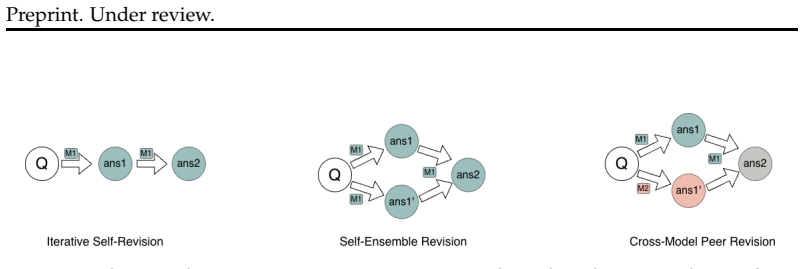
The central machinery is the Human–LLM Reflection Framework (HRF), a two-pass protocol in which annotators first answer and then revise their own, a peer's, or another agent type's answer, plus a per-iteration information measure defined as cross-entropy reduction between the model's predicted answer distribution and the ground-truth label. This measure places accuracy and MSE on a single 'bits' axis and yields the paper's falsifiable prediction: without external information, self-conditioning cannot reduce H(Y|·). An oracle-guided revision experiment adds one bit of external signal (correct/incorrect) to isolate error detection from error correction.
Load-bearing premise
The load-bearing premise is that a model's first-pass answer contains no task-relevant information about the target beyond the original input, so conditioning on it cannot reduce uncertainty; this is an empirical property of the tested LLMs under this prompt, not a proven theorem, and the paper's own data include human revisers and one model-task pair with positive reflection gains under no external signal.
What would settle it
The paper predicts ΔI ≤ 0 for any self-conditioned revision without external information. A controlled experiment where the second pass is required to re-derive the answer from its own first-pass reasoning trace—rather than merely re-reading the final answer—would test this: if cross-entropy reduction became significantly positive on the objective benchmark over paired repeated runs, the universal claim would be falsified.
If this is right
- Reflection prompts that give a model only its own previous answer will not systematically improve accuracy; on the tested objective task the information gain is indistinguishable from independent re-sampling.
- On subjective rating tasks, self-reflection actively harms: all five tested models moved away from the target, an effect the paper attributes to distributional flattening.
- External verification—a verifier model, tool-based checking, or human feedback—becomes the recommended mechanism for error detection, because a single bit of oracle signal changed behavior while self-conditioning did not.
- Weak-to-strong revision (a stronger agent revising a weaker agent's output) is more promising than same-model self-revision, and iteration depth beyond the first revision step has near-zero incremental gain.
- Human revision offers a reference target: sparse, targeted changes with positive information gain in both objective and subjective settings, unlike LLMs' high-frequency, high-variance revisions.
Where Pith is reading between the lines
- The paper's structural claim ('cannot reduce uncertainty') is stated as general, but its evidence comes from the tested models under an agree-or-disagree prompt; a model that uses extra computation to deliberately re-read or re-derive from its own trace could in principle extract new signal, and the paper does not rule this out.
- If the flattening mechanism is regression to the model's prior, a testable prediction follows: the second-pass rating distribution should converge toward the model's unconditional rating prior, and the degree of convergence should predict the magnitude of negative ΔI.
- Even a noisy external signal may be enough to prevent correct-to-wrong flips: oracle-guided retention was between 97% and 99.9%, suggesting that cheap approximate verifiers could capture much of the benefit without perfect feedback.
- The information-gain framing could be reused to audit other multi-pass agent protocols, such as debate or self-critique search, by measuring whether each extension actually reduces cross-entropy to the target rather than merely reshuffling outputs.
Editorial analysis
A structured set of objections, weighed in public.
Referee Report
Summary. The paper introduces the Human–LLM Reflection Framework (HRF), a two-pass protocol that compares human and LLM revision under matched conditions across self-, peer-, and cross-agent settings. It evaluates five LLMs and non-expert human annotators on MalAlgoQA (4-class math reasoning), IMDb-Rating (10-class sentiment), and TISER (free-form temporal reasoning). Using a repeated-run (K=10) design, it estimates per-iteration information gain ΔI via cross-entropy reduction. The empirical findings are that human revision yields positive reflection gains on all three tasks, while LLM self-revision is neutral on objective tasks (ΔI≈0) and significantly negative on IMDb-Rating (ΔI<0). Cross-agent and oracle-guided diagnostics are used to argue that the failure lies in the revision step, not in input quality, and that error detection versus correction varies by task and model. The paper's unifying claim is structural: without external information, self-conditioned revision cannot reduce uncertainty about the target, so LLM reflection is best understood as conditioned re-generation rather than genuine error-driven revision.
Significance. If read as a controlled empirical study of five specific LLMs, the paper is valuable: the K=10 repeated-run paired comparisons, the human baseline under identical prompts, the cross-agent matrices, and the oracle-guided detection/correction experiments are concrete and useful. The authors are also admirably explicit that ΔI_emp is a monotone reframing of accuracy/MSE and not an independent source of evidence. The two failure modes — neutral re-generation on objective tasks and negative drift on a subjective task — are well documented and worth reporting. However, the headline contribution, the structural impossibility claim, is not supported by the provided evidence and is contradicted by the paper's own data (e.g., Claude-3.5 on TISER). The information-theoretic analysis provides a common bits axis but no new measurement. With the central claim weakened to an empirical generalization about these models and prompts, the paper would be a solid empirical contribution.
major comments (3)
- [§4, Eq. (2)–(4); §5.1; §7] The central claim that 'without external information, self-conditioned revision cannot reduce uncertainty about the target' is not established as a structural law. In §4 the authors state that ΔI_emp is 'not an independent source of evidence beyond accuracy and MSE,' yet the impossibility conclusion is drawn from measurements of that same quantity. More fundamentally, the impossibility would require ŷ^(1) ⊥ y* | x. But if first-pass accuracy exceeds chance (Table 1: DeepSeek-R1 reaches 0.948 on MalAlgoQA), then I(y*; ŷ^(1)|x) > 0 and conditioning on ŷ^(1) reduces H(y*|x, ŷ^(1)) relative to H(y*|x) in expectation. The paper also reports human revisers improving without external information (Table 1). Please either prove the conditional-independence premise or reframe the contribution as an empirical claim about the tested LLMs and prompt family.
- [§5.1 vs. Appendix D, Table 4] §5.1 states that on TISER 'no model achieves significant positive gain' and refers to Appendix D. Table 4 reports Claude-3.5 on TISER with re-gen accuracy 0.530, reflection accuracy 0.548, +3.5%, p=1.84×10^-3, 95% CI (0.009, 0.028), with H0 rejected. This is a significant positive self-conditioned gain on an objective task, and it directly contradicts both the empirical sentence and the stronger 'cannot' claim. Likewise, Table 1 shows LLM-voted reflection gain +4.5% on MalAlgoQA. The paper must acknowledge these in-text exceptions or restrict the claim to 'usually does not reduce uncertainty.'
- [§7, Design implications] The design principle 'external verification is necessary' depends entirely on the unsupported impossibility claim. The cross-agent and oracle evidence supports the weaker, but still useful, conclusion that self-conditioning under these prompts does not supply a reliable error signal, while a binary external signal changes behavior and can improve retention/recovery. The paper's own Limitations section further notes that the negative IMDb effect is partly prompt-induced, and the neutral-prompt control attenuates it. Please revise the design implications to match the empirical scope: external verification helps in these settings, not that self-conditioning can never help.
minor comments (3)
- [Table 4] The column header 'H0 rej.?' is informal; use standard significance notation (e.g., 'Reject H0?' or significance stars) and report p-values consistently.
- [§3.1, Table 1 and Limitations] The phrase 'Reflection is actively harmful on subjective tasks' is too strong given the later admission that part of the IMDb effect is prompt-induced. Qualify it as 'under the agree/disagree prompt.'
- [Figure 2] The caption says error bars are 95% confidence intervals over K=10 runs, but some bars appear consistent with item-level variance. Please clarify whether the intervals are computed over runs, items, or a grouped bootstrap.
Circularity Check
No significant circularity: the empirical measurements are not defined in terms of the target conclusions, and the paper discloses that its information-gain proxy is a reframing of accuracy/MSE.
full rationale
The paper's central derivation is an empirical comparison under a controlled two-pass protocol, not a circular definition. The information-theoretic estimator ΔI_emp is explicitly defined in §4 as cross-entropy reduction, and the authors state that with a point-mass target it is a monotone reframing of the change in the empirical probability of the correct answer and 'not an independent source of evidence beyond accuracy and MSE.' This makes the information-gain framing a re-description of metric changes rather than an independent measurement, but the paper is transparent about this limitation rather than hiding a fitted parameter behind a new name. The claims about LLM behavior (ΔI≈0 on MalAlgoQA, ΔI<0 on IMDb) are empirical observations, not consequences of the definition alone. The broader structural claim in §4/§7 that 'without external information, self-conditioned revision cannot reduce uncertainty about the target' is an asserted generalization, not derived from the equations; it is under-supported and contradicted by the paper's own human data (positive human gains with no external signal, Table 1) and by Appendix D's Table 4, where Claude-3.5 on TISER shows a statistically significant +3.5% gain despite §5.1 stating 'no model achieves significant positive gain.' Those are correctness/consistency problems, not circularity. No fitted parameter is renamed as a prediction, no load-bearing self-citation is used, and the paper explicitly flags the prompt-dependence and non-independence of its proxy. Therefore no step reduces by construction to its inputs; score 0.
Axiom & Free-Parameter Ledger
axioms (4)
- ad hoc to paper Fixed-conditional-sampling model: the second pass samples from p(y|x, ŷ^(1)) with no weight/internal-state update between passes.
- domain assumption ŷ^(1) ⊥ y* | x: the first-pass output carries no information about the target beyond the input.
- domain assumption IMDb gold ratings are a well-defined target y* for a subjective task.
- domain assumption The fixed LLM judge (Atla Selene Mini) correctly scores TISER free-form answers.
read the original abstract
Reflection, the ability to revisit and revise prior reasoning, is central to how humans improve their answers. Large language models (LLMs) are increasingly prompted to "reflect," yet whether this resembles human revision remains unclear. We introduce the Human-LLM Reflection Framework (HRF), a controlled two-pass protocol comparing human and LLM revision under identical conditions across self-, peer-, and cross-agent settings. Using an information-theoretic analysis based on per-iteration cross-entropy reduction, we find two failure modes of LLM reflection. On objective tasks with finite answer spaces, reflection yields near-zero information gain (Delta I approx 0), behaving as neutral re-generation indistinguishable from re-sampling. On subjective tasks, it yields significant negative gain (Delta I < 0), moving predictions away from the target. Human revision, by contrast, yields positive gain in both settings. Cross-agent experiments localize the failure to the revision step, not input quality: LLMs degrade even high-quality human responses. Diagnostic analyses (revision conditioned on first-pass correctness, and oracle-guided revision against a random-reshuffle baseline) show that which sub-step dominates varies by task and by model rather than reducing to a single mechanism: self-error detection is present on objective multiple-choice tasks but weak on subjective ones, and recovery under an oracle error signal exceeds the baseline for some models and falls below it for others. The unifying account is structural: without external information, self-conditioned revision cannot reduce uncertainty about the target, so LLM reflection is better understood as conditioned re-generation than as genuine error-driven revision.
Figures



Reference graph
Works this paper leans on
-
[1]
, author=
Metacognition: A Textbook for Cognitive, Educational, Life Span & Applied Psychology. , author=. SAGE Publications Ltd (CA) , year=
-
[2]
Psychology of learning and motivation , volume=
Metamemory: A theoretical framework and new findings , author=. Psychology of learning and motivation , volume=. 1990 , publisher=
1990
-
[3]
Philosophical Transactions of the Royal Society B: Biological Sciences , volume=
Metacognition in human decision-making: confidence and error monitoring , author=. Philosophical Transactions of the Royal Society B: Biological Sciences , volume=. 2012 , publisher=
2012
-
[4]
Proceedings of the 37th International Conference on Neural Information Processing Systems , pages=
Reflexion: language agents with verbal reinforcement learning , author=. Proceedings of the 37th International Conference on Neural Information Processing Systems , pages=
-
[5]
Findings of the Association for Computational Linguistics: EMNLP 2023 , pages=
Towards mitigating LLM hallucination via self reflection , author=. Findings of the Association for Computational Linguistics: EMNLP 2023 , pages=
2023
-
[6]
arXiv preprint arXiv:2405.06682 , year=
Self-reflection in llm agents: Effects on problem-solving performance , author=. arXiv preprint arXiv:2405.06682 , year=
-
[7]
arXiv preprint arXiv:2310.01798 , year=
Large language models cannot self-correct reasoning yet , author=. arXiv preprint arXiv:2310.01798 , year=
-
[8]
arXiv preprint arXiv:2404.09129 , year=
When hindsight is not 20/20: Testing limits on reflective thinking in large language models , author=. arXiv preprint arXiv:2404.09129 , year=
-
[9]
Transactions of the Association for Computational Linguistics , volume=
When can llms actually correct their own mistakes? a critical survey of self-correction of llms , author=. Transactions of the Association for Computational Linguistics , volume=. 2024 , publisher=
2024
-
[10]
Communications Psychology , volume=
Studying and improving reasoning in humans and machines , author=. Communications Psychology , volume=. 2024 , publisher=
2024
-
[11]
Transactions of the Association for Computational Linguistics , volume=
Comparing humans and large language models on an Experimental Protocol Inventory for Theory of Mind Evaluation (EPITOME) , author=. Transactions of the Association for Computational Linguistics , volume=. 2024 , publisher=
2024
-
[12]
Findings of the Association for Computational Linguistics: EMNLP 2024 , pages=
Malalgoqa: Pedagogical evaluation of counterfactual reasoning in large language models and implications for ai in education , author=. Findings of the Association for Computational Linguistics: EMNLP 2024 , pages=
2024
-
[13]
arXiv preprint arXiv:2504.05258 , year=
Learning to Reason Over Time: Timeline Self-Reflection for Improved Temporal Reasoning in Language Models , author=. arXiv preprint arXiv:2504.05258 , year=
-
[14]
arXiv preprint arXiv:2501.17195 , year=
Atla selene mini: A general purpose evaluation model , author=. arXiv preprint arXiv:2501.17195 , year=
-
[15]
, author=
Metacognition and cognitive monitoring: A new area of cognitive--developmental inquiry. , author=. American psychologist , volume=. 1979 , publisher=
1979
-
[16]
Metacognition and learning , volume=
Metacognition and learning: Conceptual and methodological considerations , author=. Metacognition and learning , volume=. 2006 , publisher=
2006
-
[17]
Findings of the Association for Computational Linguistics: ACL 2024 , pages=
Selective reflection-tuning: Student-selected data recycling for LLM instruction-tuning , author=. Findings of the Association for Computational Linguistics: ACL 2024 , pages=
2024
-
[18]
Neural computation , volume=
Approximate statistical tests for comparing supervised classification learning algorithms , author=. Neural computation , volume=. 1998 , publisher=
1998
-
[19]
Pacific-Asia conference on knowledge discovery and data mining , pages=
Evaluating the replicability of significance tests for comparing learning algorithms , author=. Pacific-Asia conference on knowledge discovery and data mining , pages=. 2004 , organization=
2004
-
[20]
arXiv preprint arXiv:2110.14168 , year=
Training verifiers to solve math word problems , author=. arXiv preprint arXiv:2110.14168 , year=
-
[21]
The twelfth international conference on learning representations , year=
Let's verify step by step , author=. The twelfth international conference on learning representations , year=
-
[22]
The Journal of Symbolic Logic , volume=
On the logic of theory change: Partial meet contraction and revision functions , author=. The Journal of Symbolic Logic , volume=. 1985 , publisher=
1985
-
[23]
Artificial Intelligence , volume=
On the logic of iterated belief revision , author=. Artificial Intelligence , volume=. 1997 , publisher=
1997
discussion (0)
Sign in with ORCID, Apple, or X to comment. Anyone can read and Pith papers without signing in.