REVIEW 4 major objections 4 minor 73 references
ConText-CIR: Learning from Concepts in Text for Composed Image Retrieval
T0 review · 4 major / 4 minor · reviewed 2026-08-07 · deepseek-v4-flash
Pith's one-line read ConText-CIR claims that its Text Concept-Consistency loss and synthetic captioning pipeline achieve a new state of the art in composed image retrieval.
desk verdict A strong empirical CIR paper with a novel self-supervised attention-consistency loss; the mechanistic story is plausible but not quantitatively grounded, and the SOTA claims need same-data baselines. read the letter →
The pith
A machine-rendered reading of the paper's core claim, the machinery that carries it, and where it could break.
The reading
What carries the argument
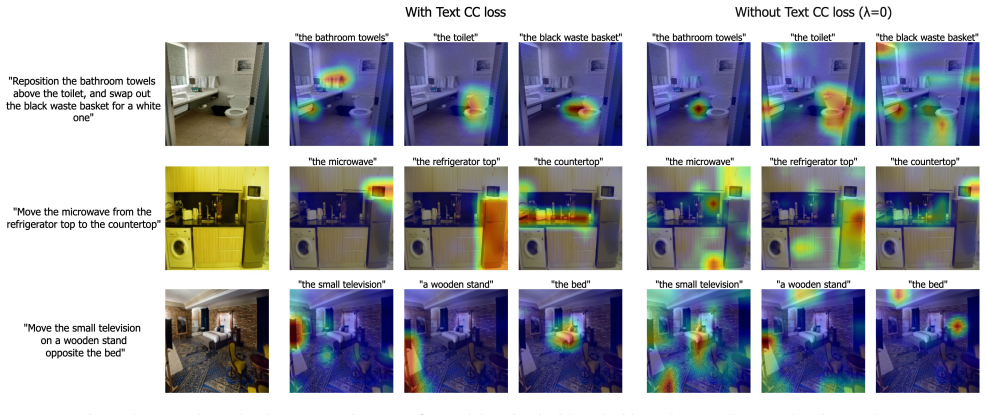
The machinery is the Text Concept-Consistency loss, defined as $\mathcal{L}_{cc} = \sum_{i=1}^{l} \mathrm{ReLU}(\mathrm{CrossAttn}(I,T_{NP_i}) - \mathrm{CrossAttn}(I, NP_i) - \epsilon)$, where noun phrases $NP_i$ are extracted by Stanza constituency parsing (branch-level phrases prioritized, at most $l=10$) and $T_{NP_i}$ is the full text restricted to the phrase's tokens. The loss tells the model: when a phrase appears in a full sentence, its attention to image tokens should not be much stronger than the attention the same phrase produces on its own, on the reasoning that the isolated phrase cannot borrow or suppress concepts from other phrases and therefore gives a cleaner grounding target. The full model is a CLIP-based image/text encoder pair fused by cross-attention and attention pooling, trained with $\mathcal{L}_{tot} = \mathcal{L}_{cont} + \lambda \mathcal{L}_{cc}$, with $\lambda=0.08$ in the main experiments.
What would settle it
Compute a quantitative grounding score, mean attention mass inside human-annotated object bounding boxes for each noun phrase, on CIRR and CIRCO queries for models trained with and without the Text Concept-Consistency loss; if the loss does not increase in-box attention on held-out concepts, or if retrieval gains persist when grounding does not improve, the paper's claim that the loss works by improving concept grounding is falsified.
Extended reading notes
Core claim
ConText-CIR's central claim is that the gap between whole-text alignment and concept-level alignment is the bottleneck in composed image retrieval, and that this gap can be closed without external grounding labels. The paper's Text Concept-Consistency loss compares, for each of up to ten noun phrases extracted from the modification text, the cross-attention map obtained when the phrase is encoded in context, $\mathrm{CrossAttn}(I, T_{NP_i})$, with the map obtained when the phrase is encoded by itself, $\mathrm{CrossAttn}(I, NP_i)$, and penalizes with a ReLU and slack $\epsilon$ whenever the in-context map exceeds the isolated map. This is added to a contrastive loss that also uses the query image encoded with empty text as an extra negative. The paper reports that removing the loss drops CIRR Recall@1 from 55.24 to 48.92, and that the full model reaches a new state of the art on CIRR and CIRCO, including zero-shot settings, across ViT-B, ViT-L, and ViT-H backbones.
Load-bearing premise
The method assumes that a noun phrase encoded in isolation produces a more accurate attention target for the image than the same phrase inside the full sentence, even though neither target is checked against external grounding annotations.
Editorial extensions
If this is right
- The Text Concept-Consistency loss can be applied to any pretrained cross-attention CIR model, since it uses only attention maps already computed during training and adds no inference-time cost.
- The synthetic captioning pipeline turns a small existing CIR dataset (CIRR) into a richer one (CIRRR) and can create new domain datasets (Hotel-CIR); ablations show the rewritten captions alone raise Recall@1 from 45.25 to 48.54.
- If the claim holds, multi-attribute, real-world queries, including multiple objects, background changes, and attribute swaps, become retrievable rather than being reduced to single foreground modifications.
- On CIRR, the model improves zero-shot Recall@1 over the prior state of the art by 12.88 points with a ViT-H backbone, outperforming ViT-G-based methods with more parameters.
- The loss's benefit transfers to other CIR benchmarks: zero-shot results on FashionIQ and ImageNet-R also improve, suggesting the grounding signal is not dataset-specific.
Reading between the lines
- Editorial inference: the same attention-matching principle could be tested in other vision-language tasks that suffer from contextual interference, such as text-guided image editing or visual question answering, where noun-phrase grounding is also a bottleneck.
- Editorial inference: the reliance on isolated noun-phrase attention as a target is a double-edged sword; on rare or multiword phrases where the isolated embedding itself is misaligned, the loss could entrench the wrong grounding rather than correct it, and a quantitative grounding metric would say which regime holds.
- Editorial inference: the data pipeline's dependence on GPT-4o means the generated captions inherit the model's object biases and hallucination tendencies; a testable extension is to measure how caption accuracy propagates into retrieval gains by corrupting a fraction of the generated descriptors.
- Editorial inference: because the good4cir pipeline is decoupled from the retrieval model, it may be portable to other domains with visually similar image pairs, such as satellite imagery or medical imaging, without retraining the caption generator.
Editorial analysis
A structured set of objections, weighed in public.
Referee Report
Summary. The paper proposes ConText-CIR, a composed image retrieval framework trained with a novel Text Concept-Consistency (CC) loss. The CC loss encourages the cross-attention map of a noun phrase in the context of the full modification text to match the cross-attention map of that noun phrase in isolation, with the goal of improving concept-level visual grounding. To support training, the authors also introduce a synthetic data generation pipeline (good4cir) that rewrites existing CIR annotations or creates new ones from image pairs. Experiments on CIRR and CIRCO report state-of-the-art results in both supervised and zero-shot settings, with ablations showing that removing the CC loss drops CIRR R@1 from 55.24 to 48.92 (Table 5). The paper additionally provides code, model checkpoints, and the generated datasets.
Significance. If the claims hold, this work makes a strong contribution to composed image retrieval: the reported gains over strong baselines are notable, and the released datasets and code will benefit the community. The ablation isolating the CC loss is clean and shows a meaningful empirical effect. However, the paper's central mechanistic claim—that the CC loss improves grounding because isolated noun-phrase attention is a better target than in-context attention—is supported only by qualitative visualizations (Figure 5 and Appendix Figure 6), and the state-of-the-art comparisons are confounded by the use of different training sets. The work is therefore promising but needs additional validation before the interpretive claims can be accepted.
major comments (4)
- [Section 3.3 (Eq. 3)] The Text Concept-Consistency loss assumes that the isolated noun-phrase attention map CrossAttn(I, NP_i) is a better grounding target than the in-context map CrossAttn(I, T_NP_i), but this premise is not empirically validated. The paper provides only qualitative attention visualizations (Figure 5 and Appendix Figure 6) and no quantitative grounding metric (e.g., IoU with human masks or a standard phrase-grounding benchmark). Since both maps come from the same CLIP text encoder being trained, the loss is self-referential and may co-adapt the target. Please add a quantitative evaluation of grounding quality (e.g., on Flickr30K Entities or RefCOCO), or substantially moderate the claim that the loss improves grounding. Without such evidence, the R@1 gain in Table 5 cannot be directly attributed to 'learning concepts in text.'
- [Tables 1-3] The state-of-the-art comparisons are confounded by training data. ConText-CIR is trained on the Aggregated dataset (CIRR, CIRRR, LaSCo, Hotel-CIR), while baselines are trained on different combinations (e.g., CASE on LaSCo, CoVR-2 on CC-CoIR, MagicLens on web-scraped data). Table 4 shows that adding data alone produces large gains (from 45.25 to 55.24 R@1 on CIRR). Therefore, the reported improvements over baselines may be due largely to the richer training set rather than to the proposed architecture or loss. Please provide controlled comparisons—for example, train a strong baseline on the same Aggregated data, or report results for all methods on a common training set (e.g., CIRR-only for supervised, or LaSCo-only for zero-shot).
- [Section 3.3 (Eq. 3)] The CC loss is asymmetric and its target is not fixed. The loss penalizes only tokens where the in-context attention value exceeds the isolated attention value plus a slack epsilon, and gradients flow to both attention maps (since CrossAttn(I, NP_i) is also a function of the trainable encoders). This means the isolated map can be pulled upward on tokens where in-context attention is already high, potentially reinforcing incorrect grounding rather than correcting it. The paper does not analyze this co-adaptation. Please investigate the behavior of the isolated attention during training (e.g., monitor its drift, or compare against a frozen target) to rule out this failure mode.
- [Section 4.6, Tables 1-5] No error bars or statistical significance tests are reported. All results are single runs, and some margins are small—for example, on CIRCO (Table 3) the ViT-H model's mAP@50 is 36.42 versus 36.03 for LDRE, a difference of 0.39 points. It is unclear whether the claimed improvements are robust across seeds or statistically meaningful. Please report means and standard deviations over at least 3 runs (or provide a significance analysis) for the main tables and the key ablation.
minor comments (4)
- [Table 3] In Table 3, the backbone for the first 'ours' row is labeled 'H' rather than 'ViT-H' as in the other rows; please make the labeling consistent.
- [Section 3.5 and Appendix B] The data generation pipeline is described at a high level, but detailed prompts and implementation choices are deferred to the separate good4cir paper [29], which is not available in this manuscript. Please include the exact prompts and any additional implementation details in the supplementary material to make the pipeline reproducible without an external reference.
- [Section 1 and 3.3] The paper claims the CC loss reduces 'contextual interference' but does not quantify this effect. Consider reporting a measure of attention concentration or inter-concept overlap before and after training to support this qualitative statement.
- [Section 5] The abstract and conclusions state 'state-of-the-art' without mentioning that the comparisons use different training data; please qualify these claims to avoid overstatement.
Circularity Check
No significant circularity: the benchmark results are external and the CC loss is an empirical regularizer, not a derivation that reduces to its own inputs.
full rationale
ConText-CIR's central retrieval claims are evaluated on independent, human-annotated test sets (CIRR test, CIRCO, FashionIQ) and are not derived by construction from any fitted parameter. The Text Concept-Consistency loss is a consistency regularizer: it penalizes divergence between in-context and isolated noun-phrase cross-attention, both produced by the same CLIP text encoder, which makes the grounding target self-referential. The paper's causal claim that this loss improves grounding rests on qualitative attention maps rather than an external grounding metric, but that is an evidence/validity gap rather than a logical circularity. The R@1 gain in Table 5 is an empirical ablation result, and the retrieval evaluation does not reduce to the loss definition. The only load-bearing self-citations (good4cir [29], Hotels-50k [53]) concern data generation and data sourcing, and the pipeline itself is described in this paper; they are not used to prove the retrieval result. Under the stated rules, no step equates a prediction to its input by construction.
Assumptions & free parameters
free parameters (4)
- epsilon (slack in Text CC loss) =
not reported in main text
- lambda (CC loss weight) =
0.08 (best in Table 5)
- max noun phrases l =
10
- temperature tau =
not specified
assumptions (4)
- domain assumption CLIP/OpenCLIP encoders provide a shared embedding space and token-level cross-attention that reflects semantic alignment.
- domain assumption Isolated noun phrase representations produce more reliable cross-attention to image regions than in-context representations.
- domain assumption Stanza constituency parser extracts meaningful noun phrases that correspond to visual concepts.
- domain assumption GPT-4o generates accurate object descriptors and difference captions without hallucination.
Cite this review
Pith. "Pith review of ConText-CIR: Learning from Concepts in Text for Composed Image Retrieval." pith.science (2026). https://pith.science/paper/AWKI4X5F
@misc{pith2026250520764,
  author       = {Pith},
  title        = {Pith review of: ConText-CIR: Learning from Concepts in Text for Composed Image Retrieval},
  year         = {2026},
  howpublished = {\url{https://pith.science/paper/AWKI4X5F}},
  note         = {Machine review of arXiv:2505.20764}
}
read the original abstract
Composed image retrieval (CIR) is the task of retrieving a target image specified by a query image and a relative text that describes a semantic modification to the query image. Existing methods in CIR struggle to accurately represent the image and the text modification, resulting in subpar performance. To address this limitation, we introduce a CIR framework, ConText-CIR, trained with a Text Concept-Consistency loss that encourages the representations of noun phrases in the text modification to better attend to the relevant parts of the query image. To support training with this loss function, we also propose a synthetic data generation pipeline that creates training data from existing CIR datasets or unlabeled images. We show that these components together enable stronger performance on CIR tasks, setting a new state-of-the-art in composed image retrieval in both the supervised and zero-shot settings on multiple benchmark datasets, including CIRR and CIRCO. Source code, model checkpoints, and our new datasets are available at https://github.com/mvrl/ConText-CIR.
Figures


Figures from the paper (4 more)


Reference graph
Works this paper leans on
-
[2]
Frozen in time: A joint video and image encoder for end-to-end retrieval
Max Bain, Arsha Nagrani, G¨ul V arol, and Andrew Zisserman. Frozen in time: A joint video and image encoder for end-to-end retrieval. InIEEE International Conference on Computer V ision,
-
[3]
Effective conditioned and composed image retrieval combining clip-based features
Alberto Baldrati, Marco Bertini, Tiberio Uricchio, and Alberto Del Bimbo. Effective conditioned and composed image retrieval combining clip-based features. In2022 IEEE/CVF Conference on Computer V ision and P attern Recognition (CVPR), pages 21434–21442, 2022. 2, 6
work page 2022
-
[4]
Zero-shot composed image retrieval with textual inversion
Alberto Baldrati, Lorenzo Agnolucci, Marco Bertini, and Alberto Del Bimbo. Zero-shot composed image retrieval with textual inversion. InProceedings of the IEEE/CVF International Conference on Computer V ision (ICCV), pages 15338–15347,
-
[5]
Alberto Baldrati, Marco Bertini, Tiberio Uricchio, and Al- berto Del Bimbo. Composed image retrieval using contrastive learning and task-oriented clip-based features.ACM Transactions on Multimedia Computing, Communications and Applications, 20(3):1–24, 2023. 2, 5, 6
work page 2023
-
[6]
Instructpix2pix: Learning to follow image editing instructions
Tim Brooks, Aleksander Holynski, and Alexei A Efros. Instructpix2pix: Learning to follow image editing instructions. arXiv preprint arXiv:2211.09800, 2022. 2
arXiv 2022
-
[7]
Emerging prop- erties in self-supervised vision transformers
Mathilde Caron, Hugo T ouvron, Ishan Misra, Herv´e J´egou, Julien Mairal, Piotr Bojanowski, and Armand Joulin. Emerging prop- erties in self-supervised vision transformers. InICCV, 2021. 3
work page 2021
-
[8]
Bakker, Theodoros Georgiou, Paul Fieguth, Li Liu, and Michael S
W ei Chen, Y u Liu, W eiping W ang, Erwin M. Bakker, Theodoros Georgiou, Paul Fieguth, Li Liu, and Michael S. Lew. Deep learn- ing for instance retrieval: A survey.IEEE Transactions on P attern Analysis and Machine Intelligence, 45(6):7270–7292, 2023. 1
work page 2023
-
[9]
Image search with text feedback by visiolinguistic attention learning
Y anbei Chen, Shaogang Gong, and Loris Bazzani. Image search with text feedback by visiolinguistic attention learning. InIEEE/CVF Conference on Computer V ision and P attern Recognition (CVPR), pages 2998–3008, 2020. 2
work page 2020
Show all 73 references
-
[10]
Metaxas, and Hongxia Y ang
Y uxiao Chen, Jianbo Y uan, Y u Tian, Shijie Geng, Xinyu Li, Ding Zhou, Dimitris N. Metaxas, and Hongxia Y ang. Revisiting multimodal representation in contrastive learning: From patch and token embeddings to finite discrete tokens. InProceedings of the IEEE/CVF Conference on ...
2023
-
[11]
Instructblip: towards general-purpose vision- language models with instruction tuning
W enliang Dai, Junnan Li, Dongxu Li, Anthony Meng Huat Tiong, Junqi Zhao, W eisheng W ang, Boyang Li, Pascale Fung, and Steven Hoi. Instructblip: towards general-purpose vision- language models with instruction tuning. InProceedings of the 37th International Conference on Neur...
2024
-
[12]
Artemis: Attention-based retrieval with text-explicit matching and implicit similarity
Ginger Delmas, Rafael S Rezende, Gabriela Csurka, and Diane Larlus. Artemis: Attention-based retrieval with text-explicit matching and implicit similarity. InInternational Conference on Learning Representations, 2022. 2, 6
2022
-
[13]
Imagenet: A large-scale hierarchical image database
Jia Deng, W ei Dong, Richard Socher, Li-Jia Li, Kai Li, and Li Fei-Fei. Imagenet: A large-scale hierarchical image database. In2009 IEEE Conference on Computer V ision and P attern Recognition, pages 248–255, 2009. 9
2009
-
[14]
Characterizing context influence and hallucination in summarization, 2024
James Flemings, W anrong Zhang, Bo Jiang, Zafar T akhirov, and Murali Annavaram. Characterizing context influence and hallucination in summarization, 2024. 5
2024
-
[15]
Neural naturalist: Generating fine-grained image comparisons.arXiv preprint arXiv:1909.04101, 2019
Maxwell Forbes, Christine Kaeser-Chen, Piyush Sharma, and Serge Belongie. Neural naturalist: Generating fine-grained image comparisons.arXiv preprint arXiv:1909.04101, 2019. 2
1909 arXiv
-
[16]
Making the V in VQA matter: Elevating the role of image understanding in Visual Question Answering
Y ash Goyal, Tejas Khot, Douglas Summers-Stay, Dhruv Batra, and Devi Parikh. Making the V in VQA matter: Elevating the role of image understanding in Visual Question Answering. InConference on Computer V ision and P attern Recognition (CVPR), 2017. 2
2017
-
[17]
Language-only training of zero-shot composed image retrieval
Geonmo Gu, Sanghyuk Chun, W onjae Kim, , Y oohoon Kang, and Sangdoo Y un. Language-only training of zero-shot composed image retrieval. InConference on Computer V ision and P attern Recognition (CVPR), 2024. 2, 6, 7, 8
2024
-
[18]
Compodiff: V ersatile composed image retrieval with latent diffusion.Transactions on Machine Learning Research, 2024
Geonmo Gu, Sanghyuk Chun, W onjae Kim, HeeJae Jun, Y oohoon Kang, and Sangdoo Y un. Compodiff: V ersatile composed image retrieval with latent diffusion.Transactions on Machine Learning Research, 2024. Expert Certification. 2, 4, 5, 6, 7, 8
2024
-
[19]
The many faces of robustness: A critical analysis of out-of-distribution generalization.ICCV, 2021
Dan Hendrycks, Steven Basart, Norman Mu, Saurav Kadavath, Frank W ang, Evan Dorundo, Rahul Desai, T yler Zhu, Samyak Parajuli, Mike Guo, Dawn Song, Jacob Steinhardt, and Justin Gilmer. The many faces of robustness: A critical analysis of out-of-distribution generalization.ICCV...
2021
-
[20]
Prompt-to-prompt image editing with cross attention control
Amir Hertz, Ron Mokady, Jay Tenenbaum, Kfir Aberman, Y ael Pritch, and Daniel Cohen-Or. Prompt-to-prompt image editing with cross attention control. 2022. 3
2022
-
[21]
Referring image segmentation via cross-modal progressive comprehension
Shaofei Huang, Tianrui Hui, Si Liu, Guanbin Li, Y unchao W ei, Jizhong Han, Luoqi Liu, and Bo Li. Referring image segmentation via cross-modal progressive comprehension. In Proceedings of the IEEE/CVF Conference on Computer V ision and P attern Recognition, pages 10488–10497, 2020. 3
2020
-
[22]
Gqa: A new dataset for real-world visual reasoning and compositional question an- swering
Drew A Hudson and Christopher D Manning. Gqa: A new dataset for real-world visual reasoning and compositional question an- swering. InProceedings of the IEEE/CVF conference on com- puter vision and pattern recognition, pages 6700–6709, 2019. 2
2019
-
[23]
Openclip, 2021
Gabriel Ilharco, Mitchell W ortsman, Ross Wightman, Cade Gordon, Nicholas Carlini, Rohan T aori, Achal Dave, V aishaal Shankar, Hongseok Namkoong, John Miller, Hannaneh Hajishirzi, Ali Farhadi, and Ludwig Schmidt. Openclip, 2021. If you use this software, please cite it as below. 6
2021
-
[24]
Spherical linear interpolation and text-anchoring for zero-shot composed image retrieval
Y oung Kyun Jang, Dat Huynh, Ashish Shah, W en-Kai Chen, and Ser-Nam Lim. Spherical linear interpolation and text-anchoring for zero-shot composed image retrieval. arXiv preprint arXiv:2405.00571, 2024. 2, 6, 7
2024 arXiv
-
[25]
Dual relation alignment for composed image retrieval, 2024
Xintong Jiang, Y axiong W ang, Y ujiao Wu, Meng W ang, and Xueming Qian. Dual relation alignment for composed image retrieval, 2024. 1
2024
-
[26]
Clevr: A diagnostic dataset for compositional language and elementary visual reasoning
Justin Johnson, Bharath Hariharan, Laurens van der Maaten, Li Fei-Fei, C Lawrence Zitnick, and Ross Girshick. Clevr: A diagnostic dataset for compositional language and elementary visual reasoning. InCVPR, 2017. 2
2017
-
[27]
Vision-by-language for training-free compositional image retrieval.International Conference on Learning Representations (ICLR), 2024
Shyamgopal Karthik, Karsten Roth, Massimiliano Mancini, and Zeynep Akata. Vision-by-language for training-free compositional image retrieval.International Conference on Learning Representations (ICLR), 2024. 6, 7, 8 13
2024
-
[28]
Berg, W an-Y en Lo, Piotr Doll´ar, and Ross Girshick
Alexander Kirillov, Eric Mintun, Nikhila Ravi, Hanzi Mao, Chloe Rolland, Laura Gustafson, T ete Xiao, Spencer Whitehead, Alexander C. Berg, W an-Y en Lo, Piotr Doll´ar, and Ross Girshick. Segment anything.arXiv:2304.02643, 2023. 3
2023 arXiv
-
[29]
good4cir: Generating detailed synthetic captions for composed image retrieval, 2025
Pranavi Kolouju, Eric Xing, Robert Pless, Nathan Jacobs, and Abby Stylianou. good4cir: Generating detailed synthetic captions for composed image retrieval, 2025. 4, 9
2025
-
[30]
Set transformer: A framework for attention-based permutation-invariant neural networks
Juho Lee, Y oonho Lee, Jungtaek Kim, Adam Kosiorek, Seungjin Choi, and Y ee Whye Teh. Set transformer: A framework for attention-based permutation-invariant neural networks. In Proceedings of the 36th International Conference on Machine Learning, pages 3744–3753, 2019. 6
2019
-
[31]
M. Levy, R. Ben-Ari, N. Darshan, and D. Lischinski. Data roaming and quality assessment for composed image retrieval. InAAAI, 2024. 2, 4, 5, 6, 7
2024
-
[32]
Language-driven semantic segmentation
Boyi Li, Kilian Q W einberger, Serge Belongie, Vladlen Koltun, and Rene Ranftl. Language-driven semantic segmentation. In ICLR, 2022. 3
2022
-
[33]
Visual-linguistic alignment and composition for image retrieval with text feedback
Dafeng Li and Yingying Zhu. Visual-linguistic alignment and composition for image retrieval with text feedback. In2023 IEEE International Conference on Multimedia and Expo (ICME), pages 108–113, 2023. 1, 2
2023
-
[34]
Blip: Bootstrapping language-image pre-training for unified vision- language understanding and generation
Junnan Li, Dongxu Li, Caiming Xiong, and Steven Hoi. Blip: Bootstrapping language-image pre-training for unified vision- language understanding and generation. InInternational confer- ence on machine learning, pages 12888–12900. PMLR, 2022. 2
2022
-
[35]
Grounded language-image pre-training
Liunian Harold Li*, Pengchuan Zhang*, Haotian Zhang*, Jianwei Y ang, Chunyuan Li, Yiwu Zhong, Lijuan W ang, Lu Y uan, Lei Zhang, Jenq-Neng Hwang, Kai-W ei Chang, and Jianfeng Gao. Grounded language-image pre-training. InCVPR, 2022. 4
2022
-
[36]
Lawrence Zitnick
Tsung-Yi Lin, Michael Maire, Serge Belongie, James Hays, Pietro Perona, Deva Ramanan, Piotr Doll´ar, and C. Lawrence Zitnick. Microsoft coco: Common objects in context. In Computer V ision – ECCV 2014, pages 740–755, Cham, 2014. Springer International Publishing. 2, 6
2014
-
[37]
Visual instruction tuning
Haotian Liu, Chunyuan Li, Qingyang Wu, and Y ong Jae Lee. Visual instruction tuning. InAdvances in Neural Information Processing Systems, pages 34892–34916. Curran Associates, Inc., 2023. 2
2023
-
[38]
Grounding dino: Marrying dino with grounded pre-training for open-set object detection.arXiv preprint arXiv:2303.05499,
Shilong Liu, Zhaoyang Zeng, Tianhe Ren, Feng Li, Hao Zhang, Jie Y ang, Qing Jiang, Chunyuan Li, Jianwei Y ang, Hang Su, et al. Grounding dino: Marrying dino with grounded pre-training for open-set object detection.arXiv preprint arXiv:2303.05499,
-
[39]
Image retrieval on real-life images with pre-trained vision-and-language models
Zheyuan Liu, Cristian Rodriguez-Opazo, Damien Teney, and Stephen Gould. Image retrieval on real-life images with pre-trained vision-and-language models. InProceedings of the IEEE/CVF International Conference on Computer V ision (ICCV), pages 2125–2134, 2021. 2, 4, 5, 6, 12
2021
-
[40]
Cfir: Fast and effective long-text to image retrieval for large corpora,
Zijun Long, Xuri Ge, Richard Mccreadie, and Joemon Jose. Cfir: Fast and effective long-text to image retrieval for large corpora,
-
[41]
Decoupled weight decay regularization
Ilya Loshchilov and Frank Hutter. Decoupled weight decay regularization. InInternational Conference on Learning Representations, 2019. 6
2019
-
[42]
G. Murphy. Noun phrase interpretation and conceptual combination.Journal of Memory and Language, 29(3), 1990. 4
1990
-
[43]
Psomas, I
B. Psomas, I. Kakogeorgiou, N. Efthymiadis, G. T olias, O. Chum, Y . A vrithis, and K. Karantzalos. Composed image retrieval for remote sensing. InIGARSS 2024 - 2024 IEEE International Geoscience and Remote Sensing Symposium, 2024. 3
2024
-
[44]
Peng Qi, Y uhao Zhang, Y uhui Zhang, Jason Bolton, and Christopher D. Manning. Stanza: A Python natural language processing toolkit for many human languages. InProceedings of the 58th Annual Meeting of the Association for Computational Linguistics: System Demonstrations, 2020. 6
2020
-
[45]
Learning transferable visual models from natural language supervision
Alec Radford, Jong W ook Kim, Chris Hallacy, Aditya Ramesh, Gabriel Goh, Sandhini Agarwal, Girish Sastry, Amanda Askell, Pamela Mishkin, Jack Clark, Gretchen Krueger, and Ilya Sutskever. Learning transferable visual models from natural language supervision. InProceedings of th...
-
[46]
Learning transferable visual models from natural language supervision
Alec Radford, Jong W ook Kim, Chris Hallacy, Aditya Ramesh, Gabriel Goh, Sandhini Agarwal, Girish Sastry, Amanda Askell, Pamela Mishkin, Jack Clark, et al. Learning transferable visual models from natural language supervision. InInternational con- ference on machine learning, ...
2021
-
[47]
Grounded sam: Assembling open-world models for diverse visual tasks, 2024
Tianhe Ren, Shilong Liu, Ailing Zeng, Jing Lin, Kunchang Li, He Cao, Jiayu Chen, Xinyu Huang, Y ukang Chen, Feng Y an, Zhaoyang Zeng, Hao Zhang, Feng Li, Jie Y ang, Hongyang Li, Qing Jiang, and Lei Zhang. Grounded sam: Assembling open-world models for diverse visual tasks, 2024. 3
2024
-
[48]
Pic2word: Mapping pictures to words for zero-shot composed image retrieval.CVPR, 2023
Kuniaki Saito, Kihyuk Sohn, Xiang Zhang, Chun-Liang Li, Chen-Y u Lee, Kate Saenko, and T omas Pfister. Pic2word: Mapping pictures to words for zero-shot composed image retrieval.CVPR, 2023. 2, 6, 7, 9
2023
-
[49]
Deep learning based large scale visual recommendation and search for e-commerce, 2017
Devashish Shankar, Sujay Narumanchi, H A Ananya, Pramod Kompalli, and Krishnendu Chaudhury. Deep learning based large scale visual recommendation and search for e-commerce, 2017. 1
2017
-
[50]
Lime: Localized image editing via attention regularization in diffusion models, 2023
Enis Simsar, Alessio T onioni, Y ongqin Xian, Thomas Hofmann, and Federico T ombari. Lime: Localized image editing via attention regularization in diffusion models, 2023. 3
2023
-
[51]
Syncmask: Synchronized atten- tional masking for fashion-centric vision-language pretraining
Chull Hwan Song, T aebaek Hwang, Jooyoung Y oon, Shunghyun Choi, and Y eong Hyeon Gu. Syncmask: Synchronized atten- tional masking for fashion-centric vision-language pretraining. In Proceedings of the IEEE/CVF Conference on Computer V ision and P attern Recognition, pages 139...
2024
-
[52]
Fd-align: Feature discrimination alignment for fine-tuning pre-trained models in few-shot learning.NeurIPS,
Kun Song, Huimin Ma, Bochao Zou, Huishuai Zhang, and W eiran Huang. Fd-align: Feature discrimination alignment for fine-tuning pre-trained models in few-shot learning.NeurIPS,
-
[53]
Hotels-50k: A global hotel recognition dataset
Abby Stylianou, Hong Xuan, Maya Shende, Jonathan Brandt, Richard Souvenir, and Robert Pless. Hotels-50k: A global hotel recognition dataset. InThe AAAI Conference on Artificial Intelligence (AAAI), 2019. 5
2019
-
[54]
Sudhish, Latha R
Dhanya K. Sudhish, Latha R. Nair, and Shailesh S. Content-based image retrieval for medical diagnosis using fuzzy clustering and deep learning.Biomedical Signal Processing and Control, 88: 105620, 2024. 1
2024
-
[55]
A corpus of natural language for visual reasoning
Alane Suhr, Mike Lewis, James Y eh, and Y oav Artzi. A corpus of natural language for visual reasoning. InProceedings of the 55th Annual Meeting of the Association for Computational Linguistics (V olume 2: Short P apers), pages 217–223, 2017. 2 14
2017
-
[56]
A corpus for reasoning about natural language grounded in photographs
Alane Suhr, Stephanie Zhou, Ally Zhang, Iris Zhang, Huajun Bai, and Y oav Artzi. A corpus for reasoning about natural language grounded in photographs. 1:6418–6428, 2019. 2
2019
-
[57]
Exploring clip for real world, text-based image retrieval
Manal Sultan, Lia Jacobs, Abby Stylianou, and Robert Pless. Exploring clip for real world, text-based image retrieval. In2023 IEEE Applied Imagery P attern Recognition W orkshop (AIPR), pages 1–6, 2023. 1
2023
-
[58]
Training-free zero-shot composed image retrieval with local concept reranking
Shitong Sun, Fanghua Y e, and Shaogang Gong. Training-free zero-shot composed image retrieval with local concept reranking. arXiv preprint arXiv:2312.08924, 2024. 2, 6, 7, 8
2024 arXiv
-
[59]
V entura, A
L. V entura, A. Y ang, C. Schmid, and G. V arol. CoVR-2: Automatic Data Construction for Composed Video Retrieval . IEEE Transactions on P attern Analysis & Machine Intelligence, 46(12):11409–11421, 2024. 2, 6, 7, 8
2024
-
[60]
V entura, A
L. V entura, A. Y ang, C. Schmid, and G. V arol. CoVR: Learning composed video retrieval from web video captions.AAAI, 2024. 2, 3, 6, 7, 8
2024
-
[61]
V entura, A
L. V entura, A. Y ang, C. Schmid, and G. V arol. CoVR-2: Automatic data construction for composed video retrieval.IEEE TP AMI, 2024. 3
2024
-
[62]
Composing text and image for image retrieval-an empirical odyssey
Nam V o, Lu Jiang, Chen Sun, Kevin Murphy, Li-Jia Li, Li Fei-Fei, and James Hays. Composing text and image for image retrieval-an empirical odyssey. InProceedings of the IEEE/CVF conference on computer vision and pattern recognition, pages 6439–6448, 2019. 1, 2
2019
-
[63]
Contrastive region guidance: Improving grounding in vision-language models without training
David W an, Jaemin Cho, Elias Stengel-Eskin, and Mohit Bansal. Contrastive region guidance: Improving grounding in vision-language models without training. InECCV, 2025. 3
2025
-
[64]
Cross-modal feature alignment and fusion for composed image retrieval
Y ongquan W an, W enhai W ang, Guobing Zou, and Bofeng Zhang. Cross-modal feature alignment and fusion for composed image retrieval. InProceedings of the IEEE/CVF Conference on Computer V ision and P attern Recognition (CVPR) W orkshops, pages 8384–8388, 2024. 2
2024
-
[65]
Dynamic prompt learning: Addressing cross-attention leakage for text-based image editing
Kai W ang, Fei Y ang, Shiqi Y ang, Muhammad Atif Butt, and Joost van de W eijer. Dynamic prompt learning: Addressing cross-attention leakage for text-based image editing. InAdvances in Neural Information Processing Systems, pages 26291–26303. Curran Associates, Inc., 2023. 3
2023
-
[66]
T arget-guided composed image retrieval
Haokun W en, Xian Zhang, Xuemeng Song, Yinwei W ei, and Liqiang Nie. T arget-guided composed image retrieval. In Proceedings of the 31st ACM International Conference on Multimedia, page 915–923. ACM, 2023. 1
2023
-
[67]
The fashion iq dataset: Retrieving images by combining side information and relative natural language feedback.CVPR, 2021
Hui Wu, Y upeng Gao, Xiaoxiao Guo, Ziad Al-Halah, Steven Rennie, Kristen Grauman, and Rogerio Feris. The fashion iq dataset: Retrieving images by combining side information and relative natural language feedback.CVPR, 2021. 2, 6, 9
2021
-
[68]
Asymmetric Feature Fusion for Image Retrieval
Hui Wu, Min W ang, W engang Zhou, Zhenbo Lu, and Houqiang Li. Asymmetric Feature Fusion for Image Retrieval . In 2023 IEEE/CVF Conference on Computer V ision and P attern Recognition (CVPR), pages 11082–11092, Los Alamitos, CA, USA, 2023. IEEE Computer Society. 1
2023
-
[69]
Align and retrieve: Composition and decomposition learning in image retrieval with text feedback
Y ahui Xu, Yi Bin, Jiwei W ei, Y ang Y ang, Guoqing W ang, and Heng T ao Shen. Align and retrieve: Composition and decomposition learning in image retrieval with text feedback. IEEE Transactions on Multimedia, 26:9936–9948, 2024. 2
2024
-
[70]
Ldre: Llm-based divergent reasoning and ensemble for zero-shot composed image retrieval
Zhenyu Y ang, Dizhan Xue, Shengsheng Qian, W eiming Dong, and Changsheng Xu. Ldre: Llm-based divergent reasoning and ensemble for zero-shot composed image retrieval. InProceedings of the 47th International ACM SIGIR Conference on Research and Development in Information Retriev...
2024
-
[71]
FILIP: fine-grained interactive language-image pre-training
Lewei Y ao, Runhui Huang, Lu Hou, Guansong Lu, Minzhe Niu, Hang Xu, Xiaodan Liang, Zhenguo Li, Xin Jiang, and Chunjing Xu. FILIP: fine-grained interactive language-image pre-training. CoRR, abs/2111.07783, 2021. 2
2021 arXiv
-
[72]
Geo- localization via ground-to-satellite cross-view image retrieval
Zelong Zeng, Zheng W ang, Fan Y ang, and Shin’ichi Satoh. Geo- localization via ground-to-satellite cross-view image retrieval. IEEE Transactions on Multimedia, 25:2176–2188, 2023. 1
2023
-
[73]
Zhang, Y
K. Zhang, Y . Luan, H. Hu, K. Lee, S. Qiao, W . Chen, Y . Su, and M-W . Chang. MagicLens: Self-supervised image retrieval with open-ended instructions. InPMLR, 2024. 2, 4, 6, 7, 8
2024
-
[74]
Irgen: Generative modeling for image retrieval, 2024
Yidan Zhang, Ting Zhang, Dong Chen, Y ujing W ang, Qi Chen, Xing Xie, Hao Sun, W eiwei Deng, Qi Zhang, Fan Y ang, Mao Y ang, Qingmin Liao, Jingdong W ang, and Baining Guo. Irgen: Generative modeling for image retrieval, 2024. 1 15
2024
Reviewed August 7, 2026 · model on record in the stance chip above.
Discussion (0). Sign in to comment.