REVIEW 5 major objections 5 minor 2 cited by
EfficientUICoder: A Bidirectional Token Compression Framework for Efficient MLLM-Based UI Code Generation
T0 review · 5 major / 5 minor · reviewed 2026-08-04 · deepseek-v4-flash
Pith's one-line read EfficientUICoder claims UI-to-code generation can drop roughly 60% of visual tokens and cut compute and latency by nearly half without hurting webpage fidelity.
desk verdict Real efficiency gains, but the 'without compromising quality' claim is not supported by the reported tables. read the letter →
The pith
A machine-rendered reading of the paper's core claim, the machinery that carries it, and where it could break.
The reading
What carries the argument
The load-bearing objects are (1) a UI element tree: detected bounding boxes become graph nodes, edge weights are shortest spatial distances between boxes, and a minimum spanning tree yields the least-token representation that preserves element and layout relationships; (2) attention scores from the vision encoder's class token, used to rank token importance for refinement; (3) structure-frequency counters fed by CSS/HTML parsers that apply an exponential logit penalty to the next s tokens when repetitions are detected. The element tree performs coarse semantic selection, attention performs fine-grained pruning, and the penalty suppresses repetition loops at decode time.
What would settle it
Construct a set of UI screenshots where a small but essential element (a form field, icon, or link) is missed by element detection or receives near-zero attention. Run EfficientUICoder and the uncompressed model on them; if the compressed outputs systematically omit that element while the uncompressed outputs include it, the central quality-preservation claim fails. A second check: perturb detected bounding boxes slightly and measure block-match on the full benchmark—if quality collapses, the method's safety margin is critically thin.
Extended reading notes
Core claim
The central discovery is that UI images and MLLM-generated HTML/CSS both contain removable redundancy, attackable on opposite sides of the model. Encoding-side element detection builds a UI element graph weighted by spatial distance, then a minimum spanning tree selects tokens that cover UI elements and layout; attention scores then trim low-value tokens inside selected regions and recover high-attention background tokens. Decoding-side HTML/CSS parsers count repeated selector-property pairs, tag/content quadruples, and repeated text, and apply an exponential logit penalty. The reported effect is 55–60% input compression, roughly 41% fewer output tokens, and about 45–49% lower FLOPs, prefill
Load-bearing premise
The load-bearing premise is that the element detector's boxes and the vision encoder's attention scores jointly capture every UI detail, and that the grid-searched parameter settings transfer to the full test sets; if either fails, compressed inputs can omit critical elements and the 'without compromising quality' claim breaks.
Editorial extensions
If this is right
- UI2Code workloads on large multimodal models could run at roughly half the compute and latency while producing webpages of comparable or better quality.
- Suppressing repetitive HTML/CSS/text does more than save tokens: it prevents models from getting trapped in generation loops that produce invalid or oversized webpages.
- Attention-based visual token pruning alone is insufficient for UI tasks; combining element/layout structure with attention refinement preserves critical UI elements that pure attention methods miss.
- Input-side visual compression and output-side code suppression address independent redundancies, so combining them yields efficiency gains larger than either approach alone.
Reading between the lines
- Beyond the paper's tests, the element-tree selection strategy may transfer to other structured visual generation tasks—slides, posters, or form designs from images—where layout hierarchy matters more than pixel-level detail.
- A testable extension would apply the repetition-suppression idea to general code generation outside UI, where boilerplate inflates token budgets; the parser-based counters would need a language-specific grammar.
- The reported gains depend on open models that expose visual-encoder and decoding hook points; closed API models may not permit the same input-token surgery, so deployment benefits in proprietary settings remain an open question.
- One implicit consequence: on long, dense webpages the benefits may be larger than the reported averages, since both attention scatter and repetition loops worsen with sequence length.
Signed reviews
Editorial analysis
A structured set of objections, weighed in public.
Referee Report
Summary. The paper proposes EfficientUICoder, a token-compression framework for MLLM-based UI-to-code generation. It combines three modules: Element and Layout-aware Token Compression (ELTC), which detects UI elements, builds a UI element graph, and applies a minimum spanning tree; Region-aware Token Refinement (RTR), which uses CLIP attention scores to refine the selected token set; and Adaptive Duplicate Token Suppression (ADTS), which tracks HTML/CSS/text repetition frequencies and applies an exponential penalty during decoding. The authors report experiments on Design2Code and WebCode2M using Llava-v1.6-7b/34b, claiming 55%–60% image-token compression, large reductions in FLOPs, prefill time, and inference time, and maintained or improved output quality. The manuscript also includes ablation, parameter, and human evaluation studies.
Significance. If the claims are substantiated, the paper addresses a real practical bottleneck in UI2Code: the high computational cost of long image-token sequences and repetitive output tokens. The direction is novel relative to prior visual-token compression methods (FastV, Pdrop, VisionZip), which ignore UI structure and do not address output redundancy. The paper is extensive: it includes two datasets, two model scales, automatic and human evaluation, an ablation study, parameter analyses, and a public code repository. The main contribution, however, rests on the assertion that large token compression can be achieved 'without compromising webpage quality'. That assertion is not consistently supported by the paper's own tables, and several key mechanism details are underspecified. The significance is therefore conditional on substantial revision.
major comments (5)
- [§6.1, Table 2] The central claim of 'without compromising webpage quality' is contradicted by the paper's own results. For Llava-v1.6-34b/WebCode2M, EfficientUICoder is numerically lower than Vanilla on every automatic quality metric: Block 0.4382 vs 0.4688, Text 0.7533 vs 0.8207, Position 0.5907 vs 0.6441, Color 0.5313 vs 0.5546, CLIP 0.7270 vs 0.7554, BLEU 0.2634 vs 0.2689. Additional drops appear in Block match for the other three configurations and in BLEU for Design2Code-34b. No confidence intervals, error bars, or significance tests are reported anywhere. The statement in §6.1 that human evaluation 'corroborate[s] our automatic metrics' does not resolve this discrepancy, because the human study compares methods against Vanilla and may not align with the automatic metrics for this configuration. The efficiency gains in Table 3 can still hold with a quality drop; the 'free lunch' claim, however, ca
- [§4.1–4.2] The mapping from the UI element tree / MST to the actual visual-token mask is never specified. Section 4.1 defines a graph and an MST over element bounding boxes, but it does not state which image patches are retained: all patches inside bounding boxes? Patches whose centers fall inside a box? How are tokens between or on the boundaries of boxes handled? How are overlapping boxes (after the merge step) reconciled with the token grid? The MST's edges are used only to define a tree, but there is no algorithmic rule connecting tree nodes/edges to token indices. Consequently, the ELTC module—the first and most novel stage—is not fully derivable or reproducible from the text. Section 4.2 describes refining the 'selected' and 'unselected' sets, but again relies on the unspecified output of ELTC. Please provide a precise, step-by-step algorithm for token selection, including any threshold or pa
- [§5.3.2 and §6.1] The compression-ratio definition is inconsistent with the reported numbers and with the abstract's '55%-60% compression' claim. Equation for R in §5.3.2 defines R = C_compressed / C_original. Under that definition, a value of 60.36% (Design2Code) or 55.86% (WebCode2M) means the method retains 60.36% and 55.86% of the original tokens, i.e., removes 39.64% and 44.14%, not 'compressing 55%-60% of tokens' as stated in §6.1 and the abstract. If the intended meaning is that 55%–60% of tokens are removed, then the formula and the reported percentages must be corrected. This is a headline-number inconsistency and must be fixed before the paper can be assessed fairly.
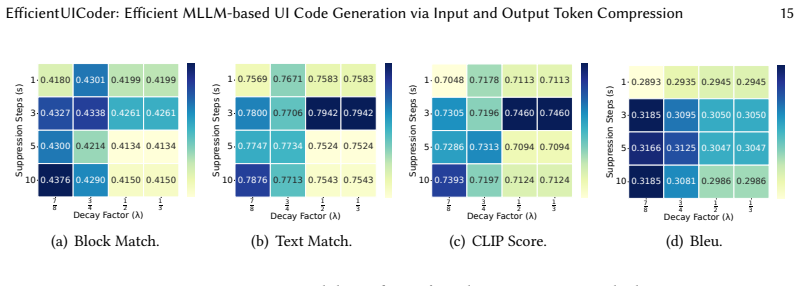
- [§6.4 and §5.2] The hyperparameters (s=3, λ=1/2, r=5–10%) are tuned on 100 webpages from Design2Code and 50 from WebCode2M, and the final performance tables (§6.1) report results on the full datasets. The paper does not state that the tuning samples are excluded from the final test sets, nor does it describe any held-out split or cross-validation for Design2Code/WebCode2M. Because parameter selection directly maximizes the same evaluation metrics on subsets of the same datasets, the reported numbers may be optimistically biased. Please clarify whether the tuning samples overlap with the final test sets and, if so, provide a separate held-out evaluation or internal cross-validation.
- [§4.3.2, Eq. (9)] The ADTS penalty procedure is underspecified. Equation (9) states that 'when duplicates occur, we will impose the following penalties on the subsequent s tokens’ logits' and writes z_i = z_i * λ^c for all i in {1,...,s}. In an autoregressive decoder, only the current step's logits can be modified; future tokens have not yet been generated. Does the method (a) at each step, penalize the logits of any token that has appeared in a tracked repeated structure, with intensity λ^c, for the next s decoding steps, or (b) re-score already generated tokens? The description in Algorithm 1 and the paragraph are too vague to reimplement. Please specify exactly which logits are modified at each decoding step, which tokens are eligible for penalty (e.g., all occurrences of the repeated string? only tokens that continue the repeated pattern?), and how c is maintained per structure.
minor comments (5)
- [§4.1.2] Typos: 'elememt' and 'construted' appear in the same paragraph. Please proofread.
- [Figures 8–10] Figure captions contain 'datatset' (Figures 8 and 9) and a mismatched caption: Figure 10 is titled 'Inference time under different λ and r' but the axes show decay factor λ and suppression step s, not r.
- [§7] The Threat to Validity section refers to 'human evaluation (Section 2)', but human evaluation is described in Section 6.1, not Section 2. The reference should be corrected.
- [§6.1, Human Evaluation] The human evaluation reports only win/tie/lose percentages. It does not report the number of comparisons per annotator, pairwise inter-annotator agreement (e.g., Fleiss' kappa), or confidence intervals. These are standard for preference studies and would strengthen the claim that human results 'corroborate' the automatic metrics.
- [§5.3.1] The metric group is titled 'High-level Similarity', but BLEU is a code-text n-gram overlap measure, not a visual similarity. Consider renaming the group to 'Overall Similarity' or splitting the metrics.
Circularity Check
No significant circularity: EfficientUICoder's claims are empirical system results, not derived by construction from their inputs.
full rationale
The paper contains no derivation chain that reduces by construction to its own inputs. The three components are concrete mechanisms: ELTC builds a UI element tree via UIED detection and a minimum spanning tree; RTR uses CLIP CLS-token attention scores to drop/add tokens; ADTS tracks HTML/CSS/text frequencies and applies an exponential logit penalty. None of these steps defines a target metric in terms of the method's own outputs, and none fits a parameter that is then reported as a prediction. The compression ratio, token reductions, FLOPs savings, and latency numbers are measured outcomes on external benchmarks (Design2Code, WebCode2M) using external metrics (CLIP, BLEU, and the Si et al. element-matching metrics), not quantities forced by the method's construction. Hyperparameters (s=3, lambda=1/2, r=5-10%) are tuned on sampled subsets and then applied to full test sets; this is standard model selection and could be a generalization risk, but it is not circularity. Self-citations (MRWeb, Interaction2Code, DesignBench, DCGen) appear only in related work and are not load-bearing evidence for the paper's central efficiency or quality claims. No uniqueness theorem from the authors' prior work is invoked to forbid alternatives, and no external method is re-imported as an unexamined ansatz via self-citation. The apparent quality drop for Llava-v1.6-34b on WebCode2M in Table 2 is a possible empirical contradiction of the 'without compromising quality' claim, but that is a correctness or significance-testing concern, not a circular derivation. Accordingly, no circular step is identified.
Assumptions & free parameters
free parameters (3)
- Suppression step s =
3
- Decay factor lambda =
1/2
- Refinement ratio r =
10% (Design2Code), 5% (WebCode2M)
assumptions (5)
- domain assumption UIED element detection accurately identifies all UI element bounding boxes on arbitrary webpage screenshots.
- domain assumption CLS-token attention scores from the frozen CLIP visual encoder reliably indicate which visual tokens are semantically important for UI code generation.
- standard math The FLOPs formula in Eq. (1) accurately models LLM inference cost for the efficiency comparison.
- domain assumption Incremental parsing of generated HTML/CSS during decoding can robustly identify intended structure repetitions.
- domain assumption CLIP score, BLEU, and the block/text/position/color element-matching metrics adequately capture 'webpage quality'.
Cite this review
Pith. "Pith review of EfficientUICoder: A Bidirectional Token Compression Framework for Efficient MLLM-Based UI Code Generation." pith.science (2026). https://pith.science/paper/AWUNLKQK
@misc{pith2026250912159,
  author       = {Pith},
  title        = {Pith review of: EfficientUICoder: A Bidirectional Token Compression Framework for Efficient MLLM-Based UI Code Generation},
  year         = {2026},
  howpublished = {\url{https://pith.science/paper/AWUNLKQK}},
  note         = {Machine review of arXiv:2509.12159}
}
read the original abstract
Multimodal Large Language Models have demonstrated exceptional performance in UI2Code tasks, significantly enhancing website development efficiency. However, these tasks incur substantially higher computational overhead than traditional code generation due to the large number of input image tokens and extensive output code tokens required. Our comprehensive study identifies significant redundancies in both image and code tokens that exacerbate computational complexity and hinder focus on key UI elements, resulting in excessively lengthy and often invalid HTML files. We propose EfficientUICoder, a compression framework for efficient UI code generation with three key components. First, Element and Layout-aware Token Compression preserves essential UI information by detecting element regions and constructing UI element trees. Second, Region-aware Token Refinement leverages attention scores to discard low-attention tokens from selected regions while integrating high-attention tokens from unselected regions. Third, Adaptive Duplicate Token Suppression dynamically reduces repetitive generation by tracking HTML/CSS structure frequencies and applying exponential penalties. Extensive experiments show EfficientUICoder achieves a 55%-60% compression ratio without compromising webpage quality and delivers superior efficiency improvements: reducing computational cost by 44.9%, generated tokens by 41.4%, prefill time by 46.6%, and inference time by 48.8% on 34B-level MLLMs. Code is available at https://github.com/WebPAI/EfficientUICoder.
Figures


Figures from the paper (9 more)




Forward citations
Cited by 2 Pith papers
-
UI2App: Benchmarking Visual Interaction Inference in Executable Web Application Generation
UI2App introduces a benchmark showing that vision-language models can reconstruct web page visuals but largely fail to infer the underlying interaction logic from screenshots alone.
-
Does It Render Everywhere? A Study of Cross-Environment Compatibility in MLLM-Generated Webpages
Sixty-eight percent of AI-generated webpages fail to render correctly in at least one of nine tested browser or device environments, and a new DOM-plus-screenshot detector catches 91% of these failures.
Reference graph
Works this paper leans on
-
[1]
How Many Websites Are There in 2025? (13 Latest Statistics).Anthony Cardillo(2025)
2025. How Many Websites Are There in 2025? (13 Latest Statistics).Anthony Cardillo(2025). https://explodingtopics. com/blog/how-many-websites-on-the-internet Accessed: 2025-07-05
2025
-
[2]
Batuhan Aşıroğlu, Büşta Rümeysa Mete, Eyyüp Yıldız, Yağız Nalçakan, Alper Sezen, Mustafa Dağtekin, and Tolga Ensari. 2019. Automatic HTML code generation from mock-up images using machine learning techniques. In2019 Scientific Meeting on Electrical-Electronics & Biomedical Engineering and Computer Science (EBBT). Ieee, 1–4
2019
-
[3]
Tony Beltramelli. 2018. pix2code: Generating code from a graphical user interface screenshot. InProceedings of the ACM SIGCHI symposium on engineering interactive computing systems. 1–6
2018
-
[4]
C. Chen, T. Su, G. Meng, Z. Xing, and Y. Liu. 2018. From UI design image to GUI skeleton: a neural machine translator to bootstrap mobile GUI implementation. InProceedings of the 40th International Conference on Software Engineering (ICSE). 665–676
2018
-
[5]
Liang Chen, Haozhe Zhao, Tianyu Liu, Shuai Bai, Junyang Lin, Chang Zhou, and Baobao Chang. 2024. An image is worth 1/2 tokens after layer 2: Plug-and-play inference acceleration for large vision-language models. InEuropean Conference on Computer Vision (ECCV). Springer, 19–35
2024
-
[6]
Wen-Yin Chen, Pavol Podstreleny, Wen-Huang Cheng, Yung-Yao Chen, and Kai-Lung Hua. 2022. Code generation from a graphical user interface via attention-based encoder–decoder model.Multimedia Systems28, 1 (2022), 121–130
2022
-
[7]
André Armstrong Janino Cizotto, Rodrigo Clemente Thom de Souza, Viviana Cocco Mariani, and Leandro dos Santos Coelho. 2023. Web pages from mockup design based on convolutional neural network and class activation mapping.Multimedia Tools and Applications82, 25 (2023), 38771–38797
2023
-
[8]
Alexey Dosovitskiy, Lucas Beyer, Alexander Kolesnikov, Dirk Weissenborn, Xiaohua Zhai, Thomas Unterthiner, Mostafa Dehghani, Matthias Minderer, Georg Heigold, Sylvain Gelly, et al. 2020. An image is worth 16x16 words: Transformers for image recognition at scale.arXiv preprint arXiv:2010.11929(2020)
arXiv 2020
Show all 43 references
-
[9]
Yi Gui, Zhen Li, Yao Wan, Yemin Shi, Hongyu Zhang, Bohua Chen, Yi Su, Dongping Chen, Siyuan Wu, Xing Zhou, et al. 2025. Webcode2m: A real-world dataset for code generation from webpage designs. InProceedings of the ACM on Web Conference (WWW). 1834–1845
2025
-
[10]
Yi Gui, Zhen Li, Zhongyi Zhang, Guohao Wang, Tianpeng Lv, Gaoyang Jiang, Yi Liu, Dongping Chen, Yao Wan, Hongyu Zhang, et al. 2025. LaTCoder: Converting Webpage Design to Code with Layout-as-Thought. InProceedings of the 31st ACM SIGKDD Conference on Knowledge Discovery and Da...
2025
-
[11]
Yi Gui, Yao Wan, Zhen Li, Zhongyi Zhang, Dongping Chen, Hongyu Zhang, Yi Su, Bohua Chen, Xing Zhou, Wenbin Jiang, and Xiangliang Zhang. 2025. UICopilot: Automating UI Synthesis via Hierarchical Code Generation from Webpage Designs. InProceedings of the ACM on Web Conference (W...
2025
-
[12]
Lianghong Guo, Yanlin Wang, Ensheng Shi, Wanjun Zhong, Hongyu Zhang, Jiachi Chen, Ruikai Zhang, Yuchi Ma, and Zibin Zheng. 2024. When to stop? towards efficient code generation in llms with excess token prevention. In Proceedings of the 33rd ACM SIGSOFT International Symposium...
2024
-
[13]
Vanita Jain, Piyush Agrawal, Subham Banga, Rishabh Kapoor, and Shashwat Gulyani. 2019. Sketch2Code: transforma- tion of sketches to UI in real-time using deep neural network.arXiv preprint arXiv:1910.08930(2019)
2019 arXiv
-
[14]
Hugo Laurençon, Léo Tronchon, and Victor Sanh. 2024. Unlocking the conversion of Web Screenshots into HTML Code with the WebSight Dataset. arXiv:2403.09029 [cs.HC]
2024 arXiv
-
[15]
Haiming Li, Qiyang Xia, Yong Wang, et al. 2017. Research and improvement of kruskal algorithm.Journal of Computer and Communications5, 12 (2017), 63
2017
-
[16]
Haotian Liu, Chunyuan Li, Yuheng Li, Bo Li, Yuanhan Zhang, Sheng Shen, and Yong Jae Lee. 2024. LLaVA-NeXT: Improved reasoning, OCR, and world knowledge. https://llava-vl.github.io/blog/2024-01-30-llava-next/
2024
-
[17]
Yuwen Lu, Alan Leung, Amanda Swearngin, Jeffrey Nichols, and Titus Barik. 2025. Misty: Ui prototyping through interactive conceptual blending. InProceedings of the 2025 CHI Conference on Human Factors in Computing Systems (CHI). 1–17
2025
-
[18]
Kevin Moran, Carlos Bernal-Cárdenas, Michael Curcio, Richard Bonett, and Denys Poshyvanyk. 2018. Machine learning-based prototyping of graphical user interfaces for mobile apps.IEEE Transactions on Software Engineering (TSE)46, 2 (2018), 196–221
2018
-
[19]
Tuan Anh Nguyen and Christoph Csallner. 2015. Reverse engineering mobile application user interfaces with remaui (t). In2015 30th IEEE/ACM International Conference on Automated Software Engineering (ASE). IEEE, 248–259
2015
-
[20]
Dangfeng Pan, Zhensu Sun, Cenyuan Zhang, David Lo, and Xiaoning Du. 2025. The Hidden Cost of Readability: How Code Formatting Silently Consumes Your LLM Budget.2026 IEEE/ACM 44th International Conference on Software , Vol. 1, No. 1, Article . Publication date: September 2026. ...
2025
-
[21]
Wei Pang, Kevin Qinghong Lin, Xiangru Jian, Xi He, and Philip Torr. 2025. Paper2Poster: Towards Multimodal Poster Automation from Scientific Papers.arXiv preprint arXiv:2505.21497(2025)
2025
-
[22]
Kishore Papineni, Salim Roukos, Todd Ward, and Wei-Jing Zhu. 2002. Bleu: a method for automatic evaluation of machine translation. InProceedings of the 40th annual meeting of the Association for Computational Linguistics. 311–318
2002
-
[23]
Alec Radford, Jong Wook Kim, Chris Hallacy, Aditya Ramesh, Gabriel Goh, Sandhini Agarwal, Girish Sastry, Amanda Askell, Pamela Mishkin, Jack Clark, et al. 2021. Learning transferable visual models from natural language supervision. InInternational conference on machine learnin...
2021
-
[24]
Jieke Shi, Zhou Yang, and David Lo. 2025. Efficient and Green Large Language Models for Software Engineering: Literature Review, Vision, and the Road Ahead.ACM Transactions on Software Engineering and Methodology (TOSEM) 34, 5 (2025), 1–22
2025
-
[25]
Chenglei Si, Yanzhe Zhang, Ryan Li, Zhengyuan Yang, Ruibo Liu, and Diyi Yang. 2025. Design2Code: Benchmarking Multimodal Code Generation for Automated Front-End Engineering. InProceedings of the 2025 Conference of the Nations of the Americas Chapter of the Association for Comp...
2025
-
[26]
Zhensu Sun, Chengran Yang, Xiaoning Du, Zhou Yang, Li Li, and David. Lo. 2025. Token Sugar: Making Source Code Sweeter for LLMs through Token-Efficient Shorthand.2025 40th IEEE/ACM International Conference on Automated Software Engineering (ASE)(2025)
2025
-
[27]
Wenxin Tang, Jingyu Xiao, Wenxuan Jiang, Xi Xiao, Yuhang Wang, Xuxin Tang, Qing Li, Yuehe Ma, Junliang Liu, Shisong Tang, et al. 2025. SlideCoder: Layout-aware RAG-enhanced Hierarchical Slide Generation from Design.arXiv preprint arXiv:2506.07964(2025)
2025 arXiv
-
[28]
Yuxuan Wan, Yi Dong, Jingyu Xiao, Yintong Huo, Wenxuan Wang, and Michael R Lyu. 2024. MRWeb: An Exploration of Generating Multi-Page Resource-Aware Web Code from UI Designs.arXiv preprint arXiv:2412.15310(2024)
2024 arXiv
-
[29]
Yuxuan Wan, Chaozheng Wang, Yi Dong, Wenxuan Wang, Shuqing Li, Yintong Huo, and Michael R Lyu. 2025. Divide- and-Conquer: Generating UI Code from Screenshots.Proceedings of the ACM on Software Engineering (FSE)1, FSE, 1–24
2025
-
[30]
Fan Wu, Cuiyun Gao, Shuqing Li, Xin-Cheng Wen, and Qing Liao. 2025. MLLM-Based UI2Code Automation Guided by UI Layout Information. In2025 International Symposium on Software Testing and Analysis (ISSTA). ACM New York, Trondheim, Norway, 1–23
2025
-
[31]
Jingyu Xiao, Yuxuan Wan, Yintong Huo, Zixin Wang, Xinyi Xu, Wenxuan Wang, Zhiyao Xu, Yuhang Wang, and Michael R Lyu. 2024. Interaction2Code: Benchmarking MLLM-based Interactive Webpage Code Generation from Interactive Prototyping.arXiv preprint arXiv:2411.03292(2024)
2024
-
[32]
Jingyu Xiao, Ming Wang, Man Ho Lam, Yuxuan Wan, Junliang Liu, Yintong Huo, and Michael R Lyu. 2025. Designbench: A comprehensive benchmark for mllm-based front-end code generation.arXiv preprint arXiv:2506.06251(2025)
2025
-
[33]
Mulong Xie, Sidong Feng, Zhenchang Xing, Jieshan Chen, and Chunyang Chen. 2020. UIED: a hybrid tool for GUI element detection. InProceedings of the 28th ACM Joint Meeting on European Software Engineering Conference and Symposium on the Foundations of Software Engineering (FSE)...
2020
-
[34]
Long Xing, Qidong Huang, Xiaoyi Dong, Jiajie Lu, Pan Zhang, Yuhang Zang, Yuhang Cao, Conghui He, Jiaqi Wang, Feng Wu, et al. 2024. Pyramiddrop: Accelerating your large vision-language models via pyramid visual redundancy reduction.arXiv preprint arXiv:2410.17247(2024)
2024 arXiv
-
[35]
Y. Xu, L. Bo, X. Sun, B. Li, J. Jiang, and W. Zhou. 2021. image2emmet: Automatic code generation from web user interface image.Journal of Software: Evolution and Process33, 8 (2021), e2369
2021
-
[36]
Mikio Yamamoto and Kenneth W Church. 2001. Using suffix arrays to compute term frequency and document frequency for all substrings in a corpus.Computational Linguistics27, 1 (2001), 1–30
2001
-
[37]
Guang Yang, Yu Zhou, Wei Cheng, Xiangyu Zhang, Xiang Chen, Terry Yue Zhuo, Ke Liu, Xin Zhou, David Lo, and Taolue Chen. 2025. Less is More: DocString Compression in Code Generation.ACM Transactions on Software Engineering and Methodology (TOSEM)(2025)
2025
-
[38]
Senqiao Yang, Yukang Chen, Zhuotao Tian, Chengyao Wang, Jingyao Li, Bei Yu, and Jiaya Jia. 2025. Visionzip: Longer is better but not necessary in vision language models. InProceedings of the Computer Vision and Pattern Recognition Conference (CVPR). 19792–19802
2025
-
[39]
Mingyue Yuan, Jieshan Chen, Zhenchang Xing, Aaron Quigley, Yuyu Luo, Tianqi Luo, Gelareh Mohammadi, Qinghua Lu, and Liming Zhu. 2025. DesignRepair: Dual-Stream Design Guideline-Aware Frontend Repair with Large Language Models . InIEEE/ACM 47th International Conference on Softw...
2025
-
[40]
Xing, Xiaodan Liang, and Zhiqiang Shen
Sukmin Yun, Haokun Lin, Rusiru Thushara, Mohammad Qazim Bhat, Yongxin Wang, Zutao Jiang, Mingkai Deng, Jinhong Wang, Tianhua Tao, Junbo Li, Haonan Li, Preslav Nakov, Timothy Baldwin, Zhengzhong Liu, Eric P. Xing, Xiaodan Liang, and Zhiqiang Shen. 2024. Web2Code: A Large-scale ...
2024
-
[41]
Sai Zhang, Zhenchang Xing, Ronghui Guo, Fangzhou Xu, Lei Chen, Zhaoyuan Zhang, Xiaowang Zhang, Zhiyong Feng, and Zhiqiang Zhuang. 2025. Empowering agile-based generative software development through human-ai teamwork. ACM Transactions on Software Engineering and Methodology (T...
2025
-
[42]
Yuan Zhang, Chun-Kai Fan, Junpeng Ma, Wenzhao Zheng, Tao Huang, Kuan Cheng, Denis Gudovskiy, Tomoyuki Okuno, Yohei Nakata, Kurt Keutzer, et al. 2025. SparseVLM: Visual Token Sparsification for Efficient Vision-Language Model Inference. InInternational Conference on Machine Lea...
2025
-
[43]
Ting Zhou, Yanjie Zhao, Xinyi Hou, Xiaoyu Sun, Kai Chen, and Haoyu Wang. 2025. Bridging Design and Development with Automated Declarative UI Code Generation.Proceedings of the ACM on Software Engineering (FSE)1, FSE, 1–24. , Vol. 1, No. 1, Article . Publication date: September 2026
2025
Reviewed August 4, 2026 · model on record in the stance chip above.
Discussion (0). Continue with ORCID to comment.