REVIEW 4 major objections 4 minor 75 references
The paper argues that monocular depth estimation degrades under camera roll because real-world training photos are overwhelmingly near-horizontal, and that its ID-Constraint training-time supervision—six auxiliary rotation-invariant tasks,
Reviewed by Pith at T0; open to challenge. T0 means a machine referee read the full paper against a public rubric. the ladder, T0–T4 →
T0 review · deepseek-v4-flash
2026-08-04 00:45 UTC pith:AXJBPNUF
load-bearing objection Useful, honestly-reported MDE robustness paper: the empirical core holds up, but the horizontal-prior histogram comes from a predictor trained on that same prior, and the 'invariant' label overreaches. the 4 major comments →
Breaking the Horizontal Prior: From Long-Tailed Orientation Bias to Roll-Robust Monocular Depth Estimation
The pith
A machine-rendered reading of the paper's core claim, the machinery that carries it, and where it could break.
Core claim
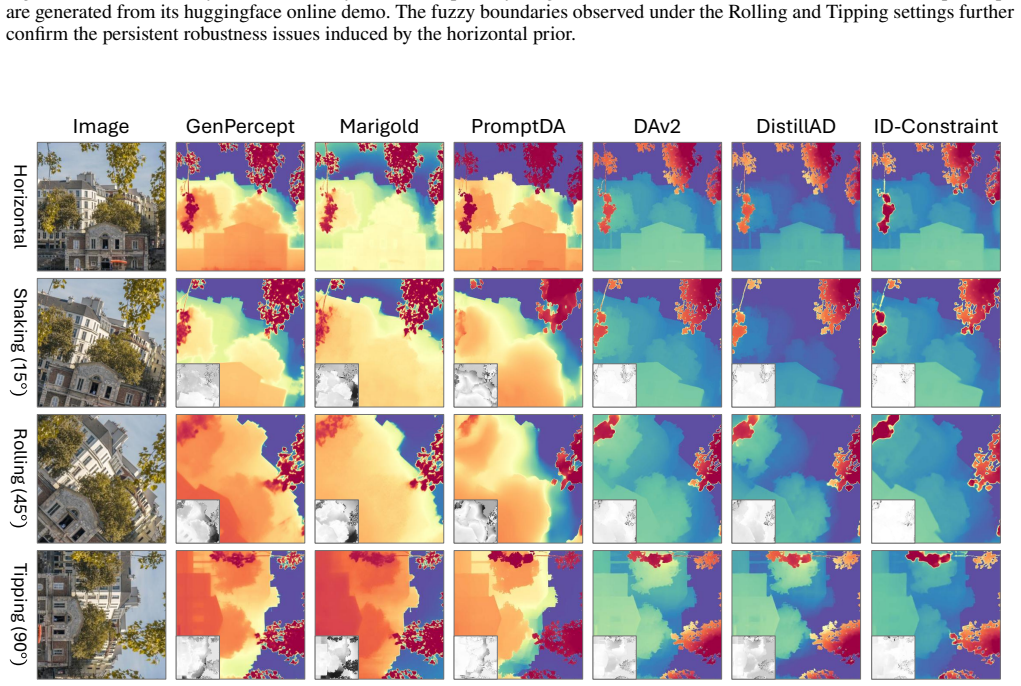
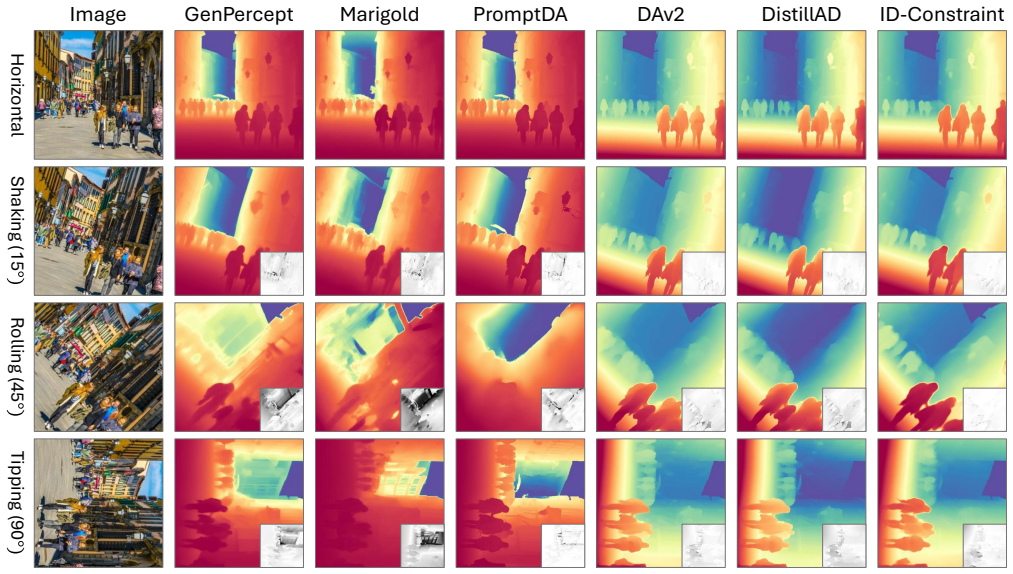
On its own terms, the paper's central discovery is the horizontal prior: a long-tailed distribution of absolute roll angles in natural images, inherited from human photographic conventions, that biases every major monocular depth model toward level inputs. The paper demonstrates the bias empirically by showing that depth error grows monotonically with roll magnitude and that a small but real population of genuinely tilted photos creates a rebound in performance near 90°. It then proposes ID-Constraint, a training-time supervision scheme that adds six auxiliary heads to the depth model—four region-level binary tasks (light/shadow, occlusion, size, texture gradient) and two new pixel-level reg
What carries the argument
The central object is the horizontal prior: the long-tailed distribution of near-horizontal image orientations that biases depth models. The carrying mechanism is ID-Constraint (Invariant Depth Constraint), a training-time supervision strategy that adds six auxiliary prediction heads—four region-level binary classification tasks (light and shadow, occlusion, size, texture gradient) and two new pixel-level regression tasks (local peak, local slope: local convex/concave depth structure and mean absolute depth gradient along four directions, computed with handcrafted 5×5 kernels)—to encourage the ViT encoder to learn rotation-stable depth features. All auxiliary heads are discarded at inference
Load-bearing premise
The method's stated mechanism is that the pixel-level constraints are rotation-invariant, but the 5x5 mean kernel and four directional slope kernels used to compute them are axis-aligned and do not commute with arbitrary rotation, so the supervision is only mathematically consistent for multiples of 90 degrees; if this invariance assumption fails, the reported gains would have to be attributed to augmentation and multi-task regularization rather than the constraint.
What would settle it
Take a horizontal image at roll theta = 30 degrees, compute the local peak and slope maps with the paper's fixed kernels, and compare them to the rotated versions of the horizontal maps (R_theta(Z(I_0)) vs Z(R_theta(I_0))). If the residual is large for angles that are not multiples of 90 degrees, the constraint is not invariant, and the method's advantage should instead be tested by retraining with kernels that rotate with the image or by limiting the evaluation to 0/90/180 degrees where the kernels are consistent.
If this is right
- If the horizontal prior is as pervasive as the paper argues, standard MDE benchmarks that evaluate only level images overstate real-world accuracy; evaluating under Shaking, Rolling, and Tipping settings becomes necessary for deployment claims.
- ID-Constraint requires no extra compute at inference, so any ViT-based depth model can be retrofitted with it by fine-tuning while keeping the same architecture.
- The two intuitive remedies—re-balanced augmentation and horizon leveling—are shown insufficient on their own; horizon leveling is particularly limited because roll-angle estimators still err by about 26 degrees on average.
- The method's gains hold across five different depth benchmarks (indoor, outdoor, synthetic, autonomous driving), suggesting the bias is dataset-agnostic.
- Because the constraint targets feature learning rather than post-processing, it could be combined with other robustness methods, such as stronger orientation estimators, for further gains.
Where Pith is reading between the lines
- The paper frames ID-Constraint as enforcing rotation-invariant constraints, but the pixel-level kernels are axis-aligned and do not rotate with the image; for roll angles that are not multiples of 90 degrees, the supervision target is only approximately consistent, so part of the measured gain may come from multi-task regularization and re-balanced augmentation rather than true invariance. A direc
- If the mechanism is genuine invariance, the same recipe should transfer to other in-plane perturbations such as translation and scaling, and to other dense tasks (surface normals, semantic segmentation) that share the same photographic training distribution.
- The near-90-degree bump in the fine-grained roll curves indicates that even a small population of truly tilted training images measurably shapes model behavior; that suggests an even cheaper intervention—filtering, downweighting, or correcting orientation outliers—deserves a head-to-head comparison with multi-task training.
- The success of discarded auxiliary heads implies the method is really a representation-learning recipe for foundation backbones; applying the same invariant constraints during pretraining (rather than only at MDE fine-tuning) might produce roll-stable features more broadly.
Editorial analysis
A structured set of objections, weighed in public.
Referee Report
Summary. The paper hypothesizes a 'Horizontal Prior' in monocular depth estimation: naturally collected images are mostly near-horizontal, producing a long-tailed roll distribution that biases MDE training and makes state-of-the-art models degrade under camera roll. After presenting two intuitive remedies (re-balanced augmentation and horizon leveling), the authors propose ID-Constraint, a training-time multi-task regularizer that adds four region-level and two pixel-level auxiliary supervision tasks to a DAv2/DistillAD-style baseline. The auxiliary heads are discarded at inference. The paper reports experiments on five benchmarks under four roll settings, claiming that ID-Constraint improves roll robustness and achieves the best overall performance in three of the four settings.
Significance. If the central claims are sound, the paper identifies a previously overlooked data bias in MDE and proposes a practical, inference-cost-free training strategy to mitigate it. The paper includes a large experimental study, a new evaluation protocol with four roll settings, and a public code link. These are concrete strengths. However, the evidence for the long-tailed horizontal prior relies on a roll predictor trained under the prior's own assumption, and the two pixel-level tasks are not rotation-equivariant as claimed. Both issues are load-bearing for the paper's two main contributions, although they are potentially addressable through reframing and additional validation.
major comments (4)
- [Method, The Horizontal Prior; Appendix, Roll Angle Distribution Analysis; Table 1; Figure 7] The long-tailed distribution in Figure 1(d)/7(b), which is the primary evidence for the Horizontal Prior, is produced by the authors' own roll-angle predictor. That predictor is trained in Stage-1 using the applied random rotation as supervision under the explicit assumption that 'most images are horizontally aligned due to horizontal prior' (Method section), and Stage-2 removes the highest-error samples. With a best mean absolute error of 25.90° (Table 1), the 45° pre-alignment threshold cannot reliably distinguish genuine near-vertical images from predictor overestimates: an image with true roll 20° predicted as 50° would be rotated by 90°, artificially creating a tail near 70°; a true 90° image predicted as 40° would be left unrotated. The appendix's statement that errors 'below 48°' make correction reliable conflates mean error with a maximum. The paper's claimed first contribution—t
- [Method, Pixel-level constraints; Eqs. (2)-(3)] The local peak and local slope operators are computed with axis-aligned 5×5 kernels (an all-ones kernel and four fixed directional kernels). These operators are not rotation-equivariant: Z(R_θ I) ≠ R_θ Z(I) for general θ. The supervision in the text compares the network output on I_θ with R_θ Z(I_0), which is a well-defined function of I_θ because the augmentation angle θ is known, but it is not the true rotated local geometry of the scene. Consequently, the claim that these tasks provide 'rotation-invariant' supervision and encourage 'rotation-stable representations' is not mathematically supported. The method may still function as a data-augmented multi-task regularizer, but the paper's mechanistic contribution requires reframing, or using genuinely equivariant operators (e.g., steerable kernels), or defining a consistency loss that does not require rotating the target.
- [Experiments, Comparisons with state-of-the-art methods; Tables 2-3 and 5-7] All comparisons to DAv2, DistillAD, Marigold, and GenPercept use the authors' re-implemented evaluation code, and for DAv2 and DistillAD the comparisons also use re-implemented training (as the authors acknowledge: 'we have to re-implement both methods' and 'may introduce minor inconsistencies'). The headline claim of 'best overall performance across five benchmarks and three out of four roll settings' rests on these reimplementations. The reported improvement over DAv2* in the Tipping setting is AbsRel 0.106 vs 0.127, and the only confidence interval in the appendix (Paired Bootstrap) is for ID-Constraint vs Aug+level, not for the main comparisons vs DAv2* or the baseline. To support the central empirical claim, either release the evaluation code and compare against the original released checkpoints of DAv2/DistillAD, or provide paired statistical significance tests for the key comparis
- [Appendix, Statistical grounding of long-tailed rolling bias; Discussion and Analysis] The paper's own limitation statements weaken the evidence. The appendix states 'we also manually check those tail images and confirm they are genuinely tilted despite the 25.9° error'; this is anecdotal and unquantified. The 'average depth map' in Figure 1(c) is presented as qualitative evidence of the prior, but its interpretation is not established. The 'three independent pieces of evidence' in the appendix are not independent: pieces 1 and 3 both rely on the same roll predictor. Please replace these with quantitative, externally validated evidence, or explicitly scope the claims to the behavior of the authors' models rather than to natural-image statistics.
minor comments (4)
- [Abstract/Introduction, Contributions] The introduction says 'The main contributions of this paper are threefold' but then lists four numbered items. Please correct the count or merge the items.
- [Appendix, Roll Angle Distribution Analysis] The sentence 'all of our angle prediction models reduce the absolute prediction error to below 48°' should specify 'mean absolute error,' not 'absolute prediction error,' since the reported metrics are averages (Table 1).
- [Appendix, Implementation Details of ID Heads] For the local peak/slope head, the text says 'Y_local-ps ∈ R^{5×H×W}' with one peak channel and four slope channels, and then states the final slope is the absolute average of the four directional outputs. Please clarify whether the L1 loss is applied to the four directional outputs, to their absolute values, or to the averaged slope map, so the supervision is unambiguous.
- [Figure 5 and Figure 8] The axis label 'Merics: δ1 ↑' contains a typo; it should be 'Metrics.'
Circularity Check
Horizontal-prior evidence is partly circular: the roll predictor used to build the long-tailed histogram is trained under the prior it is supposed to demonstrate.
specific steps
-
fitted input called prediction
[Section 3.3 (The Horizontal Prior, Horizon leveling) and Appendix C (Roll Angle Distribution Analysis)]
"In stage one, we treat most images as horizontally aligned due to horizontal prior and use the applied rotation angle θ as supervision. ... Since all of our angle prediction models reduce the absolute prediction error to below48◦, we can reliably correct these anomalies by applying a 90◦ rotation to the affected samples. After this pre-alignment, the distribution is transformed into the one shown in Figure 7(b), which we adopt as the true underlying training distribution used in the main paper."
The long-tailed roll distribution offered as evidence of the horizontal prior is produced by a roll predictor whose stage-one supervision explicitly assumes that prior ('we treat most images as horizontally aligned due to horizontal prior'). The same predictor then decides which samples exceed the 45° threshold and receive a 90° pre-alignment, so the corrected histogram in Fig. 1(d)/7(b) is not an independent measurement; it is the output of a model whose labels already encode the conclusion. This is load-bearing because the paper's first contribution is the prior itself ('we present the first systematic investigation of the Horizontal Prior'). Independent support exists—controlled-roll degradation and manual tail checks—but the quantitative long-tailed distribution is circularly construct
full rationale
The ID-Constraint method itself is not circular: its auxiliary objectives (region-level tasks from DepthCues and pixel-level local peak/slope) are external supervision signals, the auxiliary heads are discarded at inference, and the reported gains over the reimplemented baseline on five benchmark datasets are empirical comparisons against independent SOTA models. The pixel-level 'rotation-invariant' naming is loose—the kernels are axis-aligned—but the loss target R_θ Z(I_0) is well-defined for known θ, so no mathematical circularity follows. The circularity is confined to the evidence for the horizontal prior: the roll predictor used to build the long-tailed histogram is trained under the assumption that most images are horizontal, and the 90° pre-alignment threshold is also set by that predictor. The paper's manual verification of tail images and the controlled-roll degradation experiments provide some independent support, which prevents a higher score, but the central quantitative claim about the data distribution is partially constructed from its own assumption.
Axiom & Free-Parameter Ledger
free parameters (4)
- pre-alignment roll threshold =
45 degrees
- roll-predictor denoise fraction =
50%
- re-balanced augmentation range and crop =
uniform [-90,90] angle; crop 40%-100%; 10% unaugmented
- ID loss weight =
1.0
axioms (4)
- domain assumption Natural real-world images are mostly near-horizontal, and the long-tailed roll distribution can be estimated with the paper's own roll predictor.
- domain assumption DAv2 pseudo-depth on unrotated images is valid ground truth for both distillation and for constructing the auxiliary local peak/slope maps.
- ad hoc to paper The five 5x5 kernels used to compute local peak and local slope define rotation-invariant/equivariant targets.
- domain assumption The four region-level DepthCues task labels (light/shadow, occlusion, size, texture gradient) remain valid after image rotation.
Cite this review
Pith. "Pith review of Breaking the Horizontal Prior: From Long-Tailed Orientation Bias to Roll-Robust Monocular Depth Estimation." pith.science (2026). https://pith.science/paper/AXJBPNUF
@misc{pith2026260800678,
  author       = {Pith},
  title        = {Pith review of: Breaking the Horizontal Prior: From Long-Tailed Orientation Bias to Roll-Robust Monocular Depth Estimation},
  year         = {2026},
  howpublished = {\url{https://pith.science/paper/AXJBPNUF}},
  note         = {Machine review of arXiv:2608.00678}
}
read the original abstract
Despite recent advances in Monocular Depth Estimation, state-of-the-art depth foundation models remain vulnerable to robustness issues. Particularly, even slight camera rolls can result in substantial degradation in depth estimations. We attribute this problem to a previously overlooked phenomenon, termed the Horizontal Prior, which is a manifestation of long-tailed distribution bias: most training images are captured in approximately horizontal orientations due to human visual preferences and photographic habits. While intuitive remedies such as re-balanced data augmentation and horizon leveling provide partial improvements, they fail to fully address the issue. In this paper, we introduce Invariant Depth Constraint (ID-Constraint), a training-time supervision strategy that improves roll robustness by fine-tuning and jointly regularizing the depth backbone with a series of geometric and spatial reasoning tasks. These auxiliary objectives encourage the backbone to learn rotation-stable, depth-relevant representations, while the auxiliary prediction heads are discarded after training, leaving the original inference architecture unchanged. Extensive experiments on five benchmark datasets across four roll settings demonstrate the effectiveness of the proposed method.
Figures




Reference graph
Works this paper leans on
-
[1]
CVPR , year=
Repurposing Diffusion-Based Image Generators for Monocular Depth Estimation , author=. CVPR , year=
-
[2]
ICLR , year=
What Matters When Repurposing Diffusion Models for General Dense Perception Tasks? , author=. ICLR , year=
-
[3]
NeurIPS , year=
Depth Anything V2 , author=. NeurIPS , year=
-
[4]
2025 International Conference on 3D Vision (3DV) , pages=
Ags-mesh: Adaptive gaussian splatting and meshing with geometric priors for indoor room reconstruction using smartphones , author=. 2025 International Conference on 3D Vision (3DV) , pages=. 2025 , organization=
2025
-
[5]
2025 , journal =
Distill Any Depth: Distillation Creates a Stronger Monocular Depth Estimator , author =. 2025 , journal =
2025
- [6]
-
[7]
CVPR , year=
Prompting Depth Anything for 4K Resolution Accurate Metric Depth Estimation , author=. CVPR , year=
-
[8]
Neurocomputing , volume=
Deep learning for monocular depth estimation: A review , author=. Neurocomputing , volume=. 2021 , publisher=
2021
-
[9]
IEEE Transactions on Pattern Analysis and Machine Intelligence , volume=
Monocular depth estimation: A thorough review , author=. IEEE Transactions on Pattern Analysis and Machine Intelligence , volume=. 2023 , publisher=
2023
-
[10]
CVPR , pages=
Monocd: Monocular 3d object detection with complementary depths , author=. CVPR , pages=
-
[11]
CVPR , pages=
Multi-view reconstruction via sfm-guided monocular depth estimation , author=. CVPR , pages=
-
[12]
ECCV , pages=
Monocular 3d object detection with depth from motion , author=. ECCV , pages=. 2022 , organization=
2022
-
[13]
Kim, Seungryong , booktitle=. D
-
[14]
Proceedings of the AAAI Conference on Artificial Intelligence , volume=
Multi-view Consistent 3D Panoptic Scene Understanding , author=. Proceedings of the AAAI Conference on Artificial Intelligence , volume=
-
[15]
2025 IEEE International Conference on Robotics and Automation (ICRA) , pages=
Panoptic-depth forecasting , author=. 2025 IEEE International Conference on Robotics and Automation (ICRA) , pages=. 2025 , organization=
2025
-
[16]
2024 , eprint=
DINOv2: Learning Robust Visual Features without Supervision , author=. 2024 , eprint=
2024
-
[17]
Proceedings of the IEEE/CVF ICCV , pages=
Sigmoid loss for language image pre-training , author=. Proceedings of the IEEE/CVF ICCV , pages=
-
[18]
IEEE transactions on pattern analysis and machine intelligence , volume=
Deep long-tailed learning: A survey , author=. IEEE transactions on pattern analysis and machine intelligence , volume=. 2023 , publisher=
2023
-
[19]
Journal of vision , volume=
A horizontal bias in human visual processing of orientation and its correspondence to the structural components of natural scenes , author=. Journal of vision , volume=. 2004 , publisher=
2004
-
[20]
Human Vision and Electronic Imaging VIII , volume=
Psychophysical study of image orientation perception , author=. Human Vision and Electronic Imaging VIII , volume=. 2003 , organization=
2003
-
[21]
Khairi and Vijayabaskar Kasi , title =
Norhafizan Ahmad and Raja Ariffin Raja Ghazilla and Nazirah M. Khairi and Vijayabaskar Kasi , title =. International Journal of Signal Processing Systems , volume =
-
[22]
GoPro, Inc
Systems and methods for horizon leveling videos , author =. GoPro, Inc. (US11336832B1) , year =
-
[23]
Proceedings of the British Machine Vision Conference (BMVC) , pages =
Horizon Lines in the Wild , author =. Proceedings of the British Machine Vision Conference (BMVC) , pages =. 2016 , month =
2016
-
[24]
NeurIPS , volume=
Long-tailed classification by keeping the good and removing the bad momentum causal effect , author=. NeurIPS , volume=
-
[25]
ICLR , year=
Long-tail learning via logit adjustment , author=. ICLR , year=
-
[26]
ICLR , year=
Decoupling representation and classifier for long-tailed recognition , author=. ICLR , year=
-
[27]
Proceedings of the IEEE/CVF ICCV , pages=
Re-distributing biased pseudo labels for semi-supervised semantic segmentation: A baseline investigation , author=. Proceedings of the IEEE/CVF ICCV , pages=
-
[28]
ECCV , pages=
Invariant feature learning for generalized long-tailed classification , author=. ECCV , pages=. 2022 , organization=
2022
-
[29]
Proceedings of the CVPR Conference , pages=
DepthCues: Evaluating monocular depth perception in large vision models , author=. Proceedings of the CVPR Conference , pages=
-
[30]
ICCV , year=
Diode: A dense indoor and outdoor depth dataset , author=. ICCV , year=
-
[31]
Proceedings of the IEEE conference on CVPR , pages=
Scannet: Richly-annotated 3d reconstructions of indoor scenes , author=. Proceedings of the IEEE conference on CVPR , pages=
-
[32]
Proceedings of the IEEE conference on CVPR , pages=
A multi-view stereo benchmark with high-resolution images and multi-camera videos , author=. Proceedings of the IEEE conference on CVPR , pages=
-
[33]
2012 CVPR , pages=
Are we ready for autonomous driving? the kitti vision benchmark suite , author=. 2012 CVPR , pages=. 2012 , organization=
2012
-
[34]
ECCV , pages=
Indoor segmentation and support inference from rgbd images , author=. ECCV , pages=. 2012 , organization=
2012
-
[35]
arXiv preprint arXiv:1901.09402 , year=
Monocular depth estimation: A survey , author=. arXiv preprint arXiv:1901.09402 , year=
Pith/arXiv arXiv 1901
-
[36]
Sensors , volume=
Monocular depth estimation using deep learning: A review , author=. Sensors , volume=. 2022 , publisher=
2022
-
[37]
Science China Technological Sciences , volume=
Monocular depth estimation based on deep learning: An overview , author=. Science China Technological Sciences , volume=. 2020 , publisher=
2020
-
[38]
Massachusetts Institute of Technology , year=
Shape from shading: A method for obtaining the shape of a smooth opaque object from one view , author=. Massachusetts Institute of Technology , year=
-
[39]
ECCV , pages=
A factorization based algorithm for multi-image projective structure and motion , author=. ECCV , pages=. 1996 , organization=
1996
-
[40]
Journal of Electronic Imaging , volume=
Review of monocular depth estimation methods , author=. Journal of Electronic Imaging , volume=. 2025 , publisher=
2025
-
[41]
International Conference on Medical image computing and computer-assisted intervention , pages=
U-net: Convolutional networks for biomedical image segmentation , author=. International Conference on Medical image computing and computer-assisted intervention , pages=. 2015 , organization=
2015
-
[42]
Proceedings of the IEEE conference on CVPR , pages=
Deep residual learning for image recognition , author=. Proceedings of the IEEE conference on CVPR , pages=
-
[43]
2016 Fourth international conference on 3D vision (3DV) , pages=
Deeper depth prediction with fully convolutional residual networks , author=. 2016 Fourth international conference on 3D vision (3DV) , pages=. 2016 , organization=
2016
-
[44]
Proceedings of the IEEE conference on CVPR , pages=
Deep ordinal regression network for monocular depth estimation , author=. Proceedings of the IEEE conference on CVPR , pages=
-
[45]
IEEE Transactions on Intelligent Transportation Systems , volume=
Mobilexnet: An efficient convolutional neural network for monocular depth estimation , author=. IEEE Transactions on Intelligent Transportation Systems , volume=. 2022 , publisher=
2022
-
[46]
Proceedings of the IEEE/CVF winter conference on applications of computer vision , pages=
Towards good practice for CNN-based monocular depth estimation , author=. Proceedings of the IEEE/CVF winter conference on applications of computer vision , pages=
-
[47]
arXiv preprint arXiv:2110.11590 , year=
Diml/cvl rgb-d dataset: 2m rgb-d images of natural indoor and outdoor scenes , author=. arXiv preprint arXiv:2110.11590 , year=
-
[48]
2020 IEEE/RSJ International Conference on Intelligent Robots and Systems (IROS) , pages=
Tartanair: A dataset to push the limits of visual slam , author=. 2020 IEEE/RSJ International Conference on Intelligent Robots and Systems (IROS) , pages=. 2020 , organization=
2020
-
[49]
Proceedings of the IEEE/CVF conference on CVPR , pages=
Blendedmvs: A large-scale dataset for generalized multi-view stereo networks , author=. Proceedings of the IEEE/CVF conference on CVPR , pages=
-
[50]
Proceedings of the IEEE ICCV , pages=
Predicting depth, surface normals and semantic labels with a common multi-scale convolutional architecture , author=. Proceedings of the IEEE ICCV , pages=
-
[51]
Proceedings of the IEEE conference on CVPR , pages=
Pad-net: Multi-tasks guided prediction-and-distillation network for simultaneous depth estimation and scene parsing , author=. Proceedings of the IEEE conference on CVPR , pages=
-
[52]
Proceedings of the IEEE/CVF ICCV , pages=
Scalable diffusion models with transformers , author=. Proceedings of the IEEE/CVF ICCV , pages=
-
[53]
Proceedings of the IEEE/CVF Conference on CVPR , month =
Rombach, Robin and Blattmann, Andreas and Lorenz, Dominik and Esser, Patrick and Ommer, Bj\"orn , title =. Proceedings of the IEEE/CVF Conference on CVPR , month =. 2022 , pages =
2022
-
[54]
Proceedings of the IEEE/CVF conference on CVPR , pages=
Momentum contrast for unsupervised visual representation learning , author=. Proceedings of the IEEE/CVF conference on CVPR , pages=
-
[55]
Proceedings of the IEEE/CVF conference on CVPR , pages=
Depth anything: Unleashing the power of large-scale unlabeled data , author=. Proceedings of the IEEE/CVF conference on CVPR , pages=
-
[56]
Towards Robust Monocular Depth Estimation: Mixing Datasets for Zero-Shot Cross-Dataset Transfer
Ren\' e Ranftl and Katrin Lasinger and David Hafner and Konrad Schindler and Vladlen Koltun. Towards Robust Monocular Depth Estimation: Mixing Datasets for Zero-Shot Cross-Dataset Transfer. IEEE Transactions on Pattern Analysis and Machine Intelligence. 2022
2022
-
[57]
arXiv preprint arXiv:2307.14460 , year=
MiDaS v3.1 -- A Model Zoo for Robust Monocular Relative Depth Estimation , author=. arXiv preprint arXiv:2307.14460 , year=
-
[58]
Proceedings of the AAAI Conference on Artificial Intelligence , volume=
Dme: Unveiling the bias for better generalized monocular depth estimation , author=. Proceedings of the AAAI Conference on Artificial Intelligence , volume=
-
[59]
arXiv preprint arXiv:2504.15095 , year=
VistaDepth: Frequency Modulation With Bias Reweighting For Enhanced Long-Range Depth Estimation , author=. arXiv preprint arXiv:2504.15095 , year=
-
[60]
Proceedings of the IEEE/CVF ICCV , pages=
Dynamic curriculum learning for imbalanced data classification , author=. Proceedings of the IEEE/CVF ICCV , pages=
-
[61]
Proceedings of the IEEE/CVF conference on CVPR , pages=
Feature transfer learning for face recognition with under-represented data , author=. Proceedings of the IEEE/CVF conference on CVPR , pages=
-
[62]
Proceedings of the IEEE/CVF conference on CVPR , pages=
M2m: Imbalanced classification via major-to-minor translation , author=. Proceedings of the IEEE/CVF conference on CVPR , pages=
-
[63]
Proceedings of the IEEE/CVF conference on CVPR , pages=
Learning to segment the tail , author=. Proceedings of the IEEE/CVF conference on CVPR , pages=
-
[64]
NeurIPS , volume=
Self-supervised aggregation of diverse experts for test-agnostic long-tailed recognition , author=. NeurIPS , volume=
-
[65]
arXiv preprint arXiv:2010.11929 , year=
An image is worth 16x16 words: Transformers for image recognition at scale , author=. arXiv preprint arXiv:2010.11929 , year=
Pith/arXiv arXiv 2010
-
[66]
Proceedings of the IEEE/CVF ICCV , pages=
Vision transformers for dense prediction , author=. Proceedings of the IEEE/CVF ICCV , pages=
-
[67]
International conference on machine learning , pages=
Learning transferable visual models from natural language supervision , author=. International conference on machine learning , pages=. 2021 , organization=
2021
-
[68]
IEEE transactions on pattern analysis and machine intelligence , volume=
Diffusion models in vision: A survey , author=. IEEE transactions on pattern analysis and machine intelligence , volume=. 2023 , publisher=
2023
-
[69]
ECCV , pages=
Identifying hard noise in long-tailed sample distribution , author=. ECCV , pages=. 2022 , organization=
2022
-
[70]
Journal of Artificial Intelligence Research , volume=
Confident learning: Estimating uncertainty in dataset labels , author=. Journal of Artificial Intelligence Research , volume=
-
[71]
Proceedings of the 26th annual international conference on machine learning , pages=
Curriculum learning , author=. Proceedings of the 26th annual international conference on machine learning , pages=
-
[72]
arXiv preprint arXiv:1711.05101 , year=
Decoupled weight decay regularization , author=. arXiv preprint arXiv:1711.05101 , year=
-
[73]
arXiv preprint arXiv:1907.02893 , year=
Invariant risk minimization , author=. arXiv preprint arXiv:1907.02893 , year=
Pith/arXiv arXiv 1907
-
[74]
Proceedings of the IEEE/CVF conference on CVPR , pages=
Large-scale long-tailed recognition in an open world , author=. Proceedings of the IEEE/CVF conference on CVPR , pages=
-
[75]
arXiv preprint arXiv:2511.10647 , year=
Depth Anything 3: recovering the visual space from any views , author=. arXiv preprint arXiv:2511.10647 , year=
discussion (0)
Sign in with ORCID, Apple, or X to comment. Anyone can read and Pith papers without signing in.