REVIEW 4 major objections 8 minor 34 references
Always-on low-power sentinels plus a rarely woken Jetson can turn raw underwater detections into local taxonomic knowledge and reports without continuous GPU power or raw-data uplink.
Reviewed by Pith at T0; open to challenge. T0 means a machine referee read the full paper against a public rubric. the ladder, T0–T4 →
T0 review · grok-4.5
2026-07-31 18:24 UTC pith:AYDL7BME
load-bearing objection Solid energy-cascade systems paper with real hardware numbers; the species-ID half of the headline claim is undercut by the authors’ own OzFish results. the 4 major comments →
Energy Constrained Hierarchical Underwater Monitoring via Local Multi-Agent RAG
The pith
A machine-rendered reading of the paper's core claim, the machinery that carries it, and where it could break.
Core claim
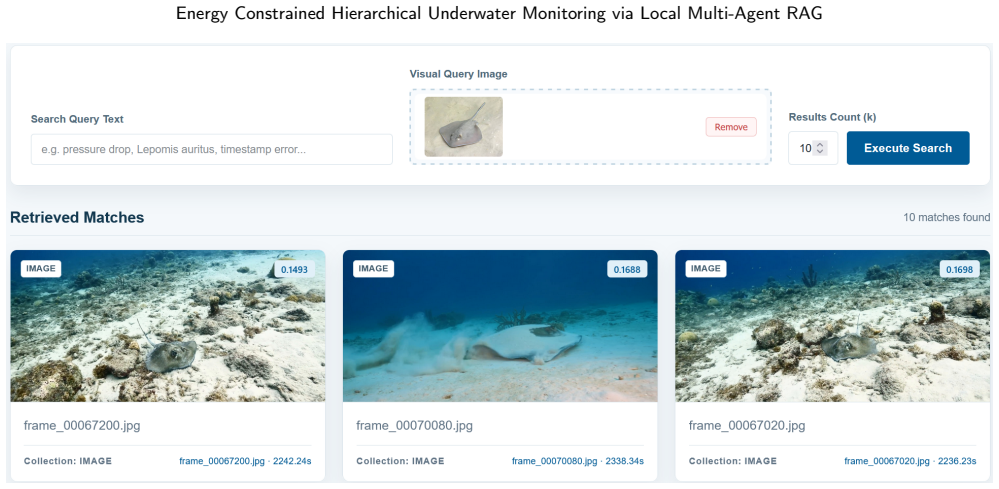
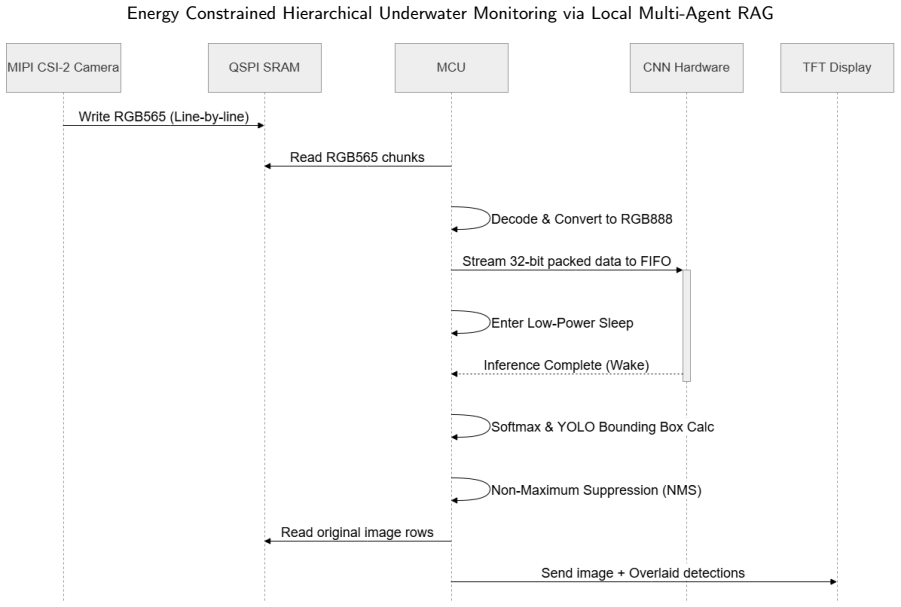
A hierarchical energy-aware architecture that keeps MAX78000/MAX78002 visual and acoustic sentinels always on and activates a Jetson Orin NX only for scheduled, event-driven, or interactive work can run a fully local multimodal pipeline—embedding, adaptive species identification, multi-agent RAG, and reporting—thereby producing researcher-ready knowledge while cutting energy use and communication volume relative to continuous high-performance sensing and raw-data uplink.
What carries the argument
The hierarchical master–satellite cascade: always-on microcontroller sentinels filter events; a selectively powered Jetson runs BioCLIP/OpenCLIP embeddings, a dedicated identification layer (centroids plus SVMs in embedding space), local ChromaDB collections, and a LangChain multi-agent controller (router, analyst, energy, hardware, reporting) that grounds answers and reports in indexed mission and taxonomic data.
Load-bearing premise
That sentinel accuracy and confidence thresholds will keep Jetson wake-ups rare enough, and that the measured per-block energy model with assumed daily frequencies will translate into multi-month battery life under real turbidity, fouling, and noise.
What would settle it
A closed-loop multi-month battery deployment that logs actual sentinel false-positive and true-event rates, realized Jetson daily energy against the block model, and whether the local reports remain taxonomically usable under field imaging and acoustic conditions.
If this is right
- Remote stations can store and later uplink compact embeddings and Markdown summaries instead of raw video and audio.
- Reference collections can be swapped per mission (invasive species, benthos, mammals) without retraining the backbone encoders.
- Three modes—autonomous batch, event-driven hybrid, and researcher-interactive—can share one hardware stack across long deployments and field visits.
- Energy and hardware agents can retune FPS, wake thresholds, and microcontroller model binaries from remaining battery and mission priorities.
- The same cascade pattern extends to ROV/AUV payloads and solar buoys that need edge interpretation under power limits.
Where Pith is reading between the lines
- If wake rates stay low in the field, the architecture becomes a template for other bandwidth-starved domains (glacier cams, forest acoustics) that need local RAG without always-on GPUs.
- Cross-dataset species drops on real-condition sets like OzFish imply that reference curation and hierarchical fallback matter as much as the cascade itself for trustworthy edge labels.
- A projector that feeds stored CLIP vectors straight into a small local LLM, as the authors sketch in future work, would further cut the cost of report generation once the identification layer is trusted.
Editorial analysis
A structured set of objections, weighed in public.
Referee Report
Summary. The manuscript presents a hierarchical underwater monitoring architecture in which always-on MAX78000 (acoustic) and MAX78002 (visual) microcontroller "sentinels" perform first-stage detection and selectively wake a Jetson Orin NX that runs a fully local multimodal pipeline: Grounding DINO/YOLO-World localization, BioCLIP-2/OpenCLIP embedding into ChromaDB, a centroid+SVM species identification layer over five taxonomic reference collections, a LangChain multi-agent framework (Router, Analyst, Energy/Sensor, Model Deployment, Reporting), and Markdown report generation for low-bandwidth uplink. Three operating modes (batch, event-driven, interactive) are supported by a hardware wake/power-hold circuit. Evaluation covers sentinel accuracy (visual mAP@50 70.75–78.4% on filtered FishDet-M; acoustic ~99% accuracy on a 13-class Watkins/DeepShip task), cross- and intra-dataset taxonomic identification (Tables 5–6), and block-wise measured energy consumption on both tiers (Tables 7–9), with a block-additive daily energy model (Eqs. 18–20).
Significance. If the claims are scoped to what is demonstrated, this is a useful and honest systems contribution: the hierarchical MAX78000/MAX78002-plus-Jetson design with a working hardware wake/hold circuit (Fig. 4) is a credible pattern for long-duration underwater stations; the sentinel metrics on external benchmarks (Table 4), the nine-block instrumented energy characterization (Tables 7–9), and the taxonomic evaluation against a deliberately held-out real-world set (OzFish) are concrete, reproducible artifacts. Notably, the paper reports its own negative cross-domain result (Table 5) rather than hiding it, which is to the authors' credit — but they must also draw the consequences of it in the claims and discussion. The work is an architecture/feasibility study rather than a validated deployment, and publication is warranted once the presentation matches that status.
major comments (4)
- [§6.3, Table 5] Table 5 (OzFish column) vs. §1/§4.3.4/abstract: on the only real in-situ evaluation set, the identification layer collapses — species Top-1 is 0.7–4.2% (Top-5 ≤ 8.2%) for every reference collection, and the hierarchical fallback the paper relies on (§4.3.4: 'a broader taxonomic label is retained instead of forcing an unreliable species assignment') also fails: family Top-1 is only 13.4–16.7% and genus ≤ 13.9%. Since §4.3.3 stores these species hypotheses as metadata and §4.3.5 groups retrieval by 'reliable' BioCLIP scores, the downstream RAG layer grounds its reports on labels that are wrong at species level ~96% of the time under deployment-realistic conditions. This directly undercuts the 'researcher-ready structured knowledge' claim (abstract, §1) and the 'dedicated species identification layer' contribution. Yet §7 (Discussion) never mentions Table 5's OzFish results. The authors sho
- [§6.3.1, Eqs. (18)–(20)] Eqs. (18)–(20) and Table 9: the energy-saving half of the central claim is never instantiated. The paper decomposes Jetson operation into nine measured blocks but never computes E_total for any concrete scenario — the daily frequencies n_i / λ_event are left 'hypothetical', and no comparison against an always-on Jetson baseline (the quantity the architecture exists to reduce) is given anywhere. Moreover, the assumption under Eq. (20) that 'the time between operations is negligible' is questionable given the paper's own Table 9: sentinel-data transfer takes 136 s for only 1 MB at 115200 baud (0.26 Wh, the second-largest block), so for a day of accumulated detections the transfer block could dominate and the inter-block idle gaps are not obviously negligible. A worked end-to-end example — e.g., one daily wake cycle with a stated detection volume, total Wh/day for each of the three modes ve
- [§3.2, §6.2, Table 4] Table 4, acoustic row: the reported 98.99% accuracy / 96.4% F1 carries a correctness risk from the split protocol. §3.2 states a 70/20/10 split of the aggregated dataset, but does not say whether the split is at the recording-file/session level or at the 0.98 s window level. If windows from the same Watkins recording appear in both train and test, the figure is inflated by near-duplicate leakage. In addition, the Noise class is built from DeepShip (ship recordings) plus synthetic board noise — not ambient ocean sound — so the model's ability to reject real underwater backgrounds (the property that determines false Jetson wake-ups in Hybrid Mode, §4.4.3) is untested. Concrete fixes: state the split granularity; re-evaluate with sessions held out; and report a false-accept rate on a held-out ambient-noise corpus, since this number, not clean-test accuracy, drives the event-driven energy bu
- [§6.3 (agentic evaluation)] The multi-agent control framework — a title contribution with five agents (§4.4) — is evaluated only by qualitative 'functional validation' (§6.3). The only quantitative statements are anecdotal (Qwen3.5-4B 'frequently required up to eight iterations'; Ornith-9B correct 'on the first iteration in most cases'), with no task suite, sample sizes, routing-accuracy numbers, or report-quality checks. The authors are candid about this limitation, which counts in their favor, but for a cs.IR venue the retrieval/routing layer in particular needs some measurable evaluation: even a small fixed query set (e.g., 30–50 researcher queries spanning the four retrieval modalities and the analytical fast path) with routing accuracy, answer groundedness against cited sources, and Analyst execution success rate would make this contribution assessable rather than asserted.
minor comments (8)
- [Table 5] Table 5 lacks confidence intervals or per-cell sample counts. OzFish has only 1,903 images across 198 species; species-level Top-1 of 3.2% vs 4.2% may be within noise. Please report binomial CIs or per-class support.
- [Table 9] Table 9, block 2: the transfer workload (1 MB, 32 audio files) seems unrepresentative of a full day of visual sentinel detections; please state expected daily data volume per sentinel and scale the block accordingly in any scenario calculation.
- [§4.4.2, §6.3] The models Qwen3.5-4B and Ornith-9B are introduced without citation, version, or quantization details. 'Ornith-9B' in particular is not identifiable from the text; reproducibility requires exact model identifiers and Ollama/quantization configurations.
- [§4.3.5] Key configuration choices are stated but not ablated or justified: τ_g = 0.86 (Eq. 17), the 6:4 visual:textual retrieval mix, the 4000-character context cap, and the top-N crop retention. A brief sensitivity note would suffice.
- [Table 7] Table 7 header has a formatting error ('FPS ms' appears as merged/duplicated column labels); also clarify that FPS and latency are separate columns.
- [Various] Typos and wording: 'mentionned' (§4.1), 'severals months' (§1), 'Rasberry Pi' (§2.1), 'specie identification' (Fig. 5 caption and §4.2.3 — should be 'species'). Figure 5's caption says it shows five taxonomic levels while §4.3.4 says it displays class level only; please reconcile.
- [§6.2] The visual sentinel's mAP@50 (70.75–78.4%) is measured on FishDet-M filtered to ≤5 boxes per image; please note explicitly in §6.2 that this is an easier subset than the full benchmark (Table 1 shows the filtering removes ~60% of instances), so readers do not compare these numbers to full-FishDet-M results.
- [End of manuscript] No code, model, or data availability statement is given. Given the engineering nature of the contribution, releasing the block-measurement scripts, the wake-circuit schematic details, and the reference-collection index manifests would substantially increase the paper's value.
Circularity Check
No significant circularity: engineering system evaluated on external datasets and measured hardware energy blocks, not a self-referential derivation.
full rationale
This paper proposes and characterizes a hierarchical underwater monitoring architecture (MAX78000/02 sentinels + selectively woken Jetson Orin NX with local multimodal RAG). Its load-bearing claims are empirical and architectural: sentinel mAP/accuracy on FishDet-M, Watkins, and DeepShip; cross- and intra-dataset taxonomic identification on FishBase, WildFish++, Fish-Vista, FishNet, BioTrove, OzFish; and discrete Wh measurements of boot, transfer, indexing, RAG, and shutdown blocks. The energy model (Eqs. 18–20) is ordinary additive accounting—E_total = E_sentinel + Σ n_i E_b_i—with n_i left as mode-dependent or hypothetical frequencies, not fitted then re-presented as independent predictions. Configuration choices (τ_g = 0.86, 6:4 visual/text retrieval mix, confidence thresholds) are stated as deployment parameters, not derived uniqueness results. The sole self-citation to prior Lionfish/Raspberry Pi work is background related work and is not used to force the architecture or forbid alternatives. There is no self-definitional loop, no fitted-input-called-prediction, no load-bearing uniqueness import, and no renaming of a known law as a new derivation. Poor OzFish species Top-1 in Table 5 is a correctness/generalization failure, not circularity. Score 0 is appropriate.
Axiom & Free-Parameter Ledger
free parameters (5)
- Visual grouping similarity threshold τ_g =
0.86
- Retrieval mix and context caps (6 visual / 4 textual; max 4 images; 4000-char text) =
6:4 top-10; 4000 chars; 4 images
- Species/centroid/SVM decision thresholds and top-N crop retention =
configurable (not fixed globally)
- Hypothetical daily block frequencies n_i / λ_event and duty interval Δt =
scenario-dependent
- QAT start epochs and train filters (≤5 boxes/image; 12 mammal species + noise) =
QAT from epoch 73 (vision) / 37 (audio); ≤5 fish/image
axioms (5)
- domain assumption Continuous high-performance GPU sensing is incompatible with multi-month battery underwater deployments, so hierarchical sentinel→master activation is required.
- domain assumption Frozen BioCLIP-2/OpenCLIP embedding space plus centroids/linear SVMs yields usable hierarchical taxonomic hypotheses without per-mission backbone retraining.
- domain assumption MAX78000/02 CNN accelerator op-set and memory map constrain deployable sentinel models to supported conv/pool patterns and quantization.
- ad hoc to paper Block-additive energy model E_total = E_sentinel + Σ n_i E_b_i with negligible idle gaps adequately predicts mission energy.
- ad hoc to paper Sandboxed LLM-generated Pandas code and local instruct models (Qwen3.5-4B / Ornith-9B) are reliable enough for analyst and reporting paths on-device.
invented entities (2)
-
Unified multi-agent control layer (Router, Analyst, Energy/Sensor, Dynamic Model Deployment, Reporting agents)
no independent evidence
-
Detection-aware local multimodal pipeline (Grounding DINO/YOLO-World crops → BioCLIP index → centroid/SVM ID → ChromaDB RAG)
independent evidence
read the original abstract
Marine life monitoring is limited by strict energy constraints, poor underwater connectivity, and the high cost of transmitting raw multimodal data from remote deployments. This paper proposes a low-consumption underwater monitoring architecture that combines always-on edge sensing with selective high-performance local reasoning. The system follows a hierarchical master--satellite design in which ultra-low-power MAX78000/MAX78002 microcontrollers continuously monitor visual and acoustic signals, while an NVIDIA Jetson Orin NX is activated only for scheduled processing, event-driven analysis, or researcher interaction. Once active, the Jetson executes a fully local multimodal pipeline for data ingestion, visual target extraction, embedding-based indexing, species identification, retrieval-augmented reasoning, and automated reporting. BioCLIP/OpenCLIP embeddings are used to organize mission data, marine taxonomic references, scientific documents, and operational metadata in local ChromaDB collections. A dedicated identification layer combines visual similarity search, centroid-based classification, and supervised classifiers to support adaptive species recognition. A LangChain-based multi-agent framework coordinates query routing, structured analysis, energy management, hardware reconfiguration, and report generation. The architecture is evaluated through visual and acoustic monitoring case studies. The proposed system bridges ultra-low-power continuous sensing with local multimodal intelligence, enabling underwater stations to produce structured, researcher-ready knowledge while compressing local data for flexible acoustic, optical, or satellite transmission, minimizing both energy use and communication overhead.
Figures





Reference graph
Works this paper leans on
-
[1]
Abujabal, M., Saoud, L.S., Hussain, I., 2025. Fishdet-m: A unified large-scalebenchmarkforrobustfishdetectionandclip-guidedmodel selectionindiverseaquaticvisualdomains. doi:10.48550/arXiv.2507. 17859,arXiv:2507.17859
work page internal anchor Pith review Pith/arXiv arXiv doi:10.48550/arxiv.2507.17859 2025
-
[2]
Aquaticclip: A vision-language foundation modelforunderwatersceneanalysis
Alawode, B., Ganapathi, I.I., Javed, S., Werghi, N., Bennamoun, M., Mahmood, A., 2025. Aquaticclip: A vision-language foundation modelforunderwatersceneanalysis. doi:10.48550/arXiv.2502.01785, arXiv:2502.01785
-
[3]
MAX78002: Artificial Intelligence Micro- controller with Low-Power Convolutional Neural Network Accel- erator
Analog Devices, 2022a. MAX78002: Artificial Intelligence Micro- controller with Low-Power Convolutional Neural Network Accel- erator. Analog Devices. URL:https://www.analog.com/media/en/ technical-documentation/data-sheets/max78002.pdf. data sheet
-
[4]
MAX78002 Artificial Intelligence Micro- controller with Low-Power Convolutional Neural Network Acceler- ator Data Sheet
Analog Devices, 2022b. MAX78002 Artificial Intelligence Micro- controller with Low-Power Convolutional Neural Network Acceler- ator Data Sheet. Technical Report. Analog Devices, Inc. URL: https://www.analog.com/en/products/max78002.html
-
[5]
OzFish Dataset - Machine Learning Dataset for Baited Remote Underwater Video Stations
Australian Institute of Marine Science, 2020. OzFish Dataset - Machine Learning Dataset for Baited Remote Underwater Video Stations. Available online:https://github.com/open-AIMS/ozfish. doi:10.25845/5E28F062C5097. accessed: June 2026
-
[6]
Real-time reporting of baleen whale passive acoustic detections from ocean gliders
Baumgartner,M.F.,Fratantoni,D.M.,Hurst,T.P.,Brown,M.W.,Cole, T.V.N., Van Parijs, S.M., Johnson, M., 2013. Real-time reporting of baleen whale passive acoustic detections from ocean gliders. The JournaloftheAcousticalSocietyofAmerica134,1814–1823.doi:10. 1121/1.4816406
2013
-
[7]
Yolo- world: Real-time open-vocabulary object detection
Cheng,T.,Song,L.,Ge,Y.,Liu,W.,Wang,X.,Shan,Y.,2024. Yolo- world: Real-time open-vocabulary object detection. doi:10.48550/ arXiv.2401.17270,arXiv:2401.17270
-
[8]
FishBase
Froese, R., Pauly, D., 2024. FishBase. World Wide Web electronic publication. URL:https://www.fishbase.org. accessed: June 2026
2024
-
[9]
Gong, Z., Wang, A.T., Huo, X., Haurum, J.B., Lowe, S.C., Taylor, G.W., Chang, A.X., 2025. CLIBD: Bridging vision and genomics forbiodiversitymonitoringatscale,in:ProceedingsoftheThirteenth InternationalConferenceonLearningRepresentations. doi:10.48550/ arXiv.2405.17537
-
[10]
Radio-triggered wake-up for wireless sensor networks
Gu, L., Stankovic, J.A., 2005. Radio-triggered wake-up for wireless sensor networks. Real-Time Systems 29, 157–182. doi:10.1007/ s11241-005-6883-z
2005
-
[11]
Irfan, M., Jiangbin, Z., Ali, S., Iqbal, M., Masood, Z., Hamid, U.,
-
[12]
Khan, F.F., Li, X., Temple, A.J., Elhoseiny, M., 2023. Fishnet: A large-scale dataset and benchmark for fish recognition, detection, and functional trait prediction, in: 2023 IEEE/CVF International Conference on Computer Vision (ICCV), pp. 20439–20449. doi:10. 1109/ICCV51070.2023.01874
arXiv 2023
-
[13]
Syrene:Anunderwater embeddedartificialintelligencecameraforinvasivefaunamonitoring
Laurent,G.,Barbot,S.,LeVourc’h,D.,2025. Syrene:Anunderwater embeddedartificialintelligencecameraforinvasivefaunamonitoring. Marine Technology Reporter Magazine 68, 40–42. URL:https: //archimer.ifremer.fr/doc/00992/110327/
2025
-
[14]
doi:10.48550/arXiv.2007.10319, arXiv:2007.10319
Lin,J.,Chen,W.M.,Lin,Y.,Cohn,J.,Gan,C.,Han,S.,2020.Mcunet: Tiny deep learning on iot devices. doi:10.48550/arXiv.2007.10319, arXiv:2007.10319
-
[15]
Liu,S.,Zeng,Z.,Ren,T.,Li,F.,Zhang,H.,Yang,J.,Jiang,Q.,Li,C., Yang,J.,Su,H.,Zhu,J.,Zhang,L.,2024. Groundingdino:Marrying dino with grounded pre-training for open-set object detection, in: Computer Vision – ECCV 2024: 18th European Conference, Mi- lan, Italy, September 29–October 4, 2024, Proceedings, Part XLVII, Springer-Verlag, Berlin, Heidelberg. p. 38–5...
-
[16]
Mehrab, K.S., Maruf, M., Daw, A., Neog, A., Manogaran, H.B., Khurana, M., Feng, Z., Altintas, B., Bakis, Y., Campolongo, E.G., Thompson, M.J., Wang, X., Lapp, H., Berger-Wolf, T., Mabee, P., Bart, H., Chao, W.L., Dahdul, W.M., Karpatne, A., 2025. Fish-vista: A multi-purpose dataset for understanding & identification of traits from images, in: 2025 IEEE/CV...
arXiv 2025
-
[17]
Mekonnen, T., Harjula, E., Koskela, T., Ylianttila, M., 2017. sleepy- cam: Power management mechanism for wireless video-surveillance cameras,in:2017IEEEInternationalConferenceonCommunications Workshops (ICC Workshops), pp. 91–96. doi:10.1109/ICCW.2017. 7962639
-
[18]
Millar, J., Huang, Y., Sethi, S., Haddadi, H., Madhavapeddy, A.,
-
[20]
Moosmann, J., Giordano, M., Vogt, C., Magno, M., 2023b. Tinyis- simoYOLO: A quantized, low-memory footprint, TinyML object detection network for low power microcontrollers, in: 2023 IEEE Mohamed Amine JANATI et al.:Preprint submitted to ElsevierPage 24 of 25 Energy Constrained Hierarchical Underwater Monitoring via Local Multi-Agent RAG 5th International ...
arXiv 2023
-
[21]
Flexible and fully quantized lightweight TinyissimoYOLO for ultra-low-power edge systems
Moosmann, J., Müller, H., Zimmerman, N., Rutishauser, G., Benini, L., Magno, M., 2024. Flexible and fully quantized lightweight TinyissimoYOLO for ultra-low-power edge systems. IEEE Access 12, 75093–75107. doi:10.1109/ACCESS.2024.3404878
arXiv 2024
-
[22]
Mots’oehli, M., Nikolaev, A., IGede, W.B., Lynham, J., Mous, P.J., Sadowski, P., 2024. Fishnet: Deep neural networks for low-cost fish stock estimation, in: 2024 IEEE International Conference on Omni- layer Intelligent Systems (COINS), IEEE. pp. 1–7. doi:10.1109/ coins61597.2024.10622134
arXiv 2024
-
[23]
Automated species classification and counting by deep-sea mobile crawler platforms using YOLO
Ortenzi, L., Aguzzi, J., Costa, C., Marini, S., D’Agostino, D., Thom- sen, L., De Leo, F.C., Correa, P.V., Chatzievangelou, D., 2024. Automated species classification and counting by deep-sea mobile crawler platforms using YOLO. Ecological Informatics 82, 102788. doi:10.1016/j.ecoinf.2024.102788
arXiv 2024
-
[24]
AntPi: A raspberry pi based edge-cloud system for real-time ant species detection using YOLO
Palazzetti,L.,Giannetti,D.,Verolino,A.,Grasso,D.A.,Pinotti,C.M., Betti Sorbelli, F., 2025. AntPi: A raspberry pi based edge-cloud system for real-time ant species detection using YOLO. Ecological Informatics 91, 103383. doi:10.1016/j.ecoinf.2025.103383
arXiv 2025
-
[25]
SeaLifeBase
Palomares, M.L.D., Pauly, D., 2024. SeaLifeBase. World Wide Web electronicpublication. URL:https://www.sealifebase.org.accessed: June 2026
2024
-
[26]
Learning transferable visual models from nat- ural language supervision, in: Proceedings of the 38th International Conference on Machine Learning, PMLR
Radford, A., Kim, J.W., Hallacy, C., Ramesh, A., Goh, G., Agar- wal, S., Sastry, G., Askell, A., Mishkin, P., Clark, J., Krueger, G., Sutskever, I., 2021. Learning transferable visual models from nat- ural language supervision, in: Proceedings of the 38th International Conference on Machine Learning, PMLR. pp. 8748–8763
2021
-
[27]
A review on tinyml: State-of-the-art and prospects
Ray, P.P., 2022. A review on tinyml: State-of-the-art and prospects. Journal of King Saud University - Computer and Information Sci- ences 34, 1595–1623. doi:10.1016/j.jksuci.2021.11.019
-
[28]
FMRAG: Retrieval-augmented multimodallargelanguagemodelsforfisheriesintelligence
Song, Y., Lv, C., Zhu, K., 2026. FMRAG: Retrieval-augmented multimodallargelanguagemodelsforfisheriesintelligence. Frontiers in Marine Science 13, 1801835. doi:10.3389/fmars.2026.1801835
arXiv 2026
-
[29]
BioCLIP: A Vision Foundation Model for the Tree of Life
Stevens,S.,Wu,J.,Thompson,M.J.,Campolongo,E.G.,Song,C.H., Carlyn, D.E., Dong, L., Dahdul, W.M., Stewart, C., Berger-Wolf, T., Chao, W.L., Su, Y., 2024. BioCLIP: A vision foundation model for the tree of life, in: Proceedings of the IEEE/CVF Conference on Computer Vision and Pattern Recognition (CVPR). doi:10.48550/ arXiv.2311.18803
work page internal anchor Pith review Pith/arXiv arXiv doi:10.48550/arxiv.2311.18803 2024
-
[30]
Velasco-Montero, D., Fernández-Berni, J., Carmona-Galán, R., San- glas, A., Palomares, F., 2024. Reliable and efficient integration of AI into camera traps for smart wildlife monitoring based on continual learning. Ecological Informatics 83, 102815. doi:10.1016/j.ecoinf. 2024.102815
arXiv 2024
-
[31]
SOUND Database of Marine Animal Vocalizations: Structure and Operations
Watkins, W.A., Fristrup, K., Daher, M.A., Howald, T.J., 1992. SOUND Database of Marine Animal Vocalizations: Structure and Operations. Technical Report. Woods Hole Oceanographic Institu- tion. doi:10.1575/1912/854
-
[32]
BioTrove: A Large Curated Image Dataset Enabling AI for Biodiversity
Yang, C.H., Feuer, B., Jubery, Z., Deng, Z.K., Nakkab, A., Hasan, M.Z.,Chiranjeevi,S.,Marshall,K.,Baishnab,N.,Singh,A.K.,Singh, A., Sarkar, S., Merchant, N., Hegde, C., Ganapathysubramanian, B., 2024. Biotrove: A large curated image dataset enabling ai for biodiversity. arXiv preprint arXiv:2406.17720 doi:10.48550/arXiv. 2406.17720
work page internal anchor Pith review Pith/arXiv arXiv doi:10.48550/arxiv.2406.17720 2024
-
[33]
Wildfish++:Acomprehensive fish benchmark for multimedia research
Zhuang,P.,Wang,Y.,Qiao,Y.,2021. Wildfish++:Acomprehensive fish benchmark for multimedia research. IEEE Transactions on Multimedia 23, 3603–3617. doi:10.1109/TMM.2020.3028482. Mohamed Amine JANATI et al.:Preprint submitted to ElsevierPage 25 of 25
arXiv 2021
-
[2021]
Expert Systems with Applications 183, 115270
Deepship: An underwater acoustic benchmark dataset and a separable convolution based autoencoder for classification. Expert Systems with Applications 183, 115270. doi:10.1016/j.eswa.2021. 115270
-
[2025]
Benchmarking ultra-low-power𝜇npus. doi:10.48550/arXiv. 2503.22567,arXiv:2503.22567
discussion (0)
Sign in with ORCID, Apple, or X to comment. Anyone can read and Pith papers without signing in.