REVIEW 3 major objections 4 minor 67 references
Divide-Then-Rule: A Cluster-Driven Hierarchical Interpolator for Attribute-Missing Graphs
T0 review · 3 major / 4 minor · reviewed 2026-08-06 · deepseek-v4-flash
Pith's one-line read A three-stage cluster-aware imputer repairs missing node attributes and lifts clustering accuracy on every dataset and method tested.
desk verdict Useful plug-and-play imputation for attribute-missing graphs, but the homophily premise is assumed rather than proven and the clustering comparisons omit existing imputation baselines. read the letter →
The pith
A machine-rendered reading of the paper's core claim, the machinery that carries it, and where it could break.
The reading
What carries the argument
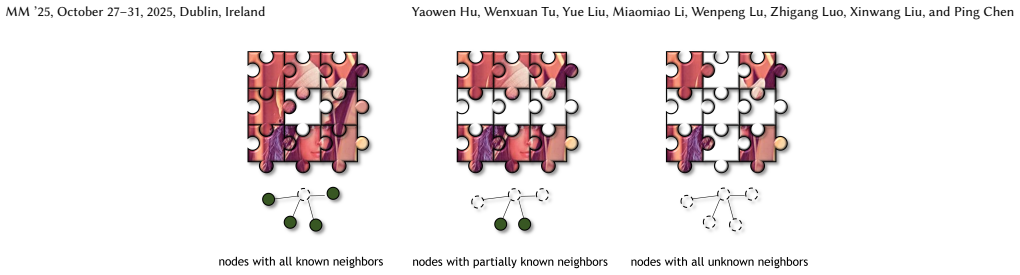
The machinery is a three-stage imputation pipeline built around a 'divide then rule' ordering. DCFP (Dynamic Cluster-Aware Feature Propagation) propagates features with adjacency weights that are periodically updated from k-means labels, multiplying intra-cluster edges by $\alpha$ > 1 and inter-cluster edges by $\beta$ < 1. HNAI (Hierarchical Neighborhood-Aware Imputation) divides missing nodes into three classes according to 1-hop neighborhood completeness and imputes them in order: all-known neighbors first, partially-known next, all-unknown last; Proposition 1 justifies treating the first class as attribute-complete because its imputed features lie in a convex hull of observed neighbor features, and the Intra-cluster Reinforcement and Inter-cluster Correction strategies decide whether a partially-known node is promoted or adjusted with an exponential moving average. HRE (Hop-wise Representation Enhancement) forms the final representation as the concatenation [H, AH, ..., A^K H] over propagation hops. The whole argument turns on these stages converting completed nodes into new knowledge that makes the next, harder class of nodes imputable.
What would settle it
Take a graph in which most edges connect nodes from different clusters, remove all attributes from 60 percent of the nodes, run DTRGC, and compare the clustering accuracy against the same deep clustering method without imputation; if accuracy fails to improve or drops, the homophily assumption behind the promotion and correction strategies is falsified for that regime.
Extended reading notes
Core claim
The central claim is that DTRGC, as a plug-and-play imputation module, makes deep graph clustering on attribute-missing graphs markedly better by exploiting both cluster structure and the varying completeness of node neighborhoods. DCFP initializes missing attributes through feature propagation whose edge weights are periodically reweighted from k-means clusters, strengthening propagation inside clusters and suppressing it across clusters. HNAI then classifies missing nodes into three groups by whether all, some, or none of their 1-hop neighbors are attribute-complete, imputes the well-supported groups first, and uses cluster-consistency checks to promote reliable imputations to 'complete' status or correct them with exponential moving averages. HRE concatenates features from multiple propagation hops so downstream methods see multi-scale context. The paper reports consistent accuracy, NMI, ARI, and F1 gains across six datasets, and its ablation shows the first two stages work synergistically, with joint gains exceeding the sum of individual contributions.
Load-bearing premise
The whole scheme depends on the assumption that neighboring nodes in a graph usually belong to the same cluster, so reconstructing a missing node as a blend of its neighbors' attributes points toward the correct cluster.
Editorial extensions
If this is right
- Any deep graph clustering method can be prefixed with DTRGC and gain accuracy on attribute-missing graphs; all six tested methods improved on all six benchmark datasets.
- Ordering imputation by neighborhood informativeness shrinks the hardest class of nodes over iterations, so even groups of all-missing nodes gradually receive reliable information and clustering quality improves.
- DTRGC is a one-time preprocessing step with roughly linear time and memory cost in the number of nodes and edges, so the accuracy gain does not demand a large compute budget.
- The same preprocessing transfers to semi-supervised node classification at a 99.5 percent missing rate, matching or exceeding dedicated imputation baselines on several datasets.
Reading between the lines
- A testable extension not covered in the paper: on heterophilic graphs, where edges mostly connect different clusters, the promotion step based on cluster agreement should be gated by a local homophily estimate; otherwise imputed features may be pulled toward the wrong cluster centroid.
- The cluster-conditioned reweighting of edges is effectively a graph-rewiring step driven by current cluster labels, which suggests DTRGC could be combined with structure-learning tools for graphs whose cluster structure is initially weak.
- All three stages are parameter-free, so nothing prevents running the whole loop repeatedly with progressively better clusters; the paper alternates imputation and clustering in DCFP but leaves a fully joint, end-to-end version unexplored.
Editorial analysis
A structured set of objections, weighed in public.
Referee Report
Summary. The paper proposes DTRGC, a plug-and-play preprocessing module for attribute-missing graphs. DTRGC has three stages: DCFP, which initializes missing features via feature propagation and periodically reweights edges according to k-means clusters on the currently imputed features; HNAI, which classifies missing nodes into three groups by 1-hop neighborhood completeness and applies category-specific imputation, including promotion to the complete set and EMA corrections toward neighbors; and HRE, which concatenates multi-hop propagated representations. The method is evaluated by feeding the completed features into six deep graph clustering backbones on six datasets at a 60% node-missing rate, by ablations on AMGC, and by semi-supervised node classification at a 0.995 missing rate. The paper reports consistent improvements across backbones and datasets, with standard deviations over 10 runs.
Significance. If the central claim holds, DTRGC is a practically relevant contribution: it is a nonparametric, preprocessing-only method with linear claimed complexity, and it improves multiple deep graph clustering backbones under a realistic missing-attribute setting. The paper provides useful empirical evidence in the form of 10-run statistics, a full ablation of all three components, t-SNE visualizations, and an additional node-classification comparison. However, the load-bearing homophily premise is assumed rather than established, the clustering experiments do not compare against the existing plug-and-play imputation baselines FP and PCFI, and the cluster-aware reweighting introduces a feedback loop whose effect on the reported gains is not isolated. These issues are addressable with additional experiments and clarification, so the result is plausible but not yet fully supported.
major comments (3)
- [Section 3.2.2, Proposition 1 and Eqs. (5)-(7)] The homophily premise is load-bearing but is assumed, not derived. Proposition 1's proof shows only that the imputed feature x_i is a non-negative linear combination of its neighbors' features, and, if the weights are row-normalized, lies in their convex hull. It does not establish that those neighbors belong to the same cluster; the concluding sentence that the imputed node 'correctly reflects its position within the cluster structure' is exactly the homophily assumption. IRS in Eq. (6) and ICS in Eq. (7) depend on the same premise. All six clustering datasets (Cora, Citeseer, PubMed, Amap, Co.CS, Co.Physics) are standard homophilic benchmarks, so the regime in which the premise fails, namely heterophilic graphs or nodes near cluster boundaries, is never tested. Please either prove the premise under stated conditions or add experiments that vary homophily (for example, a heterophilic dataset such as Wisconsin or Chameleon, or synthetic graphs with adjustable homophily) and report performance separately for boundary nodes.
- [Section 4.2, Table 1] The central claim that DTRGC improves clustering beyond existing imputation methods is not directly tested. Table 1 compares each DGC method with and without DTRGC, but it does not include FP or PCFI as alternate pre-imputation modules feeding the same DGC backbones, even though Section 2.2 identifies these as the relevant plug-and-play imputation baselines. As a result, the reported gains cannot separate the cluster-aware and hierarchical components of DTRGC from generic feature propagation, and the claim that DTRGC is a superior plug-and-play imputation module for clustering is not yet supported by the evidence. I ask for an additional comparison table with FP- and PCFI-imputed features passed into the same six backbones under the same 0.6 missing-rate protocol.
- [Section 3.2.1, Eq. (2) and Table 2] The DCFP stage has a potential feedback loop that should be quantified. Eq. (2) reweights edges according to k-means clusters computed on the currently imputed feature matrix, and the downstream evaluation measures clustering agreement on those same features. This couples the imputation procedure with the evaluation criterion, so part of the apparent gain in Table 2 may reflect the injection of the k-means partition into the features rather than an improvement in feature quality. A control experiment would strengthen the claim: for example, reweight the adjacency with a fixed partition obtained once from attribute-complete nodes only, or with a random partition, and report how much of the DCFP gain remains. This would clarify that the cluster-aware weighting is helping through better imputation rather than through circular reinforcement.
minor comments (4)
- [Algorithm 1] Several equation references in Algorithm 1 are inconsistent with the numbering in the text: line 5 should reference Eq. (2), line 9 should reference Eq. (3), and lines 12-13 and 17 should reference Eqs. (6), (7), and (11) respectively; please correct these.
- [Section 3.2.2 and Eq. (3)] The notation for the three neighborhood categories is inconsistent. Eq. (3) uses \bar V_m for the all-known-neighbors class, while the surrounding text and Algorithm 1 use \hat V_m for both the all-known and all-unknown classes. Please unify the notation, since the distinction between the two classes is central to the hierarchical imputation.
- [Section 4.1 and Table 3] The values of the hyperparameters \alpha, \beta, \gamma, T, K, F_max, and I_max are not reported, and no sensitivity analysis is provided. Since DTRGC is proposed as a general-purpose imputation module, specifying these values and their stability is important for reproducibility.
- [Table 1] Table 1 has several formatting problems: PubMed rows are misaligned, Co.Physics has missing entries for some methods, and the Citeseer ARI value '31.471±1.51' appears to contain a typo. Please reformat the table to match the reported mean±std convention used elsewhere.
Circularity Check
No significant circularity: DCFP's cluster-reinforcement loop is a heuristic, not a definitional reduction; the only self-citation (AMGC as ablation baseline) is not load-bearing because the headline gains also hold on five external DGC methods.
full rationale
DTRGC is a preprocessing imputation module with no parameters fitted to downstream cluster labels, so the main claim (improved clustering after imputation) is an empirical result, not a formal reduction. The strongest candidate for circularity is DCFP, which runs k-means on the current imputed features and then reweights edges (Eq. 2) to reinforce those clusters; however, the cluster assignments are derived from corrupted zero-padded features, the downstream DGC methods are independent algorithms, and the evaluation measures accuracy against ground-truth labels rather than the internal k-means partition, so the loop is a self-reinforcing heuristic rather than an equation-level equivalence. Proposition 1's proof only establishes that an imputed feature lies in the convex hull of its neighbors; the further conclusion that the node therefore lies in its neighbors' cluster imports the homophily assumption explicitly stated in the text ("Based on the homogeneity assumption"). This is an unsupported inference and a robustness risk on heterophilic graphs, but it is an assumption, not a circular definition. The ablation baseline AMGC (ref. [33]) is authored by members of the present team, and the ablation study uses it exclusively; however, the paper's central improvement claim is also demonstrated on GDCL, AGCN, AGC-DRR, HSAN, and CCGC, which are external methods, and the node-classification comparison uses external baselines (PCFI, FP, GCNMF, PaGNN). The self-citation is therefore real but not load-bearing for the paper's main conclusion. Overall, no step of the derivation reduces to its own input by construction, so the paper is not significantly circular; score 2 reflects only the minor, non-load-bearing self-citation in the ablation.
Assumptions & free parameters
free parameters (6)
- alpha (intra-cluster edge weight multiplier) =
not reported (>1)
- beta (inter-cluster edge weight multiplier) =
not reported (<1)
- gamma (EMA smoothing coefficient) =
not reported
- T (reclustering period in DCFP) =
40
- K (number of clusters and HRE hop count) =
dataset class count
- Fmax and Imax (maximum epochs for DCFP and HNAI) =
not specified
assumptions (4)
- domain assumption Neighboring nodes tend to belong to the same cluster (homophily).
- domain assumption K-means clusters computed on the current imputed features are a valid proxy for the true cluster structure.
- standard math Feature propagation converges within T=40 iterations, as shown by Rossi et al. [28].
- domain assumption A missing node's imputed feature lying in the convex hull of its complete neighbors is sufficient to treat it as cluster-compatible.
Cite this review
Pith. "Pith review of Divide-Then-Rule: A Cluster-Driven Hierarchical Interpolator for Attribute-Missing Graphs." pith.science (2026). https://pith.science/paper/AYIJYHTY
@misc{pith2026250710595,
  author       = {Pith},
  title        = {Pith review of: Divide-Then-Rule: A Cluster-Driven Hierarchical Interpolator for Attribute-Missing Graphs},
  year         = {2026},
  howpublished = {\url{https://pith.science/paper/AYIJYHTY}},
  note         = {Machine review of arXiv:2507.10595}
}
read the original abstract
Deep graph clustering (DGC) for attribute-missing graphs is an unsupervised task aimed at partitioning nodes with incomplete attributes into distinct clusters. Addressing this challenging issue is vital for practical applications. However, research in this area remains underexplored. Existing imputation methods for attribute-missing graphs often fail to account for the varying amounts of information available across node neighborhoods, leading to unreliable results, especially for nodes with insufficient known neighborhood. To address this issue, we propose a novel method named Divide-Then-Rule Graph Completion (DTRGC). This method first addresses nodes with sufficient known neighborhood information and treats the imputed results as new knowledge to iteratively impute more challenging nodes, while leveraging clustering information to correct imputation errors. Specifically, Dynamic Cluster-Aware Feature Propagation (DCFP) initializes missing node attributes by adjusting propagation weights based on the clustering structure. Subsequently, Hierarchical Neighborhood-aware Imputation (HNAI) categorizes attribute-missing nodes into three groups based on the completeness of their neighborhood attributes. The imputation is performed hierarchically, prioritizing the groups with nodes that have the most available neighborhood information. The cluster structure is then used to refine the imputation and correct potential errors. Finally, Hop-wise Representation Enhancement (HRE) integrates information across multiple hops, thereby enriching the expressiveness of node representations. Experimental results on six widely used graph datasets show that DTRGC significantly improves the clustering performance of various DGC methods under attribute-missing graphs.
Figures


Figures from the paper (1 more)

Reference graph
Works this paper leans on
-
[1]
Wei Ai, Yuntao Shou, Tao Meng, Nan Yin, and Keqin Li. 2023. Der-gcn: Dialogue and event relation-aware graph convolutional neural network for multimodal dialogue emotion recognition. arXiv preprint arXiv:2312.10579 (2023)
arXiv 2023
-
[2]
Wendong Bi, Lun Du, Qiang Fu, Yanlin Wang, Shi Han, and Dongmei Zhang
-
[3]
Huayue Cai, Xiang Zhang, Long Lan, Guohua Dong, Chuanfu Xu, Xinwang Liu, and Zhigang Luo. 2021. Learning Deep Discriminative Embeddings via Joint Rescaled Features and Log-Probability Centers. Pattern Recognition 114 (2021), 107852
work page 2021
-
[4]
Xu Chen, Siheng Chen, Jiangchao Yao, Huangjie Zheng, Ya Zhang, and Ivor W. Tsang. 2020. Learning on Attribute-Missing Graphs. IEEE Transactions on Pattern Analysis and Machine Intelligence 44, 2 (2020), 740–757
work page 2020
-
[5]
Lei Gong, Sihang Zhou, Wenxuan Tu, and Xinwang Liu. 2022. Attributed Graph Clustering with Dual Redundancy Reduction. In Proceedings of the International Joint Conference on Artificial Intelligence . 3015–3021
work page 2022
-
[6]
David Haynes, Steven Corns, and Ganesh Kumar Venayagamoorthy. 2012. An Exponential Moving Average Algorithm. In Proceedings of the IEEE Congress on Evolutionary Computation. 1–8
work page 2012
-
[7]
Cuiying Huo, Di Jin, Yawen Li, Dongxiao He, Yu-Bin Yang, and Lingfei Wu
-
[8]
Bo Jiang and Ziyan Zhang. 2020. Incomplete Graph Representation and Learning via Partial Graph Neural Networks. https://arxiv.org/abs/2003.10130. arXiv:2003.10130
arXiv 2020
Show all 67 references
-
[9]
Di Jin, Rui Wang, Tao Wang, Dongxiao He, Weiping Ding, Yuxiao Huang, Long- biao Wang, and Witold Pedrycz. 2022. AMER: A New Attribute-Missing Network Embedding Approach. IEEE Transactions on Cybernetics 53, 7 (2022), 4306–4319
2022
-
[10]
Wei Ju, Siyu Yi, Yifan Wang, Zhiping Xiao, Zhengyang Mao, Hourun Li, Yiyang Gu, Yifang Qin, Nan Yin, Senzhang Wang, et al. 2024. A survey of graph neural networks in real world: Imbalance, noise, privacy and ood challenges. arXiv preprint arXiv:2403.04468 (2024)
2024
-
[11]
Kipf and Max Welling
Thomas N. Kipf and Max Welling. 2017. Semi-Supervised Classification With Graph Convolutional Networks. In Proceedings of the International Conference on Learning Representations
2017
-
[12]
Mengran Li, Yong Zhang, Wei Zhang, Shiyu Zhao, Xinglin Piao, and Baocai Yin
-
[13]
Fan Liu, Zhiyong Cheng, Lei Zhu, Chenghao Liu, and Liqiang Nie. 2022. An Attribute-Aware Attentive GCN Model for Attribute Missing in Recommendation. IEEE Transactions on Knowledge and Data Engineering 34, 9 (2022), 4077–4088
2022
-
[14]
Yue Liu, Ke Liang, Jun Xia, Sihang Zhou, Xihong Yang, Xinwang Liu, and Z. Stan Li. 2023. Dink-Net: Neural Clustering on Large Graphs. In Proceedings of the International Conference on Machine Learning . 21794–21812
2023
-
[15]
IEEE Transactions on Computational Social Systems 11, 2 (2023), 2277–2290
CSAT: Contrastive Sampling-Aggregating Transformer for Community Detection in Attribute-Missing Networks. IEEE Transactions on Computational Social Systems 11, 2 (2023), 2277–2290
2023
-
[16]
Li, Xinwang Liu, and Kunlun He
Yue Liu, Jun Xia, Sihang Zhou, Xihong Yang, Ke Liang, Chenchen Fan, Yan Zhuang, Stan Z. Li, Xinwang Liu, and Kunlun He. 2022. A Survey of Deep Graph Clustering: Taxonomy, Challenge, Application, and Open Resource. https: //arxiv.org/abs/2211.12875. arXiv:2211.12875
2022 arXiv
-
[17]
Yue Liu, Xihong Yang, Sihang Zhou, Xinwang Liu, Shuang Wang, Ke Liang, and Liang Li. 2023. Simple Contrastive Graph Clustering. IEEE Transactions on Neural Networks and Learning Systems 35, 10 (2023), 13789–13800
2023
-
[18]
Yue Liu, Wenxuan Tu, Sihang Zhou, Xinwang Liu, Linxuan Song, Xihong Yang, and En Zhu. 2022. Deep Graph Clustering via Dual Correlation Reduction. In Proceedings of the AAAI Conference on Artificial Intelligence . 7603–7611
2022
-
[19]
Yue Liu, Sihang Zhou, Xihong Yang, Xinwang Liu, Wenxuan Tu, Liang Li, Xin Xu, and Fuchun Sun. 2022. Improved Dual Correlation Reduction Network. https://arxiv.org/abs/2202.12533. arXiv:2202.12533
2022 arXiv
-
[20]
Yue Liu, Shihao Zhu, Tianyuan Yang, Jian Ma, and Wenliang Zhong. 2024. Identify Then Recommend: Towards Unsupervised Group Recommendation. In Advances in Neural Information Processing Systems . 96101–96126
2024
-
[21]
Yue Liu, Xihong Yang, Sihang Zhou, Xinwang Liu, Zhen Wang, Ke Liang, Wenx- uan Tu, Liang Li, Jingcan Duan, and Cancan Chen. 2023. Hard Sample Aware Network for Contrastive Deep Graph Clustering. In Proceedings of the AAAI Conference on Artificial Intelligence, Vol. 37. 8914–8922
2023
-
[22]
Nairouz Mrabah, Mohamed Bouguessa, Mohamed Fawzi Touati, and Riadh Ksan- tini. 2023. Rethinking Graph Auto-Encoder Models for Attributed Graph Cluster- ing. IEEE Transactions on Knowledge and Data Engineering35, 9 (2023), 9037–9053
2023
-
[23]
Shirui Pan, Ruiqi Hu, Sai-fu Fung, Guodong Long, Jing Jiang, and Chengqi Zhang
-
[24]
Tao Meng, Yuntao Shou, Wei Ai, Nan Yin, and Keqin Li. 2024. Deep imbalanced learning for multimodal emotion recognition in conversations. IEEE Transactions on Artificial Intelligence (2024)
2024
-
[25]
Namyong Park, Ryan Rossi, Eunyee Koh, Iftikhar Ahamath Burhanuddin, Sungchul Kim, Fan Du, Nesreen Ahmed, and Christos Faloutsos. 2022. CGC: Con- trastive Graph Clustering for Community Detection and Tracking. InProceedings of the International World Wide Web Conference . 1115–1126
2022
-
[26]
Xin Peng, Jieren Cheng, Xiangyan Tang, Jingxin Liu, and Jiahua Wu. 2023. Dual Contrastive Learning Network for Graph Clustering. IEEE Transactions on Neural Networks and Learning Systems 34, 11 (2023), 9396–9407
2023
-
[27]
Zhihao Peng, Hui Liu, Yuheng Jia, and Junhui Hou. 2021. Attention-Driven Graph Clustering Network. In Proceedings of the ACM International Conference on Multimedia. 935–943
2021
-
[28]
Jinhui Pang, Zixuan Wang, Jiliang Tang, Mingyan Xiao, and Nan Yin. 2023. Sa- gda: Spectral augmentation for graph domain adaptation. In Proceedings of the 31st ACM International Conference on Multimedia . 309–318
2023
-
[29]
Yuntao Shou, Tao Meng, Wei Ai, Nan Yin, and Keqin Li. 2023. Adversarial representation with intra-modal and inter-modal graph contrastive learning for multimodal emotion recognition. arXiv preprint arXiv:2312.16778 (2023)
2023 arXiv
-
[30]
Hibiki Taguchi, Xin Liu, and Tsuyoshi Murata. 2021. Graph Convolutional Networks for Graphs Containing Missing Features. Future Generation Computer Systems 117 (2021), 155–168
2021
-
[31]
Anke Tang, Li Shen, Yong Luo, Nan Yin, Lefei Zhang, and Dacheng Tao. 2024. Merging Multi-Task Models via Weight-Ensembling Mixture of Experts. In Inter- national Conference on Machine Learning
2024
-
[32]
Gorinova, Benjamin Paul Chamberlain, Xiaowen Dong, and Michael M
Emanuele Rossi, Henry Kenlay, Maria I. Gorinova, Benjamin Paul Chamberlain, Xiaowen Dong, and Michael M. Bronstein. 2022. On the Unreasonable Effective- ness of Feature Propagation in Learning on Graphs With Missing Node Features. In Proceedings of the Learning on Graphs Confe...
2022
-
[33]
Wenxuan Tu, Renxiang Guan, Sihang Zhou, Chuan Ma, Xin Peng, Zhiping Cai, Zhe Liu, Jieren Cheng, and Xinwang Liu. 2024. Attribute-Missing Graph Clus- tering Network. In Proceedings of the AAAI Conference on Artificial Intelligence . 15392–15401
2024
-
[34]
Wenxuan Tu, Sihang Zhou, Xinwang Liu, Xifeng Guo, Zhiping Cai, En Zhu, and Jieren Cheng. 2021. Deep Fusion Clustering Network. In Proceedings of the AAAI Conference on Artificial Intelligence. 9978–9987
2021
-
[35]
Wenxuan Tu, Sihang Zhou, Xinwang Liu, Yue Liu, Zhiping Cai, En Zhu, Chang- wang Zhang, and Jieren Cheng. 2022. Initializing Then Refining: A Simple Graph Attribute Imputation Network. InProceedings of the International Joint Conference on Artificial Intelligence. 3494–3500
2022
-
[36]
Zhiqiang Tao, Hongfu Liu, Jun Li, Zhaowen Wang, and Yun Fu. 2019. Adversarial Graph Embedding for Ensemble Clustering. In Proceedings of the International Joint Conference on Artificial Intelligence . 2725–2731
2019
-
[37]
Laurens Van der Maaten and Geoffrey Hinton. 2008. Visualizing Data Using t-SNE. Journal of Machine Learning Research 9, 11 (2008), 2579–2605
2008
-
[38]
Eline Van Geert and Johan Wagemans. 2024. Prägnanz in Visual Perception. Psychonomic Bulletin & Review 31, 2 (2024), 541–567
2024
-
[39]
Xinhang Wan, Bin Xiao, Xinwang Liu, Jiyuan Liu, Weixuan Liang, and En Zhu
-
[40]
Daeho Um, Jiwoong Park, Seulki Park, and Jin Young Choi. 2023. Confidence- Based Feature Imputation for Graphs With Partially Known Features. In Proceed- ings of the International Conference on Learning Representations . 12
2023
-
[41]
Yang Xihong, Jing Heming, Zhang Zixing, Wang Jindong, Niu Huakang, Wang Shuaiqiang, Lu Yu, Wang Junfeng, Yin Dawei, Liu Xinwang, Zhu En, Lian Defu, and Min Erxue. 2025. DaRec: A Disentangled Alignment Framework for Large Language Model and Recommender System. In Proceedings of...
2025
-
[42]
Xihong Yang, Yue Liu, Sihang Zhou, Siwei Wang, Wenxuan Tu, Qun Zheng, Xinwang Liu, Liming Fang, and En Zhu. 2023. Cluster-Guided Contrastive Graph Clustering Network. In Proceedings of the AAAI Conference on Artificial Intelligence. 10834–10842
2023
-
[43]
Xihong Yang, Erxue Min, Ke Liang, Yue Liu, Siwei Wang, Sihang Zhou, Huijun Wu, Xinwang Liu, and En Zhu. 2024. Graphlearner: Graph Node Clustering with Fully Learnable Augmentation. In Proceedings of the ACM International Conference on Multimedia. 5517–5526
2024
-
[44]
IEEE Transactions on Image Processing 33 (2024), 2995–3008
Fast Continual Multi-View Clustering With Incomplete Views. IEEE Transactions on Image Processing 33 (2024), 2995–3008
2024
-
[45]
Jun Xia, Haitao Lin, Yongjie Xu, Cheng Tan, Lirong Wu, Siyuan Li, and Stan Z. Li
-
[46]
IEEE Transactions on Knowledge and Data Engineering 36, 2 (2024), 640–651
GNN Cleaner: Label Cleaner for Graph Structured Data. IEEE Transactions on Knowledge and Data Engineering 36, 2 (2024), 640–651
2024
-
[47]
Nan Yin, Li Shen, Baopu Li, Mengzhu Wang, Xiao Luo, Chong Chen, Zhigang Luo, and Xian-Sheng Hua. 2022. Deal: An unsupervised domain adaptive frame- work for graph-level classification. In Proceedings of the 30th ACM International Conference on Multimedia. 3470–3479
2022
-
[48]
Nan Yin, Li Shen, Mengzhu Wang, Long Lan, Zeyu Ma, Chong Chen, Xian- Sheng Hua, and Xiao Luo. 2023. COCO: A Coupled Contrastive Framework for Unsupervised Domain Adaptive Graph Classification. In Proceedings of the International Conference on Machine Learning . 40040–40053
2023
-
[49]
Nan Yin, Li Shen, Mengzhu Wang, Xiao Luo, Zhigang Luo, and Dacheng Tao
-
[50]
Nan Yin, Fuli Feng, Zhigang Luo, Xiang Zhang, Wenjie Wang, Xiao Luo, Chong Chen, and Xian-Sheng Hua. 2022. Dynamic Hypergraph Convolutional Network. In Proceedings of the International Conference on Data Engineering . 1621–1634
2022
-
[51]
Nan Yin and Zhigang Luo. 2022. Generic structure extraction with bi-level optimization for graph structure learning. Entropy 24, 9 (2022), 1228. MM ’25, October 27–31, 2025, Dublin, Ireland Yaowen Hu, Wenxuan Tu, Yue Liu, Miaomiao Li, Wenpeng Lu, Zhigang Luo, Xinwang Liu, and ...
2022
-
[52]
Nan Yin, Li Shen, Chong Chen, Xian-Sheng Hua, and Xiao Luo. [n. d.]. SPORT: A Subgraph Perspective on Graph Classification with Label Noise. ACM Transac- tions on Knowledge Discovery from Data ([n. d.])
-
[53]
Nan Yin, Mengzhu Wang, Zhenghan Chen, Li Shen, Huan Xiong, Bin Gu, and Xiao Luo. 2023. DREAM: Dual Structured Exploration with Mixup for Open-set Graph Domain Adaptation. In Proceedings of the Twelfth International Conference on Learning Representations
2023
-
[54]
Jaemin Yoo, Hyunsik Jeon, Jinhong Jung, and U Kang. 2022. Accurate Node Feature Estimation with Structured Variational Graph Autoencoder. InProceed- ings of the ACM SIGKDD Conference on Knowledge Discovery and Data Mining . 2336–2346
2022
-
[55]
Shengju Yu, Siwei Wang, Pei Zhang, Miao Wang, Ziming Wang, Zhe Liu, Liming Fang, En Zhu, and Xinwang Liu. 2024. Dvsai: Diverse View-Shared Anchors Based Incomplete Multi-View Clustering. In Proceedings of the AAAI Conference on Artificial Intelligence. 16568–16577
2024
-
[56]
IEEE Transactions on Knowledge and Data Engineering 35, 8 (2023), 8662–8677
OMG: Towards Effective Graph Classification Against Label Noise. IEEE Transactions on Knowledge and Data Engineering 35, 8 (2023), 8662–8677
2023
-
[57]
Nan Yin, Li Shen, Huan Xiong, Bin Gu, Chong Chen, Xian-Sheng Hua, Siwei Liu, and Xiao Luo. 2023. Messages are never propagated alone: Collaborative hypergraph neural network for time-series forecasting. IEEE Transactions on Pattern Analysis and Machine Intelligence (2023)
2023
-
[58]
Nan Yin, Mengzhu Wan, Li Shen, Hitesh Laxmichand Patel, Baopu Li, Bin Gu, and Huan Xiong. 2024. Continuous Spiking Graph Neural Networks. arXiv preprint arXiv:2404.01897 (2024)
2024 arXiv
-
[59]
Nan Yin, Mengzhu Wang, Zhenghan Chen, Giulia De Masi, Huan Xiong, and Bin Gu. 2024. Dynamic spiking graph neural networks. In Proceedings of the AAAI Conference on Artificial Intelligence, Vol. 38. 16495–16503
2024
-
[60]
Xiaojin Zhu and Zoubin Ghahramani. 2002. Learning from Labeled and Unlabeled Data With Label Propagation . Technical Report CMU-CALD-02-107. Carnegie Mellon University, Pittsburgh, PA, USA
2002
-
[63]
Bowen Zhang, Daijun Ding, Liwen Jing, Genan Dai, and Nan Yin. 2022. How would stance detection techniques evolve after the launch of chatgpt? arXiv preprint arXiv:2212.14548 (2022)
2022 arXiv
-
[64]
Bowen Zhang, Xianghua Fu, Daijun Ding, Hu Huang, Genan Dai, Nan Yin, Yangyang Li, and Liwen Jing. 2023. Investigating chain-of-thought with chatgpt for stance detection on social media. arXiv preprint arXiv:2304.03087 (2023)
2023 arXiv
-
[65]
Hongyuan Zhang, Pei Li, Rui Zhang, and Xuelong Li. 2022. Embedding Graph Auto-Encoder for Graph Clustering. IEEE Transactions on Neural Networks and Learning Systems 34, 11 (2022), 9352–9362
2022
-
[66]
Han Zhao, Xu Yang, Zhenru Wang, Erkun Yang, and Cheng Deng. 2021. Graph De- biased Contrastive Learning with Joint Representation Clustering. In Proceedings of the International Joint Conference on Artificial Intelligence . 3434–3440
2021
-
[2019]
IEEE Transactions on Cybernetics 50, 6 (2019), 2475–2487
Learning Graph Embedding With Adversarial Training Methods. IEEE Transactions on Cybernetics 50, 6 (2019), 2475–2487
2019
-
[2023]
In Proceedings of the AAAI Conference on Artificial Intelligence
T2-GNN: Graph Neural Networks for Graphs with Incomplete Features and Structure via Teacher-Student Distillation. In Proceedings of the AAAI Conference on Artificial Intelligence. 4339–4346
-
[2024]
IEEE Transactions on Knowledge and Data Engineering 36, 12 (2024), 8744–8757
Make Heterophilic Graphs Better Fit GNN: A Graph Rewiring Approach. IEEE Transactions on Knowledge and Data Engineering 36, 12 (2024), 8744–8757
2024
Reviewed August 6, 2026 · model on record in the stance chip above.
Discussion (0). Sign in to comment.