REVIEW 2 major objections 7 minor 171 references
Using Doppler Imaging to model stellar activity and search for planets around Sun-like stars
T0 review · 2 major / 7 minor · reviewed 2026-08-15 · deepseek-v4-flash
Pith's one-line read Doppler Imaging, a technique built for rapidly rotating stars, can map the Sun's surface from high-stability spectra and filter its radial-velocity activity down to 0.58 m/s, opening a wavelength-domain route to long-period low-mass…
desk verdict Brightness DI of the Sun from disk-integrated HARPS-N CCFs is a solid proof of concept, validated against SDO images, and the joint DI+planet fit recovers injected signals as well as 2D GP; the caveats are the cited GP baseline and mildly circular priors. read the letter →
The pith
A machine-rendered reading of the paper's core claim, the machinery that carries it, and where it could break.
The reading
What carries the argument
The central object is the Doppler Imaging inversion itself: a maximum-entropy reconstruction of relative surface brightness from a time series of cross-correlation functions. The surface is divided into roughly 10,000 cells, each with a brightness and a local line profile computed from an assumed radiative-transfer model; synthetic disc-integrated profiles are matched to the observed CCFs by conjugate-gradient iteration. Two adaptations make this work for the slow-rotating Sun: an iterative self-calibration of the unknown intrinsic line profile (subtract the median observed-minus-model CCF, re-fit, repeat until flat), and division of the two-year dataset into 27-day chunks over which active regions are assumed static. The planet search is an extension of the same code: shift the CCFs by a trial Keplerian signal, re-run the inversion, and map $\chi^2$ over the planet grid, following the joint-fit method.
What would settle it
Repeat the joint DI-plus-planet injection-recovery on a star with a known transiting planet and semi-amplitude near 0.4 m/s, or on the Sun with the true local line profile measured from disc-resolved spectroscopy; if the joint fit is biased beyond its 1-sigma uncertainties, or if using the true profile instead of the iteratively flattened one changes the maps or residuals, the slow-rotator self-calibration is absorbing signal and the central claim fails.
Extended reading notes
Core claim
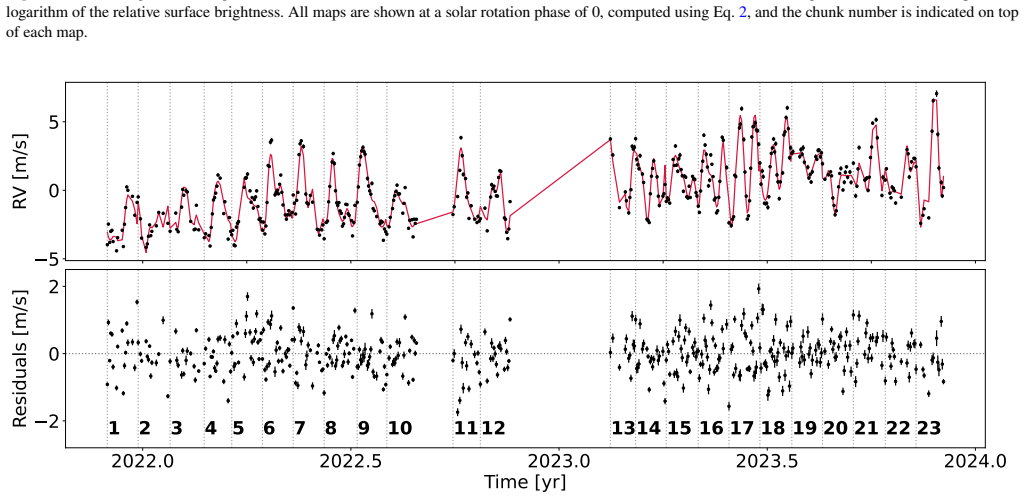
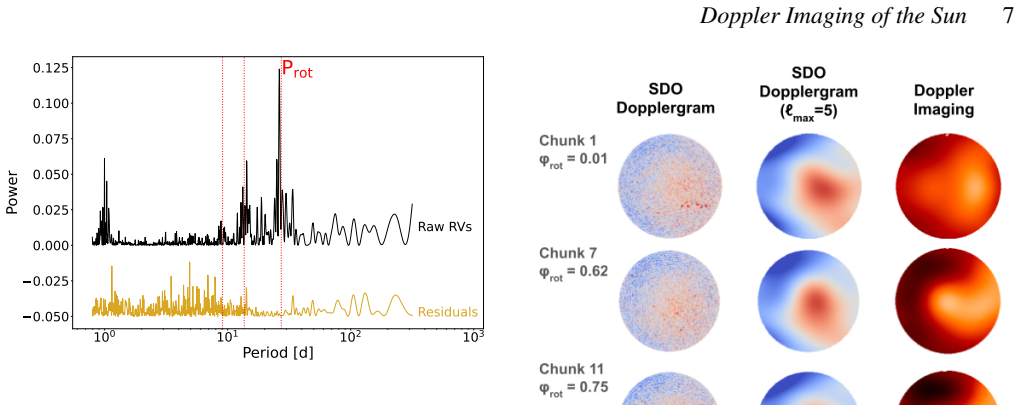
The paper's central claim is that a maximum-entropy Doppler Imaging inversion of observed cross-correlation functions can serve as an activity model for Sun-like stars. Applied chunk-by-chunk to two years of HARPS-N solar spectra, DI reconstructs brightness maps with an angular resolution of about 36 degrees, matching large-scale SDO Dopplergrams (modelled to spherical-harmonic degree $\ell_{\max}=5$) with a median absolute correlation of 0.63 at the phase of maximum profile distortion, provided the disc-integrated RV exceeds about 2 m/s. The RVs read off the best-fit profiles reproduce the observed solar RV curve with 0.58 m/s residuals, and no power remains at the rotation period or its harmonics. The same inversion, run blindly, preserves the period and phase of an injected planet but underestimates its semi-amplitude by roughly 40 percent; when the planet fit is folded directly into the inversion by Doppler-shifting the CCFs, the recovered semi-amplitudes match the injected values within $1\sigma$, with uncertainties comparable to a two-dimensional Gaussian-process fit. The paper concludes that DI is not yet an operational planet-search tool, but it is a credible physical, wavelength-domain alternative for suppressing activity around slowly rotating solar twins.
Load-bearing premise
The load-bearing premise is that the Sun's local line profile can be replaced by an assumed model and then fixed by iteratively subtracting the median data-minus-model difference until flat; if that step absorbs axisymmetric activity or part of a planet's Doppler shift, the reconstructed maps and the 0.58 m/s correction are biased.
Editorial extensions
If this is right
- DI removes the rotationally modulated activity signal from Sun-like-star RVs, leaving 0.58 m/s RMS residuals with no periodicity at the rotation period or its harmonics.
- DI brightness maps agree with disc-resolved SDO Dopplergrams on scales of about 36 degrees only when the activity-induced RV is above about 2 m/s; quieter epochs yield unreliable maps.
- Blind DI gives unbiased orbital periods and phases but underestimates injected low-mass planet semi-amplitudes by about 40 percent; the paper's joint DI-plus-planet fit is required for accurate masses.
- With the joint fit, DI recovers injected planet semi-amplitudes as accurately as a two-dimensional Gaussian-process model, with comparable 1-sigma uncertainties.
- Injection-recovery completeness reaches 100 percent for injected planets with orbital period above 100 days and semi-amplitude above 0.4 m/s, and 67 percent below 0.4 m/s, while planets with periods near the rotation period and its harmonics are lost.
Reading between the lines
- Beyond the paper, a multi-cycle Sun-like dataset could test whether DI's wavelength-domain filtering stays stable while Gaussian-process hyperparameters drift over a magnetic cycle; the two-year baseline here cannot address that.
- Beyond the paper, using CCF masks built from lines with different formation temperatures should separate convective-bluesshift inhibition from brightness contrast, potentially yielding simultaneous intensity and velocity maps from one spectral time series.
- Beyond the paper, a hybrid pipeline suggests itself: run blind DI to supply period and phase priors, then switch to a joint DI-plus-planet fit for unbiased masses, avoiding the 40 percent blind bias while keeping DI's long-period sensitivity.
- Beyond the paper, the 2 m/s threshold implies DI will be noise-dominated for very quiet stars, so a sensitivity-floor test on synthetic quiet-star spectra would show where DI should yield to time-domain methods.
Signed reviews
Editorial analysis
A structured set of objections, weighed in public.
Referee Report
Summary. This paper presents a proof-of-concept application of traditional maximum-entropy Doppler Imaging (DI) to Sun-as-a-star observations, using HARPS-N CCFs collected between December 2021 and January 2024. The data are split into 23 independent 27-day chunks, and for each chunk a relative brightness map is inverted from the CCF time series, after an iterative self-calibration of the unknown intrinsic line profile (Sec 2.2.1) and assuming non-evolving active regions (Sec 2.2.2). Three lines of evidence are presented. First, RVs extracted from the best-fit CCFs reproduce the observed activity-driven RVs with a residual RMS of 0.58 m/s, and a GLS periodogram of the residuals shows no remaining power at the rotation period or its harmonics. Second, the DI brightness maps correlate with large-scale (ell_max = 5) SDO/HMI dopplergrams at epochs of strong line-profile distortion: the median absolute Pearson correlation is about 0.63 at the phase of maximum |RV| per chunk, with correlations above roughly 0.5 only when |RV| exceeds about 2 m/s. Third, in planet injection-recovery tests, blind DI preserves the orbital period and phase of injected planets but underestimates K by about 40%, whereas a joint DI+planet fit recovers K within 1 sigma of the injected values for periods of 6 and 100 d, with uncertainties comparable to those from 1D and 2D Gaussian process regression.
Significance. The potential significance of this work is genuine: it appears to be the first demonstration that classic DI, designed for rapidly rotating stars, can be applied to a Sun-like slow rotator observed with a stable spectrograph, and that the reconstructed maps carry spatially resolved information grounded against independent, disc-resolved SDO observations. Several aspects of the paper are strengths that should be credited. The planet injection-recovery tests are built on the actual solar CCFs and include multiple phase realisations; the SDO comparison provides an external validation that is rare in this literature; the authors explicitly report the blind-DI K underestimate (about 40%) rather than hiding it; and the robustness tests in Sec 4.3 characterise the regime (noise level, number of epochs) in which the inversions are trustworthy. The paper is also appropriately hedged about map realism.
major comments (2)
- [Sec. 5.2.1-5.2.2, Tables 3-4] The joint activity+planet fit carries the abstract's central claim that DI 'yields planetary mass estimates with an accuracy comparable to, for example, multi-dimensional Gaussian process regression', but its validation has two gaps. First, the fit adopts Gaussian priors on Porb and phi_p that were obtained from the blind DI run on the same data (Sec 5.2.2: 'We thus adopt Gaussian priors for these two parameters, using the best-fit values and uncertainties reported in Tab. 3'), so the K recovery in Table 4 is not a blind validation of the full pipeline. Second, the longest injected period tested is 100 d, while the paper advertises the method for Porb > 100 d. The blind DI run already underestimates K by about 40% (Table 3), which the paper attributes to cross-talk between CCF derivatives; an equally plausible mechanism, acknowledged in Sec 2.2.1 ('could affect axisymmetric structures generating non-modulated profile distortions'), is that the iterative intrinsic-profile self-calibration absorbs the per-chunk mean of a long-period planet signal. For a 27-d chunk (Sec 3.2), a 100-d planet contributes only about 0.4 K of within-chunk RMS; for longer periods that constraint weakens further. I therefore request an additional injection-recovery test in which the joint fit is applied to a planet with Porb of about 200-300 d using wide uniform (or fully marginalised) priors on Porb and phi_p, reporting the recovered K and its credible interval. If K remains unbiased, the claim is supported; if not, the 'accuracy comparable to multi-dimensional GP' statement should be restricted to Porb of about 100 d or less.
- [Sec. 4.1, Fig. 3] The headline residual RMS of 0.58 m/s is presented as 'consistent with that obtained with a Gaussian process regression on the RV time series (see Klein et al. 2024)', but the GP residual is not computed on the same 23-chunk dataset in this paper; the comparison rests entirely on a citation. Since the DI-corrected RVs are extracted from the best-fit CCFs to which the DI model was itself fitted (Sec 4.1 reports reduced chi2 = 1), the residual is partly a fit-quality statistic, and the per-chunk self-calibrated intrinsic profile (Sec 2.2.1) gives the model freedom on non-modulated components. To support the abstract's 'comparable with existing state-of-the-art activity correction techniques', I suggest computing a 1D GP regression on the same chunks, with the same noise model and outlier selection, and quoting the resulting residual RMS alongside 0.58 m/s; alternatively, the claim should be reworded to cite the specific Klein et al. 2024 residual and note that it was obtained on the same or a neighbouring time span.
minor comments (7)
- [Eq. (4) and Tables 2-3] The units of the orbital phase phi_p are inconsistent: Eq. (4) adds phi_p to 2*pi*(T0 - t)/P as if it were an angle in radians, while the tabulated values (0.0, 0.33, 0.7) read as fractions of an orbital cycle. Please state the units explicitly and write 2*pi*phi_p in the sine argument if cycles are intended.
- [Sec. 4.3] The clause 'values consistently larger than 0.5 for relative levels larger or equal to ~10^-4' appears to contradict the preceding statement that the correlation 'decreases roughly linearly with the noise level'; presumably 'smaller than or equal to ~10^-4' is intended.
- [Sec. 3.1] 'gosts' in the list of instrumental contamination sources should read 'ghosts'.
- [Sec. 4.2] 'intensitigrams' appears twice and should be 'intensitygrams'.
- [Fig. 2 caption] The caption states that the color scale depicts the logarithm of the relative surface brightness, but the color bar is labelled 'Relative brightness [%]'; please make the labelling consistent.
- [Sec. 4.2, Fig. 5] The '~2 m/s' threshold for a good DI-SDO match is calibrated on only 23 chunks (Pearson rho_RV = 0.85 in Fig. 5) and should be explicitly presented as a tentative, small-sample calibration rather than a general detection criterion.
- [Sec. 6.2] Minor wording issues: 'one of the most promising way' should be 'ways', and 'systemtically' in Sec 5.2.2 should be 'systematically'.
Circularity Check
Mild circularity: the joint DI+planet fit reuses period/phase estimates from a blind DI run on the same data, but the SDO comparison and completeness tests remain independent.
-
other
[Section 5.2.2 (Results of joint activity and planet fit)]
"However, as shown in Section 5.1, the blind CCF modelling with DI has enabled us to accurately estimate the planet's orbital period and phase. We thus adopt Gaussian priors for these two parameters, using the best-fit values and uncertainties reported in Tab. 3."
The P_orb and phi_p values in Tab. 3 were recovered from the same injected HARPS-N CCFs, after a blind DI activity correction. Feeding those values back as Gaussian priors in the joint DI+planet fit means that the Kp recovery reported in Tab. 4 is conditional on period and phase information already extracted from the same dataset. This does not make Kp itself a fitted input, since it retains a uniform prior, so the circularity is partial rather than an equivalence by construction. The GP comparison is not on exactly the same footing because the GPs use non-informative priors on P_orb and phi_p, whereas DI is given narrow priors derived from the same data.
full rationale
The paper's main derivation chain is not circular: DI maps are inverted from CCF time series, and the primary validation of those maps is an external comparison with SDO/HMI dopplergrams, which is independent of the RV extraction. The planet-sensitivity claims are also tested by injecting synthetic planetary signals with known ground truth, and the blind-DI completeness maps are an independent, well-posed exercise. The one genuinely self-referential element is the joint-fit validation in Section 5.2.2: the Gaussian priors on P_orb and orbital phase are taken from a blind DI analysis of the same dataset, so the Kp accuracy reported for DI in Tab. 4 is not a fully end-to-end blind test and is not on exactly the same footing as the GP comparison, which uses non-informative priors for those parameters. Since Kp remains a free parameter with a uniform prior, this is a validation-circularity issue rather than a case where the predicted quantity is forced by construction. No load-bearing uniqueness theorem, ansatz smuggled in by self-citation, or renaming of a known result was found. The self-calibration limitation in Section 2.2.1 is acknowledged by the authors and is a physical degeneracy that they explicitly discuss, not a circular reduction.
Assumptions & free parameters
free parameters (5)
- Assumed stellar inclination =
80 degrees
- Intrinsic local line profile (Unno-Rachkovsky parameters) =
unspecified (standard Milne-Eddington values)
- Chunk length =
27.2753 days
- Chunk selection thresholds =
Npt >= 10; phase gap <= 25%
- Map-quality RV threshold =
about 2 m/s
assumptions (7)
- domain assumption Maximum entropy regularisation selects the correct solution to the ill-posed DI inversion
- domain assumption All CCF distortions are caused by surface brightness inhomogeneities; convective blueshift inhibition in faculae can be approximated by brightness contrast
- domain assumption Active regions do not evolve within a 27-day chunk
- ad hoc to paper The intrinsic local line profile can be recovered by iteratively subtracting the median observed-synthetic CCF difference
- standard math Unno-Rachkovsky radiative transfer in a Milne-Eddington atmosphere describes local line profiles
- domain assumption Planet orbits are circular in injection-recovery tests
- domain assumption Noise is Gaussian and characterised by the CCF continuum dispersion
Cite this review
Pith. "Pith review of Using Doppler Imaging to model stellar activity and search for planets around Sun-like stars." pith.science (2026). https://pith.science/paper/AZ3YXVJB
@misc{pith2026250812963,
  author       = {Pith},
  title        = {Pith review of: Using Doppler Imaging to model stellar activity and search for planets around Sun-like stars},
  year         = {2026},
  howpublished = {\url{https://pith.science/paper/AZ3YXVJB}},
  note         = {Machine review of arXiv:2508.12963}
}
read the original abstract
Doppler Imaging (DI) is a well-established technique to map a physical field at a stellar surface from a time series of high-resolution spectra. In this proof-of-concept study, we aim to show that traditional DI algorithms, originally designed for rapidly-rotating stars, have also the ability to model the activity of Sun-like stars, when observed with new-generation highly-stable spectrographs, and search for low-mass planets around them. We used DI to retrieve the relative brightness distribution at the surface of the Sun from radial velocity (RV) observations collected by HARPS-N between 2022 and 2024. The brightness maps obtained with DI have a typical angular resolution of about 36 degrees and are a good match to low-resolution disc-resolved Dopplergrams of the Sun at epochs when the absolute, disc-integrated RV exceeds ~2 m/s. The RV residuals after DI correction exhibit a dispersion of about 0.6 m/s, comparable with existing state-of-the-art activity correction techniques. Using planet injection-recovery tests, we also show that DI can be a powerful tool for blind planet searches, so long as the orbital period is larger than ~100days (i.e. 3 to 4 stellar rotation periods), and that it yields planetary mass estimates with an accuracy comparable to, for example, multi-dimensional Gaussian process regression. Finally, we highlight some limitations of traditional DI algorithms, which should be addressed to make DI a reliable alternative to state-of-the-art RV-based planet search techniques.
Figures


Figures from the paper (7 more)


Reference graph
Works this paper leans on
-
[1]
Afram N., Berdyugina S. V., 2015, @doi [ ] 10.1051/0004-6361/201425314 , https://ui.adsabs.harvard.edu/abs/2015A&A...576A..34A 576, A34
-
[2]
Aigrain S., Foreman-Mackey D., 2022, arXiv e-prints, https://ui.adsabs.harvard.edu/abs/2022arXiv220908940A p. arXiv:2209.08940
arXiv 2022
-
[3]
Aigrain S., Pont F., Zucker S., 2012, @doi [ ] 10.1111/j.1365-2966.2011.19960.x , https://ui.adsabs.harvard.edu/abs/2012MNRAS.419.3147A 419, 3147
arXiv 2012
-
[4]
Al Moulla K., Dumusque X., Cretignier M., Zhao Y., Valenti J. A., 2022, @doi [ ] 10.1051/0004-6361/202243276 , https://ui.adsabs.harvard.edu/abs/2022A&A...664A..34A 664, A34
-
[5]
Al Moulla K., Dumusque X., Figueira P., Lo Curto G., Santos N. C., Wildi F., 2023, @doi [ ] 10.1051/0004-6361/202244663 , https://ui.adsabs.harvard.edu/abs/2023A&A...669A..39A 669, A39
-
[6]
Al Moulla K., Dumusque X., Cretignier M., 2024, @doi [ ] 10.1051/0004-6361/202348150 , https://ui.adsabs.harvard.edu/abs/2024A&A...683A.106A 683, A106
-
[7]
Asensio Ramos A., D \' az Baso C. J., Kochukhov O., 2022, @doi [ ] 10.1051/0004-6361/202142027 , https://ui.adsabs.harvard.edu/abs/2022A&A...658A.162A 658, A162
-
[8]
Astropy Collaboration et al., 2013, @doi [ ] 10.1051/0004-6361/201322068 , https://ui.adsabs.harvard.edu/abs/2013A&A...558A..33A 558, A33
Show all 171 references
-
[9]
Astropy Collaboration et al., 2018, @doi [ ] 10.3847/1538-3881/aabc4f , https://ui.adsabs.harvard.edu/abs/2018AJ....156..123A 156, 123
2018 doi
-
[10]
Astropy Collaboration et al., 2022, @doi [ ] 10.3847/1538-4357/ac7c74 , https://ui.adsabs.harvard.edu/abs/2022ApJ...935..167A 935, 167
2022 doi
-
[11]
A., Landstreet J
Bagnulo S., Szeifert T., Wade G. A., Landstreet J. D., Mathys G., 2002, @doi [ ] 10.1051/0004-6361:20020606 , https://ui.adsabs.harvard.edu/abs/2002A&A...389..191B 389, 191
2002 doi
-
[13]
Barrag \'a n O., Gandolfi D., Antoniciello G., 2019, @doi [ ] 10.1093/mnras/sty2472 , https://ui.adsabs.harvard.edu/abs/2019MNRAS.482.1017B 482, 1017
2019 doi
-
[14]
M., Zicher N., 2022a, @doi [ ] 10.1093/mnras/stab2889 , https://ui.adsabs.harvard.edu/abs/2022MNRAS.509..866B 509, 866
Barrag \'a n O., Aigrain S., Rajpaul V. M., Zicher N., 2022a, @doi [ ] 10.1093/mnras/stab2889 , https://ui.adsabs.harvard.edu/abs/2022MNRAS.509..866B 509, 866
-
[15]
Barrag \'a n O., et al., 2022b, @doi [ ] 10.1093/mnras/stac638 , https://ui.adsabs.harvard.edu/abs/2022MNRAS.514.1606B 514, 1606
-
[16]
Barrag \'a n O., et al., 2023, @doi [ ] 10.1093/mnras/stad1139 , https://ui.adsabs.harvard.edu/abs/2023MNRAS.522.3458B 522, 3458
2023 doi
-
[17]
Bellotti S., Petit P., Morin J., Hussain G. A. J., Folsom C. P., Carmona A., Delfosse X., Moutou C., 2022, @doi [ ] 10.1051/0004-6361/202141812 , https://ui.adsabs.harvard.edu/abs/2022A&A...657A.107B 657, A107
2022 doi
-
[18]
Bellotti S., et al., 2025, @doi [ ] 10.1051/0004-6361/202452378 , https://ui.adsabs.harvard.edu/abs/2025A&A...693A.269B 693, A269
2025 doi
-
[19]
V., 2005, @doi [Living Reviews in Solar Physics] 10.12942/lrsp-2005-8 , https://ui.adsabs.harvard.edu/abs/2005LRSP....2....8B 2, 8
Berdyugina S. V., 2005, @doi [Living Reviews in Solar Physics] 10.12942/lrsp-2005-8 , https://ui.adsabs.harvard.edu/abs/2005LRSP....2....8B 2, 8
2005 doi
-
[20]
T., et al., 2020, @doi [ ] 10.3847/1538-3881/ab811d , https://ui.adsabs.harvard.edu/abs/2020AJ....159..238B 159, 238
Blackman R. T., et al., 2020, @doi [ ] 10.3847/1538-3881/ab811d , https://ui.adsabs.harvard.edu/abs/2020AJ....159..238B 159, 238
2020 doi
-
[21]
Blunt S., et al., 2023, @doi [ ] 10.3847/1538-3881/acde78 , https://ui.adsabs.harvard.edu/abs/2023AJ....166...62B 166, 62
2023 doi
-
[22]
Boro Saikia S., et al., 2016, @doi [ ] 10.1051/0004-6361/201628262 , https://ui.adsabs.harvard.edu/abs/2016A&A...594A..29B 594, A29
2016 doi
-
[23]
Boro Saikia S., et al., 2018, @doi [ ] 10.1051/0004-6361/201834347 , https://ui.adsabs.harvard.edu/abs/2018A&A...620L..11B 620, L11
2018 doi
-
[24]
M., et al., 2020, @doi [ ] 10.3847/1538-3881/ab99c9 , https://ui.adsabs.harvard.edu/abs/2020AJ....160...67B 160, 67
Brewer J. M., et al., 2020, @doi [ ] 10.3847/1538-3881/ab99c9 , https://ui.adsabs.harvard.edu/abs/2020AJ....160...67B 160, 67
2020 doi
-
[25]
F., Donati J
Brown S. F., Donati J. F., Rees D. E., Semel M., 1991, , https://ui.adsabs.harvard.edu/abs/1991A&A...250..463B 250, 463
1991
-
[26]
S., Browning M
Brun A. S., Browning M. K., 2017, @doi [Living Reviews in Solar Physics] 10.1007/s41116-017-0007-8 , https://ui.adsabs.harvard.edu/abs/2017LRSP...14....4B 14, 4
2017 doi
-
[27]
R., et al., 2024, @doi [Nature Astronomy] 10.1038/s41550-024-02405-6 , https://ui.adsabs.harvard.edu/abs/2024NatAs...8.1359C 8, 1359
Callingham J. R., et al., 2024, @doi [Nature Astronomy] 10.1038/s41550-024-02405-6 , https://ui.adsabs.harvard.edu/abs/2024NatAs...8.1359C 8, 1359
2024 doi
-
[28]
J., Cegla H
Chaplin W. J., Cegla H. M., Watson C. A., Davies G. R., Ball W. H., 2019, @doi [ ] 10.3847/1538-3881/ab0c01 , https://ui.adsabs.harvard.edu/abs/2019AJ....157..163C 157, 163
2019 doi
-
[29]
H., Witte S., 2013, @doi [ ] 10.1051/0004-6361/201220942 , https://ui.adsabs.harvard.edu/abs/2013A&A...552A..16C 552, A16
Claret A., Hauschildt P. H., Witte S., 2013, @doi [ ] 10.1051/0004-6361/201220942 , https://ui.adsabs.harvard.edu/abs/2013A&A...552A..16C 552, A16
2013 doi
-
[30]
C., 1994, @doi [ ] 10.1093/mnras/269.3.814 , https://ui.adsabs.harvard.edu/abs/1994MNRAS.269..814C 269, 814
Collier Cameron A., Unruh Y. C., 1994, @doi [ ] 10.1093/mnras/269.3.814 , https://ui.adsabs.harvard.edu/abs/1994MNRAS.269..814C 269, 814
1994 doi
-
[31]
Collier Cameron A., et al., 2019, @doi [ ] 10.1093/mnras/stz1215 , https://ui.adsabs.harvard.edu/abs/2019MNRAS.487.1082C 487, 1082
2019 doi
-
[32]
Collier Cameron A., et al., 2021, @doi [ ] 10.1093/mnras/stab1323 , https://ui.adsabs.harvard.edu/abs/2021MNRAS.505.1699C 505, 1699
2021 doi
-
[33]
S., Ramsay S
Cosentino R., et al., 2012, in McLean I. S., Ramsay S. K., Takami H., eds, Society of Photo-Optical Instrumentation Engineers (SPIE) Conference Series Vol. 8446, Ground-based and Airborne Instrumentation for Astronomy IV. p. 84461V, @doi 10.1117/12.925738
2012 doi
-
[34]
arXiv:2107.14291
Crass J., et al., 2021, arXiv e-prints, https://ui.adsabs.harvard.edu/abs/2021arXiv210714291C p. arXiv:2107.14291
2021 arXiv
-
[35]
Cretignier M., Dumusque X., Allart R., Pepe F., Lovis C., 2020a, @doi [ ] 10.1051/0004-6361/201936548 , https://ui.adsabs.harvard.edu/abs/2020A&A...633A..76C 633, A76
-
[36]
Cretignier M., Francfort J., Dumusque X., Allart R., Pepe F., 2020b, @doi [ ] 10.1051/0004-6361/202037722 , https://ui.adsabs.harvard.edu/abs/2020A&A...640A..42C 640, A42
-
[37]
C., Pepe F., 2021, @doi [ ] 10.1051/0004-6361/202140986 , https://ui.adsabs.harvard.edu/abs/2021A&A...653A..43C 653, A43
Cretignier M., Dumusque X., Hara N. C., Pepe F., 2021, @doi [ ] 10.1051/0004-6361/202140986 , https://ui.adsabs.harvard.edu/abs/2021A&A...653A..43C 653, A43
2021 doi
-
[38]
Cretignier M., Dumusque X., Pepe F., 2022, @doi [ ] 10.1051/0004-6361/202142435 , https://ui.adsabs.harvard.edu/abs/2022A&A...659A..68C 659, A68
2022 doi
-
[39]
Cretignier M., Dumusque X., Aigrain S., Pepe F., 2023, @doi [ ] 10.1051/0004-6361/202347232 , https://ui.adsabs.harvard.edu/abs/2023A&A...678A...2C 678, A2
2023 doi
-
[40]
Crossfield I. J. M., et al., 2014, @doi [ ] 10.1038/nature12955 , https://ui.adsabs.harvard.edu/abs/2014Natur.505..654C 505, 654
2014 doi
-
[41]
B., Unger N., Hara N
Delisle J. B., Unger N., Hara N. C., S \'e gransan D., 2022, @doi [ ] 10.1051/0004-6361/202141949 , https://ui.adsabs.harvard.edu/abs/2022A&A...659A.182D 659, A182
2022 doi
-
[42]
M., Galland F., Udry S., Mayor M., 2007, @doi [ ] 10.1051/0004-6361:20078144 , https://ui.adsabs.harvard.edu/abs/2007A&A...473..983D 473, 983
Desort M., Lagrange A. M., Galland F., Udry S., Mayor M., 2007, @doi [ ] 10.1051/0004-6361:20078144 , https://ui.adsabs.harvard.edu/abs/2007A&A...473..983D 473, 983
2007 doi
-
[43]
F., 1999, @doi [ ] 10.1046/j.1365-8711.1999.02096.x , https://ui.adsabs.harvard.edu/abs/1999MNRAS.302..457D 302, 457
Donati J. F., 1999, @doi [ ] 10.1046/j.1365-8711.1999.02096.x , https://ui.adsabs.harvard.edu/abs/1999MNRAS.302..457D 302, 457
1999
-
[44]
F., Brown S
Donati J. F., Brown S. F., 1997, , https://ui.adsabs.harvard.edu/abs/1997A&A...326.1135D 326, 1135
1997
-
[45]
F., Landstreet J
Donati J. F., Landstreet J. D., 2009, @doi [ ] 10.1146/annurev-astro-082708-101833 , https://ui.adsabs.harvard.edu/abs/2009ARA&A..47..333D 47, 333
2009 doi
-
[46]
F., Semel M., Praderie F., 1989, , https://ui.adsabs.harvard.edu/abs/1989A&A...225..467D 225, 467
Donati J. F., Semel M., Praderie F., 1989, , https://ui.adsabs.harvard.edu/abs/1989A&A...225..467D 225, 467
1989
-
[47]
F., Henry G
Donati J. F., Henry G. W., Hall D. S., 1995, , https://ui.adsabs.harvard.edu/abs/1995A&A...293..107D 293, 107
1995
-
[48]
F., Semel M., Carter B
Donati J. F., Semel M., Carter B. D., Rees D. E., Collier Cameron A., 1997, @doi [ ] 10.1093/mnras/291.4.658 , https://ui.adsabs.harvard.edu/abs/1997MNRAS.291..658D 291, 658
1997 doi
-
[49]
F., Mengel M., Carter B
Donati J. F., Mengel M., Carter B. D., Marsden S., Collier Cameron A., Wichmann R., 2000, @doi [ ] 10.1046/j.1365-8711.2000.03570.x , https://ui.adsabs.harvard.edu/abs/2000MNRAS.316..699D 316, 699
2000
-
[51]
F., et al., 2003, @doi [ ] 10.1046/j.1365-2966.2003.07031.x , https://ui.adsabs.harvard.edu/abs/2003MNRAS.345.1145D 345, 1145
Donati J. F., et al., 2003, @doi [ ] 10.1046/j.1365-2966.2003.07031.x , https://ui.adsabs.harvard.edu/abs/2003MNRAS.345.1145D 345, 1145
2003
-
[52]
F., Howarth I
Donati J. F., Howarth I. D., Bouret J. C., Petit P., Catala C., Landstreet J., 2006a, @doi [ ] 10.1111/j.1745-3933.2005.00115.x , https://ui.adsabs.harvard.edu/abs/2006MNRAS.365L...6D 365, L6
2005
-
[53]
F., et al., 2006b, @doi [ ] 10.1111/j.1365-2966.2006.10558.x , https://ui.adsabs.harvard.edu/abs/2006MNRAS.370..629D 370, 629
Donati J. F., et al., 2006b, @doi [ ] 10.1111/j.1365-2966.2006.10558.x , https://ui.adsabs.harvard.edu/abs/2006MNRAS.370..629D 370, 629
2006
-
[55]
F., et al., 2012, @doi [ ] 10.1111/j.1365-2966.2012.21482.x , https://ui.adsabs.harvard.edu/abs/2012MNRAS.425.2948D 425, 2948
Donati J. F., et al., 2012, @doi [ ] 10.1111/j.1365-2966.2012.21482.x , https://ui.adsabs.harvard.edu/abs/2012MNRAS.425.2948D 425, 2948
2012
-
[56]
F., et al., 2014, @doi [ ] 10.1093/mnras/stu1679 , https://ui.adsabs.harvard.edu/abs/2014MNRAS.444.3220D 444, 3220
Donati J. F., et al., 2014, @doi [ ] 10.1093/mnras/stu1679 , https://ui.adsabs.harvard.edu/abs/2014MNRAS.444.3220D 444, 3220
2014 doi
-
[57]
F., et al., 2017, @doi [ ] 10.1093/mnras/stw2904 , https://ui.adsabs.harvard.edu/abs/2017MNRAS.465.3343D 465, 3343
Donati J. F., et al., 2017, @doi [ ] 10.1093/mnras/stw2904 , https://ui.adsabs.harvard.edu/abs/2017MNRAS.465.3343D 465, 3343
2017 doi
-
[58]
F., et al., 2023, @doi [ ] 10.1093/mnras/stad1193 , https://ui.adsabs.harvard.edu/abs/2023MNRAS.525..455D 525, 455
Donati J. F., et al., 2023, @doi [ ] 10.1093/mnras/stad1193 , https://ui.adsabs.harvard.edu/abs/2023MNRAS.525..455D 525, 455
2023 doi
-
[59]
Dumusque X., 2018, @doi [ ] 10.1051/0004-6361/201833795 , https://ui.adsabs.harvard.edu/abs/2018A&A...620A..47D 620, A47
2018 doi
-
[60]
C., Monteiro M
Dumusque X., Udry S., Lovis C., Santos N. C., Monteiro M. J. P. F. G., 2011a, @doi [ ] 10.1051/0004-6361/201014097 , https://ui.adsabs.harvard.edu/abs/2011A&A...525A.140D 525, A140
-
[61]
Dumusque X., et al., 2011b, @doi [ ] 10.1051/0004-6361/201117148 , https://ui.adsabs.harvard.edu/abs/2011A&A...535A..55D 535, A55
-
[62]
Dumusque X., et al., 2015, @doi [ ] 10.1088/2041-8205/814/2/L21 , https://ui.adsabs.harvard.edu/abs/2015ApJ...814L..21D 814, L21
2015 doi
-
[63]
Dumusque X., et al., 2021, @doi [ ] 10.1051/0004-6361/202039350 , https://ui.adsabs.harvard.edu/abs/2021A&A...648A.103D 648, A103
2021 doi
-
[64]
A., Frommert M., 2011, @doi [ ] 10.1103/PhysRevD.83.105014 , https://ui.adsabs.harvard.edu/abs/2011PhRvD..83j5014E 83, 105014
En lin T. A., Frommert M., 2011, @doi [ ] 10.1103/PhysRevD.83.105014 , https://ui.adsabs.harvard.edu/abs/2011PhRvD..83j5014E 83, 105014
2011 doi
-
[65]
A., Frommert M., Kitaura F
En lin T. A., Frommert M., Kitaura F. S., 2009, @doi [ ] 10.1103/PhysRevD.80.105005 , https://ui.adsabs.harvard.edu/abs/2009PhRvD..80j5005E 80, 105005
2009 doi
-
[66]
Ervin T., et al., 2022, @doi [ ] 10.3847/1538-3881/ac67e6 , https://ui.adsabs.harvard.edu/abs/2022AJ....163..272E 163, 272
2022 doi
-
[67]
Fares R., et al., 2009, @doi [ ] 10.1111/j.1365-2966.2009.15303.x , https://ui.adsabs.harvard.edu/abs/2009MNRAS.398.1383F 398, 1383
2009
-
[68]
P., et al., 2022, @doi [ ] 10.1051/0004-6361/202142337 , https://ui.adsabs.harvard.edu/abs/2022A&A...658A.115F 658, A115
Faria J. P., et al., 2022, @doi [ ] 10.1051/0004-6361/202142337 , https://ui.adsabs.harvard.edu/abs/2022A&A...658A.115F 658, A115
2022 doi
-
[69]
F., 2022, @doi [ ] 10.1093/mnras/stac2682 , https://ui.adsabs.harvard.edu/abs/2022MNRAS.516.5887F 516, 5887
Finociety B., Donati J. F., 2022, @doi [ ] 10.1093/mnras/stac2682 , https://ui.adsabs.harvard.edu/abs/2022MNRAS.516.5887F 516, 5887
2022 doi
-
[70]
Finociety B., et al., 2021, @doi [ ] 10.1093/mnras/stab2778 , https://ui.adsabs.harvard.edu/abs/2021MNRAS.508.3427F 508, 3427
2021 doi
-
[71]
A., et al., 2016, @doi [ ] 10.1088/1538-3873/128/964/066001 , https://ui.adsabs.harvard.edu/abs/2016PASP..128f6001F 128, 066001
Fischer D. A., et al., 2016, @doi [ ] 10.1088/1538-3873/128/964/066001 , https://ui.adsabs.harvard.edu/abs/2016PASP..128f6001F 128, 066001
2016 doi
-
[72]
P., et al., 2016, @doi [ ] 10.1093/mnras/stv2924 , https://ui.adsabs.harvard.edu/abs/2016MNRAS.457..580F 457, 580
Folsom C. P., et al., 2016, @doi [ ] 10.1093/mnras/stv2924 , https://ui.adsabs.harvard.edu/abs/2016MNRAS.457..580F 457, 580
2016 doi
-
[73]
P., \'O Fionnag \'a in D., Fossati L., Vidotto A
Folsom C. P., \'O Fionnag \'a in D., Fossati L., Vidotto A. A., Moutou C., Petit P., Dragomir D., Donati J. F., 2020, @doi [ ] 10.1051/0004-6361/201937186 , https://ui.adsabs.harvard.edu/abs/2020A&A...633A..48F 633, A48
2020 doi
-
[74]
Foukal P., 1998, @doi [ ] 10.1086/305764 , https://ui.adsabs.harvard.edu/abs/1998ApJ...500..958F 500, 958
1998 doi
-
[75]
Fournier-Tondreau M., et al., 2024, @doi [ ] 10.1093/mnras/stad3813 , https://ui.adsabs.harvard.edu/abs/2024MNRAS.528.3354F 528, 3354
2024 doi
-
[76]
R., Wicht J., 2013, @doi [ ] 10.1051/0004-6361/201220317 , https://ui.adsabs.harvard.edu/abs/2013A&A...549L...5G 549, L5
Gastine T., Morin J., Duarte L., Reiners A., Christensen U. R., Wicht J., 2013, @doi [ ] 10.1051/0004-6361/201220317 , https://ui.adsabs.harvard.edu/abs/2013A&A...549L...5G 549, L5
2013 doi
-
[77]
V., Ryabchikova T
Goncharskij A. V., Ryabchikova T. A., Stepanov V. V., Khokhlova V. L., Yagola A. G., 1983, , https://ui.adsabs.harvard.edu/abs/1983AZh....60...83G 60, 83
1983
-
[78]
F., et al., 2021, @doi [ ] 10.3847/1538-3881/abd79e , https://ui.adsabs.harvard.edu/abs/2021AJ....161..130G 161, 130
Gupta A. F., et al., 2021, @doi [ ] 10.3847/1538-3881/abd79e , https://ui.adsabs.harvard.edu/abs/2021AJ....161..130G 161, 130
2021 doi
-
[79]
F., et al., 2025, @doi [ ] 10.3847/1538-3881/ad89bf , https://ui.adsabs.harvard.edu/abs/2025AJ....169....1G 169, 1
Gupta A. F., et al., 2025, @doi [ ] 10.3847/1538-3881/ad89bf , https://ui.adsabs.harvard.edu/abs/2025AJ....169....1G 169, 1
2025 doi
-
[80]
D., Thompson S
Hall R. D., Thompson S. J., Handley W., Queloz D., 2018, @doi [ ] 10.1093/mnras/sty1464 , https://ui.adsabs.harvard.edu/abs/2018MNRAS.479.2968H 479, 2968
2018 doi
-
[81]
C., Delisle J.-B., 2025, @doi [ ] 10.1051/0004-6361/202346391 , https://ui.adsabs.harvard.edu/abs/2025A&A...696A.141H 696, A141
Hara N. C., Delisle J.-B., 2025, @doi [ ] 10.1051/0004-6361/202346391 , https://ui.adsabs.harvard.edu/abs/2025A&A...696A.141H 696, A141
2025 doi
-
[82]
P., 1991, @doi [ ] 10.1093/mnras/248.3.487 , https://ui.adsabs.harvard.edu/abs/1991MNRAS.248..487H 248, 487
Hatzes A. P., 1991, @doi [ ] 10.1093/mnras/248.3.487 , https://ui.adsabs.harvard.edu/abs/1991MNRAS.248..487H 248, 487
1991 doi
-
[83]
P., 1995, @doi [ ] 10.1086/176265 , https://ui.adsabs.harvard.edu/abs/1995ApJ...451..784H 451, 784
Hatzes A. P., 1995, @doi [ ] 10.1086/176265 , https://ui.adsabs.harvard.edu/abs/1995ApJ...451..784H 451, 784
1995 doi
-
[84]
M., Donati J
H \'e brard \'E . M., Donati J. F., Delfosse X., Morin J., Moutou C., Boisse I., 2016, @doi [ ] 10.1093/mnras/stw1346 , https://ui.adsabs.harvard.edu/abs/2016MNRAS.461.1465H 461, 1465
2016 doi
-
[85]
Heitzmann A., et al., 2021, @doi [ ] 10.1093/mnras/stab1586 , https://ui.adsabs.harvard.edu/abs/2021MNRAS.505.4989H 505, 4989
2021 doi
-
[86]
A., Collier Cameron A., Wilson T
John A. A., Collier Cameron A., Wilson T. G., 2022, @doi [ ] 10.1093/mnras/stac1814 , https://ui.adsabs.harvard.edu/abs/2022MNRAS.515.3975J 515, 3975
2022 doi
-
[87]
A., et al., 2023, @doi [ ] 10.1093/mnras/stad2381 , https://ui.adsabs.harvard.edu/abs/2023MNRAS.525.1687J 525, 1687
John A. A., et al., 2023, @doi [ ] 10.1093/mnras/stad2381 , https://ui.adsabs.harvard.edu/abs/2023MNRAS.525.1687J 525, 1687
2023 doi
-
[88]
E., Stenning D
Jones D. E., Stenning D. C., Ford E. B., Wolpert R. L., Loredo T. J., Gilbertson C., Dumusque X., 2017, arXiv e-prints, https://ui.adsabs.harvard.edu/abs/2017arXiv171101318J p. arXiv:1711.01318
2017 arXiv
-
[89]
D., Vidotto A
Kavanagh R. D., Vidotto A. A., Klein B., Jardine M. M., Donati J.-F., \'O Fionnag \'a in D., 2021, @doi [ ] 10.1093/mnras/stab929 , https://ui.adsabs.harvard.edu/abs/2021MNRAS.504.1511K 504, 1511
2021 doi
-
[90]
L., Rice J
Khokhlova V. L., Rice J. B., Wehlau W. H., 1986, @doi [ ] 10.1086/164462 , https://ui.adsabs.harvard.edu/abs/1986ApJ...307..768K 307, 768
1986 doi
- [91]
-
[92]
M., Zaire B., Folsom C
Klein B., Donati J.-F., H \'e brard \'E . M., Zaire B., Folsom C. P., Morin J., Delfosse X., Bonfils X., 2021a, @doi [ ] 10.1093/mnras/staa3396 , https://ui.adsabs.harvard.edu/abs/2021MNRAS.500.1844K 500, 1844
-
[93]
Klein B., et al., 2021b, @doi [ ] 10.1093/mnras/staa3702 , https://ui.adsabs.harvard.edu/abs/2021MNRAS.502..188K 502, 188
-
[94]
Klein B., et al., 2022, @doi [ ] 10.1093/mnras/stac761 , https://ui.adsabs.harvard.edu/abs/2022MNRAS.512.5067K 512, 5067
2022 doi
-
[95]
Klein B., et al., 2024, @doi [ ] 10.1093/mnras/stae1313 , https://ui.adsabs.harvard.edu/abs/2024MNRAS.531.4238K 531, 4238
2024 doi
-
[96]
914, Lecture Notes in Physics, Berlin Springer Verlag
Kochukhov O., 2016, in Rozelot J.-P., Neiner C., eds, , Vol. 914, Lecture Notes in Physics, Berlin Springer Verlag. p. 177, @doi 10.1007/978-3-319-24151-7\_9
2016 doi
-
[97]
Kochukhov O., Piskunov N., 2002, @doi [ ] 10.1051/0004-6361:20020300 , https://ui.adsabs.harvard.edu/abs/2002A&A...388..868K 388, 868
2002 doi
-
[98]
A., 2010, @doi [ ] 10.1051/0004-6361/200913860 , https://ui.adsabs.harvard.edu/abs/2010A&A...513A..13K 513, A13
Kochukhov O., Wade G. A., 2010, @doi [ ] 10.1051/0004-6361/200913860 , https://ui.adsabs.harvard.edu/abs/2010A&A...513A..13K 513, A13
2010 doi
-
[99]
A., Piskunov N., de la Reza R., 2004, @doi [ ] 10.1051/0004-6361:20040517 , https://ui.adsabs.harvard.edu/abs/2004A&A...424..935K 424, 935
Kochukhov O., Drake N. A., Piskunov N., de la Reza R., 2004, @doi [ ] 10.1051/0004-6361:20040517 , https://ui.adsabs.harvard.edu/abs/2004A&A...424..935K 424, 935
2004 doi
-
[100]
W., Landstreet J
Kochukhov O., Ryabchikova T., Weiss W. W., Landstreet J. D., Lyashko D., 2007, @doi [ ] 10.1111/j.1365-2966.2007.11449.x , https://ui.adsabs.harvard.edu/abs/2007MNRAS.376..651K 376, 651
2007
-
[101]
J., Hackman T., Ilyin I., 2013, @doi [ ] 10.1051/0004-6361/201220432 , https://ui.adsabs.harvard.edu/abs/2013A&A...550A..84K 550, A84
Kochukhov O., Mantere M. J., Hackman T., Ilyin I., 2013, @doi [ ] 10.1051/0004-6361/201220432 , https://ui.adsabs.harvard.edu/abs/2013A&A...550A..84K 550, A84
2013 doi
-
[102]
S., et al., 2024, @doi [ ] 10.1093/mnras/stad3723 , https://ui.adsabs.harvard.edu/abs/2024MNRAS.527.7681L 527, 7681
Lakeland B. S., et al., 2024, @doi [ ] 10.1093/mnras/stad3723 , https://ui.adsabs.harvard.edu/abs/2024MNRAS.527.7681L 527, 7681
2024 doi
-
[103]
Landi Degl'Innocenti E., Landolfi M., 2004, Polarization in Spectral Lines . Vol. 307, @doi 10.1007/978-1-4020-2415-3,
2004 doi
-
[104]
D., Mathys G., 2000, , https://ui.adsabs.harvard.edu/abs/2000A&A...359..213L 359, 213
Landstreet J. D., Mathys G., 2000, , https://ui.adsabs.harvard.edu/abs/2000A&A...359..213L 359, 213
2000
-
[105]
A., 2018, @doi [ ] 10.1093/mnras/sty1825 , https://ui.adsabs.harvard.edu/abs/2018MNRAS.479.4836L 479, 4836
Lavail A., Kochukhov O., Wade G. A., 2018, @doi [ ] 10.1093/mnras/sty1825 , https://ui.adsabs.harvard.edu/abs/2018MNRAS.479.4836L 479, 4836
2018 doi
-
[106]
T., Hussain G
Lehmann L. T., Hussain G. A. J., Vidotto A. A., Jardine M. M., Mackay D. H., 2021, @doi [ ] 10.1093/mnras/staa3284 , https://ui.adsabs.harvard.edu/abs/2021MNRAS.500.1243L 500, 1243
2021 doi
-
[107]
T., et al., 2024, @doi [ ] 10.1093/mnras/stad3472 , https://ui.adsabs.harvard.edu/abs/2024MNRAS.527.4330L 527, 4330
Lehmann L. T., et al., 2024, @doi [ ] 10.1093/mnras/stad3472 , https://ui.adsabs.harvard.edu/abs/2024MNRAS.527.4330L 527, 4330
2024 doi
-
[108]
B., 1964, @doi [ ] 10.1086/148058 , https://ui.adsabs.harvard.edu/abs/1964ApJ...140.1547L 140, 1547
Leighton R. B., 1964, @doi [ ] 10.1086/148058 , https://ui.adsabs.harvard.edu/abs/1964ApJ...140.1547L 140, 1547
1964 doi
-
[109]
A., Cosentino R., 2022, @doi [ ] 10.1093/mnras/stac1098 , https://ui.adsabs.harvard.edu/abs/2022MNRAS.513.5328L 513, 5328
Lienhard F., Mortier A., Buchhave L., Collier Cameron A., L \'o pez-Morales M., Sozzetti A., Watson C. A., Cosentino R., 2022, @doi [ ] 10.1093/mnras/stac1098 , https://ui.adsabs.harvard.edu/abs/2022MNRAS.513.5328L 513, 5328
2022 doi
-
[110]
M., Cameron A
Lienhard F., Mortier A., Cegla H. M., Cameron A. C., Klein B., Watson C. A., 2023, @doi [ ] 10.1093/mnras/stad1343 , https://ui.adsabs.harvard.edu/abs/2023MNRAS.522.5862L 522, 5862
2023 doi
- [111]
-
[112]
Luger R., Foreman-Mackey D., Hedges C., 2021b, @doi [ ] 10.3847/1538-3881/abfdb9 , https://ui.adsabs.harvard.edu/abs/2021AJ....162..124L 162, 124
-
[113]
C., et al., 2014, @doi [ ] 10.1093/mnras/stu1663 , https://ui.adsabs.harvard.edu/abs/2014MNRAS.444.3517M 444, 3517
Marsden S. C., et al., 2014, @doi [ ] 10.1093/mnras/stu1663 , https://ui.adsabs.harvard.edu/abs/2014MNRAS.444.3517M 444, 3517
2014 doi
-
[114]
M., 2019, @doi [ ] 10.1051/0004-6361/201935099 , https://ui.adsabs.harvard.edu/abs/2019A&A...625L...6M 625, L6
Meunier N., Lagrange A. M., 2019, @doi [ ] 10.1051/0004-6361/201935099 , https://ui.adsabs.harvard.edu/abs/2019A&A...625L...6M 625, L6
2019 doi
-
[115]
M., 2010, @doi [ ] 10.1051/0004-6361/200913551 , https://ui.adsabs.harvard.edu/abs/2010A&A...512A..39M 512, A39
Meunier N., Desort M., Lagrange A. M., 2010, @doi [ ] 10.1051/0004-6361/200913551 , https://ui.adsabs.harvard.edu/abs/2010A&A...512A..39M 512, A39
2010 doi
-
[116]
M., Borgniet S., Rieutord M., 2015, @doi [ ] 10.1051/0004-6361/201525721 , https://ui.adsabs.harvard.edu/abs/2015A&A...583A.118M 583, A118
Meunier N., Lagrange A. M., Borgniet S., Rieutord M., 2015, @doi [ ] 10.1051/0004-6361/201525721 , https://ui.adsabs.harvard.edu/abs/2015A&A...583A.118M 583, A118
2015 doi
-
[117]
M., 2017, @doi [ ] 10.1051/0004-6361/201731017 , https://ui.adsabs.harvard.edu/abs/2017A&A...607A.124M 607, A124
Meunier N., Mignon L., Lagrange A. M., 2017, @doi [ ] 10.1051/0004-6361/201731017 , https://ui.adsabs.harvard.edu/abs/2017A&A...607A.124M 607, A124
2017 doi
-
[118]
Meunier N., Kretzschmar M., Gravet R., Mignon L., Delfosse X., 2022, @doi [ ] 10.1051/0004-6361/202142120 , https://ui.adsabs.harvard.edu/abs/2022A&A...658A..57M 658, A57
2022 doi
-
[119]
M., 2023, @doi [ ] 10.1051/0004-6361/202346218 , https://ui.adsabs.harvard.edu/abs/2023A&A...676A..82M 676, A82
Meunier N., Pous R., Sulis S., Mary D., Lagrange A. M., 2023, @doi [ ] 10.1051/0004-6361/202346218 , https://ui.adsabs.harvard.edu/abs/2023A&A...676A..82M 676, A82
2023 doi
-
[120]
W., et al., 2019, @doi [ ] 10.3847/1538-4357/ab064a , https://ui.adsabs.harvard.edu/abs/2019ApJ...874..107M 874, 107
Milbourne T. W., et al., 2019, @doi [ ] 10.3847/1538-4357/ab064a , https://ui.adsabs.harvard.edu/abs/2019ApJ...874..107M 874, 107
2019 doi
-
[122]
F., Petit P., Delfosse X., Forveille T., Jardine M
Morin J., Donati J. F., Petit P., Delfosse X., Forveille T., Jardine M. M., 2010, @doi [ ] 10.1111/j.1365-2966.2010.17101.x , https://ui.adsabs.harvard.edu/abs/2010MNRAS.407.2269M 407, 2269
2010
-
[123]
K., Aigrain S., 2024, @doi [ ] 10.1093/mnras/stae1059 , https://ui.adsabs.harvard.edu/abs/2024MNRAS.531.4181O 531, 4181
O'Sullivan N. K., Aigrain S., 2024, @doi [ ] 10.1093/mnras/stae1059 , https://ui.adsabs.harvard.edu/abs/2024MNRAS.531.4181O 531, 4181
2024 doi
-
[124]
K., et al., 2025, @doi [ ] 10.1093/mnras/staf1168 , https://ui.adsabs.harvard.edu/abs/2025MNRAS.tmp.1126O
O'Sullivan N. K., et al., 2025, @doi [ ] 10.1093/mnras/staf1168 , https://ui.adsabs.harvard.edu/abs/2025MNRAS.tmp.1126O
2025 doi
-
[125]
Pepe F., et al., 2021, @doi [ ] 10.1051/0004-6361/202038306 , https://ui.adsabs.harvard.edu/abs/2021A&A...645A..96P 645, A96
2021 doi
-
[126]
D., Thompson B
Pesnell W. D., Thompson B. J., Chamberlin P. C., 2012, @doi [ ] 10.1007/s11207-011-9841-3 , https://ui.adsabs.harvard.edu/abs/2012SoPh..275....3P 275, 3
2012 doi
-
[127]
R., et al., 2020, @doi [ ] 10.3847/1538-3881/ab7e31 , https://ui.adsabs.harvard.edu/abs/2020AJ....159..187P 159, 187
Petersburg R. R., et al., 2020, @doi [ ] 10.3847/1538-3881/ab7e31 , https://ui.adsabs.harvard.edu/abs/2020AJ....159..187P 159, 187
2020 doi
-
[128]
F., Collier Cameron A., 2002, @doi [ ] 10.1046/j.1365-8711.2002.05529.x , https://ui.adsabs.harvard.edu/abs/2002MNRAS.334..374P 334, 374
Petit P., Donati J. F., Collier Cameron A., 2002, @doi [ ] 10.1046/j.1365-8711.2002.05529.x , https://ui.adsabs.harvard.edu/abs/2002MNRAS.334..374P 334, 374
2002
-
[129]
Petit P., et al., 2008, @doi [ ] 10.1111/j.1365-2966.2008.13411.x , https://ui.adsabs.harvard.edu/abs/2008MNRAS.388...80P 388, 80
2008
-
[130]
Petit P., et al., 2015, @doi [ ] 10.1051/0004-6361/201525993 , https://ui.adsabs.harvard.edu/abs/2015A&A...584A..84P 584, A84
2015 doi
-
[131]
Petit P., et al., 2021, @doi [ ] 10.1051/0004-6361/202040027 , https://ui.adsabs.harvard.edu/abs/2021A&A...648A..55P 648, A55
2021 doi
-
[132]
F., et al., 2016, in Navarro R., Burge J
Phillips D. F., et al., 2016, in Navarro R., Burge J. H., eds, Society of Photo-Optical Instrumentation Engineers (SPIE) Conference Series Vol. 9912, Advances in Optical and Mechanical Technologies for Telescopes and Instrumentation II. p. 99126Z, @doi 10.1117/12.2232452
2016 doi
-
[133]
Piskunov N., Kochukhov O., 2002, @doi [ ] 10.1051/0004-6361:20011517 , https://ui.adsabs.harvard.edu/abs/2002A&A...381..736P 381, 736
2002 doi
-
[134]
E., Tuominen I., Vilhu O., 1990, , https://ui.adsabs.harvard.edu/abs/1990A&A...230..363P 230, 363
Piskunov N. E., Tuominen I., Vilhu O., 1990, , https://ui.adsabs.harvard.edu/abs/1990A&A...230..363P 230, 363
1990
-
[135]
H., Teukolsky S
Press W. H., Teukolsky S. A., Vetterling W. T., Flannery B. P., 1992, Numerical recipes in FORTRAN. The art of scientific computing
1992
-
[136]
Queloz D., et al., 2001, @doi [ ] 10.1051/0004-6361:20011308 , https://ui.adsabs.harvard.edu/abs/2001A&A...379..279Q 379, 279
2001 doi
-
[137]
V., Apai D., Giampapa M
Rackham B. V., Apai D., Giampapa M. S., 2018, @doi [ ] 10.3847/1538-4357/aaa08c , https://ui.adsabs.harvard.edu/abs/2018ApJ...853..122R 853, 122
2018 doi
-
[138]
V., Apai D., Giampapa M
Rackham B. V., Apai D., Giampapa M. S., 2019, @doi [ ] 10.3847/1538-3881/aaf892 , https://ui.adsabs.harvard.edu/abs/2019AJ....157...96R 157, 96
2019 doi
-
[139]
Radica M., et al., 2025, @doi [ ] 10.3847/2041-8213/ada381 , https://ui.adsabs.harvard.edu/abs/2025ApJ...979L...5R 979, L5
2025 doi
-
[140]
A., Reece S., Roberts S., 2015, @doi [ ] 10.1093/mnras/stv1428 , https://ui.adsabs.harvard.edu/abs/2015MNRAS.452.2269R 452, 2269
Rajpaul V., Aigrain S., Osborne M. A., Reece S., Roberts S., 2015, @doi [ ] 10.1093/mnras/stv1428 , https://ui.adsabs.harvard.edu/abs/2015MNRAS.452.2269R 452, 2269
2015 doi
-
[141]
Rauer H., et al., 2014, @doi [Experimental Astronomy] 10.1007/s10686-014-9383-4 , https://ui.adsabs.harvard.edu/abs/2014ExA....38..249R 38, 249
2014 doi
-
[142]
V., Morin J., Zechmeister M., Kochukhov O., Piskunov N., 2013, @doi [ ] 10.1051/0004-6361/201220437 , https://ui.adsabs.harvard.edu/abs/2013A&A...552A.103R 552, A103
Reiners A., Shulyak D., Anglada-Escud \'e G., Jeffers S. V., Morin J., Zechmeister M., Kochukhov O., Piskunov N., 2013, @doi [ ] 10.1051/0004-6361/201220437 , https://ui.adsabs.harvard.edu/abs/2013A&A...552A.103R 552, A103
2013 doi
-
[143]
Rescigno F., Al Moulla K., 2025, @doi [ ] 10.1093/mnras/stae2806 , https://ui.adsabs.harvard.edu/abs/2025MNRAS.536.3601R 536, 3601
2025 doi
-
[144]
B., 2002, @doi [Astronomische Nachrichten] 10.1002/1521-3994(200208)323:3/4<220::AID-ASNA220>3.0.CO;2-P , https://ui.adsabs.harvard.edu/abs/2002AN....323..220R 323, 220
Rice J. B., 2002, @doi [Astronomische Nachrichten] 10.1002/1521-3994(200208)323:3/4<220::AID-ASNA220>3.0.CO;2-P , https://ui.adsabs.harvard.edu/abs/2002AN....323..220R 323, 220
2002 doi
-
[145]
Rincon F., Rieutord M., 2018, @doi [Living Reviews in Solar Physics] 10.1007/s41116-018-0013-5 , https://ui.adsabs.harvard.edu/abs/2018LRSP...15....6R 15, 6
2018 doi
-
[146]
M., et al., 2017, @doi [ ] 10.3847/1538-4357/aa8ef7 , https://ui.adsabs.harvard.edu/abs/2017ApJ...849..120R 849, 120
Roettenbacher R. M., et al., 2017, @doi [ ] 10.3847/1538-4357/aa8ef7 , https://ui.adsabs.harvard.edu/abs/2017ApJ...849..120R 849, 120
2017 doi
-
[147]
H., Donahue R
Saar S. H., Donahue R. A., 1997, @doi [ ] 10.1086/304392 , https://ui.adsabs.harvard.edu/abs/1997ApJ...485..319S 485, 319
1997 doi
- [148]
-
[149]
H., et al., 2012, @doi [ ] 10.1007/s11207-011-9834-2 , https://ui.adsabs.harvard.edu/abs/2012SoPh..275..207S 275, 207
Scherrer P. H., et al., 2012, @doi [ ] 10.1007/s11207-011-9834-2 , https://ui.adsabs.harvard.edu/abs/2012SoPh..275..207S 275, 207
2012 doi
-
[150]
Schou J., et al., 2012, @doi [ ] 10.1007/s11207-011-9842-2 , https://ui.adsabs.harvard.edu/abs/2012SoPh..275..229S 275, 229
2012 doi
-
[151]
J., Simard L., Takami H., eds, Society of Photo-Optical Instrumentation Engineers (SPIE) Conference Series Vol
Schwab C., et al., 2018, in Evans C. J., Simard L., Takami H., eds, Society of Photo-Optical Instrumentation Engineers (SPIE) Conference Series Vol. 10702, Ground-based and Airborne Instrumentation for Astronomy VII. p. 1070271, @doi 10.1117/12.2314420
2018 doi
-
[152]
Semel M., 1989, , https://ui.adsabs.harvard.edu/abs/1989A&A...225..456S 225, 456
1989
-
[153]
F., Rees D
Semel M., Donati J. F., Rees D. E., 1993, , https://ui.adsabs.harvard.edu/abs/1993A&A...278..231S 278, 231
1993
-
[154]
K., 1984, @doi [ ] 10.1093/mnras/211.1.111 , https://ui.adsabs.harvard.edu/abs/1984MNRAS.211..111S 211, 111
Skilling J., Bryan R. K., 1984, @doi [ ] 10.1093/mnras/211.1.111 , https://ui.adsabs.harvard.edu/abs/1984MNRAS.211..111S 211, 111
1984 doi
-
[155]
N., et al., 2025, @doi [ ] 10.3847/2041-8213/ad9aaa , https://ui.adsabs.harvard.edu/abs/2025ApJ...978L..13S 978, L13
Smitha H. N., et al., 2025, @doi [ ] 10.3847/2041-8213/ad9aaa , https://ui.adsabs.harvard.edu/abs/2025ApJ...978L..13S 978, L13
2025 doi
-
[156]
I., Rouppe van der Voort L
Sowmya K., Shapiro A. I., Rouppe van der Voort L. H. M., Krivova N. A., Solanki S. K., 2023, @doi [ ] 10.3847/2041-8213/acf92a , https://ui.adsabs.harvard.edu/abs/2023ApJ...956L..10S 956, L10
2023 doi
-
[157]
G., 1999, , https://ui.adsabs.harvard.edu/abs/1999A&A...347..225S 347, 225
Strassmeier K. G., 1999, , https://ui.adsabs.harvard.edu/abs/1999A&A...347..225S 347, 225
1999
-
[158]
G., 2009, @doi [ ] 10.1007/s00159-009-0020-6 , https://ui.adsabs.harvard.edu/abs/2009A&ARv..17..251S 17, 251
Strassmeier K. G., 2009, @doi [ ] 10.1007/s00159-009-0020-6 , https://ui.adsabs.harvard.edu/abs/2009A&ARv..17..251S 17, 251
2009 doi
- [159]
-
[160]
J., et al., 2016, in Evans C
Thompson S. J., et al., 2016, in Evans C. J., Simard L., Takami H., eds, Society of Photo-Optical Instrumentation Engineers (SPIE) Conference Series Vol. 9908, Ground-based and Airborne Instrumentation for Astronomy VI. p. 99086F ( @eprint arXiv 1608.04611 ), @doi 10.1117/12.2232111
2016 arXiv
-
[161]
Thompson A. P. G., Watson C. A., de Mooij E. J. W., Jess D. B., 2017, @doi [ ] 10.1093/mnrasl/slx018 , https://ui.adsabs.harvard.edu/abs/2017MNRAS.468L..16T 468, L16
2017 doi
-
[162]
Unno W., 1956, , https://ui.adsabs.harvard.edu/abs/1956PASJ....8..108U 8, 108
1956
-
[163]
S., Penrod G
Vogt S. S., Penrod G. D., 1983, @doi [ ] 10.1086/131208 , https://ui.adsabs.harvard.edu/abs/1983PASP...95..565V 95, 565
1983 doi
-
[164]
S., Penrod G
Vogt S. S., Penrod G. D., Hatzes A. P., 1987, @doi [ ] 10.1086/165647 , https://ui.adsabs.harvard.edu/abs/1987ApJ...321..496V 321, 496
1987 doi
-
[165]
G., et al., 2022, @doi [ ] 10.1093/mnras/stab3799 , https://ui.adsabs.harvard.edu/abs/2022MNRAS.511.1043W 511, 1043
Wilson T. G., et al., 2022, @doi [ ] 10.1093/mnras/stab3799 , https://ui.adsabs.harvard.edu/abs/2022MNRAS.511.1043W 511, 1043
2022 doi
-
[166]
Yu L., et al., 2017, @doi [ ] 10.1093/mnras/stx009 , https://ui.adsabs.harvard.edu/abs/2017MNRAS.467.1342Y 467, 1342
2017 doi
-
[167]
Yu L., et al., 2019, @doi [ ] 10.1093/mnras/stz2481 , https://ui.adsabs.harvard.edu/abs/2019MNRAS.489.5556Y 489, 5556
2019 doi
-
[168]
J., 2024, @doi [ ] 10.1093/mnras/stae2421 , https://ui.adsabs.harvard.edu/abs/2024MNRAS.535..634Y 535, 634
Yu H., Aigrain S., Klein B., Cretignier M., Lienhard F., Roberts S. J., 2024, @doi [ ] 10.1093/mnras/stae2421 , https://ui.adsabs.harvard.edu/abs/2024MNRAS.535..634Y 535, 634
2024 doi
-
[169]
F., Klein B., 2021, @doi [ ] 10.1093/mnras/stab1019 , https://ui.adsabs.harvard.edu/abs/2021MNRAS.504.1969Z 504, 1969
Zaire B., Donati J. F., Klein B., 2021, @doi [ ] 10.1093/mnras/stab1019 , https://ui.adsabs.harvard.edu/abs/2021MNRAS.504.1969Z 504, 1969
2021 doi
-
[170]
F., Klein B., 2022, @doi [ ] 10.1093/mnras/stac721 , https://ui.adsabs.harvard.edu/abs/2022MNRAS.513.2893Z 513, 2893
Zaire B., Donati J. F., Klein B., 2022, @doi [ ] 10.1093/mnras/stac721 , https://ui.adsabs.harvard.edu/abs/2022MNRAS.513.2893Z 513, 2893
2022 doi
-
[171]
Zechmeister M., K \"u rster M., 2009, @doi [ ] 10.1051/0004-6361:200811296 , https://ui.adsabs.harvard.edu/abs/2009A&A...496..577Z 496, 577
2009 doi
-
[172]
L., et al., 2022, @doi [ ] 10.3847/1538-3881/ac5176 , https://ui.adsabs.harvard.edu/abs/2022AJ....163..171Z 163, 171
Zhao L. L., et al., 2022, @doi [ ] 10.3847/1538-3881/ac5176 , https://ui.adsabs.harvard.edu/abs/2022AJ....163..171Z 163, 171
2022 doi
-
[173]
L., Bedell M., Hogg D
Zhao L. L., Bedell M., Hogg D. W., Luger R., 2024, @doi [ ] 10.3847/1538-4357/ad90ad , https://ui.adsabs.harvard.edu/abs/2024ApJ...977..140Z 977, 140
2024 doi
-
[174]
L., et al., 2022, @doi [ ] 10.3847/1538-3881/ac738e , https://ui.adsabs.harvard.edu/abs/2022AJ....164...49D 164, 49
de Beurs Z. L., et al., 2022, @doi [ ] 10.3847/1538-3881/ac738e , https://ui.adsabs.harvard.edu/abs/2022AJ....164...49D 164, 49
2022 doi
-
[175]
write newline
" write newline "" before.all 'output.state := FUNCTION fin.entry write newline FUNCTION new.block output.state before.all = 'skip after.block 'output.state := if FUNCTION new.sentence output.state after.block = 'skip output.state before.all = 'skip after.sentence 'output.stat...
Reviewed August 15, 2026 · model on record in the stance chip above.
Discussion (0). Continue with ORCID to comment.