REVIEW 3 major objections 7 minor 43 references
EM-Net: Gaze Estimation with Expectation Maximization Algorithm
T0 review · 3 major / 7 minor · reviewed 2026-08-11 · deepseek-v4-flash
Pith's one-line read This paper proposes EM-Net, a lightweight gaze estimator that combines a global attention mechanism with an expectation-maximization module, and claims it beats the GazeNAS-ETH baseline on three public benchmarks using only half the…
desk verdict A plausible architecture with an uncontrolled head-to-head: the 50%-data claim rests on published baselines not retrained under the same protocol. read the letter →
The pith
A machine-rendered reading of the paper's core claim, the machinery that carries it, and where it could break.
The reading
What carries the argument
The load-bearing machinery is the pairing of a Global Attention Mechanism (GAM) with an Expectation-Maximization module inserted between a MobileNetV3-derived backbone and gaze regression. GAM reuses the shifted-window and masking idea from Swin Transformer to exchange information across spatial windows and across channels, explicitly enlarging the effective receptive field. The EM module first projects the 960-channel feature map down to 540 channels with a 1x1 convolution, then iterates the classic E-step/M-step update on the feature distribution: it computes the expected log-likelihood over hidden variables given current parameters, then re-estimates parameters by maximization. This iteration is what the paper claims lets the network deal with occluded or noisy facial regions and generalize from fewer samples.
What would settle it
Re-run GazeNAS-ETH under exactly EM-Net's training protocol—the same odd-indexed 50% split, the same ETH-XGaze initialization, the same preprocessing—and evaluate with the same angular-error metric. If GazeNAS-ETH's error then equals or beats EM-Net's on MPIIFaceGaze, Gaze360, or RT-Gene, the paper's central comparison collapses.
Extended reading notes
Core claim
The paper's central discovery is that a carefully combined attention-and-EM architecture can maintain or improve gaze accuracy while halving the training data. EM-Net reports angular errors of 3.88° on MPIIFaceGaze, 10.29° on Gaze360, and 6.27° on RT-Gene, improvements of 2.02%, 2.2%, and 2.03% over GazeNAS-ETH, with 2.93M parameters and 0.31 GFLOPs. The authors attribute the gains to GAM, which captures long-distance dependencies through shifted-window multi-head self-attention and masks, and to the EM module, which iterates between an expectation step and a maximization step over the feature map so that occluded or noisy input regions are handled statistically. In ablation, removing either GAM or the EM module costs a similar amount of accuracy, and removing both raises the Gaze360 error by 0.74° (7.2%).
Load-bearing premise
The central claim depends on the assumption that the GazeNAS-ETH numbers quoted from its original paper are directly comparable to EM-Net's results, even though EM-Net trains on a different 50% subsample, uses ETH-XGaze pretraining, and applies its own preprocessing.
Editorial extensions
If this is right
- Deploying gaze estimation on edge devices becomes more feasible: EM-Net's 2.93M parameters and 0.31 GFLOPs are an order of magnitude smaller than many transformer-based competitors while maintaining competitive accuracy.
- Training cost drops: using half the training data of three standard benchmarks directly halves annotation and processing effort for this task.
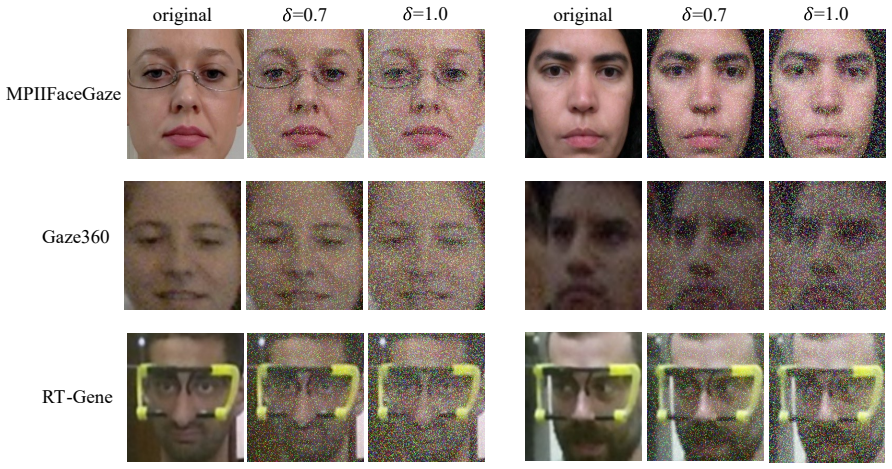
- The EM module's robustness to Gaussian noise (angle errors degrade only roughly 0.2–0.7° on MPIIFaceGaze and 0.4–0.9° on Gaze360) suggests the architecture is suited to real-world images with sensor noise or occlusion.
- The comparison implies that receptive-field expansion (via GAM) and latent-feature refinement (via EM) are roughly equally important, since ablating either one costs a similar amount of accuracy.
Reading between the lines
- Because the reported margins over GazeNAS-ETH are only 0.08° to 0.24°, a controlled re-run under identical training splits, pretraining, and preprocessing could easily reverse the ranking; the 'data efficiency' conclusion would be stronger if the baselines had been retrained on the same 50% subset.
- The EM module, as implemented, is a feature-refinement block rather than a full generative model fit; ablating the number of EM iterations (including a zero-iteration pass) would show whether the improvement comes from the EM principle or simply from the extra computation.
- If the generalization benefit is real, it should become more pronounced as the training fraction drops; testing at 25% and 10% data would provide a direct, falsifiable extension.
- GAM borrows shifted-window self-attention from the Swin design, so the comparison against SE and CBAM mainly shows that some form of windowed self-attention helps; swapping GAM for a standard Swin attention module at equal FLOPs would isolate what the GAM-specific arrangement adds.
Signed reviews
Editorial analysis
A structured set of objections, weighed in public.
Referee Report
Summary. The paper proposes EM-Net, a lightweight gaze estimation network built on an improved MobileNetV3 backbone and augmented with a Global Attention Mechanism (GAM) and an Expectation Maximization (EM) module. The authors claim that EM-Net achieves lower angular errors than GazeNAS-ETH and other baselines on MPIIFaceGaze, Gaze360, and RT-Gene while using only 50% of the training data, and that it is robust to Gaussian noise. The experiments report single-run angular errors, parameter counts, FLOPs, and inference times, along with ablation studies and attention-replacement comparisons.
Significance. If the central claims were properly validated, the paper would contribute a lightweight gaze estimation model with a notably low parameter count (2.93M) and computational cost (0.31 GFLOPs), and would demonstrate an interesting data-efficiency property via the EM module. However, the current evidence is not convincing: the headline comparison against published baseline numbers is uncontrolled, the EM module is described only at the level of generic EM equations without a concrete instantiation, and all quantitative results lack error bars or repeated-seed runs. The ablation and attention comparisons show plausible trends, but the small differences (as low as 0.08°) could easily be within run-to-run variance.
major comments (3)
- [Section 4.3, Table 2] The central claim of a 0.08°–0.24° improvement over GazeNAS-ETH using half the training data is based on baseline angular errors cited from the original papers, not from re-running those models under EM-Net's protocol. EM-Net differs in two material ways: it uses only odd-indexed 50% of the training samples (§4.2) and it initializes from ETH-XGaze pretraining (§4.1). Without a same-protocol re-run of GazeNAS-ETH (or at least training GazeNAS-ETH on the same 50% subset with the same pretraining), the comparison is not controlled, and the claimed margins are small enough that they could be explained by training noise or the pretraining initialization. The '50% data' advantage is therefore unverified.
- [Section 3.2, Algorithm 1] The EM module is not actually specified as a network layer. Algorithm 1 states the textbook EM update equations for a generic probabilistic model P(Y,Z|θ), but the paper does not define what Y, Z, and θ are in the context of the feature maps f∈R^{4×4×540}, nor how the E-step and M-step are computed on those tensors. The line 'θ(i) = Conv1×1' is not a meaningful initialization of model parameters for a probability model. Consequently, the module is not reproducible, and the assertion that it 'retains the characteristic that the EM algorithm is good at processing unobserved variables' (§4.3) has no concrete algorithmic content.
- [Sections 4.3, 4.4, 4.6 (Tables 2, 4, 6)] All angular errors in the paper are reported without standard deviations, confidence intervals, or the number of repeated runs. This is particularly problematic because the central comparison yields differences as small as 0.08° (MPIIFaceGaze) and the GAM-vs-SE/CBAM and ablation differences in Tables 4 and 6 are 0.10°–0.74°. Without error bars, one cannot distinguish the proposed method's reported improvements from run-to-run variation, especially given the known variance of gaze estimation results across training runs.
minor comments (7)
- [Algorithm 1] In the E-step, Q(θ, θ(i+1)) should be Q(θ, θ(i)); the same index correction applies to the maximization step.
- [Section 4.3] The percentage improvement for Gaze360 is reported as 2.2%, but 0.24° relative to 10.52° is approximately 2.28%; the rounding should be made consistent.
- [Section 4.2] Clarify whether the odd-indexed sampling is applied only to the training split or to the entire dataset, and specify how the test set is constructed; this affects the comparability of the reported errors.
- [Section 4.5] State explicitly whether Gaussian noise is added to the test images as well as the training images in the robustness experiments, and whether the same noise level is used for both.
- [Section 3.1.2] The GAM appears to combine SE-like channel attention with Swin Transformer's shifted-window self-attention; the novelty relative to the Swin Transformer block should be discussed, and a direct comparison with a standard Swin block would be more informative than the SE/CBAM comparison alone.
- [Table 3] The text states that inference times are computed under the same hardware conditions, but it is unclear whether the baseline times are re-measured or taken from their original papers; the subsequent sentence saying parameters and FLOPs are cited from original papers adds ambiguity.
- [General] The paper contains numerous English grammar and missing-article errors (e.g., 'the proposed Global Attention Mechanism(GAM) is added to extract features related to gaze estimation to improve the model's ability'); a careful proofread is needed.
Circularity Check
No circularity: EM-Net's accuracy and data-efficiency claims are empirical comparisons against external published baselines, not reductions of the paper's own equations or self-citations.
full rationale
The paper's claimed contributions are architectural (GAM, EM module, lightweight EM-Net) and empirical (angular error, parameters, FLOPs, inference time, robustness). None of the central claims is defined in terms of the target result. The EM module in Algorithm 1 restates the standard expectation-maximization update for a latent-variable model and is used as a feature-refinement layer; the final gaze output is produced by a learned MLP regression (Eq. 3), not by solving the EM equations for the evaluation metric. The comparison in Table 2 uses angular errors from original papers, while EM-Net is trained on 50% odd-indexed samples with ETH-XGaze pretraining; this is a protocol-comparability weakness that could affect the validity of the reported margins, but it is not circularity because the EM-Net numbers are independently measured on held-out data and are not constructed from the baseline numbers. No load-bearing self-citation was found: references to prior EM routing work (e.g., [27]) are background, not justification of this paper's results. The ablation and attention-comparison experiments are self-consistent empirical evaluations. Therefore the appropriate circularity score is 0.
Assumptions & free parameters
free parameters (3)
- EM module iteration count =
Not reported
- Conv1x1 output channels before EM module =
540
- 50% training subset parity =
odd serial numbers
assumptions (4)
- ad hoc to paper The textbook EM update in Algorithm 1 can be instantiated as the feature-refinement module used in EM-Net.
- domain assumption Baseline angular errors in Table 2 are comparable to EM-Net's errors under the same evaluation setup.
- domain assumption Odd-serial-number interval sampling yields a representative 50% training subset.
- domain assumption Pretraining on ETH-XGaze transfers to MPIIFaceGaze, Gaze360, and RT-Gene.
invented entities (2)
-
EM module
-
Global Attention Mechanism (GAM)
Cite this review
Pith. "Pith review of EM-Net: Gaze Estimation with Expectation Maximization Algorithm." pith.science (2026). https://pith.science/paper/B2IWUKI2
@misc{pith2026241208074,
  author       = {Pith},
  title        = {Pith review of: EM-Net: Gaze Estimation with Expectation Maximization Algorithm},
  year         = {2026},
  howpublished = {\url{https://pith.science/paper/B2IWUKI2}},
  note         = {Machine review of arXiv:2412.08074}
}
read the original abstract
In recent years, the accuracy of gaze estimation techniques has gradually improved, but existing methods often rely on large datasets or large models to improve performance, which leads to high demands on computational resources. In terms of this issue, this paper proposes a lightweight gaze estimation model EM-Net based on deep learning and traditional machine learning algorithms Expectation Maximization algorithm. First, the proposed Global Attention Mechanism(GAM) is added to extract features related to gaze estimation to improve the model's ability to capture global dependencies and thus improve its performance. Second, by learning hierarchical feature representations through the EM module, the model has strong generalization ability, which reduces the need for sample size. Experiments have confirmed that, on the premise of using only 50% of the training data, EM-Net improves the performance of Gaze360, MPIIFaceGaze, and RT-Gene datasets by 2.2%, 2.02%, and 2.03%, respectively, compared with GazeNAS-ETH. It also shows good robustness in the face of Gaussian noise interference.
Figures


Figures from the paper (6 more)




Reference graph
Works this paper leans on
-
[1]
Appearance-based gaze estimation for asd diagnosis,
J. Li, Z. Chen, Y . Zhong, H.-K. Lam, J. Han, G. Ouyang, X. Li, and H. Liu, “Appearance-based gaze estimation for asd diagnosis,”IEEE Transactions on Cybernetics, vol. 52, no. 7, pp. 6504–6517, 2022
work page 2022
-
[2]
Detection of malpractice in e-exams by head pose and gaze estimation,
C. S. Indi, V . Pritham, V . Acharya, and K. Prakasha, “Detection of malpractice in e-exams by head pose and gaze estimation,”International Journal of Emerg- ing Technologies in Learning (Online), vol. 16, no. 8, p. 47, 2021
work page 2021
-
[3]
S. AlKheder, “Experimental road safety study of the actual driver reaction to the street ads using eye tracking, multiple linear regression and decision trees methods,” Expert Systems with Applications, vol. 252, p. 124222, 2024
work page 2024
-
[4]
W. Khan, L. Topham, H. Alsmadi, A. Al Kafri, and H. Kolivand, “Deep face profiler (defap): Towards explicit, non-restrained, non-invasive, facial and gaze comprehension,” Expert Systems with Applications , vol. 254, p. 124425, 2024
work page 2024
-
[5]
Local eye-net: An attention based deep learning architecture for localization of eyes,
S. Maiti and A. Gupta, “Local eye-net: An attention based deep learning architecture for localization of eyes,” Expert Systems with Applications , vol. 239, p. 122416, 2024
work page 2024
-
[6]
Eye-model-based gaze estimation by rgb-d camera,
L. Jianfeng and L. Shigang, “Eye-model-based gaze estimation by rgb-d camera,” in Proceedings of the IEEE Conference on Computer Vision and Pattern Recognition Workshops, 2014, pp. 592–596
work page 2014
-
[7]
3d eye model-based gaze estimation from a depth sensor,
X. Zhou, H. Cai, Z. Shao, H. Yu, and H. Liu, “3d eye model-based gaze estimation from a depth sensor,” in 2016 IEEE international conference on robotics and biomimetics (ROBIO). IEEE, 2016, pp. 369–374
work page 2016
-
[8]
Two-eye model- based gaze estimation from a kinect sensor,
X. Zhou, H. Cai, Y . Li, and H. Liu, “Two-eye model- based gaze estimation from a kinect sensor,” in 2017 IEEE International Conference on Robotics and Au- tomation (ICRA). IEEE, 2017, pp. 1646–1653
work page 2017
Show all 43 references
-
[9]
Eye-gaze estimation under var- ious head positions and iris states,
R. Jafari and D. Ziou, “Eye-gaze estimation under var- ious head positions and iris states,” Expert Systems with Applications, vol. 42, no. 1, pp. 510–518, 2015
2015
-
[10]
Appearance-based gaze estimation in the wild,
X. Zhang, Y . Sugano, M. Fritz, and A. Bulling, “Appearance-based gaze estimation in the wild,” in Proceedings of the IEEE conference on computer vi- sion and pattern recognition, 2015, pp. 4511–4520
2015
-
[11]
Mpiigaze: Real-world dataset and deep appearance-based gaze estimation,
——, “Mpiigaze: Real-world dataset and deep appearance-based gaze estimation,” IEEE transac- tions on pattern analysis and machine intelligence , vol. 41, no. 1, pp. 162–175, 2017
2017
-
[12]
Appearance-based gaze estimation via evaluation-guided asymmetric re- gression,
Y . Cheng, F. Lu, and X. Zhang, “Appearance-based gaze estimation via evaluation-guided asymmetric re- gression,” in Proceedings of the European conference on computer vision (ECCV), 2018, pp. 100–115
2018
-
[13]
Puregaze: Purify- ing gaze feature for generalizable gaze estimation,
Y . Cheng, Y . Bao, and F. Lu, “Puregaze: Purify- ing gaze feature for generalizable gaze estimation,” in Proceedings of the AAAI Conference on Artificial In- telligence, vol. 36, no. 1, 2022, pp. 436–443
2022
-
[14]
Efe: End-to-end frame-to-gaze estima- tion,
H. Balim, S. Park, X. Wang, X. Zhang, and O. Hilliges, “Efe: End-to-end frame-to-gaze estima- tion,” in Proceedings of the IEEE/CVF Conference on Computer Vision and Pattern Recognition , 2023, pp. 2687–2696
2023
-
[15]
Rotation- constrained cross-view feature fusion for multi-view appearance-based gaze estimation,
Y . Hisadome, T. Wu, J. Qin, and Y . Sugano, “Rotation- constrained cross-view feature fusion for multi-view appearance-based gaze estimation,” in Proceedings of the IEEE/CVF Winter Conference on Applications of Computer Vision, 2024, pp. 5985–5994
2024
-
[16]
Eg-net: Appearance-based eye gaze estimation using an efficient gaze network with attention mechanism,
X. Wu, L. Li, H. Zhu, G. Zhou, L. Li, F. Su, S. He, Y . Wang, and X. Long, “Eg-net: Appearance-based eye gaze estimation using an efficient gaze network with attention mechanism,” Expert Systems with Ap- plications, p. 122363, 2023
2023
-
[17]
Searching for mobilenetv3,
A. Howard, M. Sandler, G. Chu, L.-C. Chen, B. Chen, M. Tan, W. Wang, Y . Zhu, R. Pang, V . Vasudevan et al., “Searching for mobilenetv3,” in Proceedings of the IEEE/CVF international conference on computer vision, 2019, pp. 1314–1324
2019
-
[18]
Mobilevitv3: Mobile-friendly vision transformer with simple and effective fusion of local, global and input features,
S. N. Wadekar and A. Chaurasia, “Mobilevitv3: Mobile-friendly vision transformer with simple and effective fusion of local, global and input features,” arXiv preprint arXiv:2209.15159, 2022
2022 arXiv
-
[19]
Fr- net: A light-weight fft residual net for gaze estima- tion,
T. Xu, B. Wu, R. Fan, Y . Zhou, and D. Huang, “Fr- net: A light-weight fft residual net for gaze estima- tion,” arXiv preprint arXiv:2305.11875, 2023
2023 arXiv
-
[20]
It’s written all over your face: Full-face appearance-based gaze estimation,
X. Zhang, Y . Sugano, M. Fritz, and A. Bulling, “It’s written all over your face: Full-face appearance-based gaze estimation,” in Proceedings of the IEEE con- ference on computer vision and pattern recognition workshops, 2017, pp. 51–60
2017
-
[21]
L2cs-net: Fine-grained gaze estimation in unconstrained environments,
A. A. Abdelrahman, T. Hempel, A. Khalifa, A. Al- Hamadi, and L. Dinges, “L2cs-net: Fine-grained gaze estimation in unconstrained environments,” in 2023 8th International Conference on Frontiers of Signal Processing (ICFSP). IEEE, 2023, pp. 98–102
2023
-
[22]
Source- free adaptive gaze estimation by uncertainty reduc- tion,
X. Cai, J. Zeng, S. Shan, and X. Chen, “Source- free adaptive gaze estimation by uncertainty reduc- tion,” in Proceedings of the IEEE/CVF Conference on Computer Vision and Pattern Recognition , 2023, pp. 22 035–22 045
2023
-
[23]
Attention is all you need,
A. Vaswani, N. Shazeer, N. Parmar, J. Uszkoreit, L. Jones, A. N. Gomez, Ł. Kaiser, and I. Polosukhin, “Attention is all you need,” Advances in neural infor- mation processing systems, vol. 30, 2017
2017
-
[24]
Squeeze-and-excitation networks,
J. Hu, L. Shen, and G. Sun, “Squeeze-and-excitation networks,” in Proceedings of the IEEE conference on computer vision and pattern recognition , 2018, pp. 7132–7141
2018
-
[25]
Gated channel transformation for visual recognition,
Z. Yang, L. Zhu, Y . Wu, and Y . Yang, “Gated channel transformation for visual recognition,” inProceedings of the IEEE/CVF conference on computer vision and pattern recognition, 2020, pp. 11 794–11 803
2020
-
[26]
Matrix cap- sules with em routing,
G. E. Hinton, S. Sabour, and N. Frosst, “Matrix cap- sules with em routing,” inInternational conference on learning representations, 2018
2018
-
[27]
Mirn: A multi-interest retrieval network with sequence-to-interest em routing,
X. Zhang, J. Liu, S. Chang, P. Gong, Z. Wu, and B. Han, “Mirn: A multi-interest retrieval network with sequence-to-interest em routing,” Plos one , vol. 18, no. 2, p. e0281275, 2023
2023
-
[28]
Swin transformer: Hierarchical vision transformer using shifted windows,
Z. Liu, Y . Lin, Y . Cao, H. Hu, Y . Wei, Z. Zhang, S. Lin, and B. Guo, “Swin transformer: Hierarchical vision transformer using shifted windows,” inProceedings of the IEEE/CVF international conference on computer vision, 2021, pp. 10 012–10 022
2021
-
[29]
Adam: A method for stochastic optimization,
D. P. Kingma and J. Ba, “Adam: A method for stochastic optimization,” arXiv preprint arXiv:1412.6980, 2014
2014 arXiv
-
[30]
Eth-xgaze: A large scale dataset for gaze estimation under extreme head pose and gaze varia- tion,
X. Zhang, S. Park, T. Beeler, D. Bradley, S. Tang, and O. Hilliges, “Eth-xgaze: A large scale dataset for gaze estimation under extreme head pose and gaze varia- tion,” in Computer Vision–ECCV 2020: 16th Euro- pean Conference, Glasgow, UK, August 23–28, 2020, Proceedings, Part...
2020
-
[31]
Gaze360: Physically unconstrained gaze estimation in the wild,
P. Kellnhofer, A. Recasens, S. Stent, W. Matusik, and A. Torralba, “Gaze360: Physically unconstrained gaze estimation in the wild,” in Proceedings of the IEEE/CVF international conference on computer vi- sion, 2019, pp. 6912–6921
2019
-
[32]
Rt-gene: Real-time eye gaze estimation in natural environ- ments,
T. Fischer, H. J. Chang, and Y . Demiris, “Rt-gene: Real-time eye gaze estimation in natural environ- ments,” in Proceedings of the European conference on computer vision (ECCV), 2018, pp. 334–352
2018
-
[33]
Searching efficient neural architecture with multi-resolution fusion transformer for appearance-based gaze estimation,
V . Nagpure and K. Okuma, “Searching efficient neural architecture with multi-resolution fusion transformer for appearance-based gaze estimation,” in Proceed- ings of the IEEE/CVF winter conference on applica- tions of computer vision, 2023, pp. 890–899
2023
-
[34]
Gaze-swin: Enhancing gaze estimation with a hybrid cnn-transformer network and dropkey mechanism,
R. Zhao, Y . Wang, S. Luo, S. Shou, and P. Tang, “Gaze-swin: Enhancing gaze estimation with a hybrid cnn-transformer network and dropkey mechanism,” Electronics, vol. 13, no. 2, p. 328, 2024
2024
-
[35]
Gaze estimation using trans- former,
Y . Cheng and F. Lu, “Gaze estimation using trans- former,” in 2022 26th International Conference on Pattern Recognition (ICPR). IEEE, 2022, pp. 3341– 3347
2022
-
[36]
Appearance-based gaze esti- mation using dilated-convolutions,
Z. Chen and B. E. Shi, “Appearance-based gaze esti- mation using dilated-convolutions,” in Asian Confer- ence on Computer Vision. Springer, 2018, pp. 309– 324
2018
-
[37]
A coarse-to-fine adaptive network for appearance-based gaze estimation,
Y . Cheng, S. Huang, F. Wang, C. Qian, and F. Lu, “A coarse-to-fine adaptive network for appearance-based gaze estimation,” in Proceedings of the AAAI Confer- ence on Artificial Intelligence , vol. 34, no. 07, 2020, pp. 10 623–10 630
2020
-
[38]
Towards self-supervised gaze estimation,
A. Farkhondeh, C. Palmero, S. Scardapane, and S. Es- calera, “Towards self-supervised gaze estimation,” arXiv preprint arXiv:2203.10974, 2022
2022 arXiv
-
[39]
Self-attention with convolution and deconvolution for efficient eye gaze estimation from a full face image,
J. O Oh, H. J. Chang, and S.-I. Choi, “Self-attention with convolution and deconvolution for efficient eye gaze estimation from a full face image,” in Proceed- ings of the IEEE/CVF Conference on Computer Vision and Pattern Recognition, 2022, pp. 4992–5000
2022
-
[40]
Gazecaps: Gaze estimation with self-attention-routed capsules,
H. Wang, J. O. Oh, H. J. Chang, J. H. Na, M. Tae, Z. Zhang, and S.-I. Choi, “Gazecaps: Gaze estimation with self-attention-routed capsules,” inProceedings of the IEEE/CVF conference on computer vision and pat- tern recognition, 2023, pp. 2668–2676
2023
-
[41]
Gaze es- timation via strip pooling and multi-criss-cross atten- tion networks,
C. Yan, W. Pan, C. Xu, S. Dai, and X. Li, “Gaze es- timation via strip pooling and multi-criss-cross atten- tion networks,” Applied Sciences, vol. 13, no. 10, p. 5901, 2023
2023
-
[42]
Scaling up your kernels to 31x31: Revisiting large kernel design in cnns,
X. Ding, X. Zhang, J. Han, and G. Ding, “Scaling up your kernels to 31x31: Revisiting large kernel design in cnns,” in Proceedings of the IEEE/CVF conference on computer vision and pattern recognition, 2022, pp. 11 963–11 975
2022
-
[43]
Cbam: Convolutional block attention module,
S. Woo, J. Park, J.-Y . Lee, and I. S. Kweon, “Cbam: Convolutional block attention module,” in Proceed- ings of the European conference on computer vision (ECCV), 2018, pp. 3–19
2018
Reviewed August 11, 2026 · model on record in the stance chip above.
Discussion (0). Continue with ORCID to comment.