REVIEW 3 major objections 4 minor 46 references
TinyHelen's First Curriculum: Training and Evaluating Tiny Language Models in a Simpler Language Environment
T0 review · 3 major / 4 minor · reviewed 2026-08-10 · deepseek-v4-flash
Pith's one-line read Pre-training on simplified, lower-noise text lets tiny language models beat models trained on 41% more data.
desk verdict Useful simplified-language dataset testbed, but the headline efficiency claim is only demonstrated on a benchmark built with the same GPT-4 simplification pipeline, so the general claim needs validation on original tasks. read the letter →
The pith
A machine-rendered reading of the paper's core claim, the machinery that carries it, and where it could break.
The reading
What carries the argument
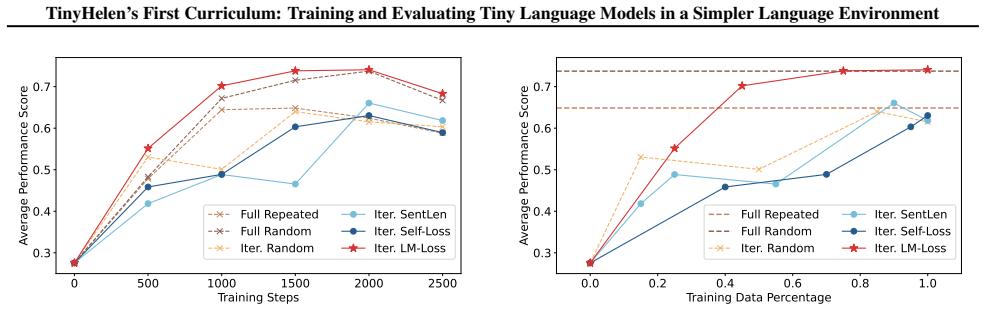
The load-bearing mechanism is the text-revision pipeline: GPT-4 rewrites each sample to use a 2,000-word vocabulary, simplify grammar and world references (names, places, times), strip ads and formatting noise, and preserve genre-specific structure. A companion label-verification step (Algorithm 2) keeps a simplified GLUE sample only when an LLM predicting the label matches the original label, targeting 70% coverage of each task. The paper frames dataset complexity as information entropy: simplification lowers n-gram entropy, and an appendix argument bounds dataset complexity below by entropy, making entropy reduction the principled target. Curriculum experiments use a 1M-parameter LLAMA proxy and an iterative sample-introduction schedule built from three difficulty metrics (sentence length, self-loss, and a reference LM's loss).
What would settle it
Evaluate the same 14M models on the original, unsimplified GLUE benchmark instead of LEANER-GLUE: if the leaner-pretrained model no longer beats the original-pretrained model, the learning-efficiency gain is an artifact of the simplified benchmark rather than of the training data. A cheaper check is to build a version of LEANER-GLUE without the LLM label-verification step (Algorithm 2) and see whether the performance advantage persists.
Extended reading notes
Core claim
The paper's central discovery is that 'leaner' pre-training improves the learning efficiency of tiny language models. Every architecture tested at 14M parameters (BERT, XLNet, LLAMA, and Mamba) scores higher on the LEANER-GLUE benchmark when pre-trained on the 71M-token LEANER-Pretrain corpus than on the 100M-token original corpus, even though the leaner corpus is 41% smaller. The same pattern appears for instruction-following: a 14M LLAMA pre-trained and instruction-tuned on leaner data beats the original-data recipe on grammar, coherence, and specificity. The paper also reports that an iterative curriculum driven by an external LM's loss reaches peak downstream performance roughly 20% earlier in training steps and with roughly 20% less data than training on all data in random order.
Load-bearing premise
The load-bearing premise is that the GPT-4-simplified GLUE benchmark preserves the original tasks' construct and labels well enough that higher scores on the simplified version reflect genuine gains in linguistic ability, rather than an artifact of training and testing on similarly simplified data.
Editorial extensions
If this is right
- If the claim holds, simpler and cleaner data is a viable route to smaller models: effective data volume for basic linguistic competence can be cut by roughly 40% without hurting downstream scores.
- The LEANER suite provides a low-cost proxy environment for comparing model architectures and training techniques at the 1M-14M parameter scale, and the authors argue the resulting rankings may transfer to larger models.
- The curriculum result implies pre-training schedules can save about 20% of steps and 20% of data by introducing samples in an order derived from a reference model's loss.
- A simplified benchmark like LEANER-GLUE opens the door to zero-shot evaluation of tiny models within the same vocabulary and knowledge scope used for training.
Reading between the lines
- The paper's central comparison is evaluated only on the simplified benchmark, which was built with the same GPT-4 style of simplification as the training data; a test on the original, unsimplified GLUE tasks would separate genuine learning-efficiency gains from artifacts of train-test distribution match.
- The improvement could come from dataset distribution shift rather than simplification per se; comparing against a randomly sampled 71M-token subset of the original corpus would distinguish 'less data' from 'simpler data'.
- The label-verification step in LEANER-GLUE curation may select systematically easier samples; ablating that step (retaining simplified samples regardless of LLM label agreement) would show whether the benchmark's difficulty or its construction drives the reported gains.
Editorial analysis
A structured set of objections, weighed in public.
Referee Report
Summary. The paper introduces LEANER, a suite of simplified language datasets for tiny language models: a 71M-token pre-training corpus, a 7M-token instruction-tuning corpus, a simplified version of GLUE (LEANER-GLUE), and a generated instruction-following benchmark (LEANER-Eval). The datasets are produced by prompting GPT-4 to rewrite source texts with a preschool-level vocabulary (≤2,000 words), simplified grammar, and a constrained world setting. The authors train 14M-parameter BERT, LLAMA, XLNET, and MAMBA models on either LEANER-Pretrain or Original-Pretrain, and report that LEANER pre-training yields higher average scores on LEANER-GLUE despite the smaller corpus size. They also compare instruction-following quality under four data recipes using a 14M LLAMA and explore curriculum-learning strategies for pre-training a 1M LLAMA on LEANER-Pretrain. The central claim is that a smaller, simplified pre-training corpus improves learning efficiency and that simplified environments can serve as resource-efficient proxies for larger-scale LM research.
Significance. If the central claim holds, the paper would contribute a useful, publicly released resource for low-resource LM research: the dataset suite, code, and detailed training configurations are all made available, and the architecture-comparison and curriculum-learning experiments are the kind of reproducible study that the community needs. The paper also makes an explicit falsifiable prediction, namely that leaner pre-training outperforms larger original pre-training on downstream linguistic tasks. However, the significance is conditional on the validity of LEANER-GLUE as a benchmark that preserves the construct of the original GLUE tasks. The paper does not report any evaluation on original GLUE, and the benchmark is constructed with the same GPT-4 simplification pipeline as the training data, so the reported efficiency gain may reflect train/test distribution matching rather than general learning efficiency. The extensive experimental documentation and the release of datasets are strengths, but the central evaluation strategy currently prevents the main claim from being accepted as established.
major comments (3)
- [Section 3.2 (Algorithm 2) and Section 4.1.3 (Table 4)] The central claim that leaner pre-training improves learning efficiency is supported only by scores on LEANER-GLUE, a benchmark built with the same GPT-4 simplification pipeline as LEANER-Pretrain: both use the same preschool-level, ≤2,000-word vocabulary prompt and the same world-setting simplification guidelines (Section 3.1.2 and Appendix G). Algorithm 2 retains a revised sample only if GPT-4 can still reproduce the original label after simplification; this filters out samples that GPT-4 cannot label, but it does not verify that the simplified text preserves the original task construct, difficulty, or label semantics. A model pre-trained on simplified text may therefore score higher on LEANER-GLUE simply because it is closer in distribution to the simplified benchmark than Original-Pretrain is. The paper reports no results on original GLUE and no human or external validation of label preservation. I would like to see at least a subset evaluation on the original GLUE tasks using the same fine-tuning protocol, or a human-validated construct-preservation study on a sample of each of the eight LEANER-GLUE tasks; without one of these, the advantage shown in Table 4 is not evidence of general learning efficiency.
- [Section 4.1.1 (Tokenizer section)] All models, including those pre-trained on Original-Pretrain, use a tokenizer retrained on the LEANER-Training corpus with a vocabulary limited to 2K tokens. This creates a potential confound in the architecture-comparison experiment: the original web, book, textbook, and conversation text is tokenized with a vocabulary built from simplified, preschool-level data, which may inflate tokenization length, increase out-of-vocabulary replacements, and degrade models trained on Original-Pretrain. The paper does not report out-of-vocabulary rates or tokenization statistics on the original corpus. A fair comparison should train two matched-vocabulary tokenizers (one on each corpus), or demonstrate that the LEANER-trained tokenizer does not systematically disadvantage the Original-Pretrain condition.
- [Section 4.2 (Table 5) and Appendix G.3] The instruction-following experiment in EXP2 is evaluated by GPT-4 using a grammar/coherence/specificity rubric, on questions that were themselves generated by GPT-4 from LEANER-Instruct examples. The evaluation prompt explicitly asks the grader to be lenient and to reflect relative differences between models, which invites evaluator bias. The paper provides no evidence that the rubric correlates with human judgments, and the reported differences between recipes are small (e.g., +0.6 grammar for LEANER-Ori over Ori-Ori out of 5). A human-rated subset of at least 100 responses with inter-annotator agreement would make these claims testable; without it, the instruction-following results are not robust evidence for the paper's second research question.
minor comments (4)
- [Section 4.1.3 and Abstract] The claim that LEANER-Pretrain is '41% smaller' is arithmetically incorrect: 71M tokens versus 100M tokens is a 29% reduction, not 41%. This quantitative description should be corrected wherever it appears.
- [Table 4 and Appendix H.2] Table 4 reports averages over five random seeds but gives no standard deviations or confidence intervals; given the small model sizes and the variance-prone WNLI task mentioned in Section 4.1.2, the reader cannot assess whether the observed differences between LEANER and Ori pre-training are significant.
- [Section 7 (Limitations)] The Limitations section acknowledges that 71M tokens are insufficient for instruction-following and that LLM rewriting introduces bias, but it does not address the more fundamental issue that LEANER-GLUE is built with the same simplification pipeline as LEANER-Pretrain; a brief statement of this limitation and its implications for interpreting Table 4 would be appropriate.
- [Throughout the text] There are several typographical and formatting errors, including 'preforms' for 'performs' in the contribution list of Section 1, the inconsistent capitalization 'LEANER -glue' in Appendix H, and the unusual spacing in 'L EANER' throughout the tables and text; these should be cleaned up.
Circularity Check
No significant circularity: the LEANER advantage is an empirical result, though the shared GPT-4 simplification pipeline between training and evaluation data limits external validity.
full rationale
None of the paper's claimed derivations reduces to its inputs by construction. The central claim (Section 4.1.3) that LEANER-Pretrain improves downstream scores over Original-Pretrain is an empirical comparison on a shared benchmark; both pre-training corpora are evaluated under identical fine-tuning protocols, and the outcome is not logically forced (e.g., Ori-Pretrained XLNET outperforms LEANER-Pretrained MAMBA in the same table). The LEANER-GLUE benchmark is constructed with the same GPT-4 simplification style as LEANER-Pretrain (Sections 3.1.2 and G.2), which raises a legitimate external-validity concern: gains may reflect style matching rather than general learning efficiency, and no original-GLUE evaluation is reported. However, a confound is not circularity: the benchmark is not a fitted parameter, the claim is not defined in terms of the benchmark, and no self-citation or imported uniqueness result is load-bearing. The '41% smaller' wording is arithmetically wrong (71M vs 100M is 29% smaller), but this is an error, not a circular step. The entropy bounds in Appendix B are mathematical consequences of the defined complexity measure, not a circular validation of the empirical claims. Accordingly, no circular step is identified.
Assumptions & free parameters
free parameters (4)
- Vocabulary size limit =
2000 words
- LEANER-GLUE coverage ratio r =
70%
- LEANER-Eval dedup similarity threshold s =
0.876
- Curriculum update step pi =
5% increments
assumptions (4)
- domain assumption GPT-4 revision preserves the semantic content and labels of original texts and GLUE tasks
- domain assumption Reducing vocabulary and simplifying grammar lowers information entropy and improves LM learning efficiency
- standard math The entropy-based complexity proof in Appendix B is correct and relevant
- domain assumption 100M tokens is comparable to a human adolescent's language exposure
Cite this review
Pith. "Pith review of TinyHelen's First Curriculum: Training and Evaluating Tiny Language Models in a Simpler Language Environment." pith.science (2026). https://pith.science/paper/B2PZYEPM
@misc{pith2026250100522,
  author       = {Pith},
  title        = {Pith review of: TinyHelen's First Curriculum: Training and Evaluating Tiny Language Models in a Simpler Language Environment},
  year         = {2026},
  howpublished = {\url{https://pith.science/paper/B2PZYEPM}},
  note         = {Machine review of arXiv:2501.00522}
}
read the original abstract
Training language models (LMs) and their application agents is increasingly costly due to large datasets and models, making test failures difficult to bear. Simplified language environments serve as primordial training and testing grounds, retaining essential commonsense and communication skills but in a more digestible form, potentially enhancing the learning efficiency of LMs, and thus reducing the required model size and data volume for effective training and evaluation. In these simplified language environments, workable strategies for small models, datasets, and agents may be adaptable to larger models, datasets, and agents in complex language environments. To create such environments, we focus on two aspects: i) minimizing language dataset noise and complexity, and ii) preserving the essential text distribution characteristics. Unlike previous methods, we propose a pipeline to refine text data by eliminating noise, minimizing vocabulary, and maintaining genre-specific patterns (e.g., for books, conversation, code, etc.). Implementing this pipeline with large LMs, we have created a leaner suite of LM training and evaluation datasets: 71M Leaner-Pretrain, 7M Leaner-Instruct, Leaner-Glue for assessing linguistic proficiency, and Leaner-Eval for testing instruction-following ability. Our experiments show that leaner pre-training boosts LM learning efficiency. Tiny LMs trained on these datasets outperform those trained on original datasets in instruction-following across different language granularity levels. Moreover, the Leaner-Pretrain dataset's alignment with conventional large LM training sets enables resource-optimized analysis of how learning objectives, model architectures, and training techniques impact performance on language modeling and downstream tasks. Our code and datasets are available at https://github.com/EmpathYang/TinyHelen.git.
Figures

Reference graph
Works this paper leans on
-
[1]
Content of the first problem
-
[2]
Content of the second problem ... n. Content of the nth problem [DIFFICULTY GRADING]
-
[3]
Children will love the best milk out there
-
[5]
Children will love the best milk out every day
-
[6]
Difficulty grading of the first problem
-
[7]
Difficulty grading of the second problem ... n. Difficulty grading of the nth problem [PROBLEMS] {problems} [DIFFICULTY GRADING] E Dataset Statistics The statistics for the original datasets are presented in Table 7. These figures represent the number of tokens sampled from the original data sources for the subsequent process. Statistics for the L EANER -...
work page 2000
-
[8]
Having a better day: When you leave the behind, you feel happy and red. It makes you feel happy and full of joy. 2. Move and play: Paying attention can make you feel happy. It makes you feel happy and less worried. 3. Spending daily play: Doing sports can help you feel less stressed. It makes you calm down and happy. 4. Doing fun things: Doing things like...
work page 2000
-
[9]
Come up with a list of ingredients or ingredients that would be perfect for every child to enjoy
Show all 46 references
-
[10]
Children will love anything in your life beforehand
-
[14]
Cheertitle and gift for a child
-
[15]
Camping camping camping camping camping camping camping camping camping camping camping camping camping camps
-
[16]
Camping camping camping camps
-
[17]
Thank you?
Camping camping camping camps. LEANER -LEANER Model One way to give one gift to every person in the world could be a gift that helps many people. This would be used to keep the world safe and help make the world a pretty and healthy place. A gift could also give people a place...
-
[18]
This can help you stay motivated and focused
Strongness and self-control: Take time to think about what you want to learn and how to be more. This can help you stay motivated and focused. Take time for self-control and relaxation, and focus on your perspective on what you can expect
-
[19]
It can help you stay motivated and focused on your personal goals and personal life
Relaxation and self-control: Relaxation and self-control can also help you better understand the world around you. It can help you stay motivated and focused on your personal goals and personal life. It can also help you stay motivated and focused on your personal tasks. LEANE...
-
[20]
What you think of find in a shop: a
Brown Ori-LEANER Model 1. What you think of find in a shop: a. What is the name of the shop? b. What is the place in the town b. Who owns and does shops
-
[21]
Talk about this for you in the town system on the town own a
Where do shops look for this? (The place in the town that is called the place where people areutis){ . Talk about this for you in the town system on the town own a. What is the place in the town that is popular or have at least 1,200 million people?
-
[22]
Ori-Ori Model epson/family
What you think of this place in the town that is popular or have bought or looked in a new way that made the shop money. Ori-Ori Model epson/family
-
[23]
On average, a weekly basket and a day allotted midpoint cannot be overwhelmed or tilted, with a short break of time spent in a day
-
[24]
Enhances work-life balance and strengthens relationships
-
[25]
We all have stories to tell, but it takes courage to share them
Promotes a healthy diet to be rationed, balanced and maintained. J.2 Training Similarity 7-8 J.2.1 C AN YOU THINK OF A STORY AND TELL IT IN YOUR OWN WORDS ? Similar Questions in Instruction-tuning Data ({Instruction Data Source}: {Cosine Similarity}) • Read the simple story, t...
-
[26]
28 TinyHelen’s First Curriculum: Training and Evaluating Tiny Language Models in a Simpler Language Environment
Plan a fun outing or cooking: Apparemet is a great way to spend time with your family, and you can create your own specialtime. 28 TinyHelen’s First Curriculum: Training and Evaluating Tiny Language Models in a Simpler Language Environment
-
[27]
This is a great way to get some foods from the loved ones
Plan a surprise weekend trip: Choose a theme or place to visit and enjoy the great outdoors. This is a great way to get some foods from the loved ones
-
[28]
This will help you know what directions you need and can help focus on the trip
Set a date and time: Create a time built and time for another day with your family. This will help you know what directions you need and can help focus on the trip
-
[29]
This will help you to relax and recharge
Set a date and time: Set a timeline for self-care to help you relax and recharge. This will help you to relax and recharge
-
[30]
This will help you to stay on top of your day and make the most of your day
Set a date and time: Set a timeline for self-care to help you recharge and stay on topic. This will help you to stay on top of your day and make the most of your day
-
[31]
This will help you to stay on top of your day and reduce the chances of losing everything in your passion
Set a date and time: Set a timeline for your family to complete as they are in your specialect. This will help you to stay on top of your day and reduce the chances of losing everything in your passion
-
[32]
This will help you to refresh your family’s specialties and experience
Save for the next time: Set a specific time slot for the next day, and take a walk if needed. This will help you to refresh your family’s specialties and experience
-
[33]
This will help you to make the most of your day and also make it easier to eat
Save for the next time: Save as toothpaste or toothpaste. This will help you to make the most of your day and also make it easier to eat. Overall, there are many fun things to do, and it’s important to remember that family members are interested in spending time with their fam...
-
[34]
Try to keep them safe from big storms
Go slow, slow, loudly b. Try to keep them safe from big storms
-
[35]
Go slow and slow baths when using up a lot of power
-
[36]
Make your room b
Go slow and slow baths a. Make your room b. Make your house better by turning the hole no higher or away
-
[37]
Go slowly and follow your town steps
-
[40]
Go slowly and follow your dreams
-
[41]
Get help from friends
-
[42]
D ID YOU FINISH YOUR HOMEWORK ?
Go slowly and take it out! 29 TinyHelen’s First Curriculum: Training and Evaluating Tiny Language Models in a Simpler Language Environment Ori-Ori Model ’ire your family would be fun trip! J.3 Training Similarity 8-9 J.3.1 T ELL IF THIS SENTENCE IS A QUESTION OR A STATEMENT : ...
-
[43]
This way, people can be trust, kinder, and respect each other
Always be kind: Everyone is talking nicely to each other. This way, people can be trust, kinder, and respect each other
-
[44]
They can help each other feel happy and calm
Come often: Good leaders can help make them trust you in life. They can help each other feel happy and calm. They also can also help make things feel better
-
[45]
But if you talk to someone a lot, it can make things worse
Listen to what people say about themselves: When you start to feel happier, others can understand them. But if you talk to someone a lot, it can make things worse
-
[46]
This way, not only to conit the situation the person helping them, but also to make sure they understand themselves
Listen to your feelings: Good leaders can come when you’re feeling to a situation. This way, not only to conit the situation the person helping them, but also to make sure they understand themselves
-
[47]
This way, you can do all your hard work
Take breaks: If you start to feel okay, you can take a short rest. This way, you can do all your hard work
-
[48]
This time, you can do your best
Give yourself an adult: Going to someone a new friend, one you about. This time, you can do your best
-
[49]
Rain pours down
Be a good: Being a good friend can make you feel good. They love their own thoughts and want to reach your goals. Ori-Ori Model to be kind to someone, I feel at a casual school, and it’s important to be kind toishful to be kind to. J.4 Training Similarity 9-10 J.4.1 C REATE A ...
-
[2006]
org/CorpusID:13385138
URL https://api.semanticscholar. org/CorpusID:13385138. Bentivogli, L., Magnini, B., Dagan, I., Dang, H. T., and 11 TinyHelen’s First Curriculum: Training and Evaluating Tiny Language Models in a Simpler Language Environment Giampiccolo, D. The fifth PASCAL recognizing textual...
2009 arXiv
-
[2011]
org/CorpusID:15710851
URL https://api.semanticscholar. org/CorpusID:15710851. 12 TinyHelen’s First Curriculum: Training and Evaluating Tiny Language Models in a Simpler Language Environment Li, C., Zhang, M., and He, Y . The stability-efficiency dilemma: Investigating sequence length warmup for tra...
2022 arXiv
-
[2023]
Rajpurkar, P., Zhang, J., Lopyrev, K., and Liang, P
Accessed: 2024-4. Rajpurkar, P., Zhang, J., Lopyrev, K., and Liang, P. Squad: 100,000+ questions for machine comprehen- sion of text, 2016. URLhttps://arxiv.org/abs/ 1606.05250. Soboleva, D., Al-Khateeb, F., Myers, R., Steeves, J. R., Hestness, J., and Dey, N. SlimPajama: A 62...
2024 arXiv
Reviewed August 10, 2026 · model on record in the stance chip above.
Discussion (0). Continue with ORCID to comment.