REVIEW 3 major objections 5 minor 78 references
This paper develops a representation-basis framework for Hamiltonian lattice QCD and claims the first noiseless quantum simulations of theta-angle effects, hadronic states, string dynamics, and baryon chemical potential in three spatial dim
Reviewed by Pith at T0; open to challenge. T0 means a machine referee read the full paper against a public rubric. the ladder, T0–T4 →
T0 review · deepseek-v4-flash
2026-08-01 15:37 UTC pith:B3WAGJ5N
load-bearing objection A careful, honest extension of the representation-basis Hamiltonian framework to fermions and theta in 3D; the machinery is reusable but the simulation results are explicitly exploratory and the theta comparison is not controlled. the 3 major comments →
Lattice Quantum Chromodynamics for Quantum Simulations
The pith
A machine-rendered reading of the paper's core claim, the machinery that carries it, and where it could break.
Core claim
The central claim is that the Kogut-Susskind Hamiltonian for SU(3) lattice gauge theory with staggered or Wilson fermions, including a topological theta term, can be implemented on a quantum computer using a local irreducible-representation encoding. The load-bearing evidence is a set of site-factor formulas that decompose Hamiltonian transition amplitudes into products of Clebsch-Gordan coefficients and phase factors, which then feed into Givens-rotation-based Trotterized circuits. The paper shows that these circuits, in noiseless simulations and with good agreement against exact diagonalization, reproduce qualitative features of real-time QCD: theta-dependent time evolution, meson propagat
What carries the argument
The load-bearing object is the site factor: a gauge-invariant transition amplitude assembled from SU(Nc) Clebsch-Gordan coefficients and phase factors at a single lattice site, with the physical Hilbert space defined by the requirement that the irreps meeting at each site couple to a singlet. The explicit matrix-element formulas decompose the Hamiltonian's action into such site factors, which are then used to build two-level Givens rotations for Trotterized time evolution. The local encoding assigns qubits to irrep labels and singlet-multiplicity indices rather than to group elements, keeping the qubit count logarithmic in the truncated Hilbert-space dimension.
Load-bearing premise
The load-bearing premise is that the strongly truncated, strong-coupling dynamics shown in the noiseless simulations are qualitatively faithful to QCD, rather than dominated by truncation cutoffs; the paper itself concedes that the exact-diagonalization baryon result is heavily contaminated by lattice and truncation artifacts.
What would settle it
Fix the lattice geometry and fermion parameters, then lower the coupling g while keeping the same truncation ladder and measure whether the theta-angle dependence of the averaged quadratic Casimir shifts from the strong-coupling aperiodic form toward a 2π-periodic form; if the qualitative phenomena—string breaking, meson propagation, baryon energy cost—vary discontinuously or vanish as truncation cutoffs are relaxed, the claim that these are QCD phenomena rather than truncation artifacts is falsified.
If this is right
- If the site-factor formulas are correct, the same machinery extends to larger lattices and higher truncation cutoffs as quantum hardware improves.
- The framework gives a concrete quantum-circuit compilation pathway for the Kogut-Susskind Hamiltonian with a theta term, enabling classical exact-diagonalization checks at small volumes.
- The strong-coupling simulations predict that the lattice theory is aperiodic in theta, with time-reversal symmetry TH(θ)T = H(-θ), and that the two inequivalent theta implementations produce observably different time evolution.
- The baryon chemical potential demonstration suggests the Hamiltonian formalism can probe finite-density equilibrium without a fermion sign problem, providing a route to equation-of-state studies.
- The explicit match between Trotterized circuits and exact diagonalization across the simulated time range indicates that Trotterization error is under control for these small lattices.
Where Pith is reading between the lines
- A natural editorial extension would be to test the same site-factor toolkit on other gauge groups, such as U(1) or SU(2), where the Clebsch-Gordan machinery is simpler and direct comparisons with existing simulations could validate the approach.
- One could run the same circuits at weaker coupling and check whether the theta-angle aperiodicity shifts toward the continuum 2π periodicity; this would distinguish genuine theta dependence from strong-coupling truncation artifacts.
- The two theta implementations provide a controlled diagnostic: computing the same observable both ways at fixed truncation isolates lattice-artifact contamination, which could guide the design of improved or counterterm-corrected Hamiltonians.
- Adding the explicit baryon chemical potential term to the time-evolution circuits would turn the static energy-cost curve into a dynamical finite-density probe, a step the paper leaves implicit.
Editorial analysis
A structured set of objections, weighed in public.
Referee Report
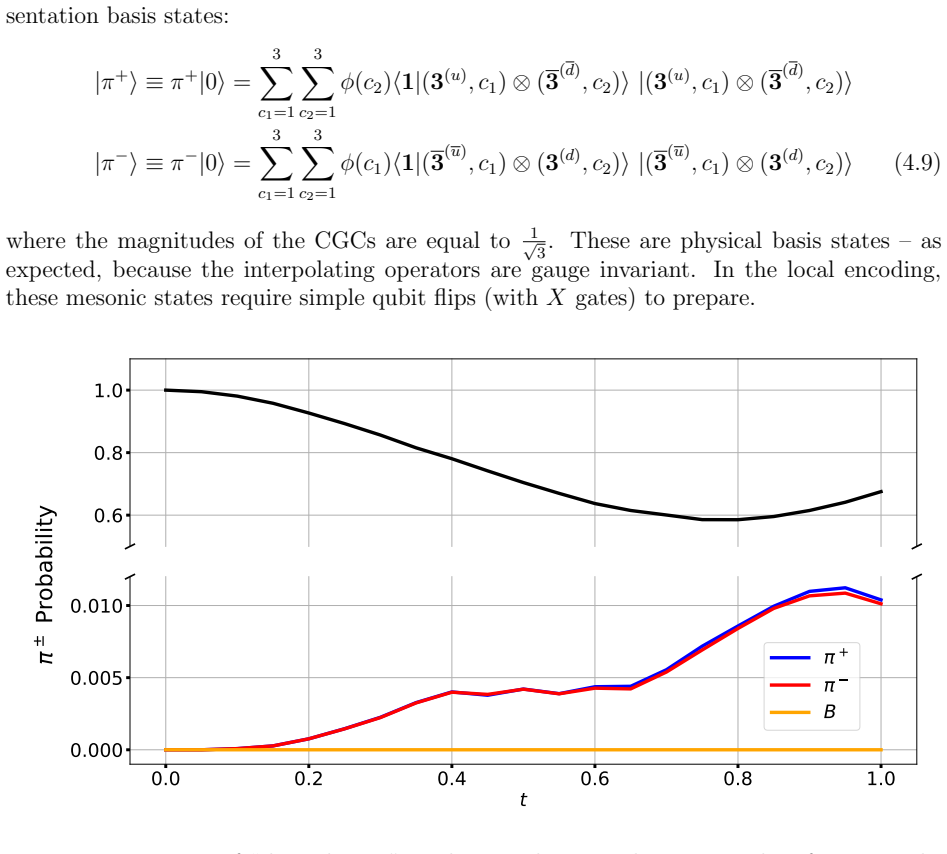
Summary. The paper develops a Hamiltonian formulation of SU(3) lattice gauge theory with staggered and Wilson fermions in two and three spatial dimensions, using a representation basis in which gauge and fermionic degrees of freedom are labeled by SU(3) irreps and gauge invariance is enforced by singlet Clebsch-Gordan coefficients. The authors derive site-factor matrix elements for the plaquette, theta, kinetic, mass, and Wilson terms, describe a local qubit encoding, and construct first-order Trotter circuits. They report noiseless classical statevector simulations on lattices up to 32 qubits, including truncation studies, theta-angle dependence, meson propagation, string dynamics, and an exact-diagonalization study of the baryon chemical potential. The paper explicitly states that the simulations are proof-of-concept and not intended to make serious statements about real-time QCD.
Significance. The primary theoretical product is a substantial set of explicit, convention-explicit matrix-element formulas and circuit constructions for Hamiltonian SU(3) lattice gauge theory with matter, including a theta term. If correct, this is a useful contribution to the growing toolkit for quantum simulation of lattice QCD. The paper is commendably honest about truncation and lattice artifacts, and the ED spot-checks reported in Sec. 5 provide some support for the correctness of the Trotter circuits. However, the advertised physics demonstrations are all performed deep in the strong-coupling regime with aggressive Hilbert-space truncations, and the paper's own appendix shows that the theta-angle results are dominated by lattice artifacts. The empirical claims in the abstract therefore go beyond what the controlled results support.
major comments (3)
- [Sec. 4.2, App. E, Figs. 11 and 21] The theta-angle showcase is not controlled. Fig. 11 and Fig. 21 use two continuum-equivalent implementations of the theta term at identical parameters and produce dramatically different theta-dependence. App. E states that this is due to unsuppressed lattice artifacts at strong coupling and that such artifacts are 'roughly what is driving the form of Fig. 11.' Thus the theta-angle effects highlighted in the abstract have not been separated from cutoff effects. Either add a controlled study that distinguishes physical theta dependence from lattice/truncation artifacts, or reword the abstract and Sec. 4.2 to present these simulations only as truncation/lattice-artifact-dominated demonstrators of the framework.
- [Sec. 4.2, Fig. 8, Sec. 6] All dynamics simulations fix g=2 and a=1, deep in the strong-coupling regime, and use very aggressive cutoffs (e.g., C*_2=2.67, M1/N1). Fig. 8 shows relative truncation-induced differences reaching about 50% for Wilson fermions at later times. There is no evidence that the qualitative phenomena advertised in the abstract—pion propagation, string breaking, baryon chemical potential—persist under less aggressive truncations or closer to the continuum limit. The authors themselves state that none of the results attempt to make serious statements of real-time QCD. The abstract's 'showcasing ... for the first time in three spatial dimensions' therefore overstates the scientific content; please either provide convergence checks or move these claims to a clearly labeled proof-of-principle context.
- [Sec. 5, Fig. 14] The baryon chemical potential result is obtained by exact diagonalization and is explicitly described as 'highly contaminated by lattice and truncation artifacts.' Despite this, the abstract lists a baryon chemical potential as one of the showcased phenomena for the first time in three spatial dimensions. As presented, this is a toy ED illustration, not a physics demonstration with controlled systematics. The claim should be reworded or moved to a statement about the framework's potential, with the strong caveats placed alongside the abstract-level claim.
minor comments (5)
- [Fig. 10 caption] The lower-right panel is labeled 'N(t)' but the text and Eq. (4.7) define the observable as 'N_q(t)'. Please correct for consistency.
- [Eq. (C.72)] The choice Xi = identity for the singlet multiplicity mixing matrix is introduced without discussion. This is presumably a convention, but the paper should state explicitly that different Xi choices correspond to a basis change in the physical Hilbert space, or explain any physical consequences for the site-factor matrix elements.
- [Figures 8-13 captions] Several captions contain 'were ran' instead of 'were run'. Please correct throughout.
- [Sec. 4.2] The truncation families T_n, C*_2, M_{N_q}, N_{N_q} are defined in the text, but the caption-only usages in Figs. 16-18 could be made more reader-friendly by including a short summary table of the truncation labels and their meanings.
- [Sec. 1] The dependence on Ref. [16] is heavy and disclosed, but it would help the reader if the introduction explicitly listed which constructions are new to this paper (e.g., the theta-term site factors, the Wilson-fermion kinetic-site factors, the matrix-element counts) and which are carried over from prior work.
Circularity Check
No significant circularity; underpinning derivations are self-contained and self-citations are disclosed, non-load-bearing.
full rationale
Walking the derivation chain: the paper starts from the Kogut-Susskind Hamiltonian (Sec. 3, Eqs. 3.10-3.13), defines the physical Hilbert space in Eq. 3.30 via Gauss's law and SU(N_c) Clebsch-Gordan coefficients (App. C), and computes Hamiltonian matrix elements directly from the operator definitions (App. D, Eqs. D.8, D.12, D.20-D.23). No parameter is fitted to the simulated observables: g, a, m_f, r, and theta are fixed theory inputs, and the displayed quantities (langle Pi^2(t)rangle, langle N_q(t)rangle, pion probabilities, string-breaking probabilities, baryon energy differences) are expectation values computed from the Hamiltonian, not constants recovered from the data. The quantum circuits are checked against exact diagonalization (Sec. 5: 'spot-checks of the noiseless simulation results above and obtained good agreement with ED'). The authors' own prior work [16] is cited for the local encoding and F-order conventions ('Building on previous works [16,24,25]'), but this is a disclosed methodological dependency, not a result derived from the citation; App. C.5 reconstructs the Hilbert-space construction and App. D derives the matrix elements. The strong-coupling and truncation limitations are explicitly acknowledged ('none of the results shown here attempt to make serious statements of the physics of real-time QCD'; App. E: Fig. 11 is driven by 'unsuppressed lattice artifacts at strong coupling'), which are validity caveats rather than circular reasoning. The only reason not to assign 0 is the recurring reliance on the authors' own prior work for encoding conventions; this is minor and not load-bearing, so the score is 2.
Axiom & Free-Parameter Ledger
free parameters (5)
- gauge truncation C*_2 (max sum of quadratic Casimir eigenvalues meeting at a site) =
2.67–4 (values 4, 2.67, 1.33 used)
- T_1 link truncation =
links restricted to {1, 3, 3-bar}
- fermion truncations (M_1, N_1, M_2, N_3 families) =
M_1: at most one particle–antiparticle pair per site; N_1: single particle or antiparticle per site
- bare coupling g and lattice spacing a =
g=2, a=1 for all runs
- first-order Trotter step Delta-t =
0.1
axioms (7)
- standard math SU(N) representation theory: Clebsch-Gordan orthogonality, great orthogonality theorem, Clebsch-Gordan series (App. C)
- domain assumption Kogut-Susskind Hamiltonian with staggered or Wilson fermions is the correct lattice discretization of continuum QCD (Sec. 3, Eqs. 3.10–3.13)
- domain assumption The two theta-term presentations (H_theta in Eq. 3.10; complex-mass form in App. E) are valid lattice discretizations of the continuum theta term
- domain assumption Gauss's-law singlets plus the global site order (L,R,P,A) define a complete physical basis (Sec. 3.3, Eq. 3.30)
- domain assumption Zero-point state |0> normal ordering with projectors P+/- yields a valid fermionic Hilbert-space starting point (Sec. 3.2, App. B)
- ad hoc to paper Xi = identity for singlet multiplicity mixing (Eq. C.72)
- ad hoc to paper The truncation ladder (T_n, C*_2, M/N families) keeps the qualitative dynamics intact (Sec. 4)
read the original abstract
We develop a framework for quantum simulations of lattice SU($N_c$) gauge theory with quarks. Staggered and Wilson lattice fermions are considered in two and three spatial dimensions and a theta angle is included in three dimensions. The physical, gauge-invariant Hilbert space is formulated in a representation basis, where gauge and fermionic degrees of freedom are encoded by irreducible representations of SU($N_c$) that tensor at each lattice site to contain a singlet. We discuss algorithms for simulating time evolution on quantum computers and carry out noiseless simulations of lattice quantum chromodynamics ($N_c=3$) on small lattices with up to 32 qubits, showcasing theta angle effects, hadronic states, string dynamics, and a baryon chemical potential for the first time in three spatial dimensions.
Figures




Reference graph
Works this paper leans on
-
[1]
R. K. Ellis, W. J. Stirling, and B. R. Webber,QCD and Collider Physics(Cambridge University Press, 2011). 64
2011
-
[2]
Campbell, J
J. Campbell, J. Huston, and F. Krauss,The Black Book of Quantum Chromodynamics: A Primer for the LHC Era(Oxford University Press, 2018)
2018
-
[3]
DeGrand and C
T. DeGrand and C. E. Detar,Lattice Methods for Quantum Chromodynamics(World Scientific, 2006)
2006
-
[4]
Aokiet al.(Flavour Lattice Averaging Group (FLAG) Collaboration), FLAG review 2024,Phys
Y. Aokiet al.(Flavour Lattice Averaging Group (FLAG) Collaboration), FLAG review 2024,Phys. Rev. D113, 014508 (2026)
2024
-
[5]
Alibertiet al., The anomalous magnetic moment of the muon in the Standard Model: an update,Physics Reports1143, 1-158 (2025)
R. Alibertiet al., The anomalous magnetic moment of the muon in the Standard Model: an update,Physics Reports1143, 1-158 (2025)
2025
-
[6]
Troyer and U.-J
M. Troyer and U.-J. Wiese, Computational Complexity and Fundamental Limitations to Fermionic Quantum Monte Carlo Simulations,Phys. Rev. Lett.94, 170201 (2005)
2005
-
[7]
G. Aarts and D. Sexty, Lattice field theories with a sign problem, arXiv:2604.24290
-
[8]
C. Bonanno, C. Bonati, and M. D’Elia, Strong CP problem, theta term and QCD topological properties, arXiv:2510.03059
-
[9]
Kogut and L
J. Kogut and L. Susskind, Hamiltonian formulation of Wilson’s lattice gauge theories, Phys. Rev. D11, 395–408 (1975)
1975
-
[10]
Zohar and M
E. Zohar and M. Burrello, Formulation of lattice gauge theories for quantum simulations, Phys. Rev. D91, 054506 (2015)
2015
-
[11]
C. W. Baueret al., Quantum Simulation for High-Energy Physics,PRX Quantum4, 027001 (2023)
2023
-
[12]
C. W. Bauer, Z. Davoudi, N. Klco, and M. J. Savage, Quantum simulation of funda- mental particles and forces,Nature Reviews Physics5, 420–432 (2023)
2023
-
[13]
Di Meglioet al., Quantum Computing for High-Energy Physics: State of the Art and Challenges,PRX Quantum5, 037001 (2024)
A. Di Meglioet al., Quantum Computing for High-Energy Physics: State of the Art and Challenges,PRX Quantum5, 037001 (2024)
2024
-
[14]
J. C. Halimeh, N. Mueller, J. Knolle, Z. Papi´ c, and Z. Davoudi, Quantum simulation of out-of-equilibrium dynamics in gauge theories, arXiv:2509.03586
-
[15]
C. E. P. Robin and M. J. Savage, Quantum Complexity and New Directions in Nuclear Physics and High-Energy Physics Phenomenology, arXiv:2604.26376
-
[16]
Balaji, C
P. Balaji, C. Conefrey-Shinozaki, P. Draper, J. K. Elhaderi, D. Gupta, L. Hidalgo, A. Lytle, and E. Rinaldi, Quantum circuits for SU(3) lattice gauge theory,Phys. Rev. D112, 054511 (2025)
2025
-
[17]
N. S. Modi, A. N. Ciavarella, J. C. Halimeh, and C. W. Bauer, LargeN c Truncations for SU(Nc) Lattice Yang-Mills Theory with Fermions, arXiv:2602.02344
-
[18]
S. V. Kadam, A. Naskar, I. Raychowdhury, and J. R. Stryker, Loop-string-hadron ap- proach to SU(3) lattice Yang-Mills theory: Hilbert space of a trivalent vertex,Phys. Rev. D111, 074516 (2025). 65
2025
-
[19]
S. V. Kadam, A. Naskar, I. Raychowdhury, and J. R. Stryker, Loop-string-hadron ap- proach to SU(3) lattice Yang-Mills theory, II: Operator representation for the trivalent vertex, arXiv:2512.11796
-
[20]
Mariani, S
A. Mariani, S. Pradhan, and E. Ercolessi, Hamiltonians and gauge-invariant Hilbert space for lattice Yang-Mills-like theories with finite gauge group,Phys. Rev. D107, 114513 (2023)
2023
-
[21]
S. O. Perez, E. M. Murairi, E. J. Gustafson, and H. Lamm, Primitive Quantum Gates for anSU(3) Discrete Subgroup: Σ(72×3), arXiv:2511.17437
-
[22]
H. Froland, D. M. Grabowska, and Z. Li, Simulating Fully Gauge-Fixed SU(2) Hamil- tonian Dynamics on Digital Quantum Computers, arXiv:2512.22782
-
[23]
G. Bergner, M. Hanada, and E. Mendicelli, A minimal implementation of Yang-Mills theory on a digital quantum computer, arXiv:2604.15132
-
[24]
Byrnes and Y
T. Byrnes and Y. Yamamoto, Simulating lattice gauge theories on a quantum computer, Phys. Rev. A73, 022328 (2006)
2006
-
[25]
Ciavarella, N
A. Ciavarella, N. Klco, and M. J. Savage, Trailhead for quantum simulation of SU(3) Yang-Mills lattice gauge theory in the local multiplet basis,Phys. Rev. D103, 094501 (2021)
2021
-
[26]
P. A. M. Dirac,Lectures on Quantum Mechanics(Belfer Graduate School of Science, Yeshiva University, NY, 1964)
1964
-
[27]
M. Illa, M. J. Savage, and X. Yao, Improved honeycomb and hyperhoneycomb lattice Hamiltonians for quantum simulations of non-Abelian gauge theories,Phys. Rev. D 111, 114520 (2025)
2025
-
[28]
A. H. Z. Kavaki and R. Lewis, False vacuum decay in triamond lattice gauge theory, Phys. Rev. D112, 014502 (2025)
2025
-
[29]
Nielsen and M
H. Nielsen and M. Ninomiya, A no-go theorem for regularizing chiral fermions,Physics Letters B105, 219-223 (1981)
1981
-
[30]
T. V. Zache, F. Hebenstreit, F. Jendrzejewski, M. K. Oberthaler, J. Berges, and P. Hauke, Quantum simulation of lattice gauge theories using Wilson fermions,Quan- tum Science and Technology3, 034010 (2018)
2018
-
[31]
Angelides, L
T. Angelides, L. Funcke, K. Jansen, and S. K¨ uhn, Computing the mass shift of Wilson and staggered fermions in the lattice Schwinger model with matrix product states,Phys. Rev. D108, 014516 (2023)
2023
-
[32]
S. Bharadwaj, E. Rosanowski, S. Singh, A. di Tucci, C. Peng, K. Jansen, L. Funcke, and D. Luo, Hamiltonian Lattice QED3 with One and Two Flavors of Wilson Fermions: Topological Structure and Response, arXiv:2603.05616. 66
-
[33]
K. G. Wilson, Quarks and Strings on a Lattice, inNew Phenomena in Subnuclear Physics: Part A(Springer US, Boston, MA, 1977)
1977
-
[34]
K. G. Wilson, Confinement of quarks,Phys. Rev. D10, 2445–2459 (1974)
1974
-
[35]
Chiew and S
M. Chiew and S. Strelchuk, Discovering optimal fermion-qubit mappings through algo- rithmic enumeration,Quantum7, 1145 (2023)
2023
-
[36]
J. T. Seeley, M. J. Richard, and P. J. Love, The Bravyi-Kitaev transformation for quantum computation of electronic structure,The Journal of Chemical Physics137, 224109 (2012)
2012
-
[37]
O’Brien and S
O. O’Brien and S. Strelchuk, Ultrafast hybrid fermion-to-qubit mapping,Phys. Rev. B 109, 115149 (2024)
2024
-
[38]
Pardo, T
G. Pardo, T. Greenberg, A. Fortinsky, N. Katz, and E. Zohar, Resource-efficient quan- tum simulation of lattice gauge theories in arbitrary dimensions: Solving for Gauss’s law and fermion elimination,Phys. Rev. Res.5, 023077 (2023)
2023
-
[39]
Ballarin, G
M. Ballarin, G. Cataldi, G. Magnifico, D. Jaschke, M. D. Liberto, I. Siloi, S. Montangero, and P. Silvi, Digital quantum simulation of lattice fermion theories with local encoding, Quantum8, 1460 (2024)
2024
-
[40]
A. Alex, M. Kalus, A. Huckleberry, and J. von Delft, A numerical algorithm for the explicit calculation of SU(N) and SL(N,C) Clebsch–Gordan coefficients,Journal of Mathematical Physics52, 023507 (2011)
2011
-
[41]
Balaji, C
P. Balaji, C. Conefrey-Shinozaki, P. Draper, J. K. Elhaderi, D. Gupta, L. Hidalgo, and A. Lytle, Perturbation theory, irrep truncations, and state preparation methods for quantum simulations ofSU(3) lattice gauge theory,Phys. Rev. D113, 094505 (2026)
2026
-
[42]
A. Kan and Y. Nam, Lattice Quantum Chromodynamics and Electrodynamics on a Universal Quantum Computer, arXiv:2107.12769
-
[43]
M. L. Rhodes, M. Kreshchuk, and S. Pathak, Exponential Improvements in the Sim- ulation of Lattice Gauge Theories Using Near-Optimal Techniques,PRX Quantum5, 040347 (2024)
2024
-
[44]
N. Klco, M. J. Savage, and J. R. Stryker, SU(2) non-Abelian gauge field theory in one dimension on digital quantum computers,Phys. Rev. D101, 074512 (2020)
2020
-
[45]
A Rahman, R
S. A Rahman, R. Lewis, E. Mendicelli, and S. Powell, SU(2) lattice gauge theory on a quantum annealer,Phys. Rev. D104, 034501 (2021)
2021
-
[46]
Hariprakash, N
S. Hariprakash, N. S. Modi, M. Kreshchuk, C. F. Kane, and C. W. Bauer, Strategies for simulating the time evolution of Hamiltonian lattice field theories,Phys. Rev. A111, 022419 (2025)
2025
-
[47]
J. M. Martyn, Z. M. Rossi, A. K. Tan, and I. L. Chuang, Grand Unification of Quantum Algorithms,PRX Quantum2, 040203 (2021). 67
2021
-
[48]
M. Mohseniet al., How to Build a Quantum Supercomputer: Scaling from Hundreds to Millions of Qubits, arXiv:2411.10406
-
[49]
M. A. Nielsen and I. L. Chuang,Quantum Computation and Quantum Information (Cambridge University Press, 2012)
2012
-
[50]
Javadi-Abhariet al., Quantum computing with Qiskit, arXiv:2405.08810
A. Javadi-Abhariet al., Quantum computing with Qiskit, arXiv:2405.08810
-
[51]
A. Kan, L. Funcke, S. K¨ uhn, L. Dellantonio, J. Zhang, J. F. Haase, C. A. Muschik, and K. Jansen, Investigating a (3+1)D topologicalθ-term in the Hamiltonian formulation of lattice gauge theories for quantum and classical simulations,Phys. Rev. D104, 034504 (2021)
2021
-
[52]
R. Lewis, S. Pourbakhsh, A. Pradhan, and L. Siquioco, SU(2) gauge theory with fermions on a semi-simple cubic lattice, arXiv:2606.21563
-
[53]
J.-S. Kim, A. McCaskey, B. Heim, M. Modani, S. Stanwyck, and T. Costa, CUDA Quan- tum: The Platform for Integrated Quantum-Classical Computing, inProceedings of the 60th Annual ACM/IEEE Design Automation Conference(IEEE Press, San Francisco, CA, 2023)
2023
-
[54]
Y. Y. Atas, J. F. Haase, J. Zhang, V. Wei, S. M.-L. Pfaendler, R. Lewis, and C. A. Muschik, Simulating one-dimensional quantum chromodynamics on a quantum com- puter: Real-time evolutions of tetra- and pentaquarks,Phys. Rev. Res.5, 033184 (2023)
2023
-
[55]
R. C. Farrell, I. A. Chernyshev, S. J. M. Powell, N. A. Zemlevskiy, M. Illa, and M. J. Savage, Preparations for quantum simulations of quantum chromodynamics in 1 + 1 dimensions. I. Axial gauge,Phys. Rev. D107, 054512 (2023)
2023
-
[56]
J. Schuhmacher, G.-X. Su, J. J. Osborne, A. Gandon, J. C. Halimeh, and I. Tavernelli, Observation of hadron scattering in a lattice gauge theory on a quantum computer, arXiv:2505.20387
-
[57]
G. Cataldi, S. Orlando, and J. C. Halimeh, Real-Time String Dynamics in a 2+1D Non- Abelian Lattice Gauge Theory: String Breaking, Glueball Formation, Baryon Blockade, and Tension Reduction, arXiv:2509.08868
- [58]
-
[59]
R. Joshi, Y. Tian, K. Hemery, N. S. Srivatsa, J. J. Osborne, H. Dreyer, E. Rinaldi, and J. C. Halimeh, Observation of genuine 2 + 1D string dynamics in a U(1) lat- tice gauge theory with a tunable plaquette term on a trapped-ion quantum computer, arXiv:2604.07436
-
[60]
S. Grieninger, M. J. Savage, and N. A. Zemlevskiy, The Quantum Complexity of String Breaking in the Schwinger Model, arXiv:2601.08825. 68
-
[61]
Carena, H
M. Carena, H. Lamm, Y.-Y. Li, and W. Liu, Improved Hamiltonians for Quantum Simulations of Gauge Theories,Phys. Rev. Lett.129, 051601 (2022)
2022
-
[62]
Gustafson and R
E. Gustafson and R. Van de Water, Improved Fermion Hamiltonians for quantum sim- ulation,PoSLATTICE2023, 215 (2023)
2023
-
[63]
A. N. Ciavarella and I. A. Chernyshev, Preparation of the SU(3) lattice Yang-Mills vacuum with variational quantum methods,Phys. Rev. D105, 074504 (2022)
2022
-
[64]
A. N. Ciavarella, Quantum simulation of lattice QCD with improved Hamiltonians, Phys. Rev. D108, 094513 (2023)
2023
-
[65]
Schw¨ agerl, K
T. Schw¨ agerl, K. Jansen, and S. K¨ uhn, Fermion discretization effects in the two-flavor lattice Schwinger model: A study with matrix product states,Phys. Rev. D112, 094501 (2025)
2025
-
[66]
Singh, Ginsparg-Wilson Hamiltonians with Improved Chiral Symmetry, arXiv:2505.20419
H. Singh, Ginsparg-Wilson Hamiltonians with Improved Chiral Symmetry, arXiv:2505.20419
-
[67]
Nagata, Finite-density lattice QCD and sign problem: Current status and open problems,Progress in Particle and Nuclear Physics127, 103991 (2022)
K. Nagata, Finite-density lattice QCD and sign problem: Current status and open problems,Progress in Particle and Nuclear Physics127, 103991 (2022)
2022
-
[68]
L. B. Ho, Quantum simulation of strong charge-parity violation and the Peccei-Quinn mechanism,Phys. Rev. D113, 074507 (2026)
2026
-
[69]
G. Rouxinol, T. Magorsch, J. J. Osborne, N. Brambilla, and J. C. Halimeh, Schwinger Model with a Dynamical Axion, arXiv:2603.12194
-
[70]
Susskind, Lattice fermions,Phys
L. Susskind, Lattice fermions,Phys. Rev. D16, 3031–3039 (1977)
1977
-
[71]
Catterall, A
S. Catterall, A. Pradhan, and A. Samlodia, Symmetries and anomalies of Hamiltonian staggered fermions,Phys. Rev. D113, 014504 (2026)
2026
-
[72]
D’Andrea, C
I. D’Andrea, C. W. Bauer, D. M. Grabowska, and M. Freytsis, New basis for Hamilto- nian SU(2) simulations,Phys. Rev. D109, 074501 (2024)
2024
-
[73]
Kasper, G
V. Kasper, G. Juzeli¯ unas, M. Lewenstein, F. Jendrzejewski, and E. Zohar, From the Jaynes–Cummings model to non-abelian gauge theories: a guided tour for the quantum engineer,New Journal of Physics22, 103027 (2020)
2020
-
[74]
Anishetty and T
R. Anishetty and T. P. Sreeraj, Mass gap in the weak coupling limit of (2 + 1)- dimensional SU(2) lattice gauge theory,Phys. Rev. D97, 074511 (2018)
2018
-
[75]
Raychowdhury and J
I. Raychowdhury and J. R. Stryker, Solving Gauss’s law on digital quantum computers with loop-string-hadron digitization,Phys. Rev. Res.2, 033039 (2020)
2020
-
[76]
Weinberg,The Quantum Theory of Fields
S. Weinberg,The Quantum Theory of Fields. Vol. 2: Modern Applications(Cambridge University Press, 2013). 69
2013
-
[77]
Fujikawa, Path-Integral Measure for Gauge-Invariant Fermion Theories,Phys
K. Fujikawa, Path-Integral Measure for Gauge-Invariant Fermion Theories,Phys. Rev. Lett.42, 1195–1198 (1979)
1979
-
[78]
Mueller, J
N. Mueller, J. A. Carolan, A. Connelly, Z. Davoudi, E. F. Dumitrescu, and K. Yeter- Aydeniz, Quantum Computation of Dynamical Quantum Phase Transitions and Entan- glement Tomography in a Lattice Gauge Theory,PRX Quantum4, 030323 (2023). 70
2023
discussion (0)
Sign in with ORCID, Apple, or X to comment. Anyone can read and Pith papers without signing in.