REVIEW 3 major objections 5 minor 87 references
Virtual Fitting Room: Generating Arbitrarily Long Videos of Virtual Try-On from a Single Image -- Technical Preview
T0 review · 3 major / 5 minor · reviewed 2026-08-15 · deepseek-v4-flash
Pith's one-line read VFR turns a single photo and one garment into a minute-long try-on video, sustained by a 360-degree anchor video that keeps the garment's appearance consistent across all generated segments.
desk verdict Plausible engineering advance in long video try-on, but the paper's own ablation table contradicts its 'consistently outperforms' claim; worth serious review with expected major revisions. read the letter →
The pith
A machine-rendered reading of the paper's core claim, the machinery that carries it, and where it could break.
The reading
What carries the argument
The central mechanism is the anchor video combined with prefix conditioning. The anchor video is a short 360-degree clip of the user in a simple 'A' pose wearing the target garment, generated by the same model; it supplies a stable, whole-body appearance reference for every later segment. The prefix video is the overlapping tail of the previously generated segment, passed as a condition to ensure the next segment continues smoothly without sudden jumps or morphing. These two conditions are implemented as additional CondNets on top of the base Dress&Dance [8] model, and an immediate refiner is trained to clean up each segment's output. Together they are what let the generator produce arbitrarily long videos without training on long videos.
What would settle it
Generate a long try-on video in which the person rotates fully, so the back of the garment is visible both early and late in the video; if the back pattern, logo, or texture differs between distant timestamps despite the anchor conditioning, the central claim of global temporal consistency fails. This could be quantified by measuring the similarity of back-of-garment crops across segments with a vision-language or pixel-level consistency metric.
Extended reading notes
Core claim
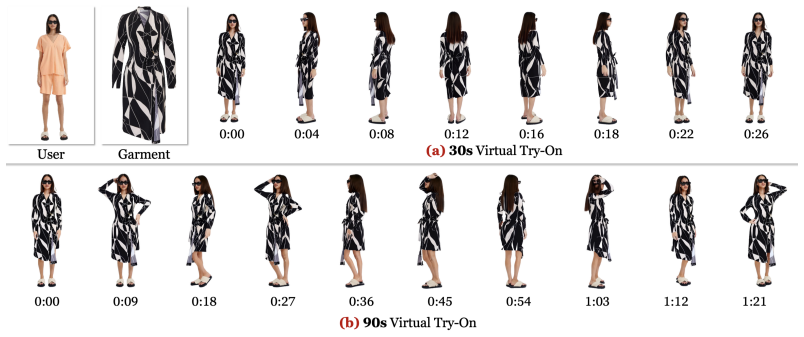
The paper claims that long virtual try-on generation can be decomposed into a two-stage process: first generate a short 360-degree video of the user in an 'A' pose wearing the target garment, then generate each video segment conditioned on both the overlapping tail of the previous segment and this anchor video. The anchor acts as a global memory of the user's whole-body appearance, so segments consistent with the anchor are also consistent with each other. Experiments show 30-second and 90-second try-on videos at 720x1152 resolution, with base 8 FPS output refined to 24 FPS, exhibiting both local smoothness and long-range garment and identity preservation. The paper further observes that the same temporally consistent outputs can be reconstructed into a 3D human mesh, indicating that 3D structure emerges without explicit 3D supervision.
Load-bearing premise
The method assumes that a short 360-degree 'A-pose' video of the user, generated by the same model, captures enough of the person's whole-body appearance that conditioning on it keeps the garment and identity stable even when later poses deviate far from that anchor pose.
Editorial extensions
If this is right
- A shopper could see a garment on themselves across motions lasting a minute or more, not just a few seconds, which is closer to real fitting-room exploration.
- Long videos can be produced with only short-video training data, since the model learns to generate consistent segment-by-segment rather than needing long sequences as ground truth.
- The reported emergent 3D consistency would allow free-viewpoint rendering of the user in the target garment, effectively turning a single photo into a navigable 3D try-on.
- The paper's four-tier evaluation protocol provides a concrete way to measure long video try-on quality, covering garment fidelity, human appearance, hand-body interaction, and arbitrary poses.
- If the approach scales, it could shift online clothing retail from static images to interactive long-form video previews, though the paper notes current generation takes 1-2 hours for a 30-second video.
Reading between the lines
- Editorial extension: the anchor-video idea is not obviously limited to clothing; the same pattern of generating a 360-degree identity anchor could be tested for long-form face animation, character consistency in narrative video, or other tasks where a single identity must persist across minutes.
- Editorial extension: one can probe the limits of the anchor by varying its length and pose coverage; a natural test is whether a shorter anchor or one without full 360-degree coverage causes garment details on the back to drift in longer videos.
- Editorial extension: the reported implicit 3D consistency suggests a testable hypothesis that temporal-consistency training alone can substitute for explicit 3D supervision in other single-image-to-video scenarios, which could be examined by ablating the anchor and measuring 3D reconstruction quality.
- Editorial extension: the 8 FPS base plus a 24 FPS refiner hints at a two-stage efficiency design; a direct extension would be applying the same refine step to increase spatial resolution or to extend segment length, trading quality against the stated 1-2 hour generation time.
Signed reviews
Editorial analysis
A structured set of objections, weighed in public.
Referee Report
Summary. The paper proposes VFR (Virtual Fitting Room), a video-generation framework for virtual try-on from a single user image, a garment image, and a reference motion video. The method generates long videos auto-regressively, segment by segment, using a prefix video condition for local smoothness and an "anchor video"—a model-generated 5-second 360-degree A-pose video of the user in the target garment—for global temporal consistency. The authors claim this enables arbitrarily long, minute-scale, high-resolution (720×1152) try-on videos. They introduce a four-part evaluation protocol (360° garment consistency, 360° human+garment consistency, 90s hand-body interaction, and arbitrary poses) and report quantitative comparisons in Table 1 against baselines and ablations. They also claim that implicit 3D consistency emerges, allowing free-viewpoint rendering via NeRF reconstruction of the anchor video.
Significance. If validated, the paper would address an important gap: prior virtual try-on methods are limited to images or short (5–10s) videos, whereas VFR targets arbitrarily long videos with both local smoothness and global appearance consistency. The anchor-video idea is conceptually simple and potentially influential for long video generation beyond try-on. The proposed evaluation protocol is a useful step toward standardizing long try-on video assessment. The paper is clearly written and includes compelling qualitative examples. However, the central empirical claim is not supported by the reported numbers: the full model does not consistently beat its own ablations on the GPT metrics, and no uncertainty estimates are provided. The anchor video, which is load-bearing for the method, is generated by the same model and is not independently validated. The dependence on an anonymous, unpublished base model (Dress&Dance) further undermines reproducibility. These issues currently prevent acceptance.
major comments (3)
- [§4.2 and Table 1] The statement in §4.2 that "our full VFR consistently outperforms all the baselines and variants" is contradicted by Table 1 on multiple GPT Overall scores. In the 90s Hand-Body task, the No-Prefix (NP) variant scores 84.62 and the Dress&Dance (D&D) variant scores 86.15, both higher than full VFR's 82.62. In the 4-Medium task, D&D scores 83.61 versus VFR's 81.93; in the 4-Hard task, D&D scores 80.39 and NP scores 79.60, both above VFR's 79.05. The claim of consistent superiority also conflates VBench metrics, where VFR does lead, with GPT metrics, where it does not. Moreover, no error bars, number of seeds, or statistical significance tests are reported, so even the VBench differences may be within noise. This is a load-bearing issue because the paper's central claim is empirical: the anchor and prefix conditioning are supposed to improve global consistency and try-on quality. The authors should either revise the claim, report multiple runs with variances, and/or provide a metric-by-metric statistical analysis that accounts for the observed contradictions.
- [§3 and Figure 3] The anchor video is the core mechanism for global consistency, but the paper provides no independent validation that a model-generated 5-second 360-degree A-pose video faithfully captures the user's whole-body appearance. The anchor is produced by the same diffusion model that must solve the underlying try-on problem, so it can be self-consistent while hallucinating back-of-garment texture, body shape, or occluded regions. The NeRF reconstruction in Figure 3(b) is built from the model's own generated anchor, so it cannot validate geometric fidelity. To support the central claim, the authors should measure anchor fidelity against ground-truth multi-view data (e.g., real 360° captures of subjects), or at minimum show that the final video quality is sensitive to anchor quality, for instance by corrupting the anchor and demonstrating degradation. Without such evidence, the anchor-based consistency mechanism remains a plausible but unsubstantiated assumption.
- [§4.1 and Reference [8]] The method is built on Dress&Dance [8], which is cited as "Anonymous Author(s)" and described as "Under Review, January 2025." According to §4.1, "Our VFR model is built on Dress&Dance [8] with the addition of 'prefix video' and 'anchor video' CondNets," and the baselines also rely on Dress&Dance for initial frames and try-on quality. This makes the contribution non-self-contained: the core try-on capability is inherited from an unpublished, unavailable model, so a reader cannot reproduce the results or separate VFR's contribution from that of Dress&Dance. The authors should disclose the relation between VFR and Dress&Dance (including whether Dress&Dance is their own prior work), provide sufficient architecture and training details for the base model, or release the checkpoint so that the incremental contribution is testable.
minor comments (5)
- [Table 1, row 1] The 360° Garment Consistency (5s) row shows only the full VFR, with no baseline or ablation comparison. Adding at least the D&D and NP variants there would make the table self-consistent with the other tasks and would help assess the anchor-consistency claim.
- [Abstract and §1] The abstract states the output is "720×1152 resolution at 8 FPS and can be further refined to 24 FPS," while §1 says "720×1152 resolution at 24FPS" and the contribution says "720×1152 resolution at 24FPS." Please harmonize these numbers and state clearly which resolutions/framerates were used in the experiments.
- [§4.1] Training details are sparse: the model is trained for 10,000 iterations, but no batch size, dataset size, number of GPUs, or learning rate is reported. For a method that depends on training a video diffusion model, these details are important for reproducibility.
- [§4.2] The subsection heading "Hand-Body Interaction Faithfullness" contains a typo; it should be "Faithfulness."
- [Discussions] The Discussion states that generating a 30s video takes 1–2 hours, which is substantial and may undercut the practical framing of "arbitrarily long" videos in the introduction. Adding inference-time analysis and a discussion of scalability would strengthen the paper.
Circularity Check
No constructional circularity found; VFR is an empirical method demonstration whose anchor-video mechanism is an intermediate conditioning signal, not a fitted parameter or imported theorem.
full rationale
The paper does not present a mathematical derivation or a first-principles prediction; it proposes a generative architecture and evaluates it empirically. The central mechanism—generating a 360-degree 'anchor' video and conditioning later segments on it—is an inference-time design choice rather than a fitted constant or a quantity defined in terms of the target output. The anchor is generated by the same model, which raises a validity question: the anchor is not externally validated, and the 3D-consistency observation is based on reconstructing the model's own generated frames. However, this is not circularity in the constructional sense, because the long-video output is not equal to the anchor by construction and the paper does not claim the anchor is an external ground truth. The main dependency, Dress&Dance [8], is an unpublished anonymous base model; this creates a reproducibility and verification concern but not a circular reduction, since no load-bearing argument reduces to a self-citation chain or to a theorem imported from the authors. Table 1 even shows the 'No Anchor' and 'D&D' variants sometimes exceeding full VFR on GPT-Overall, which undercuts the empirical claim, but that is a statistical/correctness issue rather than circularity. No fitted input is renamed as a prediction, no uniqueness theorem is invoked, and no known result is merely renamed. The paper's own Discussion concedes generation inefficiency, but that is a limitation statement, not a circular step. Therefore the appropriate finding is no significant circularity.
Assumptions & free parameters
free parameters (4)
- Segment duration / overlap length
- Anchor video duration =
5s
- Training iterations =
base: 10,000; refiner: 5,000 + 5,000
- Refiner checkpoint iteration =
5,000
assumptions (3)
- domain assumption Dress&Dance base model provides effective short-video try-on generation that can be extended with additional conditioning.
- ad hoc to paper A single 360-degree A-pose video captures all appearance information (front, back, sides) needed to maintain garment identity across arbitrary poses.
- domain assumption The motion reference video supplies sufficient signal to condition human motion; no disentanglement of motion and appearance is needed beyond anchor conditioning.
Cite this review
Pith. "Pith review of Virtual Fitting Room: Generating Arbitrarily Long Videos of Virtual Try-On from a Single Image -- Technical Preview." pith.science (2026). https://pith.science/paper/B3X532P2
@misc{pith2026250904450,
  author       = {Pith},
  title        = {Pith review of: Virtual Fitting Room: Generating Arbitrarily Long Videos of Virtual Try-On from a Single Image -- Technical Preview},
  year         = {2026},
  howpublished = {\url{https://pith.science/paper/B3X532P2}},
  note         = {Machine review of arXiv:2509.04450}
}
read the original abstract
We introduce the Virtual Fitting Room (VFR), a novel video generative model that produces arbitrarily long virtual try-on videos. Our VFR models long video generation tasks as an auto-regressive, segment-by-segment generation process, eliminating the need for resource-intensive generation and lengthy video data, while providing the flexibility to generate videos of arbitrary length. The key challenges of this task are twofold: ensuring local smoothness between adjacent segments and maintaining global temporal consistency across different segments. To address these challenges, we propose our VFR framework, which ensures smoothness through a prefix video condition and enforces consistency with the anchor video -- a 360-degree video that comprehensively captures the human's wholebody appearance. Our VFR generates minute-scale virtual try-on videos with both local smoothness and global temporal consistency under various motions, making it a pioneering work in long virtual try-on video generation.
Figures


Figures from the paper (5 more)


Reference graph
Works this paper leans on
-
[8]
Dress&Dance: Dress up and dance as you like it
Anonymous Author(s). Dress&Dance: Dress up and dance as you like it. In Under Review, January 2025. URL https://anonymous.4open.science/r/Dress_and_Dance_paper. 1, 3, 6, 7, 8
2025
-
[1]
D 4-vton: Dynamic semantics disentangling for differential diffusion based virtual try-on
Zhaotong Yang, Zicheng Jiang, Xinzhe Li, Huiyu Zhou, Junyu Dong, Huaidong Zhang, and Yong Du. D 4-vton: Dynamic semantics disentangling for differential diffusion based virtual try-on. In European Conference on Computer Vision, pages 36–52. Springer, 2024. 1
2024
-
[2]
Gp-vton: Towards general purpose virtual try-on via collaborative local-flow global-parsing learning
Zhenyu Xiel, Zaiyu Huang, Xin Dong, Fuwei Zhao, Haoye Dong, Xijin Zhang, Feida Zhu, and Xiaodan Liang. Gp-vton: Towards general purpose virtual try-on via collaborative local-flow global-parsing learning. In ArXiV, pages 23550–23559, 06 2023. doi: 10.1109/CVPR52729.2023.02255
arXiv 2023
-
[3]
Texture-preserving diffusion models for high-fidelity virtual try-on, 2024
Xu Yang, Changxing Ding, Zhibin Hong, Junhao Huang, Jin Tao, and Xiangmin Xu. Texture-preserving diffusion models for high-fidelity virtual try-on, 2024
2024
-
[4]
Stableviton: Learning semantic correspondence with latent diffusion model for virtual try-on
Jeongho Kim, Gyojung Gu, Minho Park, Sunghyun Park, and Jaegul Choo. Stableviton: Learning semantic correspondence with latent diffusion model for virtual try-on. In CVPR, 2024
2024
-
[5]
Stablegarment: Garment-centric generation via stable diffusion
Rui Wang, Hailong Guo, Jiaming Liu, Huaxia Li, Haibo Zhao, Xu Tang, Yao Hu, Hao Tang, and Peipei Li. Stablegarment: Garment-centric generation via stable diffusion. arXiv preprint arXiv:2403.10783, 2024
arXiv 2024
-
[6]
Ootdiffusion: Outfitting fusion based latent diffusion for controllable virtual try-on
Yuhao Xu, Tao Gu, Weifeng Chen, and Chengcai Chen. Ootdiffusion: Outfitting fusion based latent diffusion for controllable virtual try-on. arXiv preprint arXiv:2403.01779, 2024. 1
arXiv 2024
-
[7]
Fashion-vdm: Video diffusion model for virtual try-on
Johanna Karras, Yingwei Li, Nan Liu, Luyang Zhu, Innfarn Yoo, Andreas Lugmayr, Chris Lee, and Ira Kemelmacher-Shlizerman. Fashion-vdm: Video diffusion model for virtual try-on. In Proceedings of ACM SIGGRAPH Asia 2024, December 2024. 1, 3
2024
Show all 87 references
-
[9]
One-minute video generation with test-time training, 2025
Karan Dalal, Daniel Koceja, Gashon Hussein, Jiarui Xu, Yue Zhao, Youjin Song, Shihao Han, Ka Chun Cheung, Jan Kautz, Carlos Guestrin, Tatsunori Hashimoto, Sanmi Koyejo, Yejin Choi, Yu Sun, and Xiaolong Wang. One-minute video generation with test-time training, 2025. URL https:...
2025 arXiv
-
[10]
Diffusion forcing: Next-token prediction meets full-sequence diffusion
Boyuan Chen, Diego Martí Monsó, Yilun Du, Max Simchowitz, Russ Tedrake, and Vincent Sitzmann. Diffusion forcing: Next-token prediction meets full-sequence diffusion. Advances in Neural Information Processing Systems, 37:24081–24125, 2025. 6
2025
-
[11]
History- guided video diffusion, 2025
Kiwhan Song, Boyuan Chen, Max Simchowitz, Yilun Du, Russ Tedrake, and Vincent Sitzmann. History- guided video diffusion, 2025. URL https://arxiv.org/abs/2502.06764. 6
2025 arXiv
-
[12]
From slow bidirectional to fast autoregressive video diffusion models
Tianwei Yin, Qiang Zhang, Richard Zhang, William T Freeman, Fredo Durand, Eli Shechtman, and Xun Huang. From slow bidirectional to fast autoregressive video diffusion models. In CVPR, 2025. 6
2025
-
[13]
Streamingt2v: Consistent, dynamic, and extendable long video generation from text
Roberto Henschel, Levon Khachatryan, Daniil Hayrapetyan, Hayk Poghosyan, Vahram Tadevosyan, Zhangyang Wang, Shant Navasardyan, and Humphrey Shi. Streamingt2v: Consistent, dynamic, and extendable long video generation from text. arXiv preprint arXiv:2403.14773, 2024. 6
2024 arXiv
-
[14]
Packing input frame contexts in next-frame prediction models for video generation
Lvmin Zhang and Maneesh Agrawala. Packing input frame contexts in next-frame prediction models for video generation. Arxiv, 2025. 1, 4, 6, 7, 8
2025
-
[15]
Nerfstudio: A modular framework for neural radiance field development
Matthew Tancik, Ethan Weber, Evonne Ng, Ruilong Li, Brent Yi, Justin Kerr, Terrance Wang, Alexander Kristoffersen, Jake Austin, Kamyar Salahi, Abhik Ahuja, David McAllister, and Angjoo Kanazawa. Nerfstudio: A modular framework for neural radiance field development. In SIGGRAPH...
2023
-
[16]
Viton: An image-based virtual try-on network
Xintong Han, Zuxuan Wu, Zhe Wu, Ruichi Yu, and Larry S Davis. Viton: An image-based virtual try-on network. In Proceedings of the IEEE conference on computer vision and pattern recognition , pages 7543–7552, 2018. 3
2018
-
[17]
Toward characteristic-preserving image-based virtual try-on network
Bochao Wang, Huabin Zheng, Xiaodan Liang, Yimin Chen, Liang Lin, and Meng Yang. Toward characteristic-preserving image-based virtual try-on network. In Proceedings of the European conference on computer vision (ECCV), pages 589–604, 2018
2018
-
[18]
Do not mask what you do not need to mask: a parser-free virtual try-on
Thibaut Issenhuth, Jérémie Mary, and Clément Calauzenes. Do not mask what you do not need to mask: a parser-free virtual try-on. In Computer Vision–ECCV 2020: 16th European Conference, Glasgow, UK, August 23–28, 2020, Proceedings, Part XX 16, pages 619–635. Springer, 2020
2020
-
[19]
Towards photo- realistic virtual try-on by adaptively generating-preserving image content
Han Yang, Ruimao Zhang, Xiaobao Guo, Wei Liu, Wangmeng Zuo, and Ping Luo. Towards photo- realistic virtual try-on by adaptively generating-preserving image content. In Proceedings of the IEEE/CVF conference on computer vision and pattern recognition, pages 7850–7859, 2020. 10
2020
-
[20]
Tryongan: Body-aware try-on via layered interpolation
Kathleen M Lewis, Srivatsan Varadharajan, and Ira Kemelmacher-Shlizerman. Tryongan: Body-aware try-on via layered interpolation. ACM Transactions on Graphics (TOG), 40(4):1–10, 2021. 3
2021
-
[21]
Parser-free virtual try-on via distilling appearance flows
Yuying Ge, Yibing Song, Ruimao Zhang, Chongjian Ge, Wei Liu, and Ping Luo. Parser-free virtual try-on via distilling appearance flows. In Proceedings of the IEEE/CVF conference on computer vision and pattern recognition, pages 8485–8493, 2021
2021
-
[22]
Viton-hd: High-resolution virtual try-on via misalignment-aware normalization
Seunghwan Choi, Sunghyun Park, Minsoo Lee, and Jaegul Choo. Viton-hd: High-resolution virtual try-on via misalignment-aware normalization. In Proceedings of the IEEE/CVF conference on computer vision and pattern recognition, pages 14131–14140, 2021
2021
-
[23]
Dress code: High-resolution multi-category virtual try-on
Davide Morelli, Matteo Fincato, Marcella Cornia, Federico Landi, Fabio Cesari, and Rita Cucchiara. Dress code: High-resolution multi-category virtual try-on. In Proceedings of the IEEE/CVF conference on computer vision and pattern recognition, pages 2231–2235, 2022
2022
-
[24]
Single stage virtual try-on via deformable attention flows
Shuai Bai, Huiling Zhou, Zhikang Li, Chang Zhou, and Hongxia Yang. Single stage virtual try-on via deformable attention flows. In European Conference on Computer Vision, pages 409–425. Springer, 2022
2022
-
[25]
Dressing in the wild by watching dance videos
Xin Dong, Fuwei Zhao, Zhenyu Xie, Xijin Zhang, Daniel K Du, Min Zheng, Xiang Long, Xiaodan Liang, and Jianchao Yang. Dressing in the wild by watching dance videos. In Proceedings of the IEEE/CVF Conference on Computer Vision and Pattern Recognition, pages 3480–3489, 2022
2022
-
[26]
Style-based global appearance flow for virtual try-on
Sen He, Yi-Zhe Song, and Tao Xiang. Style-based global appearance flow for virtual try-on. InProceedings of the IEEE/CVF conference on computer vision and pattern recognition, pages 3470–3479, 2022
2022
-
[27]
High-resolution virtual try-on with misalignment and occlusion-handled conditions
Sangyun Lee, Gyojung Gu, Sunghyun Park, Seunghwan Choi, and Jaegul Choo. High-resolution virtual try-on with misalignment and occlusion-handled conditions. In European Conference on Computer Vision, pages 204–219. Springer, 2022
2022
-
[28]
Full-range virtual try-on with recurrent tri-level transform
Han Yang, Xinrui Yu, and Ziwei Liu. Full-range virtual try-on with recurrent tri-level transform. In Proceedings of the IEEE/CVF conference on computer vision and pattern recognition, pages 3460–3469, 2022
2022
-
[29]
Virtual try-on with pose-garment keypoints guided inpainting
Zhi Li, Pengfei Wei, Xiang Yin, Zejun Ma, and Alex C Kot. Virtual try-on with pose-garment keypoints guided inpainting. In Proceedings of the IEEE/CVF international conference on computer vision, pages 22788–22797, 2023
2023
-
[30]
Ladi-vton: Latent diffusion textual-inversion enhanced virtual try-on
Davide Morelli, Alberto Baldrati, Giuseppe Cartella, Marcella Cornia, Marco Bertini, and Rita Cucchiara. Ladi-vton: Latent diffusion textual-inversion enhanced virtual try-on. In Proceedings of the 31st ACM international conference on multimedia, pages 8580–8589, 2023
2023
-
[31]
Gp-vton: Towards general purpose virtual try-on via collaborative local-flow global-parsing learning
Zhenyu Xie, Zaiyu Huang, Xin Dong, Fuwei Zhao, Haoye Dong, Xijin Zhang, Feida Zhu, and Xiaodan Liang. Gp-vton: Towards general purpose virtual try-on via collaborative local-flow global-parsing learning. In Proceedings of the IEEE/CVF conference on computer vision and pattern ...
2023
-
[32]
Linking garment with person via semantically associated landmarks for virtual try-on
Keyu Yan, Tingwei Gao, Hui Zhang, and Chengjun Xie. Linking garment with person via semantically associated landmarks for virtual try-on. In Proceedings of the IEEE/CVF conference on computer vision and pattern recognition, pages 17194–17204, 2023
2023
-
[33]
Tryondiffusion: A tale of two unets
Luyang Zhu, Dawei Yang, Tyler Zhu, Fitsum Reda, William Chan, Chitwan Saharia, Mohammad Norouzi, and Ira Kemelmacher-Shlizerman. Tryondiffusion: A tale of two unets. In Proceedings of the IEEE/CVF Conference on Computer Vision and Pattern Recognition, pages 4606–4615, 2023. 3
2023
-
[34]
Povnet: Image-based virtual try-on through accurate warping and residual
Kedan Li, Jeffrey Zhang, and David Forsyth. Povnet: Image-based virtual try-on through accurate warping and residual. IEEE Transactions on Pattern Analysis and Machine Intelligence, 45(10):12222–12235,
-
[35]
Texture-preserving diffusion models for high-fidelity virtual try-on
Xu Yang, Changxing Ding, Zhibin Hong, Junhao Huang, Jin Tao, and Xiangmin Xu. Texture-preserving diffusion models for high-fidelity virtual try-on. In Proceedings of the IEEE/CVF conference on computer vision and pattern recognition, pages 7017–7026, 2024
2024
-
[36]
Improving diffusion models for authentic virtual try-on in the wild
Yisol Choi, Sangkyung Kwak, Kyungmin Lee, Hyungwon Choi, and Jinwoo Shin. Improving diffusion models for authentic virtual try-on in the wild. In European Conference on Computer Vision , pages 206–235. Springer, 2024
2024
-
[37]
Acdg-vton: Accurate and contained diffusion generation for virtual try-on, 2024
Jeffrey Zhang, Kedan Li, Shao-Yu Chang, and David Forsyth. Acdg-vton: Accurate and contained diffusion generation for virtual try-on, 2024. URL https://arxiv.org/abs/2403.13951. 11
2024 arXiv
-
[38]
Stableviton: Learning semantic correspondence with latent diffusion model for virtual try-on
Jeongho Kim, Guojung Gu, Minho Park, Sunghyun Park, and Jaegul Choo. Stableviton: Learning semantic correspondence with latent diffusion model for virtual try-on. In Proceedings of the IEEE/CVF conference on computer vision and pattern recognition, pages 8176–8185, 2024
2024
-
[39]
Controlling virtual try-on pipeline through rendering policies
Kedan Li, Jeffrey Zhang, Shao-Yu Chang, and David Forsyth. Controlling virtual try-on pipeline through rendering policies. In Proceedings of the IEEE/CVF winter conference on applications of computer vision, pages 5866–5875, 2024
2024
-
[40]
Ootdiffusion: Outfitting fusion based latent diffusion for controllable virtual try-on
Yuhao Xu, Tao Gu, Weifeng Chen, and Arlene Chen. Ootdiffusion: Outfitting fusion based latent diffusion for controllable virtual try-on. In Proceedings of the AAAI Conference on Artificial Intelligence, volume 39, pages 8996–9004, 2025
2025
-
[41]
Catvton: Concatenation is all you need for virtual try-on with diffusion models
Zheng Chong, Xiao Dong, Haoxiang Li, Wenqing Zhang, Hanqing Zhao, Dongmei Jiang, Xiaodan Liang, et al. Catvton: Concatenation is all you need for virtual try-on with diffusion models. In The Thirteenth International Conference on Learning Representations. 3
-
[42]
Generative adversarial nets
Ian J Goodfellow, Jean Pouget-Abadie, Mehdi Mirza, Bing Xu, David Warde-Farley, Sherjil Ozair, Aaron Courville, and Yoshua Bengio. Generative adversarial nets. Advances in neural information processing systems, 27, 2014. 3
2014
-
[43]
High-resolution image synthesis with latent diffusion models
Robin Rombach, Andreas Blattmann, Dominik Lorenz, Patrick Esser, and Björn Ommer. High-resolution image synthesis with latent diffusion models. In Proceedings of the IEEE/CVF conference on computer vision and pattern recognition, pages 10684–10695, 2022. 3
2022
-
[44]
Sdxl: Improving latent diffusion models for high-resolution image synthesis
Dustin Podell, Zion English, Kyle Lacey, Andreas Blattmann, Tim Dockhorn, Jonas Müller, Joe Penna, and Robin Rombach. Sdxl: Improving latent diffusion models for high-resolution image synthesis. arXiv preprint arXiv:2307.01952, 2023
2023 arXiv
-
[45]
Scalable diffusion models with transformers
William Peebles and Saining Xie. Scalable diffusion models with transformers. In Proceedings of the IEEE/CVF international conference on computer vision, pages 4195–4205, 2023. 3
2023
-
[46]
M&m vto: Multi-garment virtual try-on and editing
Luyang Zhu, Yingwei Li, Nan Liu, Hao Peng, Dawei Yang, and Ira Kemelmacher-Shlizerman. M&m vto: Multi-garment virtual try-on and editing. In Proceedings of the IEEE/CVF Conference on Computer Vision and Pattern Recognition, pages 1346–1356, 2024. 3
2024
-
[47]
Pose guided person image generation
Liqian Ma, Xu Jia, Qianru Sun, Bernt Schiele, Tinne Tuytelaars, and Luc Van Gool. Pose guided person image generation. Advances in neural information processing systems, 30, 2017. 3
2017
-
[48]
Synthesizing images of humans in unseen poses
Guha Balakrishnan, Amy Zhao, Adrian V Dalca, Fredo Durand, and John Guttag. Synthesizing images of humans in unseen poses. In Proceedings of the IEEE conference on computer vision and pattern recognition, pages 8340–8348, 2018
2018
-
[49]
A variational u-net for conditional appearance and shape generation
Patrick Esser, Ekaterina Sutter, and Björn Ommer. A variational u-net for conditional appearance and shape generation. In Proceedings of the IEEE conference on computer vision and pattern recognition , pages 8857–8866, 2018
2018
-
[50]
Deformable gans for pose- based human image generation
Aliaksandr Siarohin, Enver Sangineto, Stéphane Lathuiliere, and Nicu Sebe. Deformable gans for pose- based human image generation. In Proceedings of the IEEE conference on computer vision and pattern recognition, pages 3408–3416, 2018
2018
-
[51]
Controllable person image synthesis with attribute-decomposed gan
Yifang Men, Yiming Mao, Yuning Jiang, Wei-Ying Ma, and Zhouhui Lian. Controllable person image synthesis with attribute-decomposed gan. In Proceedings of the IEEE/CVF conference on computer vision and pattern recognition, pages 5084–5093, 2020
2020
-
[52]
Xinggan for person image generation
Hao Tang, Song Bai, Li Zhang, Philip HS Torr, and Nicu Sebe. Xinggan for person image generation. In Computer Vision–ECCV 2020: 16th European Conference, Glasgow, UK, August 23–28, 2020, Proceedings, Part XXV 16, pages 717–734. Springer, 2020. 3
2020
-
[53]
Swapnet: Image based garment transfer
Amit Raj, Patsorn Sangkloy, Huiwen Chang, James Hays, Duygu Ceylan, and Jingwan Lu. Swapnet: Image based garment transfer. In Computer Vision–ECCV 2018: 15th European Conference, Munich, Germany, September 8–14, 2018, Proceedings, Part XII 15, pages 679–695. Springer, 2018. 3
2018
-
[54]
Clothflow: A flow-based model for clothed person generation
Xintong Han, Xiaojun Hu, Weilin Huang, and Matthew R Scott. Clothflow: A flow-based model for clothed person generation. In Proceedings of the IEEE/CVF international conference on computer vision, pages 10471–10480, 2019
2019
-
[55]
Neural re-rendering of humans from a single image
Kripasindhu Sarkar, Dushyant Mehta, Weipeng Xu, Vladislav Golyanik, and Christian Theobalt. Neural re-rendering of humans from a single image. In Computer Vision–ECCV 2020: 16th European Conference, Glasgow, UK, August 23–28, 2020, Proceedings, Part XI 16, pages 596–613. Sprin...
2020
-
[56]
Dressing in order: Recurrent person image generation for pose transfer, virtual try-on and outfit editing
Aiyu Cui, Daniel McKee, and Svetlana Lazebnik. Dressing in order: Recurrent person image generation for pose transfer, virtual try-on and outfit editing. In Proceedings of the IEEE/CVF International Conference on Computer Vision (ICCV), pages 14638–14647, October 2021
2021
-
[57]
Style and pose control for image synthesis of humans from a single monocular view
Kripasindhu Sarkar, Vladislav Golyanik, Lingjie Liu, and Christian Theobalt. Style and pose control for image synthesis of humans from a single monocular view. arXiv preprint arXiv:2102.11263, 2021. 3
2021 arXiv
-
[58]
Shineon: Illuminating de- sign choices for practical video-based virtual clothing try-on
Gaurav Kuppa, Andrew Jong, Xin Liu, Ziwei Liu, and Teng-Sheng Moh. Shineon: Illuminating de- sign choices for practical video-based virtual clothing try-on. In Proceedings of the IEEE/CVF Winter Conference on Applications of Computer Vision, pages 191–200, 2021. 3
2021
-
[59]
Mv-ton: Memory-based video virtual try-on network
Xiaojing Zhong, Zhonghua Wu, Taizhe Tan, Guosheng Lin, and Qingyao Wu. Mv-ton: Memory-based video virtual try-on network. In Proceedings of the 29th ACM International Conference on Multimedia, pages 908–916, 2021
2021
-
[60]
Clothformer: Taming video virtual try-on in all module
Jianbin Jiang, Tan Wang, He Yan, and Junhui Liu. Clothformer: Taming video virtual try-on in all module. In Proceedings of the IEEE/CVF Conference on Computer Vision and Pattern Recognition, pages 10799–10808, 2022
2022
-
[61]
Tunnel try-on: Excavating spatial-temporal tunnels for high-quality virtual try-on in videos
Zhengze Xu, Mengting Chen, Zhao Wang, Linyu Xing, Zhonghua Zhai, Nong Sang, Jinsong Lan, Shuai Xiao, and Changxin Gao. Tunnel try-on: Excavating spatial-temporal tunnels for high-quality virtual try-on in videos. In Proceedings of the 32nd ACM International Conference on Multi...
2024
-
[62]
Vivid: Video virtual try-on using diffusion models
Zixun Fang, Wei Zhai, Aimin Su, Hongliang Song, Kai Zhu, Mao Wang, Yu Chen, Zhiheng Liu, Yang Cao, and Zheng-Jun Zha. Vivid: Video virtual try-on using diffusion models. arXiv preprint arXiv:2405.11794, 2024
2024 arXiv
-
[63]
Gpd-vvto: Preserving garment details in video virtual try-on
Yuanbin Wang, Weilun Dai, Long Chan, Huanyu Zhou, Aixi Zhang, and Si Liu. Gpd-vvto: Preserving garment details in video virtual try-on. In Proceedings of the 32nd ACM International Conference on Multimedia, pages 7133–7142, 2024. 3
2024
-
[64]
Wildvidfit: Video virtual try-on in the wild via image-based controlled diffusion models
Zijian He, Peixin Chen, Guangrun Wang, Guanbin Li, Philip HS Torr, and Liang Lin. Wildvidfit: Video virtual try-on in the wild via image-based controlled diffusion models. In European Conference on Computer Vision, pages 123–139. Springer, 2024. 3
2024
-
[65]
Everybody dance now
Caroline Chan, Shiry Ginosar, Tinghui Zhou, and Alexei A Efros. Everybody dance now. In IEEE International Conference on Computer Vision (ICCV), 2019. 3
2019
-
[66]
First order motion model for image animation
Aliaksandr Siarohin, Stéphane Lathuilière, Sergey Tulyakov, Elisa Ricci, and Nicu Sebe. First order motion model for image animation. In Conference on Neural Information Processing Systems (NeurIPS), December 2019
2019
-
[67]
Curless, Steven M
Aleksander Holynski, Brian L. Curless, Steven M. Seitz, and Richard Szeliski. Animating pictures with eulerian motion fields. In Proceedings of the IEEE/CVF Conference on Computer Vision and Pattern Recognition (CVPR), pages 5810–5819, June 2021
2021
-
[68]
Motion representa- tions for articulated animation
Aliaksandr Siarohin, Oliver Woodford, Jian Ren, Menglei Chai, and Sergey Tulyakov. Motion representa- tions for articulated animation. In CVPR, 2021
2021
-
[69]
Magicanimate: Temporally consistent human image animation using diffusion model
Zhongcong Xu, Jianfeng Zhang, Jun Hao Liew, Hanshu Yan, Jia-Wei Liu, Chenxu Zhang, Jiashi Feng, and Mike Zheng Shou. Magicanimate: Temporally consistent human image animation using diffusion model. 2024
2024
-
[70]
Animatediff: Animate your personalized text-to-image diffusion models without specific tuning
Yuwei Guo, Ceyuan Yang, Anyi Rao, Zhengyang Liang, Yaohui Wang, Yu Qiao, Maneesh Agrawala, Dahua Lin, and Bo Dai. Animatediff: Animate your personalized text-to-image diffusion models without specific tuning. In The Twelfth International Conference on Learning Representations ...
2024
-
[71]
Dreampose: Fashion image-to-video synthesis via stable diffusion
Johanna Karras, Aleksander Holynski, Ting-Chun Wang, and Ira Kemelmacher-Shlizerman. Dreampose: Fashion image-to-video synthesis via stable diffusion. 2023
2023
-
[72]
Mimicmotion: High-quality human motion video generation with confidence-aware pose guidance
Yuang Zhang, Jiaxi Gu, Li-Wen Wang, Han Wang, Junqi Cheng, Yuefeng Zhu, and Fangyuan Zou. Mimicmotion: High-quality human motion video generation with confidence-aware pose guidance. arXiv preprint arXiv:2406.19680, 2024
2024 arXiv
-
[73]
Make-an-animation: Large- scale text-conditional 3d human motion generation
Samaneh Azadi, Akbar Shah, Thomas Hayes, Devi Parikh, and Sonal Gupta. Make-an-animation: Large- scale text-conditional 3d human motion generation. In Proceedings of the IEEE/CVF International Conference on Computer Vision, pages 15039–15048, 2023. 13
2023
-
[74]
Human motion diffusion model
Guy Tevet, Sigal Raab, Brian Gordon, Yonatan Shafir, Daniel Cohen-Or, and Amit H Bermano. Human motion diffusion model. arXiv preprint arXiv:2209.14916, 2022
2022 arXiv
-
[75]
Generating diverse and natural 3d human motions from text
Chuan Guo, Shihao Zou, Xinxin Zuo, Sen Wang, Wei Ji, Xingyu Li, and Li Cheng. Generating diverse and natural 3d human motions from text. In Proceedings of the IEEE/CVF conference on computer vision and pattern recognition, pages 5152–5161, 2022
2022
-
[76]
Animate anyone: Consistent and controllable image-to-video synthesis for character animation
Li Hu. Animate anyone: Consistent and controllable image-to-video synthesis for character animation. In Proceedings of the IEEE/CVF Conference on Computer Vision and Pattern Recognition, pages 8153–8163, 2024
2024
-
[77]
Champ: Controllable and consistent human image animation with 3d parametric guidance
Shenhao Zhu, Junming Leo Chen, Zuozhuo Dai, Zilong Dong, Yinghui Xu, Xun Cao, Yao Yao, Hao Zhu, and Siyu Zhu. Champ: Controllable and consistent human image animation with 3d parametric guidance. In European Conference on Computer Vision, pages 145–162. Springer, 2024. 3
2024
-
[78]
Fw-gan: Flow-navigated warping gan for video virtual try-on
Haoye Dong, Xiaodan Liang, Xiaohui Shen, Bowen Wu, Bing-Cheng Chen, and Jian Yin. Fw-gan: Flow-navigated warping gan for video virtual try-on. In Proceedings of the IEEE/CVF international conference on computer vision, pages 1161–1170, 2019. 3
2019
-
[79]
Srinivasan, Jonathan T
Chung-Yi Weng, Brian Curless, Pratul P. Srinivasan, Jonathan T. Barron, and Ira Kemelmacher-Shlizerman. HumanNeRF: Free-viewpoint rendering of moving people from monocular video. In Proceedings of the IEEE/CVF Conference on Computer Vision and Pattern Recognition (CVPR), pages...
-
[80]
Neural actor: Neural free-view synthesis of human actors with pose control
Lingjie Liu, Marc Habermann, Viktor Rudnev, Kripasindhu Sarkar, Jiatao Gu, and Christian Theobalt. Neural actor: Neural free-view synthesis of human actors with pose control. ACM Trans. Graph.(ACM SIGGRAPH Asia), 2021. 4
2021
-
[81]
Kling ai: Next-generation ai creative studio, 2024
Kling AI. Kling ai: Next-generation ai creative studio, 2024. URL https://klingai.com/. 6, 7, 8
2024
-
[82]
Diffedit: Diffusion- based semantic image editing with mask guidance
Guillaume Couairon, Jakob Verbeek, Holger Schwenk, and Matthieu Cord. Diffedit: Diffusion- based semantic image editing with mask guidance. ArXiv, abs/2210.11427, 2022. URL https: //api.semanticscholar.org/CorpusID:253018768. 6
2022 arXiv
-
[83]
GPT-4 technical report
OpenAI. GPT-4 technical report. arXiv preprint arXiv:2303.08774, 2023. 6
2023 arXiv
-
[84]
VBench: Comprehensive benchmark suite for video generative models
Ziqi Huang, Yinan He, Jiashuo Yu, Fan Zhang, Chenyang Si, Yuming Jiang, Yuanhan Zhang, Tianxing Wu, Qingyang Jin, Nattapol Chanpaisit, Yaohui Wang, Xinyuan Chen, Limin Wang, Dahua Lin, Yu Qiao, and Ziwei Liu. VBench: Comprehensive benchmark suite for video generative models. I...
2024
-
[85]
VBench++: Comprehensive and versatile benchmark suite for video generative models
Ziqi Huang, Fan Zhang, Xiaojie Xu, Yinan He, Jiashuo Yu, Ziyue Dong, Qianli Ma, Nattapol Chanpaisit, Chenyang Si, Yuming Jiang, Yaohui Wang, Xinyuan Chen, Ying-Cong Chen, Limin Wang, Dahua Lin, Yu Qiao, and Ziwei Liu. VBench++: Comprehensive and versatile benchmark suite for v...
2024 arXiv
-
[86]
VBench-2.0: Advancing video generation benchmark suite for intrinsic faithfulness
Dian Zheng, Ziqi Huang, Hongbo Liu, Kai Zou, Yinan He, Fan Zhang, Yuanhan Zhang, Jingwen He, Wei-Shi Zheng, Yu Qiao, and Ziwei Liu. VBench-2.0: Advancing video generation benchmark suite for intrinsic faithfulness. arXiv preprint arXiv:2503.21755, 2025. 6 14
2025 arXiv
-
[2023]
doi: 10.1109/TPAMI.2023.3283302
2023
Reviewed August 15, 2026 · model on record in the stance chip above.
Discussion (0). Continue with ORCID to comment.