REVIEW 2 major objections 3 minor 93 references
The paper proposes that measuring fidelity on classically simulable stabilizer-scar states yields a benchmark for the fidelity of classically hard quantum simulations, under local depolarizing noise.
Reviewed by Pith at T0; open to challenge. T0 means a machine referee read the full paper against a public rubric. the ladder, T0–T4 →
T0 review · deepseek-v4-flash
2026-08-02 02:46 UTC pith:B5GBOYNC
load-bearing objection Genuinely new analytic result with an honestly admitted gap: the average-fidelity equivalence is proven, but the transfer to fixed circuit-evolved states rests on n=10 numerics; worth refereeing, not worth taking as a proven benchmark. the 2 major comments →
Benchmarking quantum simulation at scale
The pith
A machine-rendered reading of the paper's core claim, the machinery that carries it, and where it could break.
Core claim
The central claim is that stabilizer scars—a polynomially large subspace spanned by stabilizer states that remains invariant under a non-integrable Hamiltonian—provide a scalable verification handle for quantum simulation. The authors show that, under a physically motivated local depolarizing error model, the average fidelity of states drawn uniformly from the scar subspace is asymptotically equal to the average fidelity of Haar-random states from the full Hilbert space. Since scar states are classically simulable and their fidelity can be estimated efficiently by sampling Pauli observables, the measured scar fidelity serves as a bound/proxy for the fidelity of classically intractable non-sc
What carries the argument
The method combines three ingredients: (i) an exactly solvable stabilizer-scar subspace of dimension polynomial in qubit number, spanned by stabilizer states with closed dynamics; (ii) direct fidelity estimation (DFE), which estimates the fidelity of a scar target state from a polynomial number of Pauli samples and measurement shots; (iii) an average-fidelity equivalence between scar and Haar-random input states under local depolarizing noise, proved for the channel and supported by a Markov Chain Monte Carlo sampler for the Pauli distribution.
Load-bearing premise
The fidelity equivalence is proven as an average over Haar-random input states to the noise channel, but the benchmark relies on the untested assumption that this same equivalence holds for the specific fixed non-scar bitstring input states that an actual benchmark circuit would use; numerical evidence is only provided for a small system size.
What would settle it
A concrete test would be to classically emulate a circuit with a specific non-scar bitstring input at gradually larger qubit counts (e.g., n=12, 14, 16) under local depolarizing noise and compute the exact fidelity of the output; if the non-scar fidelity deviates from the scar-subspace bound by more than the predicted subleading correction as n grows, the transfer from average to individual states fails. A second test would repeat the same comparison under a different error model, such as amplitude damping or cross-talk noise, to see whether the equivalence persists.
If this is right
- A device's performance on classically hard non-equilibrium states can be certified by measuring only easy scar-subspace states, without classically solving the hard problem.
- The measurement overhead scales polynomially with system size, enabling benchmarks at scales where classical simulation is impossible.
- The protocol gives a concrete route to quantum-advantage experiments in non-equilibrium dynamics, particularly for lattice gauge theory models that host such scars.
- Concentration of measure implies the fidelity equivalence holds not just on average but for the overwhelming majority of input states.
- The method provides a uniform benchmark across scar and non-scar dynamics, with corrections that vanish asymptotically in system size or noise strength.
Where Pith is reading between the lines
- If the average-to-specific transfer holds on real hardware, the protocol could be used as a routine pre-flight diagnostic: measure scar fidelity before running a hard simulation to predict the fidelity of the hard output.
- The underlying principle—a classically simulable subspace with efficient DFE can certify fidelity of hard dynamics—may extend beyond stabilizer scars to other structured subspaces embedded in thermalizing spectra.
- The benchmark's reliability hinges on the noise being local and unstructured; testing with correlated noise, amplitude damping, or non-Markovian error models would reveal how far the equivalence extends beyond depolarizing channels.
Editorial analysis
A structured set of objections, weighed in public.
Referee Report
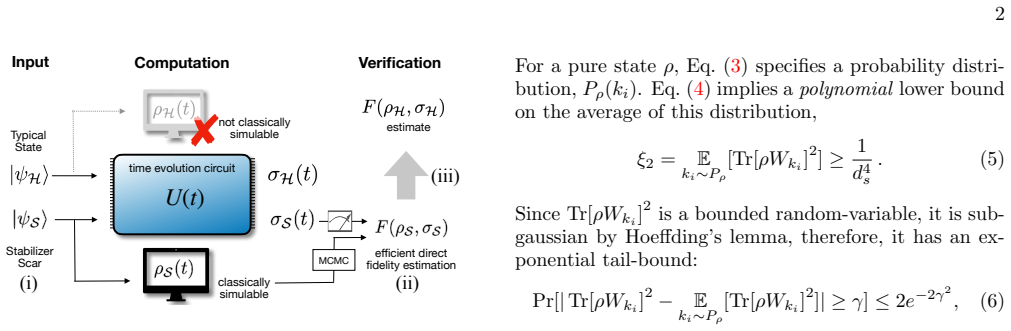
Summary. The paper proposes a benchmarking protocol for non-equilibrium quantum simulation based on stabilizer scars. For a Z2-lattice-gauge-theory-dual Ising model with a stabilizer-scar subspace, the authors argue (i) scar dynamics are classically simulable; (ii) direct fidelity estimation (DFE) is efficient for scar states, using bounds on the stabilizer Rényi entropy and a Markov-chain sampler; and (iii) under local depolarizing noise, the fidelity of scar states approximately equals the fidelity of typical, classically intractable non-scar states, so scar fidelity can certify device performance on hard dynamics. The analytic core, Eqs. (8)--(15), computes the average channel fidelity for Haar-random inputs in the full Hilbert space and in the scar subspace and bounds the difference. Numerical demonstrations include MCMC-based DFE for up to n=142 qubits and noisy qiskit simulations for n=10 qubits. The authors explicitly concede in the Discussion that claim (iii) is proven only as an average over input states to the error channel.
Significance. If the central equivalence were established for the actual circuit-evolved states used in a benchmark experiment, the protocol would be a genuinely useful tool: it would convert a classically simulable stabilizer-scar subspace into a quantitative, efficiently measurable proxy for device fidelity on thermalizing, classically hard dynamics. The analytic treatment is parameter-free and clearly presented, the bounds in Eqs. (9)--(15) are explicit, and the numerical MCMC demonstrations with both exact and shot-limited data are concrete and encouraging. The paper is also refreshingly candid about the main limitation. However, the missing transfer from Haar-averaged single-channel fidelity to fixed, circuit-evolved states is the load-bearing step for the headline claim, so the result as stated is not yet sufficiently supported.
major comments (2)
- [Fidelity estimation for classically non-simulable states; Discussion] The central claim (iii) is proven only for a single depolarizing channel acting on Haar-random input states (Eq. (8) and SM S3). The benchmark protocol, by contrast, initializes a fixed computational-basis bitstring, applies a deterministic circuit, and inserts depolarizing noise after every gate; the state entering each noise channel is a deterministic circuit output, not a Haar-random state. Haar-measure concentration (SM S3c) does not apply to this structured set. The numerical evidence in Fig. 4 is n=10 with random subspace-preserving circuits (Eq. (16)) and a single effective error rate; it does not test the Trotterized evolution of Eq. (11) at large n, nor does it provide a bound for fixed states. Since the abstract claims that scar fidelity 'bounds the fidelity of classically intractable simulations,' this average-to-individual transfer must be proved, or the claim must be restric
- [Numerical Simulations; SM S4; Discussion] The scalable-verification claim requires an efficient classical procedure to sample from the Pauli distribution P_rho of the target scar state. The MCMC algorithm used here proposes uniformly from P_S, whose size is d(n^2-n+2) -- exponential in n -- and no mixing-time bound is supplied. The Discussion explicitly states that the MCMC algorithm 'is not efficient.' Without a polynomial-time sampler or a mixing-time guarantee, the total classical overhead of the DFE protocol is not established, and the protocol cannot yet be called scalable at large n. The n=142 numerical chains are useful empirical evidence but do not constitute a complexity guarantee.
minor comments (3)
- [Eq. (6) and SM S1] The tail bound in Eq. (6) does not by itself justify the claim that samples with Pauli expectation significantly below the mean are 'exponentially unlikely.' Hoeffding's inequality with range [0,1] gives the exponent 2 gamma^2; to rule out X < mean/2 one needs gamma ~ 1/(2 d_s^4), for which the bound 2 exp(-2 gamma^2) is close to 2 and vacuous. The rigorous efficiency guarantee comes from the epsilon-truncation argument in SM S1 (Eq. (S12)) rather than from Eq. (6). Please revise the text so that the truncation argument is the primary support, and avoid overstating the concentration result.
- [Fig. 4 caption and main text] The symbol 's' is used both for the input bitstring and for the number of MCMC samples. This creates confusion in Fig. 4(a) and the surrounding text; please use distinct notation.
- [Discussion, final paragraph] There is a typo: 'A next step is is the implementation' should read 'A next step is the implementation.'
Circularity Check
No significant circularity: the fidelity bounds are derived analytically from a stated depolarizing channel; the average-to-fixed-state transfer is an acknowledged extrapolation, not a circular reduction.
full rationale
Walking the derivation chain, Eqs. (8)-(15) and SM S3 compute F(μ_H) and F(μ_S) directly from the local depolarizing channel and the stabilizer-scar projector. No quantity is fitted to the target result: Eq. (9) and Eq. (10) are closed-form channel averages, and Eq. (15) bounds F(μ_S) without invoking F(μ_H) as an input. The p_eff used in Fig. 4(b) is a closed-form function of p and the number of layers, not a fitted parameter. The stabilizer-scar model is imported from the authors' own Ref. [65], but that is a published, independently checkable prior result and is used as a substrate, not as the conclusion of this paper; it does not make the derivation circular. The paper itself flags the one genuine limitation: '(iii) has only been proven as an average over input states to the error channel. Numerical evidence, however, strongly suggests that it also holds for individual states computed by quantum circuits.' That is a proof gap between Haar-averaged inputs and fixed circuit-evolved states, supported only by n=10 qiskit numerics, but it is an extrapolation rather than a reduction of the claim to its own premises. There is no step in which the 'prediction' is defined in terms of the measured quantity or in which a fitted value is renamed as a prediction. Therefore the paper exhibits no significant circularity.
Axiom & Free-Parameter Ledger
axioms (5)
- domain assumption The dominant noise is local depolarizing noise with per-qubit error probability p.
- ad hoc to paper The fidelity equivalence proven on average over Haar-random input states extends to specific states produced by quantum circuit evolution.
- domain assumption The non-scar dynamics of the model are classically hard for generic inputs.
- domain assumption The stabilizer-scar model of Eq. (11) has an exactly polynomially large QMBS subspace spanned by stabilizer states.
- domain assumption The numerical MCMC chains converge and are approximately i.i.d. after burn-in and thinning.
read the original abstract
The applications for which quantum computers will clearly outperform classical computers are still being identified and benchmarking such an advantage is challenging. We propose a scalable verification scheme for non-equilibrium quantum simulation based on stabilizer scars, a special class of quantum many-body scars, whose structure ensures both classical simulability and efficient direct fidelity estimation. Assuming a physically motivated error model, we show that the fidelity of quantum simulating these states bounds the fidelity of classically intractable simulations, providing a benchmark for quantum-advantage experiments in non-equilibrium dynamics.
Figures


Reference graph
Works this paper leans on
-
[1]
Preskill, Quantum computing and the entanglement frontier, arXiv preprint arXiv:1203.5813 (2012)
J. Preskill, Quantum computing and the entanglement frontier, arXiv preprint arXiv:1203.5813 (2012)
Pith/arXiv arXiv 2012
-
[2]
S. Aaronson and L. Chen, Complexity-theoretic founda- tions of quantum supremacy experiments, arXiv preprint arXiv:1612.05903 (2016)
Pith/arXiv arXiv 2016
-
[3]
A. W. Harrow and A. Montanaro, Quantum computa- tional supremacy, Nature549, 203 (2017)
2017
-
[4]
I. H. Deutsch, Harnessing the power of the second quan- tum revolution, PRX Quantum1, 020101 (2020)
2020
-
[5]
P. W. Shor, Algorithms for quantum computation: dis- crete logarithms and factoring, inProceedings 35th an- nual symposium on foundations of computer science (Ieee, 1994) pp. 124–134
1994
-
[6]
Abbas, A
A. Abbas, A. Ambainis, B. Augustino, A. B¨ artschi, H. Buhrman, C. Coffrin, G. Cortiana, V. Dunjko, D. J. Egger, B. G. Elmegreen,et al., Challenges and opportu- nities in quantum optimization, Nature Reviews Physics , 1 (2024)
2024
-
[7]
Shepherd and M
D. Shepherd and M. J. Bremner, Temporally unstruc- tured quantum computation, Proceedings of the Royal Society A: Mathematical, Physical and Engineering Sci- ences465, 1413 (2009)
2009
-
[8]
Aaronson and A
S. Aaronson and A. Arkhipov, The computational com- plexity of linear optics, inProceedings of the forty-third annual ACM symposium on Theory of computing(2011) pp. 333–342
2011
-
[9]
M. J. Bremner, A. Montanaro, and D. J. Shep- herd, Achieving quantum supremacy with sparse and noisy commuting quantum computations, Quantum1, 8 (2017)
2017
-
[10]
Boixo, S
S. Boixo, S. V. Isakov, V. N. Smelyanskiy, R. Babbush, N. Ding, Z. Jiang, M. J. Bremner, J. M. Martinis, and H. Neven, Characterizing quantum supremacy in near- term devices, Nature Physics14, 595 (2018)
2018
-
[11]
R. P. Feynman, Simulating physics with computers, in Feynman and computation(cRc Press, 2018) pp. 133– 153
2018
-
[12]
Lloyd, Universal quantum simulators, Science273, 1073 (1996)
S. Lloyd, Universal quantum simulators, Science273, 1073 (1996)
1996
-
[13]
J. I. Cirac and P. Zoller, Goals and opportunities in quan- tum simulation, Nature physics8, 264 (2012)
2012
-
[14]
Gross and I
C. Gross and I. Bloch, Quantum simulations with ultra- cold atoms in optical lattices, Science357, 995 (2017)
2017
-
[15]
Becket al., Nuclear physics and quantum informa- tion science, Report from the NSAC QIS Subcommittee (2019)
D. Becket al., Nuclear physics and quantum informa- tion science, Report from the NSAC QIS Subcommittee (2019)
2019
-
[16]
Y. Cao, J. Romero, J. P. Olson, M. Degroote, P. D. John- son, M. Kieferov´ a, I. D. Kivlichan, T. Menke, B. Per- opadre, N. P. Sawaya,et al., Quantum chemistry in the age of quantum computing, Chemical reviews119, 10856 (2019)
2019
-
[17]
Altman, K
E. Altman, K. R. Brown, G. Carleo, L. D. Carr, E. Dem- ler, C. Chin, B. DeMarco, S. E. Economou, M. A. Eriks- son, K.-M. C. Fu,et al., Quantum simulators: Architec- tures and opportunities, PRX quantum2, 017003 (2021)
2021
-
[18]
C. W. Bauer, Z. Davoudi, A. B. Balantekin, T. Bhat- tacharya, M. Carena, W. A. De Jong, P. Draper, A. El- Khadra, N. Gemelke, M. Hanada,et al., Quantum simu- lation for high-energy physics, PRX quantum4, 027001 (2023)
2023
-
[19]
C. W. Bauer, Z. Davoudi, N. Klco, and M. J. Savage, Quantum simulation of fundamental particles and forces, Nature Reviews Physics5, 420 (2023)
2023
-
[20]
A. Y. Kitaev, A. Shen, and M. N. Vyalyi,Classical and quantum computation, 47 (American Mathematical Soc., 2002)
2002
-
[21]
Hangleiter, M
D. Hangleiter, M. Kliesch, M. Schwarz, and J. Eisert, Direct certification of a class of quantum simulations, Quantum Science and Technology2, 015004 (2017)
2017
-
[22]
J. F. Fitzsimons, M. Hajduˇ sek, and T. Morimae, Post hoc verification of quantum computation, Physical re- view letters120, 040501 (2018)
2018
-
[23]
Elben, B
A. Elben, B. Vermersch, R. Van Bijnen, C. Kokail, T. Brydges, C. Maier, M. K. Joshi, R. Blatt, C. F. Roos, and P. Zoller, Cross-platform verification of intermedi- ate scale quantum devices, Physical review letters124, 010504 (2020)
2020
-
[24]
Eisert, D
J. Eisert, D. Hangleiter, N. Walk, I. Roth, D. Markham, R. Parekh, U. Chabaud, and E. Kashefi, Quantum cer- tification and benchmarking, Nature Reviews Physics2, 382 (2020)
2020
-
[25]
Carrasco, A
J. Carrasco, A. Elben, C. Kokail, B. Kraus, and P. Zoller, Theoretical and experimental perspectives of quantum verification, PRX Quantum2, 010102 (2021)
2021
-
[26]
Mills, S
D. Mills, S. Sivarajah, T. L. Scholten, and R. Duncan, Application-motivated, holistic benchmarking of a full quantum computing stack, Quantum5, 415 (2021)
2021
-
[27]
Kliesch and I
M. Kliesch and I. Roth, Theory of quantum system cer- tification, PRX quantum2, 010201 (2021)
2021
-
[28]
S. Aaronson and Y. Zhang, On verifiable quantum ad- vantage with peaked circuit sampling, arXiv preprint arXiv:2404.14493 (2024). 7
Pith/arXiv arXiv 2024
-
[29]
Proctor, K
T. Proctor, K. Young, A. D. Baczewski, and R. Blume- Kohout, Benchmarking quantum computers, Nature Re- views Physics7, 105 (2025)
2025
-
[30]
P. F. Kolb and U. Heinz, Hydrodynamic description of ultrarelativistic heavy-ion collisions, inQuark–Gluon Plasma 3(World Scientific, 2004) pp. 634–714
2004
-
[31]
Schollw¨ ock, The density-matrix renormalization group in the age of matrix product states, Annals of physics 326, 96 (2011)
U. Schollw¨ ock, The density-matrix renormalization group in the age of matrix product states, Annals of physics 326, 96 (2011)
2011
-
[32]
J. I. Cirac and F. Verstraete, Renormalization and ten- sor product states in spin chains and lattices, Journal of physics a: mathematical and theoretical42, 504004 (2009)
2009
-
[33]
Probert,Electronic Structure: Basic Theory and Practical Methods(Taylor & Francis, 2011)
M. Probert,Electronic Structure: Basic Theory and Practical Methods(Taylor & Francis, 2011)
2011
-
[34]
Aharonov, Quantum to classical phase transition in noisy quantum computers, Physical Review A62, 062311 (2000)
D. Aharonov, Quantum to classical phase transition in noisy quantum computers, Physical Review A62, 062311 (2000)
2000
-
[35]
A. W. Harrow and M. A. Nielsen, Robustness of quantum gates in the presence of noise, Physical Review A68, 012308 (2003)
2003
-
[36]
Flannigan, N
S. Flannigan, N. Pearson, G. H. Low, A. Buyskikh, I. Bloch, P. Zoller, M. Troyer, and A. J. Daley, Propaga- tion of errors and quantitative quantum simulation with quantum advantage, Quantum Science & Technology7, 045025 (2022)
2022
-
[37]
Schuster, C
T. Schuster, C. Yin, X. Gao, and N. Y. Yao, A polynomial-time classical algorithm for noisy quantum circuits, Physical Review X15, 041018 (2025)
2025
-
[38]
A. Angrisani, A. A. Mele, M. S. Rudolph, M. Cerezo, and Z. Holmes, Simulating quantum circuits with arbi- trary local noise using pauli propagation, arXiv preprint arXiv:2501.13101 (2025)
Pith/arXiv arXiv 2025
-
[39]
S. Shravan, M. Raza, and A. Shlosberg, Efficient simula- tion of noisy iqp circuits with amplitude-damping noise, arXiv preprint arXiv:2604.05036 (2026)
Pith/arXiv arXiv 2026
-
[40]
Trivedi, A
R. Trivedi, A. Franco Rubio, and J. I. Cirac, Quantum advantage and stability to errors in analogue quantum simulators, Nature Communications15, 6507 (2024)
2024
-
[41]
Z. Liu, D. Devulapalli, D. Hangleiter, Y.-K. Liu, A. J. Koll´ ar, A. V. Gorshkov, and A. M. Childs, Efficiently verifiable quantum advantage on near-term analog quan- tum simulators, PRX Quantum6, 010341 (2025)
2025
-
[42]
Arute, K
F. Arute, K. Arya, R. Babbush, D. Bacon, J. C. Bardin, R. Barends, R. Biswas, S. Boixo, F. G. Brandao, D. A. Buell,et al., Quantum supremacy using a programmable superconducting processor, nature574, 505 (2019)
2019
-
[43]
DeCross, R
M. DeCross, R. Haghshenas, M. Liu, E. Rinaldi, J. Gray, Y. Alexeev, C. H. Baldwin, J. P. Bartolotta, M. Bohn, E. Chertkov,et al., Computational power of random quantum circuits in arbitrary geometries, Physical Re- view X15, 021052 (2025)
2025
-
[44]
D. Gao, D. Fan, C. Zha, J. Bei, G. Cai, J. Cai, S. Cao, F. Chen, J. Chen, K. Chen,et al., Establishing a new benchmark in quantum computational advantage with 105-qubit zuchongzhi 3.0 processor, Physical Review Let- ters134, 090601 (2025)
2025
-
[45]
Morvan, B
A. Morvan, B. Villalonga, X. Mi, S. Mandr` a, A. Bengts- son, P. Klimov, Z. Chen, S. Hong, C. Erickson, I. Droz- dov,et al., Phase transitions in random circuit sampling, Nature634, 328 (2024)
2024
-
[46]
Wu, W.-S
Y. Wu, W.-S. Bao, S. Cao, F. Chen, M.-C. Chen, X. Chen, T.-H. Chung, H. Deng, Y. Du, D. Fan,et al., Strong quantum computational advantage using a super- conducting quantum processor, Physical review letters 127, 180501 (2021)
2021
-
[47]
Emerson, R
J. Emerson, R. Alicki, and K. ˙Zyczkowski, Scalable noise estimation with random unitary operators, Journal of Optics B: Quantum and Semiclassical Optics7, S347 (2005)
2005
-
[48]
Knill, D
E. Knill, D. Leibfried, R. Reichle, J. Britton, R. B. Blakestad, J. D. Jost, C. Langer, R. Ozeri, S. Seidelin, and D. J. Wineland, Randomized benchmarking of quan- tum gates, Physical Review A—Atomic, Molecular, and Optical Physics77, 012307 (2008)
2008
-
[49]
T. J. Proctor, A. Carignan-Dugas, K. Rudinger, E. Nielsen, R. Blume-Kohout, and K. Young, Direct ran- domized benchmarking for multiqubit devices, Physical review letters123, 030503 (2019)
2019
-
[50]
A. W. Cross, L. S. Bishop, S. Sheldon, P. D. Nation, and J. M. Gambetta, Validating quantum computers us- ing randomized model circuits, Physical Review A100, 032328 (2019)
2019
-
[51]
Nielsen, J
E. Nielsen, J. K. Gamble, K. Rudinger, T. Scholten, K. Young, and R. Blume-Kohout, Gate set tomography, Quantum5, 557 (2021)
2021
-
[52]
Helsen, I
J. Helsen, I. Roth, E. Onorati, A. H. Werner, and J. Eis- ert, General framework for randomized benchmarking, PRX quantum3, 020357 (2022)
2022
-
[53]
Blume-Kohout and K
R. Blume-Kohout and K. C. Young, A volumetric frame- work for quantum computer benchmarks, Quantum4, 362 (2020)
2020
-
[54]
Bernien, S
H. Bernien, S. Schwartz, A. Keesling, H. Levine, A. Om- ran, H. Pichler, S. Choi, A. S. Zibrov, M. Endres, M. Greiner,et al., Probing many-body dynamics on a 51-atom quantum simulator, Nature551, 579 (2017)
2017
-
[55]
C. J. Turner, A. A. Michailidis, D. A. Abanin, M. Serbyn, and Z. Papi´ c, Weak ergodicity breaking from quantum many-body scars, Nature Physics14, 745 (2018)
2018
-
[56]
Serbyn, D
M. Serbyn, D. A. Abanin, and Z. Papi´ c, Quantum many- body scars and weak breaking of ergodicity, Nature Physics17, 675 (2021)
2021
-
[57]
Moudgalya, B
S. Moudgalya, B. A. Bernevig, and N. Regnault, Quan- tum many-body scars and hilbert space fragmentation: a review of exact results, Reports on Progress in Physics 85, 086501 (2022)
2022
-
[58]
Chandran, T
A. Chandran, T. Iadecola, V. Khemani, and R. Moess- ner, Quantum many-body scars: A quasiparticle perspec- tive, Annual Review of Condensed Matter Physics14, 443 (2023)
2023
-
[59]
J. C. Halimeh, N. Mueller, J. Knolle, Z. Papi´ c, and Z. Davoudi, Quantum simulation of out-of- equilibrium dynamics in gauge theories, arXiv preprint arXiv:2509.03586 (2025)
Pith/arXiv arXiv 2025
-
[60]
Fradkin,Field theories of condensed matter physics (Cambridge University Press, 2013)
E. Fradkin,Field theories of condensed matter physics (Cambridge University Press, 2013)
2013
-
[61]
Kleinert,Gauge Fields in Condensed Matter: Vol
H. Kleinert,Gauge Fields in Condensed Matter: Vol. 1: Superflow and Vortex Lines (Disorder Fields, Phase Transitions) Vol. 2: Stresses and Defects (Differential Geometry, Crystal Melting)(World Scientific, 1989)
1989
-
[62]
D. Gottesman, An introduction to quantum error correc- tion and fault-tolerant quantum computation, inQuan- tum information science and its contributions to mathe- matics, Proceedings of Symposia in Applied Mathematics, Vol. 68 (2010) pp. 13–58
2010
-
[63]
Das Sarma, M
S. Das Sarma, M. Freedman, and C. Nayak, Topological quantum computation, Physics Today59, 32 (2006). 8
2006
-
[64]
Nayak, S
C. Nayak, S. H. Simon, A. Stern, M. Freedman, and S. Das Sarma, Non-abelian anyons and topological quan- tum computation, Rev. Mod. Phys.80, 1083 (2008)
2008
-
[65]
Hartse, L
J. Hartse, L. Fidkowski, and N. Mueller, Stabilizer scars, Physical Review Letters135, 060402 (2025)
2025
-
[66]
S. Dooley, Parent hamiltonians for stabilizer quan- tum many-body scars, arXiv preprint arXiv:2601.10805 (2026)
arXiv 2026
-
[67]
Hokkyo, Exact thermal stabilizer eigenstates at infi- nite temperature, arXiv e-prints , arXiv (2026)
A. Hokkyo, Exact thermal stabilizer eigenstates at infi- nite temperature, arXiv e-prints , arXiv (2026)
2026
-
[68]
Gupta, P
S. Gupta, P. Sierant, L. Santos, and P. Stornati, Ex- act stabilizer scars in two-dimensional u (1) lattice gauge theory, Physical Review D113, 094509 (2026)
2026
-
[69]
S. T. Flammia and Y.-K. Liu, Direct fidelity estima- tion from few pauli measurements, Physical review letters 106, 230501 (2011)
2011
-
[70]
M. P. da Silva, O. Landon-Cardinal, and D. Poulin, Prac- tical characterization of quantum devices without tomog- raphy, Physical Review Letters107, 210404 (2011)
2011
-
[71]
Leone, S
L. Leone, S. F. Oliviero, and A. Hamma, Stabilizer r´ enyi entropy, Physical Review Letters128, 050402 (2022)
2022
-
[72]
Haug and L
T. Haug and L. Piroli, Stabilizer entropies and nonstabi- lizerness monotones, Quantum7, 1092 (2023)
2023
-
[73]
Boucheron, G
S. Boucheron, G. Lugosi, and P. Massart,Concentration Inequalities: A Nonasymptotic Theory of Independence (Oxford University Press, 2013)
2013
-
[74]
Leone, S
L. Leone, S. F. E. Oliviero, and A. Hamma, Nonstabiliz- erness determining the hardness of direct fidelity estima- tion, Phys. Rev. A107, 022429 (2023)
2023
-
[75]
Brooks, A
S. Brooks, A. Gelman, G. Jones, and X.-L. Meng,Hand- book of markov chain monte carlo(CRC press, 2011)
2011
-
[76]
A. Javadi-Abhari, M. Treinish, K. Krsulich, C. J. Wood, J. Lishman, J. Gacon, S. Martiel, P. D. Nation, L. S. Bishop, A. W. Cross,et al., Quantum computing with qiskit, arXiv preprint arXiv:2405.08810 (2024)
Pith/arXiv arXiv 2024
-
[77]
A Trotter time evolution circuit is obtained by setting αk,i =β k,i =γ k,i =δtwhereδtis the time step
-
[78]
B. Rahn, A. C. Doherty, and H. Mabuchi, Exact perfor- mance of concatenated quantum codes, Physical Review A66, 032304 (2002)
2002
-
[79]
P. Iyer, A. Jain, S. D. Bartlett, and J. Emerson, Effi- cient diagnostics for quantum error correction, Physical Review Research4, 043218 (2022)
2022
-
[80]
Sutherland, T
C. Sutherland, T. A. Brun, and D. A. Lidar, Non- markovianity of the post-markovian master equation, Physical Review A98, 042119 (2018)
2018
discussion (0)
Sign in with ORCID, Apple, or X to comment. Anyone can read and Pith papers without signing in.