REVIEW 3 major objections 5 minor 1 cited by
Asymptotic gauge symmetry and UV extension of the nonperturbative coupling in holographic QCD
T0 review · 3 major / 5 minor · reviewed 2026-08-07 · deepseek-v4-flash
Pith's one-line read This paper imposes asymptotic-freedom boundary conditions on the analytic holographic QCD coupling and shows that for SU(3) color they force a UV scaling exponent $r = 1/2$, six quark flavors, an infrared fixed point…
desk verdict A useful UV extension of the holographic coupling, but the flavor/exponent link is a consistency check that leans hard on the inherited maximal-analyticity input. read the letter →
The pith
A machine-rendered reading of the paper's core claim, the machinery that carries it, and where it could break.
The reading
What carries the argument
The load-bearing object is the rescaled effective coupling, $\alpha_{\mathrm{eff}}(Q^2,\kappa(Q^2)) = \alpha_{\mathrm{eff}}(0)\exp\left[-\int_0^{Q^2/4\kappa^2(Q^2)} \frac{dv}{1 + v\ln(\rho v)}\right]$, obtained by replacing $u$ with $u/f(u)$ in the predecessor model's integral, which is equivalent to letting $\kappa_0^2 \to \kappa_0^2 f(Q^2)$. This rescaling preserves the singularity flow of the original model and, by construction, the maximal analyticity condition $\kappa_0^2 = (\pi/8)\Lambda^2$, namely $\rho = \pi/2$. The relation that carries the argument is the asymptotic boundary identity $\alpha_{\mathrm{eff}}(0)\,\beta_0\,K_{w\to\infty}(\rho) = 1 - r$, which converts the one-loop $\beta$-function coefficient into a constraint linking the ultraviolet scaling exponent $r$, the number of flavors $n_f$, and the infrared fixed point; for $N_c = 3$, $\rho = \pi/2$, and $K = 2/7$ it becomes the Diophantine relation $(11N_c - 2n_f)/42 = 1 - r$. Flavor dynamics enter through the threshold function $f(Q^2) = \sum_f C_f\left(1 + Q^2/m_f^2\right)^r$ with the sum rules $\sum_f C_f = 1$ and $\sum_f C_f \sigma_f^r = \sigma^r$; imposing equal bottom and top weights at zero charm weight fixes $\sigma = 1/(4\mu^2)$ with $1/\mu = 1/m_b + 1/m_t$, determining the ultraviolet scale from the two heavy-quark masses alone.
What would settle it
A decisive test is a measurement of $\alpha_s$ at the Z pole with total uncertainty below about $5 \times 10^{-4}$: the paper predicts $0.1161 \pm 0.0017$, so a settled value at or above the current world average ($0.1180 \pm 0.0009$) would rule the prediction out. A second check targets the parameter-free scale $\sigma$: an independent fit of the multi-hundred-GeV to TeV world data to the threshold function (50) must return $\sigma \approx 0.015$ GeV$^{-2}$ within the locus band of Fig. 3, and a best-fit outside that band would falsify the threshold sum rules (51). A third probe is a lattice computation of the effective charge's analytic continuation: if the first singularity of $\alpha_{\mathrm{eff}}$ were located at a value of $\rho$ different from $\pi/2$, the chain from maximal analyticity to $r = 1/2$ would break at its root.
Extended reading notes
Core claim
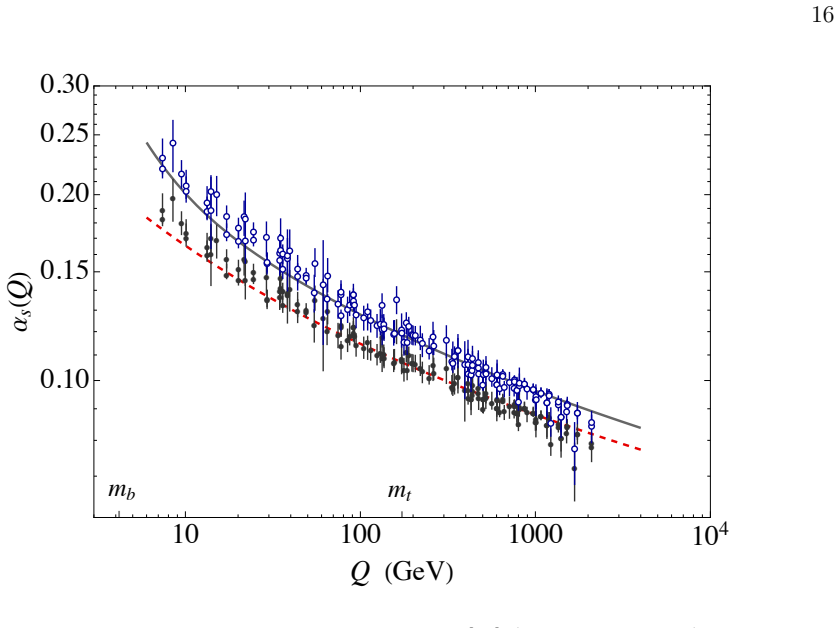
The central claim is that gauge symmetry at the asymptotic boundary fixes the ultraviolet running of the holographic confinement strength, and through it the flavor content of QCD. Imposing $\lim_{Q^2\to\infty}\alpha_{\mathrm{eff}}(Q^2,\kappa(Q^2))/\alpha_s(Q^2) = 1$ on the analytically continued effective coupling yields the identity $\alpha_{\mathrm{eff}}(0)\,\beta_0\,K_{w\to\infty}(\rho) = 1 - r$, where $r$ is the power of $Q^2$ in the scaling function and $K$ is a constant computed from the singularity structure of the model. For color SU(3), the Bjorken-scheme fixed point $\alpha_{\mathrm{eff}}(0) = \pi$, and the maximal analyticity value $\rho = \pi/2$ at which $K$ converges to $2/7$, the identity reduces to $(11N_c - 2n_f)/42 = 1 - r$: six open flavors select the exponent $r = 1/2$ observed in heavy-quark holographic spectroscopy, and conversely $r = 1/2$ requires $n_f = 6$. The paper states the outcome directly: the deep-UV boundary conditions require six flavors and an infrared fixed point $\alpha_{\mathrm{eff}}(0) = \pi$. With threshold weights satisfying $\sum_f C_f = 1$ and $\sum_f C_f \sigma_f^r = \sigma^r$, and setting the bottom and top weights equal with zero charm weight, the ultraviolet scale is fixed to $\sigma = 0.01501\ \mathrm{GeV}^{-2}$ from the two quark masses alone, giving $\alpha_{\overline{\mathrm{MS}}}(M_Z) = 0.1161 \pm 0.0017$ and an accurate description of the measured coupling at all scales.
Load-bearing premise
The argument's load-bearing premise is that the maximal analyticity relation $\kappa_0^2 = (\pi/8)\Lambda^2$, equivalently $\rho = \pi/2$, holds exactly, because it sets the constant $K = 2/7$ that converts the one-loop $\beta$-function coefficient into the scaling exponent $r = 1/2$; if $\rho$ deviates from $\pi/2$ even slightly, the six-flavor requirement and the predicted $\alpha_{\overline{\mathrm{MS}}}(M_Z) = 0.1161$ both shift.
Editorial extensions
If this is right
- A single dimensionful scale, the confinement scale $\kappa_0 \simeq 0.534$ GeV from hadron spectroscopy, now drives the strong coupling from its infrared fixed point $\alpha_{\mathrm{eff}}(0) = \pi$ through the transition region to the highest measured virtualities.
- The deep-UV boundary condition fixes the flavor content: six open flavors are required for $N_c = 3$ with $r = 1/2$, matching the three-generation structure seen in the $Z$ width, CKM unitarity, and cosmological bounds on the effective number of neutrino species.
- The ultraviolet scaling exponent of the confinement strength is pinned to $r = 1/2$, the same power law previously found in holographic heavy-quark spectroscopy, so two independent observables point to the same ultraviolet behavior.
- Equal bottom and top threshold weights with zero charm weight determine the ultraviolet scale $\sigma = 0.01501$ GeV$^{-2}$ from the quark masses alone, and the model then predicts $\alpha_{\overline{\mathrm{MS}}}(M_Z) = 0.1161 \pm 0.0017$, compatible with the current world average.
- For other gauge groups the same relation $(11N_c - 2n_f)/42 = 1 - r$ admits exactly 42 discrete scaling exponents, so the framework specifies how the ultraviolet scaling of the coupling must depend on the color group and flavor content.
Reading between the lines
- The derivation reverses the usual role of flavor thresholds: rather than inputting the measured flavor content and evolving the coupling through thresholds, the model derives $n_f = 6$ at infinity from an infrared datum ($\alpha_{\mathrm{eff}}(0) = \pi$) plus maximal analyticity. If this is right, a QCD-like theory with a different infrared fixed point would be forced to a different flavor count,
- The threshold construction leaves the charm weight $C_c$ free in the interval $[0, 0.15]$, which translates into a band of possible couplings at intermediate $Q^2$ of order 10-100 GeV$^2$. A high-precision measurement of the Bjorken-sum effective charge in that window, from future polarized deep-inelastic data, would effectively measure $C_c$, the one parameter the model does not fix.
- Because the identity $(11N_c - 2n_f)/42 = 1 - r$ ties the ultraviolet scaling to the particle content, any extension of the strong gauge group that changes the effective flavor count at high energies would have to announce itself as a change in the measured scaling of $\kappa(Q^2)$; confronting this relation with high-energy jet data is a quantitative way to look for beyond-Standard-Model color dy
Signed reviews
Editorial analysis
A structured set of objections, weighed in public.
Referee Report
Summary. This manuscript extends the holographic light-front QCD effective coupling of Ref. [1] into the deep UV by imposing asymptotic-freedom boundary conditions. The authors introduce a scale-dependent confinement strength kappa^2(Q^2) = kappa_0^2 f(Q^2) with f(Q^2) -> 1 in the IR and f(Q^2) ~ (sigma Q^2)^r in the UV (Eqs. 30 and 38), and show that the integral form of the coupling is preserved (Eq. 33). Imposing lim_{Q^2->infty} alpha_eff/alpha_s = 1 (Eq. 39) yields the central relation alpha_eff(0) beta_0 K_{w->infty}(rho) = 1 - r (Eq. 40). With alpha_eff(0) = pi (Bjorken-g1 scheme), maximal analyticity rho = pi/2 inherited from Ref. [1] (Eqs. 19 and 23), and (N_c, n_f) = (3, 6), this gives r = 1/2; conversely, assuming r = 1/2 reproduces n_f = 6 (Eqs. 41-43 and Fig. 1). Heavy-quark thresholds are encoded in f(Q^2) = sum_f C_f (1 + Q^2/m_f^2)^r (Eq. 50), with two sum rules (Eq. 51) leaving a one-parameter locus of solutions; fixing the locus by C_b = C_t, C_c = 0 determines sigma = 0.01501 GeV^-2 (Eqs. 53-54) without a UV fit. The model is then compared with world data at all scales (Figs. 4-5) and yields alpha_MS(MZ) = 0.1161 +/- 0.0017 (Eq. 55).
Significance. If the robustness issues below are addressed, this is a useful contribution: it is an explicit construction in which one holographic scale kappa_0 interpolates between the IR fixed point and the perturbative regime, with an all-scale description of the strong coupling data. The analytic chain from Eq. (29) to Eq. (40) is internally consistent; I have re-derived Eq. (33), verified that Eq. (40) follows from the large-Q^2 forms, and checked the algebraic content of Eqs. (53)-(54) and the n_f = 6 crossing in Fig. 1. The near-equality of the data-independent value sigma = 0.01501 GeV^-2 with the fitted value 0.015 GeV^-2 is a genuine internal consistency result, and Eq. (55) is a concrete, falsifiable target. However, the headline claim, advertised in the abstract and in Sec. IX as 'the deep UV boundary conditions require six flavors', overstates what the model actually delivers: the connection among r, alpha_eff(0), and n_f is a consistency relation contingent on the exact inherited input rho = pi/2, and the quoted alpha_s(MZ) lacks a complete error budget. The paper is best framed as a successful consistency check together with an all-scale phenomenological description.
major comments (3)
- [Sec. VI A; Eqs. (19), (21), (40); Table I] Eq. (40) is the pivot of the central claim, and it inherits the exact input rho = pi/2 from Eq. (19), which is taken from Ref. [1] and not re-derived here. Table I shows that K_w(rho) is extremely sensitive to rho: K(pi/2) = 0.2858 versus K(pi/4) = 0.0571, a factor of five over the allowed range stated in Eq. (21). Inserting rho = pi/4 into Eq. (40) with alpha_eff(0) = pi, N_c = 3, n_f = 6 gives 1 - r ~ 0.100 (r ~ 0.90) instead of 1/2; conversely, keeping r = 1/2 at rho = pi/4 would require 11N_c - 2n_f ~ 105, i.e., a negative n_f. Since Eq. (21) permits any rho in (1/e, pi/2] and the asymptotic boundary condition (39) does not by itself select rho, the advertised r = 1/2 and n_f = 6 results are only as secure as the unquantified maximal-analyticity input. The manuscript should either quantify the robustness (for example, the shift in alpha_s(MZ) as rho moves within its allowed interval, propagated through Eqs. (40)-(43) and (48)-(55)) or explicitly delimit the claim to the exact rho = pi/2 case.
- [Sec. VI A (Eqs. 40-43, Fig. 1) and Sec. IX] Eq. (40) is used in both directions: with n_f = 6 as input to derive r = 1/2, and then with r = 1/2 as input to derive n_f = 6; the Conclusions then state that 'the deep UV boundary conditions require six flavors.' This is a consistency loop rather than an independent derivation. The boundary condition (39) determines only the product combination in Eq. (40); with alpha_eff(0) = pi, N_c = 3, and n_f = 6 all being established external inputs, the genuinely model-derived content is the near-equality K_{w->infty}(pi/2) ~ 2/7 (Eq. 42), which makes those inputs mutually consistent. Because n_f = 6 is already known from direct observation, the 'requires six flavors' wording should be replaced by an explicit statement of mutual consistency of r = 1/2, alpha_eff(0) = pi, and n_f = 6 within the model. The comparison with Neff from BBN/CMB in Sec. IX concerns the number of light neutrino generations and is not an independent constraint on the six active quark flavors.
- [Sec. VII B (Eqs. 53-55) and Sec. VIII (Fig. 5)] The quoted prediction alpha_MS(MZ) = 0.1161 +/- 0.0017 has no stated error budget. Figure 5 shows two distinct bands, the threshold-locus spread (C_c in [0, 0.15], narrow gray band) and the kappa_0 uncertainty (wide band), but the text does not state which uncertainties are propagated into Eq. (55). Moreover, the central value is computed for one particular point of the locus, C_b = C_t, C_c = 0, while the 'red curve' compared with data in Figs. 4-5 corresponds to a different point (C_c = 0.075, C_b = 0.250, C_t = 0.675); the manuscript should state which trajectory underlies Eq. (55) and report the spread of alpha_s(MZ) across the locus. The condition C_b = C_t is an unmotivated choice that converts a one-parameter family of fits into a 'data-independent' determination (Sec. VII B); the claim in Sec. IX that the model describes the data 'without any additional free parameter' is therefore overstated, since sigma is either fitted to UV data (Fig. 2) or fixed by an ad hoc equality of weights.
minor comments (5)
- [Sec. VII and Fig. 2 caption] The value Lambda_MS^{n_f=6} = 87 GeV appears inconsistent with the standard n_f = 6 QCD scale (Lambda_MS ~ 90 MeV) and with the behavior implied by the NLO formula (27); please verify whether 0.087 GeV (87 MeV) is intended and correct all occurrences.
- [Sec. VII A and Fig. 3 discussion] The inequality '0 >= Cc >= 0.15' is written backwards in two places and should read 0 <= Cc <= 0.15; the symbols 'Cs = 0' and 'Cs = 0.15' should read 'Cc = 0' and 'Cc = 0.15'.
- [Fig. 4 caption] The symbols 'Cq' and 'sigma_q' are introduced without definition; they should be replaced by the corresponding coefficients (C_c or the heavy-quark weights) and sigma (or sigma_f).
- [Sec. II C] There is a duplicated word in the sentence 'its usefulness has been limited in practice limited to a few predictions'; one 'limited' should be removed.
- [Sec. V A] The assertion that the rescaling (28) preserves the singularity-flow analysis of Ref. [1] and hence the maximal-analyticity condition (19) is stated rather than demonstrated; since Eq. (19) is load-bearing for the central result, a short argument or an explicit reference showing that the branch cuts of f(Q^2) do not overlap the singularity flow would be valuable.
Circularity Check
One internal consistency loop in the K=2/7 rationalization of r=1/2; the central nf=6 and alpha_s(MZ) results are otherwise conditional on external inputs, not circular.
-
self definitional
[Section VI.B, Eqs. (41)-(47); Eq. (42)]
"From (41) Kw→∞(π/2) = 2/7 = 0.285714···, (42)... Substituting the power solution (45) in (37) we obtain βeff_0 = (1−r)/(αeff(0)Kw→∞(ρ)) , (46) which we compare with the leading coefficient of the QCD β-function β0 (26) with six open flavors β0 = 7/4π . (47) Thus, we recover the solution r = 1/2 obtained above for maximal analyticity, ρ=π/2, K(π/2)=2/7 from (42), and αeff(0)=π."
Equation (41) is Eq. (40) with r=1/2 already inserted ('start with the exponent r=1/2'). Inserting the chosen nf=6 and αeff(0)=π into (41) fixes K=2/7; this is not an independent evaluation of the integral (22). This K is then fed into (46) and compared with β0=7/(4π) for nf=6, algebraically returning 1−r=1/2. Thus the 'recovery' of r=1/2 is an identity: r=1/2 entered through K and was pulled out again. The exact rational relation (43) and the Diophantine table in Appendix B consequently rest on this circularly fixed K, while the numerical integral gives K(π/2)=0.285785 and 1−r≈0.500124, not exactly 1/2.
full rationale
The main derivation is not centrally circular. Equation (40) follows algebraically from the asymptotic boundary condition (39) plus the power-law ansatz (38), and the numerical branch using K(π/2)=0.285785 independently gives r≈1/2 for nf=6, αeff(0)=π and ρ=π/2. The second branch that yields nf=6 uses r=1/2 from external heavy-quark spectroscopy and αeff(0)=π from the Bjorken sum rule, so the advertised nf=6 result is a genuine conditional inference rather than a restatement of its own conclusion. The alpha_s(MZ) prediction is also a legitimate external benchmark: σ can be obtained without fitting via Eq. (54), and the comparison with the PDG value is data outside the model. The circularity that does exist is localized: the rational value K=2/7 in Eq. (42) is derived from Eq. (41) after r=1/2 has already been assumed, and is then used in Eqs. (46)-(47) to 'recover' r=1/2. This is an algebraic identity, not a new result, and it feeds the exact relation (43) and the Diophantine uniqueness claim in Appendix B. The conclusion in Section IX that the deep UV boundary conditions 'require six flavors' also omits the external r=1/2 premise, overstating what the boundary conditions alone imply. Because the approximate numerical route independently fixes r≈1/2 and the nf=6 claim has independent support, the paper is only partially circular, not globally reducible to its inputs.
Assumptions & free parameters
free parameters (5)
- kappa_0 =
0.534 GeV (0.5345 in places), from hadron spectroscopy [84]
- sigma =
0.015 GeV^-2 (0.01501 via Eq. 54)
- r =
1/2
- Cc =
0.075 for the central curve; 0 in the independent-sigma route
- Lambda_MS (nf = 6) =
87 GeV
assumptions (5)
- standard math Asymptotic freedom and the one- and two-loop RG coefficients beta_0, beta_1 for an SU(Nc) gauge theory (Eqs. 24 to 27)
- domain assumption Maximal analyticity relation kappa_0^2 = (pi/8) Lambda^2 and rho = pi/2 (Eq. 19) from the prior paper [1]
- domain assumption The g1 effective charge is a physical observable with IR fixed point alpha_g1(0) = pi (Eq. 15)
- domain assumption Six active quark flavors in the deep UV (nf = 6)
- ad hoc to paper The scaling function f(Q^2) = (1 + sigma Q^2)^r and its threshold decomposition (Eqs. 48 and 50) preserve the holomorphy and maximal analyticity of alpha_eff
invented entities (1)
-
Scale-dependent confinement strength kappa(Q^2) = kappa_0 sqrt(f(Q^2))
Cite this review
Pith. "Pith review of Asymptotic gauge symmetry and UV extension of the nonperturbative coupling in holographic QCD." pith.science (2026). https://pith.science/paper/B5HW2Z7D
@misc{pith2026250519545,
  author       = {Pith},
  title        = {Pith review of: Asymptotic gauge symmetry and UV extension of the nonperturbative coupling in holographic QCD},
  year         = {2026},
  howpublished = {\url{https://pith.science/paper/B5HW2Z7D}},
  note         = {Machine review of arXiv:2505.19545}
}
abstract
We extend our recent analytic study of the strong coupling $\alpha_{\rm eff}$ in the nonperturbative and near-perturbative regimes~\cite{deTeramond:2024ikl} by imposing rigorous renormalization-group results from asymptotically free gauge theories at $Q^2 \to \infty$. The asymptotic boundary conditions modify the scaling properties of $\alpha_{\rm eff}$ at large values of the momentum transfer $Q^2$, and lead to a scale-dependent confinement strength $\kappa(Q^2)$. This requires that both $\kappa(Q^2)$ and $\alpha_{\rm eff}\left(Q^2, \kappa(Q^2)\right)$ remain holomorphic in the complex $Q^2$ plane, except at the physical cuts associated with the heavy-quark thresholds and the singularity flow trajectory studied in~\cite{deTeramond:2024ikl}. For color $SU(3)$, a precise connection is found between the scaling exponent of $\kappa(Q^2)$ in the ultraviolet, the value of the infrared fixed point of the strong coupling, and the number of flavors in agreement with observations. The nonperturbative analytic model gives an accurate description of the strong coupling at all scales, up to the highest available data.
Figures


Figures from the paper (3 more)


Forward citations
Cited by 1 Pith paper
-
Insight on confinement from the QCD effective charge
Assigning the imaginary poles of α_g1 to parton propagators produces long-distance damping e^{-Λ_s|x|/√2}|x|^{-5/2+d_a}, interpreting confinement as Green's-function suppression.
Reference graph
Works this paper leans on
-
[1]
G. F. de T´ eramond, A. Paul, S. J. Brodsky, A. Deur, H. G. Dosch, T. Liu, and R. S. Sufian (HLFHS), QCD running coupling in the nonperturbative and near-perturbative regimes, Phys. Rev. Lett. 133, 181901 (2024), arXiv:2403.16126 [hep-ph]
arXiv 2024
-
[2]
J. M. Maldacena, The large N limit of superconformal field theories and supergravity, Adv. Theor. Math. Phys. 2, 231, arXiv:hep-th/9711200
-
[3]
S. S. Gubser, I. R. Klebanov, and A. M. Polyakov, Gauge theory correlators from noncritical string theory, Phys. Lett. B 428, 105 (1998), arXiv:hep-th/9802109
arXiv 1998
-
[4]
Witten, Anti-de Sitter space and holography, Adv
E. Witten, Anti-de Sitter space and holography, Adv. Theor. Math. Phys. 2, 253 (1998), arXiv:hep-th/9802150. 26
arXiv 1998
-
[5]
A. Deur, S. J. Brodsky, and G. F. de T´ eramond, The QCD running coupling, Nucl. Phys. 90, 1 (2016), arXiv:1604.08082 [hep-ph]
arXiv 2016
-
[6]
J. D. Bekenstein, Black holes and entropy, Phys. Rev. D 7, 2333 (1973)
1973
-
[7]
S. W. Hawking, Particle creation by black holes, Commun. Math. Phys. 43, 199 (1975), [Erratum: Commun.Math.Phys. 46, 206 (1976)]
1975
-
[8]
’t Hooft, Dimensional reduction in quantum gravity, Conf
G. ’t Hooft, Dimensional reduction in quantum gravity, Conf. Proc. C 930308, 284 (1993), arXiv:gr-qc/9310026
arXiv 1993
Show all 89 references
-
[9]
Susskind, The world as a hologram, J
L. Susskind, The world as a hologram, J. Math. Phys. 36, 6377 (1995), arXiv:hep-th/9409089
1995 arXiv
-
[10]
Gross et al., 50 Years of Quantum Chromodynamics, Eur
F. Gross et al., 50 Years of Quantum Chromodynamics, Eur. Phys. J. C 83, 1125 (2023), arXiv:2212.11107 [hep-ph]
2023 arXiv
-
[11]
P. A. M. Dirac, Forms of relativistic dynamics, Rev. Mod. Phys. 21, 392 (1949)
1949
-
[12]
G. F. de T´ eramond and S. J. Brodsky, Light-front holography: A first approximation to QCD, Phys. Rev. Lett. 102, 081601 (2009), arXiv:0809.4899 [hep-ph]
2009 arXiv
-
[13]
S. J. Brodsky, G. F. de T´ eramond, H. G. Dosch, and J. Erlich, Light-front holographic QCD and emerging confinement, Phys. Rept. 584, 1 (2015), arXiv:1407.8131 [hep-ph]
2015 arXiv
-
[14]
S. J. Brodsky, G. F. de T´ eramond, and A. Deur, Nonperturbative QCD coupling and its β-function from light-front holography, Phys. Rev. D 81, 096010 (2010), arXiv:1002.3948 [hep-ph]
2010 arXiv
-
[15]
Grunberg, Renormalization group improved perturbative QCD, Phys
G. Grunberg, Renormalization group improved perturbative QCD, Phys. Lett. B95, 70 (1980), [Erratum: Phys.Lett.B 110, 501 (1982)]
1980
-
[16]
Grunberg, Renormalization-scheme-invariant QCD and QED: The method of effective charges, Phys
G. Grunberg, Renormalization-scheme-invariant QCD and QED: The method of effective charges, Phys. Rev. D 29, 2315 (1984)
1984
-
[17]
A. Deur, S. J. Brodsky, and C. D. Roberts, QCD running couplings and effective charges, Prog. Part. Nucl. Phys. 134, 104081 (2024), arXiv:2303.00723 [hep-ph]
2024 arXiv
-
[18]
Gutsche, V
T. Gutsche, V. E. Lyubovitskij, I. Schmidt, and A. Vega, Chiral symmetry breaking and meson wave functions in soft-wall AdS/QCD, Phys. Rev. D 87, 056001 (2013), arXiv:1212.5196 [hep- ph]
2013 arXiv
-
[19]
H. G. Dosch, G. F. de T´ eramond, and S. J. Brodsky, Supersymmetry across the light and heavy-light hadronic spectrum II, Phys. Rev. D 95, 034016 (2017), arXiv:1612.02370 [hep- ph]
2017 arXiv
-
[20]
Nielsen, S
M. Nielsen, S. J. Brodsky, G. F. de T´ eramond, H. G. Dosch, F. S. Navarra, and L. Zou, Supersymmetry in the double-heavy hadronic spectrum, Phys. Rev. D 98, 034002 (2018), arXiv:1805.11567 [hep-ph]
2018 arXiv
-
[21]
E. V. Shuryak, Hadrons containing a heavy quark and QCD sum rules, Nucl. Phys. B 198, 83 (1982)
1982
-
[22]
Isgur and M
N. Isgur and M. B. Wise, Spectroscopy with heavy quark symmetry, Phys. Rev. Lett. 66, 1130 (1991). 27
1991
-
[23]
Binosi, C
D. Binosi, C. Mezrag, J. Papavassiliou, C. D. Roberts, and J. Rodriguez-Quintero, Process- independent strong running coupling, Phys. Rev. D96, 054026 (2017), arXiv:1612.04835 [nucl- th]
2017 arXiv
-
[24]
Cui, J.-L
Z.-F. Cui, J.-L. Zhang, D. Binosi, F. de Soto, C. Mezrag, J. Papavassiliou, C. D. Roberts, J. Rodr ´ ıguez-Quintero, J. Segovia, and S. Zafeiropoulos, Effective charge from lattice QCD, Chin. Phys. C 44, 083102 (2020), arXiv:1912.08232 [hep-ph]
2020 arXiv
-
[25]
Aharony, S
O. Aharony, S. S. Gubser, J. M. Maldacena, H. Ooguri, and Y. Oz, Large N field theories, string theory and gravity, Phys. Rept. 323, 183 (2000), arXiv:hep-th/9905111
2000 arXiv
-
[26]
Gursoy, E
U. Gursoy, E. Kiritsis, and F. Nitti, Exploring improved holographic theories for QCD: Part II, JHEP 02, 019, arXiv:0707.1349 [hep-th]
-
[27]
H. J. Pirner and B. Galow, Strong equivalence of the AdS-metric and the QCD running coupling, Phys. Lett. B 679, 51 (2009), arXiv:0903.2701 [hep-ph]
2009 arXiv
-
[28]
Cancio and P
H. Cancio and P. Masjuan, Holographic QCD running coupling constant from the Ricci flow, Phys. Rev. D 111, 094020 (2025), arXiv:2408.00455 [hep-ph]
2025
-
[29]
G. F. de T´ eramond, H. G. Dosch, and S. J. Brodsky, Kinematical and dynamical aspects of higher-spin bound-state equations in holographic QCD, Phys. Rev. D 87, 075005 (2013), arXiv:1301.1651 [hep-ph]
2013 arXiv
-
[30]
G. F. de T´ eramond and S. J. Brodsky, Color symmetry and confinement as an underlying superconformal structure in holographic QCD, Int. J. Mod. Phys. A 39, 2441007 (2024), arXiv:2308.09280 [hep-ph]
2024 arXiv
-
[31]
S. J. Brodsky, H.-C. Pauli, and S. S. Pinsky, Quantum chromodynamics and other field theories on the light cone, Phys. Rept. 301, 299 (1998), arXiv:hep-ph/9705477
1998 arXiv
-
[32]
S. J. Brodsky and G. F. de T´ eramond, Hadronic spectra and light-front wave functions in holographic QCD, Phys. Rev. Lett. 96, 201601 (2006), arXiv:hep-ph/0602252
2006 arXiv
-
[33]
de Alfaro, S
V. de Alfaro, S. Fubini, and G. Furlan, Conformal invariance in quantum mechanics, Nuovo Cim. A 34, 569 (1976)
1976
-
[34]
S. J. Brodsky, G. F. de T´ eramond, and H. G. Dosch, Threefold complementary approach to holographic QCD, Phys. Lett. B 729, 3 (2014), arXiv:1302.4105 [hep-th]
2014 arXiv
-
[35]
Fubini and E
S. Fubini and E. Rabinovici, Superconformal quantum mechanics, Nucl. Phys. B 245, 17 (1984)
1984
-
[36]
V. P. Akulov and A. I. Pashnev, Quantum superconformal model in (1,2) space, Theor. Math. Phys. 56, 862 (1983)
1983
-
[37]
G. F. de T´ eramond, H. G. Dosch, and S. J. Brodsky, Baryon spectrum from superconfor- mal quantum mechanics and its light-front holographic embedding, Phys. Rev. D 91, 045040 (2015), arXiv:1411.5243 [hep-ph]
2015 arXiv
-
[38]
H. G. Dosch, G. F. de T´ eramond, and S. J. Brodsky, Superconformal baryon-meson symmetry and light-front holographic QCD, Phys. Rev. D 91, 085016 (2015), arXiv:1501.00959 [hep-th]. 28
2015 arXiv
-
[39]
S. J. Brodsky, G. F. de T´ eramond, H. G. Dosch, and C. Lorc´ e, Universal effective hadron dynamics from superconformal algebra, Phys. Lett. B 759, 171 (2016), arXiv:1604.06746 [hep- ph]
2016 arXiv
-
[40]
J. D. Bjorken, Applications of the chiral U (6) ⊗ U (6) algebra of current densities, Phys. Rev. 148, 1467 (1966)
1966
-
[41]
J. D. Bjorken, Inelastic scattering of polarized leptons from polarized nucleons, Phys. Rev. D 1, 1376 (1970)
1970
-
[42]
Adeva et al
B. Adeva et al. (Spin Muon), Measurement of the spin-dependent structure function g1(x) of the deuteron, Phys. Lett. B 302, 533 (1993)
1993
-
[43]
Adams et al
D. Adams et al. (Spin Muon (SMC)), Measurement of the spin-dependent structure function g1(x) of the proton, Phys. Lett. B 329, 399 (1994), [Erratum: Phys.Lett.B 339, 332–333 (1994)], arXiv:hep-ph/9404270
1994 arXiv
-
[44]
Adeva et al
B. Adeva et al. (Spin Muon (SMC)), The spin-dependent structure function g1(x) of the proton from polarized deep-inelastic muon scattering, Phys. Lett. B 412, 414 (1997)
1997
-
[45]
Adams et al
D. Adams et al. (Spin Muon), A new measurement of the spin dependent structure function g1(x) of the deuteron, Phys. Lett. B 357, 248 (1995)
1995
-
[46]
Adams et al
D. Adams et al. (Spin Muon (SMC)), Spin structure of the proton from polarized inclusive deep-inelastic muon-proton scattering, Phys. Rev. D 56, 5330 (1997), arXiv:hep-ex/9702005
1997 arXiv
-
[47]
M. G. Alekseev et al. (COMPASS), The spin-dependent structure function of the proton gp 1 and a test of the Bjorken sum rule, Phys. Lett. B 690, 466 (2010), arXiv:1001.4654 [hep-ex]
2010 arXiv
-
[48]
Abe et al
K. Abe et al. (E143), Precision measurement of the proton spin structure function gp 1, Phys. Rev. Lett. 74, 346 (1995)
1995
-
[49]
Abe et al
K. Abe et al. (E143), Precision measurement of the deuteron spin structure function gd 1, Phys. Rev. Lett. 75, 25 (1995)
1995
-
[50]
P. L. Anthony et al. (E142), Deep inelastic scattering of polarized electrons by polarized 3He and the study of the neutron spin structure, Phys. Rev. D 54, 6620 (1996), arXiv:hep- ex/9610007
1996
-
[51]
Abe et al
K. Abe et al. (E143), Measurements of the Q2 dependence of the proton and deuteron spin structure functions gp 1 and gd 1, Phys. Lett. B 364, 61 (1995), arXiv:hep-ex/9511015
1995 arXiv
-
[52]
Abe et al
K. Abe et al. (E143), Measurements of the proton and deuteron spin structure function g1 in the resonance region, Phys. Rev. Lett. 78, 815 (1997), arXiv:hep-ex/9701004
1997 arXiv
-
[53]
Abe et al
K. Abe et al. (E154), Precision determination of the neutron spin structure function gn 1 , Phys. Rev. Lett. 79, 26 (1997), arXiv:hep-ex/9705012
1997 arXiv
-
[54]
Abe et al
K. Abe et al. (E154), Next-to-leading order QCD analysis of polarized deep inelastic scattering data, Phys. Lett. B 405, 180 (1997), arXiv:hep-ph/9705344
1997 arXiv
-
[55]
Abe et al
K. Abe et al. (E143), Measurements of the proton and deuteron spin structure functions g1 and g2, Phys. Rev. D 58, 112003 (1998), arXiv:hep-ph/9802357. 29
1998 arXiv
-
[56]
P. L. Anthony et al. (E155), Measurement of the deuteron spin structure function gd 1(x) for 1 − (GeV /c)2 < Q2 < 40 − (GeV /c)2, Phys. Lett. B 463, 339 (1999), arXiv:hep-ex/9904002
1999 arXiv
-
[57]
P. L. Anthony et al. (E155), Measurements of the Q2 dependence of the proton and neutron spin structure functions gp 1 and gn 1 , Phys. Lett. B 493, 19 (2000), arXiv:hep-ph/0007248
2000 arXiv
-
[58]
Ackerstaff et al
K. Ackerstaff et al. (HERMES), Determination of the deep inelastic contribution to the gen- eralized Gerasimov-Drell-Hearn integral for the proton and neutron, Phys. Lett. B 444, 531 (1998), arXiv:hep-ex/9809015
1998 arXiv
-
[59]
Airapetian et al
A. Airapetian et al. (HERMES), The Q2-dependence of the generalized Gerasimov-Drell-Hearn integral for the proton, Phys. Lett. B 494, 1 (2000), arXiv:hep-ex/0008037
2000 arXiv
-
[60]
Airapetian et al
A. Airapetian et al. (HERMES), The Q2 dependence of the generalized Gerasimov-Drell-Hearn integral for the deuteron, proton and neutron, Eur. Phys. J. C 26, 527 (2003), arXiv:hep- ex/0210047
2003
-
[61]
Deur et al., Experimental determination of the evolution of the Bjorken integral at low Q2, Phys
A. Deur et al., Experimental determination of the evolution of the Bjorken integral at low Q2, Phys. Rev. Lett. 93, 212001 (2004), arXiv:hep-ex/0407007
2004 arXiv
-
[62]
Deur et al., Experimental study of isovector spin sum rules, Phys
A. Deur et al., Experimental study of isovector spin sum rules, Phys. Rev. D 78, 032001 (2008), arXiv:0802.3198 [nucl-ex]
2008 arXiv
-
[63]
A. Deur, Y. Prok, V. Burkert, D. Crabb, F. X. Girod, K. A. Griffioen, N. Guler, S. E. Kuhn, and N. Kvaltine, High precision determination of the Q2 evolution of the Bjorken Sum, Phys. Rev. D 90, 012009 (2014), arXiv:1405.7854 [nucl-ex]
2014 arXiv
-
[64]
Deur et al., Experimental study of the behavior of the Bjorken sum at very low Q2, Phys
A. Deur et al., Experimental study of the behavior of the Bjorken sum at very low Q2, Phys. Lett. B 825, 136878 (2022), arXiv:2107.08133 [nucl-ex]
2022 arXiv
-
[65]
S. J. Brodsky and H. J. Lu, Commensurate scale relations in quantum chromodynamics, Phys. Rev. D 51, 3652 (1995), arXiv:hep-ph/9405218
1995 arXiv
-
[66]
Di Giustino, S
L. Di Giustino, S. J. Brodsky, P. G. Ratcliffe, S.-Q. Wang, and X.-G. Wu, Scheme-independent determination of the QCD running coupling at all scales from jet observables using the prin- ciple of maximum conformality and infinite-order scale setting, (2024), arXiv:2407.08570 [hep-ph]
2024 arXiv
-
[67]
A. L. Kataev, Ellis-Jaffe sum rule: The estimates of the next-to-next-to-leading-order QCD corrections, Phys. Rev. D 50, R5469 (1994), arXiv:hep-ph/9408248
1994 arXiv
-
[68]
A. L. Kataev, Deep inelastic sum rules at the boundaries between perturbative and nonper- turbative QCD, Mod. Phys. Lett. A 20, 2007 (2005), arXiv:hep-ph/0505230
2005 arXiv
-
[69]
P. A. Baikov, K. G. Chetyrkin, and J. H. Kuhn, Adler function, Bjorken sum rule, and the Crewther relation to order α4 s in a general gauge theory, Phys. Rev. Lett. 104, 132004 (2010), arXiv:1001.3606 [hep-ph]
2010 arXiv
-
[70]
Gell-Mann and F
M. Gell-Mann and F. E. Low, Quantum electrodynamics at small distances, Phys. Rev. 95, 1300 (1954)
1954
-
[71]
A. Deur, V. Burkert, J. P. Chen, and W. Korsch, Experimental determination of the QCD effective charge αg1(Q), Particles 5, 171 (2022), arXiv:2205.01169 [hep-ph]. 30
2022 arXiv
-
[72]
A. Deur, S. J. Brodsky, and G. F. de T´ eramond, Connecting the hadron mass scale to the fundamental mass scale of quantum chromodynamics, Phys. Lett. B 750, 528 (2015), arXiv:1409.5488 [hep-ph]
2015 arXiv
-
[73]
A. Deur, S. J. Brodsky, and G. F. de T´ eramond, On the interface between perturbative and nonperturbative QCD, Phys. Lett. B 757, 275 (2016), arXiv:1601.06568 [hep-ph]
2016 arXiv
-
[74]
A. Deur, S. J. Brodsky, and G. F. de T´ eramond, Determination of Λ M Sat five loops from holographic QCD, J. Phys. G 44, 105005 (2017), arXiv:1608.04933 [hep-ph]
2017 arXiv
-
[75]
G. F. de T´ eramond, T. Liu, R. S. Sufian, H. G. Dosch, S. J. Brodsky, and A. Deur (HLFHS), Universality of generalized parton distributions in light-front holographic QCD, Phys. Rev. Lett. 120, 182001 (2018), arXiv:1801.09154 [hep-ph]
2018 arXiv
-
[76]
T. Liu, R. S. Sufian, G. F. de T´ eramond, H. G. Dosch, S. J. Brodsky, and A. Deur (HLFHS), Unified description of polarized and unpolarized quark distributions in the proton, Phys. Rev. Lett. 124, 082003 (2020), arXiv:1909.13818 [hep-ph]
2020 arXiv
-
[77]
G. F. de T´ eramond, H. G. Dosch, T. Liu, R. S. Sufian, S. J. Brodsky, and A. Deur (HLFHS), Gluon matter distribution in the proton and pion from extended holographic light-front QCD, Phys. Rev. D 104, 114005 (2021), arXiv:2107.01231 [hep-ph]
2021 arXiv
-
[78]
H. G. Dosch, G. F. de T´ eramond, T. Liu, R. S. Sufian, S. J. Brodsky, and A. Deur (HLFHS), Towards a single scale-dependent Pomeron in holographic light-front QCD, Phys. Rev. D105, 034029 (2022), arXiv:2201.09813 [hep-ph]
2022 arXiv
-
[79]
Ayala and G
C. Ayala and G. Cvetic, Towards unifying perturbative and holographic light-front QCD via holomorphic coupling, JHEP 12, 075, arXiv:2410.00220 [hep-ph]
-
[80]
Deur, Spin sum rules and the strong coupling constant at large distance, AIP Conf
A. Deur, Spin sum rules and the strong coupling constant at large distance, AIP Conf. Proc. 1155, 112 (2009), arXiv:0906.4285 [nucl-ex]
2009 arXiv
-
[81]
D. J. Gross and F. Wilczek, Ultraviolet behavior of non-abelian gauge theories, Phys. Rev. Lett. 30, 1343 (1973)
1973
-
[82]
H. D. Politzer, Reliable perturbative results for strong interactions?, Phys. Rev. Lett. 30, 1346 (1973)
1973
-
[83]
Navas et al
S. Navas et al. (Particle Data Group), Review of particle physics, Phys. Rev. D 110, 030001 (2024)
2024
-
[84]
R. S. Sufian, T. Liu, G. F. de T´ eramond, H. G. Dosch, S. J. Brodsky, A. Deur, M. T. Islam, and B.-Q. Ma, Nonperturbative strange-quark sea from lattice QCD, light-front holography, and meson-baryon fluctuation models, Phys. Rev. D 98, 114004 (2018), arXiv:1809.04975 [hep-ph]
2018 arXiv
-
[85]
Horak, J
J. Horak, J. M. Pawlowski, J. Turnwald, J. M. Urban, N. Wink, and S. Zafeiropoulos, Nonperturbative strong coupling at timelike momenta, Phys. Rev. D 107, 076019 (2023), arXiv:2301.07785 [hep-ph]
2023 arXiv
-
[86]
Pitrou, A
C. Pitrou, A. Coc, J.-P. Uzan, and E. Vangioni, Precision big bang nucleosynthesis with improved Helium-4 predictions, Phys. Rept. 754, 1 (2018), arXiv:1801.08023 [astro-ph.CO]. 31
2018 arXiv
-
[87]
Aghanim et al
N. Aghanim et al. (Planck), Planck 2018 results. VI. Cosmological parameters, Astron. As- trophys. 641, A6 (2020), [Erratum: Astron.Astrophys. 652, C4 (2021)], arXiv:1807.06209 [astro-ph.CO]
2020 arXiv
-
[88]
Schael et al
S. Schael et al. (ALEPH, DELPHI, L3, OPAL, SLD, LEP Electroweak Working Group, SLD Electroweak Group, SLD Heavy Flavour Group), Precision electroweak measurements on the Z resonance, Phys. Rept. 427, 257 (2006), arXiv:hep-ex/0509008
2006 arXiv
-
[89]
L. J. Mordell, Diophantine Equations (Academic Press, 1969)
1969
Reviewed August 7, 2026 · model on record in the stance chip above.
Discussion (0). Continue with ORCID to comment.