REVIEW 4 major objections 6 minor 5 cited by
Ultra-High Resolution Segmentation via Boundary-Enhanced Patch-Merging Transformer
T0 review · 4 major / 6 minor · reviewed 2026-08-11 · deepseek-v4-flash
Pith's one-line read The paper claims that a single-branch Patch-Merging Transformer with a training-only boundary module beats all prior ultra-high-resolution segmentation methods on five benchmarks while using no more GPU memory.
desk verdict A plausible incremental improvement in UHR segmentation, but the missing clustering hyperparameters and memory-only efficiency claim make the SOTA claim non-reproducible as written. read the letter →
The pith
A machine-rendered reading of the paper's core claim, the machinery that carries it, and where it could break.
The reading
What carries the argument
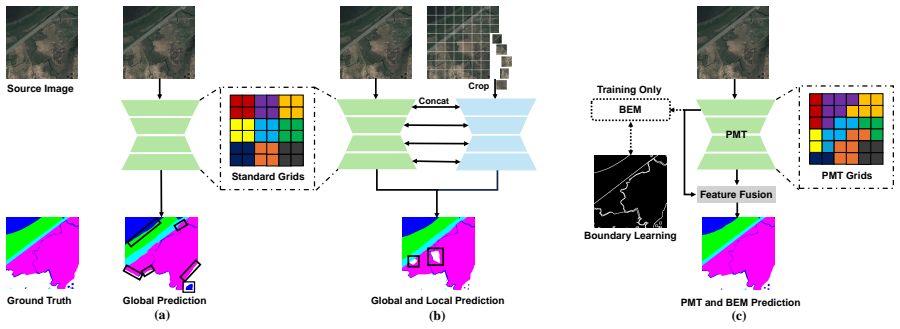
The central mechanism is the Patch-Merging Transformer (PMT), a dynamic token-allocation scheme: uniform 32x32 patches are first extracted, then merged into variable-shape regions by a density-peaks clustering step, where each patch's importance score is the product of its local density and its distance to a denser patch. Merged features are refined by an attention-like similarity update that recovers original patch detail, then restored by the Patch Recovering Block for the final feature map. The companion Boundary-Enhanced Module (BEM) adds a training-only binary boundary supervision signal, and a Feature Fusion Module adaptively combines PMT and boundary features.
What would settle it
Re-run BPT and at least the strongest quoted baseline, GPWFormer, on DeepGlobe and Inria Aerial with the same test split, preprocessing, input crop size, and memory measurement; the central claim fails if BPT's mIoU no longer exceeds the baseline or if its GPU memory is higher under identical conditions.
Extended reading notes
Core claim
On its own terms, the paper's central claim is that boundaries and scale differences do not require a dual-branch design. BPT's Patch-Merging Transformer clusters the initial 32x32 patch features with a density-peaks algorithm, scores each patch by local density times distance to a denser patch, merges cluster members by importance-weighted averaging, and then updates merged features with an attention-like residual that brings back original patch detail. A Patch Recovering Block restores the merged tokens to the original grid using recorded merge history. In parallel, a Boundary-Enhanced Module predicts a binary boundary mask from low-level features with a Canny-derived boundary target, and a Feature Fusion Module mixes the two paths adaptively. The paper reports that on DeepGlobe, Inria Aerial, Cityscapes, ISIC, and CRAG this design beats every compared baseline, including the best prior method GPWFormer, on mIoU while using no more GPU memory.
Load-bearing premise
The load-bearing premise is that the baseline numbers quoted from the prior work were produced under the same evaluation conditions, including identical test splits, preprocessing, and GPU-memory measurement, as BPT's own numbers; if those conditions differ, the reported accuracy and memory advantages may not be real.
Editorial extensions
If this is right
- The reported mIoU gains would make BPT the new accuracy leader on all five benchmarks: 76.6 versus 75.8 on DeepGlobe, 77.1 versus 76.5 on Inria Aerial, 78.5 versus 78.1 on Cityscapes, 81.6 versus 80.7 on ISIC, and 90.9 versus 89.9 on CRAG.
- Memory use is equal or lower than the strongest baseline (2074 MB versus 2380 MB on DeepGlobe and 1686 MB versus 1897 MB on Cityscapes), so the higher accuracy does not come with a memory penalty.
- Because the boundary head is removed at inference, the deployed model is a single-branch network; boundary enhancement improves training without adding inference cost.
- The single-branch adaptive grid replaces the explicit global and local fusion of prior methods, so the design space for UHR segmentation shifts from branch fusion to token allocation.
Reading between the lines
- The method's token-merging machinery is not obviously specific to segmentation; the same adaptive patch allocation could be applied to other dense prediction tasks on large images, such as depth estimation or change detection, where resolution is also bottlenecked by memory.
- The paper measures efficiency by GPU memory only and does not report wall-clock latency or throughput; an independent speed comparison would determine whether the no-extra-overhead claim extends to runtime.
- The margins over the best baseline are 0.5 to 0.9 mIoU, and the baseline numbers are quoted from one prior paper rather than re-run; the cleanest test is to re-evaluate both methods on identical hardware and splits, which the paper does not report.
- Because the ablations show the patch-merging block, patch-recovering block, boundary module, and feature fusion each add a separate gain, the components appear complementary; this suggests the training-only boundary supervision could be grafted onto other backbones independently of the dynamic patch merging.
Signed reviews
Editorial analysis
A structured set of objections, weighed in public.
Referee Report
Summary. The paper proposes a Boundary-Enhanced Patch-Merging Transformer (BPT) for ultra-high-resolution (UHR) image segmentation. BPT comprises a Patch-Merging Transformer (PMT) that dynamically clusters and merges image patches into tokens of varying shape and size, aiming to capture both global context and local details in a single branch, and a Boundary-Enhanced Module (BEM) that adds auxiliary boundary supervision during training only. Experiments on DeepGlobe, Inria Aerial, Cityscapes, ISIC, and CRAG report mIoU improvements over previous state-of-the-art methods, particularly GPWFormer, while using lower GPU memory.
Significance. If the empirical claims hold, BPT is a plausible and interesting single-branch alternative to the dual-branch architectures that currently dominate UHR segmentation. The dynamic token-merging idea based on density-peaks clustering is well motivated by the spatial statistics of UHR remote-sensing images, and the training-only boundary module is a sensible design for avoiding inference overhead. The paper provides consistent ablations across three datasets and comparisons on five benchmarks, which is a reasonable evidence base. However, the strength of the central claims is limited by missing clustering hyperparameters, borrowed baseline numbers, and the absence of runtime or variance reporting; these issues must be addressed before the results can be considered reproducible and the SOTA claim fully supported.
major comments (4)
- [Patch Merging Block (PMB), Eqs. (1)-(4)] The DPC-KNN clustering in the Patch Merging Block requires two hyperparameters that are never reported: the number of nearest neighbors k in Eq. (1) and the number of patch centers N (equivalently, the token retention ratio) in Eq. (4). Since N directly controls the trade-off between memory savings and segmentation accuracy, and the reported improvements over GPWFormer are only 0.5–1.0 mIoU (Tables 1–4), the central claim cannot be reproduced or distinguished from a particular (possibly over-tuned) retention setting without these values. Please report k, N (or the retention ratio) for each dataset and include a sensitivity analysis over N.
- [Experimental Setup, Baselines] All baseline results are quoted from a single external source (Ji, Zhao, and Lu 2023) with no statement that the evaluation conditions—test splits, preprocessing, and the memory-measurement protocol used for the 'Mem' columns—are identical to those for BPT. Given that the reported SOTA margins are only 0.3–0.9 mIoU, a mismatch in evaluation conditions could invert the comparison. The authors should either re-run the baselines under their own protocol or explicitly confirm and document identical conditions.
- [Abstract and Experimental Results] The claim that BPT achieves SOTA 'without introducing extra computational overhead' is supported only by peak GPU memory (Tables 1–3); no inference time, throughput, or FLOPs are reported. The dynamic DPC-KNN clustering in PMB may incur runtime overhead even if peak memory is lower, and the 'training-only' BEM statement does not address the PMT cost. Please report runtime and FLOPs, or narrow the claim to memory efficiency.
- [Ablation Study, Table 5] Several ablation differences are very small (e.g., ExpID #6 vs #1 shows 0.2 mIoU on Cityscapes), yet no runs are repeated and no error bars or standard deviations are reported. Without multiple seeds or statistical significance, the contribution of the Feature Fusion Module and the Boundary-Enhanced Module is not firmly established. Please report mean and standard deviation over at least three seeds for the main results and ablations.
minor comments (6)
- [Figure 3] The qualitative figure labels are duplicated: both GPWFormer and BPT panels are labeled '(d)'; the BPT panel should be '(e)'.
- [Eq. (3)] The merged patch feature is denoted 'y' in Eq. (3) but 'ym' in Eqs. (4)-(5); please use consistent notation and clarify the index m.
- [Boundary-Enhanced Module] The boundary extraction step ('Canny operator and Dilation operation') lacks parameters such as Canny thresholds and dilation kernel size; please specify them or reference a standard setting.
- [Implementation] The paper states that 'we adopt PVT block as the base transformer block' without specifying the PVT variant (e.g., PVTv1/v2, tiny/small) or the embedding dimensions of the four Patch-Merging/Recovering blocks; this information is needed for reproducibility.
- [Table 5 header] The ablation table header reads 'Mem (%)↓' but the values are reported in MB; please correct the unit or the header.
- [Experimental Setup] The 'Acc' metric in Tables 1 and 2 is not defined in the text; please state that it is pixel accuracy.
Circularity Check
No circularity: BPT's SOTA claim is an empirical benchmark comparison with externally sourced baselines, not a derivation that consumes its own output.
full rationale
The paper's central claim is that BPT achieves higher mIoU than prior UHR segmentation methods on five held-out test benchmarks while using comparable or lower GPU memory. This claim is supported by Tables 1-4, where baseline numbers are 'referenced from (Ji, Zhao, and Lu 2023)' (Experimental Setup, Baselines), an external source, and BPT's own numbers come from trained models evaluated on the same test splits. No quantity is fitted to a subset of the target metric and then renamed as a prediction: the DPC-KNN merging in Eqs. (1)-(5) is an architectural mechanism whose hyperparameters control operation, but the paper does not use that operation to reproduce or derive the reported mIoU values. The 'no extra computational overhead' claim is based on BEM being used only at training time and on measured memory costs (Tables 1-3); this is an empirical claim, not an identity. The two self-citations in the related work (Cheng and Sun 2024; Sun et al. 2024) are context acknowledgments, not load-bearing support for the central claim, and no uniqueness theorem from the authors is invoked to force the architecture choice. Missing implementation details such as k and token retention count are reproducibility risks, not circularity. Therefore the derivation chain, to the extent there is one, is self-contained against external benchmarks and no circular step is exhibited.
Assumptions & free parameters
free parameters (3)
- Loss weights {λ1, λ2, λ3, α1, β1, α2, β2, α3, β3} =
λ1=0.3, λ2=0.3, λ3=0.4; α1=0.6, β1=0.4, α2=0.3, β2=0.7, α3=0.5, β3=0.5
- DPC-KNN k and number of patch centers =
Not reported
- Patch size =
32x32 pixels
assumptions (4)
- domain assumption ImageNet-1K pretraining transfers to UHR segmentation
- domain assumption Canny operator plus dilation produces valid boundary supervision
- ad hoc to paper DPC-KNN patch clustering yields meaningful groupings for segmentation
- domain assumption Baseline numbers from (Ji, Zhao, and Lu 2023) are directly comparable
Cite this review
Pith. "Pith review of Ultra-High Resolution Segmentation via Boundary-Enhanced Patch-Merging Transformer." pith.science (2026). https://pith.science/paper/B5KQ4XWC
@misc{pith2026241210181,
  author       = {Pith},
  title        = {Pith review of: Ultra-High Resolution Segmentation via Boundary-Enhanced Patch-Merging Transformer},
  year         = {2026},
  howpublished = {\url{https://pith.science/paper/B5KQ4XWC}},
  note         = {Machine review of arXiv:2412.10181}
}
read the original abstract
Segmentation of ultra-high resolution (UHR) images is a critical task with numerous applications, yet it poses significant challenges due to high spatial resolution and rich fine details. Recent approaches adopt a dual-branch architecture, where a global branch learns long-range contextual information and a local branch captures fine details. However, they struggle to handle the conflict between global and local information while adding significant extra computational cost. Inspired by the human visual system's ability to rapidly orient attention to important areas with fine details and filter out irrelevant information, we propose a novel UHR segmentation method called Boundary-enhanced Patch-merging Transformer (BPT). BPT consists of two key components: (1) Patch-Merging Transformer (PMT) for dynamically allocating tokens to informative regions to acquire global and local representations, and (2) Boundary-Enhanced Module (BEM) that leverages boundary information to enrich fine details. Extensive experiments on multiple UHR image segmentation benchmarks demonstrate that our BPT outperforms previous state-of-the-art methods without introducing extra computational overhead. Codes will be released to facilitate research.
Figures


Forward citations
Cited by 5 Pith papers
-
STeInFormer: Spatial-Temporal Interaction Transformer Architecture for Remote Sensing Change Detection
STeInFormer enhances remote sensing change detection by interacting bi-temporal features during feature extraction and using fixed DCT frequency components as a parameter-light token mixer.
-
Conditional Latent Coding with Learnable Synthesized Reference for Deep Image Compression
Conditional Latent Coding compresses images by synthesizing a per-image reference latent from a learned feature dictionary, improving low-bitrate rate-distortion over TCM, VTM, and BPG.
-
A Novel Scene Coupling Semantic Mask Network for Remote Sensing Image Segmentation
SCSM, a scene coupling and semantic mask attention decoder, reports higher accuracy than prior methods on four remote sensing segmentation benchmarks with lower computational cost.
-
Multi-View Factorizing and Disentangling: A Novel Framework for Incomplete Multi-View Multi-Label Classification
A two-stage framework that factorizes multi-view representations into view-consistent and view-specific parts, using masked reconstruction, semantic contrast, and a graph disentangling loss, outperforms ten baselines ...
-
Pinwheel-shaped Convolution and Scale-based Dynamic Loss for Infrared Small Target Detection
A pinwheel convolution and a scale-based dynamic loss give small but consistent gains for infrared small-target detection, along with a new drone and bird benchmark.
Reference graph
Works this paper leans on
-
[1]
, " * write output.state after.block = add.period write newline
ENTRY address archivePrefix author booktitle chapter edition editor eid eprint howpublished institution isbn journal key month note number organization pages publisher school series title type volume year label extra.label sort.label short.list INTEGERS output.state before.all mid.sentence after.sentence after.block FUNCTION init.state.consts #0 'before.a...
-
[2]
write newline
" write newline "" before.all 'output.state := FUNCTION n.dashify 't := "" t empty not t #1 #1 substring "-" = t #1 #2 substring "--" = not "--" * t #2 global.max substring 't := t #1 #1 substring "-" = "-" * t #2 global.max substring 't := while if t #1 #1 substring * t #2 global.max substring 't := if while FUNCTION word.in bbl.in capitalize " " * FUNCT...
-
[3]
Chen, L.-C.; Zhu, Y.; Papandreou, G.; Schroff, F.; and Adam, H. 2018. Encoder-decoder with atrous separable convolution for semantic image segmentation. In ECCV, 801--818
2018
-
[4]
Chen, Q.; Wang, T.; Yang, Z.; Li, H.; Lu, R.; Sun, Y.; Zheng, B.; and Yan, C. 2024. SDPL: Shifting-Dense Partition Learning for UAV-View Geo-Localization. IEEE Trans. Circuits Syst. Video Technol., 34(11): 11810--11824
work page 2024
-
[5]
Chen, W.; Jiang, Z.; Wang, Z.; Cui, K.; and Qian, X. 2019. Collaborative global-local networks for memory-efficient segmentation of ultra-high resolution images. In CVPR, 8924--8933
work page 2019
-
[6]
Cheng, B.; Schwing, A.; and Kirillov, A. 2021. Per-pixel classification is not all you need for semantic segmentation. NeurIPS, 34: 17864--17875
work page 2021
-
[7]
K.; Chung, J.; Tai, Y.-W.; and Tang, C.-K
Cheng, H. K.; Chung, J.; Tai, Y.-W.; and Tang, C.-K. 2020. CascadePSP: Toward class-agnostic and very high-resolution segmentation via global and local refinement. In CVPR, 8890--8899
work page 2020
-
[8]
Cheng, S.; and Sun, H. 2024. SPT: Sequence Prompt Transformer for Interactive Image Segmentation. arXiv:2412.10224
arXiv 2024
Show all 75 references
-
[9]
Cordts, M.; Omran, M.; Ramos, S.; Rehfeld, T.; Enzweiler, M.; Benenson, R.; Franke, U.; Roth, S.; and Schiele, B. 2016. The cityscapes dataset for semantic urban scene understanding. In ICCV, 3213--3223
2016
-
[10]
Demir, I.; Koperski, K.; Lindenbaum, D.; Pang, G.; Huang, J.; Basu, S.; Hughes, F.; Tuia, D.; and Raskar, R. 2018. Deepglobe 2018: A challenge to parse the earth through satellite images. In CVPR Workshops, 172--181
2018
-
[11]
Fan, M.; Lai, S.; Huang, J.; Wei, X.; Chai, Z.; Luo, J.; and Wei, X. 2021. Rethinking BiSeNet for real-time semantic segmentation. In CVPR, 9716--9725
2021
-
[12]
Fu, J.; Liu, J.; Tian, H.; Li, Y.; Bao, Y.; Fang, Z.; and Lu, H. 2019. Dual attention network for scene segmentation. In CVPR, 3146--3154
2019
-
[13]
W.; and Rajpoot, N
Graham, S.; Chen, H.; Gamper, J.; Dou, Q.; Heng, P.-A.; Snead, D.; Tsang, Y. W.; and Rajpoot, N. 2019. MILD-Net: Minimal information loss dilated network for gland instance segmentation in colon histology images. Med. Image Anal., 52: 199--211
2019
-
[14]
Guan, R.; Li, Z.; Tu, W.; Wang, J.; Liu, Y.; Li, X.; Tang, C.; and Feng, R. 2024 a . Contrastive Multiview Subspace Clustering of Hyperspectral Images Based on Graph Convolutional Networks. IEEE TGRS., 62: 1--14
2024
-
[15]
Guan, R.; Tu, W.; Li, Z.; Yu, H.; Hu, D.; Chen, Y.; Tang, C.; Yuan, Q.; and Liu, X. 2024 b . Spatial-Spectral Graph Contrastive Clustering with Hard Sample Mining for Hyperspectral Images. IEEE TGRS., 1--16
2024
-
[16]
Guo, S.; Liu, L.; Gan, Z.; Wang, Y.; Zhang, W.; Wang, C.; Jiang, G.; Zhang, W.; Yi, R.; Ma, L.; et al. 2022. ISDNet: Integrating shallow and deep networks for efficient ultra-high resolution segmentation. In CVPR, 4361--4370
2022
-
[17]
He, J.; Nie, T.; and Ma, W. 2024. Geolocation representation from large language models are generic enhancers for spatio-temporal learning. arXiv:2408.12116
2024 arXiv
-
[18]
Hu, Q.; Yi, Z.; Zhou, Y.; Li, T.; Huang, F.; Liu, M.; Li, Q.; and Wang, Z. 2024. MonoBox: Tightness-free Box-supervised Polyp Segmentation using Monotonicity Constraint. arXiv e-prints, arXiv--2404
2024
-
[19]
T.; Luu, K.; and Hoai, M
Huynh, C.; Tran, A. T.; Luu, K.; and Hoai, M. 2021. Progressive semantic segmentation. In CVPR, 16755--16764
2021
-
[20]
Ji, D.; Zhao, F.; and Lu, H. 2023. Guided patch-grouping wavelet transformer with spatial congruence for ultra-high resolution segmentation. arXiv:2307.00711
2023 arXiv
-
[21]
Ji, D.; Zhao, F.; Lu, H.; Tao, M.; and Ye, J. 2023. Ultra-high resolution segmentation with ultra-rich context: A novel benchmark. In CVPR, 23621--23630
2023
-
[22]
Jiang, J.; Feng, Y.; Chen, J.; Guo, D.; and Zheng, J. 2023. Latent-space Unfolding for MRI Reconstruction. In Proc. 31st ACM Int. Conf. Multimedia, 1294--1302
2023
-
[23]
Jiang, J.; He, Z.; Quan, Y.; Wu, J.; and Zheng, J. 2024. PGIUN: Physics-Guided Implicit Unrolling Network for Accelerated MRI. IEEE Trans. Comput. Imaging
2024
-
[24]
Kirillov, A.; Wu, Y.; He, K.; and Girshick, R. 2020. PointRend: Image segmentation as rendering. In CVPR, 9799--9808
2020
-
[25]
a henb \
Kr \"a henb \"u hl, P.; and Koltun, V. 2011. Efficient inference in fully connected CRFs with Gaussian edge potentials. NeurIPS, 24
2011
-
[26]
Li, L.; Xing, J.; Yu, X.; and Zhang, X.-P. 2024 a . Deviation Wing Loss for High-Performance 2D Pose Estimation. In IEEE ICME, 1--6. IEEE
2024
-
[27]
Li, L.; Yang, W.; Yu, X.; Xing, J.; and Zhang, X.-P. 2024 b . Translating Motion to Notation: Hand Labanotation for Intuitive and Comprehensive Hand Movement Documentation. In Proc. 32nd ACM Int. Conf. Multimedia, 4092--4100
2024
-
[28]
Li, Q.; Yang, W.; Liu, W.; Yu, Y.; and He, S. 2021. From contexts to locality: Ultra-high resolution image segmentation via locality-aware contextual correlation. In CVPR, 7252--7261
2021
-
[29]
Li, S.; Ye, M.; Zhou, L.; Li, N.; Xiao, S.; Tang, S.; and Zhu, X. 2024 c . Cloud Object Detector Adaptation by Integrating Different Source Knowledge. In Proc. 38th Annu. Conf. Neural Inf. Process. Syst
2024
-
[30]
Li, Y.; Long, Q.; Zhou, Y.; Cao, N.; Liu, S.; Zheng, F.; Zhu, Z.; Ning, Z.; Xiao, M.; Wang, X.; et al. 2024 d . COMAE: COMprehensive Attribute Exploration for Zero-shot Hashing. arXiv preprint arXiv:2402.16424
2024 arXiv
-
[31]
Li, Y.; Lu, Y.; Dong, Z.; Yang, C.; Chen, Y.; and Gou, J. 2024 e . SGLP: A Similarity Guided Fast Layer Partition Pruning for Compressing Large Deep Models. arXiv preprint arXiv:2410.14720
2024
-
[32]
Liu, Y.; Shi, S.; Wang, J.; and Zhong, Y. 2023. Seeing Beyond the Patch: Scale-Adaptive Semantic Segmentation of High-resolution Remote Sensing Imagery based on Reinforcement Learning. In CVPR, 16868--16878
2023
-
[33]
Long, J.; Shelhamer, E.; and Darrell, T. 2015. Fully convolutional networks for semantic segmentation. In CVPR, 3431--3440
2015
-
[34]
Long, X.; Zeng, J.; Meng, F.; Ma, Z.; Zhang, K.; Zhou, B.; and Zhou, J. 2024. Generative multi-modal knowledge retrieval with large language models. In AAAI, 18733--18741
2024
-
[35]
Lu, H.; Tang, J.; Xu, X.; Cao, X.; Zhang, Y.; Wang, G.; Du, D.; Chen, H.; and Chen, Y. 2024 a . Scaling Multi-Camera 3D Object Detection through Weak-to-Strong Eliciting. arXiv:2404.06700
2024 arXiv
-
[36]
Lu, H.; Xu, T.; Zheng, W.; Zhang, Y.; Zhan, W.; Du, D.; Tomizuka, M.; Keutzer, K.; and Chen, Y. 2024 b . DrivingRecon: Large 4D Gaussian Reconstruction Model For Autonomous Driving. arXiv preprint arXiv:2412.09043
2024 arXiv
-
[37]
Lu, H.; Zhang, Y.; Lian, Q.; Du, D.; and Chen, Y. 2025. Towards generalizable multi-camera 3D object detection via perspective debiasing. AAAI
2025
-
[38]
Maggiori, E.; Tarabalka, Y.; Charpiat, G.; and Alliez, P. 2017. Can semantic labeling methods generalize to any city? the inria aerial image labeling benchmark. In IEEE IGARSS, 3226--3229
2017
-
[39]
Milletari, F.; Navab, N.; and Ahmadi, S.-A. 2016. V-net: Fully convolutional neural networks for volumetric medical image segmentation. In 3DV, 565--571. IEEE
2016
-
[40]
Nie, T.; Qin, G.; Ma, W.; Mei, Y.; and Sun, J. 2024. ImputeFormer: Low rankness-induced transformers for generalizable spatiotemporal imputation. In Proc. 30th ACM SIGKDD Conf. Knowl. Discov. Data Min., 2260--2271
2024
-
[41]
Qian, H.; Chen, Y.; Lou, S.; Khan, F.; Jin, X.; and Fan, D.-P. 2024. MaskFactory: Towards High-quality Synthetic Data Generation for Dichotomous Image Segmentation. In NeurIPS
2024
-
[42]
Ronneberger, O.; Fischer, P.; and Brox, T. 2015. U-net: Convolutional networks for biomedical image segmentation. In MICCAI, 234--241. Springer
2015
-
[43]
Shen, F.; Du, X.; Zhang, L.; and Tang, J. 2023 a . Triplet Contrastive Learning for Unsupervised Vehicle Re-identification. arXiv:2301.09498
2023 arXiv
-
[44]
Shen, F.; Shu, X.; Du, X.; and Tang, J. 2023 b . Pedestrian-specific Bipartite-aware Similarity Learning for Text-based Person Retrieval. In Proc. 31st ACM Int. Conf. Multimedia
2023
-
[45]
Shen, F.; Xie, Y.; Zhu, J.; Zhu, X.; and Zeng, H. 2023 c . Git: Graph interactive transformer for vehicle re-identification. IEEE Trans. Image Process
2023
-
[46]
Sun, H.; Xu, L.; Jin, S.; Luo, P.; Qian, C.; and Liu, W. 2024. PROGRAM : PRO totype GRA ph Model based Pseudo-Label Learning for Test-Time Adaptation. In ICLR
2024
-
[47]
Tao, H.; Li, J.; Hua, Z.; and Zhang, F. 2023. DUDB: Deep Unfolding Based Dual-Branch Feature Fusion Network for Pan-sharpening remote sensing images. IEEE TGRS
2023
-
[48]
Tschandl, P.; Rosendahl, C.; and Kittler, H. 2018. The HAM10000 dataset, a large collection of multi-source dermatoscopic images of common pigmented skin lesions. Sci. Data, 5(1): 1--9
2018
-
[49]
Wang, T.; Yang, Z.; Chen, Q.; Sun, Y.; and Yan, C. 2024. Rethinking Pooling for Multi-Granularity Features in Aerial-View Geo-Localization. IEEE Signal Process. Lett., 31: 3005--3009
2024
-
[50]
Wu, H.; Zheng, S.; Zhang, J.; and Huang, K. 2018. Fast end-to-end trainable guided filter. In CVPR, 1838--1847
2018
-
[51]
Wu, T.; Lei, Z.; Lin, B.; Li, C.; Qu, Y.; and Xie, Y. 2020. Patch proposal network for fast semantic segmentation of high-resolution images. In AAAI, 12402--12409
2020
-
[52]
Wu, X.; Jiang, B.; Zhong, Y.; and Chen, H. 2022. Multi-target Markov boundary discovery: Theory, algorithm, and application. IEEE Trans. Pattern Anal. Mach. Intell., 45(4): 4964--4980
2022
-
[53]
M.; and Luo, P
Xie, E.; Wang, W.; Yu, Z.; Anandkumar, A.; Alvarez, J. M.; and Luo, P. 2021. SegFormer: Simple and efficient design for semantic segmentation with transformers. NeurIPS, 34: 12077--12090
2021
-
[54]
Xie, J.; Cai, Y.; Chen, J.; Xu, R.; Wang, J.; and Li, Q. 2024 a . Knowledge-Augmented Visual Question Answering With Natural Language Explanation. IEEE Trans. Image Process
2024
-
[55]
Xie, J.; Chen, J.; Liu, Z.; Cai, Y.; Huang, Q.; and Li, Q. 2024 b . Video Question Generation for Dynamic Changes. IEEE Trans. Circuits Syst. Video Technol
2024
-
[56]
Xie, J.; Zhou, Z.; Wu, Z.; Zhang, X.; Wang, J.; Cai, Y.; and Li, Q. 2024 c . Automated Defect Report Generation for Enhanced Industrial Quality Control. In Proc. AAAI Conf. Artif. Intell., 19306--19314
2024
-
[57]
Yin, B.; Zhang, X.; Hou, Q.; Sun, B.-Y.; Fan, D.-P.; and Van Gool, L. 2022. Camoformer: Masked separable attention for camouflaged object detection. arXiv:2212.06570
2022 arXiv
-
[58]
Yin, B.; Zhang, X.; Li, Z.; Liu, L.; Cheng, M.-M.; and Hou, Q. 2023. DFormer: Rethinking RGBD Representation Learning for Semantic Segmentation. arXiv:2309.09668
2023 arXiv
-
[59]
Yu, C.; Gao, C.; Wang, J.; Yu, G.; Shen, C.; and Sang, N. 2021. Bisenet v2: Bilateral network with guided aggregation for real-time semantic segmentation. Int. J. Comput. Vis., 129: 3051--3068
2021
-
[60]
Yu, C.; Wang, J.; Peng, C.; Gao, C.; Yu, G.; and Sang, N. 2018. BiSeNet: Bilateral segmentation network for real-time semantic segmentation. In Proceedings of the European Conference on Computer Vision (ECCV), 325--341
2018
-
[61]
Yuan, Y.; Xie, J.; Chen, X.; and Wang, J. 2020. SegFix: Model-agnostic boundary refinement for segmentation. In Computer Vision--ECCV 2020: 16th European Conference, Glasgow, UK, August 23--28, 2020, Proceedings, Part XII, 489--506. Springer
2020
-
[62]
Yuan, Z.; Cao, J.; Li, Z.; Jiang, H.; and Wang, Z. 2024 a . SD-MVS : Segmentation-Driven Deformation Multi-View Stereo with Spherical Refinement and EM Optimization . In Proc. AAAI Conf. Artif. Intell., volume 38, 6871--6880
2024
-
[63]
Yuan, Z.; Cao, J.; Wang, Z.; and Li, Z. 2024 b . Tsar-Mvs: Textureless-aware Segmentation and Correlative Refinement Guided Multi-View Stereo. Pattern Recognit., 154: 110565
2024
-
[64]
Yuan, Z.; Liu, C.; Shen, F.; Li, Z.; Mao, T.; and Wang, Z. 2024 c . MSP-MVS : Multi-granularity Segmentation Prior Guided Multi-View Stereo . arXiv:2407.19323
2024
-
[65]
Zeng, W.; Jin, S.; Liu, W.; Qian, C.; Luo, P.; Ouyang, W.; and Wang, X. 2022. Not all tokens are equal: Human-centric visual analysis via token clustering transformer. In CVPR, 11101--11111
2022
-
[66]
Zhang, F.; Chen, G.; Wang, H.; Li, J.; and Zhang, C. 2023. Multi-scale video super-resolution transformer with polynomial approximation. IEEE Trans. Circuits Syst. Video Technol., 33(9): 4496--4506
2023
-
[67]
Zhang, F.; Chen, G.; Wang, H.; and Zhang, C. 2024 a . CF-DAN: Facial-expression recognition based on cross-fusion dual-attention network. Comput. Visual Media, 1--16
2024
-
[68]
Zhang, Z.; Chen, M.; Xiao, S.; Peng, L.; Li, H.; Lin, B.; Li, P.; Wang, W.; Wu, B.; and Cai, D. 2024 b . Pseudo Label Refinery for Unsupervised Domain Adaptation on Cross-dataset 3D Object Detection. In CVPR, 15291--15300
2024
-
[69]
Zhao, H.; Qi, X.; Shen, X.; Shi, J.; and Jia, J. 2018. ICNet for real-time semantic segmentation on high-resolution images. In Proceedings of the European Conference on Computer Vision (ECCV), 405--420
2018
-
[70]
Zhao, H.; Shi, J.; Qi, X.; Wang, X.; and Jia, J. 2017. Pyramid scene parsing network. In ICCV, 2881--2890
2017
-
[71]
Zhou, Y.; Liang, D.; Chen, S.; Huang, S.-J.; Yang, S.; and Li, C. 2023. Improving lens flare removal with general-purpose pipeline and multiple light sources recovery. In Proc. IEEE/CVF Int. Conf. Comput. Vis., 12969--12979
2023
-
[72]
Zhou, Y.; Song, L.; Wang, B.; and Chen, W. 2024. MetaGPT: Merging Large Language Models Using Model Exclusive Task Arithmetic. arXiv preprint arXiv:2406.11385
2024 arXiv
-
[73]
Zhu, H.; Zhu, Y.; Xiao, J.; Ma, Y.; Zhang, Y.; Li, J.; and Dai, F. 2024 a . MISA: Mining Saliency-Aware Semantic Prior for Box Supervised Instance Segmentation. In IJCAI
2024
-
[74]
Zhu, H.; Zhu, Y.; Xiao, J.; Xiao, T.; Ma, Y.; Zhang, Y.; and Dai, F. 2024 b . Exact: Exploring Space-Time Perceptive Clues for Weakly Supervised Satellite Image Time Series Semantic Segmentation. arXiv:2412.03968
2024 arXiv
-
[75]
A.; Shih, K
Zhu, Y.; Sapra, K.; Reda, F. A.; Shih, K. J.; Newsam, S.; Tao, A.; and Catanzaro, B. 2019. Improving semantic segmentation via video propagation and label relaxation. In CVPR, 8856--8865
2019
Reviewed August 11, 2026 · model on record in the stance chip above.
Discussion (0). Continue with ORCID to comment.