Diverse Histories and Common Origins of Nitrogen-enhanced JWST Galaxies
Pith reviewed 2026-06-26 23:50 UTC · model grok-4.3
The pith
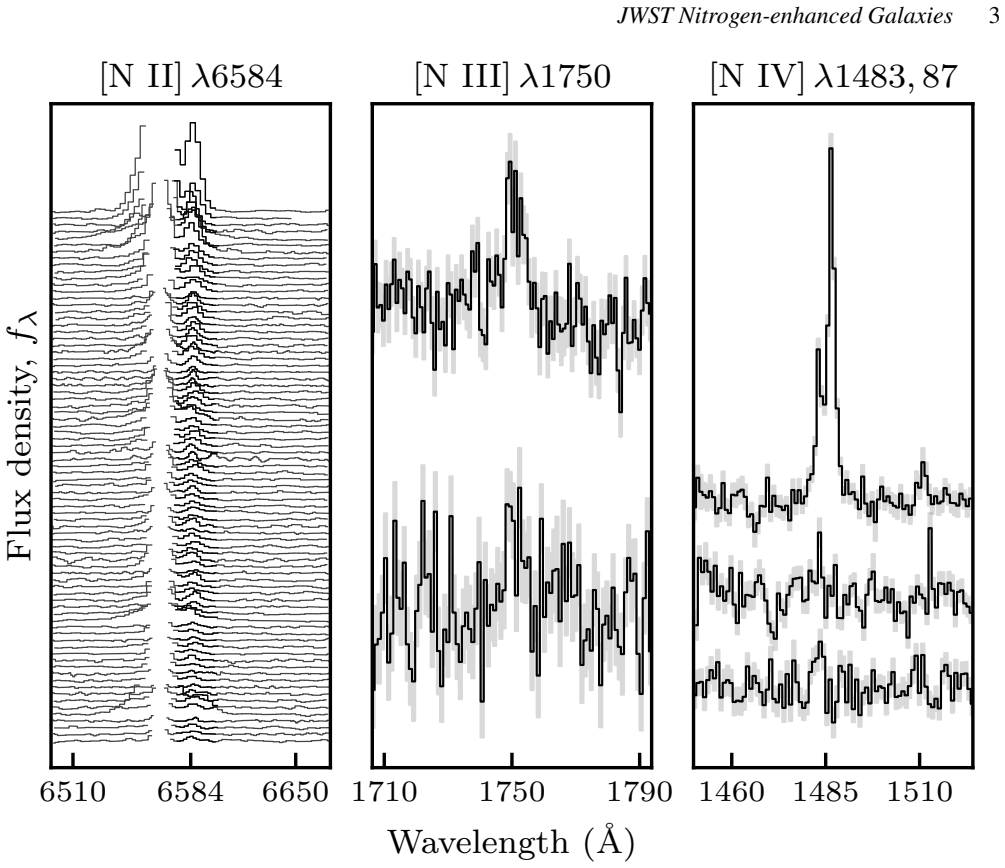
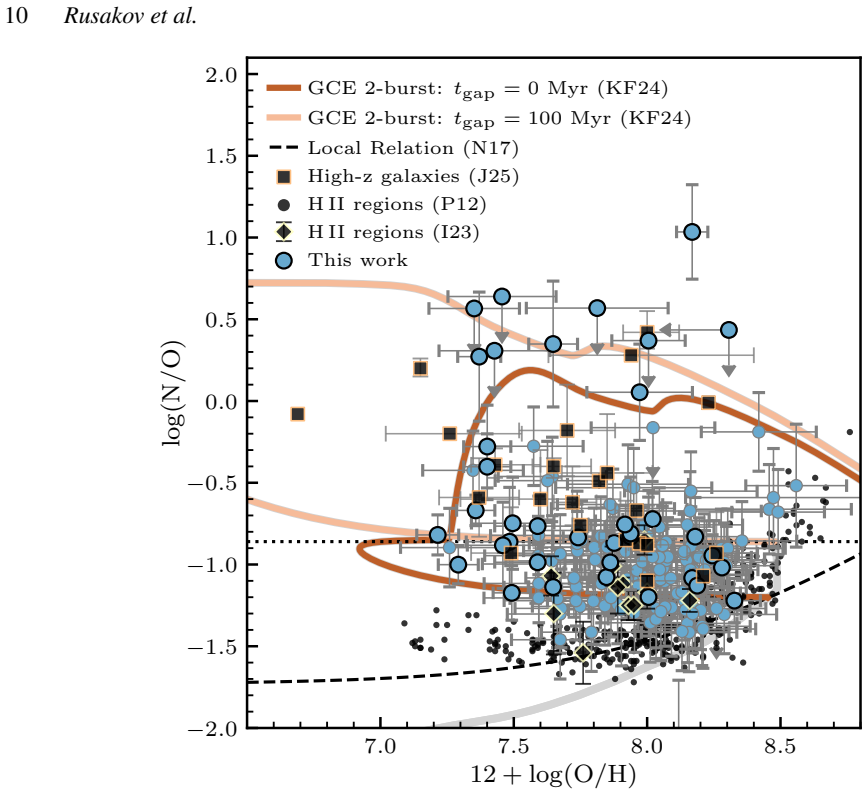
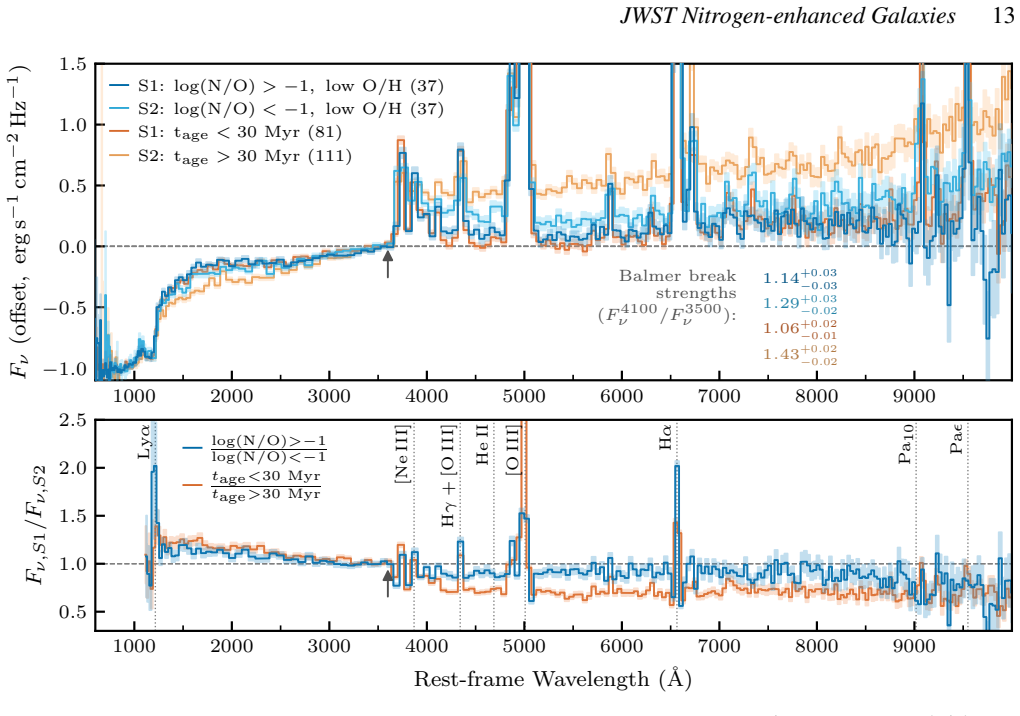
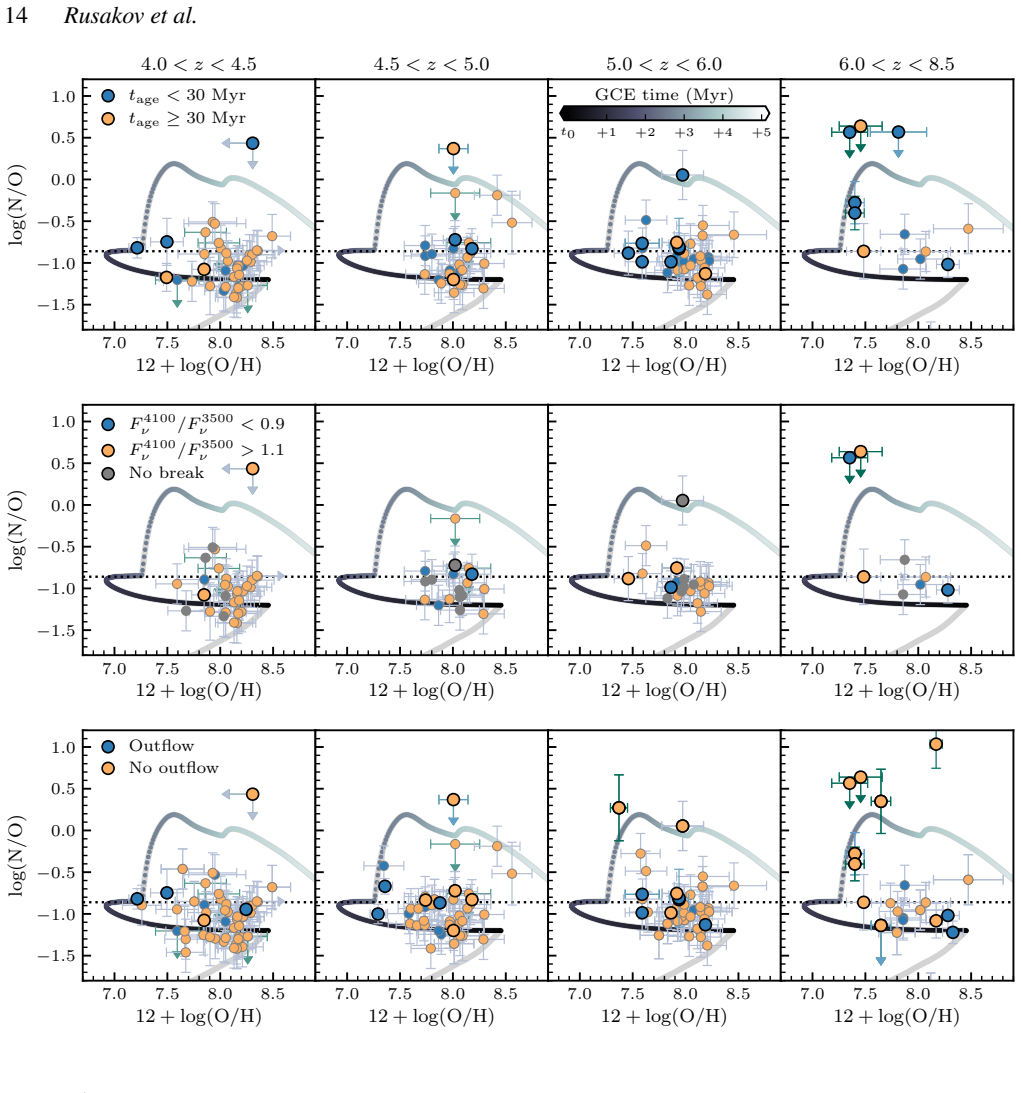
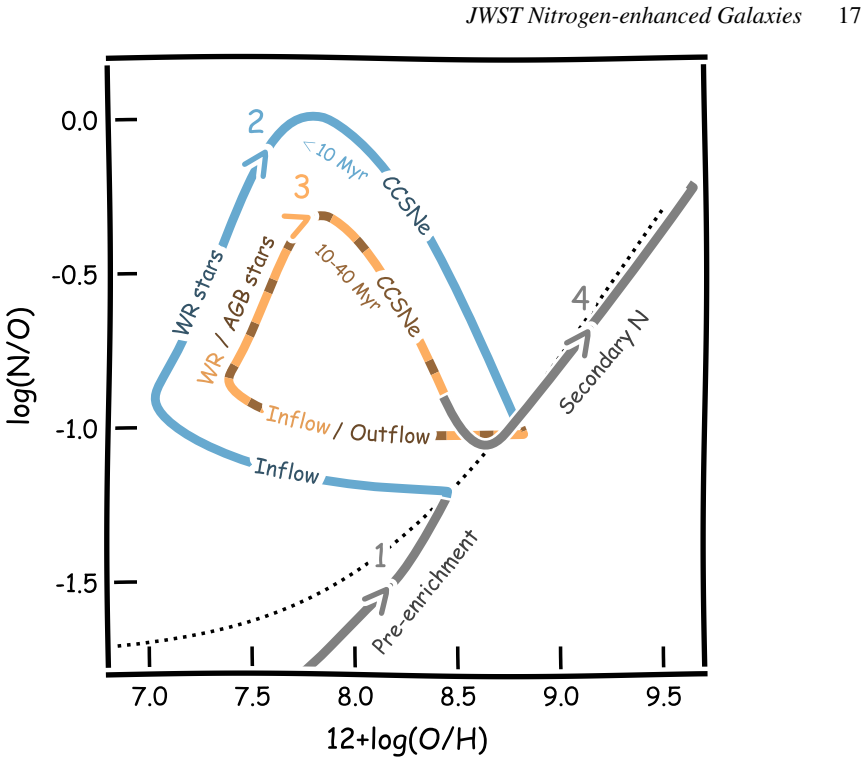
Nitrogen-enhanced galaxies at high redshift are observed in two brief windows right after starbursts, driven by Wolf-Rayet stars within 10 Myr or AGB stars after 30-40 Myr once outflows have diluted the gas.
A machine-rendered reading of the paper's core claim, the machinery that carries it, and where it could break.
Core claim
NOEGs are caught briefly after a recent starburst: either within ∼10 Myr, when WR winds drive nitrogen enrichment, or after 30-40 Myr, when AGB winds take over following an outflow driven by radiative or supernova feedback.
What carries the argument
Timing of primary nitrogen production from low-metallicity Wolf-Rayet stars in the first few Myr and from AGB stars at 30-40 Myr, mapped onto galaxies that have experienced recent outflows diluting prior metallicity.
If this is right
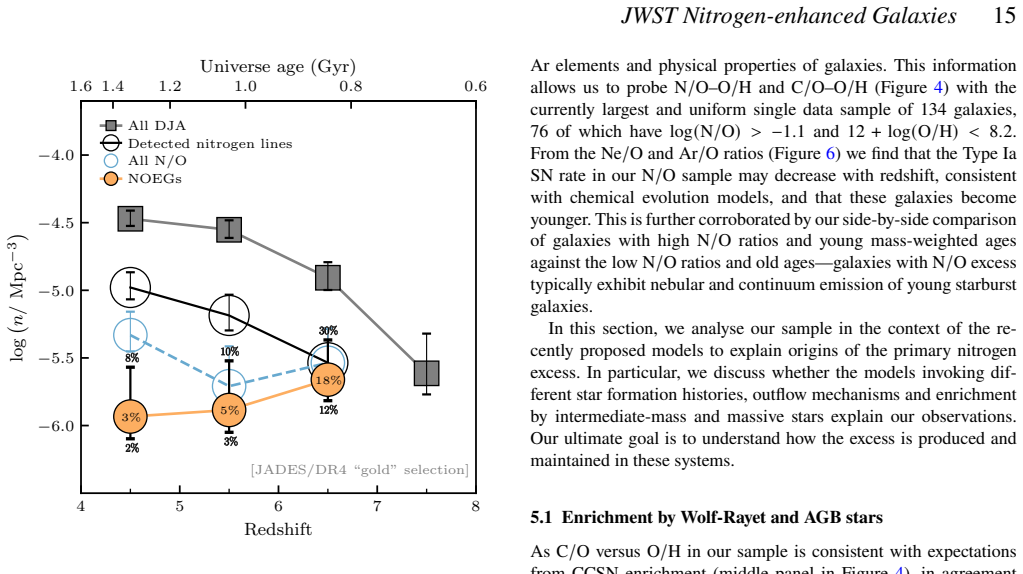
- The fraction of nitrogen-enhanced galaxies increases from about 3 percent at redshift 4 to 18 percent at redshift 7.
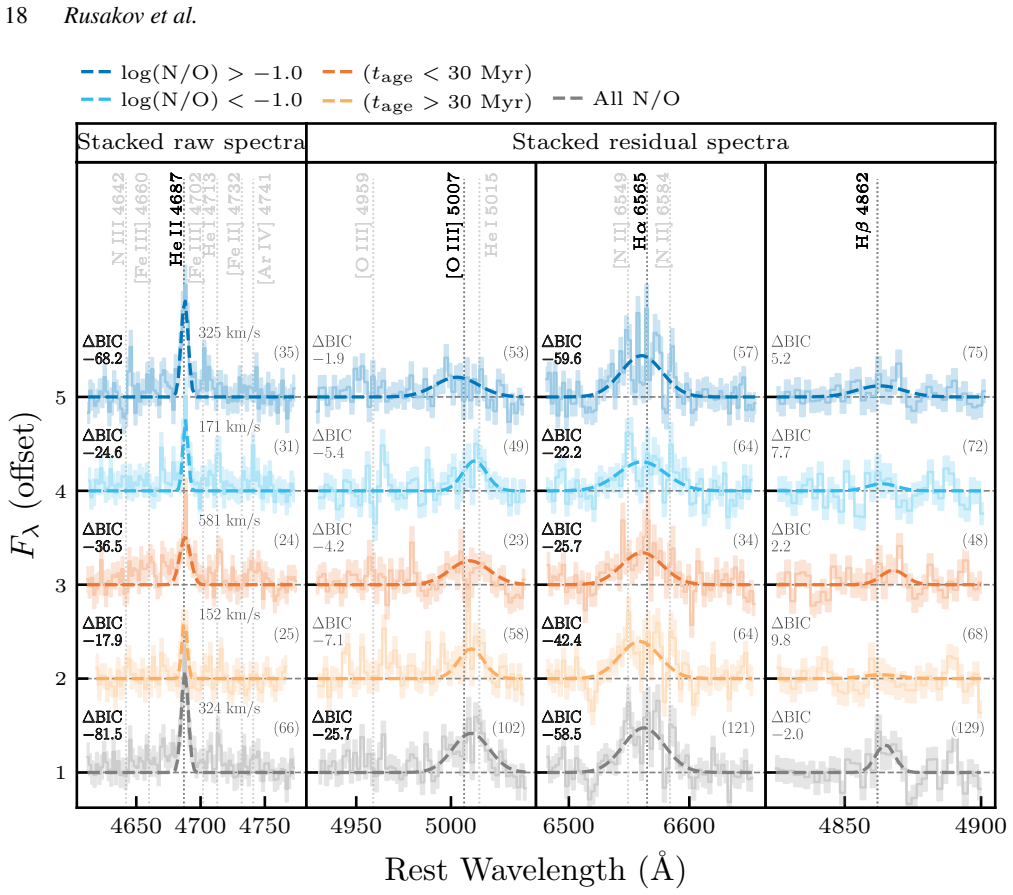
- Outflows appear in 40 percent of the sample as secondary [O III] and H-alpha components, with the remainder showing broadened, offset H-alpha without forbidden-line counterparts.
- After the first few Myr, outflows reduce gas metallicity enough for later AGB stars to drive a second round of N/O enhancement.
- The observed pattern matches recent chemical-evolution models that include radiative and supernova feedback after a starburst.
Where Pith is reading between the lines
- The same short post-burst windows may explain why nitrogen excess appears rarer in local galaxies than at high redshift.
- Individual high-resolution spectra could test whether the two age windows produce distinguishable line ratios or continuum shapes.
- If outflows are required to reset metallicity, galaxies without detectable outflows should rarely show strong nitrogen excess.
- The model implies that nitrogen enhancement episodes are transient and should correlate with recent star-formation rate spikes on 10-40 Myr timescales.
Load-bearing premise
The stacked spectral features come from low-metallicity Wolf-Rayet or AGB stars as the main primary nitrogen sources and the 10 Myr and 30-40 Myr age windows are correctly assigned from stellar models.
What would settle it
Finding a population of nitrogen-enhanced galaxies whose stacked spectra lack both the expected Wolf-Rayet features at young ages and the Balmer-break plus AGB signatures at 30-40 Myr, or whose line kinematics show no outflow evidence at either stage.
Figures
read the original abstract
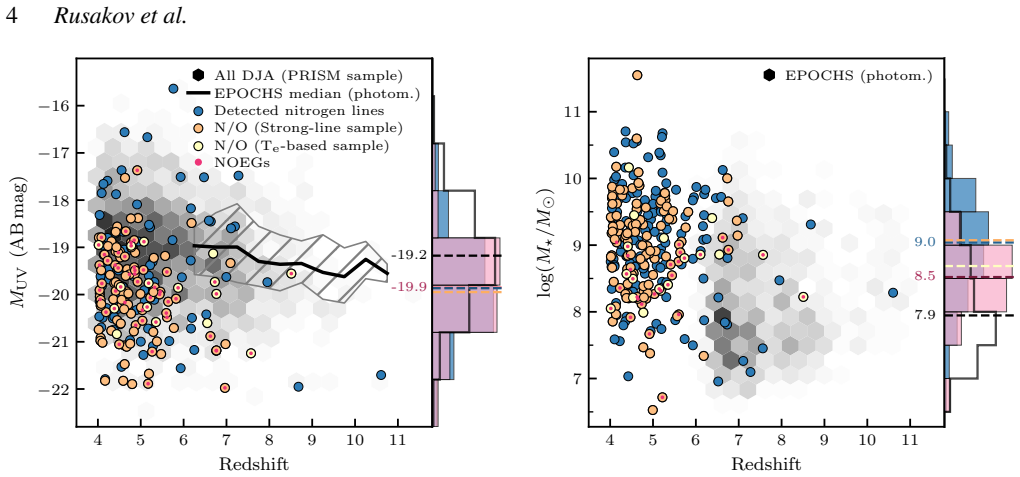
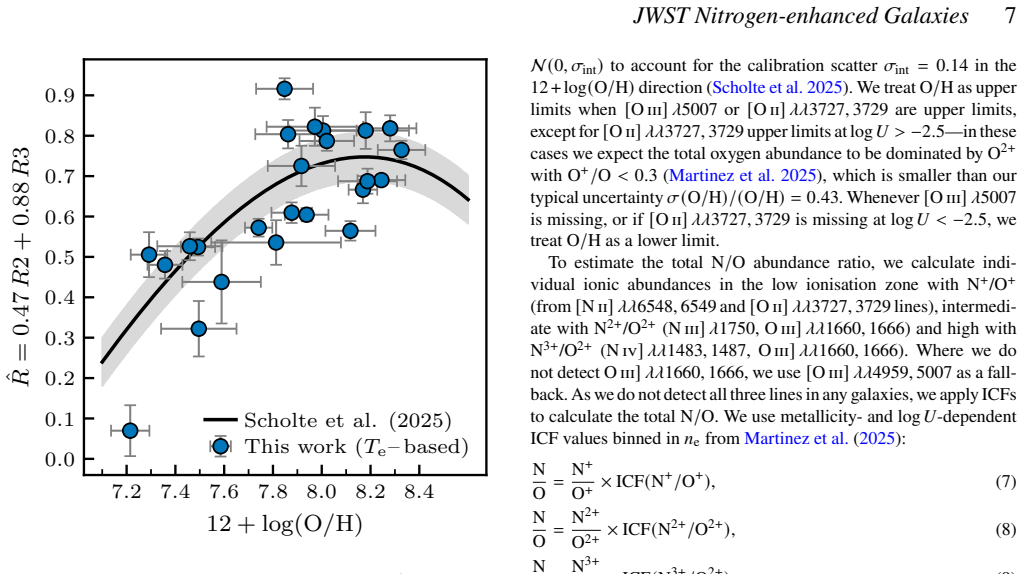
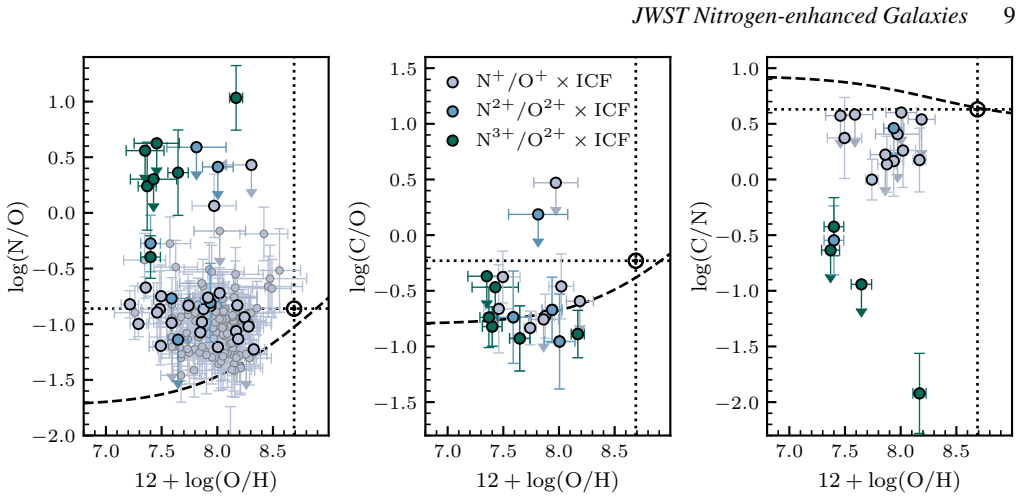
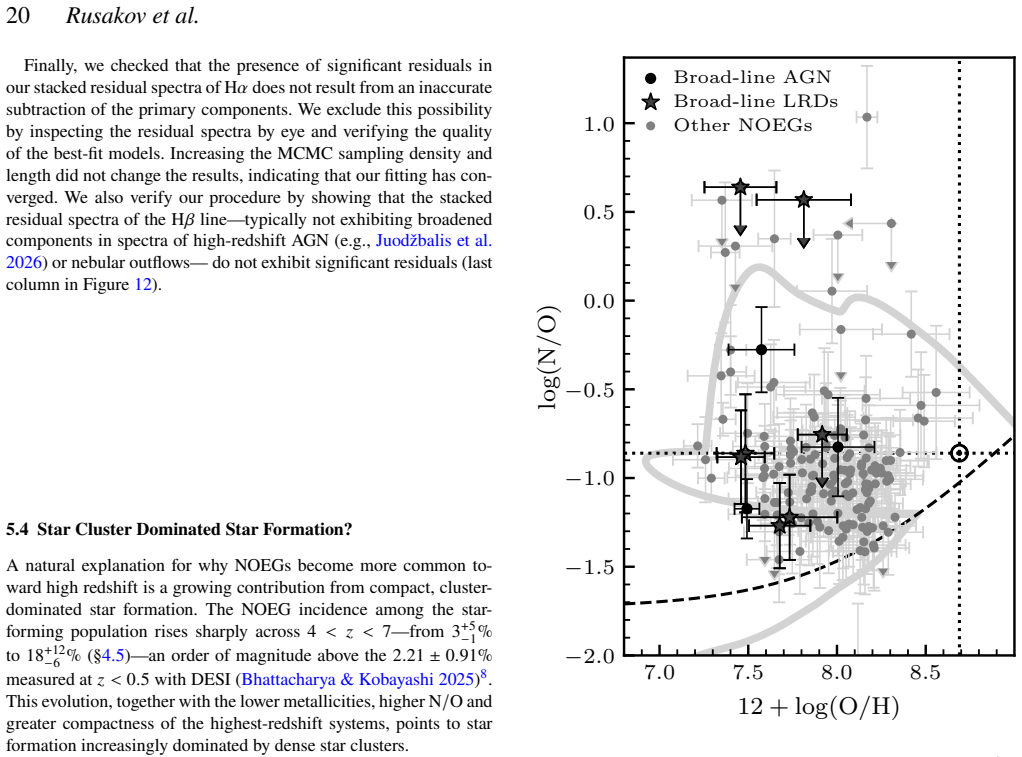
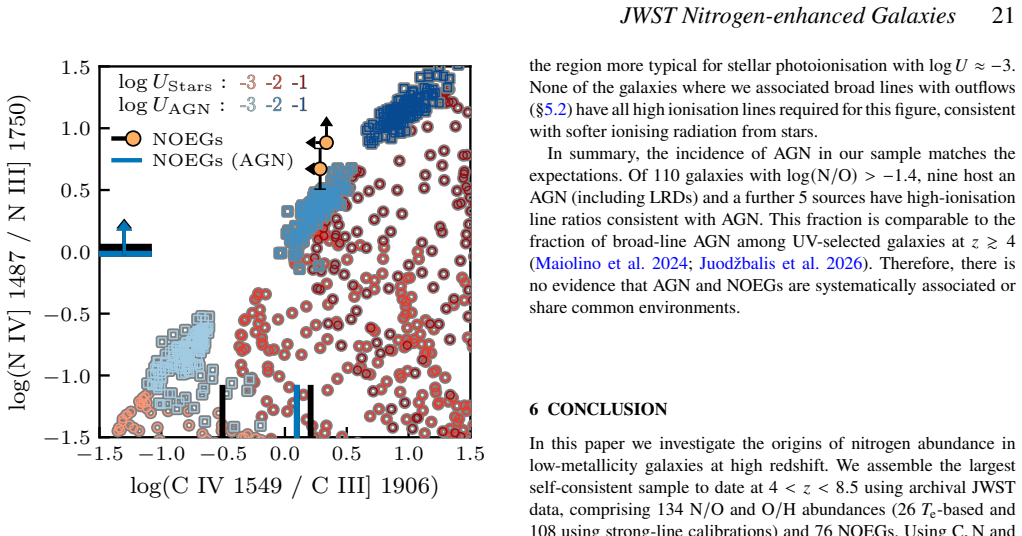
Early JWST spectra revealed galaxies with a strong nitrogen excess challenging galactic chemical evolution models. Using public JWST surveys, we construct a sample of 76 N/O-enhanced galaxies (NOEGs) at 4 $<z<$ 8.5, the largest at high redshift to date. The NOEG fraction rises from $\sim$3% to $\sim$18% between $z\sim$ 4 and 7 - well above the $\sim$2% measured locally - potentially driven by burstier, cluster-dominated star formation. Stacked spectra of the most nitrogen-rich galaxies show signatures of low-metallicity Wolf-Rayet (WR) stars, a likely source of primary nitrogen within the first few Myr of a starburst, with UV and optical continua dominated by young stellar emission and Balmer jumps evident in some cases. Many NOEGs also exhibit ionised outflows: 40% show secondary [O III] and H$\alpha$ components, while stacked spectra of the remainder reveal a broadened, offset H$\alpha$ without forbidden-line counterparts, suggesting dust-attenuated or faded outflows. The continuum in the latter shows a weak Balmer break, indicating these galaxies are past their most recent burst. This suggests that outflows dilute gas metallicity after the first few Myr of the initial enrichment and enable renewed N/O enhancement driven by low-metallicity Asymptotic Giant Branch (AGB) stars. We conclude that NOEGs are caught briefly after a recent starburst: either within $\sim$10 Myr, when WR winds drive nitrogen enrichment, or after 30-40 Myr, when AGB winds take over - following an outflow driven by radiative or supernova feedback, consistent with recent chemical evolution models.
Editorial analysis
A structured set of objections, weighed in public.
Referee Report
Summary. The manuscript constructs a sample of 76 N/O-enhanced galaxies (NOEGs) at 4<z<8.5 from public JWST surveys, the largest such high-redshift sample to date. It reports that the NOEG fraction rises from ~3% to ~18% over this range, presents stacked spectra of the most N-rich systems showing low-metallicity WR signatures and UV/optical continua dominated by young stars (with some Balmer jumps), notes ionized outflows in 40% via secondary [O III]/Hα components, and interprets broadened Hα in the remainder plus a weak Balmer break as evidence of post-burst status. The central claim is that NOEGs are observed only in narrow post-starburst windows: within ~10 Myr (WR-driven primary N enrichment) or after 30-40 Myr (AGB-driven), following outflow dilution, consistent with chemical evolution models.
Significance. If the age and enrichment-phase attributions hold after quantitative modeling, the result would provide a valuable empirical timeline for primary nitrogen production and the role of feedback in resetting gas reservoirs at early epochs, with a statistically useful sample size. The use of public JWST data and stacked spectra is a methodological strength that enables direct comparison with stellar yields.
major comments (3)
- [Abstract, final interpretive paragraph; stacked spectra analysis] Abstract (final interpretive paragraph) and the stacked-spectra section: the claim that the most N-rich stacks are produced by low-Z WR stars (~10 Myr) or AGB stars (30-40 Myr) as dominant primary N sources, and that these map uniquely to the observed populations, rests on qualitative feature attribution without reported quantitative SPS fits (e.g., BPASS or Starburst99) that marginalize over dust, IMF, continuous vs. burst SFH, or metallicity. At the low metallicities and high redshifts involved, WR wind strengths and AGB dredge-up efficiencies vary by factors of several across models; this mapping is load-bearing for the narrow-window conclusion.
- [Outflow and non-outflow stack description] The section on outflow identification and the non-outflow stack: the inference that outflows dilute metallicity after the first few Myr (resetting for renewed AGB enrichment) is drawn from secondary [O III]/Hα components in 40% of the sample and broadened/offset Hα without forbidden-line counterparts in the rest, but lacks kinematic modeling, abundance-gradient measurements, or comparison to radiative-transfer simulations to confirm the dilution step; the weak Balmer break is cited for post-burst status without error bars or model-grid comparisons at the relevant Z.
- [Sample construction and fraction calculation] Sample construction and fraction evolution: the reported rise from ~3% to ~18% between z~4 and 7 is presented as evidence for burstier star formation, but the text does not detail the parent sample size, exact N/O selection thresholds with uncertainties, or completeness/selection-function corrections; without these, the redshift trend and its link to the timeline claim cannot be quantitatively assessed.
minor comments (2)
- [Abstract; stacked spectra] The abstract states 'Balmer jumps evident in some cases' but the main text should specify the exact number of stacks showing this feature, the measurement method (e.g., discontinuity amplitude), and any statistical significance.
- [Throughout] Notation for nitrogen enhancement (N/O vs. N/O-enhanced) and the definition of 'most nitrogen-rich' subsample should be made fully consistent between abstract, methods, and figures to avoid ambiguity.
Simulated Author's Rebuttal
We thank the referee for the constructive and detailed report. Below we respond point-by-point to the major comments, indicating where revisions will strengthen the manuscript while defending the core analysis where the evidence supports it.
read point-by-point responses
-
Referee: [Abstract, final interpretive paragraph; stacked spectra analysis] Abstract (final interpretive paragraph) and the stacked-spectra section: the claim that the most N-rich stacks are produced by low-Z WR stars (~10 Myr) or AGB stars (30-40 Myr) as dominant primary N sources, and that these map uniquely to the observed populations, rests on qualitative feature attribution without reported quantitative SPS fits (e.g., BPASS or Starburst99) that marginalize over dust, IMF, continuous vs. burst SFH, or metallicity. At the low metallicities and high redshifts involved, WR wind strengths and AGB dredge-up efficiencies vary by factors of several across models; this mapping is load-bearing for the narrow-window conclusion.
Authors: We agree that the age and enrichment-phase mapping would be strengthened by quantitative SPS modeling. The current interpretation rests on well-documented spectral diagnostics (WR bumps, Balmer jumps) whose timing at low Z is established in the literature, but model-to-model variations in yields are indeed significant. In revision we will add BPASS-based fits to the stacked spectra, marginalizing over dust, IMF, and SFH where the data permit, and explicitly discuss remaining uncertainties in WR/AGB yields. This addresses the load-bearing concern without altering the qualitative conclusions. revision: yes
-
Referee: [Outflow and non-outflow stack description] The section on outflow identification and the non-outflow stack: the inference that outflows dilute metallicity after the first few Myr (resetting for renewed AGB enrichment) is drawn from secondary [O III]/Hα components in 40% of the sample and broadened/offset Hα without forbidden-line counterparts in the rest, but lacks kinematic modeling, abundance-gradient measurements, or comparison to radiative-transfer simulations to confirm the dilution step; the weak Balmer break is cited for post-burst status without error bars or model-grid comparisons at the relevant Z.
Authors: The secondary kinematic components provide direct evidence of outflows, consistent with standard high-z diagnostics. For the non-outflow stack the broadened Hα and weak Balmer break support a post-burst interpretation. We acknowledge the absence of full kinematic modeling and radiative-transfer comparisons. In revision we will report error bars on the Balmer-break strength and add comparisons to low-Z model grids; we will also note that detailed abundance-gradient or RT modeling lies beyond the current data quality and will be flagged as a limitation. revision: partial
-
Referee: [Sample construction and fraction calculation] Sample construction and fraction evolution: the reported rise from ~3% to ~18% between z~4 and 7 is presented as evidence for burstier star formation, but the text does not detail the parent sample size, exact N/O selection thresholds with uncertainties, or completeness/selection-function corrections; without these, the redshift trend and its link to the timeline claim cannot be quantitatively assessed.
Authors: We will add a dedicated methods subsection detailing the parent JWST survey samples, the precise N/O thresholds (including measurement uncertainties), and an assessment of selection completeness and redshift-dependent biases. This will allow quantitative evaluation of the reported fraction evolution and its connection to the proposed enrichment timeline. revision: yes
Circularity Check
No significant circularity in derivation chain
full rationale
The paper is an observational study that selects NOEGs from public JWST surveys, stacks spectra, and reports empirical features (WR signatures, Balmer breaks, outflow components). Interpretations map these to stellar phases via external models, but no equations, fitted parameters, or self-citations reduce any claim to its own inputs by construction. The central timing windows and enrichment scenarios are presented as inferences from cited stellar evolution literature rather than self-referential definitions or renamings. This is the most common honest finding for data-driven papers without internal fitting loops.
Axiom & Free-Parameter Ledger
axioms (2)
- domain assumption Low-metallicity Wolf-Rayet stars produce primary nitrogen within the first few Myr of a starburst
- domain assumption AGB stars drive renewed N/O enhancement after 30-40 Myr following outflows
Reference graph
Works this paper leans on
-
[1]
Roper, Will J. and Lovell, Christopher C. and Vijayan, Aswin and Wilkins, Stephen and Akins, Hollis and Berger, Sabrina and Sant Fournier, Connor and Harvey, Thomas and Iyer, Kartheik and Leonardi, Marco and Newman, Sophie and Pautasso, Borja and Perry, Ashley and Seeyave, Louise and Sommovigo, Laura and Punyasheel, Paurush and d'Hautefort, Adrien Aufan S...
-
[2]
JWST's GLIMPSE: an overview of the deepest probe of early galaxy formation and cosmic reionization. arXiv e-prints , keywords =. doi:10.48550/arXiv.2511.07542 , archivePrefix =. 2511.07542 , primaryClass =
-
[3]
An observed population of intermediate-mass helium stars that have been stripped in binaries. Science , keywords =. doi:10.1126/science.ade4970 , archivePrefix =. 2307.00061 , primaryClass =
-
[4]
The impact of stars stripped in binaries on the integrated spectra of stellar populations. , keywords =. doi:10.1051/0004-6361/201834525 , archivePrefix =. 1908.06102 , primaryClass =
-
[5]
Can nebular He II emission be explained by ultra-luminous X-ray sources?. , keywords =. doi:10.1051/0004-6361/202141856 , archivePrefix =. 2108.12438 , primaryClass =
-
[6]
H II Regions With He II Emission. , keywords =. doi:10.1086/132892 , adsurl =
-
[7]
Stellar evolution with rotation. XI. Wolf-Rayet star populations at different metallicities. , keywords =. doi:10.1051/0004-6361:20047106 , archivePrefix =. astro-ph/0408319 , primaryClass =
work page internal anchor Pith review Pith/arXiv arXiv doi:10.1051/0004-6361:20047106
-
[8]
Physical Properties of Wolf-Rayet Stars. , keywords =. doi:10.1146/annurev.astro.45.051806.110615 , archivePrefix =. astro-ph/0610356 , primaryClass =
-
[9]
Updated stellar yields from asymptotic giant branch models. , keywords =. doi:10.1111/j.1365-2966.2009.16198.x , archivePrefix =. 0912.2142 , primaryClass =
-
[10]
Tracing star formation across cosmic time at tens of parsec-scales in the lensing cluster field Abell 2744. , keywords =. doi:10.1093/mnras/staf058 , archivePrefix =. 2410.10974 , primaryClass =
-
[11]
JADES: The diverse population of infant black holes at 4 < z < 11: Merging, tiny, poor, but mighty. , keywords =. doi:10.1051/0004-6361/202347640 , archivePrefix =. 2308.01230 , primaryClass =
-
[12]
Accreted versus in situ Milky Way globular clusters. , keywords =. doi:10.1111/j.1365-2966.2010.16373.x , archivePrefix =. 1001.4289 , primaryClass =
-
[13]
1986, ApJ, 303, 336, doi: 10.1086/164079
Confidence Limits for Small Numbers of Events in Astrophysical Data. , keywords =. doi:10.1086/164079 , adsurl =
-
[14]
Enhanced Subkiloparsec-scale Star Formation: Results from a JWST Size Analysis of 341 Galaxies at 5 < z < 14. , keywords =. doi:10.3847/1538-4357/ad1404 , archivePrefix =. 2308.05018 , primaryClass =
-
[15]
EPOCHS. IV. SED Modeling Assumptions and Their Impact on the Stellar Mass Function at 6.5 z 13.5 Using PEARLS and Public JWST Observations. , keywords =. doi:10.3847/1538-4357/ad8c29 , archivePrefix =. 2403.03908 , primaryClass =
-
[16]
EPOCHS. I. The Discovery and Star-forming Properties of Galaxies in the Epoch of Reionization at 6.5 < z < 18 with PEARLS and Public JWST Data. , keywords =. doi:10.3847/1538-4357/ada608 , archivePrefix =. 2407.14973 , primaryClass =
-
[18]
Unveiling Galaxy Chemical Enrichment Mechanisms Out to z 8 from Direct Determination of O and Ar Abundances from JWST/NIRSPEC Spectroscopy. , keywords =. doi:10.3847/2041-8213/adc735 , archivePrefix =. 2408.13396 , primaryClass =
-
[19]
Redshift Evolution of Electron Density in the Interstellar Medium at z 0-9 Uncovered with JWST/NIRSpec Spectra and Line-spread Function Determinations. , keywords =. doi:10.3847/1538-4357/acf376 , archivePrefix =. 2301.06811 , primaryClass =
-
[20]
CEERS Key Paper. I. An Early Look into the First 500 Myr of Galaxy Formation with JWST. , keywords =. doi:10.3847/2041-8213/acade4 , archivePrefix =. 2211.05792 , primaryClass =
-
[21]
JADES Initial Data Release for the Hubble Ultra Deep Field: Revealing the Faint Infrared Sky with Deep JWST NIRCam Imaging. , keywords =. doi:10.3847/1538-4365/acf44d , archivePrefix =. 2306.02466 , primaryClass =
-
[22]
The NIRSpec Wide GTO Survey. , year = 2024, month = sep, volume =. doi:10.1051/0004-6361/202449914 , archivePrefix =. 2403.05506 , primaryClass =
-
[23]
, year = 2024, month = aug, volume =
Diverse Oxygen Abundance in Early Galaxies Unveiled by Auroral Line Analysis with JWST. , year = 2024, month = aug, volume =. doi:10.3847/1538-4357/ad5290 , archivePrefix =. 2402.14084 , primaryClass =
-
[24]
The Puzzling Properties of the MACS1149-JD1 Galaxy at z = 9.11. , keywords =. doi:10.3847/2041-8213/ad0159 , archivePrefix =. 2308.14696 , primaryClass =
-
[25]
The GLASS-JWST Early Release Science Program. I. Survey Design and Release Plans. , year = 2022, month = aug, volume =. doi:10.3847/1538-4357/ac8158 , archivePrefix =. 2206.07978 , primaryClass =
-
[26]
, year = 2023, month = oct, volume =
JWST/NIRSpec Measurements of Extremely Low Metallicities in High Equivalent Width Ly Emitters. , year = 2023, month = oct, volume =. doi:10.3847/1538-4357/acf12b , archivePrefix =. 2304.08511 , primaryClass =
-
[27]
The JWST Early Release Observations. , year = 2022, month = sep, volume =. doi:10.3847/2041-8213/ac8a4e , archivePrefix =. 2207.13067 , primaryClass =
-
[28]
, year = 2023, month = jul, volume =
A SPectroscopic Survey of Biased Halos in the Reionization Era (ASPIRE): JWST Reveals a Filamentary Structure around a z = 6.61 Quasar. , year = 2023, month = jul, volume =. doi:10.3847/2041-8213/accd6f , archivePrefix =. 2304.09894 , primaryClass =
-
[29]
The JWST EXCELS Survey: Too Much, Too Young, Too Fast? Ultra-massive Quiescent Galaxies at 3 < z < 5. , year = 2024, month = oct, volume =. doi:10.1093/mnras/stae2092 , archivePrefix =. 2405.02242 , primaryClass =
-
[30]
arXiv e-prints , year = 2025, month = oct, eid =
The Blue Jay Survey: Deep JWST Spectroscopy for a Representative Sample of Galaxies at Cosmic Noon. arXiv e-prints , year = 2025, month = oct, eid =. doi:10.48550/arXiv.2510.11775 , archivePrefix =. 2510.11775 , primaryClass =
-
[31]
The AURORA Survey: A New Era of Emission-line Diagrams with JWST/NIRSpec. , year = 2025, month = feb, volume =. doi:10.3847/1538-4357/adad68 , archivePrefix =. 2407.00157 , primaryClass =
-
[32]
, year = 2024, month = oct, volume =
The JWST-SUSPENSE Ultradeep Spectroscopic Program: Survey Overview and Star Formation Histories of Quiescent Galaxies at 1 < z < 3. , year = 2024, month = oct, volume =. doi:10.3847/1538-4357/ad65ff , archivePrefix =. 2404.12432 , primaryClass =
-
[33]
Deep Rest-UV JWST/NIRSpec Spectroscopy of Early Galaxies: The Demographics of C IV and N-emitters in the Reionization Era. , keywords =. doi:10.3847/1538-4357/ada95c , archivePrefix =. 2407.19009 , primaryClass =
-
[34]
and Scholtz, Jan and Carniani, Stefano and Willott, Chris J
JADES Data Release 3: NIRSpec/Microshutter Assembly Spectroscopy for 4000 Galaxies in the GOODS Fields. , keywords =. doi:10.3847/1538-4365/ada148 , archivePrefix =. 2404.06531 , primaryClass =
-
[35]
The JADES Origins Field: A New JWST Deep Field in the JADES Second NIRCam Data Release. , keywords =. doi:10.3847/1538-4365/ae1137 , archivePrefix =. 2310.12340 , primaryClass =
-
[36]
L., Pascale, M., Pierel, J., et al
The JWST Discovery of the Triply Imaged Type Ia ``Supernova H0pe'' and Observations of the Galaxy Cluster PLCK G165.7+67.0. , keywords =. doi:10.3847/1538-4357/ad1034 , archivePrefix =. 2309.07326 , primaryClass =
-
[37]
An Atlas of Color-selected Quiescent Galaxies at z > 3 in Public JWST Fields. , keywords =. doi:10.3847/1538-4357/acbefa , archivePrefix =. 2302.10936 , primaryClass =
-
[38]
Novel z 10 auroral line measurements extend the gradual offset of the fundamental metallicity relation deep into the first gigayear of cosmic time. , keywords =. doi:10.1051/0004-6361/202556032 , archivePrefix =. 2506.15779 , primaryClass =
work page internal anchor Pith review Pith/arXiv arXiv doi:10.1051/0004-6361/202556032
-
[39]
Gas outflows in two recently quenched galaxies at z = 4 and 7. , keywords =. doi:10.1051/0004-6361/202553908 , archivePrefix =. 2503.01990 , primaryClass =
-
[40]
Energies and E1, M1, E2, M2 transition rates for states of the 2s ^ 2 2p ^ 3 , 2s2p ^ 4 , and 2p ^ 5 configurations in nitrogen-like ions between F III and Zn XXIV. , year = 2019, volume =. doi:10.1051/0004-6361/201834931 , adsurl =
-
[41]
Atomic Data and Nuclear Data Tables , year = 1997, volume =
Effective Collision Strengths for Electron Impact Excitation of Ar iv. Atomic Data and Nuclear Data Tables , year = 1997, volume =. doi:10.1006/adnd.1997.0739 , adsurl =
-
[42]
, year = 1982, month = jan, volume =
Transition probabilities for forbidden lines in the 2p ^ 3 configuration. , year = 1982, month = jan, volume =. doi:10.1093/mnras/198.1.111 , adsurl =
-
[43]
Atomic Transition Probabilities of Carbon, Nitrogen, and Oxygen
-
[44]
Theoretical values for the [O iii ] 5007/4959 line-intensity ratio and homologous cases. , year = 2000, month = mar, volume =. doi:10.1046/j.1365-8711.2000.03184.x , adsurl =
-
[45]
Atomic Data and Nuclear Data Tables , year = 2004, month = may, volume =
Breit-Pauli energy levels, lifetimes, and transition probabilities for the beryllium-like to neon-like sequences. Atomic Data and Nuclear Data Tables , year = 2004, month = may, volume =. doi:10.1016/j.adt.2003.11.002 , adsurl =
-
[46]
Atomic data from the IRON Project. XXIX . Radiative rates for transitions within the n = 2 complex in ions of the boron isoelectronic sequence. , year = 1998, month = sep, volume =. doi:10.1051/aas:1998286 , adsurl =
-
[47]
Electric quadrupole transitions in the beryllium isoelectronic sequence. , year = 1983, volume =. doi:10.1007/BF00651295 , adsurl =
-
[48]
, year = 1978, volume =
[VERIFY TITLE IN ADS]. , year = 1978, volume =
1978
-
[49]
Atomic data from the IRON Project. XXII . Radiative rates for forbidden transitions within the ground configuration of ions in the carbon and oxygen isoelectronic sequences. , year = 1997, volume =. doi:10.1051/aas:1997156 , adsurl =
-
[50]
Electron-impact excitation of O ii fine-structure levels. , year = 2009, month = aug, volume =. doi:10.1111/j.1365-2966.2009.14989.x , adsurl =
-
[51]
Improved collision strengths and line ratios for forbidden [O iii ] far-infrared and optical lines. , year = 2012, month = jun, volume =. doi:10.1111/j.1745-3933.2012.01253.x , adsurl =
-
[52]
, year = 1999, month = sep, volume =
Excitation Rate Coefficients for Fine-Structure Transitions in O iii. , year = 1999, month = sep, volume =. doi:10.1086/313232 , adsurl =
-
[53]
, year = 2011, month = aug, volume =
Electron Excitation Collision Strengths for Singly Ionized Nitrogen. , year = 2011, month = aug, volume =. doi:10.1088/0067-0049/195/2/12 , adsurl =
-
[54]
, year = 1992, month = feb, volume =
Rate Coefficients for the Excitation of Infrared and Ultraviolet Lines in C ii , N iii , and O iv. , year = 1992, month = feb, volume =. doi:10.1086/191674 , adsurl =
-
[55]
Physica Scripta , year = 1994, month = sep, volume =
Electron impact excitation rates for transitions involving the n = 2 and n = 3 levels of beryllium-like N iv. Physica Scripta , year = 1994, month = sep, volume =. doi:10.1088/0031-8949/50/3/005 , adsurl =
-
[56]
Electron-Impact-Excitation Collision Strengths for Be-like Ions. II . Intermediate-Energy Region and Collision Rates. Atomic Data and Nuclear Data Tables , year = 1985, volume =. doi:10.1016/0092-640X(85)90017-8 , adsurl =
-
[57]
Electron-impact excitation of Ar ^ 2+. , year = 2009, volume =. doi:10.1051/0004-6361/200911743 , adsurl =
-
[58]
Journal of Physics B: Atomic, Molecular and Optical Physics , year = 2000, month = feb, volume =
Electron collisional excitation of Ne iii : (1s^22s^22p^4\ ^3P_ 2,1,0 ,\ ^1D_2,\ ^1S_0) fine-structure transitions. Journal of Physics B: Atomic, Molecular and Optical Physics , year = 2000, month = feb, volume =. doi:10.1088/0953-4075/33/4/301 , adsurl =
-
[59]
On the electron temperatures in high-metallicity HII regions. , keywords =. doi:10.1111/j.1365-2966.2009.15182.x , archivePrefix =. 0907.0084 , primaryClass =
-
[60]
Boletin de los Observatorios Tonantzintla y Tacubaya , keywords =
Chemical Abundances in Galactic HII Regions. Boletin de los Observatorios Tonantzintla y Tacubaya , keywords =
-
[61]
JWST NIRSpec High-resolution Spectroscopy of MACS0647─JD at z = 10.167: Resolved [O II] Doublet and Electron Density in an Early Galaxy. , keywords =. doi:10.3847/1538-4357/ad6001 , archivePrefix =. 2404.16201 , primaryClass =
-
[62]
Nicholas Earl and Erik Tollerud and Ricky O'Steen and brechmos and Wolfgang Kerzendorf and Ivo Busko and shaileshahuja and P. L. Lim and Dan D'Avella and Thomas Robitaille and Adam Ginsburg and Derek Homeier and Brigitta Sipőcz and Jesse Averbukh and Brian Cherinka and James Tocknell and Sara Ogaz and Robel Geda and James Davies and Kyle Conroy and Hans M...
-
[63]
Little red dots as young supermassive black holes in dense ionized cocoons. , keywords =. doi:10.1038/s41586-025-09900-4 , archivePrefix =. 2503.16595 , primaryClass =
-
[64]
DeepDive: A deep dive into the physics of the first massive quiescent galaxies in the Universe. arXiv e-prints , keywords =. doi:10.48550/arXiv.2506.22642 , archivePrefix =. 2506.22642 , primaryClass =
-
[65]
The impact of the nitrogen-to-oxygen ratio on ionized nebula diagnostics based on [NII] emission lines. , keywords =. doi:10.1111/j.1365-2966.2009.15145.x , archivePrefix =. 0905.4621 , primaryClass =
-
[66]
Unveiling the Cosmic Chemistry: Revisiting the Mass─Metallicity Relation with JWST/NIRSpec at 4 < z < 10. , keywords =. doi:10.3847/1538-4357/ad8f32 , archivePrefix =. 2408.07974 , primaryClass =
-
[67]
JADES: Detecting [OIII] 4363 emitters and testing strong line calibrations in the high-z Universe with ultra-deep JWST/NIRSpec spectroscopy up to z 9.5. , keywords =. doi:10.1051/0004-6361/202347133 , archivePrefix =. 2306.03120 , primaryClass =
-
[68]
Little Red Dots at an Inflection Point: Ubiquitous V-shaped Turnover Consistently Occurs at the Balmer Limit. , keywords =. doi:10.3847/1538-4357/ae1500 , archivePrefix =. 2411.03424 , primaryClass =
-
[69]
Little Red Dots: An Abundant Population of Faint Active Galactic Nuclei at z 5 Revealed by the EIGER and FRESCO JWST Surveys. , keywords =. doi:10.3847/1538-4357/ad2345 , archivePrefix =. 2306.05448 , primaryClass =
-
[70]
A Census of Photometrically Selected Little Red Dots at 4 < z < 9 in JWST Blank Fields. , keywords =. doi:10.3847/1538-4357/ad4265 , archivePrefix =. 2401.09981 , primaryClass =
-
[71]
Little Red Dots host Black Hole Stars: A unified family of gas-reddened AGN revealed by JWST/NIRSpec spectroscopy. arXiv e-prints , keywords =. doi:10.48550/arXiv.2511.21820 , archivePrefix =. 2511.21820 , primaryClass =
-
[72]
The 2017 Release Cloudy. , keywords =. doi:10.48550/arXiv.1705.10877 , archivePrefix =. 1705.10877 , primaryClass =
-
[73]
Outflows in Infrared-Luminous Starbursts at z < 0.5. II. Analysis and Discussion. , keywords =. doi:10.1086/432889 , archivePrefix =. astro-ph/0506611 , primaryClass =
work page internal anchor Pith review Pith/arXiv arXiv doi:10.1086/432889
-
[74]
EMPRESS. VI. Outflows Investigated in Low-mass Galaxies with M _ * = 10 ^ 4 - 10 ^ 7 M _ ☉ : Weak Feedback in Low-mass Galaxies?. , keywords =. doi:10.3847/1538-4357/ac5e32 , archivePrefix =. 2112.08045 , primaryClass =
-
[75]
The Sunburst Arc with JWST: I. Detection of Wolf-Rayet stars injecting nitrogen into a low-metallicity, z = 2.37 proto-globular cluster leaking ionizing photons. , keywords =. doi:10.1051/0004-6361/202450359 , archivePrefix =. 2404.08884 , primaryClass =
-
[76]
The Chemical Evolution of QSOs and the Implications for Cosmology and Galaxy Formation. , keywords =. doi:10.1086/173366 , adsurl =
-
[77]
GA-NIFS: A massive black hole in a low-metallicity AGN at z 5.55 revealed by JWST/NIRSpec IFS. , keywords =. doi:10.1051/0004-6361/202346137 , archivePrefix =. 2302.06647 , primaryClass =
-
[78]
GA-NIFS: an extremely nitrogen-loud and chemically stratified galaxy at z 5.55. , keywords =. doi:10.1093/mnras/stae2375 , archivePrefix =. 2404.04148 , primaryClass =
-
[79]
JADES: The star formation and chemical enrichment history of a luminous galaxy at z 9.43 probed by ultra-deep JWST/NIRSpec spectroscopy. , keywords =. doi:10.1051/0004-6361/202451410 , archivePrefix =. 2407.02575 , primaryClass =
-
[80]
Probing the role of the galactic environment in the formation of stellar clusters, using M83 as a test bench. , keywords =. doi:10.1093/mnras/stv1203 , archivePrefix =. 1505.07475 , primaryClass =
work page internal anchor Pith review Pith/arXiv arXiv doi:10.1093/mnras/stv1203
-
[81]
Monthly Notices of the Royal Astronomical Society , volume =
'Counterpart' method for abundance determinations in H II regions. , keywords =. doi:10.1111/j.1365-2966.2012.21398.x , archivePrefix =. 1205.5716 , primaryClass =
discussion (0)
Sign in with ORCID, Apple, or X to comment. Anyone can read and Pith papers without signing in.