As above, so below: assessing extremeness of the neutron-star equation of state based on the unstable branch
Pith reviewed 2026-06-26 06:00 UTC · model grok-4.3
The pith
Requiring causal stable extensions to perturbative QCD disfavors purely nucleonic models for all stable neutron stars.
A machine-rendered reading of the paper's core claim, the machinery that carries it, and where it could break.
Core claim
By demanding that any valid extension of a microscopic neutron-star model to the perturbative-QCD regime must be causal, stable, and thermodynamically consistent, we reveal the required high-density behavior and provide a tool for constructing such extensions. Purely hadronic models trusted up to the maximal central density often require radically different behaviour at higher densities from that assumed in the original model, while models with additional degrees of freedom fare better. Our analysis disfavors purely nucleonic models for describing all stable neutron stars and supports the appearance of some type of additional degrees of freedom in stable massive neutron stars.
What carries the argument
The unstable branch of the equation of state together with the demand for a causal, stable, thermodynamically consistent extension to perturbative QCD.
If this is right
- Purely nucleonic models require radically different high-density behavior than the one assumed in the original construction.
- Models already containing additional degrees of freedom align more readily with the high-density constraints.
- Some type of additional degrees of freedom must appear inside stable massive neutron stars.
Where Pith is reading between the lines
- The same extension requirement could be applied to candidate equations of state derived from heavy-ion collision data.
- Future radius or tidal-deformability measurements of the most massive neutron stars may directly test whether nucleonic models remain viable.
- The method supplies a concrete way to quantify how much room remains for phase transitions or new particles at densities above those reached in stable stars.
Load-bearing premise
Any valid extension of a neutron-star equation of state to the perturbative-QCD regime must remain causal, stable, and thermodynamically consistent.
What would settle it
A purely nucleonic equation of state that reaches the central density of the heaviest stable neutron star and can still be continued to perturbative QCD without violating causality, stability, or thermodynamic consistency.
Figures
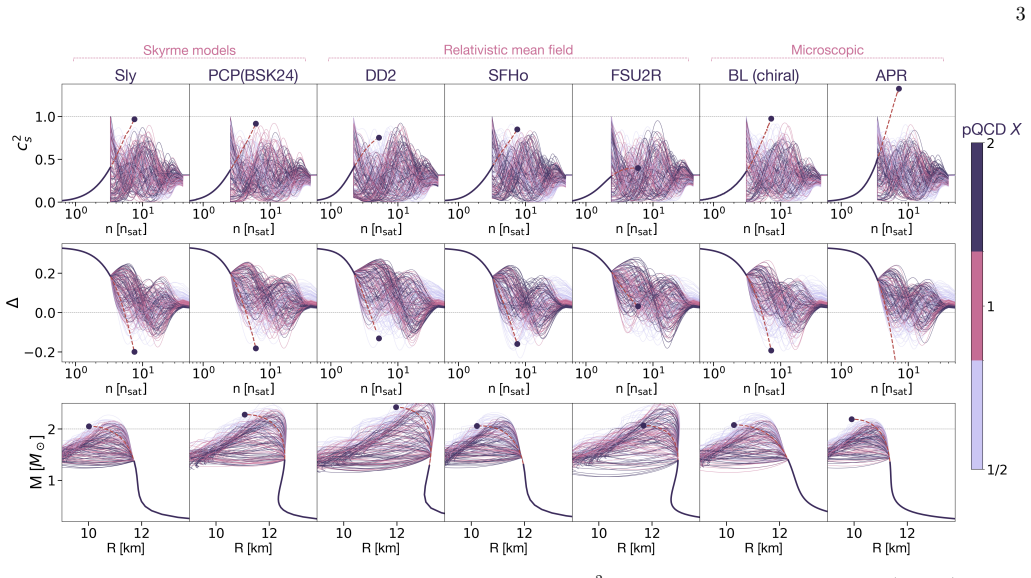
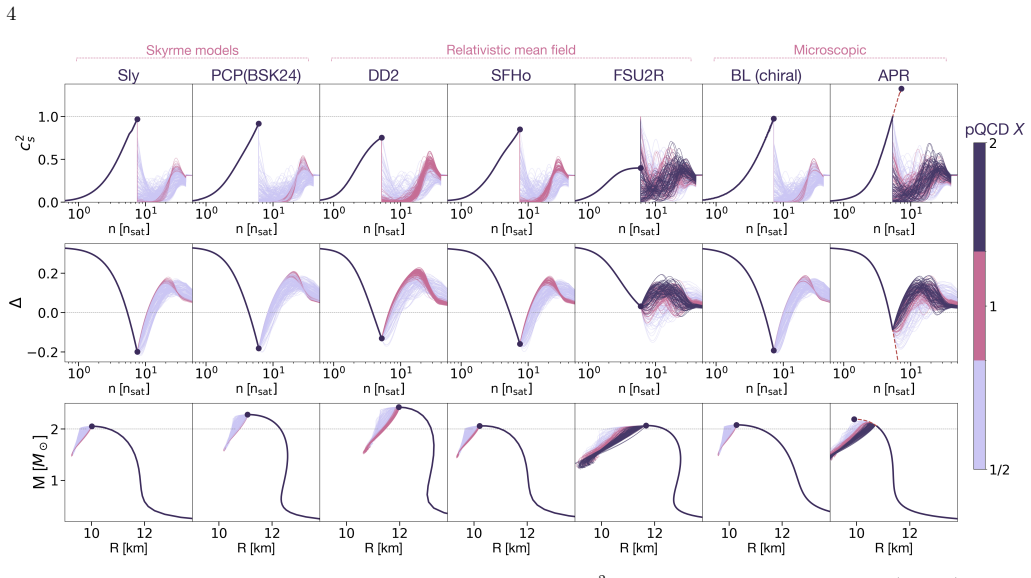
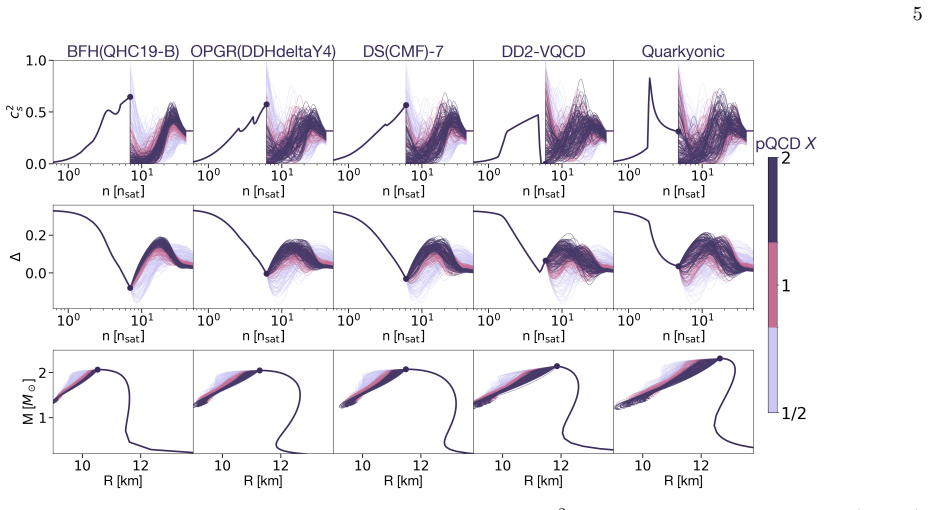
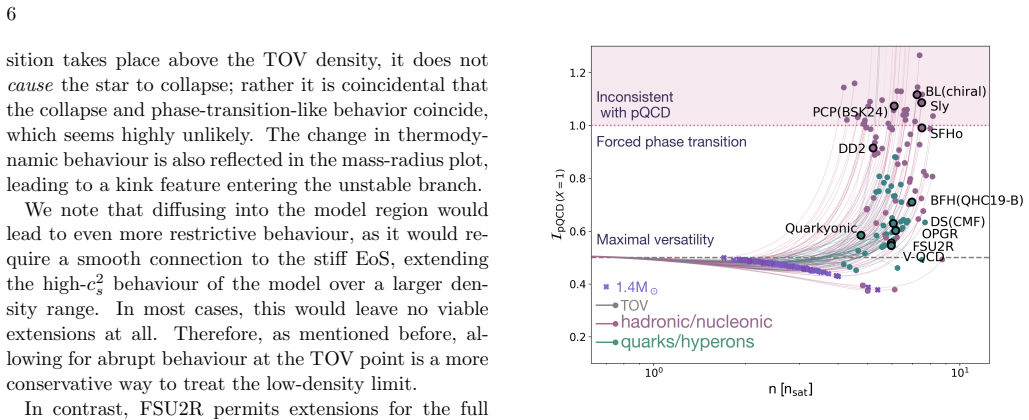
read the original abstract
Microscopic models of neutron-star matter have been widely used in astrophysical applications. The focus of attention has been on densities up to the maximal densities reached in stable neutron stars. The possibility that the underlying model assumptions may have important implications at higher densities has not been addressed. Here, we show that the behaviour at higher densities is strongly constrained by requiring a causal, stable, and thermodynamically consistent extension to the perturbative-QCD regime. We explicitly reveal what that behaviour must be and provide a tool for constructing and visualizing such extensions. We find that purely hadronic models trusted up to the maximal central density often require radically different behaviour at higher densities from that assumed in the original model, while models with additional degrees of freedom fare better. Our analysis disfavors purely nucleonic models for describing all stable neutron stars and supports the appearance of some type of additional degrees of freedom in stable massive neutron stars.
Editorial analysis
A structured set of objections, weighed in public.
Referee Report
Summary. The manuscript argues that requiring any extension of a microscopic neutron-star EOS model to the pQCD regime to remain causal, stable, and thermodynamically consistent imposes strong constraints on high-density behavior. Purely nucleonic models trusted only up to the maximum central density of stable stars are shown to typically demand behavior at higher densities that differs radically from the original model assumptions, whereas models incorporating additional degrees of freedom satisfy the conditions more naturally. This leads to the conclusion that purely nucleonic EOS are disfavored for describing all stable neutron stars and that some form of additional degrees of freedom must appear in stable massive neutron stars.
Significance. If the central methodology holds, the work supplies a concrete diagnostic for the viability of EOS models beyond the densities probed by stable stars and a practical tool for constructing and visualizing consistent extensions. This could sharpen constraints on the composition of dense matter and help interpret future multimessenger observations of massive neutron stars.
major comments (2)
- [Abstract and introduction] The central claim that purely nucleonic models are disfavored rests on the premise that every valid extension to the pQCD regime must remain causal, stable, and thermodynamically consistent even along the unstable branch. The manuscript does not demonstrate why thermodynamic consistency or stability cannot be relaxed on the unstable branch without invalidating the underlying microscopic model; if such relaxation is permissible, the reported distinction between nucleonic and non-nucleonic models does not necessarily follow.
- [Abstract] The abstract states that nucleonic models 'often require radically different behaviour at higher densities from that assumed in the original model,' yet no quantitative measure (e.g., a distance metric between the original and the forced high-density continuation) or explicit counter-example for a specific nucleonic EOS is supplied in the provided text. Without such a metric or example, the strength of the disfavoring conclusion cannot be assessed.
minor comments (1)
- [Abstract] The abstract refers to 'a tool for constructing and visualizing such extensions' but does not indicate whether this tool is made publicly available or described in sufficient detail for reproduction.
Simulated Author's Rebuttal
We thank the referee for the careful reading and constructive comments on our manuscript. We address each major comment below, providing clarifications on our methodology and indicating revisions where appropriate to strengthen the presentation.
read point-by-point responses
-
Referee: [Abstract and introduction] The central claim that purely nucleonic models are disfavored rests on the premise that every valid extension to the pQCD regime must remain causal, stable, and thermodynamically consistent even along the unstable branch. The manuscript does not demonstrate why thermodynamic consistency or stability cannot be relaxed on the unstable branch without invalidating the underlying microscopic model; if such relaxation is permissible, the reported distinction between nucleonic and non-nucleonic models does not necessarily follow.
Authors: The requirement for causality, stability, and thermodynamic consistency along the entire extension, including the unstable branch, follows directly from the construction of the microscopic models. These models derive the EOS from a consistent thermodynamic potential (e.g., a single free-energy functional) based on assumed degrees of freedom and interactions; thermodynamic consistency and stability are therefore intrinsic properties that must hold for the EOS to remain a coherent physical description at all densities. The unstable branch represents the mathematical continuation of the same EOS function beyond the central density of the maximum-mass configuration. Selectively relaxing these conditions only on the unstable branch would amount to replacing the high-density part with an arbitrary construction unrelated to the original model assumptions, which would invalidate the premise of testing extensions of that specific microscopic model. We will add an explicit justification paragraph in the introduction to articulate this point. revision: yes
-
Referee: [Abstract] The abstract states that nucleonic models 'often require radically different behaviour at higher densities from that assumed in the original model,' yet no quantitative measure (e.g., a distance metric between the original and the forced high-density continuation) or explicit counter-example for a specific nucleonic EOS is supplied in the provided text. Without such a metric or example, the strength of the disfavoring conclusion cannot be assessed.
Authors: The full manuscript contains explicit counter-examples for specific nucleonic EOS models (e.g., APR4 and SLy4) in Section III and the associated figures, which illustrate the required changes in high-density behavior to satisfy the pQCD matching conditions. To make the strength of the conclusion more readily assessable, we will introduce a quantitative metric (the integrated absolute difference in the squared speed of sound between the original model extrapolation and the constrained extension, integrated from the maximum central density of stable stars to the pQCD matching density) and report it both in the revised abstract and in a new results subsection. revision: yes
Circularity Check
No significant circularity; derivation applies independent physical constraints
full rationale
The paper derives constraints on high-density EOS behavior by requiring causal, stable, and thermodynamically consistent extensions from the unstable branch to the pQCD regime. These requirements are external physical principles, not quantities fitted or defined within the paper itself. No steps reduce by construction to the inputs (no self-definitional relations, no fitted parameters renamed as predictions, and no load-bearing self-citations that substitute for independent justification). The distinction between nucleonic and extended models follows directly from applying the stated conditions, without circular reduction.
Axiom & Free-Parameter Ledger
Reference graph
Works this paper leans on
-
[1]
CompOSE - CompStar Online Supernovae Equations of State
Typel, S. and Oertel, M. and Kl. CompOSE CompStar online supernova equations of state harmonising the concert of nuclear physics and astrophysics compose.obspm.fr. Phys. Part. Nucl. 2015. doi:10.1134/S1063779615040061. arXiv:1307.5715
work page internal anchor Pith review Pith/arXiv arXiv doi:10.1134/s1063779615040061 2015
-
[2]
Equations of state for supernovae and compact stars
Oertel, M. and Hempel, M. and Kl. Equations of state for supernovae and compact stars. Rev. Mod. Phys. 2017. doi:10.1103/RevModPhys.89.015007. arXiv:1610.03361
work page internal anchor Pith review Pith/arXiv arXiv doi:10.1103/revmodphys.89.015007 2017
-
[3]
Typel, S. and others. CompOSE Reference Manual. Eur. Phys. J. A. 2022. doi:10.1140/epja/s10050-022-00847-y. arXiv:2203.03209
-
[4]
Finch, Eliot and Legred, Isaac and Chatziioannou, Katerina and Essick, Reed and Han, Sophia and Landry, Phillippe. Unified nonparametric equation-of-state inference from the neutron-star crust to perturbative-QCD densities. 2025. arXiv:2505.13691
arXiv 2025
-
[5]
Simulating QCD at finite density
de Forcrand, Philippe. Simulating QCD at finite density. PoS. 2009. doi:10.22323/1.091.0010. arXiv:1005.0539
work page internal anchor Pith review Pith/arXiv arXiv doi:10.22323/1.091.0010 2009
-
[6]
Fujimoto, Yuki and Fukushima, Kenji and McLerran, Larry D. and Praszalowicz, Michal. Trace Anomaly as Signature of Conformality in Neutron Stars. Phys. Rev. Lett. 2022. doi:10.1103/PhysRevLett.129.252702. arXiv:2207.06753
-
[7]
Perturbative QCD and the neutron star equation of state
Somasundaram, Rahul and Tews, Ingo and Margueron, J \'e r \^o me. Perturbative QCD and the neutron star equation of state. Phys. Rev. C. 2023. doi:10.1103/PhysRevC.107.L052801. arXiv:2204.14039
-
[8]
Constraining the equation of state in neutron-star cores via the long-ringdown signal
Ecker, Christian and Gorda, Tyler and Kurkela, Aleksi and Rezzolla, Luciano. Constraining the equation of state in neutron-star cores via the long-ringdown signal. Nature Commun. 2025. doi:10.1038/s41467-025-56500-x. arXiv:2403.03246
-
[9]
Equation of State of Cold Quark Matter to O( _s^3 _s)
Gorda, Tyler and Paatelainen, Risto and S. Equation of State of Cold Quark Matter to O( _s^3 _s). Phys. Rev. Lett. 2023. doi:10.1103/PhysRevLett.131.181902. arXiv:2307.08734
-
[10]
Quark Matter at Four Loops: Hardships and How to Overcome Them
K. Quark Matter at Four Loops: Hardships and How to Overcome Them. Phys. Rev. Lett. 2025. doi:10.1103/627n-5g6l. arXiv:2501.17921
-
[11]
Dittmann, Alexander J. and others. A More Precise Measurement of the Radius of PSR J0740+6620 Using Updated NICER Data. Astrophys. J. 2024. doi:10.3847/1538-4357/ad5f1e. arXiv:2406.14467
-
[12]
The Ground state of matter at high densities: Equation of state and stellar models
Baym, Gordon and Pethick, Christopher and Sutherland, Peter. The Ground state of matter at high densities: Equation of state and stellar models. Astrophys. J. 1971. doi:10.1086/151216
-
[13]
and Prakash, Madappa and Reddy, Sanjay and Zhao, Tianqi
Drischler, Christian and Han, Sophia and Lattimer, James M. and Prakash, Madappa and Reddy, Sanjay and Zhao, Tianqi. Limiting masses and radii of neutron stars and their implications. Phys. Rev. C. 2021. doi:10.1103/PhysRevC.103.045808. arXiv:2009.06441
-
[14]
Semposki, A. C. and Drischler, C. and Furnstahl, R. J. and Phillips, D. R. Microscopic constraints for the equation of state and structure of neutron stars: A Bayesian model mixing framework. Phys. Rev. C. 2026. doi:10.1103/fxv6-gdnw. arXiv:2505.18921
work page internal anchor Pith review Pith/arXiv arXiv doi:10.1103/fxv6-gdnw 2026
-
[15]
Legred, Isaac and Chatziioannou, Katerina and Essick, Reed and Landry, Philippe. Implicit correlations within phenomenological parametric models of the neutron star equation of state. Phys. Rev. D. 2022. doi:10.1103/PhysRevD.105.043016. arXiv:2201.06791
-
[16]
Ab-initio QCD Calculations Impact the Inference of the Neutron-star-matter Equation of State
Gorda, Tyler and Komoltsev, Oleg and Kurkela, Aleksi. Ab-initio QCD Calculations Impact the Inference of the Neutron-star-matter Equation of State. Astrophys. J. 2023. doi:10.3847/1538-4357/acce3a. arXiv:2204.11877
-
[17]
How Perturbative QCD Constrains the Equation of State at Neutron-Star Densities
Komoltsev, Oleg and Kurkela, Aleksi. How Perturbative QCD Constrains the Equation of State at Neutron-Star Densities. Phys. Rev. Lett. 2022. doi:10.1103/PhysRevLett.128.202701. arXiv:2111.05350
-
[18]
Coleman and Noronha-Hostler, Jacquelyn and Yunes, Nicolas
Mroczek, Debora and Miller, M. Coleman and Noronha-Hostler, Jacquelyn and Yunes, Nicolas. Nontrivial features in the speed of sound inside neutron stars. Phys. Rev. D. 2024. doi:10.1103/PhysRevD.110.123009. arXiv:2309.02345
-
[19]
Constraining neutron star matter with QCD
Kurkela, Aleksi and Fraga, Eduardo S. and Schaffner-Bielich, J. Constraining neutron star matter with Quantum Chromodynamics. Astrophys. J. 2014. doi:10.1088/0004-637X/789/2/127. arXiv:1402.6618
work page internal anchor Pith review Pith/arXiv arXiv doi:10.1088/0004-637x/789/2/127 2014
-
[20]
Soft Interactions in Cold Quark Matter
Gorda, Tyler and Kurkela, Aleksi and Paatelainen, Risto and S. Soft Interactions in Cold Quark Matter. Phys. Rev. Lett. 2021. doi:10.1103/PhysRevLett.127.162003. arXiv:2103.05658
-
[21]
Bayesian uncertainty quantification of perturbative QCD input to the neutron-star equation of state
Gorda, Tyler and Komoltsev, Oleg and Kurkela, Aleksi and Mazeliauskas, Aleksas. Bayesian uncertainty quantification of perturbative QCD input to the neutron-star equation of state. JHEP. 2023. doi:10.1007/JHEP06(2023)002. arXiv:2303.02175
-
[22]
Hinderer, Tanja and Lackey, Benjamin D. and Lang, Ryan N. and Read, Jocelyn S. Tidal deformability of neutron stars with realistic equations of state and their gravitational wave signatures in binary inspiral. Phys. Rev. D. 2010. doi:10.1103/PhysRevD.81.123016. arXiv:0911.3535
work page internal anchor Pith review Pith/arXiv arXiv doi:10.1103/physrevd.81.123016 2010
-
[23]
From hadrons to quarks in neutron stars: a review
Baym, Gordon and Hatsuda, Tetsuo and Kojo, Toru and Powell, Philip D. and Song, Yifan and Takatsuka, Tatsuyuki. From hadrons to quarks in neutron stars: a review. Rept. Prog. Phys. 2018. doi:10.1088/1361-6633/aaae14. arXiv:1707.04966
work page internal anchor Pith review Pith/arXiv arXiv doi:10.1088/1361-6633/aaae14 2018
-
[24]
Equation of state and neutron star properties constrained by nuclear physics and observation
Hebeler, K. and Lattimer, J. M. and Pethick, C. J. and Schwenk, A. Equation of state and neutron star properties constrained by nuclear physics and observation. Astrophys. J. 2013. doi:10.1088/0004-637X/773/1/11. arXiv:1303.4662
work page internal anchor Pith review Pith/arXiv arXiv doi:10.1088/0004-637x/773/1/11 2013
-
[25]
Steiner, A. W. and Lattimer, J. M. and Brown, E. F. Neutron Star Radii, Universal Relations, and the Role of Prior Distributions. Eur. Phys. J. A. 2016. doi:10.1140/epja/i2016-16018-1. arXiv:1510.07515
work page internal anchor Pith review Pith/arXiv arXiv doi:10.1140/epja/i2016-16018-1 2016
-
[26]
Landry, Philippe and Essick, Reed and Chatziioannou, Katerina. Nonparametric constraints on neutron star matter with existing and upcoming gravitational wave and pulsar observations. Phys. Rev. D. 2020. doi:10.1103/PhysRevD.101.123007. arXiv:2003.04880
-
[27]
Direct Astrophysical Tests of Chiral Effective Field Theory at Supranuclear Densities
Essick, Reed and Tews, Ingo and Landry, Philippe and Reddy, Sanjay and Holz, Daniel E. Direct Astrophysical Tests of Chiral Effective Field Theory at Supranuclear Densities. Phys. Rev. C. 2020. doi:10.1103/PhysRevC.102.055803. arXiv:2004.07744
-
[28]
Equation of state at neutron-star densities and beyond from perturbative QCD
Komoltsev, Oleg and Somasundaram, Rahul and Gorda, Tyler and Kurkela, Aleksi and Margueron, J \'e r \^o me and Tews, Ingo. Equation of state at neutron-star densities and beyond from perturbative QCD. Phys. Rev. D. 2024. doi:10.1103/PhysRevD.109.094030. arXiv:2312.14127
-
[29]
Evidence for quark-matter cores in massive neutron stars
Annala, Eemeli and Gorda, Tyler and Kurkela, Aleksi and N. Evidence for quark-matter cores in massive neutron stars. Nature Phys. 2020. doi:10.1038/s41567-020-0914-9. arXiv:1903.09121
-
[30]
Strongly interacting matter exhibits deconfined behavior in massive neutron stars
Annala, Eemeli and Gorda, Tyler and Hirvonen, Joonas and Komoltsev, Oleg and Kurkela, Aleksi and N. Strongly interacting matter exhibits deconfined behavior in massive neutron stars. Nature Commun. 2023. doi:10.1038/s41467-023-44051-y. arXiv:2303.11356
-
[31]
Saffer, Alexander and Fonseca, Emmanuel and Ransom, Scott and Stairs, Ingrid and Lynch, Ryan and Good, Deborah and Masui, Kiyoshi W. and McKee, James W. and Meyers, Bradley W. and Patil, Swarali Shivraj and Tan, Chia Min , title = ". Astrophys. J. Lett. 2025. doi:10.3847/2041-8213/adc25e. arXiv:2412.02850
-
[32]
The NANOGrav 11-year Data Set: High-precision timing of 45 Millisecond Pulsars
Arzoumanian, Zaven and Adam Brazier and Sarah Burke-Spolaor and others. The NANOGrav 11-year Data Set: High-precision timing of 45 Millisecond Pulsars. Astrophys. J. Suppl. 2018. doi:10.3847/1538-4365/aab5b0. arXiv:1801.01837
work page internal anchor Pith review Pith/arXiv arXiv doi:10.3847/1538-4365/aab5b0 2018
-
[33]
The NANOGrav Nine-year Data Set: Mass and Geometric Measurements of Binary Millisecond Pulsars
Fonseca, Emmanuel and Pennucci, Timothy and Ellis, Justin and others. The NANOGrav Nine-year Data Set: Mass and Geometric Measurements of Binary Millisecond Pulsars. Astrophys. J. 2016. doi:10.3847/0004-637X/832/2/167. arXiv:1603.00545
work page internal anchor Pith review Pith/arXiv arXiv doi:10.3847/0004-637x/832/2/167 2016
-
[34]
Shapiro delay measurement of a two solar mass neutron star
Demorest, Paul and Pennucci, Tim and Ransom, Scott and Roberts, Mallory and Hessels, Jason. Shapiro Delay Measurement of A Two Solar Mass Neutron Star. Nature. 2010. doi:10.1038/nature09466. arXiv:1010.5788
work page internal anchor Pith review Pith/arXiv arXiv doi:10.1038/nature09466 2010
-
[35]
John Antoniadis and Paulo C. C. Freire and Norbert Wex and Thomas M. Tauris and Ryan S. Lynch and Marten H. van Kerkwijk and Michael Kramer and Cees Bassa and Vik S. Dhillon and Thomas Driebe and Jason W. T. Hessels and Victoria M. Kaspi and Vladislav I. Kondratiev and Norbert Langer and Thomas R. Marsh and Maura A. McLaughlin and Timothy T. Pennucci and ...
2013
-
[36]
E. Fonseca and H. T. Cromartie and T. T. Pennucci and P. S. Ray and A. Yu. Kirichenko and S. M. Ransom and P. B. Demorest and I. H. Stairs and Z. Arzoumanian and L. Guillemot and A. Parthasarathy and M. Kerr and I. Cognard and P. T. Baker and H. Blumer and P. R. Brook and M. DeCesar and T. Dolch and F. A. Dong and E. C. Ferrara and W. Fiore and N. Garver-...
-
[37]
Properties of the Binary Neutron Star Merger GW170817 , author =. Phys. Rev. X , volume =. 2019 , month =. doi:10.1103/PhysRevX.9.011001 , url =
-
[38]
M. C. Miller and F. K. Lamb and A. J. Dittmann and S. Bogdanov and Z. Arzoumanian and K. C. Gendreau and S. Guillot and W. C. G. Ho and J. M. Lattimer and M. Loewenstein and S. M. Morsink and P. S. Ray and M. T. Wolff and C. L. Baker and T. Cazeau and S. Manthripragada and C. B. Markwardt and T. Okajima and S. Pollard and I. Cognard and H. T. Cromartie an...
-
[39]
Thomas E. Riley and Anna L. Watts and Paul S. Ray and Slavko Bogdanov and Sebastien Guillot and Sharon M. Morsink and Anna V. Bilous and Zaven Arzoumanian and Devarshi Choudhury and Julia S. Deneva and Keith C. Gendreau and Alice K. Harding and Wynn C. G. Ho and James M. Lattimer and Michael Loewenstein and Renee M. Ludlam and Craig B. Markwardt and Takas...
-
[40]
2025 , eprint=
A NICER view of the 1.4 solar-mass edge-on pulsar PSR J0614--3329 , author=. 2025 , eprint=
2025
-
[41]
A NICER View of the Nearest and Brightest Millisecond Pulsar: PSR J0437 4715
Choudhury, Devarshi and Salmi, Tuomo and Vinciguerra, Serena and others. A NICER View of the Nearest and Brightest Millisecond Pulsar: PSR J0437 4715. Astrophys. J. Lett. 2024. doi:10.3847/2041-8213/ad5a6f. arXiv:2407.06789
-
[42]
Abbott, B. P. and Abbott, R. and Abbott, T. D. and others , collaboration =. GW170817: Observation of Gravitational Waves from a Binary Neutron Star Inspiral. Phys. Rev. Lett. , volume =. 2017 , month =. doi:10.1103/PhysRevLett.119.161101 , url =
-
[43]
T. E. Riley and A. L. Watts and S. Bogdanov and P. S. Ray and R. M. Ludlam and S. Guillot and Z. Arzoumanian and C. L. Baker and A. V. Bilous and D. Chakrabarty and K. C. Gendreau and A. K. Harding and W. C. G. Ho and J. M. Lattimer and S. M. Morsink and T. E. Strohmayer , title = ". 2019 , month =. doi:10.3847/2041-8213/ab481c , url =
-
[44]
M. C. Miller and F. K. Lamb and A. J. Dittmann and others , title = ". 2019 , month =. doi:10.3847/2041-8213/ab50c5 , url =
-
[45]
Non-parametric inference of the neutron star equation of state from gravitational wave observations
Landry, Philippe and Essick, Reed. Nonparametric inference of the neutron star equation of state from gravitational wave observations. Phys. Rev. D. 2019. doi:10.1103/PhysRevD.99.084049. arXiv:1811.12529
work page internal anchor Pith review Pith/arXiv arXiv doi:10.1103/physrevd.99.084049 2019
-
[46]
On the Sound Speed in Neutron Stars
Altiparmak, Sinan and Ecker, Christian and Rezzolla, Luciano. On the Sound Speed in Neutron Stars. Astrophys. J. Lett. 2022. doi:10.3847/2041-8213/ac9b2a. arXiv:2203.14974
-
[47]
Cartaxo, Jo \ a o and Huang, Chun and Malik, Tuhin and Sourav, Shashwat and Yuan, Wen-Li and Zhou, Tianzhe and Liu, Xuezhi and Provid \^e ncia, Constan c a. Covariant Energy Density Functionals for Neutron Star Matter Equation of State Modeling: Cross-Comparison Analysis Using texttt CompactObject. 2025. arXiv:2506.03112
arXiv 2025
-
[48]
First-order phase transitions in the cores of neutron stars
Komoltsev, Oleg. First-order phase transitions in the cores of neutron stars. Phys. Rev. D. 2024. doi:10.1103/PhysRevD.110.L071502. arXiv:2404.05637
-
[49]
Perturbative QCD reveals the softening of matter in the cores of massive neutron stars
Komoltsev, Oleg. Perturbative QCD reveals the softening of matter in the cores of massive neutron stars. 2025. arXiv:2506.06465
arXiv 2025
-
[50]
Essick, Reed and Legred, Isaac and Chatziioannou, Katerina and Han, Sophia and Landry, Philippe. Phase transition phenomenology with nonparametric representations of the neutron star equation of state. Phys. Rev. D. 2023. doi:10.1103/PhysRevD.108.043013. arXiv:2305.07411
-
[51]
Constraints on Strong Phase Transitions in Neutron Stars
Gorda, Tyler and Hebeler, Kai and Kurkela, Aleksi and Schwenk, Achim and Vuorinen, Aleksi. Constraints on Strong Phase Transitions in Neutron Stars. Astrophys. J. 2023. doi:10.3847/1538-4357/aceefb. arXiv:2212.10576
-
[52]
Critical examination of constraints on the equation of state of dense matter obtained from GW170817 , author =. Phys. Rev. C , volume =. 2018 , month =. doi:10.1103/PhysRevC.98.045804 , url =
-
[53]
Koehn, Hauke and others. From existing and new nuclear and astrophysical constraints to stringent limits on the equation of state of neutron-rich dense matter. Phys. Rev. X. 2025. doi:10.1103/PhysRevX.15.021014. arXiv:2402.04172
-
[54]
Gravitational-Wave Constraints on the Neutron-Star-Matter Equation of State , author =. Phys. Rev. Lett. , volume =. 2018 , month =. doi:10.1103/PhysRevLett.120.172703 , url =
-
[55]
and Tews, Ingo and Brown, Stephanie M
Capano, Collin D. and Tews, Ingo and Brown, Stephanie M. and Margalit, Ben and De, Soumi and Kumar, Sumit and Brown, Duncan A. and Krishnan, Badri and Reddy, Sanjay , title=. Nature Astronomy , year=. doi:10.1038/s41550-020-1014-6 , url=
-
[56]
Dietrich, Tim and Coughlin, Michael W. and Pang, Peter T. H. and Bulla, Mattia and Heinzel, Jack and Issa, Lina and Tews, Ingo and Antier, Sarah. Multimessenger constraints on the neutron-star equation of state and the Hubble constant. Science. 2020. doi:10.1126/science.abb4317. arXiv:2002.11355
-
[57]
Combining Electromagnetic and Gravitational-Wave Constraints on Neutron-Star Masses and Radii , author =. Phys. Rev. Lett. , volume =. 2021 , month =. doi:10.1103/PhysRevLett.126.061101 , url =
-
[58]
Raaijmakers, G. and Greif, S. K. and Hebeler, K. and Hinderer, T. and Nissanke, S. and Schwenk, A. and Riley, T. E. and Watts, A. L. and Lattimer, J. M. and Ho, W. C. G. , title =. 2021 , month =. doi:10.3847/2041-8213/ac089a , url =
-
[59]
Huth, Sabrina and Pang, Peter T. H. and Tews, Ingo and Dietrich, Tim and Le F. Constraining neutron-star matter with microscopic and macroscopic collisions , journal=. 2022 , month=. doi:10.1038/s41586-022-04750-w , url=
-
[60]
Uncertainty quantification in the machine-learning inference from neutron star probability distribution to the equation of state , author =. Phys. Rev. D , volume =. 2024 , month =. doi:10.1103/PhysRevD.110.034035 , url =
-
[61]
Lim, Yeunhwan and Holt, Jeremy W. Neutron Star Radii, Deformabilities, and Moments of Inertia from Experimental and Ab Initio Theory Constraints of the ^ 208 Pb Neutron Skin Thickness. Galaxies. 2022. doi:10.3390/galaxies10050099. arXiv:2204.09000
-
[62]
Binary neutron-star mergers: a review of Einstein's richest laboratory
Baiotti, Luca and Rezzolla, Luciano. Binary neutron star mergers: a review of Einstein s richest laboratory. Rept. Prog. Phys. 2017. doi:10.1088/1361-6633/aa67bb. arXiv:1607.03540
work page internal anchor Pith review Pith/arXiv arXiv doi:10.1088/1361-6633/aa67bb 2017
-
[63]
Oppenheimer, J. R. and Volkoff, G. M. On massive neutron cores. Phys. Rev. 1939. doi:10.1103/PhysRev.55.374
-
[64]
Static solutions of Einstein's field equations for spheres of fluid
Tolman, Richard C. Static solutions of Einstein's field equations for spheres of fluid. Phys. Rev. 1939. doi:10.1103/PhysRev.55.364
-
[65]
Constrained Gaussian-process bridge prior for neutron-star equation-of-state inference
Gorda, Tyler and Komoltsev, Oleg and Kurkela, Aleksi and Sunde, Eirik. Constrained Gaussian-process-bridge Prior for Neutron-star Equation-of-state Inference. Astrophys. J. 2026. doi:10.3847/1538-4357/ae552a. arXiv:2512.18044
work page internal anchor Pith review Pith/arXiv arXiv doi:10.3847/1538-4357/ae552a 2026
-
[66]
Semposki, A. C. and Drischler, C. and Furnstahl, R. J. and Melendez, J. A. and Phillips, D. R. From chiral effective field theory to perturbative QCD: A Bayesian model mixing approach to symmetric nuclear matter. Phys. Rev. C. 2025. doi:10.1103/PhysRevC.111.035804. arXiv:2404.06323
-
[67]
CompOSE: a repository for neutron star equations of state and transport properties
Antonopoulou, Danai and Bozzo, Enrico and Ishizuka, Chikako and Jones, David Ian and Oertel, Micaela and Providencia, Constan c a and Tolos, Laura and Typel, Stefan. CompOSE: a repository for neutron star equations of state and transport properties. Eur. Phys. J. A. 2022. doi:10.1140/epja/s10050-022-00908-2
-
[68]
Theoretical and experimental constraints for the equation of state of dense and hot matter
Kumar, Rajesh and others. Theoretical and experimental constraints for the equation of state of dense and hot matter. Living Rev. Rel. 2024. doi:10.1007/s41114-024-00049-6. arXiv:2303.17021
-
[69]
Plausible presence of new state in neutron stars with masses above 0.98MTOV
Han, Ming-Zhe and Huang, Yong-Jia and Tang, Shao-Peng and Fan, Yi-Zhong. Plausible presence of new state in neutron stars with masses above 0.98MTOV. Sci. Bull. 2023. doi:10.1016/j.scib.2023.04.007. arXiv:2207.13613
-
[70]
The equation of state for nucleon matter and neutron star structure
Akmal, A. and Pandharipande, V. R. and Ravenhall, D. G. The Equation of state of nucleon matter and neutron star structure. Phys. Rev. C. 1998. doi:10.1103/PhysRevC.58.1804. arXiv:nucl-th/9804027
work page internal anchor Pith review Pith/arXiv arXiv doi:10.1103/physrevc.58.1804 1998
-
[71]
Bombaci, Ignazio and Logoteta, Domenico. Equation of state of dense nuclear matter and neutron star structure from nuclear chiral interactions. Astron. Astrophys. 2018. doi:10.1051/0004-6361/201731604. arXiv:1805.11846
work page internal anchor Pith review Pith/arXiv arXiv doi:10.1051/0004-6361/201731604 2018
-
[72]
Pearson, J. M. and Chamel, N. and Potekhin, A. Y. and Fantina, A. F. and Ducoin, C. and Dutta, A. K. and Goriely, S. Unified equations of state for cold non-accreting neutron stars with Brussels Montreal functionals I. Role of symmetry energy. Mon. Not. Roy. Astron. Soc. 2018. doi:10.1093/mnras/sty2413. arXiv:1903.04981
-
[73]
Unified treatment of sub-saturation stellar matter at zero and finite temperature
Gulminelli, F. and Raduta, Ad. R. Unified treatment of subsaturation stellar matter at zero and finite temperature. Phys. Rev. C. 2015. doi:10.1103/PhysRevC.92.055803. arXiv:1504.04493
work page internal anchor Pith review Pith/arXiv arXiv doi:10.1103/physrevc.92.055803 2015
-
[74]
Chabanat, E. and Bonche, P. and Haensel, P. and Meyer, J. and Schaeffer, R. A Skyrme parametrization from subnuclear to neutron star densities. 2. Nuclei far from stablities. Nucl. Phys. A. 1998. doi:10.1016/S0375-9474(98)00180-8
-
[75]
A statistical model for a complete supernova equation of state , journal =
Matthias Hempel and Jürgen Schaffner-Bielich , keywords =. A statistical model for a complete supernova equation of state , journal =. 2010 , issn =. doi:https://doi.org/10.1016/j.nuclphysa.2010.02.010 , url =
-
[76]
Core-collapse supernova equations of state based on neutron star observations
Steiner, Andrew W. and Hempel, Matthias and Fischer, Tobias. Core-collapse supernova equations of state based on neutron star observations. Astrophys. J. 2013. doi:10.1088/0004-637X/774/1/17. arXiv:1207.2184
work page internal anchor Pith review Pith/arXiv arXiv doi:10.1088/0004-637x/774/1/17 2013
-
[77]
The Astrophysical Journal , abstract =
Negreiros, Rodrigo and Tolos, Laura and Centelles, Mario and Ramos, Angels and Dexheimer, Veronica , title =. The Astrophysical Journal , abstract =. 2018 , month =. doi:10.3847/1538-4357/aad049 , url =
-
[78]
The Astrophysical Journal , abstract =
Baym, Gordon and Furusawa, Shun and Hatsuda, Tetsuo and Kojo, Toru and Togashi, Hajime , title =. The Astrophysical Journal , abstract =. 2019 , month =. doi:10.3847/1538-4357/ab441e , url =
-
[79]
Journal of Physics G: Nuclear and Particle Physics , abstract =
Oertel, M and Providência, C and Gulminelli, F and Raduta, Ad R , title =. Journal of Physics G: Nuclear and Particle Physics , abstract =. 2015 , month =. doi:10.1088/0954-3899/42/7/075202 , url =
-
[80]
Dense and Hot QCD at Strong Coupling , author =. Phys. Rev. X , volume =. 2022 , month =. doi:10.1103/PhysRevX.12.041012 , url =
discussion (0)
Sign in with ORCID, Apple, or X to comment. Anyone can read and Pith papers without signing in.