REVIEW 1 major objections 8 minor 1 cited by
In-flight positron annihilation as a probe of feebly interacting particles
T0 review · 1 major / 8 minor · reviewed 2026-08-10 · deepseek-v4-flash
Pith's one-line read In-flight annihilation of supernova positrons gives the strongest astrophysical bounds on the electron couplings of heavy axion-like particles, sterile neutrinos, and dark photons, improving previous limits by one to two orders of…
desk verdict Extends the in-flight annihilation probe to ALPs, dark photons, and sterile neutrinos with full supernova production spectra, but the IA normalization anchored to the model's own 511 keV prediction leaves the headline limits hostage to that anchor. read the letter →
The pith
A machine-rendered reading of the paper's core claim, the machinery that carries it, and where it could break.
The reading
What carries the argument
The load-bearing object is the in-flight annihilation spectrum of relativistic positrons on interstellar electrons. Its energy dependence is set by the injected positron spectrum from FIP decay, the energy losses during Galactic propagation, and the Dirac annihilation cross section; its normalization is anchored by the model's own 511 keV line emission in the same sky region, following a strategy in which the continuum is obtained from the measured para-positronium to IA ratio at 511 keV. This anchoring means the IA signal is not an independent flux: it inherits whatever errors affect the propagated positron number, the thermalization fraction, and the positronium fraction, and it scales linearly with those quantities.
What would settle it
Measure the diffuse gamma-ray spectrum in the $|l|<60^\circ$, $|b|<10^\circ$ region with sensitivity in the few-MeV to 100 MeV band: a detected bump matching the IA shape at the level predicted for couplings just above the quoted limits would falsify the exclusions, while an independent determination of the 511 keV disk flux a factor of two below the adopted anchor would rescale every limit upward by the same factor.
Extended reading notes
Core claim
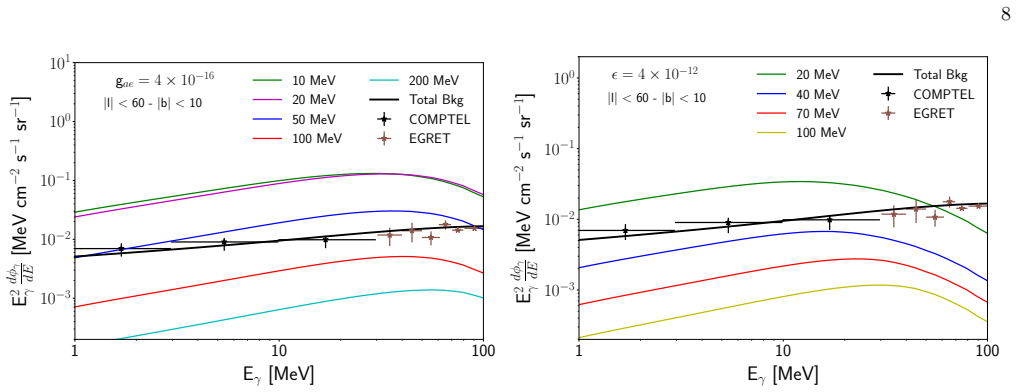
The paper's claim, stated on its own terms, is that in-flight positron annihilation from FIP decays in Galactic supernovae is the dominant secondary gamma-ray signal and the best available astrophysical probe of FIP-electron couplings. Normalizing the continuum to the 511 keV line in the same region of interest, the authors derive 2-$\sigma$ exclusion limits: for nucleon-coupled ALPs with $g_{ap}=2\times10^{-11}$, electron couplings $g_{ae}\gtrsim 10^{-17}$ are excluded for $10\,\mathrm{MeV}\lesssim m_a\lesssim100\,\mathrm{MeV}$ (with resonant structure around 135 and 147 MeV); for sterile neutrinos mixed with muon or tau neutrinos, $|U_{\mu 4}|^2\gtrsim4\times10^{-14}$ and $|U_{\tau 4}|^2\gtrsim6\times10^{-14}$ are excluded for masses between 10 and 150 MeV; and for dark photons, $\epsilon\gtrsim7\times10^{-14}$ is excluded with a fixed background model, or $\epsilon\gtrsim6\times10^{-13}$ without any background, for masses between 5 and 50 MeV. These bounds are claimed to strengthen existing limits by one to two orders of magnitude.
Load-bearing premise
The IA signal's absolute size is fixed by the model's own 511 keV line emission in the same sky region, so any error in the propagated positron number, the thermalization fraction, or the positronium fraction shifts the IA spectrum and all derived limits by the same factor.
Editorial extensions
If this is right
- If the central claim holds, the IA gamma-ray continuum replaces the 511 keV line as the most constraining astrophysical observable for electron couplings of MeV-scale FIPs produced in supernovae.
- Nucleon-coupled ALPs in the 10-100 MeV mass range with $g_{ae}$ above about $10^{-17}$ would be excluded (for $g_{ap}=2\times10^{-11}$), with the limits relaxing near the 135 MeV photon-decay resonance and tightening near 147 MeV.
- Sterile neutrinos mixed with muon or tau neutrinos would be excluded for $|U_{\alpha 4}|^2$ above roughly $4\times10^{-14}$ (muon) or $6\times10^{-14}$ (tau) across 10-150 MeV.
- Dark photons in the 5-50 MeV range would be excluded for kinetic mixing $\epsilon$ above about $7\times10^{-14}$ with a fixed background, complementing cosmological and SN 1987A constraints.
- In every background model considered, the COMPTEL data require no IA signal on top of the background, so the bounds are purely exclusion limits rather than evidence for new physics.
Reading between the lines
- A future MeV gamma-ray telescope with better angular resolution and lower backgrounds should sharpen these limits substantially, and could convert the current null into a detection if the true coupling lies just below the COMPTEL bound.
- Because the IA normalization is inherited from the 511 keV line, improving the modeling of the Galactic disk's 511 keV emission would directly strengthen all three sets of limits without any new gamma-ray data.
- The same IA method applies to any steady Galactic source of energetic positrons, including dark-matter decay or neutron-star merger remnants, so the framework is broader than supernova-produced FIPs.
- The spectral shape difference (dark-photon IA peaking near 20-30 MeV, axion IA near 60 MeV) gives a potential diagnostic for identifying which particle produces a future signal.
Formalized claims in Lean
-
Claim #1: The paper's claim, stated on its own terms, is that in-flight positron annihilation from FIP decays in Galactic supernovae is the dominant secondary gamma-ray signal and the best available astrophysical probe of FIP-electron couplings. Normalizing the continuum to the 511 keV line in the same region of interest, the authors derive 2-$\sigma$ exclusion limits: for nucleon-coupled ALPs with $g_{ap}=
/-- @claim 1 The paper's claim, stated on its own terms, is that in-flight positron annihilation from FIP decays in Galactic supernovae is the dominant secondary gamma-ray signal and the best available astrophysical probe of FIP-electron couplings. Normalizing the continuum to the 511 keV line in the same region of interest, the authors derive 2-$\sigma$ exclusion limits: for nucleon-coupled ALPs with $g_{ap}= -/
def central_claim : Prop :=
Signed reviews
Editorial analysis
A structured set of objections, weighed in public.
Referee Report
Summary. This paper computes the diffuse gamma-ray signal from in-flight annihilation (IA) of positrons produced by decays of feebly interacting particles (FIPs) emitted by Galactic core-collapse supernovae, and uses it to constrain ALPs coupled to electrons (and separately to nucleons plus electrons), sterile neutrinos mixed with muon or tau neutrinos, and dark photons kinetically mixed with the photon. FIP production spectra are computed for the Garching SFHo-s18.8 SN model; the injected e± are propagated with a customized DRAGON2 setup; and the IA continuum is normalized, following the Beacom-Yuksel approach, to the model's own integrated 511 keV line emission in the region |l| < 60°, |b| < 10°. Two-sigma coupling limits are derived from COMPTEL data under four background treatments (none, power-law, reference model fixed, reference model with free normalization), with propagation uncertainties bracketed by extreme halo-height and Alfven-velocity scenarios. The headline exclusions are gae ≲ 10^-17 for 10-100 MeV nucleon-plus-electron-coupled ALPs at gap = 2×10^-11, |U_μ4|^2 ≲ 4×10^-14 and |U_τ4|^2 ≲ 6×10^-14 for sterile neutrinos, and ε ≳ 7×10^-14 for dark photons (fixed background), claimed to improve previous astrophysical bounds by one to two orders of magnitude.
Significance. If the absolute IA normalization holds, the paper demonstrates a genuinely more powerful astrophysical probe of FIP-electron couplings than the 511 keV line or the previously used IC and bremsstrahlung channels: the IA continuum peaks at tens of MeV where the diffuse gamma-ray background is low, and the three FIP models are computed from explicit production spectra rather than a generic parametrization. Strengths include the use of a modern SN model, the full DRAGON2 propagation treatment, a transparent menu of background and propagation scenarios, conservative choices (coldest SN profile, no-background limits), and falsifiable MeV-range predictions that next-generation telescopes can test. The main correctness risk is that the IA normalization is anchored to the same pipeline that predicts the 511 keV line, so the absolute exclusions inherit unquantified systematics; the relative claim that IA is the strongest positron channel is robust to this risk, while the absolute numbers are not. The authors also deserve credit for displaying the full spread between the most and least conservative analyses.
major comments (1)
- [III (gamma-ray signals section)] The absolute normalization of the IA signal is fixed by the model's own integrated 511 keV line emission in the same region of interest, since the text states that 'the normalization is fixed by the 511 keV emission in that region of interest' and that 511 keV emission is itself a prediction of the same pipeline (same FIP injection spectra, same DRAGON2 propagation, same thermalization and positronium assumptions). A systematic error in the propagated positron yield, thermalization fraction, or positronium fraction therefore enters the IA spectrum and the 511 keV anchor coherently, and comparing the IA signal to COMPTEL data does not cancel this common mode. The paper does not present a direct IA calculation from the steady-state positron distribution that would validate the anchored normalization, nor does it propagate anchor systematics into the limits of Fig. 9; the IA method is only described by reference to Eq. (2) of the companion work [24]. Since the headline couplings scale with a fractional power of the IA flux (flux ∝ gae^2 and ∝ |U_alpha4|^4 in the cases shown in Fig. 9), an unquantified factor-2-3 anchor error shifts the quoted exclusions by factors of order 1.2-1.7. I request either (a) a direct first-principles computation of the IA flux from the propagated positron spectra that reproduces the anchored normalization, or (b) a systematic band associated with the anchor (positronium fraction, thermalization time, free-electron density) added to the limits.
minor comments (8)
- [Abstract] The statement that bounds are derived 'using data from COMPTEL and EGRET' is inaccurate because Section III explains that EGRET data are used only for illustrative purposes and that all constraints are derived from COMPTEL; please rephrase and fix the typo 'strenghten' in the same paragraph.
- [II (after Eq. (6))] The sentence following Eq. (6) reads 'where where E−,+ and f−,+ are the electron and positron energies and distribution functions'; the duplicated 'where' should be removed, and the positron distribution function f+ should be defined explicitly since it is not introduced before this equation.
- [II (sterile neutrinos)] The decay channels producing the e± pairs (presumably ν4 → νℓ e+e−) and the positron injection spectra used in Eq. (21) are not described; since the sterile neutrino limits are headline results, the decay mode, branching ratios, and how the three-body final state is mapped onto the Ea = xi Epos prescription of Eq. (21) should be stated in the text rather than referenced only to Refs. [15, 24].
- [Abstract and Section IV] The headline numbers (e.g., ε ≳ 7×10^-14 for DPs, gae ≲ 10^-17 for ALPs) correspond to the analysis with the reference fixed background, while the no-background analysis gives limits up to an order of magnitude weaker; the abstract should state this dependence explicitly so that the claimed 'one to two orders of magnitude' improvement is not read as background-independent.
- [III (Eq. (24) discussion)] The text says the propagation accounts for 'diffusion-reacceleration-advection-loss effects,' but Eq. (24) displays no advection term; please clarify whether advection is neglected for sub-GeV positrons and explain the justification.
- [III (propagation setup)] The e± injection tables are stated to be available 'upon request'; depositing them in a permanent public repository would improve reproducibility, particularly because the IA normalization is otherwise recoverable only from the companion work [24].
- [Fig. 10 caption] The caption contains a typo: 'This underscores the important of IA at "higher" masses' should read 'the importance of IA'.
- [II (Eq. (21) discussion)] The FIP emission-time interval written as 'i.e. 1 − 10 s' should be '1–10 s' (en dash), since '1 − 10 s' is ambiguous.
Circularity Check
IA normalization anchored to the model's own 511 keV flux; no fully circular reduction, but headline limits inherit 511 keV systematics.
-
self definitional
[Section III, 'γ-ray signals' (IA calculation paragraph)]
"This strategy consists of first evaluating the integrated 511 keV line emission in a region of interest and then computing the continuum IA flux via the measured ratio of the para-positronium emission to IA emission at 511 keV. ... while the normalization is fixed by the 511 keV emission in that region of interest."
The IA continuum's absolute normalization is not independently predicted; it is set by the model's own integrated 511 keV line emission in the same ROI. That 511 keV emission is itself computed from the same propagated positron population and the same thermalization/positronium assumptions (as described in the preceding paragraph of Section III). Therefore the IA flux is, by construction, a rescaling of the same positron model rather than an independent observable: any systematic error in the injected positron number, energy-loss rate, or positronium fraction enters both the 511 keV anchor and the IA spectrum identically.
full rationale
The derivation chain is not circular in the strong sense: FIP production spectra (Eqs. 4, 6, 14), positron injection (Eq. 21), and DRAGON2 propagation (Eq. 24) are computed from standard physics inputs, and the IA spectrum is then compared with external COMPTEL data to obtain 2-sigma coupling limits, with no fitted constant renamed as a prediction. The one structural dependency is the IA normalization, which is fixed by the integrated 511 keV line emission of the same FIP positrons in the same ROI (Section III, 'γ-ray signals'). This creates a shared-systematics limitation: IA and 511 keV share the propagated positron number, thermalization time, and positronium fraction, so a bias in the 511 keV anchor propagates directly into the headline limits. It is not a circular reduction of the central claim, because the 511 keV anchor is a model output rather than a fit parameter, and the final constraints are obtained against COMPTEL data, not against the 511 keV line. The IA spectral shape is independently derived from Dirac cross sections and the positron energy-loss rate. Self-citations to Refs. [24, 26, 44, 94, 111, 112, 118, 119] are frequent; the IA method is imported from the same-author companion paper [24], but it originates from the external Beacom-Yuksel strategy [115], and the benchmark nucleon coupling gap = 2e-11 is taken from the published constraint in Ref. [44]. These citations are methodological continuity rather than load-bearing circularity. Overall, the paper is externally benchmarked against COMPTEL data, so the circularity score is low.
Assumptions & free parameters
free parameters (7)
- ALP-electron coupling gae =
upper limit ≈ 1e-17 for ma 10-100 MeV with gap=2e-11 and fixed background
- ALP-nucleon coupling gap =
fixed to 2×10^-11
- Dark photon kinetic mixing epsilon =
excluded above ≈7×10^-14 with fixed background, ≈6×10^-13 without background for 5-50 MeV
- Sterile neutrino mixing |Ualpha4|^2 =
excluded above ≈4×10^-14 (mu) and ≈6×10^-14 (tau) for 10-150 MeV
- Propagation halo height H and Alfven velocity VA =
benchmark H=8 kpc, VA=13.4 km/s; conservative H=3 kpc, VA=0; aggressive H=16 kpc, VA=40 km/s
- Background normalization and spectral index in power-law fit =
Nγ ≈ 1.06e4 (scaled units), α ≈ 1.80 in the 30 MeV sterile neutrino example
- Generic FIP spectral parameters E0 and beta =
used only for illustrative generic FIP curve in Fig 6
assumptions (9)
- domain assumption The SFHo-s18.8 1D supernova model with 18.8 solar masses and a 1.35 solar mass neutron star provides a conservative FIP emission environment.
- domain assumption FIPs are produced in the free-streaming regime with negligible back-reaction on the SN profile.
- domain assumption The e± propagation is described by the DRAGON2 diffusion-reacceleration equation with parameters adjusted to CR data.
- domain assumption The IA flux normalization is fixed by the model's integrated 511 keV line emission in the ROI, using the Beacom-Yuksel ratio of para-positronium to IA emission.
- domain assumption The COMPTEL data in the ROI |l|<60 degrees, |b|<10 degrees are a valid tracer of the diffuse Galactic gamma-ray background, and EGRET data are unreliable for constraints due to unresolved sources.
- domain assumption The electron model of Refs. [118,119] reproduces the gamma-ray background down to 100 keV and is used as the reference background.
- domain assumption For ALPs, the QCD-induced photon coupling with cg=1, cd=0 and the branching ratios in Eq. (11) govern the decay competition.
- domain assumption Sterile neutrinos in the 10-150 MeV range mix dominantly with muon or tau neutrinos and are produced via neutral and charged current scattering.
- domain assumption Dark photon production is dominated by proton bremsstrahlung with resonant in-medium mixing.
Cite this review
Pith. "Pith review of In-flight positron annihilation as a probe of feebly interacting particles." pith.science (2026). https://pith.science/paper/B7PA3ITJ
@misc{pith2026250107725,
  author       = {Pith},
  title        = {Pith review of: In-flight positron annihilation as a probe of feebly interacting particles},
  year         = {2026},
  howpublished = {\url{https://pith.science/paper/B7PA3ITJ}},
  note         = {Machine review of arXiv:2501.07725}
}
read the original abstract
Core-collapse supernovae (SNe) provide a unique environment to study Feebly Interacting Particles (FIPs) such as Axion-Like Particles (ALPs), sterile neutrinos, and Dark Photons (DPs). This paper focuses on heavy FIPs produced in SNe, whose decay produces electrons and positrons, generating observable secondary signals during their propagation and annihilation. We focus on the In-flight Annihilation (IA) of positrons, which emerge as the most significant contribution to the resulting gamma-ray spectrum. Using data from COMPTEL and EGRET we derive the most stringent bounds on the FIP-electron couplings for heavy ALPs, sterile neutrinos, and DPs. These results strenghten existing bounds of one or two orders of magnitude, depending on the FIP model.
Figures


Figures from the paper (7 more)



Forward citations
Cited by 1 Pith paper
-
Cooling the Shock: New Supernova Constraints on Dark Photons
Resonant dark photon production in the gain layer of a core-collapse supernova can quench the neutrino-driven shock revival, yielding constraints that supersede the SN1987A cooling bound for masses around 0.1-0.4 MeV.
Reference graph
Works this paper leans on
-
[24]
P. De la Torre Luque, S. Balaji, P. Carenza, and L. Mas- trototaro, (2024), arXiv:2405.08482 [hep-ph]
arXiv 2024
-
[1]
G. G. Raffelt, (1996)
1996
-
[2]
A. Mirizzi, I. Tamborra, H.-T. Janka, N. Sa- viano, K. Scholberg, R. Bollig, L. Hudepohl, and S. Chakraborty, Riv. Nuovo Cim. 39, 1 (2016), arXiv:1508.00785 [astro-ph.HE]
arXiv 2016
-
[3]
S. Horiuchi and J. P. Kneller, J. Phys. G 45, 043002 (2018), arXiv:1709.01515 [astro-ph.HE]
arXiv 2018
-
[4]
A. Caputo and G. Raffelt, PoS COSMICWISPers, 041 (2024), arXiv:2401.13728 [hep-ph]
arXiv 2024
-
[5]
Raffelt and D
G. Raffelt and D. Seckel, Phys. Rev. Lett. 60, 1793 (1988)
1988
-
[6]
W. Keil, H.-T. Janka, D. N. Schramm, G. Sigl, M. S. Turner, and J. R. Ellis, Phys. Rev. D 56, 2419 (1997), arXiv:astro-ph/9612222
arXiv 1997
-
[7]
J. H. Chang, R. Essig, and S. D. McDermott, JHEP 09, 051 (2018), arXiv:1803.00993 [hep-ph]
arXiv 2018
Show all 137 references
-
[8]
Carenza, T
P. Carenza, T. Fischer, M. Giannotti, G. Guo, G. Mart ´ ınez-Pinedo, and A. Mirizzi, JCAP 10, 016 (2019), [Erratum: JCAP 05, E01 (2020)], arXiv:1906.11844 [hep-ph]
2019 arXiv
-
[9]
Carenza, B
P. Carenza, B. Fore, M. Giannotti, A. Mirizzi, and S. Reddy, Phys. Rev. Lett. 126, 071102 (2021), arXiv:2010.02943 [hep-ph]
2021 arXiv
-
[10]
Caputo, G
A. Caputo, G. Raffelt, and E. Vitagliano, JCAP 08, 045 (2022), arXiv:2204.11862 [astro-ph.SR]
2022 arXiv
-
[11]
Caputo, G
A. Caputo, G. Raffelt, and E. Vitagliano, Phys. Rev. D 105, 035022 (2022), arXiv:2109.03244 [hep-ph]
2022 arXiv
-
[12]
E. W. Kolb, R. N. Mohapatra, and V. L. Teplitz, Phys. Rev. Lett. 77, 3066 (1996), arXiv:hep-ph/9605350
1996 arXiv
-
[13]
G. G. Raffelt and S. Zhou, Phys. Rev. D 83, 093014 (2011), arXiv:1102.5124 [hep-ph]
2011 arXiv
-
[14]
Mastrototaro, A
L. Mastrototaro, A. Mirizzi, P. D. Serpico, and A. Es- maili, JCAP 01, 010 (2020), arXiv:1910.10249 [hep-ph]
2020 arXiv
-
[15]
Carenza, G
P. Carenza, G. Lucente, L. Mastrototaro, A. Mirizzi, and P. D. Serpico, Phys. Rev. D 109, 063010 (2024), arXiv:2311.00033 [hep-ph]
2024 arXiv
-
[16]
Akita, S
K. Akita, S. H. Im, M. Masud, and S. Yun, JHEP 07, 057 (2024), arXiv:2312.13627 [hep-ph]
2024 arXiv
-
[17]
J. H. Chang, R. Essig, and S. D. McDermott, JHEP 01, 107 (2017), arXiv:1611.03864 [hep-ph]
2017 arXiv
-
[18]
Linden, T
T. Linden, T. T. Q. Nguyen, and T. M. P. Tait, (2024), arXiv:2406.19445 [hep-ph]
2024 arXiv
-
[19]
P. S. B. Dev, R. N. Mohapatra, and Y. Zhang, JCAP 08, 003 (2020), [Erratum: JCAP 11, E01 (2020)], arXiv:2005.00490 [hep-ph]
2020 arXiv
-
[20]
Balaji, P
S. Balaji, P. S. B. Dev, J. Silk, and Y. Zhang, JCAP 12, 024 (2022), arXiv:2205.01669 [hep-ph]
2022 arXiv
-
[21]
J. M. Camalich, J. Terol-Calvo, L. Tolos, and R. Ziegler, Phys. Rev. D 103, L121301 (2021), arXiv:2012.11632 [hep-ph]
2021 arXiv
-
[22]
Hannestad, G
S. Hannestad, G. Raffelt, and Y. Y. Y. Wong, Phys. Rev. D 76, 121701 (2007), arXiv:0708.1404 [hep-ph]
2007 arXiv
-
[23]
Antel et al., Eur
C. Antel et al., Eur. Phys. J. C 83, 1122 (2023), arXiv:2305.01715 [hep-ph]
2023 arXiv
-
[25]
De la Torre Luque, S
P. De la Torre Luque, S. Balaji, and P. Carenza, Phys. Rev. D 109, L101305 (2024), arXiv:2307.13728 [hep-ph]
2024 arXiv
-
[26]
De la Torre Luque, S
P. De la Torre Luque, S. Balaji, and P. Carenza, Phys. Rev. D 109, 103028 (2024), arXiv:2307.13731 [hep-ph]
2024 arXiv
-
[27]
Calore, P
F. Calore, P. Carenza, M. Giannotti, J. Jaeckel, G. Lu- cente, L. Mastrototaro, and A. Mirizzi, Phys. Rev. D 105, 063026 (2022), arXiv:2112.08382 [hep-ph]
2022 arXiv
-
[28]
Calore, P
F. Calore, P. Carenza, M. Giannotti, J. Jaeckel, G. Lu- cente, and A. Mirizzi, Phys. Rev. D 104, 043016 (2021), arXiv:2107.02186 [hep-ph]
2021 arXiv
-
[29]
J. W. Foster, M. Kongsore, C. Dessert, Y. Park, N. L. Rodd, K. Cranmer, and B. R. Safdi, Phys. Rev. Lett. 127, 051101 (2021), arXiv:2102.02207 [astro-ph.CO]
2021 arXiv
-
[30]
Bouchet, E
L. Bouchet, E. Jourdain, J. P. Roques, A. Strong, R. Diehl, F. Lebrun, and R. Terrier, Astrophys. J. 679, 1315 (2008), arXiv:0801.2086 [astro-ph]
2008 arXiv
-
[31]
Bouchet, J.-P
L. Bouchet, J.-P. Roques, and E. Jourdain, Astrophys. J. 720, 1772 (2010), arXiv:1007.4753 [astro-ph.HE]
2010 arXiv
-
[32]
Siegert, R
T. Siegert, R. Diehl, G. Khachatryan, M. G. H. Krause, F. Guglielmetti, J. Greiner, A. W. Strong, and X. Zhang, Astron. Astrophys. 586, A84 (2016), arXiv:1512.00325 [astro-ph.HE]
2016 arXiv
-
[33]
Berteaud, F
J. Berteaud, F. Calore, J. Iguaz, P. Serpico, and T. Siegert, Physical Review D 106 (2022), 10.1103/phys- revd.106.023030
2022 doi
-
[34]
Sreekumar, F
P. Sreekumar, F. W. Stecker, and S. C. Kappadath, AIP Conf. Proc. 410, 344 (1997), arXiv:astro-ph/9709258
1997 arXiv
-
[35]
A. W. Strong, I. V. Moskalenko, and O. Reimer, Astro- phys. J. 613, 962 (2004), arXiv:astro-ph/0406254
2004 arXiv
-
[36]
F. W. Stecker, apss 3, 579 (1969)
1969
-
[37]
E. C. Stone, A. C. Cummings, F. B. McDonald, B. C. Heikkila, N. Lal, and W. R. Webber, Science 341, 1236408 (2013)
2013
-
[38]
Garching core-collapse supernova research archive,
“Garching core-collapse supernova research archive,” https://wwwmpa.mpa-garching.mpg.de/ccsnarchive/ /
-
[39]
Bollig, W
R. Bollig, W. DeRocco, P. W. Graham, and H.-T. Janka, Phys. Rev. Lett. 125, 051104 (2020), [Erratum: Phys.Rev.Lett. 126, 189901 (2021)], arXiv:2005.07141 [hep-ph]
2020 arXiv
-
[40]
Caputo, H.-T
A. Caputo, H.-T. Janka, G. Raffelt, and E. Vitagliano, Phys. Rev. Lett. 128, 221103 (2022), arXiv:2201.09890 [astro-ph.HE]
2022 arXiv
-
[41]
Lella, P
A. Lella, P. Carenza, G. Lucente, M. Giannotti, and A. Mirizzi, Phys. Rev. D 107, 103017 (2023), arXiv:2211.13760 [hep-ph]
2023 arXiv
-
[42]
Lella, P
A. Lella, P. Carenza, G. Co’, G. Lucente, M. Giannotti, A. Mirizzi, and T. Rauscher, Phys. Rev. D 109, 023001 (2024), arXiv:2306.01048 [hep-ph]
2024 arXiv
-
[43]
Lella, F
A. Lella, F. Calore, P. Carenza, C. Eckner, M. Giannotti, G. Lucente, and A. Mirizzi, (2024), arXiv:2405.02395 [hep-ph]
2024 arXiv
-
[44]
Lella, E
A. Lella, E. Ravensburg, P. Carenza, and M. C. D. Marsh, Phys. Rev. D 110, 043019 (2024), arXiv:2405.00153 [hep-ph]
2024 arXiv
-
[45]
C. A. Manzari, Y. Park, B. R. Safdi, and I. Savoray, Phys. Rev. Lett. 133, 211002 (2024), arXiv:2405.19393 [hep-ph]
2024
-
[46]
Sukhbold, S
T. Sukhbold, S. Woosley, and A. Heger, Astrophys. J. 860, 93 (2018), arXiv:1710.03243 [astro-ph.HE]
2018 arXiv
-
[47]
Rampp and H
M. Rampp and H. T. Janka, Astron. Astrophys. 396, 361 (2002), arXiv:astro-ph/0203101
2002 arXiv
-
[48]
Buras, M
R. Buras, M. Rampp, H. T. Janka, and K. Kifoni- dis, Astron. Astrophys. 447, 1049 (2006), arXiv:astro- ph/0507135
2006
-
[49]
Janka, Ann
H.-T. Janka, Ann. Rev. Nucl. Part. Sci. 62, 407 (2012), arXiv:1206.2503 [astro-ph.SR]. 15
2012 arXiv
-
[50]
Bollig, H
R. Bollig, H. T. Janka, A. Lohs, G. Martinez-Pinedo, C. J. Horowitz, and T. Melson, Phys. Rev. Lett. 119, 242702 (2017), arXiv:1706.04630 [astro-ph.HE]
2017 arXiv
-
[51]
D. F. G. Fiorillo, M. Heinlein, H.-T. Janka, G. Raffelt, E. Vitagliano, and R. Bollig, Phys. Rev. D 108, 083040 (2023), arXiv:2308.01403 [astro-ph.HE]
2023 arXiv
-
[52]
Rembiasz, M
T. Rembiasz, M. Obergaulinger, M. Masip, M. A. P´ erez- Garc ´ ıa, M.-A. Aloy, and C. Albertus, Phys. Rev. D98, 103010 (2018), arXiv:1806.03300 [astro-ph.HE]
2018 arXiv
-
[53]
Fischer, P
T. Fischer, P. Carenza, B. Fore, M. Giannotti, A. Mi- rizzi, and S. Reddy, Phys. Rev. D 104, 103012 (2021), arXiv:2108.13726 [hep-ph]
2021 arXiv
-
[54]
Betranhandy and E
A. Betranhandy and E. O’Connor, Phys. Rev. D 106, 063019 (2022), arXiv:2204.00503 [astro-ph.HE]
2022 arXiv
-
[55]
K. Mori, T. Takiwaki, K. Kotake, and S. Horiuchi, Phys. Rev. D 110, 023031 (2024), arXiv:2402.14333 [astro-ph.HE]
2024 arXiv
-
[56]
Carenza and G
P. Carenza and G. Lucente, Phys. Rev. D 103, 123024 (2021), arXiv:2104.09524 [hep-ph]
2021 arXiv
-
[57]
Carenza and G
P. Carenza and G. Lucente, Phys. Rev. D 104, 103007 (2021), [Erratum: Phys.Rev.D 110, 049901 (2024)], arXiv:2107.12393 [hep-ph]
2021 arXiv
-
[58]
Di Luzio, M
L. Di Luzio, M. Giannotti, E. Nardi, and L. Visinelli, Phys. Rept. 870, 1 (2020), arXiv:2003.01100 [hep-ph]
2020 arXiv
- [59]
-
[60]
K. Choi, H. J. Kim, H. Seong, and C. S. Shin, JHEP 02, 143 (2022), arXiv:2110.01972 [hep-ph]
2022 arXiv
-
[61]
R. L. Workman et al. (Particle Data Group), PTEP 2022, 083C01 (2022)
2022
-
[62]
Grilli di Cortona, E
G. Grilli di Cortona, E. Hardy, J. Pardo Vega, and G. Villadoro, JHEP 01, 034 (2016), arXiv:1511.02867 [hep-ph]
2016 arXiv
-
[63]
Carena and R
M. Carena and R. D. Peccei, Phys. Rev. D 40, 652 (1989)
1989
-
[64]
R. P. Brinkmann and M. S. Turner, Phys. Rev. D 38, 2338 (1988)
1988
-
[65]
Raffelt and D
G. Raffelt and D. Seckel, Phys. Rev. D 52, 1780 (1995), arXiv:astro-ph/9312019
1995 arXiv
-
[66]
Stoica, B
S. Stoica, B. Pastrav, J. E. Horvath, and M. P. Allen, Nucl. Phys. A 828, 439 (2009), [Erratum: Nucl.Phys.A 832, 148 (2010)], arXiv:0906.3134 [nucl-th]
2009 arXiv
-
[67]
T. E. O. Ericson and J. F. Mathiot, Phys. Lett. B 219, 507 (1989)
1989
-
[68]
Raffelt and D
G. Raffelt and D. Seckel, Phys. Rev. Lett. 67, 2605 (1991)
1991
-
[69]
Janka, W
H.-T. Janka, W. Keil, G. Raffelt, and D. Seckel, Phys. Rev. Lett. 76, 2621 (1996), arXiv:astro-ph/9507023
1996 arXiv
-
[70]
Springmann, M
K. Springmann, M. Stadlbauer, S. Stelzl, and A. Weiler, (2024), arXiv:2410.10945 [hep-ph]
2024 arXiv
-
[71]
M. S. Turner, Phys. Rev. D 45, 1066 (1992)
1992
-
[72]
Fore and S
B. Fore and S. Reddy, Phys. Rev. C 101, 035809 (2020), arXiv:1911.02632 [astro-ph.HE]
2020 arXiv
-
[73]
S.-Y. Ho, J. Kim, P. Ko, and J.-h. Park, Phys. Rev. D 107, 075002 (2023), arXiv:2212.01155 [hep-ph]
2023 arXiv
- [74]
-
[75]
Altmann, F
M. Altmann, F. von Feilitzsch, C. Hagner, L. Oberauer, Y. Declais, and E. Kajfasz, Z. Phys. C 68, 221 (1995)
1995
-
[76]
A. M. Suliga, I. Tamborra, and M.-R. Wu, JCAP 08, 018 (2020), arXiv:2004.11389 [astro-ph.HE]
2020 arXiv
-
[77]
C. A. Arg¨ uelles, V. Brdar, and J. Kopp, Phys. Rev. D 99, 043012 (2019), arXiv:1605.00654 [hep-ph]
2019 arXiv
-
[78]
Alekhin et al., Rept
S. Alekhin et al., Rept. Prog. Phys. 79, 124201 (2016), arXiv:1504.04855 [hep-ph]
2016 arXiv
-
[79]
L. B. Okun, Sov. Phys. JETP 56, 502 (1982)
1982
-
[80]
Holdom, Phys
B. Holdom, Phys. Lett. B 166, 196 (1986)
1986
-
[81]
T. T. Q. Nguyen, I. John, T. Linden, and T. M. P. Tait, (2024), arXiv:2412.00180 [hep-ph]
2024 arXiv
-
[82]
Foot and X.-G
R. Foot and X.-G. He, Phys. Lett. B 267, 509 (1991)
1991
-
[83]
Kazanas, R
D. Kazanas, R. N. Mohapatra, S. Nussinov, V. L. Teplitz, and Y. Zhang, Nucl. Phys. B 890, 17 (2014), arXiv:1410.0221 [hep-ph]
2014 arXiv
- [84]
-
[85]
Stetina, E
S. Stetina, E. Rrapaj, and S. Reddy, Phys. Rev. C 97, 045801 (2018), arXiv:1712.05447 [astro-ph.HE]
2018 arXiv
-
[86]
DeRocco, P
W. DeRocco, P. W. Graham, D. Kasen, G. Marques- Tavares, and S. Rajendran, JHEP 02, 171 (2019), arXiv:1901.08596 [hep-ph]
2019 arXiv
- [87]
-
[88]
Rrapaj and S
E. Rrapaj and S. Reddy, Phys. Rev. C 94, 045805 (2016), arXiv:1511.09136 [nucl-th]
2016 arXiv
-
[89]
W. Li, R. Chornock, J. Leaman, A. V. Filippenko, D. Poznanski, X. Wang, M. Ganeshalingam, and F. Man- nucci, Mon. Not. Roy. Astron. Soc. 412, 1473 (2011), arXiv:1006.4613 [astro-ph.SR]
2011 arXiv
-
[90]
V. L. Ginzburg and S. I. Syrovatskii, The origin of cosmic rays (Gordon & Breach Pub- lishing Group, 1969)
1969
-
[91]
V. L. Ginzburg, I. M. Khazan, and V. S. Ptuskin, Astrophysics and Space Science 68, 295 (1980)
1980
-
[93]
A. W. Strong and I. V. Moskalenko, Astrophys. J. 509, 212 (1998), arXiv:astro-ph/9807150
1998 arXiv
-
[94]
De la Torre Luque, S
P. De la Torre Luque, S. Balaji, and J. Koechler, Astro- phys. J. 968, 46 (2024), arXiv:2311.04979 [hep-ph]
2024 arXiv
-
[95]
”dragon2 optimized dm&antinuclei
P. De La Torre Luque, “”dragon2 optimized dm&antinuclei”,” (2023)
2023
-
[96]
Evoli, D
C. Evoli, D. Gaggero, A. Vittino, G. Di Bernardo, M. Di Mauro, A. Ligorini, P. Ullio, and D. Grasso, JCAP 02, 015 (2017), arXiv:1607.07886 [astro-ph.HE]
2017 arXiv
-
[97]
Evoli, D
C. Evoli, D. Gaggero, A. Vittino, M. Di Mauro, D. Grasso, and M. N. Mazziotta, JCAP 07, 006 (2018), arXiv:1711.09616 [astro-ph.HE]
2018 arXiv
-
[98]
Stone et al., Science 341, 150 (2013)
E. Stone et al., Science 341, 150 (2013)
2013
-
[99]
Cummings et al., Astrophys
A. Cummings et al., Astrophys. J. 831, 18 (2016)
2016
-
[100]
De la Torre Luque, J
P. De la Torre Luque, J. Koechler, and S. Balaji, (2024), arXiv:2406.11949 [astro-ph.HE]
2024
-
[101]
Evoli, R
C. Evoli, R. Aloisio, and P. Blasi, Phys. Rev. D 99, 103023 (2019), arXiv:1904.10220 [astro-ph.HE]
2019 arXiv
-
[102]
Derome, D
L. Derome, D. Maurin, P. Salati, M. Boudaud, Y. G´ enolini, and P. Kunz´ e, Astronomy & Astrophysics 627, A158 (2019)
2019
-
[103]
P. D. L. T. Luque, M. N. Mazziotta, F. Loparco, F. Gargano, and D. Serini, JCAP 07, 010 (2021), arXiv:2102.13238 [astro-ph.HE]
2021 arXiv
-
[104]
Ferriere, W
K. Ferriere, W. Gillard, and P. Jean, Astron. Astrophys. 467, 611 (2007), arXiv:astro-ph/0702532
2007 arXiv
-
[105]
T. Y. Steiman-Cameron, M. Wolfire, and D. Hollenbach, Astrophys. J. 722, 1460 (2010)
2010
-
[106]
D. R. Lorimer et al., Mon. Not. Roy. Astron. Soc. 372, 777 (2006), arXiv:astro-ph/0607640. 16
2006 arXiv
-
[107]
E. C. Stone, A. C. Cummings, F. B. Mc- Donald, B. C. Heikkila, N. Lal, and W. R. Webber, Science 341, 150 (2013), https://science.sciencemag.org/content/341/6142/150.full.pdf
2013
-
[108]
A. W. Strong, K. Bennett, H. Bloemen, R. Diehl, W. Hermsen, D. Morris, V. Schoenfelder, J. G. Stacy, C. de Vries, M. Varendorff, C. Winkler, and G. Youssefi, Astronomy & Astrophysics 292, 82 (1994)
1994
-
[109]
A. W. Strong, K. Bennett, H. Bloemen, R. Diehl, W. Hermsen, D. Morris, V. Schoenfelder, J. G. Stacy, C. de Vries, M. Varendorff, C. Winkler, and G. Youssefi, A&A 292, 82 (1994)
1994
-
[110]
A. W. Strong, I. V. Moskalenko, and O. Reimer, The Astrophysical Journal 613, 962 (2004)
2004
-
[111]
De la Torre Luque, S
P. De la Torre Luque, S. Balaji, and J. Silk, Astrophys. J. Lett. 973, L6 (2024), arXiv:2312.04907 [hep-ph]
2024
-
[112]
De la Torre Luque, S
P. De la Torre Luque, S. Balaji, M. Fairbairn, F. Sala, and J. Silk, (2024), arXiv:2410.16379 [astro-ph.HE]
2024 arXiv
-
[113]
J. M. Cordes and T. J. W. Lazio, (2003), arXiv:astro- ph/0301598
2003
-
[114]
J. M. Cordes and T. J. W. Lazio, (2002), arXiv:astro- ph/0207156
2002
-
[115]
J. F. Beacom and H. Yuksel, Phys. Rev. Lett. 97, 071102 (2006), arXiv:astro-ph/0512411
2006 arXiv
-
[116]
P. A. M. Dirac, Mathematical Proceedings of the Cam- bridge Philosophical Society 26, 361–375 (1930)
1930
-
[117]
S. C. Kappadath, Measurement of ..., Ph.D. thesis, Uni- versity of New Hampshire (1998)
1998
-
[118]
de la Torre Luque, M
P. de la Torre Luque, M. N. Mazziotta, A. Ferrari, F. Loparco, P. Sala, and D. Serini, JCAP 07, 008 (2022), arXiv:2202.03559 [astro-ph.HE]
2022 arXiv
-
[119]
De la Torre Luque, F
P. De la Torre Luque, F. Loparco, and M. N. Mazziotta, JCAP 10, 011 (2023), arXiv:2305.02958 [astro-ph.HE]
2023 arXiv
-
[120]
Heinbach and M
U. Heinbach and M. Simon, The Astrophysical Journal 441, 209 (1995)
1995
-
[121]
Cosmic-ray diffusive reacceleration: a critical look,
L. O. Drury and A. W. Strong, “Cosmic-ray diffusive reacceleration: a critical look,” (2015), arXiv:1508.02675 [astro-ph.HE]
2015 arXiv
-
[122]
Seo and V
E.-S. Seo and V. S. Ptuskin, ApJ 431, 705 (1994)
1994
-
[123]
Osborne and V
J. Osborne and V. Ptuskin, in International Cosmic Ray Conference , Vol. 2 (1987) p. 218
1987
-
[124]
Weinrich, M
N. Weinrich, M. Boudaud, L. Derome, Y. G´ enolini, J. Lavalle, D. Maurin, P. Salati, P. Serpico, and G. Weymann-Despres, The Astrophysical Journal 639, A74 (2020), arXiv:2004.00441 [astro-ph.HE]
2020 arXiv
-
[125]
and Strong, Andrew W., A&A 597, A117 (2017)
Drury, Luke O´C. and Strong, Andrew W., A&A 597, A117 (2017)
2017
-
[126]
Foreman-Mackey, D
D. Foreman-Mackey, D. W. Hogg, D. Lang, and J. Goodman, Publ. Astron. Soc. Pac. 125, 306 (2013), arXiv:1202.3665 [astro-ph.IM]
2013 arXiv
-
[127]
De la Torre Luque, M
P. De la Torre Luque, M. W. Winkler, and T. Linden, JCAP 05, 104 (2024), arXiv:2401.10329 [astro-ph.HE]
2024 arXiv
-
[128]
P. D. L. T. Luque, JCAP 11, 018 (2021), arXiv:2107.06863 [astro-ph.HE]
2021 arXiv
-
[129]
De La Torre Luque, J
P. De La Torre Luque, J. Smirnov, and T. Linden, Phys. Rev. D 109, L041301 (2024), arXiv:2309.03281 [hep-ph]
2024 arXiv
-
[130]
A. Sung, H. Tu, and M.-R. Wu, Phys. Rev. D 99, 121305 (2019), arXiv:1903.07923 [hep-ph]
2019 arXiv
- [131]
-
[132]
Fradette, M
A. Fradette, M. Pospelov, J. Pradler, and A. Ritz, Phys. Rev. D 90, 035022 (2014), arXiv:1407.0993 [hep-ph]
2014 arXiv
-
[133]
J.-T. Li, G. M. Fuller, and E. Grohs, JCAP 12, 049 (2020), arXiv:2009.14325 [astro-ph.CO]
2020 arXiv
-
[134]
Sabti, A
N. Sabti, A. Magalich, and A. Filimonova, JCAP 11, 056 (2020), arXiv:2006.07387 [hep-ph]
2020 arXiv
-
[135]
Boyarsky, M
A. Boyarsky, M. Ovchynnikov, O. Ruchayskiy, and V. Syvolap, Phys. Rev. D 104, 023517 (2021), arXiv:2008.00749 [hep-ph]
2021 arXiv
-
[136]
Mastrototaro, P
L. Mastrototaro, P. D. Serpico, A. Mirizzi, and N. Saviano, Phys. Rev. D 104, 016026 (2021), arXiv:2104.11752 [hep-ph]
2021 arXiv
-
[137]
M. D. Diamond and G. Marques-Tavares, Phys. Rev. Lett. 128, 211101 (2022), arXiv:2106.03879 [hep-ph]
2022 arXiv
-
[138]
R. Z. Ferreira, M. C. D. Marsh, and E. M¨ uller, JCAP 11, 057 (2022), arXiv:2205.07896 [hep-ph]
2022 arXiv
Reviewed August 10, 2026 · model on record in the stance chip above.
Discussion (0). Continue with ORCID to comment.