REVIEW 2 major objections 3 minor 2 cited by
Two ground-based gamma-ray surveys set the tightest lifetime bounds yet on PeV-scale decaying dark matter
Reviewed by Pith at T0; open to challenge. T0 means a machine referee read the full paper against a public rubric. the ladder, T0–T4 →
Tibet ASγ and LHAASO-KM2A diffuse gamma-ray data exclude decaying dark matter lifetimes below about 10^28 seconds for masses around 10^6-10^9 GeV, for many Standard Model final states.
T0 review reviewed 2026-08-04 challenge →
load-bearing objection Solid, standard limits paper; the LHAASO half is genuinely new, but the 'most stringent to date' claim needs a bracketed background systematic and resolution of the Boehm overlap. the 2 major comments →
Breaking Dark: Hunting Heavy Decaying Dark Matter with Tibet AS$_\gamma$ and LHAASO-KM2A
The pith
A machine-rendered reading of the paper's core claim, the machinery that carries it, and where it could break.
The reading
Core claim
On the paper's own terms, the core result is a set of 95% C.L. lower bounds on the lifetime of decaying dark matter derived from the Tibet ASγ high-latitude upper limit and the LHAASO-KM2A spectral and longitudinal measurements. For χ→e+e− the bounds reach several times 10^28 seconds in the 10^6–10^9 GeV mass range; for hadronic and gauge-boson channels they are slightly weaker but still competitive. The authors show that the inner Galactic-plane LHAASO data give stronger limits than the outer region, that the limits vary by only about 2% among NFW, Einasto, and isothermal halo profiles, and that the choice of astrophysical background model can change the LHAASO-derived bounds by up to a fac
What carries the argument
The analysis is built on the total gamma-ray flux from dark matter decay, split into four components: Galactic prompt, Galactic inverse-Compton, extragalactic prompt, and extragalactic inverse-Compton. Prompt spectra are computed with HDMSpectra; the inverse-Compton contribution uses the full Klein–Nishina kernel with CMB, starlight, and infrared photon backgrounds; the diffusion halo function is set to unity because energy losses dominate at multi-TeV electron energies. The LHAASO constraint comes from a χ² fit of the sum of a fixed astrophysical background model and the dark-matter signal to the measured flux, with the 95% confidence limit taken from Δχ² = 2.71. The Tibet constraint uses t
Load-bearing premise
The LHAASO-derived bounds treat the Chen et al. model of ordinary gamma-ray emission from the Galactic plane as exactly known, subtracting it before any dark matter signal; if this astrophysical background is mis-modeled, the quoted lifetimes shift by up to a factor of five.
What would settle it
A direct test would be an independent, source-by-source census of the Galactic plane at 10 TeV to 1 PeV: if the LHAASO diffuse excess is fully explained by resolved astrophysical sources such as pulsar halos and PeVatron cocoons, the residual room for dark matter shrinks and the lifetime bounds weaken by about the factor of five the paper reports from background-model changes. Conversely, if the excess persists after such a census and matches the Chen et al. model only with a dark matter component, the quoted bounds would be validated and potentially strengthened.
If this is right
- Dark matter in the 10^6–10^9 GeV range decaying mostly to e+e− must have a lifetime above several times 10^28 seconds, excluding many short-lived heavy dark matter models.
- Hadronic and gauge-boson channels receive competitive lifetime bounds that improve on earlier IceCube, KM3NeT, Fermi-LAT, and LHAASO limits in parts of the mass range.
- The inner Galactic-plane LHAASO dataset gives stronger constraints than the outer region because the dark matter density is higher toward the Galactic center.
- The lifetime limits change by only about 2% across NFW, Einasto, and isothermal halo profiles, so the constraints are robust to halo profile uncertainty.
- Future LHAASO-WCDA and KM2A measurements, with a better diffuse background model, could strengthen these bounds or uncover a signal.
Where Pith is reading between the lines
- The factor-of-five dependence on the assumed diffuse background means the headline 'most stringent' claim is conditional on the Chen et al. model being correct; a future revision of the diffuse emission could move the quoted bounds by that factor.
- If the LHAASO excess above the canonical background is eventually explained by unresolved astrophysical sources such as pulsar halos or PeVatron cocoons, the room for a dark matter contribution shrinks and the lifetime limits would weaken.
- Applying the same pipeline to LHAASO-WCDA data at 1–25 TeV, where cascaded gamma rays from dark matter decay become relevant, could extend the constraints to lower masses.
- For models with multiple decay channels, the single-channel limits rescale with branching ratios, so a model with subdominant leptonic branching could evade the strongest quoted bounds.
Editorial analysis
A structured set of objections, weighed in public.
Referee Report
Summary. The paper derives 95% CL lower limits on the lifetime of decaying dark matter in the 10^6--10^9 GeV mass range from two datasets: the Tibet ASgamma high-latitude diffuse gamma-ray upper limits of Neronov et al. [51] and the LHAASO-KM2A Galactic-plane diffuse gamma-ray spectral and angular measurements [50]. The signal is modeled with Galactic and extragalactic prompt and inverse-Compton components, using HDMSpectra for decay spectra, an NFW profile, and full Klein--Nishina IC losses. The LHAASO analysis uses the Chen et al. [64] diffuse background as a fixed model; the paper compares this with the LHAASO 'naive' background and finds up to a factor of about five variation in the limits. The authors claim the resulting bounds surpass previous IceCube/KM3NeT/LHAASO/Fermi-LAT limits for several channels.
Significance. If the constraints stand, this is a useful and timely update in a mass range where air-shower gamma-ray telescopes are becoming competitive. The calculation is largely standard and internally consistent: it uses the publicly available HDMSpectra package, includes all four prompt/IC components, and explicitly tests angular data, density-profile dependence, and background-model dependence. The main weakness is that the headline comparative claim rests on a single fixed background model for LHAASO-KM2A, and the factor-of-five background variation shown in the paper is not propagated into the quoted limits. Because previous limits often lie only a factor of a few above the new curves, the central claim is not yet bracketed. This is fixable within the scope of the paper, either by quoting an envelope over background models or by softening the 'most stringent' claim.
major comments (2)
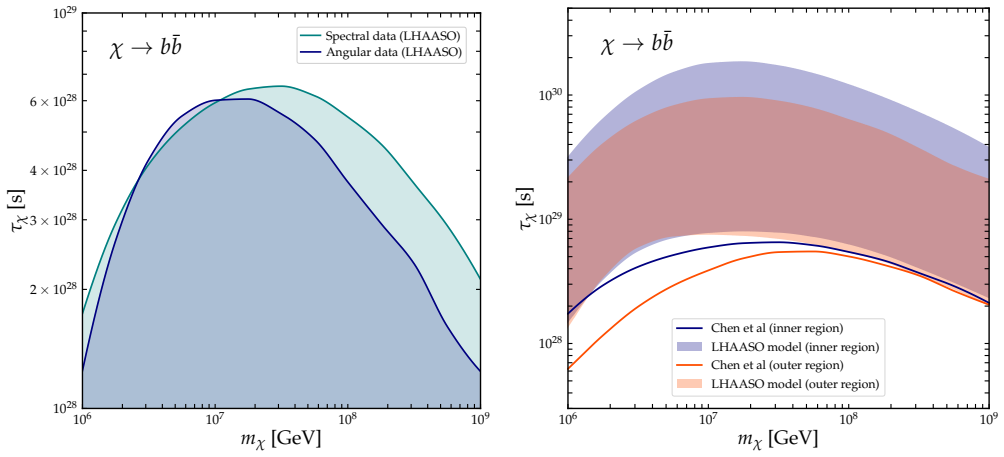
- [Section IV, Fig. 5 (right); Section III.B] The claim that the LHAASO-KM2A data give the most stringent constraints to date is conditional on the adopted diffuse background. The authors fix the Chen et al. [64] background, but Fig. 5 (right) shows that switching to the LHAASO 'naive' background changes the lifetime limits by up to a factor of about five. Since the previous combined limits in Figs. 1, 4, and 6 are only a factor of a few to ten above the new curves over much of the mass range, a factor-of-five background dependence can decide whether the new limits actually surpass the previous ones. Comparing two models is not an uncertainty budget for the true diffuse emission, and the statement that the benchmark model yields the most conservative bounds is relative only to those two choices. Please propagate this systematic into the quoted 95% limits (e.g., a bracketed envelope or nuisance parameters in Eq. (15)), or soften the
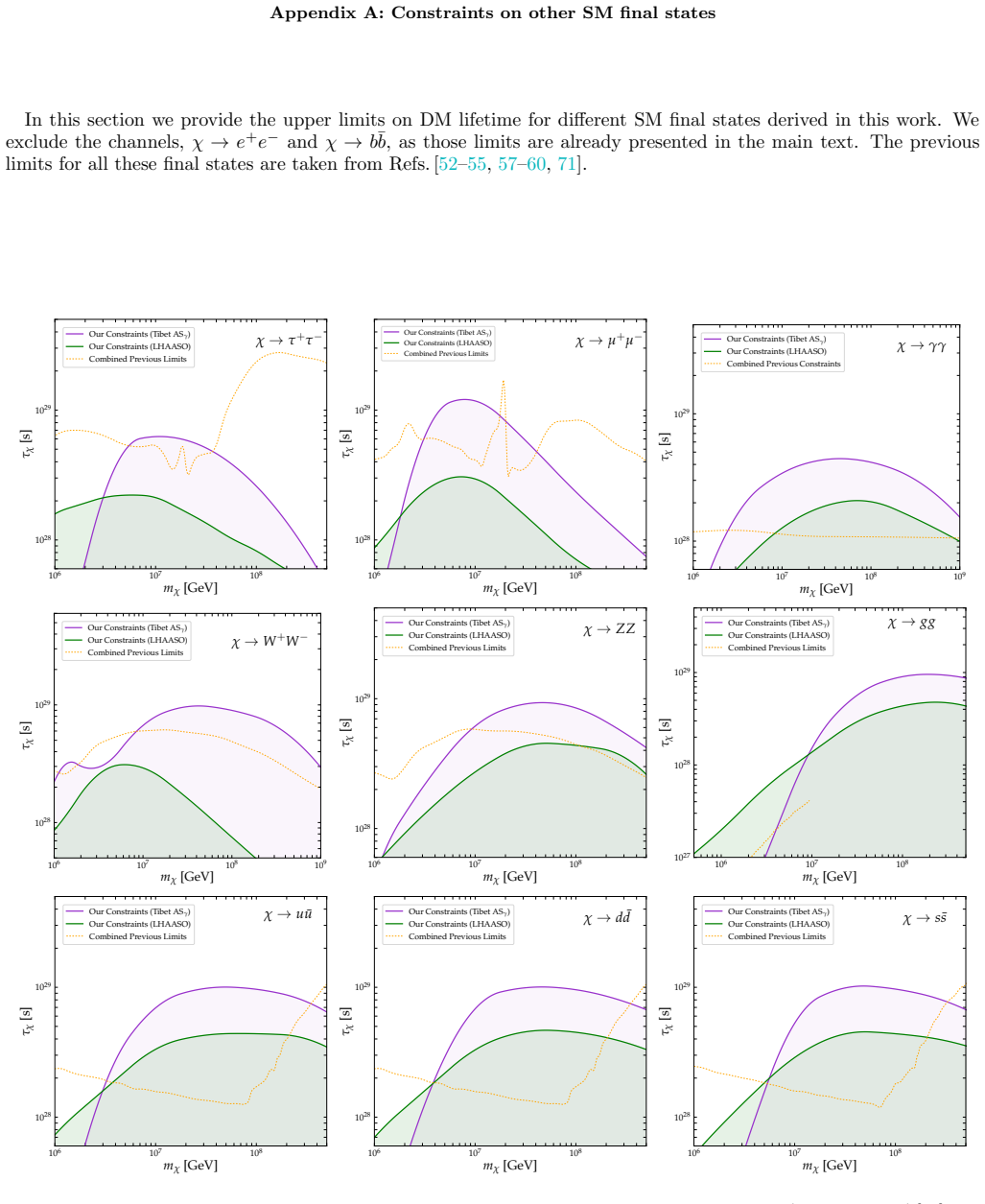
- [Section III.A, Eq. (14)] The Tibet ASgamma leg uses the criterion Phi_DM > Phi_UL in any energy bin, but the paper does not specify how the direction-dependent flux from Eq. (1) is averaged over the high-latitude region |b|>20 deg used by Ref. [51], nor which energy bins are adopted. The Neronov et al. limit already includes an exposure/mask, so the model flux must be convolved with the same sky region. Without this detail, the purple curves in Figs. 1, 4, and 6 are not reproducible. Since this is one of the two datasets supporting the headline claim, the region-averaging and binning should be stated explicitly.
minor comments (3)
- [Note added, Section V] The 'Note added' mentions a work by Boehm et al. but gives no reference or discussion. Either cite the work or remove the note.
- [Fig. 3 caption] The caption says 'the peak in the astrophysical model at around 80 deg latitude'; since the horizontal axis is Galactic longitude, this should be 'longitude'.
- [Section V] Typo: 'annhilation' should be 'annihilation'.
Circularity Check
No significant circularity; derivation is self-contained and the only self-citation is non-load-bearing.
full rationale
The paper's derivation chain is self-contained: gamma-ray spectra are taken from the external HDMSpectra code, astrophysical backgrounds are adopted from external models (Neronov et al. for Tibet, Chen et al. and the LHAASO 'naive' model for KM2A), and the DM flux is computed from standard line-of-sight integrals without fitting any parameter that is then renamed a prediction. The only self-citation, Ref. [76], appears in a list of previous limits used for comparison in Figs. 1, 4, and 6; it is not used to derive any new bound, so it is not load-bearing. The paper explicitly demonstrates the dependence of the LHAASO-KM2A limits on the background model in Fig. 5 (up to a factor of ~5) and adopts the more conservative choice, which is a model systematic rather than a circular reduction. No equation is defined in terms of the claimed result, and no known result is renamed as a new prediction.
Axiom & Free-Parameter Ledger
axioms (5)
- domain assumption NFW dark matter density profile with rs=20 kpc, rho_s=0.318 GeV/cm^3, R_sun=8.3 kpc
- domain assumption Diffusion halo function I_diff is effectively unity at multi-TeV electron energies
- domain assumption The Chen et al. [64] astrophysical background model correctly describes the LHAASO diffuse gamma-ray emission
- domain assumption Extragalactic electromagnetic cascades contribute negligibly above 10 TeV
- domain assumption 100% branching ratio into each individual Standard Model final state
Cite this review
Pith. "Pith review of Breaking Dark: Hunting Heavy Decaying Dark Matter with Tibet AS$_\gamma$ and LHAASO-KM2A." pith.science (2026). https://pith.science/paper/BAMBBCIP
@misc{pith2026250908039,
  author       = {Pith},
  title        = {Pith review of: Breaking Dark: Hunting Heavy Decaying Dark Matter with Tibet AS$_\gamma$ and LHAASO-KM2A},
  year         = {2026},
  howpublished = {\url{https://pith.science/paper/BAMBBCIP}},
  note         = {Machine review of arXiv:2509.08039}
}
abstract
Recent measurements of diffuse sub-PeV gamma-rays by the Tibet AS$_\gamma$ and LHAASO collaborations have reshaped our understanding of the gamma-ray sky. Besides uncovering the nature of `PeVatrons', these measurements can also be used to probe the non-gravitational nature of dark matter. PeV-scale decaying dark matter can produce high-energy gamma rays in the final state and contribute to the measurements made by extensive air-shower detectors like Tibet AS$_\gamma$ and LHAASO. Using the latest Tibet AS$_\gamma$ upper limits on diffuse gamma rays away from the Galactic plane and the LHAASO-KM2A measurements of diffuse gamma rays from the Galactic plane, we put stringent constraints on lifetimes of decaying DM for masses $\sim 10^6 - 10^9$ GeV. Future observations of high-energy diffuse gamma-ray emission can thus provide stronger limits or potentially discover heavy decaying dark matter.
Figures



Forward citations
Cited by 2 Pith papers
-
Too Heavy to Hide: Gamma-Ray Constraints on Annihilating Dark Matter beyond Unitarity
Gamma-ray upper limits from five high-energy observatories constrain the annihilation cross sections of composite dark matter in the mass range 10^5--10^12 GeV.
-
Constraints on Ultra-heavy DM from TeV-PeV gamma-ray diffuse measurements
HAWC and LHAASO diffuse gamma-ray data, modeled with prompt, inverse-Compton, absorption, and astrophysical background, produce the strongest constraints on decaying ultra-heavy dark matter above ~100 TeV.
Reference graph
Works this paper leans on
-
[1]
G. Bertone and D. Hooper,History of dark matter, Rev. Mod. Phys.90(2018) 045002, [1605.04909]
Pith/arXiv arXiv 2018
-
[2]
V. C. Rubin and W. K. Ford, Jr.,Rotation of the Andromeda Nebula from a Spectroscopic Survey of Emission Regions,Astrophys. J.159(1970) 379–403
1970
-
[3]
D. Clowe, M. Bradac, A. H. Gonzalez, M. Markevitch, S. W. Randall, C. Jones et al.,A direct empirical proof of the existence of dark matter,Astrophys. J. Lett.648 (2006) L109–L113, [astro-ph/0608407]. [4]Planckcollaboration, N. Aghanim et al.,Planck 2018 results. VI. Cosmological parameters,Astron. Astrophys.641(2020) A6, [1807.06209]
Pith/arXiv arXiv 2006
- [5]
-
[6]
L. E. Strigari,Galactic Searches for Dark Matter, Phys. Rept.531(2013) 1–88, [1211.7090]
Pith/arXiv arXiv 2013
-
[7]
M. Lisanti,Lectures on Dark Matter Physics, in Theoretical Advanced Study Institute in Elementary Particle Physics: New Frontiers in Fields and Strings, pp. 399–446, 2017.1603.03797. DOI
arXiv 2017
-
[8]
T. R. Slatyer,Indirect detection of dark matter., in Theoretical Advanced Study Institute in Elementary Particle Physics: Anticipating the Next Discoveries in Particle Physics, pp. 297–353, 2018.1710.05137. DOI
arXiv 2018
-
[9]
Lin,Dark matter models and direct detection,PoS 333(2019) 009, [1904.07915]
T. Lin,Dark matter models and direct detection,PoS 333(2019) 009, [1904.07915]
Pith/arXiv arXiv 2019
-
[10]
D. J. H. Chung, E. W. Kolb and A. Riotto,Superheavy dark matter,Phys. Rev. D59(1998) 023501, [hep-ph/9802238]
Pith/arXiv arXiv 1998
-
[11]
D. J. H. Chung, E. W. Kolb and A. Riotto,Production of massive particles during reheating,Phys. Rev. D60 (1999) 063504, [hep-ph/9809453]
Pith/arXiv arXiv 1999
-
[12]
G. F. Giudice, I. Tkachev and A. Riotto,Nonthermal production of dangerous relics in the early universe, JHEP08(1999) 009, [hep-ph/9907510]
Pith/arXiv arXiv 1999
-
[13]
D. J. H. Chung, E. W. Kolb and A. Riotto, Nonthermal supermassive dark matter,Phys. Rev. Lett.81(1998) 4048–4051, [hep-ph/9805473]
Pith/arXiv arXiv 1998
-
[14]
F. D. Steffen,Gravitino dark matter and cosmological constraints,JCAP09(2006) 001, [hep-ph/0605306]
Pith/arXiv arXiv 2006
-
[15]
K. Harigaya, M. Ibe and T. T. Yanagida,Lower Bound on the Garvitino Massm 3/2 > O(100)TeV in R-Symmetry Breaking New Inflation,Phys. Rev. D89 (2014) 055014, [1311.1898]
Pith/arXiv arXiv 2014
-
[16]
K. Harigaya, M. Kawasaki, K. Mukaida and M. Yamada,Dark Matter Production in Late Time Reheating,Phys. Rev. D89(2014) 083532, [1402.2846]
Pith/arXiv arXiv 2014
-
[17]
M. Garny, M. Sandora and M. S. Sloth,Planckian Interacting Massive Particles as Dark Matter,Phys. Rev. Lett.116(2016) 101302, [1511.03278]. 8
Pith/arXiv arXiv 2016
-
[18]
P. S. B. Dev, D. Kazanas, R. N. Mohapatra, V. L. Teplitz and Y. Zhang,Heavy right-handed neutrino dark matter and PeV neutrinos at IceCube,JCAP08 (2016) 034, [1606.04517]
Pith/arXiv arXiv 2016
-
[19]
A. Berlin, D. Hooper and G. Krnjaic,PeV-Scale Dark Matter as a Thermal Relic of a Decoupled Sector, Phys. Lett. B760(2016) 106–111, [1602.08490]
Pith/arXiv arXiv 2016
-
[20]
K. Harigaya, M. Ibe, K. Kaneta, W. Nakano and M. Suzuki,Thermal Relic Dark Matter Beyond the Unitarity Limit,JHEP08(2016) 151, [1606.00159]
Pith/arXiv arXiv 2016
-
[21]
E. Babichev, D. Gorbunov and S. Ramazanov,New mechanism of producing superheavy Dark Matter, Phys. Lett. B794(2019) 69–76, [1812.03516]
Pith/arXiv arXiv 2019
-
[22]
H. Kim and E. Kuflik,Superheavy Thermal Dark Matter,Phys. Rev. Lett.123(2019) 191801, [1906.00981]
Pith/arXiv arXiv 2019
-
[23]
E. Dudas, L. Heurtier, Y. Mambrini, K. A. Olive and M. Pierre,Model of metastable EeV dark matter,Phys. Rev. D101(2020) 115029, [2003.02846]
Pith/arXiv arXiv 2020
-
[24]
T. Hambye, M. Lucca and L. Vanderheyden,Dark matter as a heavy thermal hot relic,Phys. Lett. B807 (2020) 135553, [2003.04936]
Pith/arXiv arXiv 2020
-
[25]
Y. Mambrini, K. A. Olive and J. Zheng, Post-inflationary dark matter bremsstrahlung,JCAP 10(2022) 055, [2208.05859]
Pith/arXiv arXiv 2022
-
[26]
G. F. Giudice, H. M. Lee, A. Pomarol and B. Shakya, Nonthermal heavy dark matter from a first-order phase transition,JHEP12(2024) 190, [2403.03252]
Pith/arXiv arXiv 2024
-
[27]
Carney et al.,Snowmass2021 cosmic frontier white paper: Ultraheavy particle dark matter,SciPost Phys
D. Carney et al.,Snowmass2021 cosmic frontier white paper: Ultraheavy particle dark matter,SciPost Phys. Core6(2023) 075, [2203.06508]
Pith/arXiv arXiv 2023
-
[28]
O. Deligny,Constraints on superheavy dark matter decaying intohν,ZνandW ℓ– Benchmark example within an extended seesaw framework,2408.17111
-
[29]
I. V. Moskalenko, A. W. Strong and O. Reimer, Diffuse gamma-rays: Galactic and extragalactic diffuse emission,Astrophys. Space Sci. Libr.304(2004) 279, [astro-ph/0402243]
Pith/arXiv arXiv 2004
-
[30]
S. R. Kelner, F. A. Aharonian and V. V. Bugayov, Energy spectra of gamma-rays, electrons and neutrinos produced at proton-proton interactions in the very high energy regime,Phys. Rev. D74(2006) 034018, [astro-ph/0606058]
Pith/arXiv arXiv 2006
-
[31]
A. Kappes, J. Hinton, C. Stegmann and F. A. Aharonian,Potential Neutrino Signals from Galactic Gamma-Ray Sources,Astrophys. J.656(2007) 870–896, [astro-ph/0607286]
Pith/arXiv arXiv 2007
-
[32]
A. A. Abdo et al.,TeV Gamma-Ray Sources from a Survey of the Galactic Plane with Milagro,Astrophys. J. Lett.664(2007) L91–L94, [0705.0707]
Pith/arXiv arXiv 2007
-
[33]
C. D. Dermer and G. Menon,High Energy Radiation from Black Holes: Gamma Rays, Cosmic Rays, and Neutrinos. 2009
2009
-
[34]
N. Gupta,PeV gamma rays from interactions of ultra high energy cosmic rays in the Milky Way, Astroparticle Physics35(Mar., 2012) 503–507, [1110.5257]
Pith/arXiv arXiv 2012
-
[35]
P. Lipari and S. Vernetto,Diffuse Galactic gamma ray flux at very high energy,Phys. Rev. D98(2018) 043003, [1804.10116]
Pith/arXiv arXiv 2018
-
[36]
I. V. Moskalenko, T. A. Porter and A. W. Strong, Attenuation of vhe gamma rays by the milky way interstellar radiation field,Astrophys. J. Lett.640 (2006) L155–L158, [astro-ph/0511149]
Pith/arXiv arXiv 2006
-
[37]
T. C. Weekes, M. F. Cawley, D. J. Fegan, K. G. Gibbs, A. M. Hillas, P. W. Kowk et al.,Observation of TeV Gamma Rays from the Crab Nebula Using the Atmospheric Cerenkov Imaging Technique, ApJ342 (July, 1989) 379
1989
-
[38]
A. Capanema, A. Esmaili and P. D. Serpico,Where do IceCube neutrinos come from? Hints from the diffuse gamma-ray flux,JCAP02(2021) 037, [2007.07911]
Pith/arXiv arXiv 2021
-
[39]
T. M. Venters,Contribution to the Extragalactic Gamma-Ray Background from the Cascades of very High Energy Gamma Rays from Blazars, ApJ710 (Feb., 2010) 1530–1540, [1001.1363]
Pith/arXiv arXiv 2010
-
[40]
S. Vernetto and P. Lipari,Absorption of very high energy gamma rays in the Milky Way,Phys. Rev. D 94(2016) 063009, [1608.01587]
Pith/arXiv arXiv 2016
-
[41]
A. De Angelis, G. Galanti and M. Roncadelli, Transparency of the Universe to gamma rays,Mon. Not. Roy. Astron. Soc.432(2013) 3245–3249, [1302.6460]
Pith/arXiv arXiv 2013
-
[42]
R. Ruffini, G. V. Vereshchagin and S. S. Xue,Cosmic absorption of ultra high energy particles,Astrophys. Space Sci.361(2016) 82, [1503.07749]
Pith/arXiv arXiv 2016
-
[43]
T. Sudoh and J. F. Beacom,Where are Milky Way’s hadronic PeVatrons?,Phys. Rev. D107(2023) 043002, [2209.03970]
Pith/arXiv arXiv 2023
-
[44]
F. W. Stecker,Cosmic gamma rays, vol. 249. 1971
1971
-
[45]
D. Bose, V. R. Chitnis, P. Majumdar and A. Shukla, Galactic and extragalactic sources of very high energy gamma rays,Eur. Phys. J. ST231(2022) 27–66, [2201.06789]
Pith/arXiv arXiv 2022
-
[46]
M. Cardillo and A. Giuliani,The LHAASO PeVatron Bright Sky: What We Learned,Appl. Sciences13 (2023) 6433, [2305.10526]
Pith/arXiv arXiv 2023
-
[47]
P. Lipari and S. Vernetto,Resolved and unresolved Galactic gamma-ray sources,Phys. Rev. D111(2025) 063035, [2412.08861]
Pith/arXiv arXiv 2025
-
[48]
D. Ehlert, A. van Vliet, F. Oikonomou and W. Winter, Constraints on the proton fraction of cosmic rays at the highest energies and the consequences for cosmogenic neutrinos and photons,JCAP02(2024) 022, [2304.07321]. [49]Tibet ASgammacollaboration, M. Amenomori et al., First Detection of sub-PeV Diffuse Gamma Rays from the Galactic Disk: Evidence for Ubiq...
Pith/arXiv arXiv 2024
-
[51]
A. Neronov, D. Semikoz and I. Vovk,New limit on high Galactic latitude PeVγ-ray flux from Tibet ASγ data,Astron. Astrophys.653(2021) L4, [2107.06541]
Pith/arXiv arXiv 2021
-
[52]
A. Esmaili, S. K. Kang and P. D. Serpico,IceCube events and decaying dark matter: hints and constraints,JCAP12(2014) 054, [1410.5979]
Pith/arXiv arXiv 2014
-
[53]
T. Cohen, K. Murase, N. L. Rodd, B. R. Safdi and Y. Soreq,γ-ray Constraints on Decaying Dark Matter and Implications for IceCube,Phys. Rev. Lett.119 (2017) 021102, [1612.05638]
Pith/arXiv arXiv 2017
-
[54]
C. Blanco and D. Hooper,Constraints on Decaying Dark Matter from the Isotropic Gamma-Ray Background,JCAP03(2019) 019, [1811.05988]. 9 [55]IceCubecollaboration, M. G. Aartsen et al.,Search for neutrinos from decaying dark matter with IceCube, Eur. Phys. J. C78(2018) 831, [1804.03848]
Pith/arXiv arXiv 2019
-
[56]
A. Bhattacharya, A. Esmaili, S. Palomares-Ruiz and I. Sarcevic,Update on decaying and annihilating heavy dark matter with the 6-year IceCube HESE data, JCAP05(2019) 051, [1903.12623]
Pith/arXiv arXiv 2019
-
[57]
K. Ishiwata, O. Macias, S. Ando and M. Arimoto, Probing heavy dark matter decays with multi-messenger astrophysical data,JCAP01(2020) 003, [1907.11671]
Pith/arXiv arXiv 2020
-
[58]
M. Chianese, D. F. G. Fiorillo, G. Miele, S. Morisi and O. Pisanti,Decaying dark matter at IceCube and its signature on High Energy gamma experiments,JCAP 11(2019) 046, [1907.11222]. [59]LHAASOcollaboration, Z. Cao et al.,Constraints on Heavy Decaying Dark Matter from 570 Days of LHAASO Observations,Phys. Rev. Lett.129(2022) 261103, [2210.15989]. [60]LHAA...
Pith/arXiv arXiv 2019
-
[61]
M. Cirelli, G. Corcella, A. Hektor, G. Hutsi, M. Kadastik, P. Panci et al.,PPPC 4 DM ID: A Poor Particle Physicist Cookbook for Dark Matter Indirect Detection,JCAP03(2011) 051, [1012.4515]
Pith/arXiv arXiv 2011
-
[62]
C. W. Bauer, N. L. Rodd and B. R. Webber,Dark matter spectra from the electroweak to the Planck scale, JHEP06(2021) 121, [2007.15001]
Pith/arXiv arXiv 2021
-
[63]
C. Arina, M. Di Mauro, N. Fornengo, J. Heisig, A. Jueid and R. R. de Austri,CosmiXs: cosmic messenger spectra for indirect dark matter searches, JCAP03(2024) 035, [2312.01153]
Pith/arXiv arXiv 2024
-
[64]
E.-S. Chen, K. Fang and X.-J. Bi,A new perspective on the diffuse gamma-ray emission excess*,Chin. Phys. C48(2024) 115105, [2407.15474]
Pith/arXiv arXiv 2024
-
[65]
K. Ishiwata, S. Matsumoto and T. Moroi,High Energy Cosmic Rays from the Decay of Gravitino Dark Matter,Phys. Rev. D78(2008) 063505, [0805.1133]
Pith/arXiv arXiv 2008
-
[66]
K. Murase and J. F. Beacom,Constraining Very Heavy Dark Matter Using Diffuse Backgrounds of Neutrinos and Cascaded Gamma Rays,JCAP10 (2012) 043, [1206.2595]
Pith/arXiv arXiv 2012
-
[67]
K. Murase, R. Laha, S. Ando and M. Ahlers,Testing the Dark Matter Scenario for PeV Neutrinos Observed in IceCube,Phys. Rev. Lett.115(2015) 071301, [1503.04663]
Pith/arXiv arXiv 2015
-
[68]
A. Esmaili and P. D. Serpico,Gamma-ray bounds from EAS detectors and heavy decaying dark matter constraints,JCAP10(2015) 014, [1505.06486]
Pith/arXiv arXiv 2015
-
[69]
O. K. Kalashev and M. Y. Kuznetsov,Constraining heavy decaying dark matter with the high energy gamma-ray limits,Phys. Rev. D94(2016) 063535, [1606.07354]
Pith/arXiv arXiv 2016
-
[70]
O. E. Kalashev and M. Y. Kuznetsov,Heavy decaying dark matter and large-scale anisotropy of high-energy cosmic rays,JETP Lett.106(2017) 73–80, [1704.05300]
Pith/arXiv arXiv 2017
-
[71]
M. Kachelriess, O. E. Kalashev and M. Y. Kuznetsov, Heavy decaying dark matter and IceCube high energy neutrinos,Phys. Rev. D98(2018) 083016, [1805.04500]
Pith/arXiv arXiv 2018
-
[72]
E. Alcantara, L. A. Anchordoqui and J. F. Soriano, Hunting for superheavy dark matter with the highest-energy cosmic rays,Phys. Rev. D99(2019) 103016, [1903.05429]
Pith/arXiv arXiv 2019
-
[73]
O. E. Kalashev, M. Y. Kuznetsov and Y. V. Zhezher, Dark matter component decaying after recombination: constraints from diffuse gamma-ray and neutrino flux measurements,JCAP10(2019) 039, [1905.05170]
Pith/arXiv arXiv 2019
-
[74]
M. Y. Kuznetsov,Hadronically decaying heavy dark matter and high-energy neutrino limits,JETP Lett. 105(2017) 561–567, [1611.08684]
Pith/arXiv arXiv 2017
-
[75]
Y. Sui and P. S. Bhupal Dev,A Combined Astrophysical and Dark Matter Interpretation of the IceCube HESE and Throughgoing Muon Events,JCAP 07(2018) 020, [1804.04919]
Pith/arXiv arXiv 2018
-
[76]
T. N. Maity, A. K. Saha, A. Dubey and R. Laha, Search for dark matter using sub-PeVγ-rays observed by Tibet ASγ,2105.05680
-
[77]
L. A. Anchordoqui et al.,Hunting super-heavy dark matter with ultra-high energy photons,Astropart. Phys. 132(2021) 102614, [2105.12895]
Pith/arXiv arXiv 2021
-
[78]
A. Esmaili and P. D. Serpico,First implications of Tibet ASγdata for heavy dark matter,Phys. Rev. D 104(2021) L021301, [2105.01826]
Pith/arXiv arXiv 2021
-
[79]
M. Chianese, D. F. G. Fiorillo, R. Hajjar, G. Miele and N. Saviano,Constraints on heavy decaying dark matter with current gamma-ray measurements,JCAP 11(2021) 035, [2108.01678]. [80]IceCubecollaboration, R. Abbasi et al.,Searches for connections between dark matter and high-energy neutrinos with IceCube,JCAP10(2023) 003, [2205.12950]
Pith/arXiv arXiv 2021
-
[81]
C. A. Arg¨ uelles, D. Delgado, A. Friedlander, A. Kheirandish, I. Safa, A. C. Vincent et al.,Dark matter decay to neutrinos,Phys. Rev. D108(2023) 123021, [2210.01303]
Pith/arXiv arXiv 2023
-
[82]
T. Aramaki et al.,Snowmass2021 Cosmic Frontier: The landscape of cosmic-ray and high-energy photon probes of particle dark matter,2203.06894
-
[83]
B. Skrzypek, M. Chianese, C. A. Arg¨ uelles and C. Delgado Arg¨ uelles,Multi-messenger high-energy signatures of decaying dark matter and the effect of background light,JCAP01(2023) 037, [2205.03416]
Pith/arXiv arXiv 2023
-
[84]
T. Hambye, M. Hufnagel and M. Lucca,Cosmological constraints on the decay of heavy relics into neutrinos, JCAP05(2022) 033, [2112.09137]
Pith/arXiv arXiv 2022
-
[85]
R. Allahverdi, C. Arina, M. Chianese, M. Cicoli, F. Maltoni, D. Massaro et al.,Phenomenology of superheavy decaying dark matter from string theory, JHEP02(2024) 192, [2312.00136]. [86]IceCubecollaboration, R. Abbasi et al.,Search for Dark Matter Decay in Nearby Galaxy Clusters and Galaxies with IceCube,PoSICRC2023(2023) 1378, [2308.04833]. [87]Pierre Auge...
Pith/arXiv arXiv 2024
-
[89]
P. Sarmah, N. Das, D. Borah, S. Chakraborty and P. Mehta,Constraining the superheavy dark matter origin of ultrahigh-energy cosmic rays with the 10 Amaterasu event,Phys. Rev. D111(2025) 083048, [2406.03174]
Pith/arXiv arXiv 2025
-
[90]
S. Das, J. A. Carpio and K. Murase,Probing superheavy dark matter through lunar radio observations of ultrahigh-energy neutrinos and the impacts of neutrino cascades,Phys. Rev. D111(2025) 083007, [2405.06382]
Pith/arXiv arXiv 2025
This paper was first reviewed by deepseek-v4-flash on August 4, 2026.
discussion (0)
Sign in with ORCID, Apple, or X to comment. Anyone can read and Pith papers without signing in.