REVIEW 1 major objections 54 references
Magnetic obstacle signatures appear in ICMEs only when the flux rope axial field is not tightly confined by its own magnetic tension.
Reviewed by Pith at T0; open to challenge. T0 means a machine referee read the full paper against a public rubric. the ladder, T0–T4 →
T0 review · grok-4.3
2026-06-27 20:52 UTC pith:BB6M6HSX
load-bearing objection The 2.5D runs tie MO signatures to weak initial axial confinement by tension, but the dimensionality choice undercuts how general that 'only when... disappear otherwise' claim can be. the 1 major comments →
Radial and angular evolution of magnetic cloud signatures in the turbulent solar wind: virtual spacecraft analysis
The pith
A machine-rendered reading of the paper's core claim, the machinery that carries it, and where it could break.
Core claim
High-resolution 2.5D MHD simulations of an embedded flux rope reproduce clear and stable MC signatures when virtual spacecraft intercept the core. Disordered MO signatures appear at the edges and are produced by expansion plus turbulent transport. The pace of the expanding flow sets the angular width of observable MC signatures, while turbulence intensity controls asymmetry and distortion at 1 AU. MO signatures are possible only when the axial flux rope field is not well confined by the rope's magnetic tension; they disappear when the field is tightly confined.
What carries the argument
The 2.5D MHD expanding-box model of a flux-rope cross-section, sampled by virtual spacecraft, which tracks how expansion and turbulence interact with the rope's initial magnetic tension to produce or suppress observable signatures.
Load-bearing premise
The chosen 2.5D MHD expanding-box setup with its initial flux-rope and turbulence parameters adequately captures the three-dimensional radial and angular evolution of real ICMEs at 1 AU.
What would settle it
Detection of MO signatures inside a flux rope whose axial field is shown to be strongly confined by magnetic tension, or complete absence of MO signatures when the axial field is demonstrably not confined.
If this is right
- Spacecraft paths through the flux-rope core produce clear MC signatures while edge paths produce disordered MO signatures.
- Faster expansion widens the angular region where MC signatures remain coherent.
- Stronger turbulence increases the asymmetry and distortion seen at 1 AU.
- Encounter geometry alone can decide whether an observer records an MC or an MO interval.
- The rope's early magnetic configuration sets whether any MO signatures can appear at all.
Where Pith is reading between the lines
- Multi-spacecraft observations that measure both magnetic tension and the presence of MO intervals could test whether initial confinement controls signature type without new formation physics.
- If real ICMEs start with a range of tension strengths, the model predicts a corresponding range in the fraction of encounters that show MO rather than MC intervals.
- Separating radial expansion effects from angular turbulence effects in data might be possible by comparing how signature coherence changes with distance versus with impact parameter.
- Extending the model to full 3D could show whether out-of-plane motions reduce the angular coherence further than the 2.5D runs indicate.
Editorial analysis
A structured set of objections, weighed in public.
Referee Report
Summary. The paper uses high-resolution 2.5D MHD simulations of a flux-rope cross-section embedded in turbulent, expanding solar wind via the expanding-box model. Virtual spacecraft probes show that MC signatures appear in the rope core while disordered MO signatures arise at the edges due to expansion and turbulent transport. Parameter variations indicate that expansion pace controls the angular extent of MC signatures, turbulence intensity controls asymmetry and distortion at 1 AU, and encounter geometry determines MC vs. MO observation. The central claim is that a magnetic structure capable of producing MO signatures is controlled by the initial/early flux-rope configuration: MO signatures appear only when the axial field is spatially not well confined by the rope's own magnetic tension and disappear otherwise.
Significance. If the results hold, the work links observed MC/MO variability in ICMEs at 1 AU to a small set of controllable physical parameters (expansion rate, turbulence level, initial axial confinement) through forward simulation, offering a mechanistic explanation for why some spacecraft encounters yield smooth rotation while others yield disordered fields. The approach of embedding an isolated flux rope in a turbulent expanding medium and sampling with virtual spacecraft is a clear strength.
major comments (1)
- [Abstract / simulation setup] Abstract and simulation-setup paragraph: the claim that MO signatures 'can only be observed when the axial flux rope field is spatially not well confined by the rope's own magnetic tension, and disappear otherwise' is load-bearing for the paper's strongest conclusion, yet it rests entirely on a fixed 2.5D expanding-box framework with three varied parameters. The 2.5D assumption enforces invariance along one coordinate and therefore cannot capture fully three-dimensional turbulent cascades, kink or interchange instabilities, or angular distortions that might generate MO-like disorder even in tension-confined cases. No 3D comparison runs or explicit discussion of this limitation are provided, so the generality of the 'only when... disappear otherwise' statement does not follow from the reported experiments.
Simulated Author's Rebuttal
We thank the referee for the constructive review and for highlighting the importance of qualifying the scope of our conclusions. We address the single major comment below.
read point-by-point responses
-
Referee: [Abstract / simulation setup] Abstract and simulation-setup paragraph: the claim that MO signatures 'can only be observed when the axial flux rope field is spatially not well confined by the rope's own magnetic tension, and disappear otherwise' is load-bearing for the paper's strongest conclusion, yet it rests entirely on a fixed 2.5D expanding-box framework with three varied parameters. The 2.5D assumption enforces invariance along one coordinate and therefore cannot capture fully three-dimensional turbulent cascades, kink or interchange instabilities, or angular distortions that might generate MO-like disorder even in tension-confined cases. No 3D comparison runs or explicit discussion of this limitation are provided, so the generality of the 'only when... disappear otherwise' statement does not follow from the reported experiments.
Authors: We agree that the 2.5D framework is a genuine limitation and that the strong phrasing in the abstract requires qualification. The expanding-box approach in 2.5D was chosen to achieve the necessary resolution to capture the turbulent cascade and expansion effects in the plane perpendicular to the rope axis; equivalent 3D runs at the same resolution remain computationally prohibitive. We will revise the abstract to read 'in our 2.5D simulations, MO signatures appear only when the axial flux rope field is spatially not well confined...' and will add an explicit limitations paragraph in the discussion section that acknowledges the absence of kink/interchange instabilities and full 3D turbulent cascades. This revision will make clear that the reported 'only when... disappear otherwise' result is demonstrated within the 2.5D parameter space explored. revision: yes
Circularity Check
No circularity: forward simulation outcomes independent of inputs by construction
full rationale
The paper runs explicit 2.5D MHD expanding-box simulations, varies a small set of initial flux-rope and turbulence parameters, and records virtual-spacecraft signatures. The central claim (MO signatures appear only when axial field is not tension-confined) is reported as an observed simulation result, not derived by re-expressing the input parameters or by any self-citation chain. No equations, fitted quantities, or uniqueness theorems reduce the reported outcomes to the setup by definition. The dimensionality choice is stated as a modeling assumption but does not create a tautological mapping from inputs to conclusions.
Axiom & Free-Parameter Ledger
free parameters (3)
- expansion pace
- turbulence intensity
- initial axial-field confinement
axioms (2)
- domain assumption The expanding box model accurately captures the radial expansion and embedded turbulence of the solar wind at 1 AU
- domain assumption 2.5D MHD is sufficient to study the cross-sectional evolution and angular coherence of the flux rope
read the original abstract
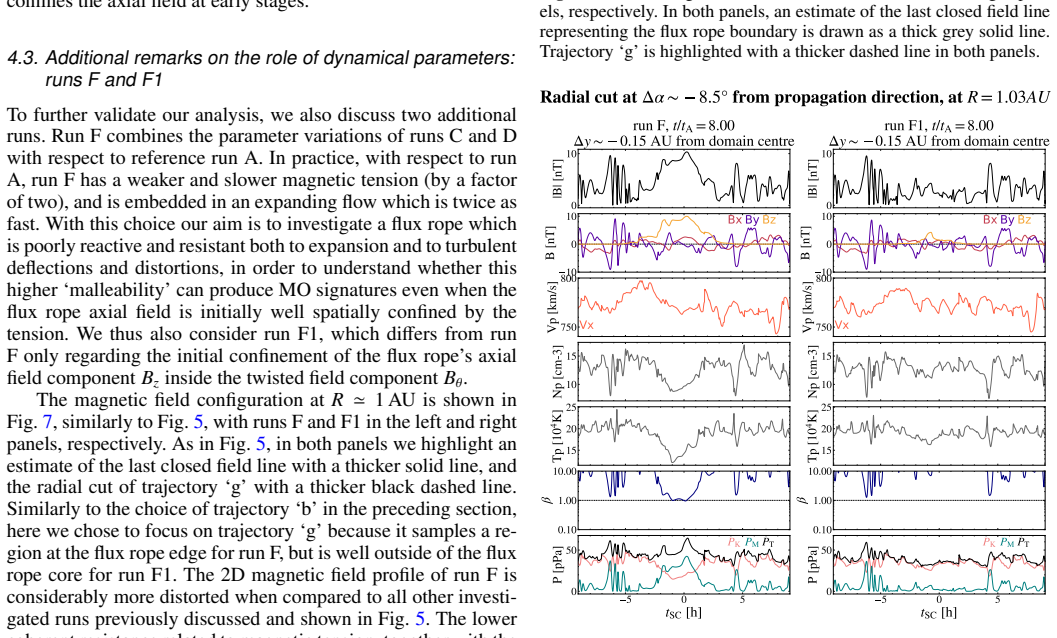
Interplanetary coronal mass ejections (ICMEs) carry magnetic clouds (MCs), large-scale structures with average radial widths about a fifth of an astronomical unit at Earth's orbit. ICMEs display substructures in white light images and reveal rich dynamics across many spatial scales when directly measured by spacecraft. A spacecraft encounter with an ICME can result in smoothly rotating MC intervals or less organised magnetic obstacle (MO) ones. We investigate how the interplay of expansion, turbulence, and internal cloud dynamics affects magnetic cloud properties, which are reflected in the plasma signatures measured by spacecraft. We perform high-resolution 2.5D MHD simulations of a magnetic flux rope cross-section, which is embedded in the turbulent, expanding solar wind with the expanding box model. We probe the local plasma properties, and thus the flux rope signatures and angular coherence, with virtual spacecraft. Our simulations reproduce clear and stable MC signatures when the flux rope core is intercepted by virtual spacecraft. Disordered MO signatures appear at the edges of the flux rope, and are attributed to both expansion and turbulent transport. We vary some key physical parameters of the flux rope and the environment to understand their effect on the observed coherence and signatures. The pace of the expanding flow controls the angular extent of MC signatures, whereas the intensity of interplanetary turbulence controls how asymmetric and distorted the flux rope appears at 1 AU. The geometry of spacecraft encounters determines whether MC or MO signatures are observed. The presence of a magnetic structure which can result in MO signatures is strongly controlled by the flux rope's initial/early magnetic configuration: MO signatures can only be observed when the axial flux rope field is spatially not well confined by the rope's own magnetic tension, and disappear otherwise.
Figures


Reference graph
Works this paper leans on
-
[1]
& Lugaz, N
Al-Haddad, N. & Lugaz, N. 2025, Space Sci. Rev., 221, 12
2025
-
[2]
Ala-Lahti, M., Ruohotie, J., Good, S., Kilpua, E. K. J., & Lugaz, N. 2020, Journal of Geophysical Research (Space Physics), 125, e2020JA028002
2020
-
[3]
2021, A&A, 652, A27
Asvestari, E., Pomoell, J., Kilpua, E., et al. 2021, A&A, 652, A27
2021
-
[4]
& Schwenn, R
Bothmer, V . & Schwenn, R. 1998, Annales Geophysicae, 16, 1
1998
-
[5]
Burlaga, L., Sittler, E., Mariani, F., & Schwenn, R. 1981, J. Geophys. Res., 86, 6673
1981
-
[6]
F., Klein, L., Sheeley, N
Burlaga, L. F., Klein, L., Sheeley, N. R., J., et al. 1982, Geophys. Res. Lett., 9, 1317
1982
-
[7]
F., Plunkett, S
Burlaga, L. F., Plunkett, S. P., & St. Cyr, O. C. 2002, Journal of Geophysical Research (Space Physics), 107, 1266
2002
-
[8]
F., Skoug, R
Burlaga, L. F., Skoug, R. M., Smith, C. W., et al. 2001, J. Geophys. Res., 106, 20957
2001
-
[9]
V ., Richardson, I
Cane, H. V ., Richardson, I. G., & Wibberenz, G. 1997, J. Geophys. Res., 102, 7075
1997
-
[10]
M., Temmer, M., V ourlidas, A., et al
Cappello, G. M., Temmer, M., V ourlidas, A., et al. 2024, A&A, 688, A162
2024
-
[11]
Chen, J. 1996, J. Geophys. Res., 101, 27499
1996
-
[12]
2017, Physics of Plasmas, 24, 090501 Cicalò, S., Alessi, E
Chen, J. 2017, Physics of Plasmas, 24, 090501 Cicalò, S., Alessi, E. M., Provinciali, L., et al. 2025, Ap&SS, 370, 83
2017
-
[13]
E., Forsyth, R
Davies, E. E., Forsyth, R. J., Good, S. W., & Kilpua, E. K. J. 2020, Sol. Phys., 295, 157 Démoulin, P. & Dasso, S. 2009, A&A, 498, 551
2020
-
[14]
W., Rantala, O
Good, S. W., Rantala, O. K., Jylhä, A. S. M., et al. 2023, ApJ, 956, L30
2023
-
[15]
2022, Atmosphere, 13, 1781
Gopalswamy, N. 2022, Atmosphere, 13, 1781
2022
-
[16]
Gosling, J. T. 1990, Washington DC American Geophysical Union Geophysical Monograph Series, 58, 343
1990
-
[17]
& Velli, M
Grappin, R. & Velli, M. 1996, J. Geophys. Res., 101, 425
1996
-
[18]
1993, Phys
Grappin, R., Velli, M., & Mangeney, A. 1993, Phys. Rev. Lett., 70, 2190
1993
-
[19]
M., Török, T., Vršnak, B., Manchester, W., & Veronig, A
Green, L. M., Török, T., Vršnak, B., Manchester, W., & Veronig, A. 2018, Space Sci. Rev., 214, 46
2018
-
[20]
C., V ourlidas, A., Howard, R
Hess, P., Colaninno, R. C., V ourlidas, A., Howard, R. A., & Stenborg, G. 2023, A&A, 679, A149
2023
-
[21]
Huttunen, K. E. J., Schwenn, R., Bothmer, V ., & Koskinen, H. E. J. 2005, An- nales Geophysicae, 23, 625
2005
-
[22]
T., Luhmann, J
Jian, L., Russell, C. T., Luhmann, J. G., & Skoug, R. M. 2006, Sol. Phys., 239, 393
2006
-
[23]
K., Russell, C
Jian, L. K., Russell, C. T., & Luhmann, J. G. 2011, Sol. Phys., 274, 321
2011
-
[24]
K., Russell, C
Jian, L. K., Russell, C. T., Luhmann, J. G., Skoug, R. M., & Steinberg, J. T. 2008, Sol. Phys., 249, 85
2008
-
[25]
Kilpua, E., Koskinen, H. E. J., & Pulkkinen, T. I. 2017, Living Reviews in Solar Physics, 14, 5
2017
-
[26]
Kilpua, E. K. J., Jian, L. K., Li, Y ., Luhmann, J. G., & Russell, C. T. 2011, Journal of Atmospheric and Solar-Terrestrial Physics, 73, 1228
2011
-
[27]
Kilpua, E. K. J., Liewer, P. C., Farrugia, C., et al. 2009, Sol. Phys., 254, 325
2009
-
[28]
J., Smith, C
Leamon, R. J., Smith, C. W., & Ness, N. F. 1998, Geophys. Res. Lett., 25, 2505
1998
-
[29]
P., Wu, C.-C., & Berdichevsky, D
Lepping, R. P., Wu, C.-C., & Berdichevsky, D. B. 2005, Annales Geophysicae, 23, 2687
2005
-
[30]
P., Wu, C
Lepping, R. P., Wu, C. C., Berdichevsky, D. B., & Ferguson, T. 2008, Annales Geophysicae, 26, 1919
2008
-
[31]
J., Winslow, R
Lugaz, N., Farrugia, C. J., Winslow, R. M., et al. 2018, ApJ, 864, L7
2018
-
[32]
Manchester, W., Kilpua, E. K. J., Liu, Y . D., et al. 2017, Space Sci. Rev., 212, 1159
2017
-
[33]
T., Anderson, B
Mulligan, T., Russell, C. T., Anderson, B. J., et al. 1999, J. Geophys. Res., 104, 28217
1999
-
[34]
& Goldstein, R
Neugebauer, M. & Goldstein, R. 1997, Geophysical Monograph Series, 99, 245
1997
-
[35]
C., et al
Nieves-Chinchilla, T., V ourlidas, A., Raymond, J. C., et al. 2018, Sol. Phys., 293, 25
2018
-
[36]
Owens, M. J. 2020, Sol. Phys., 295, 148
2020
-
[37]
J., Lockwood, M., & Barnard, L
Owens, M. J., Lockwood, M., & Barnard, L. A. 2017, Scientific Reports, 7, 4152
2017
-
[38]
2018, ApJ, 865, 4
Pal, S., Nandy, D., Srivastava, N., Gopalswamy, N., & Panda, S. 2018, ApJ, 865, 4
2018
-
[39]
Y ., et al
Palmerio, E., Carcaboso, F., Khoo, L. Y ., et al. 2024, ApJ, 963, 108
2024
-
[40]
2024, A&A, 686, A116
Pezzi, O., Trotta, D., Benella, S., et al. 2024, A&A, 686, A116
2024
-
[41]
2007, Living Reviews in Solar Physics, 4, 1
Pulkkinen, T. 2007, Living Reviews in Solar Physics, 4, 1
2007
-
[42]
F., Velli, M., Einaudi, G., & Dahlburg, R
Rappazzo, A. F., Velli, M., Einaudi, G., & Dahlburg, R. B. 2005, ApJ, 633, 474
2005
-
[43]
2024, ApJ, 962, 190
Regnault, F., Al-Haddad, N., Lugaz, N., et al. 2024, ApJ, 962, 190
2024
-
[44]
Richardson, I. G. & Cane, H. V . 2004, Geophys. Res. Lett., 31, L18804
2004
-
[45]
G., Cliver, E
Richardson, I. G., Cliver, E. W., & Cane, H. V . 2001, Geophys. Res. Lett., 28, 2569
2001
-
[46]
2025, A&A, 699, A258
Sangalli, M., Verdini, A., Landi, S., & Papini, E. 2025, A&A, 699, A258
2025
-
[47]
M., Lugaz, N., & Poedts, S
Scolini, C., Winslow, R. M., Lugaz, N., & Poedts, S. 2023, ApJ, 944, 46
2023
-
[48]
P., & Telloni, D
Sorriso-Valvo, L., Yordanova, E., Dimmock, A. P., & Telloni, D. 2021, ApJ, 919, L30
2021
-
[49]
1992, Annales Geophysicae, 10, 344
Vrsnak, B. 1992, Annales Geophysicae, 10, 344
1992
-
[50]
2018, Journal of Geophysical Research (Space Physics), 123, 3238
Wang, Y ., Shen, C., Liu, R., et al. 2018, Journal of Geophysical Research (Space Physics), 123, 3238
2018
-
[51]
F., Cliver, E
Webb, D. F., Cliver, E. W., Crooker, N. U., Cry, O. C. S., & Thompson, B. J. 2000, J. Geophys. Res., 105, 7491
2000
-
[52]
Webb, D. F. & Howard, T. A. 2012, Living Reviews in Solar Physics, 9, 3
2012
-
[53]
J., Nieves-Chinchilla, T., & Möstl, C
Weiss, A. J., Nieves-Chinchilla, T., & Möstl, C. 2024, ApJ, 975, 169
2024
-
[54]
Zurbuchen, T. H. & Richardson, I. G. 2006, in Coronal Mass Ejections, ed. H. Kunow, N. U. Crooker, J. A. Linker, R. Schwenn, & R. von Steiger, V ol. 21, 31 Article number, page 12 of 12
2006
discussion (0)
Sign in with ORCID, Apple, or X to comment. Anyone can read and Pith papers without signing in.