REVIEW 4 major objections 5 minor 31 references
CertBind from Multimodal Connectivity to Certifiable Retrieval Decisions
T0 review · 4 major / 5 minor · reviewed 2026-08-10 · deepseek-v4-flash
Pith's one-line read CertBind claims that a retrieval decision through a composed connector graph can be certified when the recovered top-k margin exceeds twice a conformally calibrated radius, with a user-declared error bound.
desk verdict Sound multiscale certificate chain with a needed semantic fix: Eq. (22) is a marginal bound, not a per-output guarantee. read the letter →
The pith
A machine-rendered reading of the paper's core claim, the machinery that carries it, and where it could break.
The reading
What carries the argument
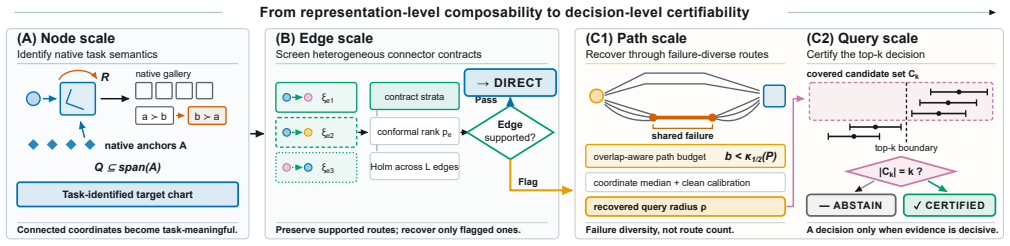
The load-bearing objects are: native anchors $A$ that fix the target gauge, with task identification iff their columns span the query or gallery span; contract-stratified conformal ranks $p_e$ with Holm step-down control for graph-wide edge screening; the path-transversal number $\kappa_{1/2}(P)$ — the minimum number of corrupted edges needed to contaminate half the declared route family — which the corruption budget must stay below; and the covered top-$k$ candidate set $C_k$ built from the conformal radius $\rho$, with $|C_k| = k$ iff the observed boundary gap $\hat{\gamma}_k$ exceeds $2\rho$. Theorem 3 is the hinge: on the conformal coverage event, the certified top-$k$ equals the clean native top-$k$, so a certified error can only occur when coverage fails, giving $P(\mathrm{Certified} \cap \{\hat{S}_k \neq S^*_k\}) \le \delta_p$.
What would settle it
A concrete adversarial test: collect a native retrieval workload with clean targets, run CertBind with declared budget $b$, then corrupt exactly $b$ edges that lie on at least half the routes and see whether the certified top-$k$ error frequency exceeds the declared $\delta_p$ or the recovered output leaves the $\rho$-ball. If it does, the path-budget or exchangeability assumption is violated.
Extended reading notes
Core claim
The central discovery is a finite-sample certificate for retrieval decisions made through composed connector graphs. Under the stated conditions—an edge-corruption budget $b$ below the half-contamination number $\kappa_{1/2}(P)$, exchangeable clean-path residuals, and a gallery of unit-norm vectors—the coordinate-median recovered output $\hat{y}$ lies within radius $\rho = \sqrt{d}\,\hat{\varepsilon}_{\delta_p}$ of the clean native target $y^*$ with probability at least $1-\delta_p$. This radius yields a covered top-$k$ candidate set $C_k$ with $P(S^*_k \subseteq C_k) \ge 1-\delta_p$. The paper proves the equivalence $|C_k| = k \iff \hat{\gamma}_k > 2\rho$, and therefore that a Certified output (a point top-$k$ of size $k$) differs from the clean native top-$k$ with probability at most $\delta_p$. At the node scale, it establishes that native task scores are identifiable iff $\mathrm{rank}(A) = r$ in the universal case, with registered-query error bounded by $\delta_A = \lVert E \rVert_{\mathrm{op}}/\sigma_r(A)$, so anchor conditioning, not just anchor count, controls identification accuracy.
Load-bearing premise
The guarantee collapses if future clean-path residuals are not exchangeable with the calibration split, or if the operator does not actually know a corruption budget $b$ below $\kappa_{1/2}(P)$; the paper demonstrates neither the availability of clean native targets for the deployed query distribution nor a way to certify the corruption budget in advance.
Editorial extensions
If this is right
- Only routes that pass screening remain Direct; flagged routes enter recovery, so a supported connector's native behavior is preserved exactly on the routing layer.
- Recovery is certified only when the observed query margin clears twice the calibrated radius; boundary-adjacent queries return Abstain with a covered candidate set instead of a forced point guess.
- Graph design acquires a concrete objective: maximize $\kappa_{1/2}(P)$, for instance by edge-disjoint routes, since overlapping paths share failure incidence and add no protection.
- The end-to-end probability of a wrong non-abstaining output decomposes into the screening miss bound plus the query coverage error, giving an auditable per-decision error budget.
Reading between the lines
- The same certificate chain applies to any inner-product retrieval task over frozen encoders, not just the multimodal cases tested, whenever a calibrated radius around a recovered representation can be established.
- The node-scale boundary suggests that anchor selection should optimize the smallest singular value on the task subspace rather than anchor count; a redundant anchor cluster can be less stable than a small well-conditioned one.
- The equivalence $|C_k| = k \iff \hat{\gamma}_k > 2\rho$ offers a simple operational test for any deployment: measure the top-$k$ margin and compare it to twice the conformal radius; only then certify. Extending this to per-query adaptive radii or to non-orthogonal symmetry groups would broaden the guarantee.
Editorial analysis
A structured set of objections, weighed in public.
Referee Report
Summary. The paper introduces CertBind, a multiscale framework for certifying retrieval decisions made by composed frozen multimodal encoders. It develops four scales of results: node-scale anchor-based task identification (Theorem 1), edge-scale contract-stratified conformal screening with Holm family-wise error control (Theorem 2), path-scale coordinate-median recovery with a finite-sample conformal radius under a declared corruption budget (Theorem 3), and a query-scale covered top-k candidate set in which the condition |C_k|=k is called Certified. The central formal statement is Eq. (22), which bounds P(Certified and {bS_k != S*_k}) <= delta_p. Corollary 1 combines the screening miss bound with the coverage failure probability into an end-to-end error decomposition. The paper also proposes a three-state deployment rule (Direct, Certified, Abstain) and reports R@1 comparisons and recovery ratios on released CLIP/C-MCR and Clotho records. The proof sketches for Theorems 1-3 are internally consistent and match standard conformal and robust-statistics arguments, but complete proofs are deferred to an unavailable supplement, and the empirical section does not exercise the Certified/Abstain certificate that is the paper's main output.
Significance. The conceptual separation between representation-level connectivity and decision-level preservation is valuable and timely: connector graphs can expand a model's reach while silently degrading an established native retrieval capability. The paper's split-discipline rules and predeclared contracts are methodologically sound, no fitted constants appear in the theoretical statements, and the finite-sample, distribution-free flavor of the path-scale result is a genuine strength. If the stated guarantees are interpreted correctly, the framework could provide a useful blueprint for auditable deployment of composed multimodal systems. However, the headline guarantee in Eq. (22) is a marginal unconditional bound, not a guarantee about an individual Certified output, and the current text consistently overstates it as a 'point certificate.' The missing supplement also prevents full verification, and the deployment evidence does not test the certificate protocol. These issues are fixable in revision but are load-bearing for the paper's claims.
major comments (4)
- [Path-Scale Recovery and Query-Scale Retrieval Certification, Theorem 3, Eq. (22) and Table 2] The theorem proves an unconditional joint probability, P(Certified and {bS_k != S*_k}) <= delta_p, not the conditional probability P(bS_k != S*_k | Certified) <= delta_p. The text calls the output a 'point certificate' and Table 2 states 'point top-k output with Eq. (22)', which overstates what the equation establishes. Because Certified is a function of the observed recovered scores and the threat model allows arbitrary outputs on corrupted paths, on the delta_p-probability coverage-failure event an adversary can align corrupted outputs to produce a large apparent boundary gap, forcing Certified while the recovered top-k set differs from the clean top-k set. In that case P(error | Certified) can be close to 1 even though the left side of Eq. (22) stays below delta_p. A deployment operator who acts only on Certified needs a conditional error rate. Please either prove a conditional bound under additional assumptions or explicitly state, in the theorem, the deployment section, and the abstract, that Eq. (22) is a marginal error-rate bound over the joint distribution of calibration and future queries, not a certificate for the reliability of any individual Certified output.
- [Introduction and All Theorem Statements] The paper repeatedly defers complete justification: 'Full proofs, computational details, and additional deployment records appear in the supplement,' but no supplement is included in the arXiv submission. The reflection construction in Theorem 1, the interval-minimality statement mentioned after Theorem 3, and the 'deterministic factor' for cosine retrieval are all asserted without complete derivation. The central claims of the paper rest on these results, and the proof sketches, while plausible, are not sufficient for a journal submission. The full proofs must be made available in the submission or the affected statements must be explicitly marked as conjectural or delegated with complete arguments in the main text.
- [Deployment Evidence for Certifiable Composition, Table 3] The empirical section consists of R@1 comparisons, a production-fallback recovery ratio, and a no-harm ratio. No experiment instantiates the CertBind decision rule (Direct, Certified, Abstain), measures the coverage or error rate of Theorem 3, or validates the required exchangeability and corruption-budget assumptions on the deployment query distribution. As a result, the reported numbers do not test the central certificate claim. The section should either implement the certificate protocol and report its operating behavior, or be reframed explicitly as motivation and illustration rather than as evidence for the guarantees in Theorems 2 and 3.
- [Setting, Threat Model, and Certificate Semantics; Scope and Ethical Considerations] The path-scale guarantee depends on two deployment-side assumptions whose operationalization is not demonstrated: the operator must know a realized corruption budget b < kappa_1/2(P) for the via-edge set, and the calibration split must consist of clean native targets drawn from the same distribution as future queries. If b is misspecified or the calibration sample is not representative, the radius rho and therefore the Certified/Abstain decision are invalid. The paper declares these assumptions clearly, but for a framework titled as enabling certifiable retrieval decisions it should provide a concrete protocol for selecting and validating b and for auditing the representativeness of the calibration split, or explicitly state that such validation is outside the current scope.
minor comments (5)
- [Abstract] There is a missing space in 'establishesthe' in the first paragraph of the abstract; this should be corrected.
- [Path-Scale Recovery and Query-Scale Retrieval Certification, Eq. (21)] The quantity bgamma_k is used in Eq. (21) before it is defined; the text should state explicitly that it is the observed top-k boundary gap, generally s_(k) - s_(k+1), with an agreed convention for ties.
- [Setting, Threat Model, and Certificate Semantics, Eq. (2)-(3)] The 'statistical owner cluster' O_i and the score functional D_e(O_i, xi_e) are not precisely defined in the main text; a formal definition is needed for the screening theorem to be fully interpretable.
- [Deployment Evidence for Certifiable Composition, Table 3] The expansion rows report point values such as 0.168, 0.180, and 0.267 without error bars or seed counts, while the routing rows report 0.963 +/- 0.002 and 1.000; reporting conventions should be uniform across the table.
- [Deployment Evidence for Certifiable Composition, Preserve-or-Recover Routing] The 'five-family blind-median stress suite' that recovered 0.983-0.989 is described in one sentence without the composition of the five families or the evaluation protocol; this makes the result impossible to interpret or reproduce.
Circularity Check
No circularity: the certificate chain is derived from stated assumptions and honest split-conformal calibration, not from its own conclusions.
full rationale
CertBind's derivation chain is self-contained and does not reduce by construction. The node-scale identification (Theorem 1) is proven from the gauge-invariance condition Eq. (4); the edge-scale control (Theorem 2) is a standard conformal/Holm argument conditional on predeclared contract strata; and the path-scale radius (Theorem 3, Eq. (17)) is a split-conformal quantile of clean-path residuals rather than a fitted parameter, so Eq. (18) is an honest finite-sample coverage statement. Equations (20)-(22) follow from the coverage event and the definition of C_k; 'Certified' is defined by |C_k|=k, and Eq. (22) bounds the joint event of Certified and a wrong top-k output, which is a direct consequence of coverage failure. No load-bearing step is justified by self-citation: the empirical comparisons use released C-MCR and Ex-MCR checkpoints as external benchmarks, and the classical tools (Holm, Menger, coordinate-median robustness, conformal ranks) are cited as standard results rather than as the authors' own uniqueness theorems. The skeptical concern that Eq. (22) does not give a conditional error rate given Certified is a real semantic limitation, but it is not circularity: no parameter is fitted and renamed as a prediction, and no equation is equivalent to its input by construction.
Assumptions & free parameters
free parameters (4)
- path conformity level delta_p
- screening FWER level delta_s
- corruption budget b
- top-k size k
assumptions (6)
- domain assumption Orthogonal chart model with residual gauge R in O(W) for node-scale identification
- domain assumption Within-contract exchangeability of owner audit scores
- domain assumption Conditional mean separation and independent bad-edge owner scores
- domain assumption Future clean-path residual exchangeability with calibration owners
- domain assumption Corruption budget b < kappa_1/2(P) known in advance
- domain assumption Bounded gallery norms and deterministic tie rule
Cite this review
Pith. "Pith review of CertBind from Multimodal Connectivity to Certifiable Retrieval Decisions." pith.science (2026). https://pith.science/paper/BCFTNAKW
@misc{pith2026260806516,
  author       = {Pith},
  title        = {Pith review of: CertBind from Multimodal Connectivity to Certifiable Retrieval Decisions},
  year         = {2026},
  howpublished = {\url{https://pith.science/paper/BCFTNAKW}},
  note         = {Machine review of arXiv:2608.06516}
}
read the original abstract
Lightweight connectors make frozen multimodal encoders composable at the representation level. Deployment exposes a second problem at the level of task decisions. A connected route can expand cross-modal reach while changing an established native retrieval capability. We introduce CertBind, a multiscale theory of certifiable composition for frozen multimodal connector graphs. At the node scale, native anchors establish the exact task identification boundary under the stated chart model. At the edge scale, contract-aware conformal ranks provide graph-wide family-wise error control. At the path scale, an overlap-aware budget and clean calibration yield a finite-sample recovery radius under declared conditions. At the query scale, this radius yields a covered top-k candidate set that becomes a point certificate when its size equals k. CertBind therefore retains supported routes as Direct, sends only flagged routes to recovery, returns Certified for decisive recovery, and returns Abstain for unresolved queries. The evaluated C-MCR shared route reduced native CLIP R@1 from 0.524 to 0.290. The production fallback recovered 0.963 +- 0.002 of clean retrieval, while the passing branch recorded a no-harm value of 1.000. CertBind extends multimodal composability from connected representations to certifiable task decisions.
Figures
Reference graph
Works this paper leans on
-
[1]
Advances in Neural Information Processing Systems , year=
Connecting Multi-modal Contrastive Representations , author=. Advances in Neural Information Processing Systems , year=
-
[2]
Advances in Neural Information Processing Systems , year=
Extending Multi-modal Contrastive Representations , author=. Advances in Neural Information Processing Systems , year=
- [3]
-
[4]
LanguageBind: Extending Video-Language Pretraining to N-modality by Language-based Semantic Alignment , author=. ICLR , year=
-
[5]
UniBind: LLM-Augmented Unified and Balanced Representation Space to Bind Them All , author=. CVPR , year=
-
[6]
FreeBind: Free Lunch in Unified Multimodal Space via Knowledge Fusion , author=. ICML , year=
-
[7]
OmniBind: Large-scale Omni Multimodal Representation via Binding Spaces , author=. ICLR , year=
-
[8]
arXiv preprint arXiv:2602.06205 , year=
Multi-Way Representation Alignment , author=. arXiv preprint arXiv:2602.06205 , year=
Show all 31 references
-
[9]
Foundations of Computational Mathematics , volume=
Robust Group Synchronization via Cycle-Edge Message Passing , author=. Foundations of Computational Mathematics , volume=
-
[10]
NeurIPS , year=
Learning with Noisy Correspondence for Cross-modal Matching , author=. NeurIPS , year=
-
[11]
CVPR , year=
Noisy Correspondence Learning With Meta Similarity Correction , author=. CVPR , year=
-
[12]
AAAI , year=
Noisy Correspondence Learning with Self-Reinforcing Errors Mitigation , author=. AAAI , year=
-
[13]
ICML , year=
On Linear Identifiability of Learned Representations , author=. ICML , year=
-
[14]
ICML , year=
Similarity of Neural Network Representations Revisited , author=. ICML , year=
-
[15]
NeurIPS , year=
Revisiting Model Stitching to Compare Neural Representations , author=. NeurIPS , year=
-
[16]
ICLR , year=
Relative Representations Enable Zero-Shot Latent Space Communication , author=. ICLR , year=
-
[17]
NeurIPS , year=
Mind the Gap: Understanding the Modality Gap in Multi-modal Contrastive Representation Learning , author=. NeurIPS , year=
-
[18]
ICML , year=
Position: The Platonic Representation Hypothesis , author=. ICML , year=
-
[19]
Algorithmic Learning in a Random World , author=
-
[20]
Robust Statistics , author=
-
[21]
Fundamenta Mathematicae , volume=
Zur allgemeinen Kurventheorie , author=. Fundamenta Mathematicae , volume=
-
[22]
CVPR , year=
Cross Modal Retrieval With Querybank Normalisation , author=. CVPR , year=
-
[23]
ICLR , year=
Word Translation Without Parallel Data , author=. ICLR , year=
-
[24]
ICASSP , year=
Clotho: An Audio Captioning Dataset , author=. ICASSP , year=
-
[25]
ACM Multimedia , year=
ESC: Dataset for Environmental Sound Classification , author=. ACM Multimedia , year=
-
[26]
ICML , year=
Learning Transferable Visual Models From Natural Language Supervision , author=. ICML , year=
-
[27]
arXiv preprint arXiv:1807.03748 , year=
Representation Learning with Contrastive Predictive Coding , author=. arXiv preprint arXiv:1807.03748 , year=
-
[28]
Scandinavian Journal of Statistics , volume=
A Simple Sequentially Rejective Multiple Test Procedure , author=. Scandinavian Journal of Statistics , volume=
-
[29]
Complexity of Computer Computations , editor=
Reducibility Among Combinatorial Problems , author=. Complexity of Computer Computations , editor=
-
[30]
2026 , eprint =
Text-Preserving Lossy Text Compression: A Study of Strategic Deletion and LLM Reconstruction , author =. 2026 , eprint =
2026
-
[31]
Proceedings of the AAAI Conference on Artificial Intelligence , volume =
Affordance-R1: Reinforcement Learning for Generalizable Affordance Reasoning in Multimodal Large Language Models , author =. Proceedings of the AAAI Conference on Artificial Intelligence , volume =. 2026 , doi =
2026
Reviewed August 10, 2026 · model on record in the stance chip above.
Discussion (0). Continue with ORCID to comment.