REVIEW 4 major objections 4 minor 43 references
MS-DPPs: Multi-Source Determinantal Point Processes for Contextual Diversity Refinement of Composite Attributes in Text to Image Retrieval
T0 review · 4 major / 4 minor · reviewed 2026-08-06 · deepseek-v4-flash
Pith's one-line read One formula diversifies images along several attributes at once.
desk verdict A genuinely new task and a substantial empirical study, but the central theorem that justifies the unified DPP representation is algebraically false and needs a major fix. read the letter →
The pith
A machine-rendered reading of the paper's core claim, the machinery that carries it, and where it could break.
The reading
What carries the argument
The load-bearing object is the SPD manifold and its tangent space: the matrix logarithm maps each attribute's similarity matrix to a tangent vector, the weighted sum of tangent vectors is taken in that Euclidean space, and the matrix exponential maps the result back to a unified similarity matrix. This is the operation that collapses a product of attribute DPPs into one DPP. Tangent Normalization (TN) resizes each $\logm S_{i,Y_g}$ to the Frobenius norm of $\logm R_{Y_g}$ and then resizes the fused mean, so that a user's weight $w_i$ changes the diversity of attribute $i$ instead of being swamped by that attribute's raw matrix norm. The Preference Reflection Score (PRS) quantifies whether increasing $w_i$ actually increases the measured diversity of attribute $i$.
What would settle it
Run the four CDR-CA tasks with an additive baseline that maximizes $\sum_j s_j w_j \log |S_{j,Y_g}|$ (or an MMR variant using a weighted sum of per-attribute similarities) under the same grid search; if it matches or beats MS-DPP on harmonic mean and PRS, the multiplicative unification and Tangent Normalization are not the source of the reported gains. A complementary check is a user study in which people rank retrieved lists by how faithfully the requested attribute emphasis comes through, testing whether PRS tracks human preference.
Extended reading notes
Core claim
The paper's central claim is that the product of per-attribute DPP models, $\prod_i |R_{Y_g}|\,|S_{i,Y_g}|\,|R_{Y_g}|$, is exactly representable as a single DPP whose unified similarity matrix is $M = \expm(\sum_i \logm S_{i,Y_g})$; the proof uses $|S_{i,Y_g}| = e^{\operatorname{tr} \logm S_{i,Y_g}}$, so the logs add before one matrix exponential. The same unification extends to weighted, mixed-direction tasks: $f_{ms}(Y_g)$ above is one DPP with similarity matrix $\expm(\sum_i s_i w_i \logm S_{i,Y_g})$ and relevance matrix $e^{\alpha R_{Y_g}}$, so standard greedy k-DPP optimization applies unchanged. The experimental claim is that this formulation, together with Tangent Normalization, yields higher harmonic means of retrieval accuracy and diversity than clustering, MMR, and k-DPP baselines on four CDR-CA tasks across three datasets, and that the Preference Reflection Score confirms user weights move attribute diversity in the requested direction.
Load-bearing premise
The load-bearing premise is that the right way to combine several attributes is to multiply their per-attribute DPP determinants, so that diversities combine multiplicatively through summed matrix logarithms; if an application wants additive diversity scores instead, the unified DPP optimizes the wrong objective.
Editorial extensions
If this is right
- Any text-to-image retrieval model can use MS-DPP as a post-processing re-ranker, because it only needs the model's relevance scores and per-attribute image features.
- Flipping the sign of $s_i$ switches the objective for that attribute between diversification and concentration, so one code path covers increasing and decreasing tasks.
- With Tangent Normalization, interactive users can trust the weights: raising $w_i$ raises the diversity of attribute $i$, as measured by PRS, which supports user-in-the-loop retrieval systems.
- Since the unified object is a single DPP, the fast greedy MAP inference algorithms developed for DPPs apply directly, so adding more attributes does not change the optimization machinery.
- The framework extends beyond two attributes; the paper's three-attribute experiment on PixelProse also outperforms baselines.
Reading between the lines
- Editorial inference: the factorization $f_{base}=\prod_i p_i$ assumes attribute diversities combine multiplicatively; if a real application rewards a weighted additive combination of diversities instead, the Log-Euclidean unification optimizes a different objective than the one the user intended.
- Editorial inference: Tangent Normalization discards the natural scale of each attribute's similarity matrix, which helps weight fidelity but may hide meaningful information when one attribute is intrinsically much more spread out; a test with deliberately mismatched attribute scales would show where this trade-off bites.
- Editorial inference: the paper's attribute embeddings (circular time coordinates, geodetic location coordinates) are hand-chosen; the unification theorem itself does not depend on them, so learning the similarity matrices or deriving them from metadata is a natural next test.
- Editorial inference: PRS measures monotone tracking of weights, not end-user value; a human study of whether users prefer the normalized rankings would be the ultimate check.
Editorial analysis
A structured set of objections, weighed in public.
Referee Report
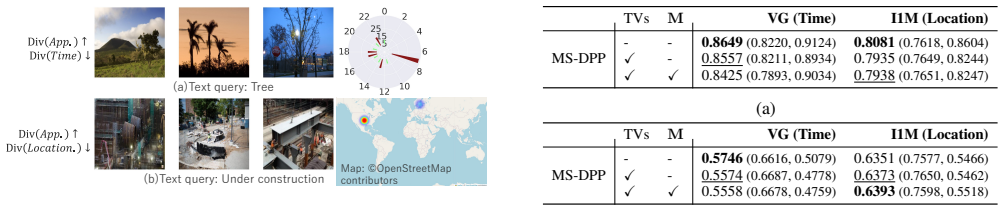
Summary. The paper introduces a new task, Contextual Diversity Refinement of Composite Attributes (CDR-CA), in which a text-to-image retrieval system should refine the diversity of several attributes (e.g., appearance, time, location) in an application-dependent way, increasing some diversities and decreasing others. To solve it, the authors propose Multi-Source Determinantal Point Processes (MS-DPPs): they start from a product of per-attribute DPPs, claim a unification into a single DPP via a Log-Euclidean mean of similarity matrices (Theorem 1), and add Tangent Normalization to make the output reflect user-specified attribute weights. They introduce a Preference Reflection Score, and report experiments on VG, I1M, and PixelProse showing that MS-DPP improves the harmonic mean of retrieval accuracy and Vendi-score diversity relative to clustering, MMR, and k-DPP baselines.
Significance. If the theoretical and empirical claims were fully correct, the paper would make a useful contribution by extending DPP-based diversification from single attributes to multi-attribute, mixed-direction settings and by providing a principled way to inject user preferences into the re-ranking stage. The paper is also commendable for its practical scope: three datasets, four tasks, ablations, runtime measurements, and public code. However, the main unification theorem contains an algebraic error, and several experimental design issues weaken the evidence. The proposed f_ms model is still a well-defined DPP, so the empirical approach is not automatically invalidated, but the paper in its current form does not establish the theoretical foundation it claims.
major comments (4)
- [§5.1, Eq. (5); Suppl. Sec. B, Eqs. (13)–(14)] Theorem 1 is incorrect as stated. From Eq. (4), f_base(Y_g)=∏_{i=1}^{N_A} |R_{Y_g}| |S_{i,Y_g}| |R_{Y_g}| = |R_{Y_g}|^{2N_A} ∏_i |S_{i,Y_g}|. The proposed unified DPP has value |R_{Y_g}|^2 |M_{Y_g}| = |R_{Y_g}|^2 ∏_i |S_{i,Y_g}|, since det(expm(Σ logm S_i)) = ∏_i |S_i|. The ratio is |R_{Y_g}|^{2(N_A-1)}, which depends on Y_g unless N_A=1. The supplementary proof slips at the step replacing |R|^{2N_A} by e^{N_A}|R||R| in Eq. (14); this identity is false (e.g., N_A=2, a one-element subset with r=0.5 gives ratio 0.25, while r=0.8 gives ratio 0.64). Because the claimed equivalence is the stated justification for 'seamlessly transforming' the composite model into a single DPP and for using standard DPP optimizers, the theoretical foundation of §5.1 needs to be rewritten. Note that f_ms in Eq. (6) is a valid DPP in its own right, so the empirical numbers are not automatically invalidated, but they can no longer be justified by the product-of-DPPs derivation.
- [§4, Eq. (3); §5.1, Eq. (4)] The CDR-CA objective in Eq. (3) is an additive combination of weighted per-attribute diversities, but the proposed f_base (Eq. (4)) is a product of per-attribute DPP weights. The manuscript does not give a formal or empirical justification for this multiplicative factorization, e.g., why a user’s additive preferences should correspond to a product of determinants rather than a weighted geometric or arithmetic mean. Since the entire construction (unification, TN, and the PRS evaluation) follows from this choice, an ablation or a comparison against a natural additive variant is needed to support the design.
- [§6.1, Baselines; Table 3; Table A] The decreasing-diversity baseline is not well defined for k-DPP. The paper states that for diversity-decreasing tasks it multiplies the similarity matrix of each attribute by -1. A k-DPP with L=R(-S)R uses a kernel that is not positive semidefinite, so the determinant-based probability is not a valid DPP and the greedy MAP algorithm is not justified. Consequently, the k-DPP results in the decreasing rows of Table 3 and Table A do not constitute a sound comparison; the authors should either use a principled clustering/MMR-style baseline for decreasing diversity or explain how the k-DPP algorithm was actually run on an indefinite kernel.
- [Tables 2–5] All quantitative claims rest on single point estimates; no error bars, standard deviations, or significance tests are reported. Several margins are small (e.g., Table 2, PP-Time: MS-DPP 0.7269 vs k-DPP 0.7266; VG has 649 images), so without repeated runs or significance testing the claimed improvements cannot be assessed reliably.
minor comments (4)
- [Table 4] The row labeled 'MS-DPP' is the no-TN variant, while Table 3 reports the best configuration selected per dataset (VG: no TN; I1M: TN on TVs+M). The caption should state this explicitly; otherwise the I1M HM of 0.6351 in Table 4(b) appears to contradict the 0.6393 in Table 3.
- [Table 1] The formatting of the row for RD is broken ('RD 1 s= +1 w= 1'); also use consistent capitalization for 'App.' in Tables 2 and 3.
- [Eq. (6)] The definition of the relevance factor uses e^{αR}; since R is a diagonal matrix, this equals diag(e^{α r_i}), but the text should state explicitly that the notation is elementwise to avoid confusion with the matrix exponential of a non-diagonal argument.
- [§5.1] The paper invokes the Log-Euclidean mean without a citation; please add a reference to the original Log-Euclidean framework (e.g., Arsigny et al.) in the main text, as the supplementary only cites the general SPD-manifold background.
Circularity Check
No significant circularity: MS-DPP is a self-contained algebraic construction; no fitted parameter is renamed as a prediction and no load-bearing self-citation.
full rationale
The paper's central derivation is Theorem 1 (Eq. 5), which claims the product of per-attribute DPP weights is proportional to a single DPP with the Log-Euclidean unified similarity matrix. This is an algebraic identity about determinants, det(expm(Σ logm S_i)) = Π det(S_i), and the claimed proportionality does not depend on any fitted parameter. The later MS-DPP definition (Eq. 6) is introduced as a definition, not as a fitted quantity, and its greedy optimization is a standard k-DPP algorithm applied to that defined model. Hyperparameters (θ, {w_i}, TN choice) are tuned on a validation set and results are reported on a test set, so the headline numbers are not forced by construction. The paper defines the CDR-CA task and the Vendi-based HM metric, which is a mild self-reference common to new-task papers, but the method's outputs are not equal by construction to the metric's inputs. The two self-citations ([Sogi et al., 2024a, 2024b]) are contextual examples, not load-bearing premises. Note: the supplementary proof of Theorem 1 (Eq. 14) appears to contain an algebraic slip (replacing |R|^{2N_A} by e^{N_A}|R||R|), but that is a mathematical-correctness concern, not circularity; it does not reduce the claimed result to its inputs.
Assumptions & free parameters
free parameters (2)
- theta (trade-off) =
0.75 to 0.95 in steps of 0.05, chosen on validation; alpha = theta/(2(1-theta))
- attribute weights w_i =
selected from 0.1 to 0.9 in steps of 0.2, normalized to sum to 1
assumptions (5)
- domain assumption DPP MAP inference can be approximated by sequential greedy maximization
- standard math For SPD matrices, |S| = exp(tr log S)
- domain assumption The joint CDR-CA objective factorizes as the product of per-attribute DPP values (Eq. 4)
- domain assumption The inverse-distance similarity matrices 1/(||fi-fj||+1) are positive definite so the DPP kernel and matrix logarithm are well-defined
- domain assumption Vendi score with the paper's attribute kernels is a valid diversity measure for CDR-CA
Cite this review
Pith. "Pith review of MS-DPPs: Multi-Source Determinantal Point Processes for Contextual Diversity Refinement of Composite Attributes in Text to Image Retrieval." pith.science (2026). https://pith.science/paper/BCQRBV6M
@misc{pith2026250706654,
  author       = {Pith},
  title        = {Pith review of: MS-DPPs: Multi-Source Determinantal Point Processes for Contextual Diversity Refinement of Composite Attributes in Text to Image Retrieval},
  year         = {2026},
  howpublished = {\url{https://pith.science/paper/BCQRBV6M}},
  note         = {Machine review of arXiv:2507.06654}
}
read the original abstract
Result diversification (RD) is a crucial technique in Text-to-Image Retrieval for enhancing the efficiency of a practical application. Conventional methods focus solely on increasing the diversity metric of image appearances. However, the diversity metric and its desired value vary depending on the application, which limits the applications of RD. This paper proposes a novel task called CDR-CA (Contextual Diversity Refinement of Composite Attributes). CDR-CA aims to refine the diversities of multiple attributes, according to the application's context. To address this task, we propose Multi-Source DPPs, a simple yet strong baseline that extends the Determinantal Point Process (DPP) to multi-sources. We model MS-DPP as a single DPP model with a unified similarity matrix based on a manifold representation. We also introduce Tangent Normalization to reflect contexts. Extensive experiments demonstrate the effectiveness of the proposed method. Our code is publicly available at https://github.com/NEC-N-SOGI/msdpp.
Figures


Figures from the paper (2 more)

Reference graph
Works this paper leans on
-
[1]
Learning the Parameters of De- terminantal Point Process Kernels
[Affandi et al., 2014] Raja Hafiz Affandi, Emily Fox, Ryan Aerdams, and Ben Taskar. Learning the Parameters of De- terminantal Point Process Kernels. In ICML, volume 32, pages 1224–1232. PMLR, 22–24 Jun
work page 2014
-
[7]
Image-Text Retrieval: A Survey on Recent Research and Development
[Cao et al., 2022] Min Cao, Shiping Li, Juntao Li, Liqiang Nie, and Min Zhang. Image-Text Retrieval: A Survey on Recent Research and Development. InIJCAI, pages 5410– 5417,
work page 2022
-
[8]
The use of MMR, diversity-based reranking for reordering documents and producing summaries
[Carbonell and Goldstein, 1998] Jaime Carbonell and Jade Goldstein. The use of MMR, diversity-based reranking for reordering documents and producing summaries. InSI- GIR, page 335–336. Association for Computing Machin- ery,
work page 1998
-
[13]
The Vendi Score: A Diversity Evaluation Metric for Machine Learning
[Friedman and Dieng, 2023] Dan Friedman and Adji Bousso Dieng. The Vendi Score: A Diversity Evaluation Metric for Machine Learning. TMLR,
work page 2023
-
[18]
Visual genome: Connecting language and vision using crowdsourced dense image annotations
[Krishna et al., 2017] Ranjay Krishna, Yuke Zhu, Oliver Groth, Justin Johnson, Kenji Hata, Joshua Kravitz, Stephanie Chen, Yannis Kalantidis, Li-Jia Li, David A Shamma, et al. Visual genome: Connecting language and vision using crowdsourced dense image annotations. IJCV, 123:32–73,
work page 2017
-
[19]
K-DPPs: Fixed-size determinantal point processes
[Kulesza and Taskar, 2011] Alex Kulesza and Ben Taskar. K-DPPs: Fixed-size determinantal point processes. In ICML, pages 1193–1200, June
work page 2011
-
[22]
Align before Fuse: Vision and Language Representation Learning with Momentum Distillation
[Li et al., 2021] Junnan Li, Ramprasaath Selvaraju, Akhilesh Gotmare, Shafiq Joty, Caiming Xiong, and Steven Chu Hong Hoi. Align before Fuse: Vision and Language Representation Learning with Momentum Distillation. In NeurIPS, pages 9694–9705,
work page 2021
-
[23]
[Li et al., 2022] Junnan Li, Dongxu Li, Caiming Xiong, and Steven Hoi. BLIP: Bootstrapping Language-Image Pre- training for Unified Vision-Language Understanding and Generation. In ICML, pages 12888–12900,
work page 2022
Show all 43 references
-
[24]
BLIP-2: Bootstrapping Language-Image Pre- training with Frozen Image Encoders and Large Language Models
[Li et al., 2023] Junnan Li, Dongxu Li, Silvio Savarese, and Steven Hoi. BLIP-2: Bootstrapping Language-Image Pre- training with Frozen Image Encoders and Large Language Models. In ICML, pages 19730–19742,
2023
-
[25]
Microsoft coco: Common objects in context
[Lin et al., 2014] Tsung-Yi Lin, Michael Maire, Serge Be- longie, James Hays, Pietro Perona, Deva Ramanan, Pi- otr Doll ´ar, and C Lawrence Zitnick. Microsoft coco: Common objects in context. In ECCV, pages 740–755. Springer,
2014
-
[26]
Learning determinantal point processes by corrective negative sampling
[Mariet et al., 2019] Zelda Mariet, Mike Gartrell, and Suvrit Sra. Learning determinantal point processes by corrective negative sampling. In Kamalika Chaudhuri and Masashi Sugiyama, editors, AISTATS, volume 89 of Proceedings of Machine Learning Research, pages 2251–2260. PMLR...
2019
-
[27]
The coincidence approach to stochastic point processes
[Odile, 1975] Macchi Odile. The coincidence approach to stochastic point processes. Advances in Applied Probabil- ity, 7(01):83–122, 03
1975
-
[29]
A riemannian framework for tensor computing
[Pennec et al., 2006] Xavier Pennec, Pierre Fillard, and Nicholas Ayache. A riemannian framework for tensor computing. IJCV, 66:41–66,
2006
-
[31]
From Pixels to Prose: A Large Dataset of Dense Image Captions
[Singla et al., 2024] Vasu Singla, Kaiyu Yue, Sukriti Paul, Reza Shirkavand, Mayuka Jayawardhana, Alireza Gan- jdanesh, Heng Huang, Abhinav Bhatele, Gowthami Somepalli, and Tom Goldstein. From Pixels to Prose: A Large Dataset of Dense Image Captions. In arXiv:2406.10328,
2024 arXiv
-
[32]
An overview of cluster-based image search result organization: Background, techniques, and ongoing challenges
[Tekli, 2022] Joe Tekli. An overview of cluster-based image search result organization: Background, techniques, and ongoing challenges. Knowledge and Information Systems, 64(3):589–642, March
2022
-
[33]
van Leuken, Lluis Gar- cia, Ximena Olivares, and Roelof van Zwol
[van Leuken et al., 2009] Reinier H. van Leuken, Lluis Gar- cia, Ximena Olivares, and Roelof van Zwol. Visual diver- sification of image search results. In WWW, pages 341– 350, New York, NY , USA, April
2009
-
[35]
Image as a Foreign Language: BEIT Pretraining for Vision and Vision-Language Tasks.CVPR, pages 19175–19186,
[Wang et al., 2023] Wen Wang, Hangbo Bao, Li Dong, Jo- han Bjorck, Zhiliang Peng, Qiangbo Liu, Kriti Aggar- wal, Owais Khan Mohammed, Saksham Singhal, Subhojit Som, and Furu Wei. Image as a Foreign Language: BEIT Pretraining for Vision and Vision-Language Tasks.CVPR, pages 191...
2023
-
[36]
Pa- padopoulos, Aritro Biswas, Agata Lapedriza, Ferda Ofli, Muhammad Imran, and Antonio Torralba
[Weber et al., 2020] Ethan Weber, Nuria Marzo, Dim P. Pa- padopoulos, Aritro Biswas, Agata Lapedriza, Ferda Ofli, Muhammad Imran, and Antonio Torralba. Detecting natu- ral disasters, damage, and incidents in the wild. In ECCV, August
2020
-
[37]
Incidents1M: a large-scale dataset of im- ages with natural disasters, damage, and incidents
[Weber et al., 2022] Ethan Weber, Dim P Papadopoulos, Agata Lapedriza, Ferda Ofli, Muhammad Imran, and An- tonio Torralba. Incidents1M: a large-scale dataset of im- ages with natural disasters, damage, and incidents. IEEE TPAMI, 45(4):4768–4781,
2022
-
[38]
Uniir: Training and benchmarking universal mul- timodal information retrievers
[Wei et al., 2024] Cong Wei, Yang Chen, Haonan Chen, Hexiang Hu, Ge Zhang, Jie Fu, Alan Ritter, and Wenhu Chen. Uniir: Training and benchmarking universal mul- timodal information retrievers. In ECCV, pages 387–404. Springer,
2024
-
[39]
Re- sult Diversification in Search and Recommendation: A Survey
[Wu et al., 2024] Haolun Wu, Yansen Zhang, Chen Ma, Fuyuan Lyu, Bowei He, Bhaskar Mitra, and Xue Liu. Re- sult Diversification in Search and Recommendation: A Survey. IEEE TKDE, pages 1–20,
2024
-
[40]
Coca: Contrastive captioners are image-text foundation models
[Yu et al., 2022] Jiahui Yu, Zirui Wang, Vijay Vasudevan, Legg Yeung, Mojtaba Seyedhosseini, and Yonghui Wu. Coca: Contrastive captioners are image-text foundation models. TMLR,
2022
-
[41]
X22-VLM: All-in-One Pre-Trained Model for Vision- Language Tasks
[Zeng et al., 2024] Yan Zeng, Xinsong Zhang, Hang Li, Jiawei Wang, Jipeng Zhang, and Wangchunshu Zhou. X22-VLM: All-in-One Pre-Trained Model for Vision- Language Tasks. IEEE TPAMI, 46(5):3156–3168, May
2024
-
[42]
Improving web search results using affinity graph
[Zhang et al., 2005] Benyu Zhang, Hua Li, Yi Liu, Lei Ji, Wensi Xi, Weiguo Fan, Zheng Chen, and Wei-Ying Ma. Improving web search results using affinity graph. In SI- GIR, pages 504–511. Association for Computing Machin- ery, August
2005
-
[1975]
Cousins Of The Vendi Score: A Family Of Similarity-Based Diversity Metrics For Science And Machine Learning
[Pasarkar and Dieng, 2024] Amey P Pasarkar and Adji Bousso Dieng. Cousins Of The Vendi Score: A Family Of Similarity-Based Diversity Metrics For Science And Machine Learning. In AISTATS, pages 3808–3816. PMLR,
2024
-
[1998]
Fast greedy MAP inference for determinan- tal point process to improve recommendation diversity
[Chen et al., 2018] Laming Chen, Guoxin Zhang, and Han- ning Zhou. Fast greedy MAP inference for determinan- tal point process to improve recommendation diversity. In NeurIPS, pages 5627–5638, December
2018
-
[2005]
Keyword-Based Diverse Image Retrieval by Semantics- aware Contrastive Learning and Transformer
[Zhao et al., 2023] Minyi Zhao, Jinpeng Wang, Dongliang Liao, Yiru Wang, Huanzhong Duan, and Shuigeng Zhou. Keyword-Based Diverse Image Retrieval by Semantics- aware Contrastive Learning and Transformer. In SIGIR, pages 1262–1272, New York, NY , USA, July
2023
-
[2006]
Learning Transferable Visual Models From Natural Language Su- pervision
[Radford et al., 2021] Alec Radford, Jong Wook Kim, Chris Hallacy, Aditya Ramesh, Gabriel Goh, Sandhini Agar- wal, Girish Sastry, Amanda Askell, Pamela Mishkin, Jack Clark, Gretchen Krueger, and Ilya Sutskever. Learning Transferable Visual Models From Natural Language Su- perv...
2021
-
[2009]
[Vieira et al., 2011] Marcos R
Association for Computing Machinery. [Vieira et al., 2011] Marcos R. Vieira, Humberto L. Razente, Maria C. N. Barioni, Marios Hadjieleftheriou, Divesh Sri- vastava, Caetano Traina, and Vassilis J. Tsotras. On query result diversification. In ICDE, pages 1163–1174, April
2011
-
[2011]
Determinantal Point Processes for Machine Learning
[Kulesza and Taskar, 2012] Alex Kulesza and Ben Taskar. Determinantal Point Processes for Machine Learning. Foundations and Trends® in Machine Learning , 5(2– 3):123–286, December
2012
-
[2012]
Stacked Cross Atten- tion for Image-Text Matching
[Lee et al., 2018] Kuang-Huei Lee, Xi Chen, Gang Hua, Houdong Hu, and Xiaodong He. Stacked Cross Atten- tion for Image-Text Matching. In ECCV, pages 212–228,
2018
-
[2013]
Result Diversifi- cation in Social Image Retrieval: A Benchmarking Frame- work
[Ionescu et al., 2016] Bogdan Ionescu, Adrian Popescu, Anca-Livia Radu, and Henning M ¨uller. Result Diversifi- cation in Social Image Retrieval: A Benchmarking Frame- work. Multimedia Tools and Applications , 75(2):1301– 1331, January
2016
-
[2014]
FCA-based knowledge representation and local general- ized linear models to address relevance and diversity in diverse social images
[Benavent et al., 2019] Xaro Benavent, Angel Castellanos, Esther de Ves, Ana Garc ´ıa-Serrano, and Juan Cigarr ´an. FCA-based knowledge representation and local general- ized linear models to address relevance and diversity in diverse social images. Future Generation Computer ...
2019
-
[2015]
Pseudo-relevance feedback diversifica- tion of social image retrieval results
[Boteanu et al., 2017] Bogdan Boteanu, Ionut ¸ Mironic˘a, and Bogdan Ionescu. Pseudo-relevance feedback diversifica- tion of social image retrieval results. Multimedia Tools and Applications, 76(9):11889–11916, May
2017
-
[2016]
Benchmarking Image Retrieval Diversifica- tion Techniques for Social Media
[Ionescu et al., 2021] Bogdan Ionescu, Maia Rohm, Bogdan Boteanu, Alexandru Lucian Gˆınsc˘a, Mihai Lupu, and Hen- ning M ¨uller. Benchmarking Image Retrieval Diversifica- tion Techniques for Social Media. IEEE TMM, 23:677– 691,
2021
-
[2017]
A Hypergraph-Based Reranking Model for Retrieving Diverse Social Images
[Bouhlel et al., 2017] Noura Bouhlel, Ghada Feki, Anis Ben Ammar, and Chokri Ben Amar. A Hypergraph-Based Reranking Model for Retrieving Diverse Social Images. In Computer Analysis of Images and Patterns, pages 279–
2017
-
[2018]
Uniter: Universal image-text representation learning
[Chen et al., 2020] Yen-Chun Chen, Linjie Li, Licheng Yu, Ahmed El Kholy, Faisal Ahmed, Zhe Gan, Yu Cheng, and Jingjing Liu. Uniter: Universal image-text representation learning. In ECCV,
2020
-
[2019]
Is an Image Worth Five Sentences? A New Look Into Semantics for Image- Text Matching
[Biten et al., 2022] Ali Furkan Biten, Andr ´es Mafla, Llu ´ıs G´omez, and Dimosthenis Karatzas. Is an Image Worth Five Sentences? A New Look Into Semantics for Image- Text Matching. In WACV, pages 1391–1400, January
2022
-
[2020]
Internvl: Scaling up vision foundation models and aligning for generic visual- linguistic tasks
[Chen et al., 2024] Zhe Chen, Jiannan Wu, Wenhai Wang, Weijie Su, Guo Chen, Sen Xing, Muyan Zhong, Qinglong Zhang, Xizhou Zhu, Lewei Lu, et al. Internvl: Scaling up vision foundation models and aligning for generic visual- linguistic tasks. In CVPR, pages 24185–24198,
2024
-
[2021]
Comparative Analysis on Cross- Modal Information Retrieval: A Review
[Kaur et al., 2021] Parminder Kaur, Husanbir Singh Pannu, and Avleen Kaur Malhi. Comparative Analysis on Cross- Modal Information Retrieval: A Review. Computer Sci- ence Review, 39:100336,
2021
-
[2022]
Hierarchical clustering pseudo-relevance feedback for social image search result diversification
[Boteanu et al., 2015] Bogdan Boteanu, Ionut ¸ Mironic˘a, and Bogdan Ionescu. Hierarchical clustering pseudo-relevance feedback for social image search result diversification. In International Workshop on Content-Based Multimedia In- dexing (CBMI), pages 1–6, June
2015
-
[2023]
Devise: A deep visual-semantic em- bedding model
[Frome et al., 2013] Andrea Frome, Greg S Corrado, Jon Shlens, Samy Bengio, Jeff Dean, Marc' Aurelio Ranzato, and Tomas Mikolov. Devise: A deep visual-semantic em- bedding model. In NeurIPS, volume 26,
2013
-
[2024]
Fleet, Jamie Ryan Kiros, and Sanja Fidler
[Faghri et al., 2017] Fartash Faghri, David J. Fleet, Jamie Ryan Kiros, and Sanja Fidler. VSE++: Improving Visual-Semantic Embeddings with Hard Negatives. In BMVC, page ,
2017
Reviewed August 6, 2026 · model on record in the stance chip above.
Discussion (0). Sign in to comment.