REVIEW 3 major objections 5 minor 67 references
This paper claims that the overlooked failure point in HVI-based low-light enhancement is how intensity and chromaticity streams are fused, and that a fixed confidence threshold on attention probabilities—rather than a fixed Top-K quota—mak
Reviewed by Pith at T0; open to challenge. T0 means a machine referee read the full paper against a public rubric. the ladder, T0–T4 →
T0 review · deepseek-v4-flash
2026-08-02 03:17 UTC pith:BCT6HW7E
load-bearing objection The thresholded-attention idea is plausible, but the paper tunes τ on the test benchmarks and its all-off ablation appears to be CIDNet exactly, so the central comparison isn't clean. the 3 major comments →
Thresholded Cross-Attention for Reliable Intensity-Chromaticity Fusion in Low-Light Image Enhancement
The pith
A machine-rendered reading of the paper's core claim, the machinery that carries it, and where it could break.
Core claim
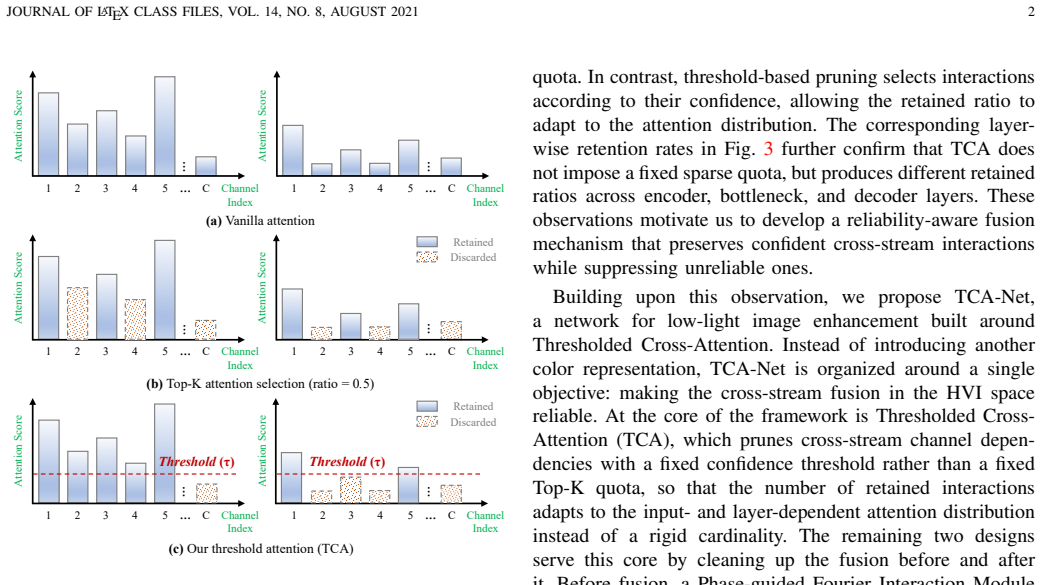
The central claim is that reliability-aware fusion, not a new color representation, is what HVI-based enhancement is missing. The paper demonstrates that cross-stream attention scores have layer-dependent distributions: some layers concentrate probability mass on a few confident responses, others spread it thinly. Top-K selection with a fixed retention ratio is therefore structurally mismatched—it wastes informative dependencies in concentrated layers and retains weak, noise-correlated responses in diffuse ones. TCA replaces the quota with a fixed threshold τ=0.025 applied after softmax normalization, keeping every interaction above the threshold plus the single strongest response as a fallb
What carries the argument
Thresholded Cross-Attention (TCA): a channel-wise cross-attention between intensity and chromaticity streams in which softmax-normalized attention probabilities below a fixed threshold (τ=0.025) are masked out, with an argmax fallback so no source channel loses all contacts. The mask is formed by element-wise threshold comparison rather than ranking, so it carries no sorting overhead; the retained number of cross-stream interactions adapts to each layer's and each input's confidence distribution. The supporting Phase-guided Fourier Interaction Module provides a structure-aware intensity initialization before fusion, and the Decoupled Dual-Stream Guidance Module subtracts chromaticity-correla
Load-bearing premise
The central attribution—that confidence-thresholded fusion, not additional parameters and compute, drives the reported improvement—rests on a comparison in which the full network is substantially larger than the HVI baseline it beats (about 2.75M parameters and 62 GFLOPs versus 1.88M and 7.6 GFLOPs), and the component-off ablation exactly reproduces that baseline's scores.
What would settle it
Train a capacity-matched control: add the same auxiliary modules and roughly the same parameter and FLOP count to the HVI baseline while keeping dense or Top-K cross-attention, then compare PSNR and chromaticity error on LOL-v1. If the gains over the baseline shrink to zero, thresholding is not the cause; if they persist, the paper's attribution is supported.
If this is right
- Layered cross-stream attention stacks should prefer confidence-threshold pruning over fixed-quota Top-K, since attention confidence shifts with depth.
- Threshold-based pruning avoids the ranking and sorting step of Top-K, making sparse cross-attention cheaper at selection time.
- A single threshold value transfers across several low-light benchmarks without per-dataset tuning, suggesting a stable probability-level confidence scale.
- If the gains hold, the same pipeline can improve color fidelity as well as brightness, reducing average chromaticity error and its variance on hard low-light images.
Where Pith is reading between the lines
- Inference: the same thresholding principle may transfer to other dual-stream fusion tasks—visible-infrared fusion, dehazing with depth guidance, or colorization—wherever attention confidence varies by layer and input.
- Inference: a learned, per-layer, or input-conditioned threshold could improve on the hand-set 0.025; the paper explicitly leaves adaptive threshold estimation as future work.
- Inference: a capacity-matched control—same auxiliary modules and parameter count but with dense or Top-K attention kept in place—would isolate how much of the reported improvement is due to the threshold rule versus added model capacity.
Editorial analysis
A structured set of objections, weighed in public.
Referee Report
Summary. The paper proposes TCA-Net, an HVI-space low-light image enhancement network whose central contribution is Thresholded Cross-Attention (TCA): instead of dense attention or a fixed Top-K retention quota, TCA applies a fixed probability threshold to softmax-normalized cross-attention and re-normalizes the surviving weights, so the number of kept interactions adapts per layer and input. Around this core the paper adds a Phase-guided Fourier Interaction Module (PFIM), a Decoupled Dual-Stream Guidance Module (DDSGM), and a Scale-Aware Consistency Regularization (SACR). The authors report that TCA-Net achieves best or near-best PSNR/SSIM/LPIPS on LOL-v1, LOL-v2-Real, and LOL-v2-Synthetic, with strong results on Sony-Total-Dark and LSRW-Huawei and the lowest E_ab chromaticity error on LOL-v1.
Significance. The motivation is clear and the design is simple: the observation that cross-stream attention confidence varies with depth (Figs. 2–3) is a useful argument against fixed-quota sparsification, and replacing sorting-based Top-K with a threshold comparison is an attractive, interpretable mechanism. If the results hold under properly controlled evaluation, this would be a practical contribution to HVI-based low-light enhancement. The paper's strengths are the breadth of benchmarks (five datasets), the separate chromaticity metric E_ab, and the transparent reporting of threshold-sensitivity values. However, the central causal claim—that thresholded selection is more reliable than dense or Top-K attention—is not yet supported because of test-set hyperparameter selection, an unexplained baseline in the ablation, capacity mismatch with the main baseline, and the absence of variance estimates.
major comments (3)
- [Sec. IV-G, Table VI] τ=0.025 is selected by comparing PSNR/SSIM/LPIPS on the LOL-v1, LOL-v2-Real, and LOL-v2-Synthetic test sets, which are the same benchmarks on which the final results in Tables I and VIII are reported. The text states that τ=0.025 is chosen 'because it provides the strongest PSNR' on these tests. Consequently, the advantage of TCA over dense attention (25.322 vs 25.016) and over Top-K (25.322 vs 25.093) may reflect test-set tuning rather than the merits of thresholded selection. Please perform threshold selection on a held-out validation split or use nested evaluation, and report the selected threshold with its validation performance; otherwise the central comparison is not an unbiased test of the method.
- [Sec. IV-G, Table VII; Table V] The first row of Table VII reports 23.809 PSNR, 0.857 SSIM, 0.079 LPIPS for the configuration without PFIM/DDSGM/SACR. These are exactly the numbers reported for CIDNet in Table I. If the baseline is CIDNet used as the foundation, the ablation is not an ablation of TCA-Net but an incremental addition of modules to CIDNet. Moreover, the comparison is not capacity-matched: Table V lists 2.75M parameters/62.09 GFLOPs for TCA-Net versus 1.88M/7.57G for CIDNet, so gains could be due to the 46% parameter increase and especially the 8.2× FLOP increase. Please clarify what the baseline row actually is, rerun the component study from a common TCA-Net backbone, and add a capacity-matched control for CIDNet.
- [Sec. IV-G, Tables VI-VIII; Table I] All ablations are reported as single runs without error bars or significance tests. The margins in the key comparisons are small: e.g., 25.322 vs 25.093 dB in Table VIII, and 24.171 vs 23.900 dB on LOL-v2-Real in Table I. Without seed variance or a statistical test, the reader cannot tell whether the observed differences are reproducible. Please report mean and standard deviation over at least three seeds for the main results and the component ablation, and ideally a significance test for the attention-mechanism comparison.
minor comments (5)
- [Sec. III-A] 'Internal SCAR' appears to be a typo; the regularization is consistently called SACR elsewhere.
- [Eq. (11)] The OneHotArgmax fallback means each source channel always retains at least one response even when all attention scores are below τ. Please state how often this fallback occurs and confirm that such retained responses are not the main carriers of noise; otherwise the 'suppress unreliable ones' claim is incomplete.
- [Figs. 2-3] Specify which model/checkpoint generated these attention statistics and how many samples were averaged; as motivation, the figures should be reproducible.
- [Table V and Conclusion] The phrase 'compact parameter size' should be qualified by the high FLOP count (62.09G, about 8× CIDNet). The cost-quality tradeoff should be discussed in terms of both parameters and FLOPs, not parameters alone.
- [Table III] The dataset is introduced as 'Sony-Total-Dark' but is a modified subset of SID. Please clarify the dataset name, the exact split, and the number of test pairs used.
Circularity Check
The defining threshold τ of TCA is selected on the same LOL test benchmarks where the final results and the dense/Top-K comparisons are reported, so the claimed advantage of thresholded over dense/Top-K attention is partly a hyperparameter artifact.
specific steps
-
fitted input called prediction
[Sec. IV-G, Table VI (used with Tables I and VIII)]
"we evaluate five threshold values, i.e., 0, 0.020, 0.025, 0.030, and 0.040. Compared with dense cross-attention, setting τ=0.025 improves the PSNR from 25.016 dB to 25.322 dB and also improves SSIM from 0.871 to 0.876, indicating that removing weak attention responses helps suppress unreliable cross-stream interactions. ... Therefore, we choose τ=0.025 as the final setting because it provides the strongest PSNR while maintaining competitive SSIM and LPIPS across the evaluated LOL benchmarks."
τ is the parameter that defines TCA (Eq. 11: M_{τ,l}=Mask(A_l≥τ) with argmax fallback). The paper chooses τ=0.025 by maximizing PSNR on the same LOL-v1/LOL-v2-Real/LOL-v2-Synthetic evaluation splits that are later used for the headline results in Table I and for the attention-mechanism comparison in Table VIII. Since τ=0 in Table VI is exactly the dense-attention baseline, requiring τ=0.025 to have the strongest PSNR makes the reported improvement of TCA over dense attention true by selection rather than by independent test. The comparison with Top-K (ρ=0.6, 0.7) is also unfair because those quotas were not tuned while τ was. Thus the central claim that thresholded pruning is more reliable than dense or fixed-quota attention is partly constructed by the test-set hyperparameter search.
full rationale
The main circularity is the selection of the TCA threshold on the test benchmarks used for the final comparison. Table VI reports threshold sensitivity for the same LOL-v1, LOL-v2-Real, and LOL-v2-Synthetic splits whose results appear in Table I, and the chosen τ=0.025 is the value that maximizes PSNR on those splits. Because τ defines the pruning behavior of TCA, the subsequent statements that TCA beats dense attention (τ=0) and Top-K attention are not independent predictions but are partly guaranteed by the selection procedure. No held-out validation split is described for this hyperparameter choice. I do not find other circular reductions: the HVI color space and IEL/CDL components are adopted from the external CIDNet work [21]; PFIM, DDSGM, and SACR are defined by explicit equations independent of the target metrics; and the component ablation (Table VII) is a standard contribution study. The exact reproduction of CIDNet's scores in the all-off ablation row and the capacity mismatch in Table V are correctness/confounding concerns rather than circularity. Overall, the architecture is not equivalent to its inputs, but the central attention-mechanism advantage is statistically forced by test-set tuning, giving a partial circularity score of 6.
Axiom & Free-Parameter Ledger
free parameters (4)
- τ (TCA confidence threshold) =
0.025
- Supervised loss weights λ1, λssim, λedge, λper, λhvi =
1.0, 0.5, 50.0, 0.01, 1.0
- β0 (initial SACR weight) =
not reported
- Architecture scale (stage count N, channels, TCA layers) =
not specified
axioms (4)
- domain assumption HVI color-space decomposition improves low-light enhancement
- domain assumption Softmax attention probability is a valid confidence measure for cross-stream fusion
- domain assumption Fourier phase encodes structure while amplitude encodes global intensity
- domain assumption Perceptual-inverse HVI transform reliably inverts the processed representation
read the original abstract
Low-Light Image Enhancement (LLIE) requires a careful balance among noise suppression, color fidelity, and efficiency. Recent HVI-based methods alleviate color entanglement by decoupling intensity and chromaticity, yet how reliably the two streams are fused again is an overlooked factor that largely determines the final quality. We observe that the confidence of cross-stream attention is strongly layer-dependent, so the fixed-quota selection of Top-K sparse attention is mismatched to it, discarding informative dependencies in some layers while retaining noisy ones in others. Motivated by this observation, we propose TCA-Net, a network built around Thresholded Cross-Attention that targets reliable intensity-chromaticity fusion in the HVI space rather than introducing yet another color representation. At its core, TCA replaces the rigid Top-K quota with a fixed confidence threshold whose retained cardinality is input- and layer-adaptive, retaining only high-confidence cross-stream interactions while suppressing unreliable ones. Around this core, two complementary designs clean up the fusion before and after it: a Phase-guided Fourier Interaction Module provides a structure-aware brightness initialization for the intensity stream prior to fusion, and a Decoupled Dual-Stream Guidance Module constructs residual intensity features to suppress chromaticity leakage during reconstruction. A Scale-Aware Consistency Regularization further improves structural robustness under scale perturbations during training. Extensive experiments on LOL-v1, LOL-v2, Sony-Total-Dark, and LSRW-Huawei demonstrate that TCA-Net delivers competitive restoration accuracy, improved color fidelity, and a compact parameter size.
Figures


Reference graph
Works this paper leans on
-
[1]
Low-light image and video enhancement using deep learning: A survey,
C. Li, C. Guo, L. Han, J. Jiang, M.-M. Cheng, J. Gu, and C. C. Loy, “Low-light image and video enhancement using deep learning: A survey,”IEEE Trans. Pattern Anal. Mach. Intell., vol. 44, no. 12, pp. 9396–9416, 2021
2021
-
[2]
Light the Night: A multi-condition diffusion framework for unpaired low-light enhancement in autonomous driving,
J. Li, B. Li, Z. Tu, X. Liu, Q. Guo, F. Juefei-Xu, R. Xu, and H. Yu, “Light the Night: A multi-condition diffusion framework for unpaired low-light enhancement in autonomous driving,” inProc. IEEE/CVF Conf. Comput. Vis. Pattern Recognit. (CVPR), 2024, pp. 15 205–15 215
2024
-
[3]
Dual degradation representation for joint deraining and low-light enhancement in the dark,
X. Lin, J. Yue, S. Ding, C. Ren, L. Qi, and M.-H. Yang, “Dual degradation representation for joint deraining and low-light enhancement in the dark,”IEEE Trans. Circuits Syst. Video Technol., 2024
2024
-
[4]
Low-light salient object detection by learning to highlight the foreground objects,
X. Lu, Y . Yuan, X. Liu, L. Wang, X. Zhou, and Y . Yang, “Low-light salient object detection by learning to highlight the foreground objects,” IEEE Trans. Circuits Syst. Video Technol., vol. 34, no. 8, pp. 7712–7724, 2024
2024
-
[5]
Contrast enhancement based on layered difference representation of 2d histograms,
C. Lee, C. Lee, and C.-S. Kim, “Contrast enhancement based on layered difference representation of 2d histograms,”IEEE Trans. Image Process., vol. 22, no. 12, pp. 5372–5384, 2013
2013
-
[6]
Efficient contrast enhance- ment using adaptive gamma correction with weighting distribution,
S.-C. Huang, F.-C. Cheng, and Y .-S. Chiu, “Efficient contrast enhance- ment using adaptive gamma correction with weighting distribution,” IEEE Trans. Image Process., vol. 22, no. 3, pp. 1032–1041, 2013
2013
-
[7]
A multiscale retinex for bridging the gap between color images and the human observation of scenes,
D. J. Jobson, Z.-u. Rahman, and G. A. Woodell, “A multiscale retinex for bridging the gap between color images and the human observation of scenes,”IEEE Trans. Image Process., vol. 6, no. 7, pp. 965–976, 1997
1997
-
[8]
Lime: Low-light image enhancement via illumination map estimation,
X. Guo, Y . Li, and H. Ling, “Lime: Low-light image enhancement via illumination map estimation,”IEEE Trans. Image Process., vol. 26, no. 2, pp. 982–993, 2016
2016
-
[9]
A weighted vari- ational model for simultaneous reflectance and illumination estimation,
X. Fu, D. Zeng, Y . Huang, X.-P. Zhang, and X. Ding, “A weighted vari- ational model for simultaneous reflectance and illumination estimation,” inProc. IEEE Conf. Comput. Vis. Pattern Recognit. (CVPR), 2016, pp. 2782–2790
2016
-
[10]
Llnet: A deep autoencoder approach to natural low-light image enhancement,
K. G. Lore, A. Akintayo, and S. Sarkar, “Llnet: A deep autoencoder approach to natural low-light image enhancement,”Pattern Recognit., vol. 61, pp. 650–662, 2017
2017
-
[11]
Deep retinex decomposition for low-light enhancement,
C. Wei, W. Wang, W. Yang, and J. Liu, “Deep retinex decomposition for low-light enhancement,” inProc. Brit. Mach. Vis. Conf. (BMVC), 2018, p. 155
2018
-
[12]
Zero- reference deep curve estimation for low-light image enhancement,
C. Guo, C. Li, J. Guo, C. C. Loy, J. Hou, S. Kwong, and R. Cong, “Zero- reference deep curve estimation for low-light image enhancement,” in Proc. IEEE/CVF Conf. Comput. Vis. Pattern Recognit. (CVPR), 2020, pp. 1780–1789
2020
-
[13]
From fidelity to perceptual quality: A semi-supervised approach for low-light image enhancement,
W. Yang, S. Wang, Y . Fang, Y . Wang, and J. Liu, “From fidelity to perceptual quality: A semi-supervised approach for low-light image enhancement,” inProc. IEEE/CVF Conf. Comput. Vis. Pattern Recognit. (CVPR), 2020, pp. 3063–3072
2020
-
[14]
Semantically contrastive learning for low-light image enhancement,
D. Liang, L. Li, M. Wei, S. Yang, L. Zhang, W. Yang, Y . Du, and H. Zhou, “Semantically contrastive learning for low-light image enhancement,” inProc. AAAI Conf. Artif. Intell., vol. 36, no. 2, 2022, pp. 1555–1563
2022
-
[15]
Interlight: Leveraging intrinsic illumination priors for low-light image enhancement,
Z. Wang, X. Zhang, L. Chang, S. Chen, J. Ma, and H. Zhang, “Interlight: Leveraging intrinsic illumination priors for low-light image enhancement,”arXiv preprint arXiv:2605.19982, 2026
Pith/arXiv arXiv 2026
-
[16]
Uniuir: Considering underwater image restoration as an all-in-one learner,
X. Zhang, H. Zhang, G. Wang, Q. Zhang, L. Zhang, and B. Du, “Uniuir: Considering underwater image restoration as an all-in-one learner,”IEEE Trans. Image Process., vol. 34, pp. 6963–6977, 2025
2025
-
[17]
Reti-diff: Illumination degradation image restoration with retinex-based latent diffusion model,
C. He, C. Fang, Y . Zhang, L. Tang, J. Huang, K. Li, Z. Guo, X. Li, and S. Farsiu, “Reti-diff: Illumination degradation image restoration with retinex-based latent diffusion model,” inProc. Int. Conf. Learn. Represent. (ICLR), 2025
2025
-
[18]
Low-light image enhancement via generative perceptual priors,
H. Zhou, W. Dong, X. Liu, Y . Zhang, G. Zhai, and J. Chen, “Low-light image enhancement via generative perceptual priors,” inProc. AAAI Conf. Artif. Intell., vol. 39, no. 10, 2025, pp. 10 752–10 760
2025
-
[19]
Deep color consistent network for low-light image enhancement,
Z. Zhang, H. Zheng, R. Hong, M. Xu, S. Yan, and M. Wang, “Deep color consistent network for low-light image enhancement,” inProc. IEEE/CVF Conf. Comput. Vis. Pattern Recognit. (CVPR), 2022, pp. 1899–1908
2022
-
[20]
Extracting noise and darkness: Low-light image enhancement via dual prior guidance,
H. Wang, X. Yan, X. Hou, K. Zhang, and Y . Dun, “Extracting noise and darkness: Low-light image enhancement via dual prior guidance,” IEEE Trans. Circuits Syst. Video Technol., vol. 35, no. 2, pp. 1700–1714, 2024
2024
-
[21]
Hvi: A new color space for low-light image enhancement,
Q. Yan, Y . Feng, C. Zhang, G. Pang, K. Shi, P. Wu, W. Dong, J. Sun, and Y . Zhang, “Hvi: A new color space for low-light image enhancement,” inProc. IEEE/CVF Conf. Comput. Vis. Pattern Recognit. (CVPR), 2025, pp. 5678–5687
2025
-
[22]
MBLLEN: Low-light image/video enhancement using CNNs,
F. Lv, F. Lu, J. Wu, and C. Lim, “MBLLEN: Low-light image/video enhancement using CNNs,” inProc. Brit. Mach. Vis. Conf. (BMVC), 2018, p. 220
2018
-
[23]
Enlightengan: Deep light enhancement without paired supervision,
Y . Jiang, X. Gong, D. Liu, Y . Cheng, C. Fang, X. Shen, J. Yang, P. Zhou, and Z. Wang, “Enlightengan: Deep light enhancement without paired supervision,”IEEE Trans. Image Process., vol. 30, pp. 2340–2349, 2021
2021
-
[24]
Toward fast, flexible, and robust low-light image enhancement,
L. Ma, T. Ma, R. Liu, X. Fan, and Z. Luo, “Toward fast, flexible, and robust low-light image enhancement,” inProc. IEEE/CVF Conf. Comput. Vis. Pattern Recognit. (CVPR), 2022, pp. 5637–5646. JOURNAL OF LATEX CLASS FILES, VOL. 14, NO. 8, AUGUST 2021 13
2022
-
[25]
Lednet: Joint low-light enhance- ment and deblurring in the dark,
S. Zhou, C. Li, and C. Change Loy, “Lednet: Joint low-light enhance- ment and deblurring in the dark,” inProc. Eur. Conf. Comput. Vis. (ECCV). Springer, 2022, pp. 573–589
2022
-
[26]
Scaling up single image dehazing algorithm by cross-data vision alignment for richer representation learning and beyond,
Y . Shi, Z. Weng, Y . Lin, C. Shi, X. Guo, X. Yang, and L. Lin, “Scaling up single image dehazing algorithm by cross-data vision alignment for richer representation learning and beyond,”IEEE Trans. Instrum. Meas., vol. 74, pp. 1–9, 2025
2025
-
[27]
Fast context- based low-light image enhancement via neural implicit representations,
T. Chobola, Y . Liu, H. Zhang, J. A. Schnabel, and T. Peng, “Fast context- based low-light image enhancement via neural implicit representations,” inProc. Eur. Conf. Comput. Vis. (ECCV). Springer, 2024, pp. 413–430
2024
-
[28]
Retinexmamba: Retinex- based mamba for low-light image enhancement,
J. Bai, Y . Yin, Q. He, Y . Li, and X. Zhang, “Retinexmamba: Retinex- based mamba for low-light image enhancement,” inProc. Int. Conf. Neural Inf. Process. (ICONIP). Springer, 2024, pp. 427–442
2024
-
[29]
QMambaBSR: Burst image super-resolution with query state space model,
X. Di, L. Peng, P. Xia, W. Li, R. Pei, Y . Cao, Y . Wang, and Z.-J. Zha, “QMambaBSR: Burst image super-resolution with query state space model,”arXiv preprint arXiv:2408.08665, 2024
Pith/arXiv arXiv 2024
-
[30]
URWKV: Unified RWKV model with multi-state perspective for low-light image restoration,
R. Xu, Y . Niu, Y . Li, H. Xu, W. Liu, and Y . Chen, “URWKV: Unified RWKV model with multi-state perspective for low-light image restoration,” inProc. IEEE/CVF Conf. Comput. Vis. Pattern Recognit. (CVPR), 2025, pp. 21 267–21 276
2025
-
[31]
Mpc-net: Multi-prior collaborative network for low-light image enhancement,
C. She, F. Han, L. Wang, S. Duan, and T. Huang, “Mpc-net: Multi-prior collaborative network for low-light image enhancement,”IEEE Trans. Circuits Syst. Video Technol., vol. 34, no. 10, pp. 10 385–10 398, 2024
2024
-
[32]
Cross-image disentan- glement for low-light enhancement in real world,
L. Guo, R. Wan, W. Yang, A. Kot, and B. Wen, “Cross-image disentan- glement for low-light enhancement in real world,”IEEE Trans. Circuits Syst. Video Technol., vol. 34, no. 4, pp. 2550–2563, 2024
2024
-
[33]
DFVO: Learning darkness-free visible and infrared image disentangle- ment and fusion all at once,
Q. Zhou, Y . Shi, X. Yang, X. Xian, L. Liao, R. Zhang, and L. Lin, “DFVO: Learning darkness-free visible and infrared image disentangle- ment and fusion all at once,”IEEE Trans. Instrum. Meas., vol. 74, pp. 1–12, 2025
2025
-
[34]
Kindling the darkness: A practical low-light image enhancer,
Y . Zhang, J. Zhang, and X. Guo, “Kindling the darkness: A practical low-light image enhancer,” inProc. ACM Int. Conf. Multimedia (ACM MM), 2019, pp. 1632–1640
2019
-
[35]
Fourllie: Boosting low-light image enhancement by fourier frequency information,
C. Wang, H. Wu, and Z. Jin, “Fourllie: Boosting low-light image enhancement by fourier frequency information,” inProc. ACM Int. Conf. Multimedia (ACM MM), 2023, pp. 7459–7469
2023
-
[36]
Embedding fourier for ultra-high-definition low-light image enhance- ment,
C. Li, C.-L. Guo, M. Zhou, Z. Liang, S. Zhou, R. Feng, and C. C. Loy, “Embedding fourier for ultra-high-definition low-light image enhance- ment,”arXiv preprint arXiv:2302.11831, 2023
Pith/arXiv arXiv 2023
-
[37]
DMFourLLIE: Dual-stage and multi-branch fourier network for low-light image enhancement,
T. Zhang, P. Liu, M. Zhao, and H. Lv, “DMFourLLIE: Dual-stage and multi-branch fourier network for low-light image enhancement,” inProc. ACM Int. Conf. Multimedia (ACM MM), 2024, pp. 7434–7443
2024
-
[38]
Exploring fourier prior and event collaboration for low-light image enhancement,
C. She, F. Han, C. Fang, S. Duan, and L. Wang, “Exploring fourier prior and event collaboration for low-light image enhancement,” inProc. ACM Int. Conf. Multimedia (ACM MM), 2025, pp. 3017–3026
2025
-
[39]
Generating long sequences with sparse transformers,
R. Child, “Generating long sequences with sparse transformers,”arXiv preprint arXiv:1904.10509, 2019
Pith/arXiv arXiv 1904
-
[40]
Big bird: Transformers for longer sequences,
M. Zaheer, G. Guruganesh, K. A. Dubey, J. Ainslie, C. Alberti, S. Ontanon, P. Pham, A. Ravula, Q. Wang, L. Yanget al., “Big bird: Transformers for longer sequences,”Adv. Neural Inf. Process. Syst., vol. 33, pp. 17 283–17 297, 2020
2020
-
[41]
Deformable detr: Deformable transformers for end-to-end object detection,
X. Zhu, W. Su, L. Lu, B. Li, X. Wang, and J. Dai, “Deformable detr: Deformable transformers for end-to-end object detection,”arXiv preprint arXiv:2010.04159, 2020
Pith/arXiv arXiv 2010
-
[42]
Biformer: Vision transformer with bi-level routing attention,
L. Zhu, X. Wang, Z. Ke, W. Zhang, and R. W. Lau, “Biformer: Vision transformer with bi-level routing attention,” inProc. IEEE/CVF Conf. Comput. Vis. Pattern Recognit. (CVPR), 2023, pp. 10 323–10 333
2023
-
[43]
Swin transformer: Hierarchical vision transformer using shifted windows,
Z. Liu, Y . Lin, Y . Cao, H. Hu, Y . Wei, Z. Zhang, S. Lin, and B. Guo, “Swin transformer: Hierarchical vision transformer using shifted windows,” inProc. IEEE/CVF Int. Conf. Comput. Vis. (ICCV), 2021, pp. 10 012–10 022
2021
-
[44]
Learning a sparse transformer network for effective image deraining,
X. Chen, H. Li, M. Li, and J. Pan, “Learning a sparse transformer network for effective image deraining,” inProc. IEEE/CVF Conf. Comput. Vis. Pattern Recognit. (CVPR), 2023, pp. 5896–5905
2023
-
[45]
From softmax to sparsemax: A sparse model of attention and multi-label classification,
A. Martins and R. Astudillo, “From softmax to sparsemax: A sparse model of attention and multi-label classification,” inProc. Int. Conf. Mach. Learn. (ICML). PMLR, 2016, pp. 1614–1623
2016
-
[46]
Adaptively sparse transformers,
G. M. Correia, V . Niculae, and A. F. Martins, “Adaptively sparse transformers,” inProc. Conf. Empirical Methods Natural Lang. Process. Int. Joint Conf. Natural Lang. Process. (EMNLP-IJCNLP), 2019, pp. 2174–2184
2019
-
[47]
Sparse attention with linear units,
B. Zhang, I. Titov, and R. Sennrich, “Sparse attention with linear units,” inProc. Conf. Empirical Methods Natural Lang. Process. (EMNLP), 2021, pp. 6507–6520
2021
-
[48]
Quantizable transform- ers: Removing outliers by helping attention heads do nothing,
Y . Bondarenko, M. Nagel, and T. Blankevoort, “Quantizable transform- ers: Removing outliers by helping attention heads do nothing,”arXiv, vol. abs/2306.12929, 2023
Pith/arXiv arXiv 2023
-
[49]
Context-guided spatial feature reconstruction for efficient semantic segmentation,
Z. Ni, X. Chen, Y . Zhai, Y . Tang, and Y . Wang, “Context-guided spatial feature reconstruction for efficient semantic segmentation,” inProc. Eur. Conf. Comput. Vis. (ECCV). Springer, 2024, pp. 239–255
2024
-
[50]
Retinex-inspired unrolling with cooperative prior architecture search for low-light image enhancement,
R. Liu, L. Ma, J. Zhang, X. Fan, and Z. Luo, “Retinex-inspired unrolling with cooperative prior architecture search for low-light image enhancement,” inProc. IEEE/CVF Conf. Comput. Vis. Pattern Recognit. (CVPR), 2021, pp. 10 561–10 570
2021
-
[51]
Low-light image enhancement with normalizing flow,
Y . Wang, R. Wan, W. Yang, H. Li, L.-P. Chau, and A. Kot, “Low-light image enhancement with normalizing flow,” inProc. AAAI Conf. Artif. Intell., vol. 36, no. 3, 2022, pp. 2604–2612
2022
-
[52]
Snr-aware low-light image enhancement,
X. Xu, R. Wang, C.-W. Fu, and J. Jia, “Snr-aware low-light image enhancement,” inProc. IEEE/CVF Conf. Comput. Vis. Pattern Recognit. (CVPR), 2022, pp. 17 714–17 724
2022
-
[53]
Low-light image enhancement via breaking down the darkness,
X. Guo and Q. Hu, “Low-light image enhancement via breaking down the darkness,”Int. J. Comput. Vis., vol. 131, no. 1, pp. 48–66, 2023
2023
-
[54]
Learning a simple low-light image enhancer from paired low-light instances,
Z. Fu, Y . Yang, X. Tu, Y . Huang, X. Ding, and K.-K. Ma, “Learning a simple low-light image enhancer from paired low-light instances,” in Proc. IEEE/CVF Conf. Comput. Vis. Pattern Recognit. (CVPR), 2023, pp. 22 252–22 261
2023
-
[55]
Restormer: Efficient transformer for high-resolution image restoration,
S. W. Zamir, A. Arora, S. Khan, M. Hayat, F. S. Khan, and M.-H. Yang, “Restormer: Efficient transformer for high-resolution image restoration,” inProc. IEEE/CVF Conf. Comput. Vis. Pattern Recognit. (CVPR), 2022, pp. 5728–5739
2022
-
[56]
Ultra-high- definition low-light image enhancement: A benchmark and transformer- based method,
T. Wang, K. Zhang, T. Shen, W. Luo, B. Stenger, and T. Lu, “Ultra-high- definition low-light image enhancement: A benchmark and transformer- based method,” inProc. AAAI Conf. Artif. Intell., vol. 37, no. 3, 2023, pp. 2654–2662
2023
-
[57]
Retinex- former: One-stage retinex-based transformer for low-light image en- hancement,
Y . Cai, H. Bian, J. Lin, H. Wang, R. Timofte, and Y . Zhang, “Retinex- former: One-stage retinex-based transformer for low-light image en- hancement,” inProc. IEEE/CVF Int. Conf. Comput. Vis. (ICCV), 2023, pp. 12 504–12 513
2023
-
[58]
Zero-reference low-light enhance- ment via physical quadruple priors,
W. Wang, H. Yang, J. Fu, and J. Liu, “Zero-reference low-light enhance- ment via physical quadruple priors,” inProc. IEEE/CVF Conf. Comput. Vis. Pattern Recognit. (CVPR), 2024, pp. 26 057–26 066
2024
-
[59]
Sparse gradient regularized deep retinex network for robust low-light image enhance- ment,
W. Yang, W. Wang, H. Huang, S. Wang, and J. Liu, “Sparse gradient regularized deep retinex network for robust low-light image enhance- ment,”IEEE Trans. Image Process., vol. 30, pp. 2072–2086, 2021
2072
-
[60]
R2rnet: Low-light image enhancement via real-low to real-normal network,
J. Hai, Z. Xuan, R. Yang, Y . Hao, F. Zou, F. Lin, and S. Han, “R2rnet: Low-light image enhancement via real-low to real-normal network,”J. Vis. Commun. Image Represent., vol. 90, p. 103712, 2023
2023
-
[61]
Learning to see in the dark,
C. Chen, Q. Chen, J. Xu, and V . Koltun, “Learning to see in the dark,” inProc. IEEE Conf. Comput. Vis. Pattern Recognit. (CVPR), 2018, pp. 3291–3300
2018
-
[62]
Image quality assessment: from error visibility to structural similarity,
Z. Wang, A. C. Bovik, H. R. Sheikh, and E. P. Simoncelli, “Image quality assessment: from error visibility to structural similarity,”IEEE Trans. Image Process., vol. 13, no. 4, pp. 600–612, 2004
2004
-
[63]
The unreasonable effectiveness of deep features as a perceptual metric,
R. Zhang, P. Isola, A. A. Efros, E. Shechtman, and O. Wang, “The unreasonable effectiveness of deep features as a perceptual metric,” in Proc. IEEE/CVF Conf. Comput. Vis. Pattern Recognit. (CVPR), 2018, pp. 586–595
2018
-
[64]
The cie 1976 color-difference formulae,
A. R. Robertson, “The cie 1976 color-difference formulae,”Color Res. Appl., vol. 2, no. 1, pp. 7–11, 1977
1976
-
[65]
Uretinex- net: Retinex-based deep unfolding network for low-light image enhance- ment,
W. Wu, J. Weng, P. Zhang, X. Wang, W. Yang, and J. Jiang, “Uretinex- net: Retinex-based deep unfolding network for low-light image enhance- ment,” inProc. IEEE/CVF Conf. Comput. Vis. Pattern Recognit. (CVPR), June 2022, pp. 5901–5910
2022
-
[66]
Darkir: Robust low-light image restoration,
D. Feijoo, J. C. Benito, A. Garcia, and M. V . Conde, “Darkir: Robust low-light image restoration,” inProc. IEEE/CVF Conf. Comput. Vis. Pattern Recognit. (CVPR), June 2025, pp. 10 879–10 889
2025
-
[67]
YOLOv10: Real-time end-to-end object detection,
A. Wang, H. Chen, L. Liu, K. Chen, Z. Lin, J. Han, and G. Ding, “YOLOv10: Real-time end-to-end object detection,”arXiv preprint arXiv:2405.14458, 2024
Pith/arXiv arXiv 2024
discussion (0)
Sign in with ORCID, Apple, or X to comment. Anyone can read and Pith papers without signing in.