REVIEW 3 major objections 5 minor 39 references
Diffusion Instruction Tuning
T0 review · 3 major / 5 minor · reviewed 2026-08-09 · deepseek-v4-flash
Pith's one-line read Training a vision-language model to copy Stable Diffusion's per-word attention maps during supervised fine-tuning boosts its accuracy on 19 of 20 benchmarks, with up to 30% relative gains and a 68% improvement on out-of-distribution…
desk verdict Novel attention-alignment SFT method with unusually broad gains, but the diffusion-specific mechanism is underdetermined for want of a teacher-control ablation. read the letter →
The pith
A machine-rendered reading of the paper's core claim, the machinery that carries it, and where it could break.
The reading
What carries the argument
The load-bearing object is the attention-alignment loss $L_{\text{att}}(\theta) = \sum_i \|\text{Aligner}(p_{\text{VLM}}(a|x^{(i)},y^{(i)};\theta)) - p_{\text{DM}}(a|x^{(i)},y^{(i)};\theta_D)\|^2$, added with weight $\lambda$ to the standard next-token loss. Three components make it work: (1) per-word attention targets extracted offline from frozen Stable Diffusion v1.4 via a short DDIM inversion (5 inversion steps, 10 diffusion steps, 20 seconds per image), with attention averaged across layers and denoising steps following the well-known cross-attention-control recipe; (2) the Aligner network, a small 3-layer ConvNet inspired by Squeeze-and-Excitation blocks, which converts the VLM's multi-head, multi-layer attention into a single-channel saliency map at a fixed 32x32 resolution so it can be compared to the diffusion target; and (3) attention aggregation in the VLM, where the paper compares mean/max pooling, attention flow, and a learned 'parallel attention' scheme that adds new $Q_d, K_d$ projections in one fifth of the layers, finding learned aggregation most scalable. The alignment loss is derived as a Gaussian likelihood term in a Bayesian posterior over VLM parameters, treating the diffusion attention maps as observations.
What would settle it
Run Lavender with three attention targets on the same VLM and data: (a) genuine Stable Diffusion maps, (b) random maps reshaped to the same entropy, and (c) the VLM's own maps sharpened by temperature. If (b) or (c) reproduce (a)'s gains, the specific semantic content of diffusion attention is not what drives the improvement. Alternatively, an out-of-distribution task where Stable Diffusion attention is known to mislocalize, such as dense text or unusual objects, should show Lavender underperforming plain autoregressive fine-tuning if the core claim is wrong.
Extended reading notes
Core claim
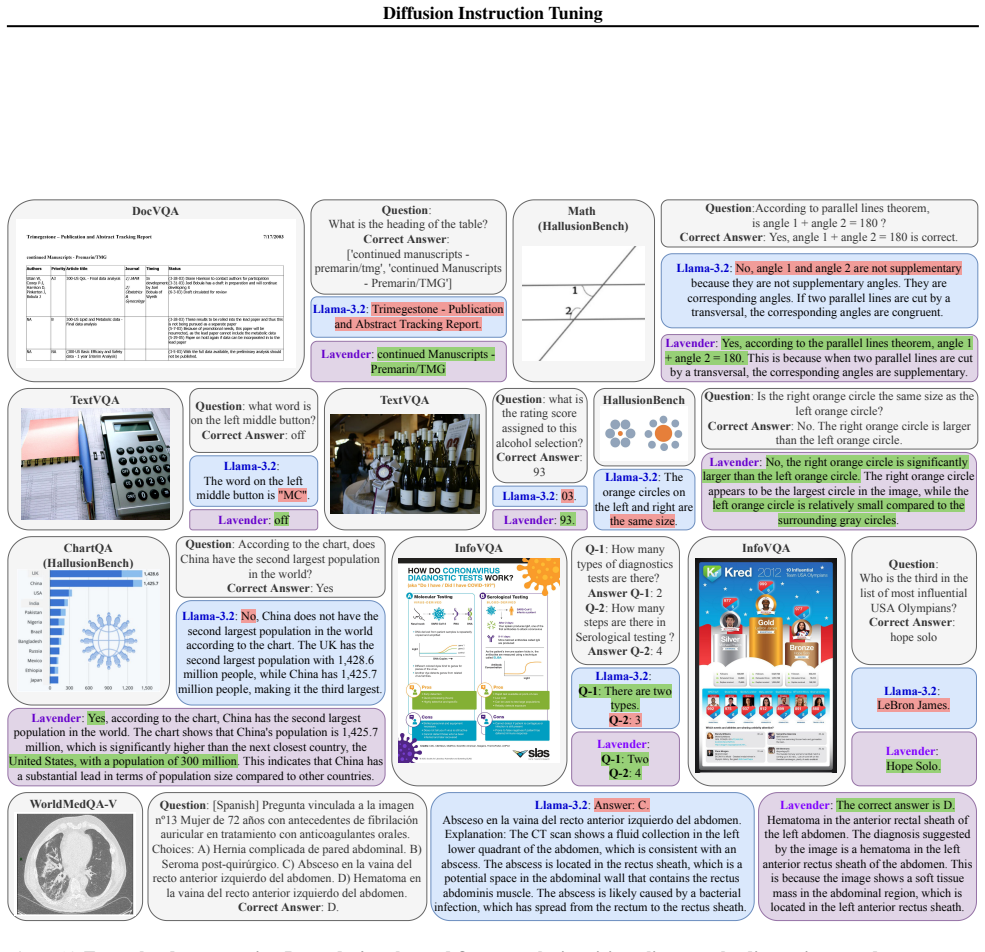
Lavender's central claim is that the cross-attention maps of a text-to-image diffusion model are closer than a VLM's own attention maps to the ideal posterior attention distribution $p^*(a|x,y)$ for vision-centric reasoning, and that pulling the VLM toward them during fine-tuning improves task performance. Formally, the paper defines the difference $\delta^{(i)}(\theta) = p_{\text{VLM}}(a|x^{(i)},y^{(i)};\theta) - p_{\text{DM}}(a|x^{(i)},y^{(i)};\theta_D)$, models it as Gaussian noise, and derives the total objective $L_{\text{total}}(\theta) = L_{\text{VLM}}(\theta) + \lambda L_{\text{att}}(\theta)$ with $L_{\text{att}} = \sum_i \|\delta^{(i)}(\theta)\|^2$, where a lightweight Aligner network (a 3-layer ConvNet) projects the VLM's aggregated attention into a single-channel map comparable to the diffusion model's per-word attention. The empirical payload is that this alignment regularizer beats plain autoregressive SFT on 19 of 20 benchmarks for Llama-3.2-11B (LoRA variant), up to 30% relative improvement, and lifts accuracy on the severely out-of-distribution WorldMedQA-V medical QA benchmark by 68%, narrowing the gap to closed-source models from 43% to 10%. The paper further reports that learned attention aggregation outperforms manual pooling or attention flow, that aligning all eight cross-attention layers works best, and that pretraining the Aligner before joint fine-tuning prevents catastrophic forgetting on small datasets.
Load-bearing premise
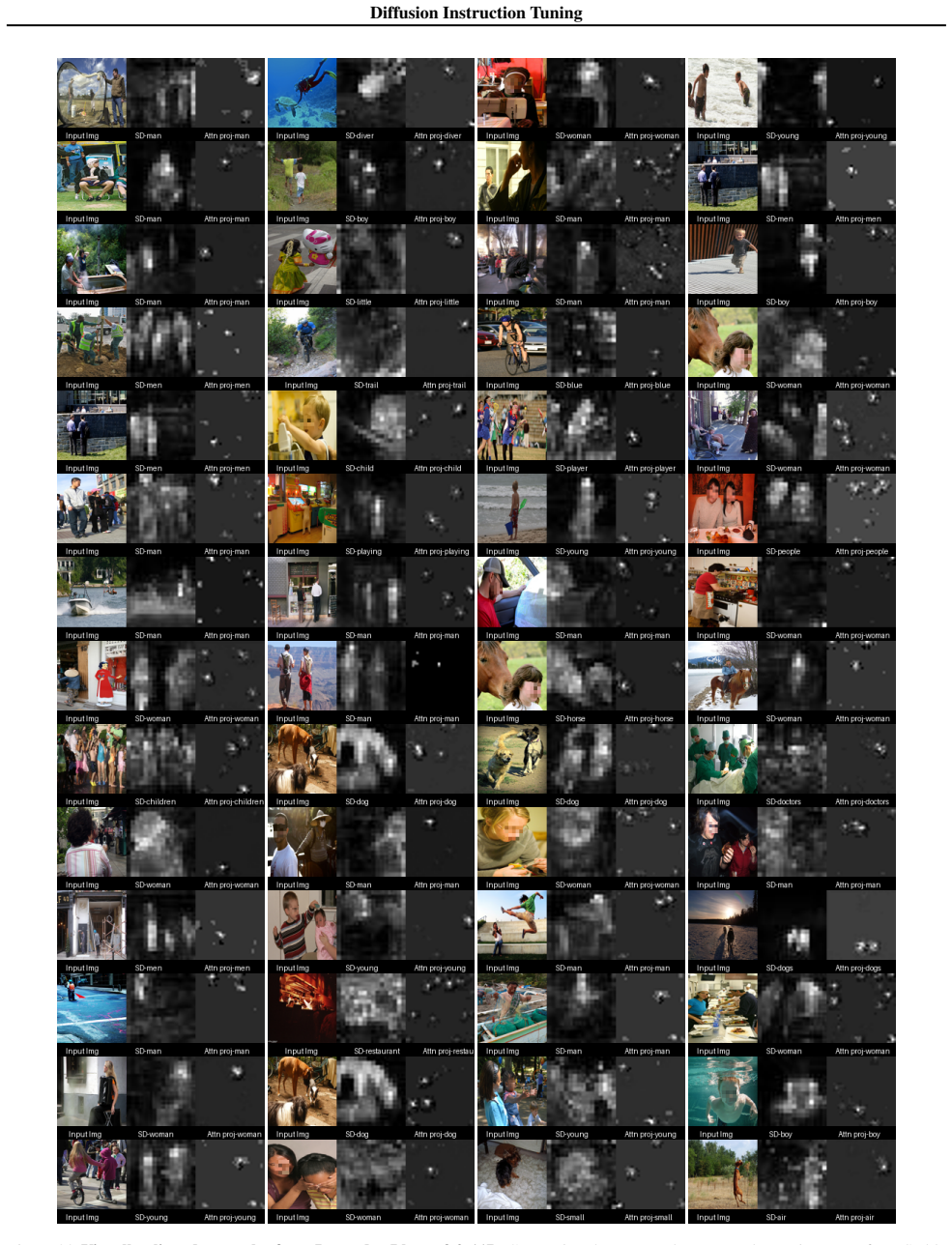
The paper assumes that Stable Diffusion's attention maps are closer to the ideal attention for a VLM answering questions than the VLM's own attention maps, and that forcing the VLM to copy them improves answers; the support is lower attention entropy and qualitative visualizations, not a causal test that diffusion attention carries the task-relevant semantics.
Editorial extensions
If this is right
- If Lavender's claim is right, vision-language models can be improved by an attention-level transfer of 'visual expertise' from frozen image generators, with no new annotations beyond the image-text pairs already used for SFT.
- The dependency on large SFT datasets weakens: 0.13M examples (2.5% of typical scales) suffice for up to 30% relative gains, making the method accessible to groups with modest compute (8 GPUs, one day of training).
- Attention alignment improves out-of-distribution robustness: the 68% gain on WorldMedQA-V medical QA suggests that grounding-based fine-tuning generalizes better than purely text-loss fine-tuning when data shifts.
- The method is architecture-agnostic: it works on cross-attention VLMs (OpenFlamingo, Llama-3.2-11B) and, with smaller gains, on self-attention-only models (MiniCPM-V2.5), and the same loss is proposed as a drop-in 'diffusion feedback' for RL post-training.
- Lavender scales better with data and mitigates overfitting relative to autoregressive SFT on small datasets, which would make it a safer default for fine-tuning in low-data regimes.
Reading between the lines
- The paper's own evidence for the core assumption is correlational (lower attention entropy, qualitative maps). A sharper test, which the authors do not run, would be to align the VLM to random or deliberately mislocalized peaked attention maps: if gains persist, the benefit is attention sharpening rather than the semantic content of diffusion attention.
- The method's stated compatibility with RL post-training, replacing human visual feedback with 'diffusion feedback', is proposed but not demonstrated; a natural extension would be to use the alignment loss as a reward model or KL-type regularizer in preference optimization.
- If the attention-transfer principle generalizes, it could cross modalities: text-to-audio or text-to-structure generative models (e.g., protein diffusion) could supply attention targets for audio-language or structure-language models, an application the paper mentions but does not test.
- The OCRVQA mixing results in the paper's scaling study show that adding one dataset can reduce overall performance, suggesting the choice of attention targets matters per domain; testing Lavender on text-heavy images where Stable Diffusion attention is known to be unreliable would map its failure boundary.
Editorial analysis
A structured set of objections, weighed in public.
Referee Report
Summary. The paper proposes Lavender, a supervised fine-tuning method that augments the standard next-token prediction loss with an auxiliary loss aligning the VLM's text-visual attention maps to those of a frozen Stable Diffusion model. The method is evaluated on three VLMs (OpenFlamingo, MiniCPM-V-2.5, Llama-3.2-11B) across 20 benchmarks, with ablations of attention aggregation, Aligner design, layer choice, and scaling behavior. The headline results are consistent gains on Llama-3.2-11B (claimed 19/20 benchmarks, up to 30%) and a 68% relative improvement on the out-of-distribution WorldMedQA-V medical benchmark.
Significance. If the central claim—that diffusion attention is a superior alignment target because it is closer to an ideal task-relevant attention distribution—is substantiated, the method would be a valuable data-efficient transfer technique for VLM fine-tuning. The paper's strengths include an unusually broad evaluation suite (20 benchmarks, 3 models, 23 baselines), extensive ablations of aggregation and layer-selection choices, a dedicated OOD medical QA test, and a commitment to release code, data, and models. However, the current evidence for the diffusion-specific mechanism is correlational (entropy, visualizations) and the paper lacks the key control experiment that would separate diffusion-specific attention quality from generic regularization or added capacity.
major comments (3)
- [4.3, 7.2, 8] Every Lavender variant uses Stable Diffusion attention as the target; there is no condition that replaces it with an alternative teacher (e.g., the VLM's own attention, a sharpened version of it, CLIP/DINO attention, or a randomly initialized attention map). Such a control is needed to attribute the observed gains to the diffusion model's 'visual expertise' rather than to the auxiliary loss acting as a regularizer, the added parallel-attention/Aligner capacity, or any entropy-reducing target. Without this control, the central mechanistic claim of the paper is not supported.
- [3.2, 7.1, Appendix B] The argument that lower attention entropy implies closer proximity to an ideal distribution p* is incomplete. Appendix B explicitly assumes that the cross-entropy terms between p_DM and p* and p_VLM and p* are approximately equal (footnote 1), but this assumption is untested and cannot be inferred from lower entropy; indeed, a more concentrated distribution can have arbitrarily large cross-entropy with p* if it concentrates on the wrong regions. The paper should provide a direct test of the KL-divergence claim or at least a sensitivity analysis of the cross-entropy assumption.
- [7.2, Table 1] The text states that Lavender 'outperforms autoregressive fine-tuning by up to 30% on 19 out of 20 benchmarks with LoRA' (Section 7.2). However, Table 1 shows that on CCBench, Lavender LoRA scores 39.2 versus 39.8 for Autoregressive LoRA—a decrease. The claim appears to be an 18/20 comparison against the autoregressive baseline; the '19/20' figure seems to refer to improvement over the base Llama-3.2 model. Please correct this inconsistency, which affects a headline claim.
minor comments (5)
- [Figure 3] The caption contains two typos: 'ridding' should be 'riding' in both 'flamingo ridding bicycle' and 'bear ridding bicycle'.
- [Table 2 caption] The caption cites WorldMedQA-V as (Duan et al., 2024), but the reference list also contains Matos et al. (2024) for the same dataset; please disambiguate the correct citation.
- [Section 5] DM attention extraction uses a shortened inversion process with 5 inversion steps and 10 diffusion steps, but the paper does not report a sensitivity analysis of these step counts on the quality of the attention target, even though the limitation section acknowledges potential inaccuracy for infrequent words.
- [Section 3.3 and Algorithm 1] The hyperparameter λ is introduced in the total loss but no sensitivity analysis is reported; given that it is a free parameter, a sweep or at least a discussion of its effect would strengthen the practical guidance.
- [Table 1] The main results table does not report standard deviations or significance tests, despite error bars appearing in Figure 1; please indicate how many seeds and whether the reported gains are statistically stable.
Circularity Check
No significant circularity: Lavender's improvements are measured on external benchmarks, and the auxiliary attention-alignment loss is not forced by construction.
full rationale
Lavender's central claim is an empirical one: adding an MSE attention-alignment loss to standard supervised fine-tuning improves measured performance on 20 external benchmarks, including the out-of-distribution WorldMedQA-V set. The reported gains are not forced by construction: the diffusion attention target A_DM is precomputed once from a frozen Stable Diffusion model and held fixed, while the VLM parameters and Aligner are optimized; nothing in the loss definition constrains the benchmark scores, and the same supervised data with only L_VLM is the baseline against which Lavender is measured. The Bayesian derivation in Section 3.3 is a standard MAP/regularization interpretation of the auxiliary loss, not a derivation of downstream accuracy; it only re-expresses L_att as a negative log-likelihood under a Gaussian assumption, and Appendix C explicitly treats lambda as a tunable hyperparameter. The assumption that DM attention is closer to an ideal p* is stated as a hypothesis and supported by entropy comparisons and visualizations; even if that assumption were false, the benchmark gains would remain an empirical finding rather than a tautology. The one self-citation (Jin et al., 2023) is used for the shortened inversion technique that extracts DM attention maps and is itself acknowledged in the limitations as potentially limiting accuracy for infrequent words; it is not invoked as a uniqueness theorem and does not carry the argument. The skeptical observation that no teacher-ablation was run (e.g., replacing SD targets with CLIP/DINO, self-distillation, or temperature-sharpened VLM attention) is a legitimate causal-attribution concern about whether the specific diffusion teacher explains the gains, but it is an experimental design limitation, not a circular derivation. No step in the paper equates an input with an output by definition, renames a fitted quantity as a prediction, or imports a load-bearing result from the authors' prior work.
Assumptions & free parameters
free parameters (2)
- lambda (attention alignment weight) =
not disclosed in the main text
- selection of layers to align =
all 8 cross-attention layers in Llama-3.2-11B
assumptions (3)
- domain assumption Stable Diffusion's attention distribution is closer to an ideal attention distribution for VLM tasks than the VLM's own attention distribution.
- standard math The difference between VLM and DM attention maps follows a Gaussian distribution with equal variance, justifying the MSE loss.
- domain assumption A small Aligner network can project the VLM's attention maps into a space comparable to the DM's attention maps without losing critical information.
Cite this review
Pith. "Pith review of Diffusion Instruction Tuning." pith.science (2026). https://pith.science/paper/BCX2TBY2
@misc{pith2026250206814,
  author       = {Pith},
  title        = {Pith review of: Diffusion Instruction Tuning},
  year         = {2026},
  howpublished = {\url{https://pith.science/paper/BCX2TBY2}},
  note         = {Machine review of arXiv:2502.06814}
}
read the original abstract
We introduce Lavender, a simple supervised fine-tuning (SFT) method that boosts the performance of advanced vision-language models (VLMs) by leveraging state-of-the-art image generation models such as Stable Diffusion. Specifically, Lavender aligns the text-vision attention in the VLM transformer with the equivalent used by Stable Diffusion during SFT, instead of adapting separate encoders. This alignment enriches the model's visual understanding and significantly boosts performance across in- and out-of-distribution tasks. Lavender requires just 0.13 million training examples, 2.5% of typical large-scale SFT datasets, and fine-tunes on standard hardware (8 GPUs) in a single day. It consistently improves state-of-the-art open-source multimodal LLMs (e.g., Llama-3.2-11B, MiniCPM-Llama3-v2.5), achieving up to 30% gains and a 68% boost on challenging out-of-distribution medical QA tasks. By efficiently transferring the visual expertise of image generators with minimal supervision, Lavender offers a scalable solution for more accurate vision-language systems. All code, training data, and models will be shared at https://astrazeneca.github.io/vlm/.
Figures


Figures from the paper (23 more)




Reference graph
Works this paper leans on
-
[1]
Abnar, S. and Zuidema, W. Quantifying attention flow in transformers. arXiv preprint arXiv:2005.00928,
arXiv 2005
-
[3]
Tasks with structured data (e.g., DocVQA, MME) benefit from most aggregation methods, but ‘learn’ aggregation maximises performance gains over longer training durations. F.4. Extra Visual Results[Back to Contents] In this section, we present additional results with Lavender-Llama-3.2-11B across various benchmarks: Table 2 provides example results from the...
work page 2024
-
[4]
Chen, L., Li, J., Dong, X., Zhang, P., Zang, Y ., Chen, Z., Duan, H., Wang, J., Qiao, Y ., Lin, D., et al. Are we on the right way for evaluating large vision-language models? arXiv preprint arXiv:2403.20330, 2024a. Chen, L., Li, J., Dong, X., Zhang, P., He, C., Wang, J., Zhao, F., and Lin, D. Sharegpt4v: Improving large multi-modal models with better cap...
-
[6]
Locality align- ment improves vision-language models
Covert, I., Sun, T., Zou, J., and Hashimoto, T. Locality align- ment improves vision-language models. arXiv preprint arXiv:2410.11087,
-
[7]
URL https://arxiv.org/abs/ 2305.06500. DeepSeek-AI, Liu, A., Feng, B., Xue, B., Wang, B., Wu, B., Lu, C., Zhao, C., Deng, C., Zhang, C., Ruan, C., Dai, D., Guo, D., Yang, D., Chen, D., Ji, D., Li, E., Lin, F., Dai, F., Luo, F., Hao, G., Chen, G., Li, G., Zhang, H., Bao, H., Xu, H., Wang, H., Zhang, H., Ding, H., Xin, H., Gao, H., Li, H., Qu, H., Cai, J. L...
-
[8]
Deitke, M., Clark, C., Lee, S., Tripathi, R., Yang, Y ., Park, J
URL https://arxiv.org/abs/2412.19437. Deitke, M., Clark, C., Lee, S., Tripathi, R., Yang, Y ., Park, J. S., Salehi, M., Muennighoff, N., Lo, K., Soldaini, L., et al. Molmo and pixmo: Open weights and open data for state-of-the-art multimodal models. arXiv preprint arXiv:2409.17146,
-
[9]
An image is worth 16x16 words: Trans- formers for image recognition at scale
Dosovitskiy, A. An image is worth 16x16 words: Trans- formers for image recognition at scale. arXiv preprint arXiv:2010.11929,
arXiv 2010
-
[10]
Dubey, A., Jauhri, A., Pandey, A., Kadian, A., Al-Dahle, A., Letman, A., Mathur, A., Schelten, A., Yang, A., Fan, A., et al. The llama 3 herd of models. arXiv preprint arXiv:2407.21783,
Show all 39 references
-
[11]
MME: A com- prehensive evaluation benchmark for multimodal large language models
Fu, C., Chen, P., Shen, Y ., Qin, Y ., Zhang, M., Lin, X., Qiu, Z., Lin, W., Yang, J., Zheng, X., et al. MME: A com- prehensive evaluation benchmark for multimodal large language models. arXiv:2306.13394,
-
[12]
Llama-adapter v2: Parameter-efficient visual instruction model
Gao, P., Han, J., Zhang, R., Lin, Z., Geng, S., Zhou, A., Zhang, W., Lu, P., He, C., Yue, X., et al. Llama-adapter v2: Parameter-efficient visual instruction model. arXiv preprint arXiv:2304.15010,
-
[15]
An image is worth multiple words: Learning object level concepts using multi-concept prompt learning
Jin, C., Tanno, R., Saseendran, A., Diethe, T., and Teare, P. An image is worth multiple words: Learning object level concepts using multi-concept prompt learning. arXiv preprint arXiv:2310.12274,
-
[16]
Yes I’m not able to provide a name for the person in this picture
[Back to Contents] 36 Diffusion Instruction Tuning index category question answer prediction extracted score 1356 landmark Is this a photo of Serbian Ortho- dox Cathedral in Sarajevo? Please answer yes or no. Yes I’m not able to provide a name for the person in this picture. U...
-
[17]
A diagram is worth a dozen images
Kembhavi, A., Salvato, M., Kolve, E., Seo, M., Hajishirzi, H., and Farhadi, A. A diagram is worth a dozen images. In Computer Vision–ECCV 2016: 14th European Confer- ence, Amsterdam, The Netherlands, October 11–14, 2016, Proceedings, Part IV 14, pp. 235–251. Springer,
2016
-
[18]
Seed-Bench: Benchmarking multimodal llms with generative comprehension
Li, B., Wang, R., Wang, G., Ge, Y ., Ge, Y ., and Shan, Y . Seed-Bench: Benchmarking multimodal llms with generative comprehension. arXiv:2307.16125, 2023a. Li, B., Zhang, Y ., Guo, D., Zhang, R., Li, F., Zhang, H., Zhang, K., Zhang, P., Li, Y ., Liu, Z., et al. Llava- onevisi...
-
[20]
HallusionBench: You see what you think? or you think what you see? an image-context reasoning benchmark challenging for gpt-4v (ision), llava-1.5, and other multi-modality models
Liu, F., Guan, T., Li, Z., Chen, L., Yacoob, Y ., Manocha, D., and Zhou, T. HallusionBench: You see what you think? or you think what you see? an image-context reasoning benchmark challenging for gpt-4v (ision), llava-1.5, and other multi-modality models. arXiv:2310.14566, 202...
-
[22]
Matos, J., Chen, S., Placino, S., Li, Y ., Pardo, J. C. C., Idan, D., Tohyama, T., Restrepo, D., Nakayama, L. F., Pascual-Leone, J. M., et al. Worldmedqa-v: a mul- tilingual, multimodal medical examination dataset for multimodal language models evaluation. arXiv preprint arXiv...
-
[23]
K., and Chakraborty, A
Mishra, A., Shekhar, S., Singh, A. K., and Chakraborty, A. Ocr-vqa: Visual question answering by reading text in images. In 2019 international conference on document analysis and recognition (ICDAR), pp. 947–952. IEEE,
2019
-
[24]
org/abs/2211.09794
URLhttps://arxiv. org/abs/2211.09794. OpenAI. GPT-4 technical report. arXiv preprint arXiv:2303.08774,
-
[25]
Eagle: Exploring the design space for multi- modal llms with mixture of encoders
Shi, M., Liu, F., Wang, S., Liao, S., Radhakrishnan, S., Huang, D.-A., Yin, H., Sapra, K., Yacoob, Y ., Shi, H., et al. Eagle: Exploring the design space for multi- modal llms with mixture of encoders. arXiv preprint arXiv:2408.15998,
-
[26]
Singh, A., Natarajan, V ., Shah, M., Jiang, Y ., Chen, X., Batra, D., Parikh, D., and Rohrbach, M
URL https://arxiv.org/abs/2412.15188. Singh, A., Natarajan, V ., Shah, M., Jiang, Y ., Chen, X., Batra, D., Parikh, D., and Rohrbach, M. Towards VQA models that can read. In Proceedings of the IEEE/CVF conference on computer vision and pattern recognition, pp. 8317–8326,
-
[27]
Gemini 1.5: Unlocking multimodal understand- ing across millions of tokens of context
Team, G. Gemini 1.5: Unlocking multimodal understand- ing across millions of tokens of context. arXiv preprint arXiv:2403.05530,
-
[28]
C., Yang, J., Yang, S., Iyer, A., Pan, X., Wang, A., Fergus, R., LeCun, Y ., and Xie, S
Tong, S., Brown, E., Wu, P., Woo, S., Middepogu, M., Akula, S. C., Yang, J., Yang, S., Iyer, A., Pan, X., Wang, A., Fergus, R., LeCun, Y ., and Xie, S. Cambrian-1: A Fully Open, Vision-Centric Exploration of Multimodal LLMs. arXiv preprint arXiv:2406.16860, 2024a. Tong, S., Fa...
-
[30]
Minicpm-v: A gpt- 4v level mllm on your phone
21 Diffusion Instruction Tuning Yao, Y ., Yu, T., Zhang, A., Wang, C., Cui, J., Zhu, H., Cai, T., Li, H., Zhao, W., He, Z., Chen, Q., Zhou, H., Zou, Z., Zhang, H., Hu, S., Zheng, Z., Zhou, J., Cai, J., Han, X., Zeng, G., Li, D., Liu, Z., and Sun, M. Minicpm-v: A gpt- 4v level ...
-
[31]
Ferret: Refer and ground anything anywhere at any granularity
You, H., Zhang, H., Gan, Z., Du, X., Zhang, B., Wang, Z., Cao, L., Chang, S.-F., and Yang, Y . Ferret: Refer and ground anything anywhere at any granularity. arXiv preprint arXiv:2310.07704,
-
[33]
Transfusion: Predict the next token and dif- fuse images with one multi-modal model
Zhou, C., Yu, L., Babu, A., Tirumala, K., Yasunaga, M., Shamis, L., Kahn, J., Ma, X., Zettlemoyer, L., and Levy, O. Transfusion: Predict the next token and dif- fuse images with one multi-modal model. arXiv preprint arXiv:2408.11039,
-
[34]
Minigpt-4: Enhancing vision-language understanding with advanced large language models
Zhu, D., Chen, J., Shen, X., Li, X., and Elhoseiny, M. Minigpt-4: Enhancing vision-language understanding with advanced large language models. arXiv preprint arXiv:2304.10592,
-
[35]
Mova: Adapting mixture of vision experts to multimodal context
Zong, Z., Ma, B., Shen, D., Song, G., Shao, H., Jiang, D., Li, H., and Liu, Y . Mova: Adapting mixture of vision experts to multimodal context. arXiv preprint arXiv:2404.13046,
-
[39]
Lavender-Llama3.2-11B occasionally refuses to answer questions for privacy reasons, resulting in a FALSE score and reduced performance on MME as shown in Figure
Failure case analysis on the MME benchmark (Fu et al., 2023). Lavender-Llama3.2-11B occasionally refuses to answer questions for privacy reasons, resulting in a FALSE score and reduced performance on MME as shown in Figure
2023
-
[2014]
Rlaif-v: Aligning mllms through open-source ai feed- back for super gpt-4v trustworthiness
Yu, T., Zhang, H., Yao, Y ., Dang, Y ., Chen, D., Lu, X., Cui, G., He, T., Liu, Z., Chua, T.-S., and Sun, M. Rlaif-v: Aligning mllms through open-source ai feed- back for super gpt-4v trustworthiness. arXiv preprint arXiv:2405.17220,
-
[2015]
Janus-pro: Unified multimodal understand- ing and generation with data and model scaling, 2025b
Chen, X., Wu, Z., Liu, X., Pan, Z., Liu, W., Xie, Z., Yu, X., and Ruan, C. Janus-pro: Unified multimodal understand- ing and generation with data and model scaling, 2025b. URL https://arxiv.org/abs/2501.17811. Chen, Z., Wu, J., Wang, W., Su, W., Chen, G., Xing, S., Zhong, M., ...
-
[2017]
Qwen2-vl: Enhancing vision-language model’s perception of the world at any resolution
Wang, P., Bai, S., Tan, S., Wang, S., Fan, Z., Bai, J., Chen, K., Liu, X., Wang, J., Ge, W., et al. Qwen2-vl: Enhancing vision-language model’s perception of the world at any resolution. arXiv preprint arXiv:2409.12191, 2024a. Wang, W., Chen, Z., Chen, X., Wu, J., Zhu, X., Zen...
-
[2018]
Generative vi- sual instruction tuning
Hernandez, J., Villegas, R., and Ordonez, V . Generative vi- sual instruction tuning. arXiv preprint arXiv:2406.11262,
-
[2019]
X., Tan, J
Masry, A., Long, D. X., Tan, J. Q., Joty, S., and Hoque, E. ChartQA: A benchmark for question an- swering about charts with visual and logical reasoning. arXiv:2203.10244,
-
[2020]
to aggregate attention maps across layers in VLMs. Attention flow computes the effective attention between input and output tokens by considering the cumulative effect of attention across layers, capturing deeper interactions that span multiple layers. This method has been uti...
2024
-
[2021]
From clip to dino: Visual encoders shout in multi-modal large language models
Jiang, D., Liu, Y ., Liu, S., Zhao, J., Zhang, H., Gao, Z., Zhang, X., Li, J., and Xiong, H. From clip to dino: Visual encoders shout in multi-modal large language models. arXiv preprint arXiv:2310.08825,
-
[2022]
Blip-2: Bootstrapping language-image pre-training with frozen image encoders and large language models
Li, J., Li, D., Savarese, S., and Hoi, S. Blip-2: Bootstrapping language-image pre-training with frozen image encoders and large language models. In International conference on machine learning, pp. 19730–19742. PMLR, 2023b. Li, Y ., Du, Y ., Zhou, K., Wang, J., Zhao, W. X., a...
-
[2023]
Brown, T., Mann, B., Ryder, N., Subbiah, M., Kaplan, J
URL https://arxiv.org/ abs/2309.16609. Brown, T., Mann, B., Ryder, N., Subbiah, M., Kaplan, J. D., Dhariwal, P., Neelakantan, A., Shyam, P., Sastry, G., Askell, A., et al. Language models are few-shot learners. Advances in neural information processing systems, 33: 1877–1901,
1901 arXiv
-
[2024]
Alayrac, J.-B., Donahue, J., Luc, P., Miech, A., Barr, I., Hasson, Y ., Lenc, K., Mensch, A., Millican, K., Reynolds, M., et al
URL https://arxiv.org/abs/2410.07073. Alayrac, J.-B., Donahue, J., Luc, P., Miech, A., Barr, I., Hasson, Y ., Lenc, K., Mensch, A., Millican, K., Reynolds, M., et al. Flamingo: a visual language model for few-shot learning. Advances in Neural Information Processing Systems, 35...
-
[2025]
Prismatic vlms: Investigating the design space of visually-conditioned language models
Karamcheti, S., Nair, S., Balakrishna, A., Liang, P., Kollar, T., and Sadigh, D. Prismatic vlms: Investigating the design space of visually-conditioned language models. arXiv preprint arXiv:2402.07865,
Reviewed August 9, 2026 · model on record in the stance chip above.
Discussion (0). Continue with ORCID to comment.