REVIEW 4 major objections 5 minor 2 cited by
MMInference: Accelerating Pre-filling for Long-Context VLMs via Modality-Aware Permutation Sparse Attention
T0 review · 4 major / 5 minor · reviewed 2026-08-16 · deepseek-v4-flash
Pith's one-line read MMInference claims that modality-aware permutation sparse attention accelerates long-context VLM pre-filling by up to 8.3x at 1M tokens while matching full-attention accuracy on the benchmarks tested.
desk verdict Credible training-free VLM prefill accelerator; permutation-based grid/modality handling is a real extension of MInference, but the 1M accuracy claim needs scoping and the EgoSchema calibration leak should be fixed. read the letter →
The pith
A machine-rendered reading of the paper's core claim, the machinery that carries it, and where it could break.
The reading
What carries the argument
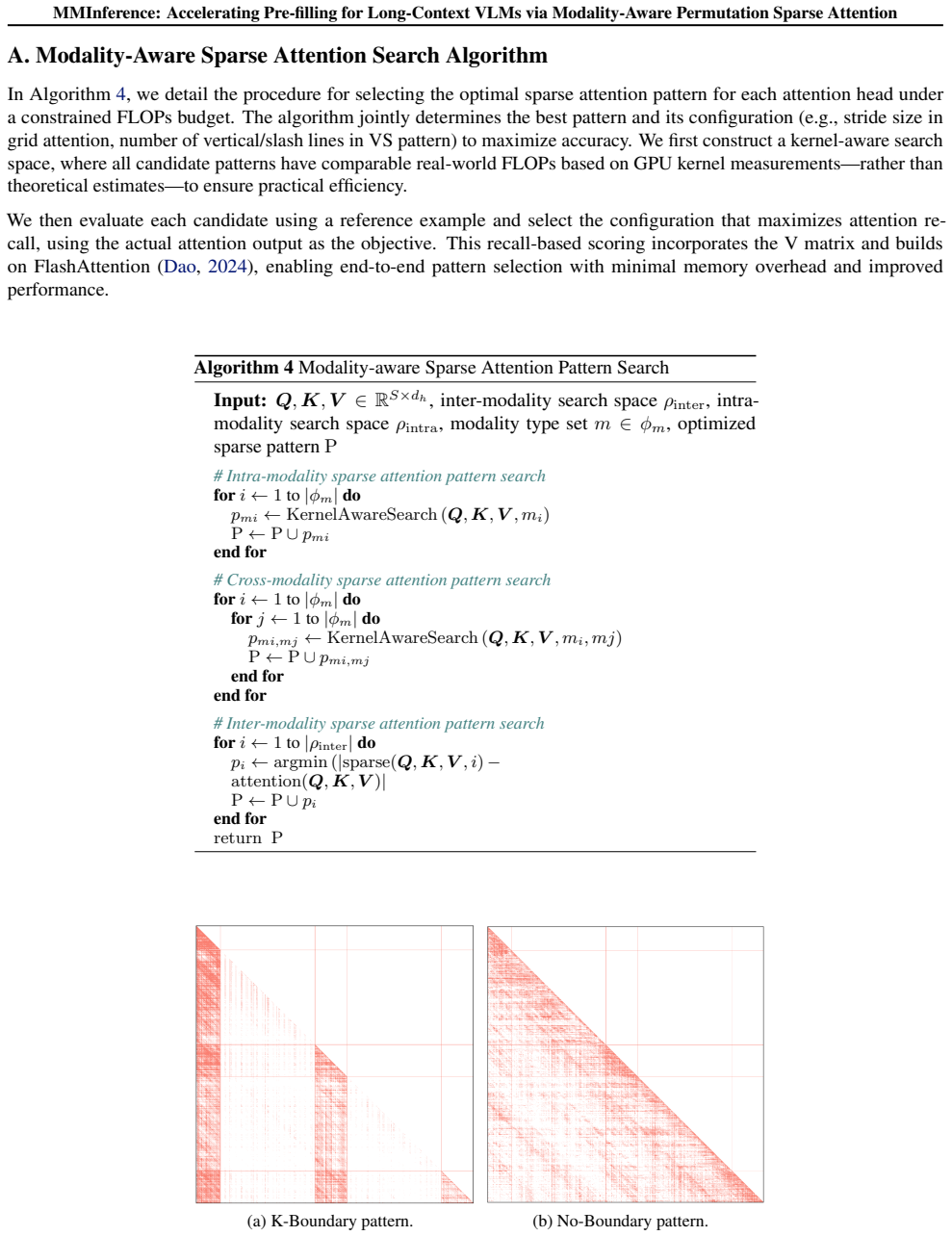
The load-bearing machinery is the permutation of the $Q$, $K$, and $V$ tensors guided by a dynamic sparse index. It works through three pattern families: (1) the Grid pattern for video-heavy heads, whose stride and phase are found online by scanning an approximate attention matrix built from the last 64 queries, after which the tensors are permuted so that grid lines align into contiguous blocks (Algorithm 1); (2) the Q-Boundary and 2D-Boundary heads, where row-wise or full modality-grouping permutation isolates intra-modality regions, so a sparse index built once in one visual region extrapolates across text-interrupted visual segments (Algorithms 2 and 3); and (3) the Modality-Aware Sparse Attention Search Algorithm (Algorithm 4), which assigns each head its pattern offline under a kernel-measured FLOPs budget, calibrated on a single 25K-token video sample. Computation is carried out by block-sparse FlashAttention-style kernels (built on FlashAttention-2 and the PIT dynamic sparse compilation approach) that load only the permuted blocks, keeping tensor-core compute dense.
What would settle it
Construct a long mixed-modality input in which the final 64 queries of a visual segment attend to a different key region than the earlier tokens of that segment (a scene cut or topic shift placed exactly at the segment end), and measure both the attention recall of the online-estimated masks and the needle-retrieval score. If attention recall falls far below the roughly 95% threshold the paper's own analysis treats as adequate, or retrieval drops from the reported 97.7% on V-NIAH, the last-64-queries extrapolation premise is false.
Extended reading notes
Core claim
The paper's central claim is that attention in long-context VLMs is sparse in a way that is both modality-structured and permutation-friendly, so that full-attention accuracy can be recovered by computing only a fraction of the attention matrix. It identifies three pattern families: the Grid pattern, in which video tokens attend along evenly spaced horizontal and vertical lines whose stride and phase are searched online from an approximate attention matrix; the Q-Boundary and 2D-Boundary patterns, where modality boundaries split the query dimension or both query and key dimensions; and the A-shape and Vertical-Slash patterns carried over from text-only LLMs. The method's namesake move is to permute the $Q$, $K$, and $V$ tensors so these patterns become consecutive, with row-wise permutation grouping same-modality queries, column-wise permutation aligning key strides, and 2D permutation isolating each modality pair into its own block, turning scattered sparse loads into dense tensor-core computation. Permutation is realized as index-based sparse loading inside FlashAttention-style kernels, so no weights change and no fine-tuning is needed. Offline, a modality-aware search (Algorithm 4) assigns each head its optimal pattern set under a kernel-measured FLOPs budget; online, the sparse index is estimated from the last 64 queries of each modality segment and the attention is computed with block-sparse kernels. On four VLMs and inputs up to 1.1M tokens, the paper reports up to 8.3x prefill speedup over FlashAttention-2 with benchmark scores matching full attention, including 97.7% versus 98.3% retrieval recall on V-NIAH and 91.3% versus 90.9% on its new mixed-modality NIAH test.
Load-bearing premise
The per-head sparse patterns chosen offline from a single 25K-token calibration sample, plus the online sparse indices estimated from the last 64 queries of each modality segment, must transfer to arbitrary inputs, contexts up to 1M tokens, and benchmarks the calibration never saw; if the transfer fails, the masks miss true attention mass and accuracy degrades.
Editorial extensions
If this is right
- At 1M-token contexts the pre-fill stage runs up to 8.3x faster end-to-end and up to 12x faster at the kernel level, turning multi-minute waits on one A100 into a small fraction of the time.
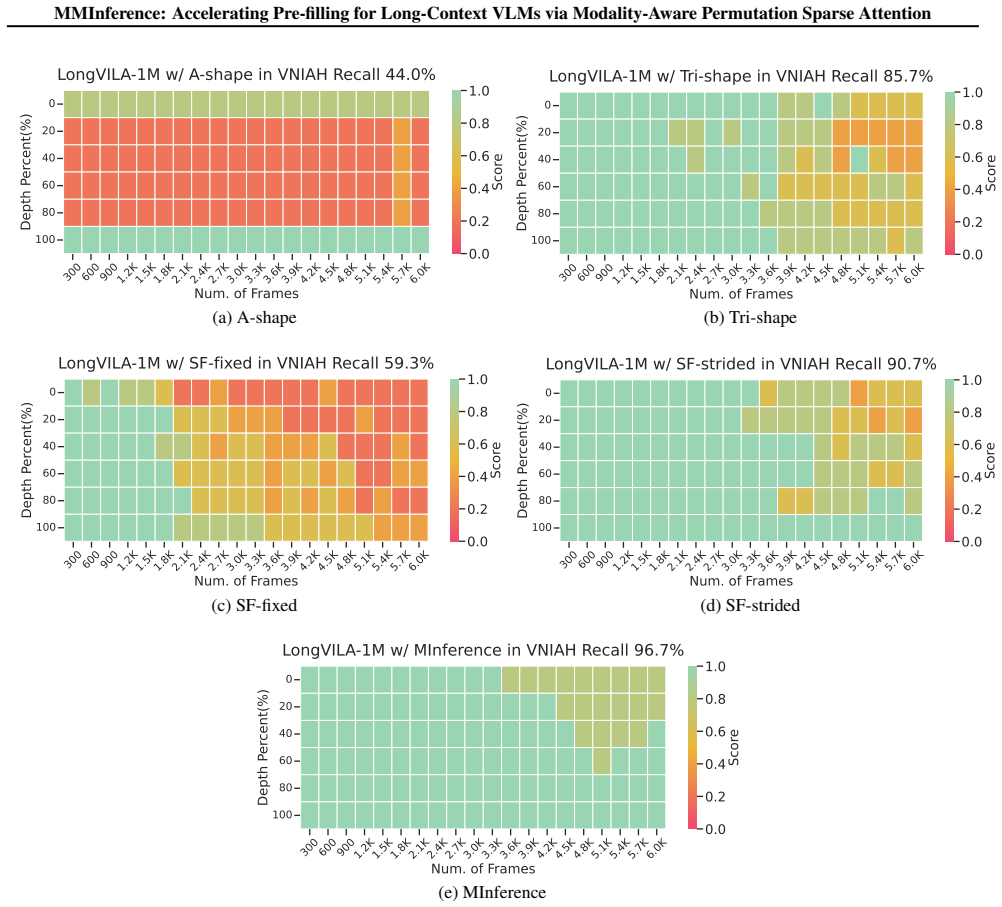
- Accuracy holds: average scores on six video understanding benchmarks stay within roughly half a point of full attention, and long-video retrieval recall remains at 97.7% versus 98.3% for full attention at 6K frames.
- The method is training-free and model-agnostic, applying to LongVILA, Llava-Video, VideoChat-Flash, and Qwen2.5-VL, and it stacks with visual-token compression instead of competing with it.
- Static sparse patterns degrade sharply on mixed-modality inputs, whereas MMInference keeps retrieval near full-attention levels up to roughly 1.1M tokens, evidence that handling modality boundaries, not sparsity alone, is what preserves accuracy.
Reading between the lines
- The permutation principle should extend beyond prefill: the paper itself notes that 2D/3D sliding-window attention in video diffusion transformers can be reshaped into dense tensor-core tiles by an analogous permutation, which would bring the same speedup to generative video models rather than only to the prefill stage of VLMs.
- A testable extension is per-modality index amortization: since a sparse index from one visual region extrapolates across text-separated visual segments, building the index once per modality segment and reusing it could remove even the small cost of the last-64-queries estimator at extreme context lengths.
- The reported robustness rests on an unusually small calibration set, one EgoSchema sample of at most 25K tokens, so re-running the offline pattern search across diverse video/text mixtures (different frame rates, scene cuts, interleaving ratios) would map where per-head pattern assignments stay stable and where they break.
Signed reviews
Editorial analysis
A structured set of objections, weighed in public.
Referee Report
Summary. The paper introduces MMInference, a training-free dynamic sparse attention method for accelerating the pre-filling stage of long-context vision-language models (VLMs). The authors identify a Grid attention pattern in video inputs, characterize modality-boundary patterns (Q-Boundary, 2D-Boundary, etc.), and propose permutation-based transformations plus an offline per-head pattern search (Algorithm 4) to construct dynamic sparse masks. They provide optimized Triton/FlashAttention-based kernels. Experiments on Llava-Video, LongVILA, Qwen2.5-VL, and VideoChat-Flash report accuracy close to full attention on video QA and captioning benchmarks, with speedups up to 8.3x at roughly 1M tokens on V-NIAH and MM-NIAH retrieval tasks.
Significance. If the accuracy-retention claim holds at the claimed scale, MMInference is a noteworthy systems contribution: it is training-free, model-agnostic, and demonstrates that modality-aware permutation can convert irregular multimodal sparse patterns into efficient dense-block computations. The latency measurements are concrete and reproducible in spirit, and the paper ships code. The kernel-level analyses and the Grid-pattern observation are useful for follow-up work on efficient long-video inference. However, the breadth of the accuracy claim currently exceeds the evidence: the calibration-to-evaluation overlap on EgoSchema and the restriction of 1M-token validation to synthetic needle-in-a-haystack tasks leave the 'maintaining accuracy' clause less secure than the abstract suggests.
major comments (4)
- [Appendix C.5, Table 1] The per-head pattern assignment is calibrated on a single EgoSchema sample of at most 25K tokens, and EgoSchema is also a headline benchmark in Table 1. This creates a selection-to-evaluation overlap: the search objective (attention recall on this one sample) directly influences the choice of sparse patterns that are then reported as improved or maintained accuracy on EgoSchema. The claim in Appendix C.5 that this calibration 'exhibits strong generalization and stability' needs quantitative support, for example by re-running the offline search on a sample from a different benchmark and reporting both configurations, or by explicitly treating EgoSchema as a development set and not a held-out evaluation.
- [Abstract, §4.3, §4.4, Fig. 5] The central claim of 'maintaining accuracy' at 1M tokens is supported only by V-NIAH and MM-NIAH, which test a single inserted needle at various depths in long video/text haystacks. These tasks do not exercise sustained reasoning, detailed captioning, or multi-turn mixed-modality interactions at long context, so the 1M-token evidence is narrower than the abstract's unqualified 'maintaining accuracy.' I recommend either adding long-context accuracy measurements on a broader set of tasks (for example, long-form video QA with explicit long-range reasoning or document-scale mixed-modal tasks) or explicitly qualifying the accuracy claim to retrieval-style tasks at the 1M scale.
- [§5 (Related Work), §4.1 (Baselines)] xAttention (Xu et al., 2025b) is cited as a recent dynamic sparse attention method for long-context VLMs, but it is not included in any comparison table or latency experiment. Since the paper's contribution is precisely a dynamic sparse attention scheme for VLMs, the absence of this closest comparable baseline leaves the claimed advantage over prior dynamic sparse VLM methods unevidenced. A direct comparison on the same benchmarks and latency setup should be added, or the exclusion should be explicitly justified.
- [Algorithm 4 and §4.6 (Fig. 8)] The offline search uses attention recall on one calibration sample as the selection objective, but the paper does not demonstrate that this recall-based proxy transfers to downstream task accuracy across diverse inputs, context lengths, or benchmarks. Fig. 8 tests index transfer within the same modality but not the transfer of the per-head pattern configuration selected on one EgoSchema sample to the full set of evaluation inputs. A sensitivity analysis showing pattern stability across multiple calibration samples and across context lengths (e.g., 20K, 66K, 300K, 1M tokens) would strengthen the load-bearing transfer assumption.
minor comments (5)
- [Appendix E.1 and E.2] There are typos: 'attenton' should be 'attention' in the sentences introducing Figs. 13 and 14.
- [Appendix C.5] 'egoschema' is written in lowercase in the text; use consistent capitalization for the benchmark name.
- [Algorithm 5] In Grid-Shape Flash Attention, the pseudocode after the softmax-like rescaling is abbreviated (the exp and normalization steps are compressed), which makes it hard to verify correctness against the FlashAttention-2 equations. Please expand the pseudocode so the rescaling and softmax updates are explicit.
- [Table 2] The VideoChat-Flash row reports performance without a full-attention baseline in the same table; adding Full Attention and MInference for this model would make the comparison easier to interpret.
- [Abstract and §3.3] The phrase 'offline search the optimal sparse patterns' is a grammatical artifact; consider rephrasing to 'offline search for the optimal sparse patterns.'
Circularity Check
One partial overlap: per-head patterns are calibrated on an EgoSchema sample while EgoSchema test is reported; the core approximation and speedup claims are otherwise independently benchmarked.
-
fitted input called prediction
[Appendix C.5 (Search Space); Algorithm 4; Table 1]
"Additionally, we use only one sample as our calibration set from the egoschema task with no more than 25K tokens, which exhibits strong generalization and stability across different lengths and domains. The search time is approximately 15 minutes on a single A100. This pattern search is individually conducted for each model: Llava-Video-7B, LongVila-256Frame, and LongVila-1M."
Algorithm 4 fits each attention head's sparse pattern by selecting the configuration that maximizes attention recall on a reference example, and the reference example is drawn from the EgoSchema task. Table 1 then reports EgoSchema test accuracy as evidence that MMInference maintains accuracy. The EgoSchema row is therefore not a fully held-out test of the searched configuration: the per-head pattern assignment was optimized on an input from the same benchmark and domain, so part of the reported score reflects the search objective's in-sample fit.
full rationale
MMInference is an approximate-attention method rather than a derived law, so most of its evaluation is honest benchmarking against full attention and sparse baselines. The speedup claim is supported by kernel-level and end-to-end latency measurements (Figs. 7 and 16), including the 8.3x figure at 1M tokens, and these do not depend on any fitted pattern. The accuracy-retention claim is supported by independent benchmarks that were not used in the offline pattern search: ActNet-QA, Next-QA, VideoMME, V-NIAH, and MM-NIAH, the latter two including 1M-token retrieval tests. The only circular burden is the calibration-to-evaluation overlap in Appendix C.5: the per-head pattern assignment is selected on one EgoSchema sample, and Table 1 then reports EgoSchema test as a headline accuracy result. This is a partial fitted-input-called-prediction issue, not a derivation-level circularity, and self-citations to MInference and PIT are implementation-level rather than load-bearing. Missing xAttention comparison is an evidence gap, not a circularity. Score 4.
Assumptions & free parameters
free parameters (7)
- per-head pattern assignment =
varies: Grid / A-shape / Vertical-Slash / Q-Boundary / 2D-Boundary per head per model
- lastq =
64
- Grid stride and phase =
estimated online; search over frame stride and stride with max_stride=1024
- Vertical-Slash sizes =
vertical in {1000, 2000, 3500}; slash in {200, 1024, 2048, 2500, 3096, 4096}
- A-shape local window =
sink=128; local in {1024, 2048, 4096}
- target FLOPs budget =
1k global + 4k local tokens
- offline calibration sample =
one EgoSchema sample, at most 25K tokens
assumptions (6)
- standard math Permuting query, key, and value indices in the same way, and permuting the attention mask accordingly, preserves the attention output.
- domain assumption The sparse pattern observed in the last 64 query tokens of a modality extrapolates to all query positions in that modality.
- domain assumption Per-head pattern assignments found offline on one 25K-token EgoSchema sample transfer to other inputs, lengths, and benchmarks.
- domain assumption Video attention heads exhibit a repeatable grid structure with evenly spaced horizontal and vertical lines.
- domain assumption Modality boundaries are fully captured by the No-Boundary, K-Boundary, Q-Boundary, and 2D-Boundary taxonomy and remain stable for a given model.
- ad hoc to paper Attention recall on one calibration sample is a sufficient proxy for downstream task accuracy.
Cite this review
Pith. "Pith review of MMInference: Accelerating Pre-filling for Long-Context VLMs via Modality-Aware Permutation Sparse Attention." pith.science (2026). https://pith.science/paper/BD4CA7UC
@misc{pith2026250416083,
  author       = {Pith},
  title        = {Pith review of: MMInference: Accelerating Pre-filling for Long-Context VLMs via Modality-Aware Permutation Sparse Attention},
  year         = {2026},
  howpublished = {\url{https://pith.science/paper/BD4CA7UC}},
  note         = {Machine review of arXiv:2504.16083}
}
read the original abstract
The integration of long-context capabilities with visual understanding unlocks unprecedented potential for Vision Language Models (VLMs). However, the quadratic attention complexity during the pre-filling phase remains a significant obstacle to real-world deployment. To overcome this limitation, we introduce MMInference (Multimodality Million tokens Inference), a dynamic sparse attention method that accelerates the prefilling stage for long-context multi-modal inputs. First, our analysis reveals that the temporal and spatial locality of video input leads to a unique sparse pattern, the Grid pattern. Simultaneously, VLMs exhibit markedly different sparse distributions across different modalities. We introduce a permutation-based method to leverage the unique Grid pattern and handle modality boundary issues. By offline search the optimal sparse patterns for each head, MMInference constructs the sparse distribution dynamically based on the input. We also provide optimized GPU kernels for efficient sparse computations. Notably, MMInference integrates seamlessly into existing VLM pipelines without any model modifications or fine-tuning. Experiments on multi-modal benchmarks-including Video QA, Captioning, VisionNIAH, and Mixed-Modality NIAH-with state-of-the-art long-context VLMs (LongVila, LlavaVideo, VideoChat-Flash, Qwen2.5-VL) show that MMInference accelerates the pre-filling stage by up to 8.3x at 1M tokens while maintaining accuracy. Our code is available at https://aka.ms/MMInference.
Figures


Figures from the paper (15 more)






Forward citations
Cited by 2 Pith papers
-
Sparse VideoGen: Accelerating Video Diffusion Transformers with Spatial-Temporal Sparsity
Sparse VideoGen accelerates video diffusion transformers by about 2.3x with only small quality loss by classifying attention heads into spatial and temporal sparse patterns and using hardware-friendly layouts.
-
Video-XL-2: Towards Very Long-Video Understanding Through Task-Aware KV Sparsification
Video-XL-2 cuts long-video inference cost with chunked pre-filling and query-gated dense-or-sparse KV reloading, reporting half the FLOPs and a third less decoding memory at roughly equal benchmark scores.
Reference graph
Works this paper leans on
-
[1]
write newline
" write newline "" before.all 'output.state := FUNCTION n.dashify 't := "" t empty not t #1 #1 substring "-" = t #1 #2 substring "--" = not "--" * t #2 global.max substring 't := t #1 #1 substring "-" = "-" * t #2 global.max substring 't := while if t #1 #1 substring * t #2 global.max substring 't := if while FUNCTION format.date year duplicate empty "emp...
-
[2]
Star attention: Efficient llm inference over long sequences
Acharya, S., Jia, F., and Ginsburg, B. Star attention: Efficient llm inference over long sequences. ArXiv preprint, abs/2411.17116, 2024. URL https://arxiv.org/abs/2411.17116
arXiv 2024
-
[3]
Bai, S., Chen, K., Liu, X., Wang, J., Ge, W., Song, S., Dang, K., Wang, P., Wang, S., Tang, J., et al. Qwen2. 5-vl technical report. ArXiv preprint, abs/2502.13923, 2025. URL https://arxiv.org/abs/2502.13923
arXiv 2025
-
[4]
R., Finn, C., Kumar, A., and Levine, S
Black, K., Nakamoto, M., Atreya, P., Walke, H. R., Finn, C., Kumar, A., and Levine, S. Zero-shot robotic manipulation with pre-trained image-editing diffusion models. In The Twelfth International Conference on Learning Representations, 2024. URL https://openreview.net/forum?id=c0chJTSbci
work page 2024
-
[5]
Token merging: Your vit but faster
Bolya, D., Fu, C.-Y., Dai, X., Zhang, P., Feichtenhofer, C., and Hoffman, J. Token merging: Your vit but faster. ICLR, 2023
work page 2023
-
[6]
Gr-2: A generative video-language-action model with web-scale knowledge for robot manipulation
Cheang, C.-L., Chen, G., Jing, Y., Kong, T., Li, H., Li, Y., Liu, Y., Wu, H., Xu, J., Yang, Y., et al. Gr-2: A generative video-language-action model with web-scale knowledge for robot manipulation. ArXiv preprint, abs/2410.06158, 2024. URL https://arxiv.org/abs/2410.06158
-
[7]
Chen, L., Zhao, H., Liu, T., Bai, S., Lin, J., Zhou, C., and Chang, B. An image is worth 1/2 tokens after layer 2: Plug-and-play inference acceleration for large vision-language models. ECCV, pp.\ 19--35, 2024. doi:10.1007/978-3-031-73004-7_2
-
[8]
Long VILA : Scaling long-context visual language models for long videos
Chen, Y., Xue, F., Li, D., Hu, Q., Zhu, L., Li, X., Fang, Y., Tang, H., Yang, S., Liu, Z., He, Y., Yin, H., Molchanov, P., Kautz, J., Fan, L., Zhu, Y., Lu, Y., and Han, S. Long VILA : Scaling long-context visual language models for long videos. In The Thirteenth International Conference on Learning Representations, 2025. URL https://openreview.net/forum?i...
work page 2025
Show all 61 references
-
[9]
Generating long sequences with sparse transformers
Child, R., Gray, S., Radford, A., and Sutskever, I. Generating long sequences with sparse transformers. ArXiv preprint, abs/1904.10509, 2019. URL https://arxiv.org/abs/1904.10509
1904 arXiv
-
[10]
Qwen2-audio technical report
Chu, Y., Xu, J., Yang, Q., Wei, H., Wei, X., Guo, Z., Leng, Y., Lv, Y., He, J., Lin, J., et al. Qwen2-audio technical report. ArXiv preprint, abs/2407.10759, 2024. URL https://arxiv.org/abs/2407.10759
2024 arXiv
-
[11]
Flashattention-2: Faster attention with better parallelism and work partitioning
Dao, T. Flashattention-2: Faster attention with better parallelism and work partitioning. ICLR, 2024
2024
-
[12]
Efficient-vdit: Efficient video diffusion transformers with attention tile
Ding, H., Li, D., Su, R., Zhang, P., Deng, Z., Stoica, I., and Zhang, H. Efficient-vdit: Efficient video diffusion transformers with attention tile. arXiv preprint arXiv:2502.06155, 2025
2025 arXiv
-
[13]
Video-mme: The first-ever comprehensive evaluation benchmark of multi-modal llms in video analysis
Fu, C., Dai, Y., Luo, Y., Li, L., Ren, S., Zhang, R., Wang, Z., Zhou, C., Shen, Y., Zhang, M., et al. Video-mme: The first-ever comprehensive evaluation benchmark of multi-modal llms in video analysis. ArXiv preprint, abs/2405.21075, 2024. URL https://arxiv.org/abs/2405.21075
2024 arXiv
-
[14]
Vista: A generalizable driving world model with high fidelity and versatile controllability
Gao, S., Yang, J., Chen, L., Chitta, K., Qiu, Y., Geiger, A., Zhang, J., and Li, H. Vista: A generalizable driving world model with high fidelity and versatile controllability. In The Thirty-eighth Annual Conference on Neural Information Processing Systems, 2024. URL https://o...
2024
-
[15]
Neighborhood attention transformer
Hassani, A., Walton, S., Li, J., Li, S., and Shi, H. Neighborhood attention transformer. In Proceedings of the IEEE/CVF conference on computer vision and pattern recognition, pp.\ 6185--6194, 2023
2023
-
[16]
Zipvl: Efficient large vision-language models with dynamic token sparsification and kv cache compression
He, Y., Chen, F., Liu, J., Shao, W., Zhou, H., Zhang, K., and Zhuang, B. Zipvl: Efficient large vision-language models with dynamic token sparsification and kv cache compression. ArXiv preprint, abs/2410.08584, 2024. URL https://arxiv.org/abs/2410.08584
2024 arXiv
-
[17]
Gaia-1: A generative world model for autonomous driving
Hu, A., Russell, L., Yeo, H., Murez, Z., Fedoseev, G., Kendall, A., Shotton, J., and Corrado, G. Gaia-1: A generative world model for autonomous driving. ArXiv preprint, abs/2309.17080, 2023. URL https://arxiv.org/abs/2309.17080
2023 arXiv
-
[18]
Dialoggen: Multi-modal interactive dialogue system for multi-turn text-to-image generation
Huang, M., Long, Y., Deng, X., Chu, R., Xiong, J., Liang, X., Cheng, H., Lu, Q., and Liu, W. Dialoggen: Multi-modal interactive dialogue system for multi-turn text-to-image generation. ArXiv preprint, abs/2403.08857, 2024. URL https://arxiv.org/abs/2403.08857
2024 arXiv
-
[19]
Q., Sablayrolles, A., Mensch, A., Bamford, C., Chaplot, D
Jiang, A. Q., Sablayrolles, A., Mensch, A., Bamford, C., Chaplot, D. S., Casas, D. d. l., Bressand, F., Lengyel, G., Lample, G., Saulnier, L., et al. Mistral 7b. ArXiv preprint, abs/2310.06825, 2023. URL https://arxiv.org/abs/2310.06825
2023 arXiv
-
[20]
H., Li, D., Lin, C.-Y., Yang, Y., and Qiu, L
Jiang, H., Li, Y., Zhang, C., Wu, Q., Luo, X., Ahn, S., Han, Z., Abdi, A. H., Li, D., Lin, C.-Y., Yang, Y., and Qiu, L. MI nference 1.0: Accelerating pre-filling for long-context LLM s via dynamic sparse attention. In The Thirty-eighth Annual Conference on Neural Information P...
2024
-
[21]
Video detail caption, 2024
Lab, L. Video detail caption, 2024. URL https://huggingface.co/datasets/lmms-lab/VideoDetailCaption
2024
-
[22]
Flexprefill: A context-aware sparse attention mechanism for efficient long-sequence inference
Lai, X., Lu, J., Luo, Y., Ma, Y., and Zhou, X. Flexprefill: A context-aware sparse attention mechanism for efficient long-sequence inference. In The Thirteenth International Conference on Learning Representations, 2025. URL https://openreview.net/forum?id=OfjIlbelrT
2025
-
[23]
Videochat-flash: Hierarchical compression for long-context video modeling
Li, X., Wang, Y., Yu, J., Zeng, X., Zhu, Y., Huang, H., Gao, J., Li, K., He, Y., Wang, C., et al. Videochat-flash: Hierarchical compression for long-context video modeling. ArXiv preprint, abs/2501.00574, 2025. URL https://arxiv.org/abs/2501.00574
2025 arXiv
-
[24]
Snap KV : LLM knows what you are looking for before generation
Li, Y., Huang, Y., Yang, B., Venkitesh, B., Locatelli, A., Ye, H., Cai, T., Lewis, P., and Chen, D. Snap KV : LLM knows what you are looking for before generation. In The Thirty-eighth Annual Conference on Neural Information Processing Systems, 2024. URL https://openreview.net...
2024
-
[25]
H., Li, D., Gao, J., Yang, Y., and Qiu, L
LI, Y., Jiang, H., Wu, Q., Luo, X., Ahn, S., Zhang, C., Abdi, A. H., Li, D., Gao, J., Yang, Y., and Qiu, L. SCB ench: A KV cache-centric analysis of long-context methods. In The Thirteenth International Conference on Learning Representations, 2025. URL https://openreview.net/f...
2025
-
[26]
Baichuan-omni-1.5 technical report
Li, Y., Liu, J., Zhang, T., Chen, S., Li, T., Li, Z., Liu, L., Ming, L., Dong, G., Pan, D., et al. Baichuan-omni-1.5 technical report. ArXiv preprint, abs/2501.15368, 2025. URL https://arxiv.org/abs/2501.15368
2025
-
[27]
Retrievalattention: Accelerating long-context llm inference via vector retrieval
Liu, D., Chen, M., Lu, B., Jiang, H., Han, Z., Zhang, Q., Chen, Q., Zhang, C., Ding, B., Zhang, K., et al. Retrievalattention: Accelerating long-context llm inference via vector retrieval. ArXiv preprint, abs/2409.10516, 2024 a . URL https://arxiv.org/abs/2409.10516
2024 arXiv
-
[28]
Dynamic sparse attention for scalable transformer acceleration
Liu, L., Qu, Z., Chen, Z., Tu, F., Ding, Y., and Xie, Y. Dynamic sparse attention for scalable transformer acceleration. IEEE Trans. Computers, pp.\ 3165--3178, 2022. doi:10.1109/TC.2022.3208206
2022
-
[29]
A survey on medical large language models: Technology, application, trustworthiness, and future directions
Liu, L., Yang, X., Lei, J., Liu, X., Shen, Y., Zhang, Z., Wei, P., Gu, J., Chu, Z., Qin, Z., et al. A survey on medical large language models: Technology, application, trustworthiness, and future directions. ArXiv preprint, abs/2406.03712, 2024 b . URL https://arxiv.org/abs/2406.03712
2024 arXiv
-
[30]
Swin transformer: Hierarchical vision transformer using shifted windows
Liu, Z., Lin, Y., Cao, Y., Hu, H., Wei, Y., Zhang, Z., Lin, S., and Guo, B. Swin transformer: Hierarchical vision transformer using shifted windows. ICCV, pp.\ 9992--10002, 2021. doi:10.1109/ICCV48922.2021.00986
2021
-
[31]
Moba: Mixture of block attention for long-context llms
Lu, E., Jiang, Z., Liu, J., Du, Y., Jiang, T., Hong, C., Liu, S., He, W., Yuan, E., Wang, Y., et al. Moba: Mixture of block attention for long-context llms. arXiv preprint arXiv:2502.13189, 2025
2025 arXiv
-
[32]
A., Khan, S., and Khan, F
Maaz, M., Rasheed, H. A., Khan, S., and Khan, F. Video-chatgpt: Towards detailed video understanding via large vision and language models. ACL, pp.\ 12585--12602, 2024. doi:10.18653/V1/2024.ACL-LONG.679
2024 doi
-
[33]
Egoschema: A diagnostic benchmark for very long-form video language understanding
Mangalam, K., Akshulakov, R., and Malik, J. Egoschema: A diagnostic benchmark for very long-form video language understanding. NeurIPS, 2023
2023
-
[34]
Perception test: A diagnostic benchmark for multimodal video models
Patraucean, V., Smaira, L., Gupta, A., Recasens, A., Markeeva, L., Banarse, D., Koppula, S., Heyward, J., Malinowski, M., Yang, Y., Doersch, C., Matejovicova, T., Sulsky, Y., Miech, A., Fréchette, A., Klimczak, H., Koster, R., Zhang, J., Winkler, S., Aytar, Y., Osindero, S., D...
2023
-
[35]
Perception test: A diagnostic benchmark for multimodal video models
Patraucean, V., Smaira, L., Gupta, A., Recasens, A., Markeeva, L., Banarse, D., Koppula, S., Malinowski, M., Yang, Y., Doersch, C., et al. Perception test: A diagnostic benchmark for multimodal video models. Advances in Neural Information Processing Systems, 36, 2024
2024
-
[36]
Consistency policy: Accelerated visuomotor policies via consistency distillation
Prasad, A., Lin, K., Wu, J., Zhou, L., and Bohg, J. Consistency policy: Accelerated visuomotor policies via consistency distillation. ArXiv preprint, abs/2405.07503, 2024. URL https://arxiv.org/abs/2405.07503
2024 arXiv
-
[37]
Dao, tri and haziza, daniel and massa, francisco and sizov, grigory, 2023
Qwen, T. Dao, tri and haziza, daniel and massa, francisco and sizov, grigory, 2023. URL https://crfm.stanford.edu/2023/10/12/flashdecoding.html
2023
-
[38]
Qvq: To see the world with wisdom, 2024
Qwen, T. Qvq: To see the world with wisdom, 2024. URL https://qwenlm.github.io/blog/qvq-72b-preview/
2024
-
[39]
Sparq attention: Bandwidth-efficient llm inference
Ribar, L., Chelombiev, I., Hudlass-Galley, L., Blake, C., Luschi, C., and Orr, D. Sparq attention: Bandwidth-efficient llm inference. ICML, 2024
2024
-
[40]
Longvu: Spatiotemporal adaptive compression for long video-language understanding
Shen, X., Xiong, Y., Zhao, C., Wu, L., Chen, J., Zhu, C., Liu, Z., Xiao, F., Varadarajan, B., Bordes, F., et al. Longvu: Spatiotemporal adaptive compression for long video-language understanding. ArXiv preprint, abs/2410.17434, 2024. URL https://arxiv.org/abs/2410.17434
-
[41]
I., Burnell, R., Bai, L., Gulati, A., Tanzer, G., Vincent, D., Pan, Z., Wang, S., et al
Team, G., Georgiev, P., Lei, V. I., Burnell, R., Bai, L., Gulati, A., Tanzer, G., Vincent, D., Pan, Z., Wang, S., et al. Gemini 1.5: Unlocking multimodal understanding across millions of tokens of context. ArXiv preprint, abs/2403.05530, 2024. URL https://arxiv.org/abs/2403.05530
2024 arXiv
-
[42]
Triton: an intermediate language and compiler for tiled neural network computations
Tillet, P., Kung, H.-T., and Cox, D. Triton: an intermediate language and compiler for tiled neural network computations. In Proceedings of the 3rd ACM SIGPLAN International Workshop on Machine Learning and Programming Languages, pp.\ 10--19, 2019
2019
-
[43]
VL -cache: Sparsity and modality-aware KV cache compression for vision-language model inference acceleration
Tu, D., Vashchilenko, D., Lu, Y., and Xu, P. VL -cache: Sparsity and modality-aware KV cache compression for vision-language model inference acceleration. In The Thirteenth International Conference on Learning Representations, 2025. URL https://openreview.net/forum?id=HMrcv7Q4Ub
2025
-
[44]
Qwen2-vl: Enhancing vision-language model's perception of the world at any resolution
Wang, P., Bai, S., Tan, S., Wang, S., Fan, Z., Bai, J., Chen, K., Liu, X., Wang, J., Ge, W., et al. Qwen2-vl: Enhancing vision-language model's perception of the world at any resolution. ArXiv preprint, abs/2409.12191, 2024 a . URL https://arxiv.org/abs/2409.12191
2024 arXiv
-
[45]
Longllava: Scaling multi-modal llms to 1000 images efficiently via a hybrid architecture
Wang, X., Song, D., Chen, S., Zhang, C., and Wang, B. Longllava: Scaling multi-modal llms to 1000 images efficiently via a hybrid architecture. ArXiv preprint, abs/2409.02889, 2024 b . URL https://arxiv.org/abs/2409.02889
2024
-
[46]
Drivedreamer: Towards real-world-drive world models for autonomous driving
Wang, X., Zhu, Z., Huang, G., Chen, X., Zhu, J., and Lu, J. Drivedreamer: Towards real-world-drive world models for autonomous driving. In European Conference on Computer Vision, pp.\ 55--72. Springer, 2024 c
2024
-
[47]
Efficient vision-language models by summarizing visual tokens into compact registers
Wen, Y., Cao, Q., Fu, Q., Mehta, S., and Najibi, M. Efficient vision-language models by summarizing visual tokens into compact registers. ArXiv preprint, abs/2410.14072, 2024. URL https://arxiv.org/abs/2410.14072
2024 arXiv
-
[48]
Longvlm: Efficient long video understanding via large language models
Weng, Y., Han, M., He, H., Chang, X., and Zhuang, B. Longvlm: Efficient long video understanding via large language models. ECCV, pp.\ 453--470, 2024. doi:10.1007/978-3-031-73414-4_26
2024 doi
-
[49]
Retrieval head mechanistically explains long-context factuality
Wu, W., Wang, Y., Xiao, G., Peng, H., and Fu, Y. Retrieval head mechanistically explains long-context factuality. In The Thirteenth International Conference on Learning Representations, 2025. URL https://openreview.net/forum?id=EytBpUGB1Z
2025
-
[50]
Sparse videogen: Accelerating video diffusion transformers with spatial-temporal sparsity
Xi, H., Yang, S., Zhao, Y., Xu, C., Li, M., Li, X., Lin, Y., Cai, H., Zhang, J., Li, D., et al. Sparse videogen: Accelerating video diffusion transformers with spatial-temporal sparsity. arXiv preprint arXiv:2502.01776, 2025
2025 arXiv
-
[51]
Efficient streaming language models with attention sinks
Xiao, G., Tian, Y., Chen, B., Han, S., and Lewis, M. Efficient streaming language models with attention sinks. ICLR, 2024
2024
-
[52]
Next-qa: Next phase of question-answering to explaining temporal actions
Xiao, J., Shang, X., Yao, A., and Chua, T.-S. Next-qa: Next phase of question-answering to explaining temporal actions. CVPR, pp.\ 9777--9786, 2021. doi:10.1109/CVPR46437.2021.00965
2021
-
[53]
Xu, J., Guo, Z., He, J., Hu, H., He, T., Bai, S., Chen, K., Wang, J., Fan, Y., Dang, K., et al. Qwen2. 5-omni technical report. ArXiv preprint, abs/2503.20215, 2025 a . URL https://arxiv.org/abs/2503.20215
2025 arXiv
-
[54]
Xattention: Block sparse attention with antidiagonal scoring
Xu, R., Xiao, G., Huang, H., Guo, J., and Han, S. Xattention: Block sparse attention with antidiagonal scoring. ArXiv preprint, abs/2503.16428, 2025 b . URL https://arxiv.org/abs/2503.16428
2025 arXiv
-
[55]
Visionzip: Longer is better but not necessary in vision language models
Yang, S., Chen, Y., Tian, Z., Wang, C., Li, J., Yu, B., and Jia, J. Visionzip: Longer is better but not necessary in vision language models. ArXiv preprint, abs/2412.04467, 2024. URL https://arxiv.org/abs/2412.04467
2024
-
[56]
Activitynet-qa: A dataset for understanding complex web videos via question answering
Yu, Z., Xu, D., Yu, J., Yu, T., Zhao, Z., Zhuang, Y., and Tao, D. Activitynet-qa: A dataset for understanding complex web videos via question answering. AAAI, pp.\ 9127--9134, 2019. doi:10.1609/AAAI.V33I01.33019127
2019 doi
-
[57]
Native sparse attention: Hardware-aligned and natively trainable sparse attention
Yuan, J., Gao, H., Dai, D., Luo, J., Zhao, L., Zhang, Z., Xie, Z., Wei, Y., Wang, L., Xiao, Z., et al. Native sparse attention: Hardware-aligned and natively trainable sparse attention. arXiv preprint arXiv:2502.11089, 2025
2025 arXiv
-
[58]
Long context transfer from language to vision
Zhang, P., Zhang, K., Li, B., Zeng, G., Yang, J., Zhang, Y., Wang, Z., Tan, H., Li, C., and Liu, Z. Long context transfer from language to vision. ArXiv preprint, abs/2406.16852, 2024 a . URL https://arxiv.org/abs/2406.16852
2024 arXiv
-
[59]
Fast video generation with sliding tile attention
Zhang, P., Chen, Y., Su, R., Ding, H., Stoica, I., Liu, Z., and Zhang, H. Fast video generation with sliding tile attention. arXiv preprint arXiv:2502.04507, 2025
2025 arXiv
-
[60]
Video instruction tuning with synthetic data
Zhang, Y., Wu, J., Li, W., Li, B., Ma, Z., Liu, Z., and Li, C. Video instruction tuning with synthetic data. ArXiv preprint, abs/2410.02713, 2024 b . URL https://arxiv.org/abs/2410.02713
2024 arXiv
-
[61]
Pit: Optimization of dynamic sparse deep learning models via permutation invariant transformation
Zheng, N., Jiang, H., Zhang, Q., Han, Z., Ma, L., Yang, Y., Yang, F., Zhang, C., Qiu, L., Yang, M., et al. Pit: Optimization of dynamic sparse deep learning models via permutation invariant transformation. In Proceedings of the 29th Symposium on Operating Systems Principles, p...
2023
Reviewed August 16, 2026 · model on record in the stance chip above.
Discussion (0). Continue with ORCID to comment.