REVIEW 4 major objections 6 minor 45 references
Gradients as an Action: Towards Communication-Efficient Federated Recommender Systems via Adaptive Action Sharing
T0 review · 4 major / 6 minor · reviewed 2026-08-06 · deepseek-v4-flash
Pith's one-line read Clustering item-gradient 'actions' lets federated recommenders send up to 96.88% less data without losing accuracy.
desk verdict Solid FedRec compression idea with a misleading headline: the 96.88% saving is computed against the full embedding matrix, not the client's actual sparse uplink payload. read the letter →
The pith
A machine-rendered reading of the paper's core claim, the machinery that carries it, and where it could break.
The reading
What carries the argument
The machinery is action sharing: K-means clustering of item-embedding gradients into $C_e$ centroids, transmission of the $C_e \times d$ centroid matrix plus a per-item group index, and reconstruction of the full gradient matrix at the receiving end. On the server, an adaptive cluster-and-split procedure starts from $C_e(1-\alpha)$ groups, computes average cosine similarity between group members and the centroid, and splits the worst-quality group until the threshold or the maximum $C_e(1+\alpha)$ is reached; the threshold is set automatically from recorded values of previous rounds. This machinery converts an $N \times d$ item-gradient matrix into roughly $C_e \times d$ floats plus index bits, which is what produces the claimed compression rates while leaving both parties' item embeddings synchronized.
What would settle it
Run FedRAS with clients that store only their local items' embeddings and compare against the full-copy setting; if reconstruction is impossible or accuracy collapses, the central claim fails. As a second check, instrument the clustering to see whether zero-gradient rows are excluded; if zero vectors reach the cosine-similarity split, cosine similarity is undefined and items untouched in a round receive corrupted updates.
Extended reading notes
Core claim
On the paper's own terms, the discovery is that gradient-valued 'actions' are a much more loss-tolerant communication format than compressed embeddings. The authors argue that because gradient magnitudes are small and gradient descent is stochastic, replacing each item's gradient with the centroid of its cluster preserves the optimization direction closely enough that later rounds correct the small deviations; compressing embeddings directly, by contrast, distorts the item features themselves. The empirical core is Table 1, where FedRAS holds nearly flat Hit Ratio and NDCG as the compression rate rises from 90.63% to 96.88%, while baselines such as SVD, TopK, and CoLR deteriorate, and an ablation against clustering embeddings directly supports the gradient-robustness intuition.
Load-bearing premise
The method assumes every client holds a complete copy of the global item-embedding matrix, so centroids plus group indices can reconstruct every item's gradient update; if clients only store embeddings for items they have interacted with, the action-sharing update cannot be applied as described.
Editorial extensions
If this is right
- At compression rates up to 96.88%, FedRAS keeps HR@10 and NDCG@10 close to its uncompressed performance on MovieLens-100K, MovieLens-1M, and Lastfm-2K, while TopK, SVD, and CoLR degrade as the rate rises.
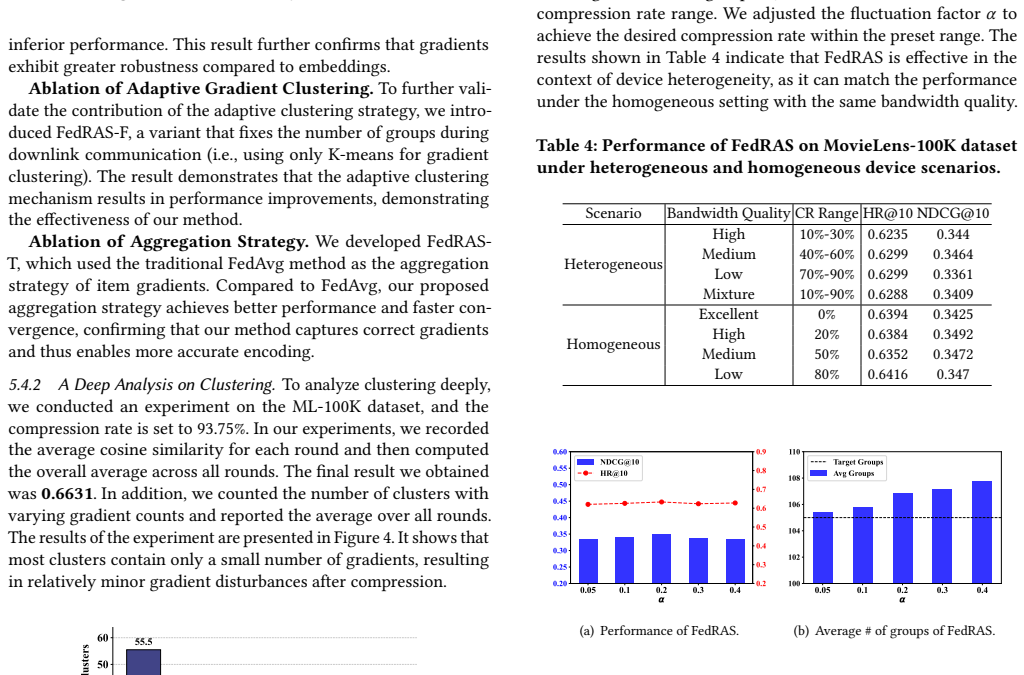
- With the adaptive clustering mechanism, heterogeneous clients whose bandwidth limits are sampled from 10%-90% compression ranges reach roughly the same accuracy as homogeneous clients with the same average bandwidth.
- Clustering gradients rather than embeddings is the source of the advantage: the variant that clusters embeddings performs clearly worse, and information-loss measurements show gradient compression has lower MSE than embedding compression.
- Faster convergence accompanies the communication savings, so the total number of rounds, and therefore total bytes, needed to reach a target accuracy also falls.
- The method remains ahead of baselines when embedding dimension varies from 8 to 64 and when only 5% of clients participate per round, which suggests the mechanism scales to sparser participation.
Reading between the lines
- Beyond the paper's recommender setting, the 'gradients are robust to directional perturbation' intuition, if general, applies to any federated model with an embedding table much larger than the rest of the network, such as large-vocabulary language or knowledge-graph models.
- The complete-copy assumption is the main deployment boundary: a practical deployment with memory-constrained clients would need a variant that transmits actions only for locally touched items and lets the server apply a separate, uncompressed update for untouched items.
- The paper omits the index-bit cost from its reported compression rate; at very high compression rates and very large item counts, $\log_2 C_e$ bits per item could become non-negligible, and a quantized or entropy-coded index scheme would test where the practical ceiling actually is.
- A testable extension suggested by the reported cluster-size distribution is to allocate more actions to clusters with high internal dispersion or high item frequency rather than a uniform target group count, which could improve accuracy at the same byte budget.
Signed reviews
Editorial analysis
A structured set of objections, weighed in public.
Referee Report
Summary. This paper introduces FedRAS, a federated recommender training framework in which item-embedding gradients are clustered into a small number of centroid "actions"; clients and server exchange centroids plus per-item group indices instead of raw item embeddings. An adaptive cluster-and-split procedure varies the number of groups across clients according to bandwidth budgets. Experiments on MovieLens-100K/1M and Lastfm-2K with MF and NCF backbones compare FedRAS against dimension-reduced FedMF/FedNCF, TopK, SVD, CoLR, RCR, RSC, LightFR, and JointRec, reporting HR@10/NDCG@10 under compression rates 90.63%-96.88%, along with ablations, heterogeneity, hyperparameter, computational-overhead, and full-set evaluation studies. The paper claims communication payload reduction up to 96.88% without performance loss.
Significance. The core idea, compressing gradient displacements rather than embedding coordinates and sharing a small action set, is simple and potentially useful for communication-efficient federated recommender systems. The paper has several strengths: the code is open-sourced; the empirical comparison is broad (three datasets, two backbones, multiple compression rates, ablations, heterogeneity, and a full-set evaluation); and the computational-overhead analysis in Table 6 shows that clustering is practical relative to SVD. If the communication-efficiency claim survives a corrected byte-accounting evaluation, FedRAS would be a solid practical contribution. However, the headline savings claim is currently measured against an inflated baseline, so the paper's main quantitative contribution is not yet established.
major comments (4)
- [Section 5.1 and Section 4.2] The compression-rate definition does not measure actual payload reduction. Section 5.1 defines CR = 1 - cost_current/cost_original with cost_original as the size of the entire embedding matrix for both uplink and downlink, but Section 4.2 and Algorithm 1 (lines 25-27) state that clients upload only gradients for items trained in the current round, so the uncompressed uplink payload per client is proportional to |O_u|, not N*d. On MovieLens-100K at CR=96.88%, with N=1682, d=32, and roughly 300 nonzero rows per client, the per-client uplink saving is about 82% rather than 96.88% once centroids and index bits are counted; the index overhead is also not negligible relative to the centroids (about 6 bits per nonzero item). The abstract's "up to 96.88%" is therefore not established for total communication. Because all methods are calibrated to the same proxy CR, the comparison at equal CR does not guarantee equal actual bytes exchanged. Please report actual per-round uplink/downlink byte counts (including indices) for each method, or define CR separately per direction.
- [Section 4.3 and Algorithm 1] The adaptive clustering mechanism is not well-defined on sparse gradient matrices. The server applies AdaCompress to the aggregated gradient matrix Delta Q(t) over all N items (Algorithm 1, line 11), and items untrained in a round have zero rows. The stopping condition and the binary split use cosine similarity (Section 4.3), which is undefined for zero vectors (0/0). The paper never states that zero rows are removed before clustering, nor how groups containing zero vectors are handled. Without this specification, the cluster-and-split algorithm cannot be run as described; please state the zero-row handling explicitly and, if zeros are dropped, describe how their indices are transmitted.
- [Tables 1, 4, and 5] All headline comparisons are reported as single runs without error bars, standard deviations, or significance tests. Since the central claim is that FedRAS "outperforms all baseline methods for all cases" (Section 5.2), the absence of variance information makes it impossible to tell whether the reported margins, some of which are small (e.g., Table 1, NCF, MovieLens-100K, CR=90.63%: FedRAS 0.5832/0.3116 vs CoLR 0.5779/0.3095), are reliable. Please report mean +/- standard deviation over at least three seeds and, where feasible, paired significance tests for the main tables.
- [Tables 1 and 6 / Figure 6] The claim of "not sacrificing recommendation performance" is not directly supported by the main table. The Base rows in Table 1 are dimension-reduced versions of FedMF/FedNCF at the same compression rate, not the uncompressed model, and no numeric uncompressed baseline appears in the main tables; Figure 6 is said to include the full-embedding FedMF reference, but the numeric values are not given in the text. Please include numeric HR@10/NDCG@10 for the uncompressed model in Table 1 (or a companion table) so the reader can verify the "no sacrifice" claim.
minor comments (6)
- [Section 1] The phrase "corresponding indies" should be "corresponding indices."
- [Section 5.2] The first comparison paragraph contains the typo "FeRAS" and should read "FedRAS."
- [Section 4.3] The description of the automatic cosine-similarity threshold calculation is difficult to follow and appears circular: the threshold is defined from previously recorded values, while the stopping condition uses the threshold. Please rewrite with precise round indices and a clear statement of when the threshold is updated and how the first-stop result is used.
- [Table 4] The NDCG values are reported with inconsistent decimal places (e.g., 0.344 vs 0.3464, 0.347 vs 0.3472); please unify the formatting.
- [Figures 2-5] The figure captions and axis labels in the provided text are corrupted (e.g., strings like "/uni00000013/..." in Figures 2-5); please ensure the submitted PDF renders all font glyphs correctly.
- [Section 3] The assumption that every client maintains a complete copy of all item embeddings is explicit but should be restated as a limitation with a discussion of memory cost, since many recommender deployments only cache embeddings for locally relevant items.
Circularity Check
No significant circularity: the reported compression rates are preset experimental conditions, and the load-bearing empirical comparisons are against external baselines.
full rationale
Walking the paper's derivation chain, I found no load-bearing step that reduces to its own inputs. The 96.88% communication-reduction figure is a preset experimental condition, not a derived prediction: Section 5.1 sets C_e = N*(1-CR) and then evaluates model performance at those preset compression rates, so the CR values are independent variables rather than fitted outputs. The paper's genuine empirical claim, that FedRAS maintains recommendation accuracy at these preset rates, is tested against external baselines (FedMF, FedNCF, TopK, SVD, CoLR, JointRec, LightFR) in Tables 1, 5, and 7. The Section 5.1 caveat that the actual compression rate will differ slightly from the preset one due to adaptive clustering is a measurement and reporting concern, not circularity. Table 3's intuition validation is self-referential in that it measures FedRAS's own compression error, but it is not load-bearing for the main performance comparison and does not use the target result to set constants. The paper's self-citations are contextual references in related work and are not used to justify the central mechanism, nor is any uniqueness theorem or ansatz imported from the authors' prior work. The separate concern that the CR denominator uses the full embedding matrix while clients upload only nonzero rows is a correctness/accounting issue, not a circularity issue under the stated rubric. I therefore find no significant circularity.
Assumptions & free parameters
free parameters (4)
- Expected group number C_e =
Set to N*(1-CR) per dataset and CR; e.g., about 52 for ML-100K at CR=96.88%
- Clustering fluctuation factor alpha =
0.2 (default)
- Local epoch tau =
2
- Per-client bandwidth limit e_u =
Equal to C_e in homogeneous experiments; sampled from a CR range in heterogeneous experiments
assumptions (5)
- domain assumption Every client maintains a complete copy of the global item embedding matrix Q and can reconstruct updates from centroids and indices.
- domain assumption Item-embedding gradients can be grouped into k centroids with acceptable loss because gradient directions are more robust to perturbation than embedding values.
- domain assumption Gradients for items not trained by a client are zero and can be ignored or reconstructed implicitly.
- standard math K-means clustering returns centroids that minimize within-cluster squared error.
- domain assumption Leave-one-out evaluation with negative sampling approximates recommendation quality.
Cite this review
Pith. "Pith review of Gradients as an Action: Towards Communication-Efficient Federated Recommender Systems via Adaptive Action Sharing." pith.science (2026). https://pith.science/paper/BD5BYALA
@misc{pith2026250708842,
  author       = {Pith},
  title        = {Pith review of: Gradients as an Action: Towards Communication-Efficient Federated Recommender Systems via Adaptive Action Sharing},
  year         = {2026},
  howpublished = {\url{https://pith.science/paper/BD5BYALA}},
  note         = {Machine review of arXiv:2507.08842}
}
read the original abstract
As a promising privacy-aware collaborative model training paradigm, Federated Learning (FL) is becoming popular in the design of distributed recommender systems. However, Federated Recommender Systems (FedRecs) greatly suffer from two major problems: i) extremely high communication overhead due to massive item embeddings involved in recommendation systems, and ii) intolerably low training efficiency caused by the entanglement of both heterogeneous network environments and client devices. Although existing methods attempt to employ various compression techniques to reduce communication overhead, due to the parameter errors introduced by model compression, they inevitably suffer from model performance degradation. To simultaneously address the above problems, this paper presents a communication-efficient FedRec framework named FedRAS, which adopts an action-sharing strategy to cluster the gradients of item embedding into a specific number of model updating actions for communication rather than directly compressing the item embeddings. In this way, the cloud server can use the limited actions from clients to update all the items. Since gradient values are significantly smaller than item embeddings, constraining the directions of gradients (i.e., the action space) introduces smaller errors compared to compressing the entire item embedding matrix into a reduced space. To accommodate heterogeneous devices and network environments, FedRAS incorporates an adaptive clustering mechanism that dynamically adjusts the number of actions. Comprehensive experiments on well-known datasets demonstrate that FedRAS can reduce the size of communication payloads by up to 96.88%, while not sacrificing recommendation performance within various heterogeneous scenarios. We have open-sourced FedRAS at https://github.com/mastlab-T3S/FedRAS.
Figures


Figures from the paper (4 more)


Reference graph
Works this paper leans on
-
[1]
Paul Resnick and Hal R Varian. Recommender systems. Communications of the ACM, 40(3):56–58, 1997
work page 1997
-
[2]
Linyuan Lü, Matúš Medo, Chi Ho Yeung, Yi-Cheng Zhang, Zi-Ke Zhang, and Tao Zhou. Recommender systems. Physics Reports, 519(1):1–49, 2012
work page 2012
-
[3]
A counterfactual framework for learning and evaluating explanations for recommender systems
Oren Barkan, Veronika Bogina, Liya Gurevitch, Yuval Asher, and Noam Koenig- stein. A counterfactual framework for learning and evaluating explanations for recommender systems. In Proceedings of the ACM on Web Conference (WWW) , pages 3723–3733, 2024
work page 2024
-
[4]
Heesoo Jung, Sangpil Kim, and Hogun Park. Dual policy learning for aggre- gation optimization in graph neural network-based recommender systems. In Proceedings of the ACM Web Conference (WWW) , pages 1478–1488, 2023
work page 2023
-
[5]
A social-semantic recommender system for advertisements
Francisco García-Sánchez, Ricardo Colomo-Palacios, and Rafael Valencia-García. A social-semantic recommender system for advertisements. Information Process- ing & Management, 57(2):102153, 2020
work page 2020
-
[6]
A survey of e-commerce recommender systems
Kangning Wei, Jinghua Huang, and Shaohong Fu. A survey of e-commerce recommender systems. In Proceedings of International Conference on Service Systems and Service Management , pages 1–5, 2007
work page 2007
-
[7]
California consumer privacy act
Rob Bonta. California consumer privacy act. Retrieved from State of California Department of Justice, 2022
work page 2022
-
[8]
The EU general data protection regulation (GDPR) A Practical Guide
Paul Voigt and Axel Von dem Bussche. The EU general data protection regulation (GDPR) A Practical Guide . Springer Cham, 2017
work page 2017
Show all 45 references
-
[9]
Communication-efficient learning of deep networks from decentralized data
Brendan McMahan, Eider Moore, Daniel Ramage, Seth Hampson, and Blaise Aguera y Arcas. Communication-efficient learning of deep networks from decentralized data. In Proceedings of the Artificial Intelligence and Statistics (AISTATS), pages 1273–1282, 2017
2017
-
[10]
Federated learning for generalization, robustness, fairness: A survey and benchmark
Wenke Huang, Mang Ye, Zekun Shi, Guancheng Wan, He Li, Bo Du, and Qiang Yang. Federated learning for generalization, robustness, fairness: A survey and benchmark. IEEE Transactions on Pattern Analysis and Machine Intelligence , 46(12):9387–9406, 2024
2024
-
[11]
Fedmut: Generalized federated learning via stochastic mu- tation
Ming Hu, Yue Cao, Anran Li, Zhiming Li, Chengwei Liu, Tianlin Li, Mingsong Chen, and Yang Liu. Fedmut: Generalized federated learning via stochastic mu- tation. In Proceedings of the AAAI Conference on Artificial Intelligence , volume 38, pages 12528–12537, 2024
2024
-
[12]
Cross-silo prototypical calibration for federated learning with non-iid data
Zhuang Qi, Lei Meng, Zitan Chen, Han Hu, Hui Lin, and Xiangxu Meng. Cross-silo prototypical calibration for federated learning with non-iid data. In Proceedings of the 31st ACM International Conference on Multimedia , pages 3099–3107, 2023
2023
-
[13]
Is aggregation the only choice? federated learning via layer-wise model recombination
Ming Hu, Zhihao Yue, Xiaofei Xie, Cheng Chen, Yihao Huang, Xian Wei, Xiang Lian, Yang Liu, and Mingsong Chen. Is aggregation the only choice? federated learning via layer-wise model recombination. In Proceedings of the ACM SIGKDD Conference on Knowledge Discovery and Data Mini...
2024
-
[14]
Multisfl: Towards accurate split federated learning via multi-model aggregation and knowledge replay
Zeke Xia, Ming Hu, Dengke Yan, Ruixuan Liu, Anran Li, Xiaofei Xie, and Ming- song Chen. Multisfl: Towards accurate split federated learning via multi-model aggregation and knowledge replay. In Proceedings of the AAAI Conference on Artificial Intelligence, volume 39, pages 914–...
2025
-
[15]
A swiss army knife for heterogeneous federated learning: Flexible coupling via trace norm
Tianchi Liao, Lele Fu, Jialong Chen, Zhen Wang, Zibin Zheng, and Chuan Chen. A swiss army knife for heterogeneous federated learning: Flexible coupling via trace norm. Advances in Neural Information Processing Systems, 37:139886–139911, 2024
2024
-
[16]
Joint client-and-sample selection for federated learning via bi-level optimization
Anran Li, Guangjing Wang, Ming Hu, Jianfei Sun, Lan Zhang, Luu Anh Tuan, and Han Yu. Joint client-and-sample selection for federated learning via bi-level optimization. IEEE Transactions on Mobile Computing , 2024
2024
-
[17]
An improved reconstruction based multi-attribute contrastive learning for digital twin-enabled industrial system
Banglie Yang, Linyu Zhu, Cheng Dai, Sahil Garg, and Georges Kaddoum. An improved reconstruction based multi-attribute contrastive learning for digital twin-enabled industrial system. IEEE Internet of Things Journal , 2024
2024
-
[18]
Fedfast: Going beyond average for faster training of federated recommender systems
Khalil Muhammad, Qinqin Wang, Diarmuid O’Reilly-Morgan, Elias Tragos, Barry Smyth, Neil Hurley, James Geraci, and Aonghus Lawlor. Fedfast: Going beyond average for faster training of federated recommender systems. In Proceedings of the ACM SIGKDD Conference on Knowledge Discov...
2020
-
[19]
Fast-adapting and privacy-preserving federated recommender system
Qinyong Wang, Hongzhi Yin, Tong Chen, Junliang Yu, Alexander Zhou, and Xiangliang Zhang. Fast-adapting and privacy-preserving federated recommender system. The VLDB Journal, 31(5):877–896, 2022
2022
-
[20]
Federated recommendation systems
Liu Yang, Ben Tan, Vincent W Zheng, Kai Chen, and Qiang Yang. Federated recommendation systems. In Federated Learning: Privacy and Incentive , pages 225–239. Springer, 2020
2020
-
[21]
Poi recommendation with federated learning and privacy preserving in cross domain recommendation
Li-e Wang, Yihui Wang, Yan Bai, Peng Liu, and Xianxian Li. Poi recommendation with federated learning and privacy preserving in cross domain recommendation. In IEEE INFOCOM 2021-IEEE Conference on Computer Communications Workshops (INFOCOM WKSHPS), pages 1–6. IEEE, 2021
2021
-
[22]
Gitfl: Uncertainty-aware real-time asynchronous federated learning using version control
Ming Hu, Zeke Xia, Dengke Yan, Zhihao Yue, Jun Xia, Yihao Huang, Yang Liu, and Mingsong Chen. Gitfl: Uncertainty-aware real-time asynchronous federated learning using version control. In2023 IEEE Real-Time Systems Symposium (RTSS), pages 145–157. IEEE, 2023
2023
-
[23]
Optimizing training efficiency and cost of hierarchical federated learning in heterogeneous mobile- edge cloud computing
Yangguang Cui, Kun Cao, Junlong Zhou, and Tongquan Wei. Optimizing training efficiency and cost of hierarchical federated learning in heterogeneous mobile- edge cloud computing. IEEE transactions on computer-aided design of integrated circuits and systems, 42(5):1518–1531, 2022
2022
-
[24]
Dafkd: Domain-aware federated knowledge distillation
Haozhao Wang, Yichen Li, Wenchao Xu, Ruixuan Li, Yufeng Zhan, and Zhigang Zeng. Dafkd: Domain-aware federated knowledge distillation. In Proceedings of the IEEE/CVF conference on Computer Vision and Pattern Recognition , pages 20412–20421, 2023
2023
-
[25]
Flexfl: Heterogeneous federated learning via apoz-guided flexible pruning in uncertain scenarios
Zekai Chen, Chentao Jia, Ming Hu, Xiaofei Xie, Anran Li, and Mingsong Chen. Flexfl: Heterogeneous federated learning via apoz-guided flexible pruning in uncertain scenarios. IEEE Transactions on Computer-Aided Design of Integrated Circuits and Systems (TCAD) , 43(11):4069–4080, 2024
2024
-
[26]
Nebulafl: Effective asynchronous federated learning for jointcloud com- puting
Fei Gao, Ming Hu, Zhiyu Xie, Peichang Shi, Xiaofei Xie, Guodong Yi, and Huaimin Wang. Nebulafl: Effective asynchronous federated learning for jointcloud com- puting. arXiv preprint arXiv:2412.04868, 2024
2024 arXiv
-
[27]
Secure federated matrix factor- ization
Di Chai, Leye Wang, Kai Chen, and Qiang Yang. Secure federated matrix factor- ization. IEEE Intelligent Systems, 36(5):11–20, 2020
2020
-
[28]
JointRec: A deep-learning-based joint cloud video recommendation framework for mobile iot
Sijing Duan, Deyu Zhang, Yanbo Wang, Lingxiang Li, and Yaoxue Zhang. JointRec: A deep-learning-based joint cloud video recommendation framework for mobile iot. IEEE Internet of Things Journal , 7(3):1655–1666, 2019
2019
-
[29]
Le, and Kok-Seng Wong
Ngoc-Hieu Nguyen, Tuan-Anh Nguyen, Tuan Nguyen, Vu Tien Hoang, Dung D. Le, and Kok-Seng Wong. Towards efficient communication and secure federated recommendation system via low-rank training. In Proceedings of the ACM on Web Conference (WWW), pages 3940–3951, 2024
2024
-
[30]
A payload optimization method for federated recommender systems
Farwa K Khan, Adrian Flanagan, Kuan Eeik Tan, Zareen Alamgir, and Muhammad Ammad-Ud-Din. A payload optimization method for federated recommender systems. In Proceedings of the ACM Conference on Recommender Systems , pages 432–442, 2021
2021
-
[31]
An efficient k-means clustering algorithm: Anal- ysis and implementation
Tapas Kanungo, David M Mount, Nathan S Netanyahu, Christine D Piatko, Ruth Silverman, and Angela Y Wu. An efficient k-means clustering algorithm: Anal- ysis and implementation. IEEE transactions on pattern analysis and machine intelligence, 24(7):881–892, 2002
2002
-
[32]
Fedcross: Towards accurate federated learning via multi-model cross-aggregation
Ming Hu, Peiheng Zhou, Zhihao Yue, Zhiwei Ling, Yihao Huang, Anran Li, Yang Liu, Xiang Lian, and Mingsong Chen. Fedcross: Towards accurate federated learning via multi-model cross-aggregation. In 2024 IEEE 40th International Conference on Data Engineering (ICDE) , pages 2137–2...
2024
-
[33]
Cabafl: Asynchronous federated learning via hierarchi- cal cache and feature balance
Zeke Xia, Ming Hu, Dengke Yan, Xiaofei Xie, Tianlin Li, Anran Li, Junlong Zhou, and Mingsong Chen. Cabafl: Asynchronous federated learning via hierarchi- cal cache and feature balance. IEEE Transactions on Computer-Aided Design of Integrated Circuits and Systems , 43(11):4057–...
2024
-
[34]
Federated collaborative filtering for privacy-preserving personalized recommendation system
Muhammad Ammad-Ud-Din, Elena Ivannikova, Suleiman A Khan, Were Oyomno, Qiang Fu, Kuan Eeik Tan, and Adrian Flanagan. Federated collaborative filtering for privacy-preserving personalized recommendation system. arXiv preprint arXiv:1901.09888, 2019
1901 arXiv
-
[35]
Fedrec: Federated recom- mendation with explicit feedback
Guanyu Lin, Feng Liang, Weike Pan, and Zhong Ming. Fedrec: Federated recom- mendation with explicit feedback. IEEE Intelligent Systems, 36(5):21–30, 2020
2020
-
[36]
Meta matrix factorization for federated rating predictions
Yujie Lin, Pengjie Ren, Zhumin Chen, Zhaochun Ren, Dongxiao Yu, Jun Ma, Maarten de Rijke, and Xiuzhen Cheng. Meta matrix factorization for federated rating predictions. In Proceedings of the International ACM SIGIR Conference on Research and Development in Information Retrieva...
2020
-
[37]
Federated neural collaborative filter- ing
Vasileios Perifanis and Pavlos S Efraimidis. Federated neural collaborative filter- ing. Knowledge-Based Systems, 242:108441, 2022
2022
-
[38]
Neural collaborative filtering
Xiangnan He, Lizi Liao, Hanwang Zhang, Liqiang Nie, Xia Hu, and Tat-Seng Chua. Neural collaborative filtering. arXiv preprint arXiv:1708.05031, 2017
2017 arXiv
-
[39]
A federated graph neural network framework for privacy-preserving per- sonalization
Chuhan Wu, Fangzhao Wu, Lingjuan Lyu, Tao Qi, Yongfeng Huang, and Xing Xie. A federated graph neural network framework for privacy-preserving per- sonalization. Nature Communications, 13(1):3091, 2022
2022
-
[40]
Maxwell Harper and Joseph A
F. Maxwell Harper and Joseph A. Konstan. The movielens datasets: History and context. ACM Transactions on Intelligent Systems and Technology , 5(4):19:1–19:19, 2016
2016
-
[41]
Second workshop on in- formation heterogeneity and fusion in recommender systems (hetrec2011)
Iván Cantador, Peter Brusilovsky, and Tsvi Kuflik. Second workshop on in- formation heterogeneity and fusion in recommender systems (hetrec2011). In Proceedings of the fifth ACM conference on Recommender systems , pages 387–388, 2011
2011
-
[42]
Adaptivefl: Adaptive heterogeneous federated learning for resource-constrained aiot systems
Chentao Jia, Ming Hu, Zekai Chen, Yanxin Yang, Xiaofei Xie, Yang Liu, and Mingsong Chen. Adaptivefl: Adaptive heterogeneous federated learning for resource-constrained aiot systems. In Proceedings of The Chips To Systems Con- ference (DAC), pages 1–6, 2024
2024
-
[43]
Federated learning: Challenges, methods, and future directions
Tian Li, Anit Kumar Sahu, Ameet Talwalkar, and Virginia Smith. Federated learning: Challenges, methods, and future directions. IEEE Signal Processing Magazine, 37(3):50–60, 2020
2020
-
[44]
Lightfr: Lightweight federated recommendation with privacy-preserving matrix factor- ization
Honglei Zhang, Fangyuan Luo, Jun Wu, Xiangnan He, and Yidong Li. Lightfr: Lightweight federated recommendation with privacy-preserving matrix factor- ization. ACM Transactions on Information Systems , 41(4):1–28, 2023
2023
-
[45]
Comm” denotes communication and “Comp
Dong Li, Ruoming Jin, Jing Gao, and Zhi Liu. On sampling top-k recommendation evaluation. In Proceedings of the 26th ACM SIGKDD International Conference on Knowledge Discovery & Data Mining , pages 2114–2124, 2020. Gradients as an Action: Towards Communication-Efficient Federa...
2020
Reviewed August 6, 2026 · model on record in the stance chip above.
Discussion (0). Continue with ORCID to comment.