REVIEW 3 major objections 5 minor 48 references
Algal Optics
T0 review · 3 major / 5 minor · reviewed 2026-08-15 · deepseek-v4-flash
Pith's one-line read For transparent single-celled algae, cell shape alone sets the average photosynthetic boost to exactly the square of the relative refractive index, while strongly bent shapes create bright focal hotspots.
desk verdict The étendue duality is a genuinely useful new idea, but the exact n^2 universal boost does not survive close scrutiny of the time-reversal argument. read the letter →
The pith
A machine-rendered reading of the paper's core claim, the machinery that carries it, and where it could break.
The reading
What carries the argument
The central object is the boost factor $\eta$, measuring how ray convergence or divergence amplifies local light intensity, and the mechanism that carries the argument is conservation of étendue, the phase-space volume $E=n^2 A\Omega$ of a light beam, which is conserved in passive optical systems. The paper uses a differential form of étendue conservation to relate the incoming boost $\eta_P=d\Omega_2/d\Omega_1$ and the outgoing boost $\eta_B=dA_1/dA_2$ through the duality $n^2\eta_B(\Omega_1)=\eta_P(\Omega_2)$, with the direction mapping set by Snell's law. The energy-conservation identity $\sum_i f_i(\Omega)=1$ then turns this local duality into the universal direction-averaged result $\eta_P^{\rm avg}=n^2$.
What would settle it
Measure, for a single cell shape, the angular distribution of light emitted by a tiny internal source and the angular distribution of intensity at a tiny internal absorber; if the ratio $\eta_P(\Omega_2)/\eta_B(\Omega_1)$ differs from $n^2$ by more than the experimental error, the duality is false. A simpler numerical falsifier is to count rays that never exit a bent or concave shape after many reflections: if even one trapped ray exists, the average boost must fall below $n^2$ for that shape, showing that the universality claim is not universal.
Extended reading notes
Core claim
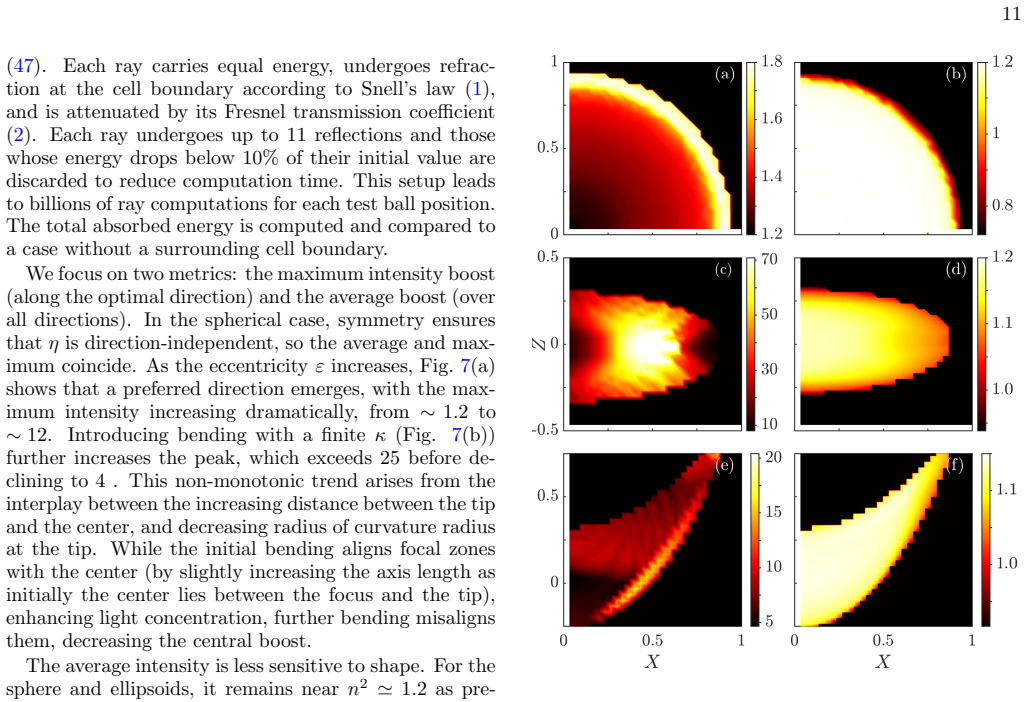
Working in the geometric-optics limit, the paper defines a boost factor for each problem: for incoming light it is the ratio of the solid angle subtended by the incoming ray bundle to that at the small absorber, and for outgoing light it is the ratio of projected beam areas as light leaves the cell. Using Snell's law, the Fresnel transmission coefficients, and conservation of étendue, it proves the identity $\eta_P(\Omega_2)=n^2\eta_B(\Omega_1)$ for each pair of linked directions. Averaging over all directions and using the energy-conservation sum $\sum_i f_i(\Omega)=1$, which holds when every ray eventually exits the cell, gives an average photosynthetic boost of exactly $n^2$ for any shape and any target position. Numerical ray-tracing of spheres, ellipsoids, and bent ellipsoids resembling dinoflagellate shapes confirms that the average boost stays near $n^2\simeq 1.2$ for convex shapes while the maximum boost at focal spots can exceed 25, and it shows that the duality breaks down near boundaries where total internal reflection traps light, where the average boost falls below 1.
Load-bearing premise
The universal average-boost rule assumes that every light ray entering the cell eventually leaves it, so none is trapped by total internal reflection; near strongly curved or concave boundaries this can fail.
Editorial extensions
If this is right
- For any convex transparent cell, the direction-averaged photosynthetic boost is exactly $n^2$, so shape alone neither amplifies nor reduces the cell's total light capture; it only redistributes it.
- Strongly eccentric or bent shapes can create focal hotspots, with maximum central boosts above 25 in the computed examples, so a chloroplast placed near a tip or focal region can receive far more light than an average location.
- Bioluminescent emission from a point source inside such cells is likewise anisotropic: spindle-like bodies direct light sideways, while crescent bodies bias emission toward the concave side, which can shape how flashing cells signal to neighbors or predators.
- Because the duality holds after multiple internal reflections and with Fresnel losses, either the incoming or outgoing problem can be simulated and the result mapped to the other, halving the ray-tracing work for arbitrary shapes.
- The exact $n^2$ average breaks down near boundaries where total internal reflection traps rays; in those regions the average boost is below 1.
Reading between the lines
- If the $n^2$ average is robust, then evolutionary pressure on cell shape is more plausibly about directing light to particular organelles than about increasing total absorption; a testable prediction is that chloroplasts in bent species should cluster near the computed bright regions.
- The duality may carry over to layered or graded-index cells, where the relevant refractive index would be an effective one; one could test whether replacing the cell with a graded-index profile preserves $n^2$ as the mean boost.
- The same étendue argument could connect the angular emission statistics of flashing cell populations to their tumbling dynamics, making a population of cells a bundle of stochastic beacons whose mean directional output obeys a conservation law.
- A direct experimental check could use fluorescent microspheres as tiny absorbers inside living cells: measure the boost as a function of position and compare with the angular emission pattern of a point source, which should be related by $n^2$.
Signed reviews
Editorial analysis
A structured set of objections, weighed in public.
Referee Report
Summary. The paper develops a geometric-optics framework for how transparent, weakly refracting algal cell bodies redistribute light, treating both the "incoming" problem (light concentrated onto a small photosynthetic absorber) and the "outgoing" problem (bioluminescence emitted from a small internal source). The authors define boost factors for each problem, derive an etendue-based duality n^2 eta_B(Omega_1) = eta_P(Omega_2), and claim that the orientation-averaged photosynthetic boost is exactly n^2, independent of cell shape and target location, provided total internal reflection does not trap light. Analytical results are given for circular and spherical geometries, perimeter and surface-area averaging laws are derived, and numerical ray-tracing results are presented for ellipsoidal and bent shapes motivated by Pyrocystis species.
Significance. If the central claims are correct, the paper provides an elegant, parameter-free prediction: the average photosynthetic boost is determined solely by the relative refractive index, while spatial maxima can be strongly shape-dependent. The etendue duality and the surface-area/perimeter laws are genuine analytical contributions, and the numerical campaign with open data is a useful resource for the biological optics community. The paper also offers testable hypotheses about chloroplast positioning and bioluminescent directionality. However, the exact n^2 average for a single absorbing target is not established by the presented proof, and the numerical verification for concave shapes has acknowledged but unquantified gaps.
major comments (3)
- [§IV.C, Eqs. (45)–(47)] The proof of the universal average boost n^2 for a single absorbing target is invalid because the energy-conservation sum sum_i f_i(Omega) = 1 counts outgoing ray histories that return to the emitter after internal reflections, and such histories do not correspond to distinct incoming absorption events. For a perfectly absorbing ball, an incoming ray is stopped at its first pass through the target, so the later reflections in the time-reversed outgoing history never occur. The legitimate domain for the reflection sum is the shell construction in §III.C, where different balls absorb on different passes; Eq. (47) applies that sum to a single target location. Consequently, for a single absorbing chloroplast the average boost should be n^2 times the probability that an outgoing ray exits without ever returning to the target, which is strictly below n^2 whenever Fresnel reflection is present. For a central absorber in a sphere this reduces to the single-pass average in Eq. (36), not Eq. (47); the numerical difference is tiny for n = 1.1 but the exactness of the central claim is lost and the discrepancy grows with n.
- [§IV.C and Fig. 5(b)] The universality claim in Eq. (45) that the average boost is n^2 "irrespective of the concave shell shape and the location of the test ball" is contradicted by the paper's own results: Fig. 5(b) and the discussion at the end of §IV.C show that near the boundary, where total internal reflection traps rays, the average boost drops below 1. The text acknowledges this in a parenthetical, but the condition "provided total internal reflection does not trap energy" is not converted into a precise geometric criterion, so the claimed universality is stated more broadly than the proof supports. The authors should either restrict the theorem to shapes and target locations satisfying an explicit no-trapping condition, or state the result as a bound with quantitative corrections.
- [§V.D and §V.A] The numerical verification for concave shapes is incomplete in a way that bears directly on the central claim. The last paragraph of §V.D states that rays re-entering the cell after reflection/refraction are not included in the analysis; these are precisely the paths that matter near concave regions where the average boost is expected to deviate from n^2. The paper dismisses them as negligible without quantifying their energy. Additionally, the simulations use an entry-region truncation of 15 target radii (§V.A), discard rays below 10% of initial energy (§V.A) or 1% in the outgoing simulation (§V.D), and report average boosts such as 1.14–1.2 without uncertainty estimates. The reported agreement with Eq. (47) therefore has unquantified systematic and statistical errors, and the claimed numerical confirmation of the universal average is not established for the concave cases.
minor comments (5)
- [§V.B, Fig. 9] The caption of Fig. 9 lists panels (a–d) for κ = 0, 0.5, 1, 2, but the text refers to "Fig. 9(e)"; the panel label should be corrected.
- [§III.C] The two derivations of α = 1/π are somewhat compressed; in particular, the sentence "this is the linear function E(r) = 2rnf(0)" would benefit from stating the normalization of E explicitly so that Eqs. (11)–(12) are unambiguous.
- [Eq. (2)] There is a typo: "The quantify 1−f(θi)" should read "The quantity 1−f(θi)."
- [§III.E] The phrase "discussed further at the end of Sc. IV C" contains an abbreviation error; it should be "Sec. IV C."
- [§IV.C] The text says "relative reflective index n"; this should be "relative refractive index n."
Circularity Check
No significant circularity: the n^2 average boost and the incoming/outgoing duality are derived from Snell's law and etendue conservation, with no fitted parameters or load-bearing self-citation.
full rationale
Walking the derivation chain, the central claims are the duality relation n^2 eta_B = eta_P (Eq. 44) and the averaged boost n^2 (Eqs. 45-47). These are obtained from standard etendue conservation (Eqs. 39-43), which is an external textbook result cited to Chaves [36], combined with an energy-conservation identity sum_i f_i = 1 for outgoing rays. The refractive index n = 1.1 is an independent literature input from Ueki et al. [2]; no parameter is fitted to the boost values that are subsequently called predictions. The numerical ray tracing in Sec. V is an independent implementation of Snell/Fresnel propagation and is compared with, not fitted to, the analytic formula. Self-citations [34] and [35] concern phototactic dynamics and Volvox fluid dynamics, and are not load-bearing for the optical derivation. The main caveat, that total internal reflection can trap rays and reduce the average boost near boundaries, is explicitly acknowledged by the authors (Sec. IV.C, Fig. 5(b), Fig. 9(b)), so the universal-n^2 statement is already qualified in the paper. Whether the time-reversal argument for a single absorbing target is fully valid is a correctness question, not a circularity: the result does not reduce to its own input by definition or by fitted-data construction.
Assumptions & free parameters
assumptions (6)
- domain assumption Geometric optics applies: cell diameter is much larger than the wavelength of visible light, so diffraction and interference are negligible.
- domain assumption The cell interior is a homogeneous, non-absorbing optical medium with uniform refractive index n = 1.1 (ncell/nwater).
- domain assumption The absorber or emitter is much smaller than the cell and can be modeled as a small sphere (radius a much smaller than R).
- domain assumption For angular averaging, the cell orientation distribution is uniform, giving isotropic illumination on average.
- domain assumption Total internal reflection does not trap light rays indefinitely, so every ray exits after finitely many reflections.
- domain assumption For the surface length and area laws, the body is convex.
Cite this review
Pith. "Pith review of Algal Optics." pith.science (2026). https://pith.science/paper/BDPW6PZL
@misc{pith2026250615214,
  author       = {Pith},
  title        = {Pith review of: Algal Optics},
  year         = {2026},
  howpublished = {\url{https://pith.science/paper/BDPW6PZL}},
  note         = {Machine review of arXiv:2506.15214}
}
abstract
Nearly a decade ago it was discovered that the spherical cell body of the alga $Chlamydomonas~reinhardtii$ can act as a lens to concentrate incoming light onto the cell's membrane-bound photoreceptor and thereby affect phototaxis. Since many nearly transparent cells in marine environments have complex, often non-axisymmetric shapes, this observation raises fundamental, yet little-explored questions in biological optics about light refraction by the bodies of microorganisms. There are two distinct contexts for such questions: the $absorption$ problem for $incoming$ light, typified by photosynthetic activity taking place in the chloroplasts of green algae, and the $emission$ problem for $outgoing$ light, where the paradigm is bioluminescence emitted from scintillons within dinoflagellates. Here we examine both of these aspects of ``algal optics" in the special case where the absorption or emission is localized in structures that are small relative to the overall organism size, taking into account both refraction and reflections at the cell-water boundary. Analytical and numerical results are developed for the distribution of light intensities inside and outside the body, and we establish certain duality relationships that connect the incoming and outgoing problems. For strongly non-spherical shapes we find lensing effects that may have implications for photosynthetic activity and for the angular distribution of light emitted during bioluminescent flashes.
Figures


Figures from the paper (7 more)




Reference graph
Works this paper leans on
-
[1]
Also let d′ 3 be the distance between S and k′ 1
S′ is a point in the light ray k′ 1 with SS′⊥ SA, and d3 =|SS′|. Also let d′ 3 be the distance between S and k′ 1. Since ξ = ∠(OA, OA′)≪ 1, we have ∠(n, AA′)≃ π/2 and|AA′|≃ ξ. Geometry then imposes the relations d1 =ξ cosβ, d 2 =ξ cosα, (22) and d3≃d′ 3 =ξ cosα−| SA|∠(k1, k′ 1). (23) To work out the angle ∠(k1, k′
-
[2]
=γ′−γ =θ′−θ +α−α′ +β′−β, (19) and hence, using Eq. (17) we obtain the boost (14) ηB(θ) = θ′−θ θ′−θ +α′−α +β′−β = 1 n sinα sin(θ−α) sinβ sinθ cosα + cosθ sinα cosβ sinθ −1 , (20) where in the last line we have used Eq. (15) and a product-to-sum trigonometric identity. For the incoming (photosynthetic) case shown in Fig. 6(b), let point A denote the interse...
-
[3]
Foster and R
K.W. Foster and R. D. Smyth, Light antennas in photo- tactic algae, Microbiol. Rev. 44, 572–630 (1980)
1980
-
[4]
=ξ−(α−α′), we apply Snell’s Law (1) sinβ =n sinα, sinβ′ =n sinα′. (24) Similar to Eq. (17), we obtain α−α′≃ cosβ n cosα(β−β′). (25) Combining with ξ =β−β′, we find ∠(k1, k′
-
[5]
=ξ 1− cosβ n cosα , (26) from which we obtain, using Eq. (22) and (23) in (21), ηP (θ) = cosα cosβ− sin(θ−α) sin(β−α) sinθ sinβ cosα cosβ −1 . (27) Trigonometry identities then lead to the duality result ηP (θ) =nηB(θ), (28) namely, the intensity profiles of the two cases are identical up to a factor ofn. This is the two-dimensional analogue of “´ etendue...
-
[6]
= 1 4π X i Z dΩi 2n2ηi B(Ω1) = X i 1 4π Z dΩ1n2fi(Ω1) =n2. (47) V. NUMERICAL RESUL TS FOR 3D BODIES In this section, we present numerical results that sup- port the conclusions drawn in the analytical sections above. We consider a two-parameter family of shapes for numerical computations. Built around the parame- terization of ellipsoids, these shapes int...
-
[7]
J. Kessler, A.M. Nedelcu, C.A. Solari, and D.E. Shelton, Cells Acting as Lenses: A Possible Role for Light in the Evolution of Morphological Asymmetry in Multicellular Volvocine Algae, Evolutionary Transitions to Multicellu- lar Life. Advances in Marine Genomics. Springer, Dor- drecht, 2, 225 (2015)
work page 2015
-
[8]
N. Ueki, T. Ide, S. Mochiji, Y. Kobayashi, R. Tokutsu, N. Ohnishi, K. Yamaguchi, S. Shigenobu, K. Tanaka, J. Minagawa, T. Hisabori, M. Hirono, and K. Wakabayashi, Eyespot-dependent determination of the phototactic sign in Chlamydomonas reinhardtii , Proc. Natl. Acad. Sci. USA 113, 5299 (2016)
work page 2016
Show all 48 references
-
[9]
Aleksandra Szczerbiak, CC BY 4.0, via Wikimedia Com- mons
-
[10]
Schaller, R
K. Schaller, R. David, and R. Uhl, How Chlamydomonas keeps track of the light once it has reached the right pho- totactic orientation, Biophys. J. 73, 1562–1572 (1997)
1997
-
[11]
Leptos, M
K.C. Leptos, M. Chioccioli, S. Furlan, A.I. Pesci and R.E. Goldstein, Phototaxis of Chlamydomonas arises from a tuned adaptive photoresponse shared with multicellular Volvocine green algae, Phys. Rev. E 107, 014404 (2023)
2023
-
[12]
J´ ekely, Evolution of phototaxis, Phil
G. J´ ekely, Evolution of phototaxis, Phil. Trans. R. Soc. B 364, 2795–2808 (2009)
2009
-
[13]
Francis, On the eyespot of the dinoflagellate, Nema- todinium, J
D. Francis, On the eyespot of the dinoflagellate, Nema- todinium, J. Exp. Biol. 47, 495 (1967)
1967
-
[14]
Schuergers, et al
N. Schuergers, et al. , Cyanobacteria use micro-optics to sense light direction, eLife 5, e12620 (2016)
2016
-
[15]
T. C. Vogelmann, Plant tissue optics, Annu. Rev. Plant Physiol. Plant Mol. Biol. 44, 231 (1993)
1993
-
[16]
Nakane, et al., Asymmetric distribution of type IV pili triggered by directional light in unicellular cyanobacteria Proc
D. Nakane, et al., Asymmetric distribution of type IV pili triggered by directional light in unicellular cyanobacteria Proc. Natl. Acad. Sci. USA 114, 6593 (2017)
2017
-
[17]
freeform optics
of the filamentous fungus Phycomyces blakesleeanus showed that the light intensity at the cell surface is en- hanced by a factor of∼ 2, while theoretical work suggests an even larger boost [18]. The epidermal cells of certain tropical plant species are thought to act as lenses...
-
[18]
Wilde et al
A. Wilde et al. , Light-controlled motility in prokaryotes and the problem of directional light perception, FEMS Microbiology Reviews 41, 900 (2017)
2017
-
[19]
M. M. Ghobara, et al. , On Light and Diatoms: A Pho- tonics and Photobiology Review, Diatoms: Fundamental and Applications, 129 (2019)
2019
-
[20]
De Tommasi, et al
E. De Tommasi, et al. , Optics with diatoms: towards efficient, bioinspired photonic devices at the micro-scale Optical Methods for Inspection, Characterization, and Imaging of Biomaterials, 8792, 99 SPIE (2013)
2013
-
[21]
Maibohm, et al
C. Maibohm, et al. , Comparing optical properties of dif- ferent species of diatoms, Organic Photonic Materials and Devices XVII, 9360, 20 SPIE (2015)
2015
-
[22]
V. R. Humphry, The effects of paraffin oil on phototropic and geotropic responses in Avena coleoptiles, Annals of Biology 30.1, 39 (1966)
1966
-
[23]
D. S. Dennison, et al. , The Phycomyces lens: measure- ment of the sporangiophore intensity profile using a fiber optic microprobe, Planta 179, 1 (1989)
1989
-
[24]
Myneni and J
R.B. Myneni and J. Ross (Eds.), Photon-vegetation inter- actions: applications in optical remote sensing and plant ecology, (Springer Science & Business media, 2012)
2012
-
[25]
R. A. Bone, et al. , Epidermal cells functioning as lenses in leaves of tropical rain-forest shade plants, Appl. Opt. 24, 1408 (1985)
1985
-
[26]
C. R. Brodersen, et al. , Do Epidermal Lens Cells Facili- tate the Absorptance of Diffuse Light?, American Journal of Botany 94, 1061 (2007)
2007
-
[27]
Plummer, J.G
W.T. Plummer, J.G. Baker, and J.Van Tassell, Photo- graphic optical systems with nonrotational aspheric sur- faces, Appl. Opt. 38, 3572-3592 (1999)
1999
-
[28]
Cakmakci, B
O. Cakmakci, B. Moore, H. Foroosh, J.P. Rolland, Optimal local shape description for rotationally non- symmetric optical surface design and analysis, Opt. Ex. 16, 1583-1589 (2008)
2008
-
[29]
Fuerschbach, J.P
K. Fuerschbach, J.P. Rolland, and K.P. thompson, A new family of optical systems employing φ-polynomial sur- faces, Opt. Ex. 19, 21919-21928 (2011)
2011
-
[30]
Smilie and T.J
P.J. Smilie and T.J. Suleski, Variable-diameter refractive beam shaping with freeform optical surfaces, Opt. Lett. 36, 4170-4172 (2011)
2011
-
[31]
Swift and W.R
E. Swift and W.R. Taylor, Bioluminescence and chloro- plast movement in the dinoflagellate Pyrocystis lunula, J. Phycol. 3, 77-81 (1967)
1967
-
[32]
Sweeney, The Circadian Rhythms, Biolumines- cence, Photosynthesis and Organellar Movements in the Large Dinoflagellate, Pyrocystis fusiformis , in H.G
B.M. Sweeney, The Circadian Rhythms, Biolumines- cence, Photosynthesis and Organellar Movements in the Large Dinoflagellate, Pyrocystis fusiformis , in H.G. Schweiger, ed., International Cell Biology 1980–1981. Springer, Berlin, Heidelberg (1981)
1981
-
[33]
Heimann, P.L
K. Heimann, P.L. Klerks and K.H. Hasenstein, Involve- ment of actin and microtubules in regulation of biolumi- nescence and translocation of chloroplasts in the dinoflag- ellate Pyrocystis lunula, Bot. Mar. 52, 170-177 (2009)
2009
-
[34]
F. C. Stephens, Variability of spectral absorption ef- ficiency within living cells of Pyrocystis lunula (Dino- phyta), Marine Biology 122, 325 (1995)
1995
-
[35]
S.H.D.Haddock, M.A.Moline and J.F.Case, Biolumines- cence in the sea, Annu. Rev. Mar. Sci. 2,443 (2010)
2010
-
[36]
M.I. Latz, M. Bovard, V.VanDelinder, E.Segre, J.Rohr, and A. Groisman, Bioluminescent response of individual dinoflagellate cells to hydrodynamic stress measured with millisecond resolution in a microfluidic device, J. Exp. Biol. 211, 2865 (2008)
2008
-
[37]
Jalaal, N
M. Jalaal, N. Schramma, A. Dode, H. de Maleprade, C. Raufaste and R.E. Goldstein, Stress-induced dinoflagel- late bioluminescence at the single cell level, Phys. Rev. Lett 125, 028102 (2020)
2020
- [38]
-
[39]
Jackson, Classical Electromagnetism, (John Wiley & Sons, 2021)
J.D. Jackson, Classical Electromagnetism, (John Wiley & Sons, 2021)
2021
-
[40]
Goldstein, et al., preprint (2025)
R.E. Goldstein, et al., preprint (2025)
2025
-
[41]
Goldstein, Green algae as model organisms for bio- logical fluid dynamics, Annu
R.E. Goldstein, Green algae as model organisms for bio- logical fluid dynamics, Annu. Rev. Fluid Mech. 47, 343- 375 (2015)
2015
-
[42]
Chaves, Introduction to Nonimaging Optics , 2nd ed
J. Chaves, Introduction to Nonimaging Optics , 2nd ed. (CRC Press, 2016)
2016
-
[43]
L. O. Bj¨ orn (Ed.),Photobiology: The Science of Life and Light, 2nd ed., (Springer, New York, 2008)
2008
-
[44]
Wada, et al
M. Wada, et al. , Chloroplast Movement, Annu. Rev. Plant Biol., vol. 54, pp. 455–468(2003)
2003
-
[45]
Airan, K.R
R.D. Airan, K.R. Thompson, L.E. Fenno, H. Bernstein, K. Deisseroth, Temporally precise in vivo control of in- tracellular signalling, Nature 458, 1025-1029 (2009)
2009
-
[46]
Johnsen, The Optics of Life: A Biologist’s Guide to Light in Nature , (Princeton University Press, Princeton, NJ, 2012)
S. Johnsen, The Optics of Life: A Biologist’s Guide to Light in Nature , (Princeton University Press, Princeton, NJ, 2012)
2012
-
[47]
Modest, Radiative Heat Transfer , 3rd ed., 15 Academic Press, 2013
Michael F. Modest, Radiative Heat Transfer , 3rd ed., 15 Academic Press, 2013
2013
-
[48]
Al- gal Optics
M. Yang, S.K. Birwa and R.E. Goldstein, Data for “Al- gal Optics”. Zenodo. doi.org/10.5281/zenodo.15552607 (2025)
2025 doi
Reviewed August 15, 2026 · model on record in the stance chip above.
Discussion (0). Continue with ORCID to comment.