REVIEW 3 major objections 6 minor 48 references
TrajFusionNet: Pedestrian Crossing Intention Prediction via Fusion of Sequential and Visual Trajectory Representations
T0 review · 3 major / 6 minor · reviewed 2026-08-05 · deepseek-v4-flash
Pith's one-line read TrajFusionNet predicts a pedestrian's crossing intention one to two seconds ahead by using predicted future trajectories and vehicle speed as priors in two attention branches, reporting state-of-the-art benchmark accuracy and a 12.09 ms end
desk verdict Solid applied fusion model with a real speed story; the SOTA claim overreaches and the predicted-trajectory normalization is under-specified. read the letter →
The pith
A machine-rendered reading of the paper's core claim, the machinery that carries it, and where it could break.
The reading
What carries the argument
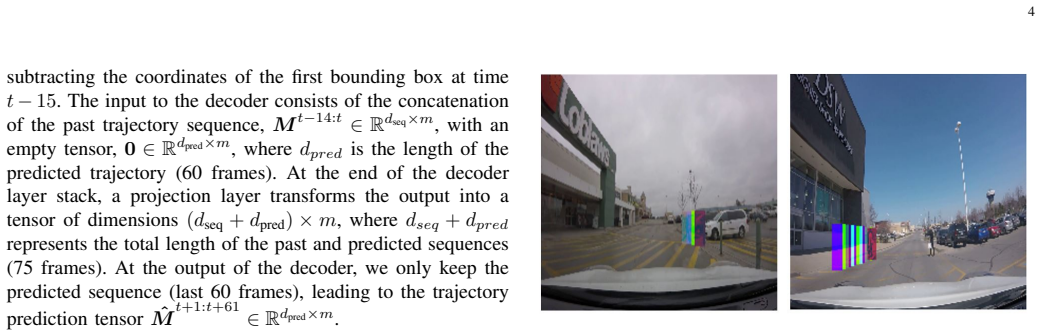
The load-bearing mechanism is the predicted trajectory-and-speed tensor, generated in one non-autoregressive pass by an encoder-decoder transformer. This tensor does double duty: concatenated with the observed trajectory after appending sequence-type identifiers (0 for past, 1 for predicted), it gives the SAM encoder a selective past/future attention pattern; drawn as colored bounding-box overlays on the first and last scene frames, it gives the VAM a visual prior that keeps pedestrian appearance visible in one color channel. The tensor is cheap enough to produce that it costs less than the pose or segmentation preprocessing used by competing methods.
What would settle it
Train an identical model except that the observed trajectory tensor is z-score normalized with the same statistics as the predicted tensor, and compare accuracy on PIE, JAAD all, and JAAD beh; if the consistently normalized version is more accurate by more than run-to-run noise, the current scale mismatch is hurting the model, and if it is statistically flat, the transformer is robust to the mismatch.
Extended reading notes
Core claim
TrajFusionNet's central claim is that a pedestrian's crossing intention can be classified more accurately and more cheaply by first predicting future bounding-box locations and vehicle speed, then using those predictions as priors. The Sequence Attention Module (SAM) generates the future trajectory and speed with a non-autoregressive encoder-decoder transformer in a single pass, concatenates past and predicted tokens with sequence-type identifiers, and classifies with an encoder-only transformer. The Visual Attention Module (VAM) draws the predicted boxes onto the first and last observed frames and processes them with two Visual Attention Networks; the two branch outputs are merged with dens
Load-bearing premise
The load-bearing premise is that a transformer encoder can safely attend over a concatenation of two trajectory tensors with inconsistent scales—observed coordinates merely shifted to start at zero, predicted values rescaled to standard units—without the mismatch distorting the attention weights and the final crossing decision.
Editorial extensions
If this is right
- An autonomous vehicle can receive a crossing-intention signal in 12.09 ms end-to-end on an RTX 3060, leaving the majority of a typical 50 ms perception-to-action cycle for other modules.
- The accuracy gains on PIE and JAAD beh over RNN and graph baselines imply that predicted trajectory and speed priors are most informative exactly in the curb-adjacent, ambiguous cases where crossing decisions are made.
- The ablation removing trajectory prediction from the SAM branch drops PIE accuracy from 0.92 to 0.89 and JAAD beh from 0.74 to 0.70, so the numeric prior is a direct contributor, not a side effect.
- The 5.20M-parameter TrajFusionNet-Small keeps most of the accuracy (0.91 PIE Acc, 0.69 JAAD beh Acc) at 4.63 ms total inference, indicating the approach scales down without losing the benefit of the priors.
Reading between the lines
- The same lightweight-prior recipe should transfer to other anticipatory driving tasks, such as predicting cyclist lane changes or vehicle turns, where a cheap future-state predictor can be substituted for trajectory generation; this is an extension, not a paper claim.
- Because replacing the late-fusion dense layer with a modality self-attention layer produced no improvement in the ablation, the two branches are probably already well aligned, so the next likely source of gains is a stronger trajectory predictor rather than a more elaborate fusion scheme.
- The paper leaves untreated a normalization mismatch between the z-scored predicted tensor and the offset-only observed tensor; a cheap robustness test would be training a variant with consistent normalization, which could change results on JAAD all and JAAD beh.
Editorial analysis
A structured set of objections, weighed in public.
Referee Report
Summary. The paper proposes TrajFusionNet, a two-branch transformer architecture for pedestrian crossing intention prediction. The Sequence Attention Module (SAM) first uses an encoder-decoder transformer to predict future pedestrian bounding-box and vehicle-speed sequences, then concatenates these predicted tokens with the observed trajectory and processes the combined sequence with an encoder transformer for classification. The Visual Attention Module (VAM) overlays observed and predicted pedestrian bounding boxes onto scene images and processes them with two Visual Attention Networks (VANs). The two branches are fused late with dense layers. The model is trained in a modular, layer-wise fashion. It is evaluated on the PIE, JAAD all, and JAAD beh splits using the Kotseruba et al. benchmark, reporting accuracy, AUC, F1, precision, and recall, as well as inference times. An ablation study examines the contributions of the fusion mechanism, the number of VAN instances, sequence type identifiers, vehicle speed, and trajectory prediction.
Significance. If the reported results are robust, TrajFusionNet is a practically relevant contribution: it replaces expensive future-frame generation with lightweight predicted trajectory and speed tokens, and its reported inference time is attractive for onboard deployment. The modular training scheme and the ablation study are strengths, and the framework is not circular: the trajectory predictor is trained on ground truth and frozen before the classifier is optimized against crossing labels. However, the state-of-the-art claim is stronger than the numbers in Table II support, and a scale mismatch in the concatenated sequence inputs needs experimental resolution. With those issues addressed, the paper would be a solid addition to the pedestrian intention prediction literature.
major comments (3)
- [III.C and IV.B] The two tensors concatenated into ψ^{t−14:t+61} are in incompatible units. The past trajectory tensor M^{t−14:t} is offset by subtracting the first bounding-box coordinates (pixel units), while the predicted tensor \hat{M}^{t+1:t+61} is produced by a transformer trained with an MSE loss on five z-score-normalized targets (Section IV.B). No re-normalization or alignment is described before the concatenation is fed into the encoder transformer. Because self-attention uses dot products between projected tokens, the scale gap can cause the encoder to under-weight the predicted tokens, which would undermine the paper's central claim that predicted trajectories act as priors. Please add an experiment that normalizes both representations consistently (e.g., z-score the past tensor using the same statistics, or de-normalize the predictions to pixel space) and report the classification metrics. I
- [Table II] The state-of-the-art claim is not fully supported by the reported numbers. On PIE, TrajFusionNet exactly ties Song et al. (2022) on accuracy (0.92), AUC (0.91), and F1 (0.86); it is not strictly better. On JAAD all, Bai et al. (2022) achieves a substantially higher F1 (0.77 vs 0.72). No variance, confidence intervals, or significance tests are reported, and many differences among the top methods are only 0.01–0.02. I recommend reporting mean±std over multiple seeds and bootstrapped confidence intervals or a paired significance test. The abstract and conclusion should be softened from "state-of-the-art" to "competitive" where the proposed method ties or trails on key metrics.
- [Table III] The claim of "lowest total inference time" depends on what preprocessing is included. For the compared methods, M+D includes external components such as OpenPose and DeepLabV3, while for TrajFusionNet the table reports M+D = M (12.09 ms), i.e., no preprocessing cost is counted. It is unclear whether pedestrian detection/tracking, image loading, resizing, and overlay drawing are included. If detection is assumed given, the comparison is not apples-to-apples with methods that include pose/segmentation preprocessing. Please specify the exact preprocessing pipeline for each method, including whether detection is assumed, and report repeated timing measurements with standard deviations or confidence intervals.
minor comments (6)
- [III.C] There is an indexing inconsistency: the input sequence is defined as M^{t−14:t} (15 frames), but the text says coordinates are offset by subtracting the first bounding box at time t−15. Clarify whether the observation window starts at t−14 or t−15.
- [IV.B] The two loss equations are not numbered. Number them for easy reference in the ablation discussion.
- [Abstract/II] The phrase "three most commonly used datasets" is imprecise: the evaluation uses two datasets with three protocol splits (PIE, JAAD all, JAAD beh). Rephrase to avoid confusion.
- [III.B] For JAAD, vehicle speed categories are encoded ordinally as 0–4. Ordinal encoding assumes equal spacing between categories; justify this choice or consider one-hot encoding.
- [IV.D] No code availability statement is provided. Given the reliance on the TSLib library and a fixed training schedule, a code release would materially aid reproducibility.
- [III.C] The decoder input is described as the concatenation of the past sequence with an empty tensor; the training procedure for this non-autoregressive decoder is not fully specified. Clarify how the target mask and teacher forcing are handled in the TSLib implementation.
Circularity Check
No significant circularity; trajectory-prediction prior is a separately trained auxiliary task, not a fitted proxy for the crossing label.
full rationale
The paper's derivation chain is self-contained. The trajectory-prediction transformer is trained with an MSE loss on ground-truth future bounding-box coordinates and vehicle speed (Section IV.B), not on the crossing-intention label. The crossing classifier is subsequently trained with a weighted cross-entropy loss on the crossing label while the trajectory transformer's weights are frozen ('Once the trajectory prediction transformer has been trained, we now train the encoder transformer. We freeze the weights of the trajectory prediction transformer...'), so the predicted trajectory tensor is a genuine auxiliary-model output rather than a parameter fitted to the classification target. Feeding that output into the classifier is a feedforward design, not circular reasoning. The same holds for the VAM branch, which overlays predicted boxes from the same frozen trajectory model. The only self-citation, the authors' review [6], appears in Related Work as one of several survey pointers and carries no load in the derivation; the VAN module [5] and TSLib transformer [42] are external implementations. No uniqueness theorem, ansatz, or fitted value is imported from the authors' prior work to force the result. The potential scale mismatch between offset past trajectories and z-score-normalized predicted trajectories in the concatenated SAM input is a testable correctness concern, not a circularity: it does not make any predicted quantity equal to an input by construction. The performance claims are benchmarked against external methods on public datasets, so the central results stand independently of any self-citation.
Assumptions & free parameters
free parameters (3)
- class weighting alpha =
not reported
- z-score normalization statistics =
computed on training set
- model hyperparameters (layers, heads, dmodel, learning rates) =
listed in Section IV.B and Table I
assumptions (4)
- domain assumption The PIE and JAAD datasets with the Kotseruba benchmark splits are representative of pedestrian crossing scenarios and the annotations are correct.
- ad hoc to paper The concatenation of past (offset) and predicted (z-score normalized) trajectory tokens into a single transformer encoder is a valid representation; the transformer can handle the scale mismatch.
- ad hoc to paper The visual overlay of 60 frames of future bounding boxes onto a single last-frame image is a sufficient visual summary of the future trajectory.
- domain assumption Standard transformer and VAM components (from TSLib and VAN references) behave as documented.
Cite this review
Pith. "Pith review of TrajFusionNet: Pedestrian Crossing Intention Prediction via Fusion of Sequential and Visual Trajectory Representations." pith.science (2026). https://pith.science/paper/BE2JJSAY
@misc{pith2026250819866,
  author       = {Pith},
  title        = {Pith review of: TrajFusionNet: Pedestrian Crossing Intention Prediction via Fusion of Sequential and Visual Trajectory Representations},
  year         = {2026},
  howpublished = {\url{https://pith.science/paper/BE2JJSAY}},
  note         = {Machine review of arXiv:2508.19866}
}
read the original abstract
With the introduction of vehicles with autonomous capabilities on public roads, predicting pedestrian crossing intention has emerged as an active area of research. The task of predicting pedestrian crossing intention involves determining whether pedestrians in the scene are likely to cross the road or not. In this work, we propose TrajFusionNet, a novel transformer-based model that combines future pedestrian trajectory and vehicle speed predictions as priors for predicting crossing intention. TrajFusionNet comprises two branches: a Sequence Attention Module (SAM) and a Visual Attention Module (VAM). The SAM branch learns from a sequential representation of the observed and predicted pedestrian trajectory and vehicle speed. Complementarily, the VAM branch enables learning from a visual representation of the predicted pedestrian trajectory by overlaying predicted pedestrian bounding boxes onto scene images. By utilizing a small number of lightweight modalities, TrajFusionNet achieves the lowest total inference time (including model runtime and data preprocessing) among current state-of-the-art approaches. In terms of performance, it achieves state-of-the-art results across the three most commonly used datasets for pedestrian crossing intention prediction.
Figures

Reference graph
Works this paper leans on
-
[1]
Pedestrian de- tection: An evaluation of the state of the art,
P. Dollar, C. Wojek, B. Schiele, and P. Perona, “Pedestrian de- tection: An evaluation of the state of the art,” IEEE transactions on pattern analysis and machine intelligence , vol. 34, no. 4, pp. 743–761, 2011
work page 2011
-
[2]
Pedestrian protection systems: Issues, survey, and challenges,
T. Gandhi and M. M. Trivedi, “Pedestrian protection systems: Issues, survey, and challenges,” IEEE Transactions on intelli- gent Transportation systems , vol. 8, no. 3, pp. 413–430, 2007
work page 2007
-
[3]
Pedestrian and vehicle be- haviour prediction in autonomous vehicle system—a review,
L. G. Galv ˜ao and M. N. Huda, “Pedestrian and vehicle be- haviour prediction in autonomous vehicle system—a review,” Expert Systems with Applications , vol. 238, p. 121983, 2023
work page 2023
-
[4]
Spatiotemporal relationship reasoning for pedestrian intent prediction,
B. Liu, E. Adeli, Z. Cao, K.-H. Lee, A. Shenoi, A. Gaidon, and J. C. Niebles, “Spatiotemporal relationship reasoning for pedestrian intent prediction,” IEEE Robotics and Automation Letters, vol. 5, no. 2, pp. 3485–3492, 2020
work page 2020
-
[5]
M.-H. Guo, C.-Z. Lu, Z.-N. Liu, M.-M. Cheng, and S.-M. Hu, “Visual attention network,” Computational Visual Media, vol. 9, no. 4, pp. 733–752, 2023
work page 2023
-
[6]
Predicting pedestrian cross- ing intention in autonomous vehicles: A review,
F.-G. Landry and M. A. Akhloufi, “Predicting pedestrian cross- ing intention in autonomous vehicles: A review,” Neurocomput- ing, vol. 618, p. 129105, 2025. 8 TABLE IV ABLATION STUDY WHERE THE PROPOSED TRAJ FUSION NET ARCHITECTURE IS COMPARED WITH VARIOUS ARCHITECTURAL MODIFICATIONS . Scenario PIE JAAD all JAADbeh Acc AUC F1 P R Acc AUC F1 P R Acc AUC F1 ...
work page 2025
-
[7]
Pedestrian behavior prediction using deep learning methods for urban scenarios: A review,
C. Zhang and C. Berger, “Pedestrian behavior prediction using deep learning methods for urban scenarios: A review,” IEEE Transactions on Intelligent Transportation Systems , vol. 24, no. 10, pp. 10 279–10 301, 2023
work page 2023
-
[8]
Intention-aware pedestrian avoidance,
T. Bandyopadhyay, C. Z. Jie, D. Hsu, M. H. Ang, D. Rus, and E. Frazzoli, “Intention-aware pedestrian avoidance,” in Experimental robotics: The 13th international symposium on experimental robotics, vol. 88. Springer, 2013, pp. 963–977
work page 2013
Show all 48 references
-
[9]
Context-based pedestrian path prediction,
J. F. P. Kooij, N. Schneider, F. Flohr, and D. M. Gavrila, “Context-based pedestrian path prediction,” in Com- puter Vision–ECCV 2014: 13th European Conference, Zurich, Switzerland, September 6-12, 2014, Proceedings, Part VI 13 , vol. 8694. Springer, 2014, pp. 618–633
2014
-
[10]
Autonomous evasive maneuvers triggered by infrastructure-based detection of pedestrian intentions,
S. K ¨ohler, B. Schreiner, S. Ronalter, K. Doll, U. Brunsmann, and K. Zindler, “Autonomous evasive maneuvers triggered by infrastructure-based detection of pedestrian intentions,” in 2013 IEEE Intelligent V ehicles Symposium (IV) . IEEE, 2013, pp. 519–526
2013
-
[11]
Context-based detection of pedestrian crossing intention for autonomous driving in urban environments,
F. Schneemann and P. Heinemann, “Context-based detection of pedestrian crossing intention for autonomous driving in urban environments,” in 2016 IEEE/RSJ International Conference on Intelligent Robots and Systems (IROS) . IEEE, 2016, pp. 2243– 2248
2016
-
[12]
Are they going to cross? a benchmark dataset and baseline for pedestrian crosswalk behavior,
A. Rasouli, I. Kotseruba, and J. K. Tsotsos, “Are they going to cross? a benchmark dataset and baseline for pedestrian crosswalk behavior,” in Proceedings of the IEEE International Conference on Computer Vision Workshops, 2017, pp. 206–213
2017
-
[13]
Action and intention recognition of pedestrians in urban traffic,
D. Varytimidis, F. Alonso-Fernandez, B. Duran, and C. En- glund, “Action and intention recognition of pedestrians in urban traffic,” in 2018 14th International conference on signal-image technology & internet-based systems (SITIS) . IEEE, 2018, pp. 676–682
2018
-
[14]
Real-time intent prediction of pedestrians for autonomous ground vehicles via spatio-temporal densenet,
K. Saleh, M. Hossny, and S. Nahavandi, “Real-time intent prediction of pedestrians for autonomous ground vehicles via spatio-temporal densenet,” in 2019 International Conference on Robotics and Automation (ICRA) . IEEE, 2019, pp. 9704–9710
2019
-
[15]
Pedestrian motion state estimation from 2d pose,
F. Li, S. Fan, P. Chen, and X. Li, “Pedestrian motion state estimation from 2d pose,” in 2020 IEEE Intelligent V ehicles Symposium (IV) . IEEE, 2020, pp. 1682–1687
2020
-
[16]
Rnn-based pedestrian crossing prediction using activity and pose-related features,
J. Lorenzo, I. Parra, F. Wirth, C. Stiller, D. F. Llorca, and M. A. Sotelo, “Rnn-based pedestrian crossing prediction using activity and pose-related features,” in 2020 IEEE Intelligent V ehicles Symposium (IV) . IEEE, 2020, pp. 1801–1806
2020
-
[17]
Do they want to cross? understanding pedestrian intention for behavior predic- tion,
I. Kotseruba, A. Rasouli, and J. K. Tsotsos, “Do they want to cross? understanding pedestrian intention for behavior predic- tion,” in 2020 IEEE Intelligent V ehicles Symposium (IV). IEEE, 2020, pp. 1688–1693
2020
-
[18]
Vrunet: Multi-task learning model for intent prediction of vulnerable road users,
A. Ranga, F. Giruzzi, J. Bhanushali, E. Wirbel, P. P ´erez, T.-H. Vu, and X. Perotton, “Vrunet: Multi-task learning model for intent prediction of vulnerable road users,” Electronic Imaging, vol. 2020, no. 16, pp. 109–1, 2020
2020
-
[19]
Pedestrian action anticipation using contextual feature fusion in stacked rnns,
A. Rasouli, I. Kotseruba, and J. K. Tsotsos, “Pedestrian action anticipation using contextual feature fusion in stacked rnns,” arXiv preprint arXiv:2005.06582 , 2020
2005 arXiv
-
[20]
Benchmark for evaluating pedestrian action prediction,
I. Kotseruba, A. Rasouli, and J. K. Tsotsos, “Benchmark for evaluating pedestrian action prediction,” in Proceedings of the IEEE/CVF Winter Conference on Applications of Computer Vision, 2021, pp. 1258–1268
2021
-
[21]
Predicting pedestrian crossing intention with feature fusion and spatio-temporal attention,
D. Yang, H. Zhang, E. Yurtsever, K. A. Redmill, and U. Oz- guner, “Predicting pedestrian crossing intention with feature fusion and spatio-temporal attention,” IEEE Transactions on Intelligent V ehicles, vol. 7, no. 2, pp. 221–230, 2022
2022
-
[22]
Trouspi-net: Spatio-temporal attention on parallel atrous con- volutions and u-grus for skeletal pedestrian crossing prediction,
J. Gesnouin, S. Pechberti, B. Stanciulcscu, and F. Moutarde, “Trouspi-net: Spatio-temporal attention on parallel atrous con- volutions and u-grus for skeletal pedestrian crossing prediction,” in 2021 16th IEEE International Conference on Automatic Face and Gesture Recognition ...
2021
-
[23]
Attention is all you need,
A. Vaswani, N. Shazeer, N. Parmar, J. Uszkoreit, L. Jones, A. N. Gomez, L. Kaiser, and I. Polosukhin, “Attention is all you need,” Advances in neural information processing systems , vol. 30, p. 6000–6010, 2017
2017
-
[24]
Is attention to bounding boxes all you need for pedestrian ac- tion prediction?
L. Achaji, J. Moreau, T. Fouqueray, F. Aioun, and F. Charpillet, “Is attention to bounding boxes all you need for pedestrian ac- tion prediction?” in 2022 IEEE Intelligent V ehicles Symposium (IV). IEEE, 2022, pp. 895–902
2022
-
[25]
Pit: Progressive interaction transformer for pedestrian crossing intention predic- tion,
Y . Zhou, G. Tan, R. Zhong, Y . Li, and C. Gou, “Pit: Progressive interaction transformer for pedestrian crossing intention predic- tion,” IEEE Transactions on Intelligent Transportation Systems , vol. 24, no. 12, pp. 14 213–14 225, 2023
2023
-
[26]
Deep virtual- to-real distillation for pedestrian crossing prediction,
J. Bai, X. Fang, J. Fang, J. Xue, and C. Yuan, “Deep virtual- to-real distillation for pedestrian crossing prediction,” in 2022 IEEE 25th International Conference on Intelligent Transporta- tion Systems (ITSC) . IEEE, 2022, pp. 1586–1592
2022
-
[27]
Capformer: Pedestrian crossing action prediction using transformer,
J. Lorenzo, I. P. Alonso, R. Izquierdo, A. L. Ballardini, A. H. Saz, D. F. Llorca, and M. A. Sotelo, “Capformer: Pedestrian crossing action prediction using transformer,” Sensors, vol. 21, no. 17, p. 5694, 2021
2021
-
[28]
Action-vit: Pedestrian intent prediction in traffic scenes,
S. Zhao, H. Li, Q. Ke, L. Liu, and R. Zhang, “Action-vit: Pedestrian intent prediction in traffic scenes,” IEEE Signal Processing Letters, vol. 29, pp. 324–328, 2022
2022
-
[29]
Classifying pedestrian actions in advance using predicted video of urban driving scenes,
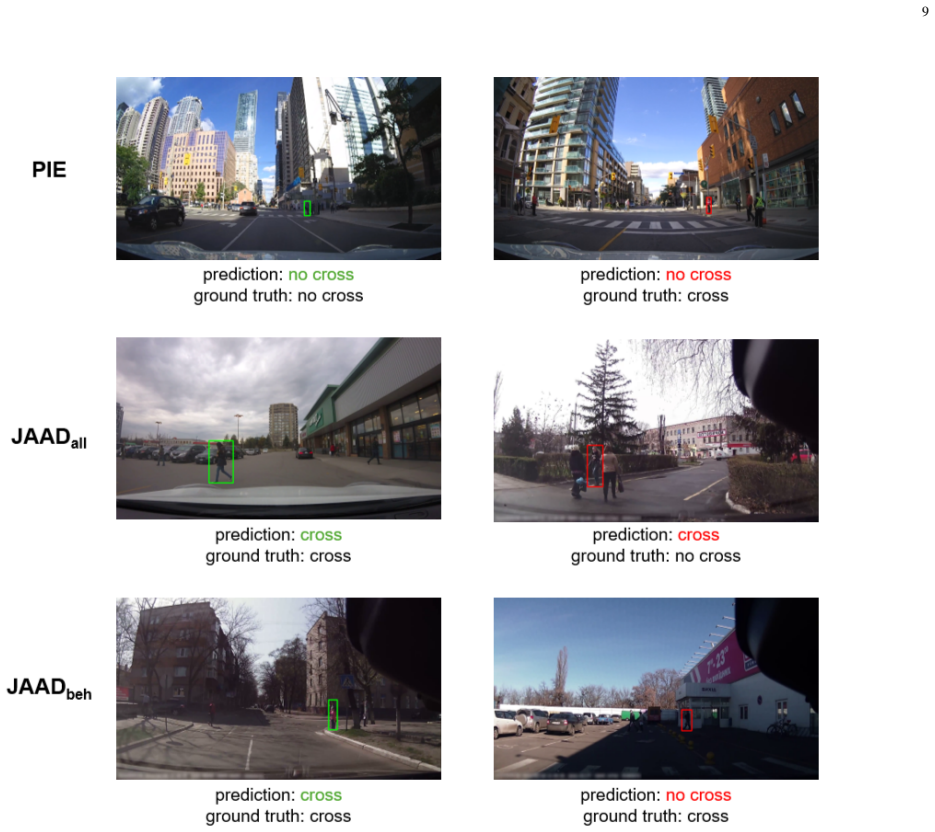
P. Gujjar and R. Vaughan, “Classifying pedestrian actions in advance using predicted video of urban driving scenes,” in 2019 9 Fig. 3. Qualitative results showing examples of correct predictions by TrajFusionNet (left column) and incorrect predictions (right column) Internatio...
2019
-
[30]
Looking ahead: Anticipating pedestrians crossing with future frames prediction,
M. Chaabane, A. Trabelsi, N. Blanchard, and R. Beveridge, “Looking ahead: Anticipating pedestrians crossing with future frames prediction,” in Proceedings of the IEEE/CVF Winter Conference on Applications of Computer Vision , 2020, pp. 2297–2306
2020
-
[31]
Pedestrian intention prediction based on traffic-aware scene graph model,
X. Song, M. Kang, S. Zhou, J. Wang, Y . Mao, and N. Zheng, “Pedestrian intention prediction based on traffic-aware scene graph model,” in 2022 IEEE/RSJ International Conference on Intelligent Robots and Systems (IROS) . IEEE, 2022, pp. 9851– 9858
2022
-
[32]
Pedestrian graph+: A fast pedestrian crossing prediction model based on graph convolutional networks,
P. R. G. Cadena, Y . Qian, C. Wang, and M. Yang, “Pedestrian graph+: A fast pedestrian crossing prediction model based on graph convolutional networks,” IEEE Transactions on Intelli- gent Transportation Systems, vol. 23, no. 11, pp. 21 050–21 061, 2022
2022
-
[33]
Dpcian: A novel dual-channel pedestrian crossing intention anticipation network,
B. Yang, Z. Wei, H. Hu, R. Wang, C. Yang, and R. Ni, “Dpcian: A novel dual-channel pedestrian crossing intention anticipation network,” IEEE Transactions on Intelligent Transportation Sys- tems, vol. 25, no. 6, pp. 6023–6034, 2024
2024
-
[34]
Pedast- gcn: Fast pedestrian crossing intention prediction using spatial– temporal attention graph convolution networks,
Y . Ling, Z. Ma, Q. Zhang, B. Xie, and X. Weng, “Pedast- gcn: Fast pedestrian crossing intention prediction using spatial– temporal attention graph convolution networks,” IEEE Transac- tions on Intelligent Transportation Systems , vol. 25, no. 10, pp. 13 277–13 290, 2024
2024
-
[35]
Feature selection and multi-task learning for pedestrian crossing prediction,
D. Sch ¨orkhuber, M. Pr ¨oll, and M. Gelautz, “Feature selection and multi-task learning for pedestrian crossing prediction,” in 2022 16th International Conference on Signal-Image Technol- ogy & Internet-Based Systems (SITIS) . IEEE, 2022, pp. 439– 444
2022
-
[36]
Using graph convolutional networks skeleton-based pedestrian intention estimation models for tra- jectory prediction,
D. Cao and Y . Fu, “Using graph convolutional networks skeleton-based pedestrian intention estimation models for tra- jectory prediction,” in Journal of Physics: Conference Series , vol. 1621. IOP Publishing, 2020, p. 012047
2020
-
[37]
Joint inten- tion and trajectory prediction based on transformer,
Z. Sui, Y . Zhou, X. Zhao, A. Chen, and Y . Ni, “Joint inten- tion and trajectory prediction based on transformer,” in 2021 IEEE/RSJ International Conference on Intelligent Robots and Systems (IROS). IEEE, 2021, pp. 7082–7088
2021
-
[38]
Multi-task deep learning for pedestrian detection, action recognition and time to cross prediction,
D. O. Pop, A. Rogozan, C. Chatelain, F. Nashashibi, and A. Bensrhair, “Multi-task deep learning for pedestrian detection, action recognition and time to cross prediction,” IEEE Access , vol. 7, pp. 149 318–149 327, 2019
2019
-
[39]
Coupling intent and action for pedestrian crossing behavior prediction,
Y . Yao, E. Atkins, M. J. Roberson, R. Vasudevan, and X. Du, “Coupling intent and action for pedestrian crossing behavior prediction,” arXiv preprint arXiv:2105.04133 , 2021
2021 arXiv
-
[40]
Social aware multi-modal pedestrian crossing behavior prediction,
X. Zhai, Z. Hu, D. Yang, L. Zhou, and J. Liu, “Social aware multi-modal pedestrian crossing behavior prediction,” in Pro- ceedings of the Asian Conference on Computer Vision , 2022, pp. 4428–4443
2022
-
[41]
Pie: A large-scale dataset and models for pedestrian intention estima- tion and trajectory prediction,
A. Rasouli, I. Kotseruba, T. Kunic, and J. K. Tsotsos, “Pie: A large-scale dataset and models for pedestrian intention estima- tion and trajectory prediction,” in Proceedings of the IEEE/CVF International Conference on Computer Vision , 2019, pp. 6261– 10 6270
2019
-
[42]
Deep time series models: A comprehensive survey and benchmark,
Y . Wang, H. Wu, J. Dong, Y . Liu, M. Long, and J. Wang, “Deep time series models: A comprehensive survey and benchmark,” arXiv preprint arXiv:2407.13278 , 2024
2024 arXiv
-
[43]
Scene parsing through ade20k dataset,
B. Zhou, H. Zhao, X. Puig, S. Fidler, A. Barriuso, and A. Tor- ralba, “Scene parsing through ade20k dataset,” in Proceedings of the IEEE conference on computer vision and pattern recog- nition, 2017, pp. 633–641
2017
-
[44]
A fast learning algorithm for deep belief nets,
G. E. Hinton, S. Osindero, and Y .-W. Teh, “A fast learning algorithm for deep belief nets,” Neural computation , vol. 18, no. 7, pp. 1527–1554, 2006
2006
-
[45]
Greedy layer-wise training of deep networks,
Y . Bengio, P. Lamblin, D. Popovici, and H. Larochelle, “Greedy layer-wise training of deep networks,” Advances in neural information processing systems , vol. 19, 2006
2006
-
[46]
Stage-wise training: An improved feature learning strategy for deep models,
E. Barshan and P. Fieguth, “Stage-wise training: An improved feature learning strategy for deep models,” in Feature extrac- tion: Modern questions and challenges . PMLR, 2015, pp. 49–59
2015
-
[47]
Realtime multi- person 2d pose estimation using part affinity fields,
Z. Cao, T. Simon, S.-E. Wei, and Y . Sheikh, “Realtime multi- person 2d pose estimation using part affinity fields,” in Proceed- ings of the IEEE conference on computer vision and pattern recognition, 2017, pp. 7291–7299
2017
-
[48]
Rethinking atrous convolution for semantic image seg- mentation,
L.-C. Chen, G. Papandreou, I. Kokkinos, K. Murphy, and A. L. Yuille, “Rethinking atrous convolution for semantic image seg- mentation,” in Proceedings of the IEEE conference on computer vision and pattern recognition , 2017, pp. 7268–7277
2017
Reviewed August 5, 2026 · model on record in the stance chip above.
Discussion (0). Sign in to comment.