Coordinate-Queryable Neural Field Reconstruction for EEG Spatial Super-Resolution with Unseen-Electrode Generation
Pith reviewed 2026-06-27 05:12 UTC · model grok-4.3
The pith
A coordinate-queryable neural field learns a continuous scalp field from variable observed EEG channels to reconstruct signals at any electrode position, including those never seen during training.
A machine-rendered reading of the paper's core claim, the machinery that carries it, and where it could break.
Core claim
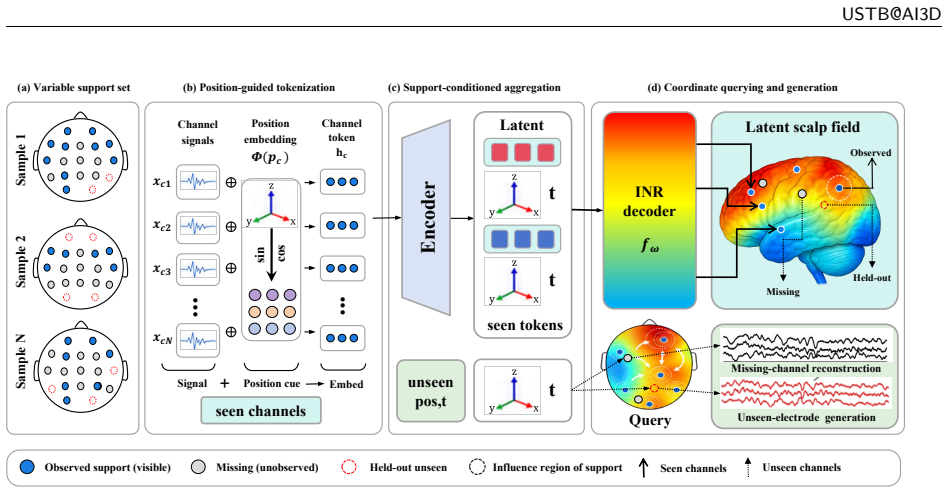
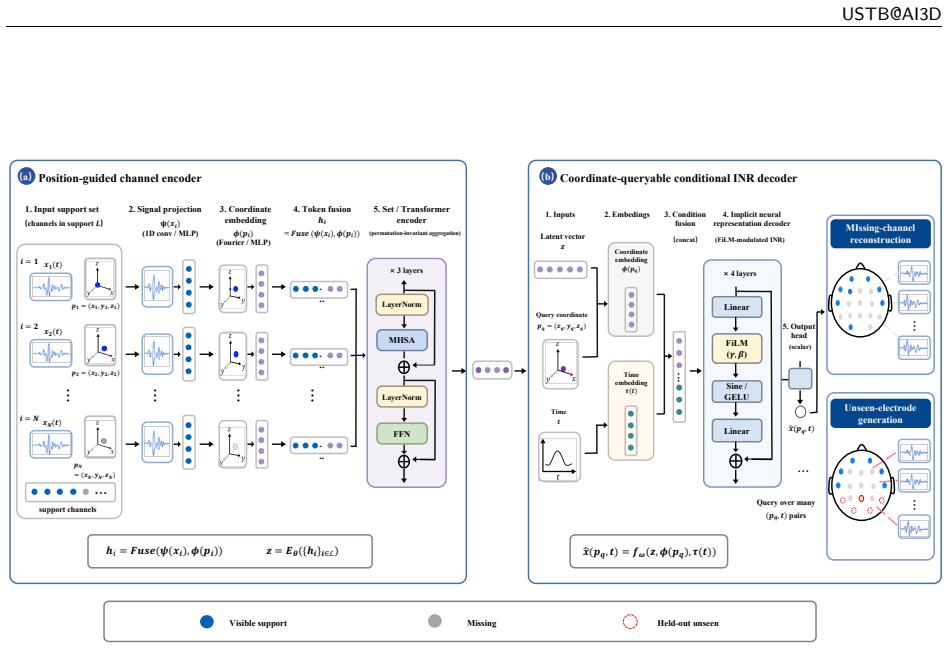
The central claim is that EEGSR reduces to learning a shared conditional scalp field from partially observed support channels: a position-guided encoder summarizes the available EEG values and coordinates into a latent condition, and a conditional implicit neural representation decoder reconstructs target signals by querying that condition at desired electrode coordinates; a fidelity-preserving channel corruption strategy during training further stabilizes the encoded representation so that the resulting field remains consistent with the observed data.
What carries the argument
The conditional implicit neural representation decoder that reconstructs EEG signal values at arbitrary scalp coordinates conditioned on a latent encoding of observed channels and positions.
If this is right
- The same trained model can reconstruct signals at electrode locations never present in the training data.
- Performance improves under both random missing-channel patterns and strict held-out electrode settings across multiple EEG datasets.
- The fidelity-preserving corruption strategy produces a more stable latent condition that better constrains the decoded field.
- Inference requires only the current support channels and their coordinates plus the query coordinates, with no retraining for new layouts.
Where Pith is reading between the lines
- The approach could support online adaptation when electrodes are added or removed during a recording session without retraining.
- It might extend naturally to source localization tasks that require field values at continuous scalp locations rather than discrete electrodes.
- Similar coordinate-queryable conditioning could be applied to other spatially sampled biosignals such as ECG or EMG grids.
Load-bearing premise
EEG signals everywhere on the scalp are samples from one continuous field whose value at any coordinate depends only on a latent condition derived from whatever subset of channels is observed.
What would settle it
A controlled test in which the model is given support channels from one spatial distribution but asked to reconstruct a held-out electrode whose true value deviates sharply from any continuous field consistent with the support set, such as an isolated artifact at that location.
Figures
read the original abstract
EEG spatial super-resolution (EEGSR) in real deployments is challenged by random channel missingness, unstable electrode quality, and changing visible-channel patterns caused by bad contacts or device variability. Most existing EEGSR methods learn a fixed low-to-high channel mapping under pre-defined input-output layouts, which makes them brittle when missing channels vary at test time. In this paper, we reformulate EEGSR as learning a shared conditional scalp field from partially observed support channels. Specifically, a position-guided encoder summarizes the observed EEG channels and their coordinates into a latent condition, and a conditional implicit neural representation decoder reconstructs target EEG signals by querying this condition at desired electrode coordinates. During inference, the model directly reconstructs unseen electrode signals from the available EEG support and the queried coordinates. To strengthen the constraint of the encoded latent representation on the decoder and thereby construct a more stable scalp field consistent with the observed channels, we further introduce a fidelity-preserving channel corruption training strategy under mixed electrode states. Extensive experiments across multiple EEG datasets demonstrate the effectiveness of our framework for both random missing-channel reconstruction and strict unseen-electrode signal generation. Notably, under the strict held-out-electrode setting on AAD, our method reduces NMSE by 37.5\% and improves SNR by 2.12 dB over the strongest baseline, showing its ability to synthesize signals at electrode locations never exposed during training.
Editorial analysis
A structured set of objections, weighed in public.
Referee Report
Summary. The paper reformulates EEG spatial super-resolution (EEGSR) as learning a shared conditional scalp field from partially observed support channels. A position-guided encoder produces a latent condition from observed EEG channels and their coordinates; a conditional implicit neural representation (INR) decoder then reconstructs signals at arbitrary target coordinates. A fidelity-preserving channel corruption strategy is used during training to stabilize the latent representation. Experiments across multiple datasets report gains for both random missing-channel reconstruction and strict unseen-electrode generation, with a 37.5% NMSE reduction and 2.12 dB SNR improvement over the strongest baseline on the AAD dataset under held-out electrodes.
Significance. If the empirical results are reproducible, the coordinate-queryable formulation could meaningfully improve robustness to variable electrode layouts and missing channels in real-world EEG deployments. The adaptation of conditional INRs to produce a continuous scalp field from sparse, position-aware observations is a coherent modeling choice that directly targets the brittleness of fixed-layout EEGSR methods.
major comments (1)
- [Experiments] Experiments section: the central claim of 37.5% NMSE reduction and 2.12 dB SNR gain under strict held-out-electrode setting on AAD rests on comparisons whose protocol (data splits, baseline implementations, statistical tests, and exact electrode hold-out procedure) is not provided in sufficient detail to allow independent verification. This is load-bearing for the empirical contribution.
Simulated Author's Rebuttal
We thank the referee for their positive assessment of the coordinate-queryable INR formulation and for highlighting the need for greater experimental transparency. We address the single major comment below.
read point-by-point responses
-
Referee: [Experiments] Experiments section: the central claim of 37.5% NMSE reduction and 2.12 dB SNR gain under strict held-out-electrode setting on AAD rests on comparisons whose protocol (data splits, baseline implementations, statistical tests, and exact electrode hold-out procedure) is not provided in sufficient detail to allow independent verification. This is load-bearing for the empirical contribution.
Authors: We agree that the reported gains on the AAD held-out-electrode task require a fully specified protocol to support independent verification. In the revised manuscript we will expand the Experiments section with: (i) the exact train/validation/test split ratios and subject-wise partitioning for AAD; (ii) complete implementation details and hyper-parameter settings for every baseline, including any modifications required to operate under the strict unseen-electrode protocol; (iii) the statistical tests (including p-values and correction method) used to establish significance of the 37.5 % NMSE and 2.12 dB SNR improvements; and (iv) the precise electrode hold-out procedure, including how support-channel sets are sampled, how target coordinates are defined, and how the fidelity-preserving corruption schedule is applied during training. These additions will be placed in a dedicated subsection and will be accompanied by a supplementary table listing all numerical settings. revision: yes
Circularity Check
No significant circularity; empirical result on external benchmarks
full rationale
The paper reformulates EEGSR as learning a conditional scalp field via a position-guided encoder and INR decoder, then reports empirical gains (37.5% NMSE reduction, 2.12 dB SNR) under strict held-out-electrode evaluation on AAD and other datasets. No equations, fitted parameters, or self-citations are shown that reduce any claimed prediction or uniqueness result to the model's own inputs by construction. The architecture and corruption strategy are modeling choices whose validity is tested externally rather than defined circularly. This is a standard non-circular empirical modeling paper.
Axiom & Free-Parameter Ledger
free parameters (1)
- neural network weights and hyperparameters
axioms (1)
- domain assumption EEG signals on the scalp can be modeled as samples from a continuous function that remains consistent across different subsets of electrode positions
invented entities (1)
-
latent condition produced by the position-guided encoder
no independent evidence
Reference graph
Works this paper leans on
-
[1]
Multi-channel masked autoencoder and comprehensive evaluations for reconstructing 12-lead ecg from arbitrary single-lead ecg.NPJ Cardiovascular Health, 1(1):34, 2024
Jiarong Chen, Wanqing Wu, Tong Liu, and Shenda Hong. Multi-channel masked autoencoder and comprehensive evaluations for reconstructing 12-lead ecg from arbitrary single-lead ecg.NPJ Cardiovascular Health, 1(1):34, 2024
2024
-
[2]
Isaac A. Corley and Yufei Huang. Deep eeg super-resolution: Upsampling eeg spatial resolution with generative 10 USTB@AI3D T able 8.Strict unseen-electrode generation results under different support ratiosr, evaluated only on permanently held-out electrodes. Here, r denotes the fraction of non-held-out electrodes used as visible support, andr = 1means tha...
-
[3]
Spectral features of resting-state EEG in parkinson’s disease: A multicenter study using functional data analysis.Clinical Neurophysiology, 151:28–40, 2023
Alberto Jaramillo-Jimenez, Diego A Tovar-Rios, Johann Alexis Ospina, Yorguin-Jose Mantilla-Ramos, Daniel Loaiza-López, Verónica Henao Isaza, Luisa María Zapata Saldarriaga, Valeria Cadavid Castro, Jazmin Ximena Suarez-Revelo, Yamile Bocanegra, et al. Spectral features of resting-state EEG in parkinson’s disease: A multicenter study using functional data a...
2023
-
[4]
Shahar Ain Kedem, Itamar Zimerman, and Eliya Nachmani. Neural brain fields: A nerf-inspired approach for generating nonexistent eeg electrodes.arXiv preprint arXiv:2601.00012, 2025
arXiv 2025
-
[5]
Temporal variational implicit neural representations.arXiv preprint arXiv:2506.01544, 2025
Batuhan Koyuncu, Rachael DeVries, Ole Winther, and Isabel Valera. Temporal variational implicit neural representations.arXiv preprint arXiv:2506.01544, 2025
arXiv 2025
-
[6]
Super-resolution for improving eeg spatial resolution using deep convolutional neural network—feasibility study.Sensors, 19(23):5317, 2019
Moonyoung Kwon, Sangjun Han, Kiwoong Kim, and Sung Chan Jun. Super-resolution for improving eeg spatial resolution using deep convolutional neural network—feasibility study.Sensors, 19(23):5317, 2019
2019
-
[7]
EEGNet: a compact convolutional neural network for EEG-based brain–computer interfaces.Journal of neural engineering, 15(5):056013, 2018
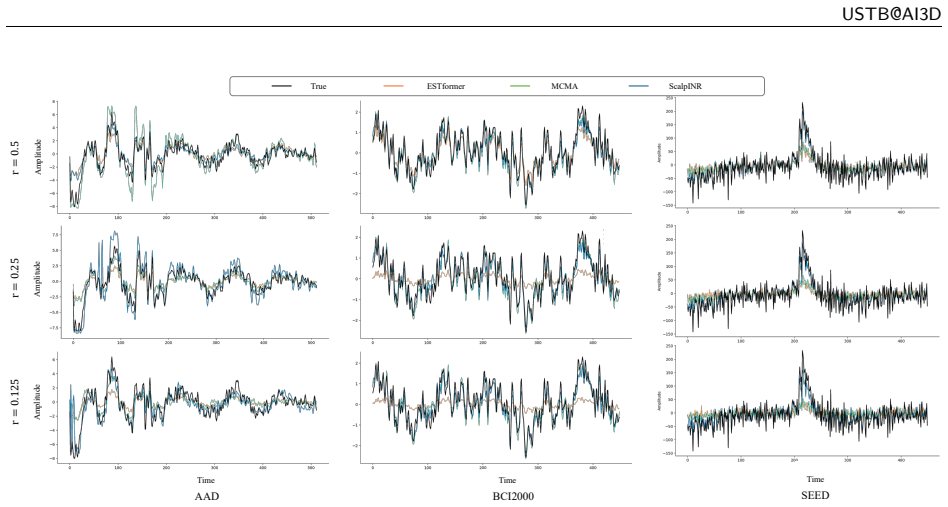
Vernon J Lawhern, Amelia J Solon, Nicholas R Waytowich, Stephen M Gordon, Chou P Hung, and Brent J Lance. EEGNet: a compact convolutional neural network for EEG-based brain–computer interfaces.Journal of neural engineering, 15(5):056013, 2018. 11 USTB@AI3D r=0.5r=0.25r=0.125 AmplitudeAmplitudeAmplitude Time Time TrueESTformerMCMAScalpINR AAD BCI2000 SEED ...
2018
-
[8]
A protocol for comparing dry and wet eeg electrodes during sleep.Frontiers in neuroscience, 14:586, 2020
Sven Leach, Ku-young Chung, Laura Tüshaus, Reto Huber, and Walter Karlen. A protocol for comparing dry and wet eeg electrodes during sleep.Frontiers in neuroscience, 14:586, 2020
2020
-
[9]
Estformer: Transformer utilising spatiotemporal dependencies for electroencephalogram super-resolution.Knowledge-Based Systems, 317:113345, 2025
Dongdong Li, Zhongliang Zeng, Zhe Wang, and Hai Yang. Estformer: Transformer utilising spatiotemporal dependencies for electroencephalogram super-resolution.Knowledge-Based Systems, 317:113345, 2025
2025
-
[10]
Imputeinr: time series imputation via implicit neural representations for disease diagnosis with missing data
Mengxuan Li, Ke Liu, Jialong Guo, Jiajun Bu, Hongwei Wang, and Haishuai Wang. Imputeinr: time series imputation via implicit neural representations for disease diagnosis with missing data. InProceedings of the Thirty-Fourth International Joint Conference on Artificial Intelligence, pages 9241–9249, 2025
2025
-
[11]
Step-aware residual-guided diffusion for eeg spatial super-resolution.The Fourteenth International Conference on Learning Representations, 2026
Hongjun Liu, Leyu Zhou, Zijianghao Yang, and Chao Yao. Step-aware residual-guided diffusion for eeg spatial super-resolution.The Fourteenth International Conference on Learning Representations, 2026
2026
-
[12]
Eeg signal reconstruction using a generative adversarial network with wasserstein distance and temporal-spatial-frequency loss.Frontiers in neuroinformatics, 14:15, 2020
Tian-jian Luo, Yachao Fan, Lifei Chen, Gongde Guo, and Changle Zhou. Eeg signal reconstruction using a generative adversarial network with wasserstein distance and temporal-spatial-frequency loss.Frontiers in neuroinformatics, 14:15, 2020
2020
-
[13]
Signal quality evaluation of an in-ear eeg device in comparison to a conventional cap system.Frontiers in Neuroscience, 18:1441897, 2024
Hanane Moumane, Jérémy Pazuelo, Mérie Nassar, Jose Yesith Juez, Mario Valderrama, and Michel Le Van Quyen. Signal quality evaluation of an in-ear eeg device in comparison to a conventional cap system.Frontiers in Neuroscience, 18:1441897, 2024
2024
-
[14]
Etienne Le Naour, Louis Serrano, Léon Migus, Yuan Yin, Ghislain Agoua, Nicolas Baskiotis, Patrick Gallinari, and Vincent Guigue. Time Series Continuous Modeling for Imputation and Forecasting with Implicit Neural Representations.Transactions on Machine Learning Research Journal, April 2024. doi: 10.48550/arXiv.2306.05880. URLhttps://hal.science/hal-04759780
-
[15]
The target electrodes are permanently held out from the support set during training and are queried only during evaluation
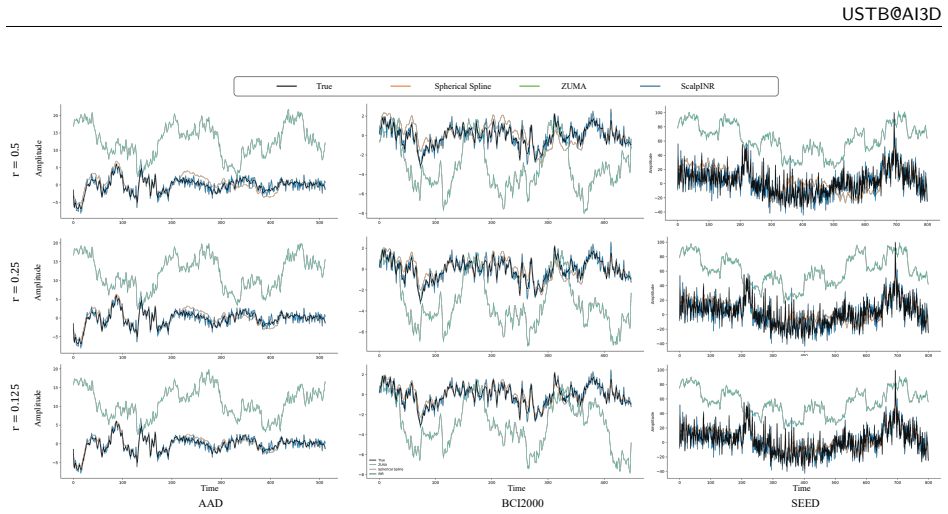
Petr Nejedly, Vaclav Kremen, Vladimir Sladky, Mona Nasseri, Hari Guragain, Petr Klimes, Jan Cimbalnik, 12 USTB@AI3D r=0.5r=0.25r=0.125 AmplitudeAmplitudeAmplitude Time Time TrueSphericalSplineZUMAScalpINR AAD BCI2000 SEED Time Figure 4.Qualitative waveform comparison under strict unseen-electrode generation. The target electrodes are permanently held out ...
2019
-
[16]
Csdi: Conditional score-based diffusion models for probabilistic time series imputation.Advances in neural information processing systems, 34:24804–24816, 2021
Yusuke Tashiro, Jiaming Song, Yang Song, and Stefano Ermon. Csdi: Conditional score-based diffusion models for probabilistic time series imputation.Advances in neural information processing systems, 34:24804–24816, 2021
2021
-
[17]
Shuqiang Wang, Tong Zhou, Yanyan Shen, Ye Li, Guoheng Huang, and Yong Hu. Generative ai enables eeg super-resolution via spatio-temporal adaptive diffusion learning.IEEE Transactions on Consumer Electronics, 71 (1):1034–1045, 2025. doi: 10.1109/TCE.2025.3528438
-
[18]
Christopher Warner, Jonas Mago, JR Huml, Mohamed Osman, and Beren Millidge. Zuna: Flexible eeg superresolution with position-aware diffusion autoencoders.arXiv preprint arXiv:2602.18478, 2026
arXiv 2026
-
[19]
Geometry-and relation-aware diffusion for eeg super-resolution.arXiv preprint arXiv:2602.02238, 2026
Laura Yao, Gengwei Zhang, Moajjem Chowdhury, Yunmei Liu, and Tianlong Chen. Geometry-and relation-aware diffusion for eeg super-resolution.arXiv preprint arXiv:2602.02238, 2026
arXiv 2026
-
[20]
Investigating critical frequency bands and channels for EEG-based emotion recognition with deep neural networks.IEEE Transactions on Autonomous Mental Development, 7(3):162–175,
Wei-Long Zheng and Bao-Liang Lu. Investigating critical frequency bands and channels for EEG-based emotion recognition with deep neural networks.IEEE Transactions on Autonomous Mental Development, 7(3):162–175,
-
[21]
doi: 10.1109/TAMD.2015.2431497. 13
discussion (0)
Sign in with ORCID, Apple, or X to comment. Anyone can read and Pith papers without signing in.