REVIEW 4 major objections 6 minor 70 references
Benchmarking the Detection of LLMs-Generated Modern Chinese Poetry
T0 review · 4 major / 6 minor · reviewed 2026-08-05 · deepseek-v4-flash
Pith's one-line read The paper claims that current AI-text detectors cannot reliably identify modern Chinese poems written by large language models, and that the hardest cases are poems imitating a human poet's style.
desk verdict Useful first benchmark with a real style-imitation finding, but the headline is overbroad and the evaluation needs a leakage fix before the out-of-domain numbers can be trusted. read the letter →
The pith
A machine-rendered reading of the paper's core claim, the machinery that carries it, and where it could break.
The reading
What carries the argument
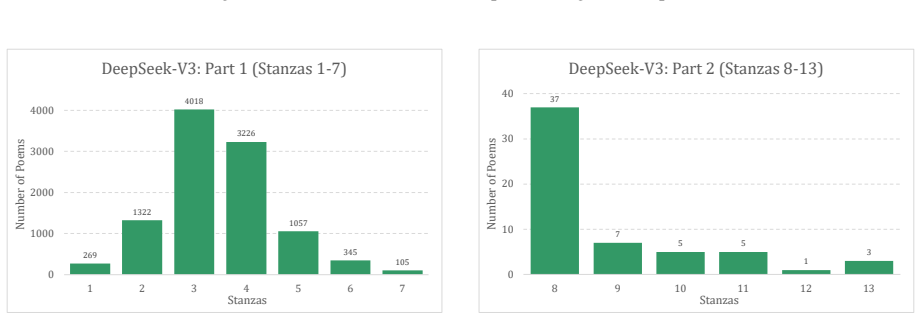
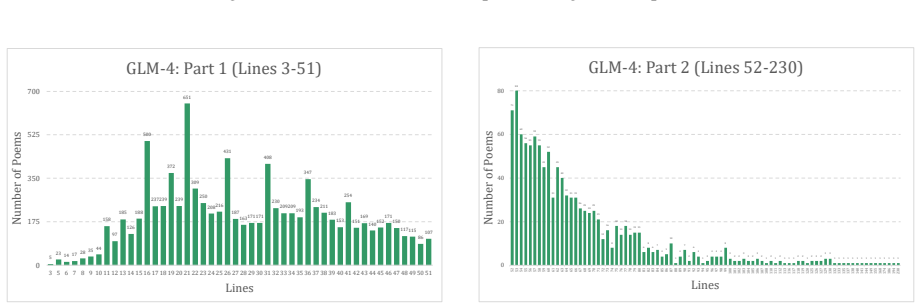
The central object is the AIGenPoetry benchmark: a paired dataset of 800 human-written modern Chinese poems and 41,600 LLM-generated poems, produced by four LLMs under 13 prompts that isolate specific poetic dimensions. Prompts P2–P5 target intrinsic qualities (style imitation, thought and sentiment, theme); P6–P8 target external structure (stanza count, line count, both); P9–P13 target emotions (none, happiness, sadness, anger, fear). Each prompt yields a matched data pair (human vs. one LLM), so detector performance can be attributed to the specific feature being controlled. Six detectors—Fast-DetectGPT, LRR, Log-Likelihood, Log-Rank, Binoculars, and a fine-tuned RoBERTa classifier—are eva
What would settle it
Give a detector only style-matched poem pairs (D2, D3) that are also matched for length and stripped of explicit emotion words, and require an F1 above 90 percent. If any current detector, or a simple style-based feature, reaches that level, the paper's conclusion that intrinsic qualities—especially style—are the hardest poetic features to detect would be contradicted.
Extended reading notes
Core claim
The paper's central claim is that current detectors cannot be used as reliable tools to detect modern Chinese poems generated by large language models. The evidence comes from a controlled benchmark in which four LLMs (GPT-4.1, DeepSeek-V3, DeepSeek-R1, GLM-4) each generated 800 poems per prompt across 13 prompt types, paired one-to-one with 800 human poems. In-domain results show average F1 around 72 percent on the baseline prompt and as low as 59.68 percent when poems are generated to imitate the style of a human poem (D2). GPT-4.1 style-matched poems are the hardest of all, with detectors averaging 48.73 percent F1. Poems that explicitly express a single emotion, especially fear, are the
Load-bearing premise
The benchmark assumes that the 800 poems from six professional poets, and the 41,600 poems generated from them at temperature 1.5 with top_p 0.95, represent the real distribution of human-written and LLM-generated modern Chinese poetry; if the poet set, the prompt distribution, or the sampling settings changed, the measured detection difficulty could shift substantially.
Editorial extensions
If this is right
- Style-matched generation is an effective evasion strategy: every detector tested loses at least 7 percentage points of F1 when the poem imitates a human poet's style, and four of the six lose more than 15 points.
- Surface emotion words are a giveaway: poems that literally express emotions, especially fear, are the easiest to detect, which reflects a real asymmetry since human poets usually convey emotion implicitly.
- Temperature matters: poems generated at temperature 1.5 are the hardest to detect, and detectors trained on 1.5 data generalize to lower-temperature data, so high-temperature generation is a reasonable worst-case benchmark setting.
- Fine-tuned RoBERTa outperforms statistical detectors on this task, but its advantage shrinks on style-matched poems, meaning no current detector is reliable for real-world style-imitation use cases.
- Detectors trained on intrinsic-quality prompts (style, thought, theme) generalize better to other feature types than detectors trained on structure or emotion prompts, pinpointing intrinsic qualities as the core unsolved difficulty.
Reading between the lines
- The pattern suggests detectors are latching onto surface statistics—explicit emotion vocabulary, poem length, and stanza or line counts—rather than deeper stylistic or semantic signals; a detector built around imagery density, syntactic deviation, or cross-stanza coherence might close the style gap.
- The one-to-one prompt pooling design could be stress-tested further by combining style imitation with other constraints (style plus structure, style plus emotion) to find which combinations are hardest, and by adding more human poets to reduce the risk that six poets' styles are unusually easy or hard to imitate.
- The temperature results imply that a detector trained only on high-temperature, style-matched data would face the toughest possible distribution; this suggests a practical recipe for red-teaming future poetry detectors before deployment.
- The benchmark's human poems come from six professional poets, so the finding is about matching those specific styles; how well detectors perform against a wider, more diverse human corpus remains an open question the paper does not resolve.
Editorial analysis
A structured set of objections, weighed in public.
Referee Report
Summary. The paper introduces AIGenPoetry, a benchmark for detecting whether modern Chinese poems were written by humans or generated by LLMs. The dataset contains 800 human poems by six professional poets and 41,600 poems generated by GPT-4.1, DeepSeek-V3, DeepSeek-R1, and GLM-4 under thirteen prompts covering intrinsic qualities (style, thought, theme), external structures (stanzas, lines), and emotions. The authors evaluate five zero-shot detectors plus a fine-tuned RoBERTa classifier in in-domain and generalization settings, and they report additional experiments across generation temperatures. The central claim is that current detectors cannot reliably detect LLM-generated modern Chinese poetry, with style-matched poems being the hardest and emotion-expressing poems—especially fear—the easiest to detect.
Significance. If the empirical findings hold, this is a useful first benchmark for an understudied domain. The dataset construction covers a broad prompt space, the human poems come from vetted professional poets, and the authors provide data/code links and a systematic comparison of six detectors. The observation that style-matched generation defeats most detectors, including near-chance performance for several zero-shot methods, is a concrete and falsifiable result. The temperature experiments also provide a practical insight for benchmark design. However, the strength of these contributions is currently limited by unresolved experimental-control issues, so the paper's sweeping conclusions outrun its evidence.
major comments (4)
- [Section 4, Table 4] The generalization experiments are confounded by data leakage. All Di conditions reuse the same 800 human poems (Section 4: 'Human-written poems and LLMs-generated poems through Pi constitute a pair of data (HDi, LDi), denoted as Di'). In Table 4, training on D2+4+5 or D6−8 means the RoBERTa classifier has already seen the identical human poems that appear in the test conditions (D1, D9, D10−13, etc.). The human side of the test set can therefore be solved by memorization rather than by detecting LLM-generated text, inflating F1 and corrupting both the generalization conclusions and the relative difficulty ordering of poetry features. Please use a disjoint-poet split (e.g., train on a subset of poets, test on held-out poets) and report exact train/test splits for all experiments, including the in-domain set-ups.
- [Tables 2–6] No variance or significance information is reported. Every F1/AUROC is a single number with no seeds, standard deviations, or statistical tests. Some conclusions rest on small differences (e.g., Table 2 zero-shot F1 scores range 67.51–69.10), and RoBERTa fine-tuning is stochastic. Without multiple runs and error bars, the claims that one detector 'significantly outperforms' another, or that current detectors 'cannot be used as reliable tools,' are not supported. Please report means and standard deviations over at least five seeds, and use a paired test where appropriate.
- [Section 5, Tables 2–3] For the zero-shot detectors, F1 depends on the decision threshold, but thresholds are not reported. AUROC is threshold-independent, yet the paper's central claims are framed primarily through F1. If thresholds were chosen on the test set, the F1 values are optimistic; if defaults were used, this should be stated and justified. Also, Table 2 shows Fast-DetectGPT with AUROC 43.24 on GPT-4.1, i.e., below chance, which suggests inverted scoring behavior; the paper should address why this occurs and how such detectors are being thresholded.
- [Abstract, Section 6.2, Conclusion] The central claim is overbroad. The experiments cover four LLMs, one generation configuration (temperature 1.5, top_p 0.95), six poets, and a specific set of prompts. The conclusion that 'current detectors cannot be used as reliable tools to detect modern Chinese poems generated by LLMs' should be qualified to the tested conditions. Additionally, the style-difficulty conclusion is partly confounded: prompts P2 and P3 explicitly supply the human reference poem in the input, so the style condition differs from the baseline and structural conditions not only in 'style' but also in the presence of the reference poem. Please add a control condition or temper the causal language.
minor comments (6)
- [Section 4] Typo: 'top_p to0.95' should read 'top_p to 0.95.'
- [Table 6] The abbreviation 'Fast-Det.' is used in the table header but only defined in the caption as 'Fast-DetectGPT' in the first row; please define it in the header or caption consistently.
- [Table 8] The column headers 'P > Avg.' and 'P < Avg.' are unclear; define 'P' (presumably proportion of poems) in the caption.
- [Section 6.1] The text says 'the remaining five detectors have F1-scores clustered between 67.51% and 68.74%,' but Table 2 lists Fast-DetectGPT at 69.10 and Log-Likelihood at 68.00. Please correct the range or explain the discrepancy.
- [Limitations] The Limitations section addresses only classical/rhyming poetry. It should also mention the small number of poets, the single generation temperature, and the specific LLM set as limits on external validity.
- [References] The ZHIPU reference is incomplete ('Zhipu ai devday glm-4' with no full title or venue); also the author name 'Fengying Y e' in the author block has an unintended space.
Circularity Check
No load-bearing circularity: the detection results are empirical and self-contained; self-citations and a self-referential validation statement do not reduce to the paper's own inputs.
full rationale
The paper's central claims—that current detectors cannot reliably detect LLM-generated modern Chinese poetry and that style-matched poems are the hardest to detect—are supported by measured F1 scores on a newly constructed dataset. The human poems and LLM-generated poems are distinct collections, and the detector evaluations in Tables 2–4 are empirical outcomes, not quantities defined into existence by the benchmark. The 'style is hardest' conclusion follows from observed performance drops on prompt conditions D2/D3, not from the prompt wording itself. Several self-citations appear (e.g., Wu et al. 2025 for dataset-construction principles, Wu et al. 2024b for RoBERTa's prior performance, Wang et al. 2024 for poetry-related background), but none of these supplies a result that the paper then merely renames as a prediction; the detectors are evaluated fresh on the new benchmark. The statement that 'the detection results verify the effectiveness and necessity of our proposed benchmark' is self-referential rhetoric, but it is not an equation-level reduction: the benchmark's difficulty is observed, not derived from its own definition. No fitted parameter is relabeled as a prediction, no uniqueness theorem is imported from the authors' prior work, and no ansatz is smuggled in via citation. The shared-800-poems leakage concern is a real validity risk for generalization claims, but it is an experimental-design issue, not a circularity of the kind this analysis targets. Overall, the central derivation is self-contained against external benchmarks, so the circularity score is low.
Assumptions & free parameters
free parameters (2)
- Generation temperature and top_p =
1.5 and 0.95
- Fine-tuning hyperparameters for RoBERTa =
3 epochs, learning rate 1e-6, batch size 16
assumptions (4)
- domain assumption Modern Chinese poetry is free-form and deliberately violates grammatical conventions, making grammar-based detectors inapplicable.
- domain assumption The 800 poems from six professional poets provide a representative sample of human-written modern Chinese poetry.
- domain assumption Binary classification into human-written versus LLM-generated is a valid and complete formulation of the detection problem.
- domain assumption Poems generated at temperature 1.5 and top_p 0.95 are representative of real-world LLM-generated modern Chinese poetry.
Cite this review
Pith. "Pith review of Benchmarking the Detection of LLMs-Generated Modern Chinese Poetry." pith.science (2026). https://pith.science/paper/BEY2547M
@misc{pith2026250901620,
  author       = {Pith},
  title        = {Pith review of: Benchmarking the Detection of LLMs-Generated Modern Chinese Poetry},
  year         = {2026},
  howpublished = {\url{https://pith.science/paper/BEY2547M}},
  note         = {Machine review of arXiv:2509.01620}
}
read the original abstract
The rapid development of advanced large language models (LLMs) has made AI-generated text indistinguishable from human-written text. Previous work on detecting AI-generated text has made effective progress, but has not involved modern Chinese poetry. Due to the distinctive characteristics of modern Chinese poetry, it is difficult to identify whether a poem originated from humans or AI. The proliferation of AI-generated modern Chinese poetry has significantly disrupted the poetry ecosystem. Based on the urgency of identifying AI-generated poetry in the real Chinese world, this paper proposes a novel benchmark for detecting LLMs-generated modern Chinese poetry. We first construct a high-quality dataset, which includes both 800 poems written by six professional poets and 41,600 poems generated by four mainstream LLMs. Subsequently, we conduct systematic performance assessments of six detectors on this dataset. Experimental results demonstrate that current detectors cannot be used as reliable tools to detect modern Chinese poems generated by LLMs. The most difficult poetic features to detect are intrinsic qualities, especially style. The detection results verify the effectiveness and necessity of our proposed benchmark. Our work lays a foundation for future detection of AI-generated poetry.
Figures


Figures from the paper (13 more)




Reference graph
Works this paper leans on
-
[1]
online" 'onlinestring :=
ENTRY address archivePrefix author booktitle chapter edition editor eid eprint eprinttype howpublished institution journal key month note number organization pages publisher school series title type volume year doi pubmed url lastchecked label extra.label sort.label short.list INTEGERS output.state before.all mid.sentence after.sentence after.block STRING...
-
[2]
write newline
" write newline "" before.all 'output.state := FUNCTION n.dashify 't := "" t empty not t #1 #1 substring "-" = t #1 #2 substring "--" = not "--" * t #2 global.max substring 't := t #1 #1 substring "-" = "-" * t #2 global.max substring 't := while if t #1 #1 substring * t #2 global.max substring 't := if while FUNCTION word.in bbl.in capitalize " " * FUNCT...
-
[3]
Josh Achiam, Steven Adler, Sandhini Agarwal, Lama Ahmad, Ilge Akkaya, Florencia Leoni Aleman, Diogo Almeida, Janko Altenschmidt, Sam Altman, Shyamal Anadkat, and 1 others. 2023. https://arxiv.org/abs/2303.08774 Gpt-4 technical report . arXiv preprint arXiv:2303.08774
arXiv 2023
-
[4]
Sina Alemohammad, Josue Casco-Rodriguez, Lorenzo Luzi, Ahmed Imtiaz Humayun, Hossein Babaei, Daniel LeJeune, Ali Siahkoohi, and Richard G Baraniuk. 2023. https://arxiv.org/abs/2307.01850 Self-consuming generative models go mad . arXiv preprint arXiv:2307.01850, 4:14
arXiv 2023
-
[5]
D. Antar. 2023. https://www.naturalspublishing.com/files/published/4i2xq2xki6j949.pdf The effectiveness of using chatgpt4 in creative writing in arabic: Poetry and short story as a model . In Information Sciences Letters
work page 2023
-
[6]
Abdul Ghafoor Awan and Yasmin Khalida. 2015. https://core.ac.uk/download/pdf/234693069.pdf New trends in modern poetry . Journal of Literature, Languages and Linguistics, 13:63--72
arXiv 2015
-
[7]
Guangsheng Bao, Yanbin Zhao, Zhiyang Teng, Linyi Yang, and Yue Zhang. 2023. https://arxiv.org/abs/2310.05130 Fast-detectgpt: Efficient zero-shot detection of machine-generated text via conditional probability curvature . arXiv preprint arXiv:2310.05130
arXiv 2023
-
[8]
Brendan Bena and Jugal Kalita. 2020. https://arxiv.org/abs/2002.02511 Introducing aspects of creativity in automatic poetry generation . arXiv preprint arXiv:2002.02511
work page Pith review arXiv 2020
Show all 70 references
-
[9]
Stefan Blohm, Valentin Wagner, Matthias Schlesewsky, and Winfried Menninghaus. 2018. https://www.sciencedirect.com/science/article/abs/pii/S0304422X17300864?casa_token=fZLWD530VLEAAAAA:6hL3soz_GX_rtn_KIC2gg3YIGOcagdgzEMJFMWje77zdeWHbsvoRzsf8I0UlPIWWAYQS_lqgtLaY Sentence judgme...
2018
-
[10]
Ben Buchanan, Andrew Lohn, Micah Musser, and Katerina Sedova. 2021. https://cset.georgetown.edu/wp-content/uploads/CSET-Truth-Lies-and-Automation.pdf Truth, lies, and automation . Center for Security and Emerging technology, 1(1):2
2021
-
[11]
Christopher JC Burges. 1998. https://link.springer.com/article/10.1023/A:1009715923555 A tutorial on support vector machines for pattern recognition . Data mining and knowledge discovery, 2(2):121--167
1998 doi
-
[12]
Jo \ a o Phillipe Cardenuto, Jing Yang, Rafael Padilha, Renjie Wan, Daniel Moreira, Haoliang Li, Shiqi Wang, Fernanda Andal \'o , S \'e bastien Marcel, Anderson Rocha, and 1 others. 2023. https://arxiv.org/abs/2306.11503 The age of synthetic realities: Challenges and opportuni...
2023 arXiv
-
[13]
Soma Chaudhuri, Maura Dooley, Dan Johnson, Roger Beaty, and Joydeep Bhattacharya. 2024. https://psycnet.apa.org/record/2024-51669-001 Evaluation of poetic creativity: Predictors and the role of expertise—a multilevel approach . Psychology of Aesthetics, Creativity, and the Arts
2024
-
[14]
Xin Chen, Junchao Wu, Shu Yang, Runzhe Zhan, Zeyu Wu, Ziyang Luo, Di Wang, Min Yang, Lidia S Chao, and Derek F Wong. 2025. https://arxiv.org/abs/2508.13152 Repreguard: Detecting llm-generated text by revealing hidden representation patterns . arXiv preprint arXiv:2508.13152
2025 arXiv
-
[15]
Zhongyi Chen. 2012 a . https://xueshu.baidu.com/usercenter/paper/show?paperid=93da768aff0a2eb7551cf8f26dc8a96f&site=xueshu_se Branch cross-industry, the trivial skills of external form? - research on modern poetic rhetoric v . Journal of Nanjing University of Science and Techn...
2012
-
[16]
twist the neck of grammar
Zhongyi Chen. 2012 b . https://xueshu.baidu.com/usercenter/paper/show?paperid=c974e7f2cdc678422498efa431cdf15e&site=xueshu_se Why "twist the neck of grammar" - a study of modern poetic rhetoric . Journal of Central China Normal University: Humanities and Social Sciences Editio...
2012
-
[17]
Nicole A Cooke. 2018. https://books.google.com/books?hl=zh-CN&lr=&id=yh99DwAAQBAJ&oi=fnd&pg=PP1&dq=Fake+news+and+alternative+facts:+Information+literacy+in+a+post-truth+era&ots=YiSv4CVN8N&sig=TLJWgxfPETOIgygz8vjmIDcKSK0#v=onepage&q=Fake American Library Association
2018
-
[18]
Kohinoor Darda, Marion Carre, and Emily Cross. 2023. https://royalsocietypublishing.org/doi/10.1098/rsos.220915 Value attributed to text-based archives generated by artificial intelligence . Royal Society Open Science, 10(2):220915
2023 doi
-
[19]
Cheng Deng. 2007. https://xueshu.baidu.com/usercenter/paper/show?paperid=9e2401da68a441c1d5e3c691c144a586&site=xueshu_se Dilemma and solution: Reflections on current new poetry . Literary Review, (3):4
2007
-
[20]
Wong, Jinpeng Hu, Lidia S
Tao Fang, Shu Yang, Kaixin Lan, Derek F. Wong, Jinpeng Hu, Lidia S. Chao, and Yue Zhang. 2023. https://arxiv.org/abs/2304.01746 Is chatgpt a highly fluent grammatical error correction system? a comprehensive evaluation . arXiv preprint arXiv:2304.01746
2023 arXiv
-
[21]
Wong, Keyan Jin, Lusheng Zhang, Qiang Zhang, Tianjiao Li, Jinlong Hou, and Lidia S
Tao Fang, Tianyu Zhang, Derek F. Wong, Keyan Jin, Lusheng Zhang, Qiang Zhang, Tianjiao Li, Jinlong Hou, and Lidia S. Chao. 2025. https://doi.org/10.1016/j.eswa.2025.127397 Llmcl-gec: Advancing grammatical error correction with llm-driven curriculum learning . Expert Systems wi...
2025
-
[22]
Yuan Gao, Ruili Wang, and Feng Hou. 2023. https://arxiv.org/pdf/2304.02182.pdf How to design translation prompts for chatgpt: An empirical study . arXiv e-prints, pages arXiv--2304
2023 arXiv
-
[23]
Sebastian Gehrmann, Hendrik Strobelt, and Alexander Rush. 2019. https://aclanthology.org/P19-3019/ GLTR : Statistical detection and visualization of generated text . In Proceedings of the 57th Annual Meeting of the Association for Computational Linguistics: System Demonstratio...
2019
-
[24]
Daya Guo, Dejian Yang, Haowei Zhang, Junxiao Song, Ruoyu Zhang, Runxin Xu, Qihao Zhu, Shirong Ma, Peiyi Wang, Xiao Bi, and 1 others. 2025. https://arxiv.org/abs/2501.12948 Deepseek-r1: Incentivizing reasoning capability in llms via reinforcement learning . arXiv preprint arXiv...
2025 arXiv
-
[25]
Moruo Guo. 1957. Talking about literary translation work. In Complete Works of Guo Moruo
1957
-
[26]
Abhimanyu Hans, Avi Schwarzschild, Valeriia Cherepanova, Hamid Kazemi, Aniruddha Saha, Micah Goldblum, Jonas Geiping, and Tom Goldstein. 2024. https://arxiv.org/abs/2401.12070 Spotting llms with binoculars: Zero-shot detection of machine-generated text . arXiv preprint arXiv:2...
2024 arXiv
-
[27]
Kadhim Hayawi, Sakib Shahriar, and Sujith Samuel Mathew. 2024. https://arxiv.org/abs/2307.12166 The imitation game: Detecting human and ai-generated texts in the era of chatgpt and bard . Journal of Information Science, page 01655515241227531
2024 arXiv
-
[28]
Sepp Hochreiter and J \"u rgen Schmidhuber. 1997. https://ieeexplore.ieee.org/abstract/document/6795963 Long short-term memory . Neural computation, 9(8):1735--1780
1997
-
[29]
quasi-text
Junming Huo. 2020. https://xueshu.baidu.com/usercenter/paper/show?paperid=1q0y0rk03s1v0e00vc2v0840f8747493&site=xueshu_se Clone li bai and 100 trillion poems - the "quasi-text" production and possible prospects of ai poetry . Southern Literature, (4):5
2020
-
[30]
Maurice Jakesch, Jeffrey T Hancock, and Mor Naaman. 2023. https://www.pnas.org/doi/10.1073/pnas.2208839120 Human heuristics for ai-generated language are flawed . Proceedings of the National Academy of Sciences, 120(11):e2208839120
2023 doi
-
[31]
David G Kleinbaum, K Dietz, M Gail, Mitchel Klein, and Mitchell Klein. 2002. https://link.springer.com/book/10.1007/978-1-4419-1742-3 Logistic regression . Springer
2002 doi
-
[32]
Nils K \"o bis and Luca D Mossink. 2021. https://arxiv.org/abs/2005.09980 Artificial intelligence versus maya angelou: Experimental evidence that people cannot differentiate ai-generated from human-written poetry . Computers in human behavior, 114:106553
2021 arXiv
-
[33]
Kaixin Lan, Tao Fang, Derek Wong, Yabo Xu, Lidia Chao, and Cecilia Zhao. 2024. https://doi.org/10.18653/v1/2024.findings-acl.858 FOCUS : Forging originality through contrastive use in self-plagiarism for language models . In Findings of the Association for Computational Lingui...
2024 doi
-
[34]
Tian Lan, Xiangdong Su, Xu Liu, Ruirui Wang, Ke Chang, Jiang Li, and Guanglai Gao. 2025. https://aclanthology.org/2025.findings-acl.313/ M c BE : A multi-task C hinese bias evaluation benchmark for large language models . In Findings of the Association for Computational Lingui...
2025
-
[35]
Andy Liaw, Matthew Wiener, and 1 others. 2002. https://journal.r-project.org/articles/RN-2002-022/RN-2002-022.pdf Classification and regression by randomforest . R news, 2(3):18--22
2002
-
[36]
Christina Linardaki. 2022. https://journals.oregondigital.org/hsda/article/view/5759 Poetry at the first steps of artificial intelligence . Humanist Studies & the Digital Age, 7(1)
2022
-
[37]
Aixin Liu, Bei Feng, Bing Xue, Bingxuan Wang, Bochao Wu, Chengda Lu, Chenggang Zhao, Chengqi Deng, Chenyu Zhang, Chong Ruan, and 1 others. 2024. https://arxiv.org/abs/2412.19437 Deepseek-v3 technical report . arXiv preprint arXiv:2412.19437
2024 arXiv
-
[38]
Yinhan Liu, Myle Ott, Naman Goyal, Jingfei Du, Mandar Joshi, Danqi Chen, Omer Levy, Mike Lewis, Luke Zettlemoyer, and Veselin Stoyanov. 2019. https://arxiv.org/abs/1907.11692 Roberta: A robustly optimized BERT pretraining approach . CoRR, abs/1907.11692
2019 arXiv
-
[39]
anti-traditional
Zhenya Luo. 2000. https://xueshu.baidu.com/usercenter/paper/show?paperid=176k0c30af2q0ck0a86k0gy0pj318121&site=xueshu_se "anti-traditional" singing - the new artistic quality of bian zhilin's poetry . Literary Review, 000(002):84--91
2000
-
[40]
Hanjia Lyu, Jiebo Luo, Jian Kang, and Allison Koenecke. 2025. https://doi.org/10.1145/3715275.3732182 Characterizing bias: Benchmarking large language models in simplified versus traditional chinese . In Proceedings of the 2025 ACM Conference on Fairness, Accountability, and T...
2025
-
[41]
Qingwei Mo. 2009. https://xueshu.baidu.com/usercenter/paper/show?paperid=e2f3d9dc30df34d15a9dda7993815b24&site=xueshu_se&hitarticle=1 Emotional classification of new poetry and its cultural roots . Management Observation, (13):1
2009
-
[42]
Ayat Najjar, Huthaifa I Ashqar, Omar Darwish, and Eman Hammad. 2025. https://arxiv.org/abs/2501.03212 Leveraging explainable ai for llm text attribution: Differentiating human-written and multiple llms-generated text . arXiv preprint arXiv:2501.03212
2025 arXiv
-
[43]
Brian Porter and Edouard Machery. 2024. https://www.nature.com/articles/s41598-024-76900-1 Ai-generated poetry is indistinguishable from human-written poetry and is rated more favorably . Scientific Reports, 14(1):26133
2024
-
[44]
Alec Radford, Jeffrey Wu, Rewon Child, David Luan, Dario Amodei, Ilya Sutskever, and 1 others. 2019. https://cdn.openai.com/better-language-models/language_models_are_unsupervised_multitask_learners.pdf Language models are unsupervised multitask learners . OpenAI blog, 1(8):9
2019
-
[45]
Qi Shen. 1999. https://xueshu.baidu.com/usercenter/paper/show?paperid=d081ff4ee5b4318c8191c898f9f75e1f&site=xueshu_se Poetic, poetic form and non-poetic . Contemporary Writers Review, (6):3
1999
-
[46]
Brian Phillips Skerratt. 2013. https://dash.harvard.edu/bitstream/handle/1/11181112/Skerratt_gsas.harvard_0084L_11116.pdf?sequence=3&isAllowed=y Form and Transformation in Modern Chinese Poetry and Poetics . Ph.D. thesis, Harvard University
2013
-
[47]
Irene Solaiman, Miles Brundage, Jack Clark, Amanda Askell, Ariel Herbert-Voss, Jeff Wu, Alec Radford, Gretchen Krueger, Jong Wook Kim, Sarah Kreps, and 1 others. 2019. https://arxiv.org/abs/1908.09203 Release strategies and the social impacts of language models . arXiv preprin...
2019 arXiv
-
[48]
Wai Lei Song, Haoyun Xu, Derek F Wong, Runzhe Zhan, Lidia S Chao, and Shanshan Wang. 2023. https://aclanthology.org/2023.mtsummit-research.27/ Towards zero-shot multilingual poetry translation . In Proceedings of Machine Translation Summit XIX, Vol. 1: Research Track, pages 324--335
2023
-
[49]
Jinyan Su, Terry Yue Zhuo, Di Wang, and Preslav Nakov. 2023. https://arxiv.org/abs/2306.05540 Detectllm: Leveraging log rank information for zero-shot detection of machine-generated text . arXiv preprint arXiv:2306.05540
2023 arXiv
-
[50]
Liyao Sun. 2011. https://xueshu.baidu.com/usercenter/paper/show?paperid=82fd55894f91be855b98ee1318be5869&site=xueshu_se The art of "travel": A new exploration of modern poetry form . Academic Monthly, (1):14
2011
-
[51]
Romal Thoppilan, Daniel De Freitas, Jamie Hall, Noam Shazeer, Apoorv Kulshreshtha, Heng-Tze Cheng, Alicia Jin, Taylor Bos, Leslie Baker, Yu Du, and 1 others. 2022. https://arxiv.org/abs/2201.08239 Lamda: Language models for dialog applications . arXiv preprint arXiv:2201.08239
2022 arXiv
-
[52]
Adaku Uchendu, Jooyoung Lee, Hua Shen, Thai Le, Dongwon Lee, and 1 others. 2023. https://arxiv.org/abs/2304.01002 Does human collaboration enhance the accuracy of identifying llm-generated deepfake texts? In Proceedings of the AAAI Conference on Human Computation and Crowdsour...
2023 arXiv
-
[53]
Jian Wang. 2007. https://xueshu.baidu.com/usercenter/paper/show?paperid=44fb21334a91242bc81db3a2d0a38f82&site=xueshu_se The rationale and function of the construction of line divisions in modern poetry . Journal of Mianyang Normal University, 26(7):6
2007
-
[54]
Mi Wang. 2019. https://xueshu.baidu.com/usercenter/paper/show?paperid=147n0pc0yu7m0030622r04t0xx370763&site=xueshu_se&hitarticle=1 Study on the relationship between external form and internal emotion in the rhythm of new poetry (1917-1949) . Ph.D. thesis, Sichuan Academy of So...
2019
-
[55]
Shanshan Wang, Derek Wong, Jingming Yao, and Lidia Chao. 2024. https://aclanthology.org/2024.acl-long.756/ What is the best way for C hat GPT to translate poetry? In Proceedings of the 62nd Annual Meeting of the Association for Computational Linguistics (Volume 1: Long Papers)...
2024
-
[56]
Shuting Wang. 2006 a . https://xueshu.baidu.com/usercenter/paper/show?paperid=1a5b02v0s6520mr0as4d0pn0u2589500&site=xueshu_se&hitarticle=1 Giving shape to emotion: The theory and practice of rhythm and imagery in new poetry (1917-1937) . World Literature Review
2006
-
[57]
Yuchun Wang. 2006 b . https://xueshu.baidu.com/usercenter/paper/show?paperid=a157d4f289f3f209d5f03f94d90315c8 Moruo guo's view on literary translation . Moruo Guo Journal, page 5
2006
-
[58]
Laura Weidinger, Jonathan Uesato, Maribeth Rauh, Conor Griffin, Po-Sen Huang, John Mellor, Amelia Glaese, Myra Cheng, Borja Balle, Atoosa Kasirzadeh, and 1 others. 2022. https://dl.acm.org/doi/10.1145/3531146.3533088 Taxonomy of risks posed by language models . In Proceedings ...
2022
-
[59]
Junchao Wu, Shu Yang, Runzhe Zhan, Yulin Yuan, Lidia Sam Chao, and Derek Fai Wong. 2025. https://aclanthology.org/2025.cl-1.8/ A survey on llm-generated text detection: Necessity, methods, and future directions . Computational Linguistics, pages 1--66
2025
-
[60]
Junchao Wu, Runzhe Zhan, Derek F Wong, Shu Yang, Xuebo Liu, Lidia S Chao, and Min Zhang. 2024 a . https://aclanthology.org/2025.coling-main.684.pdf Who wrote this? the key to zero-shot llm-generated text detection is gecscore . arXiv preprint arXiv:2405.04286
2024 arXiv
-
[61]
Wong, Shu Yang, Xinyi Yang, Yulin Yuan, and Lidia S
Junchao Wu, Runzhe Zhan, Derek F. Wong, Shu Yang, Xinyi Yang, Yulin Yuan, and Lidia S. Chao. 2024 b . http://papers.nips.cc/paper\_files/paper/2024/hash/b61bdf7e9f64c04ec75a26e781e2ad51-Abstract-Datasets\_and\_Benchmarks\_Track.html Detectrl: Benchmarking llm-generated text de...
2024
-
[62]
Yunshu Xi. 2019. https://xueshu.baidu.com/usercenter/paper/show?paperid=1s640tu0es6r0xh0q03k08t007679271&site=xueshu_se&hitarticle=1 Two characteristics of new poetry language—talking about the creation of new poetry part three . Masterpiece Appreciation: Appreciation Edition ...
2019
-
[63]
modern poetry
Jiang Xu. 2015. https://xueshu.baidu.com/usercenter/paper/show?paperid=891c2dd584b3f174b5fd967370fef4a0&site=xueshu_se "modern poetry" and "new poetry" . Xingxing Monthly
2015
-
[64]
leaving blanks
Shichang Xue. 2010. https://xueshu.baidu.com/usercenter/paper/show?paperid=442713087618622a2fade61ba84c79a4&site=xueshu_se Modern poetry formal processing methods - talk about "leaving blanks", "raising lines" and "sectioning" . Reading and Writing, (4):3
2010
-
[65]
Shichang Xue. 2016. https://xueshu.baidu.com/usercenter/paper/show?paperid=bd6148e1231d2c26338ae105eba26974&site=xueshu_se Something deeper than poetry itself -- on the artistic intention of the line arrangement of poetry . Write, page 6
2016
-
[66]
Jianhao Yan, Yun Luo, and Yue Zhang. 2024. https://aclanthology.org/2024.findings-acl.818/ R efute B ench: Evaluating refuting instruction-following for large language models . In Findings of the Association for Computational Linguistics: ACL 2024, pages 13775--13791
2024
-
[67]
Kuanghan Yang and Fuchun Liu. 1985. https://xueshu.baidu.com/usercenter/paper/show?paperid=2aa9302dcfa6448c66f8610193c624d7&site=xueshu_se Discussion on Chinese Modern Poetry, Part 1 . Discussion on Chinese Modern Poetry, Part 1
1985
-
[68]
Kejia Yuan. 1991. https://xueshu.baidu.com/usercenter/paper/show?paperid=0245779c0eeba78bd0ae7696e7426faa&site=xueshu_se A moving quartet - the trajectory of feng zhi's poetic style . Literary Review, (4):7
1991
-
[69]
ZHIPU. 2024. https://zhipuai.cn/en/devday Zhipu ai devday glm-4 . Accessed: 2024-05-01
2024
-
[70]
Ling Zhong. 2003. https://xueshu.baidu.com/usercenter/paper/show?paperid=e7b50df60f6a225027c8b8978b696b54&site=xueshu_se American Poetry and Chinese Dream: Chinese Cultural Model in Modern American Poetry . American Poetry and Chinese Dream: Chinese Cultural Model in Modern Am...
2003
Reviewed August 5, 2026 · model on record in the stance chip above.
Discussion (0). Sign in to comment.